
Specs are compiled from manufacturer listings and verified buyer reviews and can change over time — please confirm the key details on the product page before buying.
Your AC stops cooling, and the repair is rarely the hard part — finding the leak is. Refrigerant slowly escapes through a pinhole you cannot see, so the hunt begins. A good AC leak detector sniffs the gas itself and turns that invisible loss into a beep or a number on a screen, telling you exactly where to put your wrench. This guide covers nine refrigerant leak detectors that working technicians and sharp DIYers actually use, from budget-friendly sniffers to a premium heated-diode unit built for daily service calls, and explains in plain words which sensor type suits which job.
I’m Mohammad Maruf — the founder and writer behind KitchPrep. This guide is built by comparing the manufacturers’ published specifications and the patterns across verified customer reviews, so you get each pick’s real strengths and trade-offs instead of marketing spin.
Pick the wrong sensor type and you will be back at the same wall twice. A heated diode is sensitive but a consumable, while an infrared sensor trades a little reach for years of life. That single decision shapes almost everything in this roundup of the best ac leak detector.
Our Picks at a Glance


How To Choose The Best AC Leak Detector
Before you compare models, understand what a leak detector physically does. It pulls air across a heated sensor, and when that air carries halogenated refrigerant molecules, the sensor reacts and the unit lights up, beeps, or shows a rising number. The job is to make an invisible gas loss visible, then let you crawl the probe tip toward the source until the signal peaks.
Match the sensor type to the job
Three sensor families appear in this lineup, and each behaves differently. A heated diode sensor gives you the strongest sensitivity to small leaks, but the sensing element has a finite life — the Fieldpiece DR58 lists a 300-hour sensor life and the Inficon TEK-Mate lists 100 hours, so a diode is a consumable you replace periodically. A metal-oxide semiconductor sensor, used in the SENSYX SFD201 and the TOPTES RT-389, is cheaper to build and responds broadly, but it is more prone to false triggers near other airborne chemicals. An infrared sensor, like the one inside the Elitech ILD-200, resists interference better and is rated for a long 10-year sensor life, so it asks less maintenance over time.
Read the sensitivity number in ounces per year
Sensitivity is written as the smallest leak the tool can see, measured in ounces of refrigerant lost per year (oz/yr). The smaller the number, the finer the leak it can catch. The Fieldpiece DR58 reaches below 0.03 oz/yr, the tightest figure in this group, while the Inficon TEK-Mate is rated at 0.25 oz/yr and the TOPTES RT-389 lands at 3g/yr (0.1 oz/yr). If you chase stubborn micro-leaks from slow system losses, a tighter number matters. If you mostly confirm obvious leaks on valves and joints, a mid-range figure is plenty.
Check the probe reach and battery before you buy
Probe length decides which leaks are reachable at all. A 14-inch flexible probe, like the one on the Elitech CPU-1G, slips into tight copper tubing, while the 17-inch probe on the Fieldpiece DR58 is the longest here and makes indoor coil work easier. Battery style is the other practical split — the rechargeable models, such as the SENSYX SFD201 with its 2500mAh cell, free you from hunting for disposable batteries, while the Inficon TEK-Mate runs on two D-cell alkalines. Think about which of those suits the way you actually work.
Quick Comparison
| Model | Best For | Sensor Type | Sensitivity | Power Source | Amazon |
|---|---|---|---|---|---|
| Fieldpiece DR58★ Best Overall | Serious micro-leak hunting | Heated diode | <0.03 oz/yr | 18-hour USB rechargeable | Amazon |
| Elitech CPU-1GBest Value | Budget-friendly first detector | Coronal sensor | 0.11 oz/yr | 2 C alkaline batteries | Amazon |
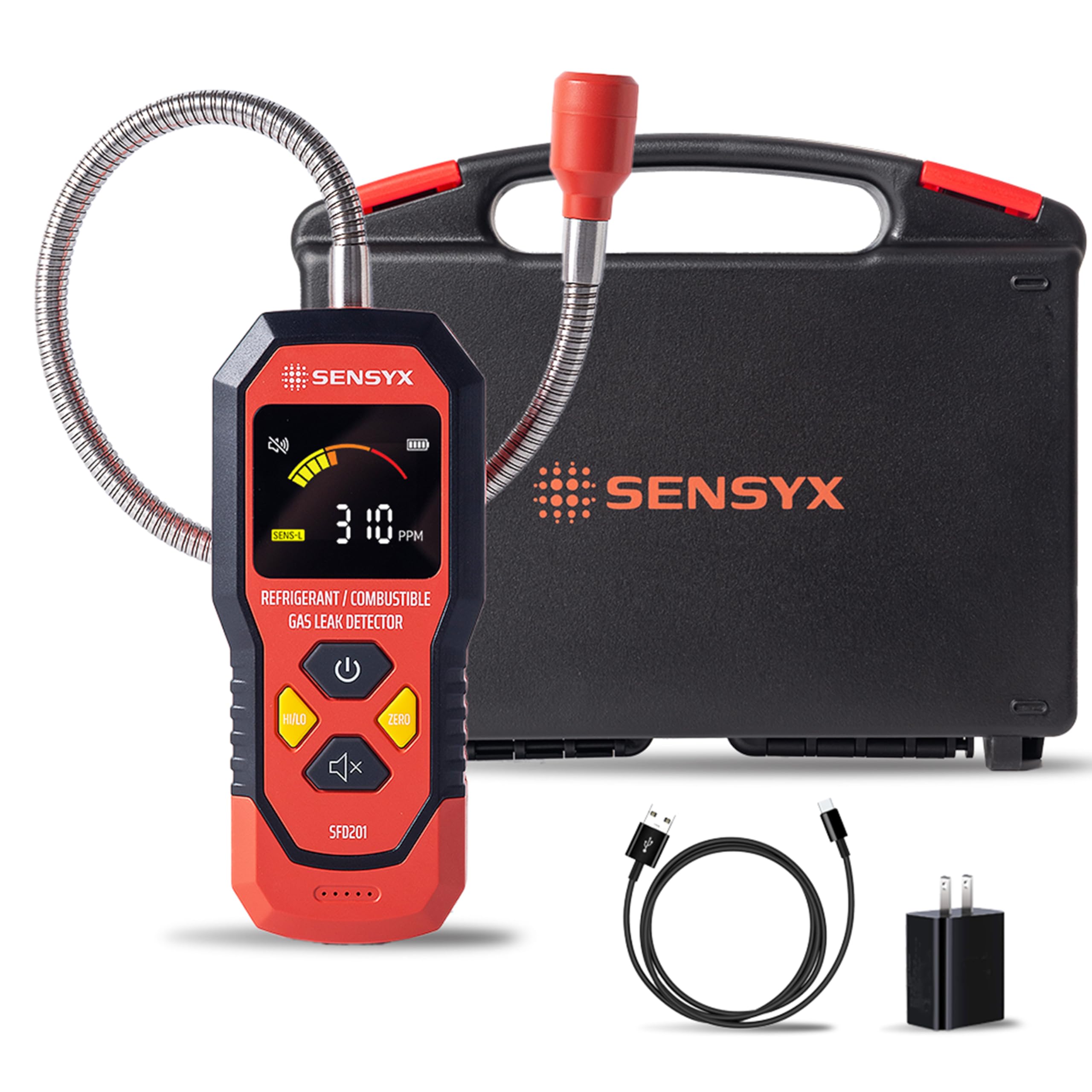
| SENSYX SFD201Most Versatile | Refrigerant plus combustible gas | Metal-oxide semiconductor | High and Low selectable | 2500mAh rechargeable | Amazon |
| TOPTES RT-389 | Home and automotive DIY | Semiconductor | 3g/yr (0.1 oz/yr) | 2000mAh rechargeable | Amazon |
| Aprvtio ALD-200 | All-day HVAC field work | Heat diode | up to 0.14 oz/yr | Rechargeable, all-day | Amazon |
| Simbow ALD-200 PRO | Newer A2L refrigerants | High-precision sensor | 0.14 oz/yr | 3000mAh rechargeable | Amazon |
| Elitech ILD-200 | Long sensor life, low upkeep | Infrared | up to 0.14 oz/yr | Battery powered | Amazon |
| Inficon TEK-Mate | Dependable automotive detection | Heated diode | 0.25 oz/yr | 2 D-cell alkaline batteries | Amazon |
In‑Depth Reviews
1. Fieldpiece DR58 Heated Diode Refrigerant Leak Detector
Our pick — over 4.5★ from 200+ verified ratings; the strongest balance of quality and price.
The professional-grade sniffer that chases micro-leaks other tools walk straight past.
This detector earns the top spot because it finds leaks smaller than 0.03 oz/yr — a whisper of refrigerant loss that drains a charge over a season and never leaves a visible oil stain. It works on the full refrigerant spread too — HFC, CFC, HCFC, HFO, H2N2 tracer gas and blends — and it is A2L compatible, so it covers both the older systems you still service and the newer low-GWP setups. A 17-inch flexible probe reaches down into an indoor evap coil without fighting the cabinet, which is exactly where slow leaks tend to hide.
What wins people over is build and function working together. The IP54 rating (a dust-and-splash protection grade) means moisture and oil on a service call do not end the sensor early, and the 300-hour sensor life gives you a real working runway before it needs replacing. The 18-hour USB rechargeable battery carries you through a long day without a wall outlet. The backlit LCD shows leak size and intensity, while the LED tip and beep let you home in on the joint. It ships with five replacement filtered tips, a blow-molded case and the heated diode sensor. Its dimensions are 12.28 by 4.13 by 10.75 inches, and it weighs 3 pounds — noticeably more to carry than the 1.7-pound Elitech CPU-1G, but that heft buys the longer probe and the tool-grade housing.
Techs running it on R410A indoor evap coil fin packs reported strong accuracy, and owners describe it as the tool that caught ultra-slow leaks their other gear missed. The honest trade-off: the sensor can spike a low-level false reading when other strong odors are nearby, like dryer sheets or soap, so you clear the area before you sweep. The sensitivity that makes it so good on real leaks is the same sensitivity that reacts to the wrong fumes. That is a technique fix, not a fault.
Why This One Earns First
- Finds leaks below 0.03 oz/yr, the tightest sensitivity in this lineup
- IP54 dust-and-splash rating with a 300-hour heated diode sensor
- 17-inch probe, 18-hour USB rechargeable battery, A2L compatible
- Backlit LCD plus LED tip and beep for pinpointing
Weigh Before You Buy
- 3 pounds and 12.28 by 4.13 by 10.75 inches — heavier than the budget picks
- Can read a low-level false positive near strong odors like soap or dryer sheets
Buy it if you service AC daily: the tightest sensitivity here and a rugged housing reward anyone who hunts micro-leaks for a living or owns a finicky system.
Think twice if you just want to confirm one obvious leak: the budget Elitech CPU-1G at 0.11 oz/yr settles that job for far less.
2. Elitech CPU-1G HVAC Leak Detector
The entry-level sniffer that does the basic job and reaches leaks through a wall.
For a first detector or a tight budget, this is the easy recommendation. A traditional coronal sensor with an upgraded low-energy CPU triggers on R11, R22, R134A, R404a, R410A and all halogenated refrigerants including HFCs, CFCs, HCFCs and blends. It warms up in 6 seconds and responds in 3 seconds, so you are not standing around waiting before you start sweeping. The coronal sensor design is what gives it that value price, but the response figures here are quick enough to feel instant in the field.
What gets mentioned most among owners is that it just works — it earns the highest functionality praise of any pick here by a wide margin, with efficiency mentions second. Seven adjustable sensitivities with a maximum of 0.11 oz/yr let you widen the search on a broad sweep, then tighten down near the suspect joint. The 14-inch flexible stainless steel probe reaches into tight copper tubing, and it ships with two alternative sensor tips. Owners note it can read through a wall, and car-AC leak hunting tends to succeed fast — owners repeatedly report catching a car A/C leak within a minute of vacuum cutoff. It runs on two C alkaline batteries, which are included.
Now the honest part. A couple of owners find the build feels cheap, and several mention it can be loud — understandable at this price point, and none of it stops the thing from finding leaks. The 1.7-pound body keeps it light in a bag, and the 2.6 by 2.6 by 9 inch frame is compact. Elitech also offers 24/7 US technician support by email and phone, which is a real plus at the entry level.
Where it wins: Seven sensitivity levels and a 0.11 oz/yr floor at a figure most DIYers can justify, backed by a light 1.7-pound build that rides easy in a service bag.
What to accept: The coronal sensor and plastic housing feel entry-level, and the alarm is on the loud side — fine for a budget tool, worth knowing if noise bothers you.
Pick it if you are a homeowner or new tech: it finds leaks fast, reaches through walls, and costs little to try.
Step up if build quality is everything: the Fieldpiece DR58 above brings the rugged housing, though at a much higher outlay.
3. SENSYX SFD201 Refrigerant and Combustible Gas Leak Detector
A two-in-one sniffer that watches refrigerant and combustible gas with a live number on screen.
If you want one tool to do more than one job, this is the pick. A Japan-made metal-oxide semiconductor sensor handles the full halogenated refrigerant family across CFCs, HCFCs, HFCs and HFOs, and the SFD201 model also detects HC and combustible gases — R50 methane, R170 ethane, R290 propane, R600a isobutane, plus natural gas, LPG, gasoline vapor and alcohol. Selectable High and Low sensitivity lets you sweep a broad area first, then drop down to close in on the exact joint.
What owners value most is reliability, then value for money. The standout feature is the large color LCD showing the actual concentration in ppm plus a bar graph, so you watch the number climb as you near the leak instead of guessing from a speeding beep. The buzzer follows the reading and can be muted when you need quiet. A 2500mAh built-in lithium battery delivers up to 24 hours per charge, and it charges from any USB-C source with the cable included — no disposable batteries to buy or carry. At 5.5 by 0.98 by 2.36 inches and just 8 ounces, it is the smallest and lightest full-featured model here.
One setup habit you must respect: like all metal-oxide sensors, it reaches full sensitivity only after running for several hours in clean air, so leave it switched on when it is new or has been in storage. In use, start it in clean air away from the leak, then move the probe no faster than 1 inch (25 mm) per second, about a quarter-inch from the joint, with fans and drafts off. Scan too quickly and you can walk straight past a leak. The other thing to size honestly: the detector aspect gets mixed marks, since a slow, methodical sweep is what separates a hit from a miss. A rare unit arrives faulty and is replaced, then works as it should. It is a hand-held inspection tool, not a substitute for a listed gas alarm.
The practical upside: Live ppm numbers plus a 24-hour rechargeable battery make this the most throw-in-the-bag versatile detector, and it swings between refrigerant and combustible gas without a second tool.
Reach for this if you want range: refrigerant and combustible detection in one 8-ounce, USB-C unit suits homeowners and techs who check more than one gas.
Look elsewhere if you chase the smallest leaks: the ultra-tight sensitivity lives in the heated-diode Fieldpiece, not in a semiconductor.
4. TOPTES RT-389 Rechargeable Refrigerant Leak Detector
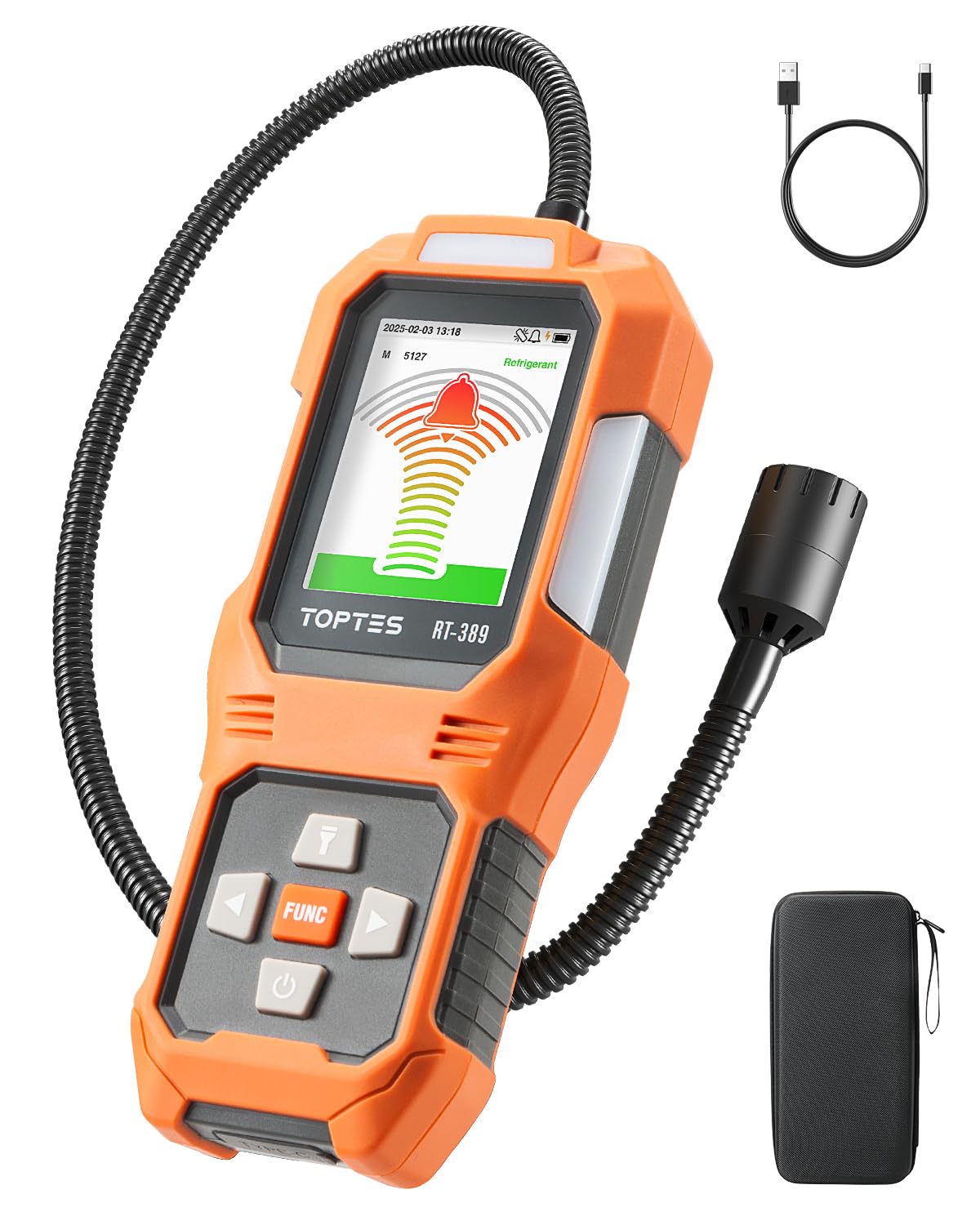
A colorful screen-and-vibration detector aimed at the home and car tinkerer.
Owners talk about the money this one helps avoid — one owner found a pinhole condenser leak at home in about ten minutes, avoiding a costly shop visit. Under the hood sits an advanced Japanese semiconductor sensor with three sensitivity modes — High, Middle and Low — that reads down to a maximum sensitivity of 3g/yr (0.1 oz/yr). The screen is the eye-catcher: a vibrant TFT color display with adjustable brightness and auto screen-off, switching between a curved funnel chart for real-time ppm and a curve graph for tracking a trend over time. Its 14.5-inch flexible gooseneck and three independent alarm types — a 90dB sound, visual, and vibration — give you several ways to confirm a hit, with a top light for basements and garages.
You get over 8 hours of continuous use from a 2000mAh rechargeable battery over USB-C, and the housing is waterproof, explosion-proof and dustproof. It rolls from HCFs and HCFCs to CFCs, PFCs and HFOs — R11, R22, R404a, R410a, R600a and R1234yf — plus HCs like R50 methane, R170 ethane, R290 propane and R600a isobutane. The value angle is real, and it comes with a 3-year manufacturer warranty for extra confidence.
Be straight with yourself about the reliability mixed reviews. A semiconductor sensor of this type can false-positive near cleaning chemicals or soapy water, and a slow-concentration learning curve is normal for a first-timer. Work high sensitivity to locate, then low to pinpoint, and confirm any hit by rescanning the same spot before you cut. The upside is real for a fridge or through-wall AC unit — buyers report finding line breaks invisible to the naked eye.
Standout Features
- 3 sensitivity modes down to 3g/yr (0.1 oz/yr) with a 14.5-inch gooseneck
- TFT color display with ppm funnel chart and trend graph
- 2000mAh USB-C battery, over 8 hours of use
- Sound, visual, and vibration alarms, 3-year warranty
Know Before You Scan
- Semiconductor sensor can false-positive near cleaning chemicals or soapy water
- Reliability draws mixed feedback — rescan a spot to confirm before you commit
Grab it if you DIY your own AC and car work: the color display, vibration alarm and USB-C battery make it genuinely easy to use around the house.
Lean pro if it is for paid jobs: a heated-diode or infrared unit handles a high-traffic schedule with fewer false triggers.
5. Aprvtio ALD-200 Refrigerant Leak Detector
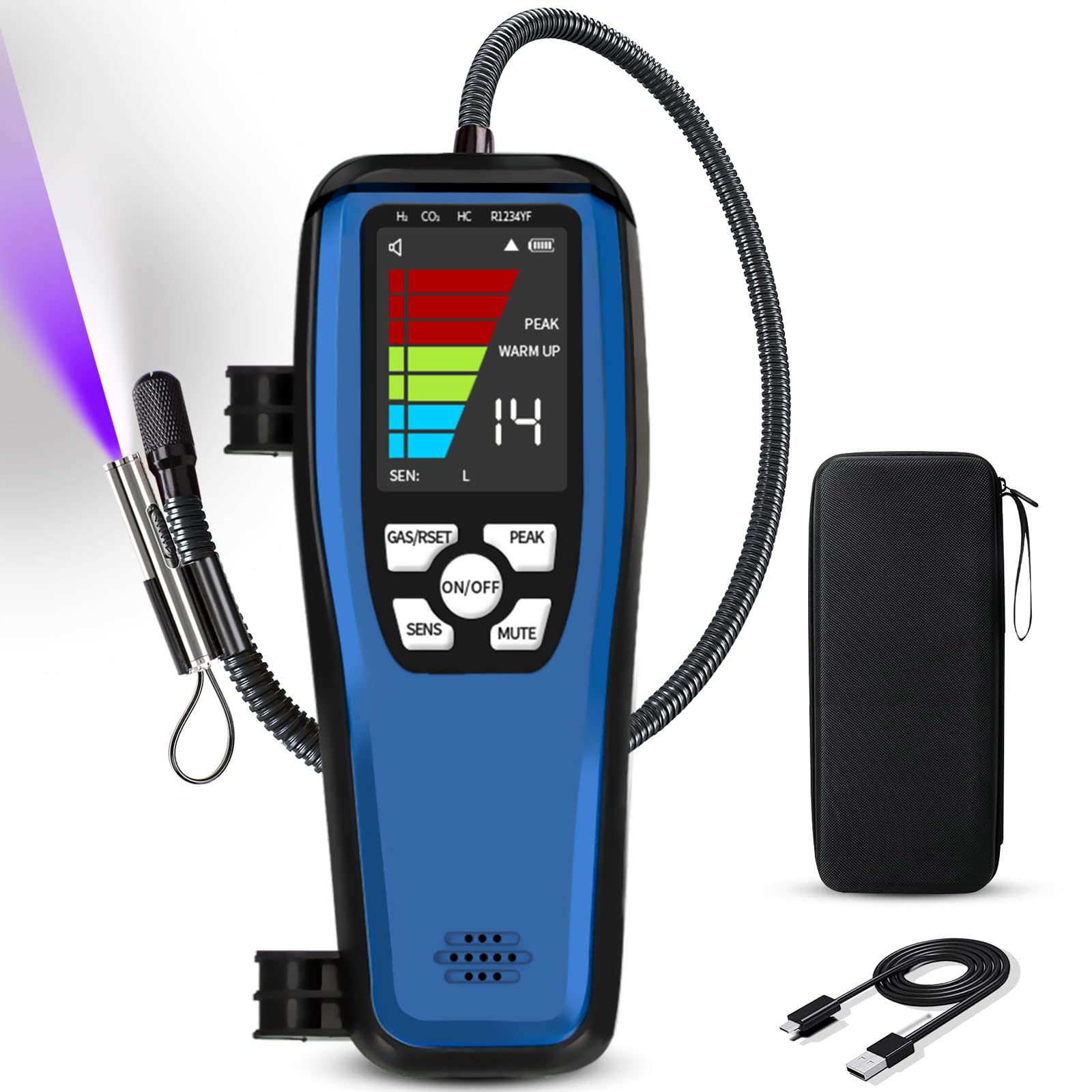
A field-ready sniffer that covers A1, A2L and A3 refrigerants and lasts a full shift.
If you work alone in an attic or in the dark, the screen does a lot of the selling. A 2.8-inch TFT color display on this unit shows concentration levels clearly in low light, and the beep frequency rises as the leak grows, so you can track intensity by ear while you read the numbers by eye. The aprvtio next-generation heat diode sensor covers A1 like R410A, A2L like R32 and R454B, A3 like R290 and R600, plus gases like H2/N2 tracer gas — a true 3-in-1 spread. Sensitivity is adjustable up to 0.14 oz/yr, which pinpoints micro-leaks that soap bubbles and dye tests miss.
Where this detector earns its keep is in the smart features. Peak Mode captures the maximum leak reading so you can watch the direction of the signal, and the Reset Function recalibrates the sensor to cut false alarms. The housing is oil-resistant and impact-resistant, so job-site knocks and grime do not slow it down, and the rechargeable battery supports a full day of service. It is built to a compact 15 by 2 by 12 inches at 16 ounces, so it hangs light off the wrist during overhead work. It ships with the ALD-200 halogen leak detector, a protective case and the usual accessories.
Owners find small R410A leaks with this regularly, and the screen keeps readings legible in attics and darkened basements. One thing to sort before your first job: the battery is not replaceable and neither is the sensor, so this is a use-it-then-retire tool rather than a maintain-forever one. The 10-centimeter sensing distance rewards moving slow and deliberate, and the included case and manual make setup straightforward. A rare unit arrives nearly drained with odd power behavior, so charge it fully before the first use.
Why field techs keep it: A bright 2.8-inch TFT screen, 3-in-1 A1/A2L/A3 coverage and all-day rechargeable power make it a practical glovebox pick for service work.
The fine print: The battery and sensor are both non-replaceable, so plan on the detector’s working life rather than swapping parts.
It fits the service tech: 3-in-1 gas coverage, a bright display and all-day battery suit daily field calls.
It does not fit the long-term buyer: a fixed battery and sensor mean the tool retires as a unit, so a user-replaceable model lasts longer.
6. Simbow ALD-200 PRO Refrigerant Leak Detector
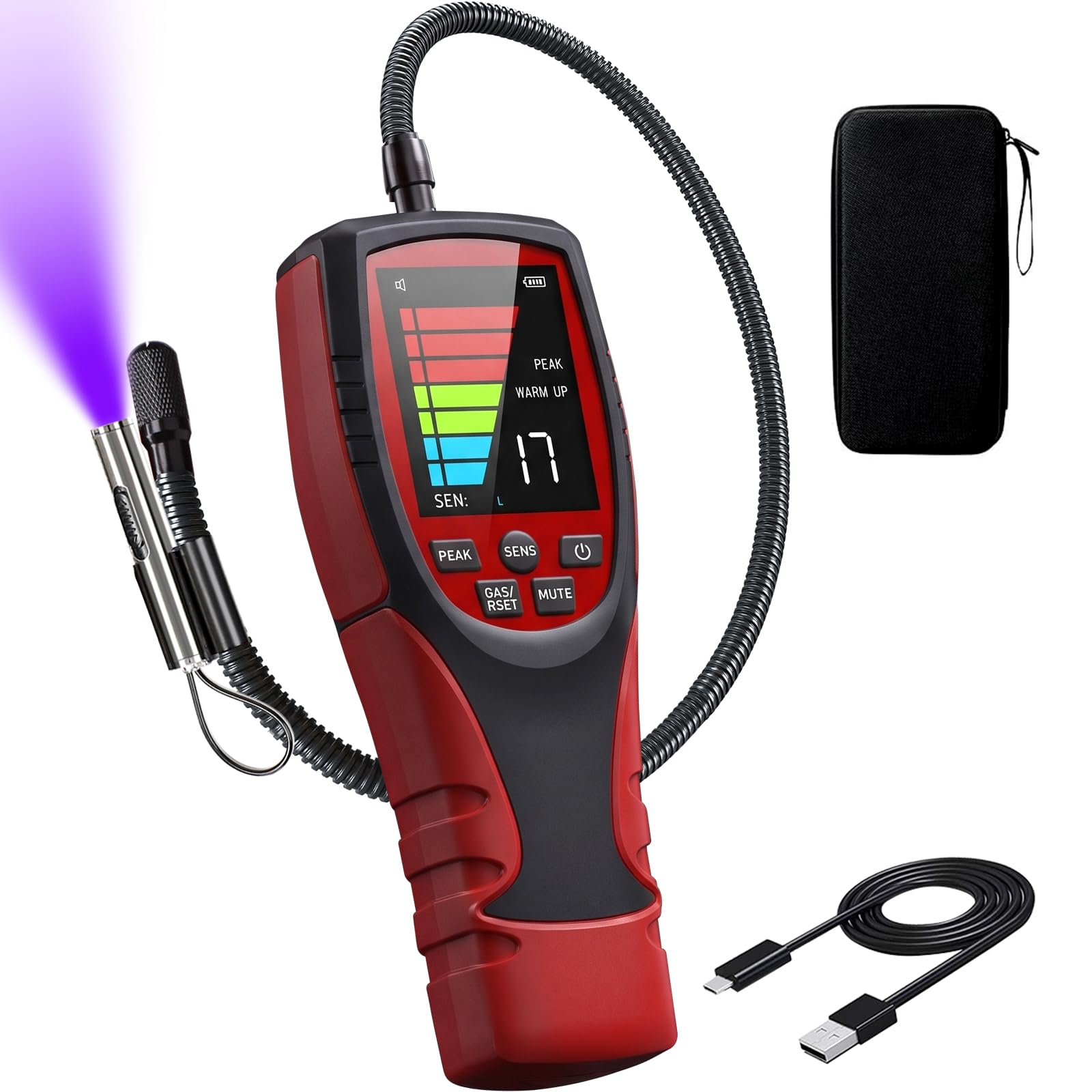
Built for the newer low-GWP refrigerants now showing up on installs.
Here is what sets this one apart: it is engineered for low-GWP refrigerants like R32, R454B, R290 and R600a while still handling the traditional set — R410A, R134a and R22. If your work is shifting toward the newer systems going forward, this detector is designed to cover both without a second tool. A high-precision sensor detects leaks as small as 0.14 oz/yr with three adjustable sensitivity levels that reduce false alarms in high-concentration areas. A built-in 3000mAh rechargeable battery supports all-day, multi-job operation.
Reach and visibility are the practical strengths here — a 16-inch flexible probe slips into confined spaces and hard-to-reach areas, and UV and LED lighting helps you see the probe tip in the dark. Peak Mode captures the highest detected value so you can identify the direction of a leak and close in on it quickly. The 2.8-inch TFT color screen stays readable from a dim basement to a sunlit roof, and the unit carries CE certification with development aligned to EN14624:2020 and SAE J2791 and J2913. Owners describe the bendable metal probe reaching under compressors and into narrow copper tubing gaps, with consistent R134a and R32 detection and a large battery for extended use.
The catch is in the small print: the manual is thin, the QR video is not much help, and the initial charge can run about 4 hours, or roughly 2 with a 5W charging block — and no charging block is included. The UV light wand clip needs its own special battery. None of that changes the detection capability, but budget your first charge time and read the sensor setup before you go out. It weighs 1.36 kg, and the ergonomic shape sits well in larger hands.
The forward-looking pick: Low-GWP coverage, a 2.8-inch TFT screen and a 3000mAh battery make it a strong choice for techs meeting A2L systems.
Pre-handle the loose ends: The thin manual and 4-hour first charge are minor frictions, not problems with how it detects.
Best for the evolving job: if R454B and R32 systems are on your calendar, the A2L coverage makes this the sensible call.
Best skipped if you just need a spare: for straightforward older-system leaks, the budget Elitech CPU-1G covers it.
7. Elitech ILD-200 Infrared Refrigerant Leak Detector

An infrared sensor rated to last a decade, so you replace less over the years.
An infrared sensor is the reason to consider this one over the diode crowd. Compared with a heated diode, an infrared sensor has stronger anti-interference ability, faster response speed, and — the headline figure — a 10-year sensor life. Sensitivity is adjustable High, Medium or Low up to a maximum of 0.14 oz/yr, and it detects all halogenated gases including CFCs, HFCs, HCFCs, HCs, HFOs and mixed refrigerants such as R11, R22, R404a, R410a, R600a, R1234yf and blends like AZ-50, HP62 and MP39. A 2.8-inch large screen with peak display points you toward the leak and keeps the work quiet.
Functionality and value carry this pick, and its sensor longevity is what makes the ownership math work over time. Owners mention pinpointing leaks to within an inch and confirming an AC coil leak that led to a manufacturer replacement. The adjustable sensitivity makes small leaks easier to flush out, and it is light at 14.88 ounces. The tool measures 3.3 by 1.5 by 7.9 inches and runs on a 3.7-volt supply. Elitech provides 24/7 customer service and technical support with US Local Team R&D.
Be realistic about the quirks. The sensitivity is very high, and the sensor is easily damaged if mistreated, so handle and store it with care. False positives do pop up, as they do on every sniffer in this class — rescanning a spot settles it. The screen scratches easily, so keep the case between jobs. None of these are deal-breakers, but they are the reasons to treat it as a precision tool rather than a tossed-in-the-truck spare.
Why the IR sensor pays off: Ten years of sensor life and stronger interference resistance mean fewer replacements and steadier readings across a long ownership.
Treat it like glass: The sensor is fragile, the screen scratches, and false positives happen — store it in the case and rescan to confirm.
Choose this for the long haul: the 10-year infrared sensor and pinpoint accuracy reward a buyer who wants low upkeep over many seasons.
Choose a diode instead if: you want the tightest micro-leak sensitivity and do not mind trading sensor life for it.
8. Inficon TEK-Mate Refrigerant Leak Detector

A rugged, made-in-the-USA workhorse with an automatic zeroing habit that keeps false alarms down.
This is the detector for buyers who want to set it down next to two D-cell alkaline batteries and forget about the setup fuss. A proven heated diode sensor handles all CFCs, HCFCs, HFCs and HFOs and is A2L certified, with a 0.25 oz/yr sensitivity rating. Where it earns trust is the automatic background adjustment — often called zeroing — which recalibrates against the surrounding air so a clean room does not read as a leak. It runs on two D-cell alkalines and lists an 8-hour average battery life, and it comes in a rugged carrying case with the sensor, filters and batteries included. No false alarms from soap solutions is a stated feature, which is welcome news if you work near a bucket of suds.
The reported pattern is steady, real-world success — leaks pinpointed in minutes and, with one owner reporting the tool paid for itself on a single repair. The high and low sensitivity ranges make small leaks easier to catch, and it detected a small R410a leak instantly on one job. Made in the United States with US technician support by email and phone.
Two honest notes round this out. Some find the accuracy and sensitivity readings mixed, which is common to the diode class — the false-reading complaint shows up while others find it dialed in. The automatic zeroing also takes a variable amount of time: sometimes it calibrates in 30 seconds and sometimes it takes over two minutes, so do not rush the warm-up. Give it the moment it asks for and it settles into a dependable rhythm.
The no-fuss choice: Automatic zeroing, D-cell batteries and a rugged case make this the grab-and-go detector for hands-on automotive and HVAC work.
Patience required: The zeroing warm-up can stretch past two minutes, and the diode-class sensitivity readings land mixed — wait it out before you trust the reading.
For the toolbag, not the bench: A2L certified, self-zeroing and D-cell powered, it suits anyone who wants a rugged everyday detector.
Not for the impatient: if a fast sensor swap without a warm-up matters, the heated-diode Elitech ILD-100H responds in a second.
Understanding the Specs
Sensor Type and Sensor Life
The sensor is the part that actually smells the refrigerant, and the type you pick shapes everything else. A heated diode sensor is the most sensitive to small leaks, but its element has a limited rated life — the Fieldpiece DR58 runs 300 hours and the Inficon TEK-Mate 100 hours — so a diode is a part you replace periodically. A metal-oxide semiconductor sensor, used on the SENSYX SFD201 and TOPTES RT-389, is cheaper to build and detects a broad gas range but reacts more readily to other fumes, so it can false-trigger near cleaning chemicals. An infrared sensor, as on the Elitech ILD-200, resists interference better and is rated for a 10-year sensor life, so it asks less upkeep over the years.
Sensitivity and Response Time
Sensitivity is the smallest leak a detector can see, written in ounces per year — the smaller the number, the finer the leak it catches. The Fieldpiece DR58 reaches below 0.03 oz/yr, the tightest here, while the Inficon TEK-Mate is rated at 0.25 oz/yr. That difference matters most when you hunt slow micro-leaks, the kind that drain a charge over a season. Response time is how fast the tool reacts once refrigerant hits the sensor, and it is usually written in seconds — the Elitech ILD-100H responds within 1 second and the Elitech CPU-1G in 3 seconds. A quick response keeps your sweep smooth and stops you from passing over a leak before the alarm fires.
FAQ
Will an AC leak detector find a leak that is too slow for soap bubbles?
Which refrigerants can these detectors actually sense?
Do I need to warm up an AC leak detector before use?
How fast should I move the probe when scanning for a leak?
Is a heated diode or an infrared sensor better for HVAC work?
Can these detectors also catch a car air-conditioning leak?
Why does my detector sometimes beep where there is no leak?
Are rechargeable detectors better than battery-powered ones?
How long does the sensor last and when do I replace it?
Can these detectors find a leak hidden inside a wall or under a panel?
Final Thoughts: The Verdict
The strongest pick overall is the Fieldpiece DR58, and it earns that spot on a single number: sensitivity below 0.03 oz/yr, the tightest in this lineup, backed by 4.7 stars across 200+ owner reviews. That is the detector that finds the micro-leaks driving everyone else crazy. If you want the widest reach for the least fuss, the Elitech CPU-1G does the everyday job on a light, budget-friendly frame. And if your work leans toward the newer A2L systems, the Simbow ALD-200 PRO is the one to reach for. Match the sensor to your job, respect the warm-up and the sweep speed, and any of these nine will save you a service call you would rather not pay for.
How We Picked
We do not accept paid placement. Every pick is matched to a real buyer and a real use-case; we do not hands-on test units.
Sources & Methodology
Specifications: manufacturer listings and product documentation. Review insights: verified customer reviews, as of September 2026. Pricing: not shown on this page (it changes often); check the current price via the retailer link.
As an Amazon Associate, KitchPrep earns from qualifying purchases. This does not affect which products we feature.
Related Guides
