
Specs are compiled from manufacturer listings and verified buyer reviews and can change over time — please confirm the key details on the product page before buying.
If your floor dips when you walk across the living room, a load-bearing steel post can lift the beam back to level and keep it there. The right post depends on your ceiling height and the load it must carry. A steel post you crank to height and pin in place beats a stack of blocks every time. This guide covers nine basement support posts, the height range each one spans, and which one fits your ceiling.
I’m Mohammad Maruf — the founder and writer behind KitchPrep. This guide is built by comparing the manufacturers’ published specifications and the patterns across verified customer reviews, so you get each pick’s real strengths and trade-offs instead of marketing spin.
You will see which posts reach the tallest ceilings, which hold the heaviest loads, and which ones suit a crawl space. The posts below span 18 to 155 inches and 10,000 to 18,000 pounds, so you can match one to your beam. This guide ranks the best basement support post options by height range, load capacity, and cranking effort.
Our Picks at a Glance


How To Choose The Best Basement Support Post
Measure floor-to-beam height at the sag point first — that number alone eliminates most of the field. Second, understand load capacity: an 18,000-pound post carries that weight, but how smoothly it lifts depends on the screw mechanism and turning bar.
Match the height range to your actual space
A post that reaches 150 inches handles a full-height basement ceiling; one that tops out at 20 inches is for a crawl space. A post that tops out at 20 inches is built for a crawl space. Measure from the top of your foundation floor to the underside of the beam — not to the ceiling above it. Add a few inches of margin so the screw has room to extend and do real lifting work.
Understand load capacity versus lifting ability
Load capacity is the maximum weight the post can carry once it is in place. A post rated for 18,000 pounds is doing structural holding work, not car-jack lifting work. The turning bar or swivel nut is what lets you crank the post up to level before you pin it. A longer bar gives you more leverage, which matters when you are pushing a beam back into position by hand.
Permanent versus temporary support
Telescoping posts with locking pins are made for permanent installation — they hold their height without creeping. Screw-style jacks with a single threaded shaft work well for temporary bracing during a repair, but some designs need to be checked and re-tightened. If you are working under a load-bearing beam long-term, look for a post that locks mechanically, not just by thread friction.
Base plate and footing
A wider base plate spreads the weight across more floor surface, which reduces the chance of the post sinking into a soft concrete slab. Most posts here use a base plate between roughly 4 and 6 inches wide. Placing the post on a concrete block or a pressure-treated wood pad adds extra bearing surface when the floor itself is questionable.
Quick Comparison
| Model | Best For | Height Range | Load Capacity | Material | Amazon |
|---|---|---|---|---|---|
| Vestil FJB-150 Basement Floor Jack★ Best Overall | Full-height basement beams | 54″–150″ | 11,200 lbs | Alloy Steel | Amazon |
| Xypholth 54″-155″ Pole House Jack PostLongest Reach | Tall ceilings and deck posts | 54″–155″ | 18,000 lbs | Alloy Steel | Amazon |
| Akron Products Big-Moe Adjustable Floor JackHeaviest Duty | Heavy structural house support | 4’8″–8’4″ | — | High Carbon Steel | Amazon |
| NAXVIO 2 Pack Floor Jack Post 31″–63″ | Crawl spaces with uneven beams | 31″–63″ | 18,000 lbs | Alloy Steel | Amazon |
| NAXVIO House Floor Jack 48″–93″ | Porch roofs and sagging floors | 48″–93″ | 18,000 lbs | Heavy Duty Steel | Amazon |
| Yaocom 2 Pcs Adjustable Jack Post | Temporary and joist support | 37″–61″ | 11,023 lbs | Alloy Steel | Amazon |
| Tiger Brand Jack Post JS-100 | Stairwells and bay windows | 4’8″–8’4″ | 18,000 lbs | High Carbon Steel | Amazon |
| QARCMQ Heavy Duty Floor Jacks 4×4 | 4×4 post replacement | 11.5″–20″ | 10,000 lbs | Carbon Steel | Amazon |
| Superjackwang 4 Pack House Floor Jack | Multi-point leveling jobs | 18″–36″ | 5 Ton | Alloy Steel | Amazon |
In-Depth Reviews
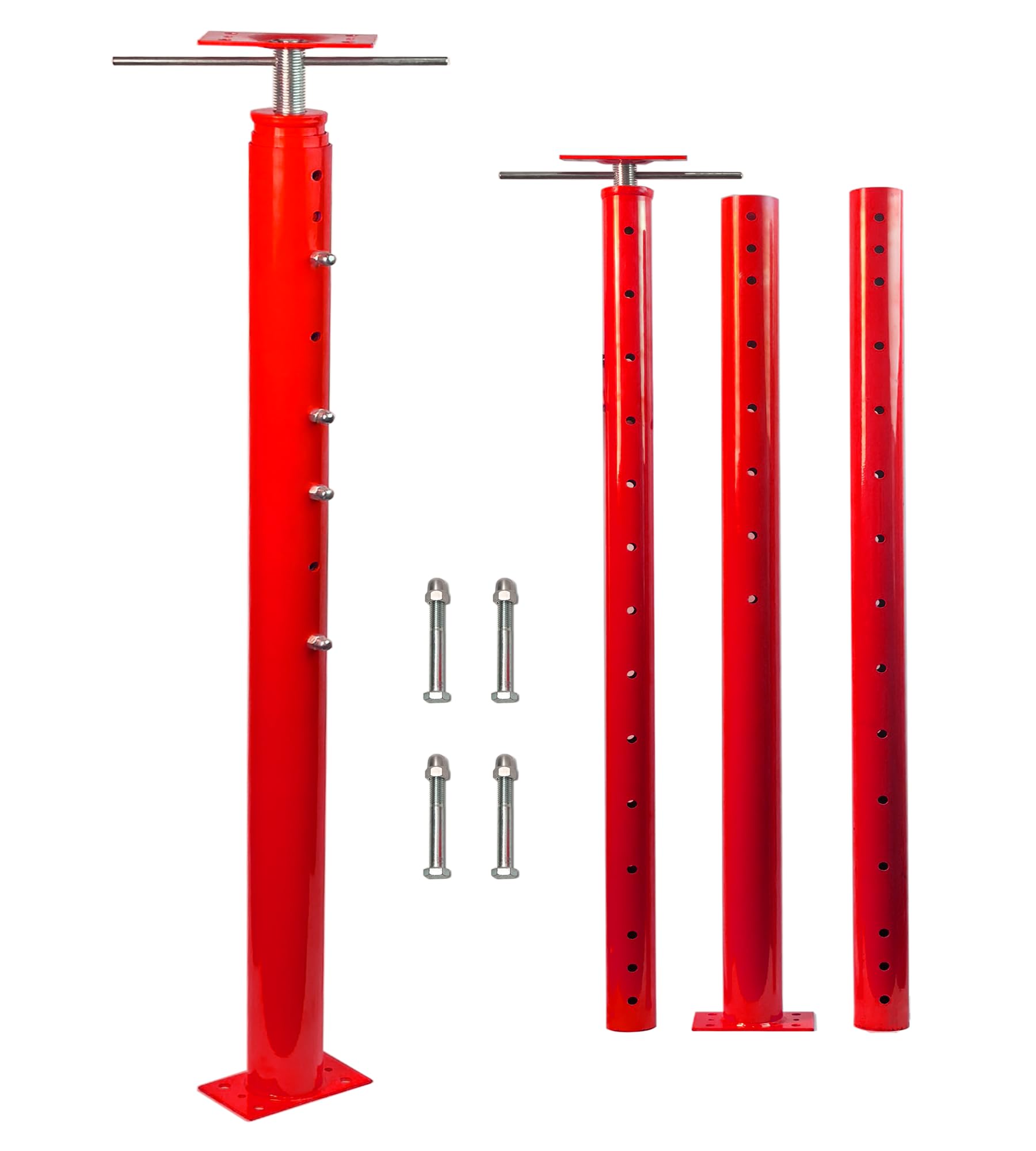
1. Vestil FJB-150 Basement Floor Jack 150 In. Maximum Height 2,588 Lb. Capacity Red
Our pick — over 4★ from 700+ verified ratings; the strongest balance of quality and price.
The telescoping steel post that reaches nearly thirteen feet and still cranks to level.
If your basement ceiling runs the full height of a finished space, this is the post that reaches it without stacking blocks underneath. The Vestil FJB-150 extends from a minimum of 54 inches all the way to 150 inches — a range that covers standard eight-foot basements and goes well beyond them. The screw and turning bar let you fine-tune the height by hand, so you are not fighting the post to get the beam exactly level.
Build quality is where this post earns its reputation. The alloy steel body carries a 11,200-pound load capacity and a red oxide finish that holds up against basement moisture. The turning bar and pins ship stored inside the inner tube — a small detail, but it means nothing rattles loose in the box before it reaches you. Builders working on long spans have leaned on this one hard: it held level for months supporting a 14-ft corner post during a replacement, and it has done duty on 12+ ft spans where lighter posts would flex.
The honest catch is the hardware. The alignment and the supplied pins have drawn steady criticism — the pins work loose as the post settles, and the holes do not always line up cleanly when the jack is fully extended. Several owners swap in 3/4-inch hitch pins or grade-8 bolts to lock it down properly, which is a small extra cost that turns a good post into a rock-solid one. The post itself is plenty strong; it is the retention hardware you want to upgrade.
What works in your favor
- 150-inch maximum height reaches nearly any basement ceiling without shimming
- 11,200-pound load capacity handles heavy structural beams with margin to spare
- Alloy steel with red oxide finish resists rust in damp basements
- Screw and turning bar give you precise, smooth height adjustment by hand
The honest trade-off
- Supplied pins work loose — upgrading to 3/4-inch hitch pins or grade-8 bolts is worth the small cost
- Hole alignment can be fussy when the jack is fully extended
- Two-person job on tall spans; the post is heavy once it is in position
Reach for this if: you are supporting a full-height basement beam and need the widest adjustment range on the list — nothing else here reaches 150 inches at this build quality.
Look elsewhere if: you are working in a low crawl space where a post this tall is simply the wrong tool.
2. Xypholth 54″-155″ Pole House Jack Post – Heavy Duty House Floor Jacks Deck Support
The two-piece steel column that stretches to 155 inches and holds 18,000 pounds.
When your beam sits higher than a standard basement ceiling — a tall crawl space, a garage with extra clearance, or a deck header — the Xypholth post is the one that gets there. Its telescoping two-piece steel column adjusts from 54 to 155 inches, which is 5 inches more reach at the top than the Vestil FJB-150 above. The alloy steel body is rated for 18,000 pounds, and the reinforced welded bases are built to take vertical compression loads that would bow a thinner tube.
You set the post, adjust the telescoping section to the height you need, then secure it with pins or bolts. Once bolted, it holds without constant monitoring — a real advantage over screw jacks that need to be re-checked. Owners have used it for deck leveling and as a machinist’s support under an overhanging workbench top, where it cut down milling machine vibration. Buyers report it is sturdy and installs easily for the load it carries.
The trade-off is the screw length. The threaded adjustment rod is short, so if you need fine control near the top of the range, the post jumps more than you might want between settings. It also arrives with lighter packaging that has occasionally left parts loose in the box — check the bolt and nut count before you start. For tall permanent support where you set the height once and bolt it, neither issue gets in your way.
Where it clearly leads: the 155-inch maximum is the tallest reach on this list, and the 18,000-pound rating gives it more load margin than the Vestil’s 11,200 pounds for beams that carry a full house corner.
The four-pack value is real for multi-point jobs — one shed leveling job needed only a single post and a log-and-brick extension to lift a leaning corner off its blocks.
Built for: tall ceiling spaces where no other post on this list will physically reach the beam without extension work.
Think twice if: you need slow, precise micro-adjustment at the very top of the extension — the short screw makes that finicky.
3. Akron Products Big-Moe Adjustable Floor Jack – Size Range 4’8″-8’4″ (11GA)
Thick high-carbon steel plates that have held entire houses off sagging beams.
This is the post for the job where failure is not an option. The Akron Big-Moe is built from high carbon steel and adjusts from 4’8″ to 8’4″ — covering standard basement and garage heights where a full-load beam needs permanent support. Owners who have used five of these at once to support a house praise the steel plates, which are noticeably thicker than the big-box jack posts they replaced. The base plates and screw cap are not welded to the tubes, which actually helps when you are fitting the post to an off-level deck.
Where it has genuinely earned its keep: one owner’s original garage post had rusted and buckled, and this post took over as the beam sagged — losing only about an 1/8 inch of sag while saving the structure. That is load-bearing work at its most serious. The design carries a risk worth knowing: because the cap is not welded, it can unseat under lateral force at full extension, so you want it plumb and securely pinned. Shipping is the other recurring frustration — boxes arrive open and hardware loose, though replacements are sent.
For a project that calls for heavy structural support rather than a quick leveling fix, the Big-Moe delivers the steel thickness and stability that lighter jack posts cannot match.
Strengths that matter on a loaded beam
- High carbon steel with plates thicker than most big-box jack posts
- Adjusts from 4’8″ to 8’4″ for full-height basement and garage beams
- Non-welded cap and base plates simplify fitting to off-level decks
- Proven in permanent house-support installations, not just temporary bracing
What to watch before you install
- Unwelded cap can unseat under lateral force at full extension — keep it plumb and pinned
- Packaging is unreliable; count your hardware the moment the box arrives
- Heavier and harder to reposition than telescoping posts once it is under a load
The pick for: permanent structural support of a full-load beam where steel thickness and stability outweigh convenience.
Not the one for: a quick weekend leveling job where you want something you can move by yourself easily.
4. NAXVIO 2 Pack Heavy Duty Floor Jack Post 31″ to 63″ Adjustable Support Pole Jack
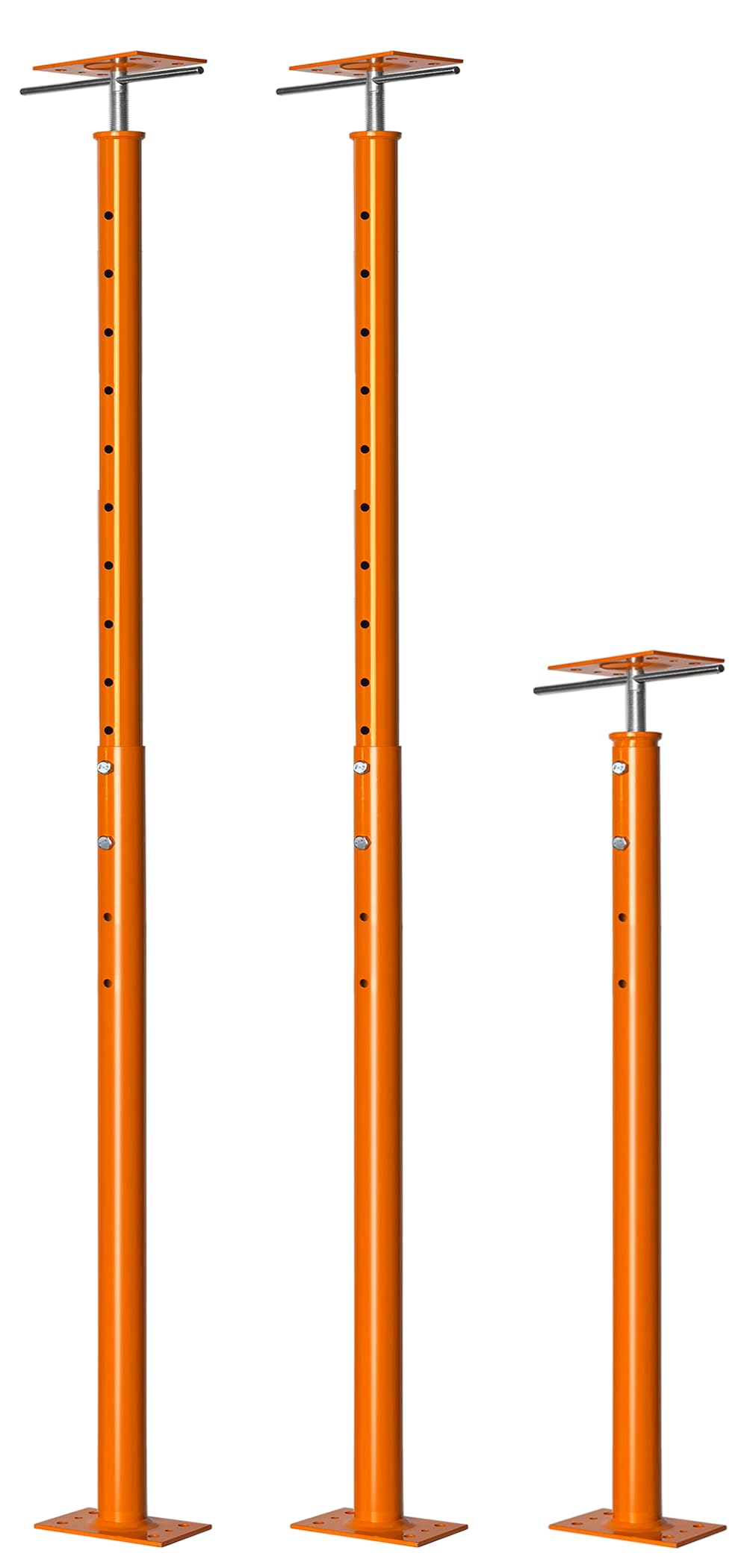
The swivel-head post built for sloped crawl space beams and tight under-floor work.
Crawl spaces are where posts earn their reputation, because the floor is rarely flat and the beam is never perfectly level. The NAXVIO 31″–63″ jack solves that with a 360° swivel top plate that tilts to match the angle of the beam or joist, so you get full contact instead of a corner digging into the wood. The threaded mechanism adjusts smoothly from 31 to 63 inches by turning the included swivel bar — no drilling, no screws, one person in minutes. This is the direct opposite approach to a fixed-head post like the Akron Big-Moe, which needs careful shimming to sit flat.
The wide 5.9″ x 3.6″ base plate spreads the load and resists tipping, and the self-locking threaded shaft holds its height once set. It is compatible with 2×4, 2×6, 4×4, 4×8, and 6×6 lumber beams, so it works under just about any joist you will find. The 18,000-pound capacity rating gives it plenty of margin for the residential and light commercial loads it is designed for.
The catch is the turning rod — it bends under heavy torque, so you may want a longer pipe for leverage when you are cranking against a stiff beam. The extended-height retention relies on two Class 4.8 cross bolts (a standard steel strength grade), which some owners upgrade to a higher grade for confidence. For temporary bracing or a well-supported permanent spot, though, this is a solid tool that fits where a full-size post will not.
The feature that separates it: the pivoting top plate is the difference-maker on sloped or irregular beams — it is what makes this post work in a crawl space where a fixed head simply will not sit flush.
Where it fits best: garage storage racks, sagging floor joists, and any spot where the beam is not perfectly level to the floor.
Choose this if: your beam is sloped or your crawl space floor is uneven and you need a post that seats itself correctly without shimming.
skip it if: you are lifting a heavy beam overhead and need maximum leverage from the turning bar without adding a pipe extension.
5. NAXVIO House Floor Jack, 48″-93″ Adjustable Jack Post Basement Support Pole Jacks

A two-pack of 93-inch posts that had a fallen-tree porch roof back up in an afternoon.
Sometimes the job is not a basement beam at all — it is a porch roof that dropped when a tree came down, or a foundation brace that rusted through and needs replacing. The NAXVIO 48″–93″ jack post handles both. Each post adjusts from 48 to 93 inches using the included turning bar, and the swiveling top plate flexes to match an uneven beam. The heavy duty steel body carries a rust-resistant oxide finish and an 18,000-pound safe load capacity, making it a legitimate permanent or temporary support system.
Owners describe this pair as exactly what they needed to lift a porch roof back up after storm damage, and as a clean replacement for a rusted-out brace. The swivel top plate and turning bar make setup fast, even when you are working alone in a tight space. The package includes two jacks, two levers, and four lock pins, so nothing extra is needed to get started.
One consistent note: the included turning bar is short, and cranking the jack up to a tall height takes some force — having a one-inch pipe on hand for extra leverage makes a real difference. That is a minor annoyance rather than a limitation on what the post can do. For a two-pack at this capacity, it covers a lot of ground for the money.
What you get for the money
- Two 18,000-pound posts with turning bars and lock pins included
- 48″–93″ range covers porch roofs, foundation braces, and sagging floors
- Swiveling top plate adapts to uneven or sloped beam surfaces
- No screws or tools required — position, spin the bar, lock in place
Small things to know
- Turning bar is short; a longer pipe makes cranking easier on tall lifts
- Delivery has run a week late in some cases — order before you start the job
- At 93 inches fully extended, the post is tall enough that leverage drops off near the top
The two-pack for: porch roof repairs, foundation brace replacement, and any sagging-floor job that needs two posts at a mid-range height.
Consider a different post if: your ceiling is above 93 inches, since this pair tops out well short of the tallest picks here.
6. Yaocom 2 Pcs Adjustable Jack Post, 37″-61″ Height Range, Basement Floor House Screw Jacks for Lifting Joist Beam Brace for Cellar Ceiling, Center Point Load Capacity 11023 Lbs, Red
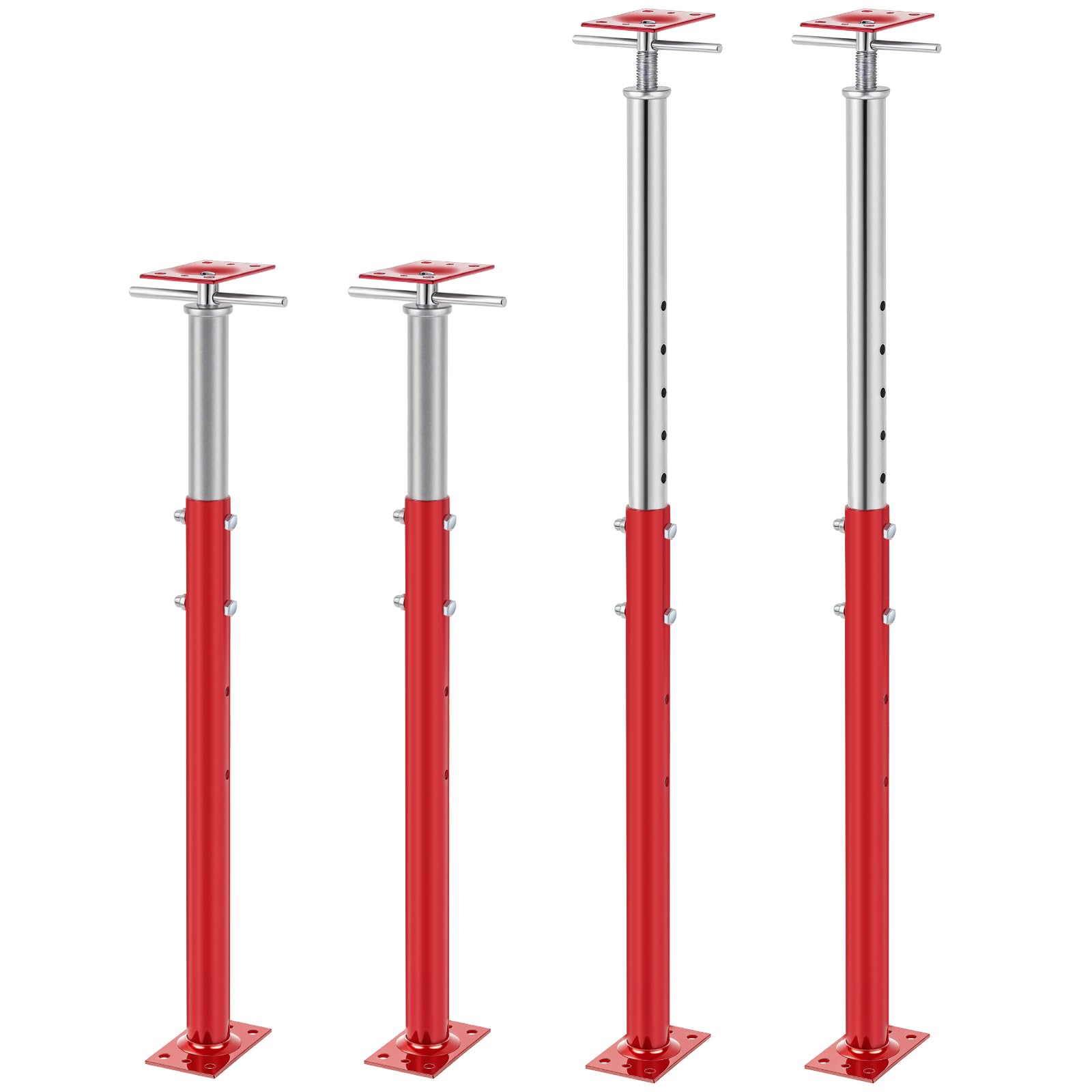
Two red all-steel posts owners compare to Sherman Tanks for the weight they take.
For a mid-height job with two problem spots, this Yaocom pair gives you a matched set. Each post adjusts from roughly 37 to 61 inches, and both come with their own turning bar. The alloy steel body carries a center-point load capacity of approximately 11,023 pounds. The top and bottom plates measure roughly 3.54 x 5.91 inches and 0.20 inches thick, and the screw pole runs about 1 inch in diameter and 8 inches long — a beefy threaded shaft for the load class.
Owners have used these to straighten a sagging roof and to fix a sagging front porch corner, and the recurring word is solid. The double-post format is genuinely useful when you have two joists that need support at the same time. The chromed lead screws turn smoothly once the post is set, and the paint is thick enough to resist basement humidity.
One note from the field: the second-person assist helps. Holding the post steady while you rotate the screw is easier with an extra set of hands, especially under a loaded beam. The posts also run shorter than the mid-range set, so if you are bridging a tall gap, measure first. A sharp metal shaving was found on one lead screw, so a quick wipe-down before you crank is worth doing.
The build in plain terms: the durability is what owners actually talk about — these posts shrug off heavy loads, and the chromed lead screws keep turning smoothly after the post is under compression.
A good match when: you have two mid-height sagging spots and want a matched pair that can take a serious load.
Measure first if: you are working under a taller joist, since the 61-inch maximum leaves less headroom than some of the taller posts on this list.
7. Tiger Brand Jack Post JS-100 – Size Range 4’8″-8’4″ (15Ga)

The double-locked high carbon post that fixes sagging floors and stairwells the old-fashioned way.
This is the classic jack post shape — a high carbon steel column that adjusts from 4’8″ to 8’4″ with 3-inch bolt holes and a 4-inch screw, designed for correcting sagging floors and supporting basement beams and stairwells. The key feature is the double lock: it secures in place with both bolts and the screw, which is a real safety margin when the post is holding a permanent load. At 18,000 pounds, the capacity matches the heavy-duty class.
Where the JS-100 shines is longevity. Owners have had four of these holding up a barn for six years, surviving a tree fall in the process, and have bought them again for new jobs. The bolt-on hardware makes it easy to install and adjust to any length, and you can mount the adjuster at top or bottom to fit the space. It has also worked as secondary support under bay windows, where an engineer specified it, and its removable nature makes it easy to access appliances behind it.
The heads-up: the outer pipe can arrive slightly bent and the paint scratched, though it straightens out in use. The capacity halves when the post is fully extended — 18,000 pounds drops to 9,000 at max reach — so do not count on the top figure at full extension. And on a long-running order, some buyers have reported missing plates or adjustment screws, so unbox and inspect before your project starts.
Why owners keep coming back: the stability is the standout — these posts hold a load for years without drifting, and the bolt-and-screw double-lock keeps them where you set them.
The math you need to know: capacity halves to 9,000 pounds at full extension, so keep the post toward its shorter range when the load is heavy.
Best if: you want a proven, widely used post for a standard-height basement floor, stairwell, or bay window with a permanent load.
Rethink it if: you need the full 18,000-pound capacity at maximum extension — that rating only holds toward the short end of the range.
8. Heavy Duty Floor Jacks for Basement – Fits 4×4 Posts Jacks, 11.5-20 inch
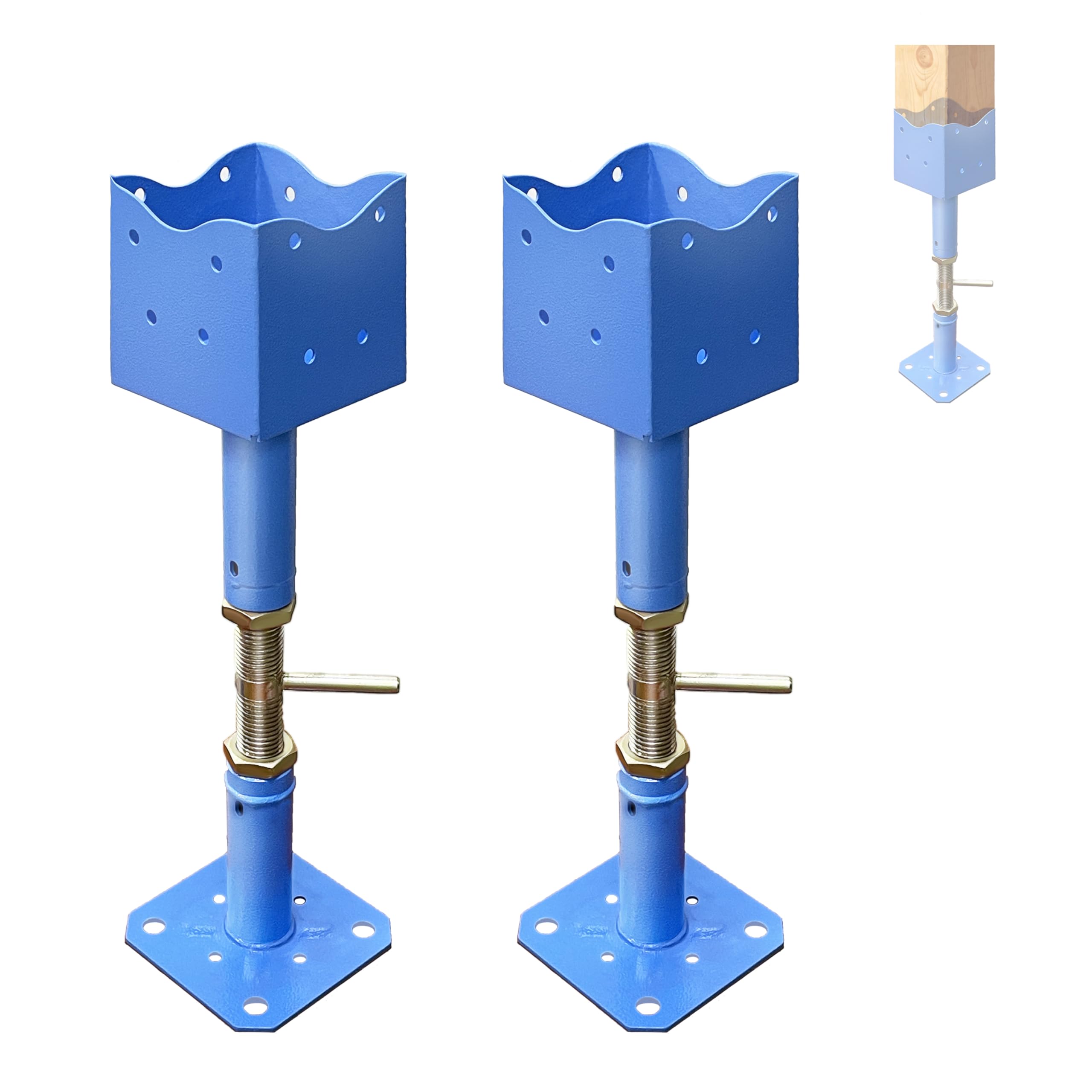
A short-throw screw jack built to cradle a 4×4 post without any wood trimming.
Not every support job is a tall beam — sometimes you are dropping in a 4×4 post to replace a rotted one, and you need a jack that fits the square end without you cutting the wood down. This QARCMQ jack is built specifically for that: its internal frame measures 4.01 x 4.01 inches, sized to take a standard 4×4 post even after it swells with moisture and heat. Competing designs that size to the outside of the post force you to shave the wood down to fit — this one costs you no secondary processing time.
The jack adjusts from 11.5 to 20 inches with a threaded mechanism, and the base plate measures 5 x 5 inches at 0.16 inches thick. The 1.5-inch-diameter support tube is 0.1 inches thick, and the carbon steel body — made from SAE 1045 — is rated for a 10,000-pound load. The AWS E8018 welded joints and the reinforcing ribs on the base add stability on uneven surfaces, and a limit-observation window warns you if you over-extend.
Owners have used these to add support points under a travel trailer and to lift a small house, reporting that the floor became more stable with each one added. The turnbuckle-style mechanism is sturdy and easy to use. Two notes: grease the threads before you load the post — the difference in turning effort is night and day — and the stem bar is a bit short, so a longer pipe or a second handle helps when you are cranking under load.
Why the 4×4 fit matters
- 4.01″ x 4.01″ internal frame fits a standard 4×4 post without trimming
- SAE 1045 carbon steel body rated for a 10,000-pound load
- Rust-resistant spray coating protects against basement moisture
- Limit-observation window and reinforcing ribs add a safety margin
Before you crank it up
- Grease the threads first — dry threads make turning much harder under load
- Stem bar is short; a longer handle gives better leverage on stiff lifts
- Height tops out at 20 inches, so it will not reach a full-height basement beam
The right tool when: you are replacing or adding a 4×4 post and want a jack that seats it without any woodworking.
Wrong fit for: full-height basement beams — the 20-inch maximum is designed for crawl spaces and short posts.
9. 4 Pack House Floor Jack, 18″-36″ Range Adjustable Basement Support Jacks
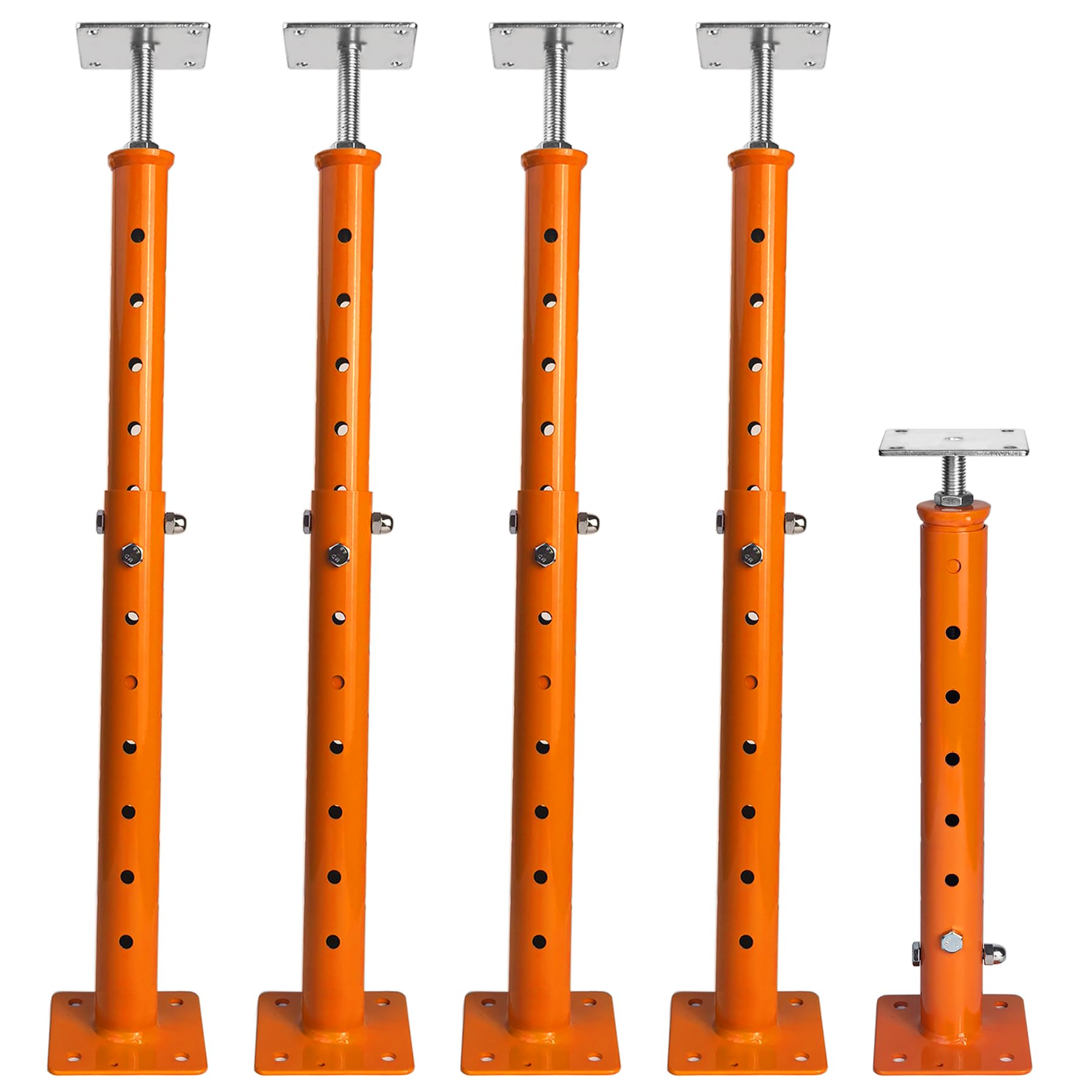
Four short posts for spreading support across a whole room on a tight budget.
If your sag runs across several joists instead of one sag point, four posts make more sense than one tall jack post. This Superjackwang set adjusts from 18 to 36 inches, with a built-in turning nut for height changes, and each post is rated for up to 11,023 pounds. The galvanized upper section and black oxide lower section give it real anti-rust protection, which is useful if you are working in a damp crawl space or an outdoor deck area. The set carries a 2-year warranty.
The posts are designed for temporary or permanent support of floors, decks, stairs, porches, roof beams, and basements. Owners have used them to shore up a screened-in porch on a lake home and to level a sagging beam from below. The turning-nut adjustment is quick once you get the post under the load, and the four-post format lets you distribute weight evenly across multiple support points.
Here is the part to understand before you buy: these are closer to stands than to true screw jacks. The top plate is welded to the screw, so raising the post means rotating the entire plate rather than turning a fixed nut below it. Owners who expected a conventional jack were caught off guard, and a few struggled to lower the post once it was raised. For simple leveling where you set the height and leave it, the design does the job fine — just go in knowing what you are getting.
What you are getting: four anti-corrosion posts with an 18″–36″ range and an 11,023-pound per-post rating for the price of fewer, taller single posts — ideal for multi-point leveling jobs.
The design quirk: because the top plate turns with the screw, this behaves like an adjustable stand rather than a crank jack — set it once and you are done.
Good value for: spreading support across several joists or a sagging room where you want four posts at a budget level.
Know before you buy: if you need to lower the post after loading it, the fixed top plate makes that hard — this is a set-and-leave support, not a lifting jack.
Understanding the Specs
Load Capacity
Load capacity is the maximum weight a post can carry once it is installed and locked in place — think of it as the post’s structural holding strength, not its lifting strength. An 18,000-pound rating means the post can safely bear that much weight from a beam above. Two things reduce that number in practice: how far the post is extended, and whether it is sitting on solid footing. On the Tiger Brand JS-100, for example, the capacity halves at full extension, so the rating you see is the rating at its shortest, most stable position. Always keep your post well within its range and set the base on a concrete block or pressure-treated pad.
Height Range and Adjustment
Height range is the span the post can cover, from its lowest setting to its highest. This is the number that decides whether a post will physically fit your space. A post that adjusts from 54 to 155 inches covers a tall basement or garage header; one that maxes out at 20 inches is meant for a crawl space or a short 4×4 post. Adjustment style matters too — a telescoping post slides and then locks with pins or bolts, while a screw jack uses a threaded shaft turned by a bar or nut. Screw jacks give finer control; telescoping posts give more reach and hold a set height without drifting.
FAQ
How do I know what load capacity my basement support post needs?
Can I use a jack post as a permanent support in my basement?
What is the difference between a screw jack and a telescoping jack post?
Why does my jack post lose capacity when it is extended?
Do I need to bolt a basement support post to the floor or beam?
How much adjustment range do I need to level a sagging beam?
Can a jack post be used to lift a porch or deck, or only to support a basement beam?
What should I put under a basement jack post to keep it from sinking?
Why does my jack post screw turn hard when I am raising it?
Are the pins and bolts that come with a jack post good enough to leave in?
Final Thoughts: The Verdict
The basement support post that covers the most ground is the Vestil FJB-150, and it is the pick for good reason — 150inches of reach, an 11,200-pound load rating, and a smooth screw-and-bar adjustment system that lets one person level a beam without a helper. If you need more height, the Xypholth 155-inch post reaches just a bit higher while carrying an 18,000-pound load. And for a crawl space or a short 4×4 post replacement, the QARCMQ 4×4 jack fits standard lumber without any trimming. If you are shoring up foundations or leveling a sagging floor and want a post you can crank, lock, and trust, the Vestil FJB-150 is the strongest overall pick here — upgrade the pins to 3/4-inch hitch pins and it will hold for the long haul.
How We Picked
We do not accept paid placement. Every pick is matched to a real buyer and a real use-case; we do not hands-on test units.
Sources & Methodology
Specifications: manufacturer listings and product documentation. Review insights: verified customer reviews, as of September 2026. Pricing: not shown on this page (it changes often); check the current price via the retailer link.
As an Amazon Associate, KitchPrep earns from qualifying purchases. This does not affect which products we feature.
Related Guides
