
Specs are compiled from manufacturer listings and verified buyer reviews and can change over time — please confirm the key details on the product page before buying.
If you want the shortest honest answer: the TIMEMORE Chestnut C2S is the grinder most people should buy. It turns whole beans into even, repeatable grounds with a hand crank, costs less than most electric rivals, and it simply keeps working. Everything below explains why, plus which pick fits your kitchen, your beans, and your patience for noise.
I’m Mohammad Maruf — the founder and writer behind KitchPrep. This guide is built by comparing the manufacturers’ published specifications and the patterns across verified customer reviews, so you get each pick’s real strengths and trade-offs instead of marketing spin.
A conical burr crushes beans between two shaped metal cones, and that even crush is what separates a real grinder from a whirling blade chopper. coffee bean grinder buyers should weigh burr type, grind settings, and how many cups you brew before choosing.
Our Picks at a Glance


How To Choose The Best Coffee Bean Grinder
The single biggest decision is burr type, because it sets how even your grounds come out and how many brew methods you can cover. A conical burr (two cone-shaped steel pieces that crush beans between them) is the standard for home brewing. A flat burr (two flat discs that shear the bean) tends to suit espresso drinkers chasing clarity in the cup. Neither is automatically better — they simply grind differently.
Grind settings tell you how many brews you can cover
More settings means more usable range. The Cuisinart runs 18 positions, the SHARDOR runs 51, and the MOKKOM runs 100. A dial with fine resolution (small steps between clicks) lets you nudge a shot without overshooting. If you only ever brew drip or French press, you do not need 100 steps — but espresso drinkers usually want the extra range.
How much coffee do you grind at once
Capacity is measured in grams of beans or ounces of hopper space. The 1Zpresso K-Ultra holds 35 g, the KINGrinder K6 holds around 30 g, and the Breville Smart Grinder Pro hopper holds 18 oz. If you make one 12-cup pot every morning, you want the bigger hopper. If you brew a single pour-over, a small single-dose chamber keeps beans fresher and wastes less.
Noise and static are the two daily annoyances
Electric burr grinders make noise — the Cuisinart is consistently described as loud, while the SHARDOR and MOKKOM are praised for staying quiet. Anti-static coatings and ionizers in the MOKKOM and Gen 4 keep grounds from clinging to the cup. If you grind before sunrise or live in a small apartment, prioritize the quieter options.
Quick Comparison
| Model | Best For | Burr Type | Grind Settings | Capacity | Amazon |
|---|---|---|---|---|---|
| TIMEMORE Chestnut C2S★ Best Overall | Best overall hand grinder | 38 mm conical steel | ~36 levels | 25 g | Amazon |
| SHARDOR Conical BurrBest Value | Espresso on a budget | 40 mm conical steel | 51 settings | 1.4 oz | Amazon |
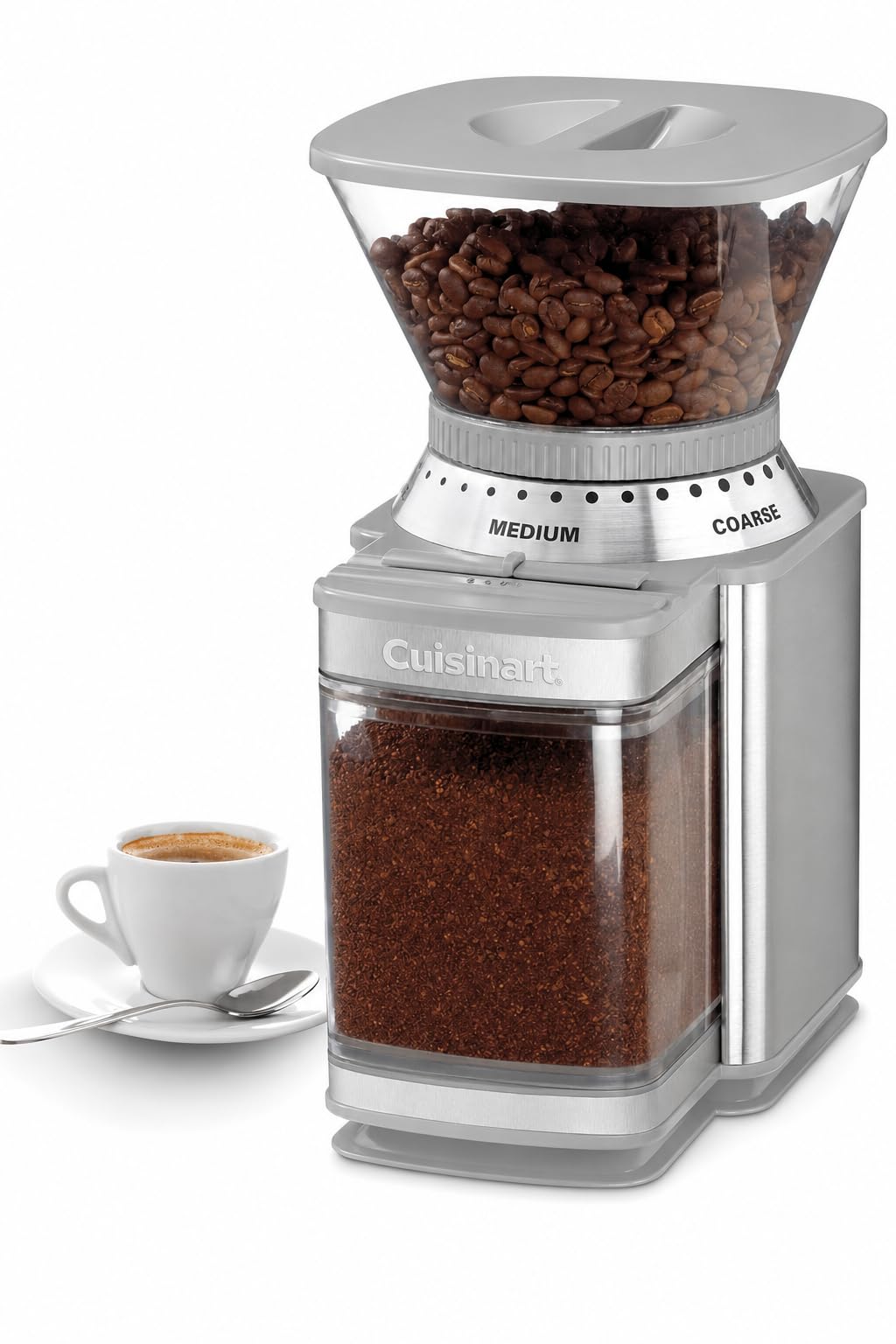
| Cuisinart Burr GrinderBest for Big Pots | Big daily drip pots | Flat burr | 18 positions | 32 cups ground | Amazon |
| KINGrinder K6 | Travel and outdoor brewing | Conical stainless steel | 60 clicks per rotation | 25–35 g | Amazon |
| Baratza Encore | Everyday home drip and pour-over | 40 mm conical steel | 40 settings | 5 oz | Amazon |
| Viesimple Gen 4 | Quiet single-dose espresso | 48 mm conical burr | Multiple grind sizes | 30 g | Amazon |
| MOKKOM 64mm Flat Burr | Fast flat-burr grinding | 64 mm flat steel | 100 settings | 12.35 oz (350 g) | Amazon |
| Breville Smart Grinder Pro | Espresso and drip in one machine | Conical burr | 60 settings | 18 oz hopper | Amazon |
| 1Zpresso K-Ultra | Premium travel and espresso | Stainless steel conical burr | 100+ clicks at 20 microns | 35–40 g | Amazon |
In‑Depth Reviews
1. TIMEMORE Chestnut C2S Manual Coffee Grinder Stainless Steel S2C Conical Burr
Our pick — over 4.5★ from 950+ verified ratings; the strongest balance of quality and price.
The hand grinder that quietly outworks machines costing more than twice as much
This is the pick for anyone who wants cafe-grade grounds without electricity, noise, or a countertop footprint. TIMEMORE built the C2S with a full metal unibody — the upgrade that fixed the plastic top cover that cracked on the older C2. Inside sits a 38 mm stainless steel conical burr, hardened to 55-58HRC and cut on a 5-axis CNC, which is the reason the grounds come out this even. A 38 mm burr is the crushing surface that does the actual grinding work, and at this size it feeds the bean steadily instead of smearing it.
You get roughly 36 levels of coarseness, adjusted by turning a nut — clockwise for finer powder, counter-clockwise for coarser. Double bearing positioning on the central axis keeps the shaft from wobbling, so a fine setting stays fine batch after batch. The body weighs 700 g and the 52 mm barrel is easy to grip, even for smaller hands. That matters because the handle keeps spinning after you release it, thanks to a built-in bearing, so the work feels lighter than the size suggests. You can fit about 24 g of beans in the chamber — enough for a large mug or a two-cup pour-over.
The recurring gripe on the review pages is the top cover cracking with heavy use, and the durability feedback is genuinely mixed rather than uniformly glowing. Treat the lid gently and it lasts; wrench it daily and you may eventually need a replacement. Cleaning is a brush-and-reassemble job, no water required, and the whole grinder breaks down by hand for travel. Compared with the Baratza Encore below, this one is quieter and needs no outlet — but it also asks you to crank it yourself every single morning.
What wins people over
- 38 mm hardened conical burr with double bearing axis for even particles
- Full metal unibody solves the older C2’s plastic-lid cracking
- 36 coarseness levels from fine to coarse with one adjustment nut
- 700 g body with a 52 mm grip that suits smaller hands
- Handle keeps turning after release, so grinding takes little force
Where it asks for care
- You supply the muscle — no motor, no timer
- 25 g chamber means grinding twice for a full pot
- Top cover can crack under rough daily handling, per owner feedback
- Cleaning is manual brushing rather than a removable bin rinse
Reach for this if: you brew pour-over or French press, want grounds rivaling machines well above this price, and do not mind a minute of quiet cranking.
Look elsewhere if: you pull multiple espresso shots back-to-back and would rather press a button than turn a handle.
2. SHARDOR Conical Burr Espresso Coffee Grinder Electric with Precision Timer 2.0
A touchscreen espresso grinder that starts grinding the moment you dock the portafilter
If you want espresso-machine results without hand-cranking, this is the value pick. The SHARDOR runs a 40 mm stainless steel conical burr — sized to cut fast and keep heat off the beans so the oils stay in the grounds. Grind quality is the thing owners rave about most, and it is not a close race in the feedback. The bean chamber holds 1.4 oz, and the whole unit weighs 6.2 lb on a 7.4 by 4.9 inch footprint, so it tucks beside the machine.
Where this gets clever is dosing. The electronic timer runs up to 60 seconds in 0.1-second increments, so you dial in a repeatable amount rather than eyeballing it. You can pick 1 to 12 cups, and the portafilter cradle lets you grind straight into the basket — no transfer scoop, no spilled pile. Anti-static technology keeps the grounds chamber from turning into a dusty mess, and a residual cleaner plus cleaning brush come in the box. Two dosing rings (51mm and 58mm) and two portafilter holders are included.
The honest catch is grind consistency: some owners find it will not go quite fine enough for their machine, and reliability feedback runs negative in the aggregated review data. Read that as a fit warning rather than a defect — this is a grinder for everyday espresso drinkers, not for someone chasing the finest turbo-shot settings. The 165-watt motor pulls on standard 120 volts, and buyers report it works on 220V with a converter.
Where it earns its spot: auto-start on portafilter insert, 51 settings, and a 0.1-second timer put genuine espresso workflow within reach at an entry-level price. Fresh-ground beans beat pre-ground for flavor and aroma, and the auto-start timer delivers that upgrade with almost no learning curve.
What to know going in: the finest setting may not satisfy every espresso setup, and the small-portafilter holder spills grounds — most owners grind into the container instead.
The short version: a smart first electric espresso grinder whose timer and cradle do the fiddly work for you.
Not the one for: you if you need lab-grade repeatability at the finest end, or you pull light-roast shots that demand micro-adjustment.
3. Cuisinart Coffee Grinder, Electric One-Touch Automatic Burr Coffee Grinder
Grinds a full morning pot in one cycle and keeps the beans sealed until you need them
For the household that brews a full pot every day, capacity is the whole game, and this Cuisinart plays it well. The flat burr grinder holds a removable 8 oz bean hopper that takes a full standard bag, and the grind chamber catches enough for 4 to 18 cups — roughly 5 oz per cup, varying by brew method. Set the slide-dial anywhere across 18 positions, from ultra-fine to extra-coarse, and the internal electric timer shuts the unit off when the cycle finishes. The one-touch power bar sits separate from the body, and an included scoop and cleaning brush round out the kit.
Owners describe the grind as fast and even, and many note it preserves the oils that give coffee its flavor. Removable hopper and chamber make cleaning straightforward, though a twist to the coarse setting followed by a brush of the burrs is the routine most people settle into. This is also the most reviewed model here by a wide margin — one of the genuinely popular burr grinders on the market, and the crowd is mostly happy.
Be ready for volume, though — noise is the loudest recurring critique, with owners describing it bluntly as loud. A few report the grind runs coarser than expected and under-doses at the largest cup setting, so plan on dialing in your own number. The upper canister can also let beans stick together if you leave them sitting for hours; a quick shake before grinding sorts it. The hopper must click into place properly or the unit will not run at all, which trips up plenty of new buyers on day one. Compared with the quieter MOKKOM below, this one trades hush for hopper size.
Buy it because: you want one grinder that fills a big drip pot, holds a whole bag of beans, and needs no attention mid-cycle.
Think twice if: your kitchen shares a wall with a bedroom, or you primarily pull espresso — this one is built around drip volume.
4. KINGrinder K6 Manual Coffee Grinder Straight Handle Stainless Burr
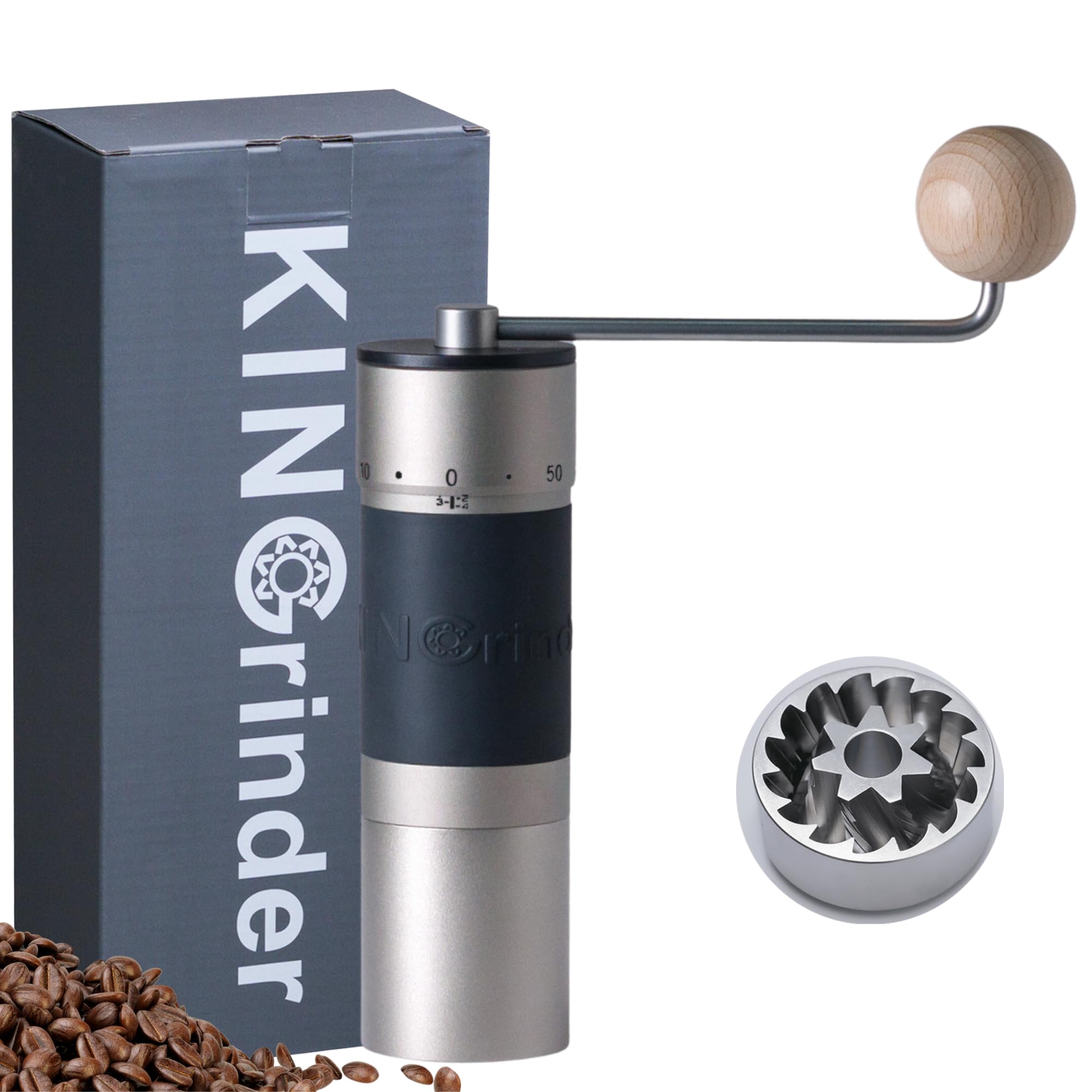
Café-level grind control in a hand grinder you can sling in a hiking pack
The KINGrinder K6 lives on one number: 16 microns per click. A micron is one-thousandth of a millimeter, and tiny steps like that mean you can nudge a grind without overshooting into a different brew method. The external adjustment ring gives you 60 clicks per rotation across up to 4 full turns — plenty of range to move from espresso to pour-over to French press without touching a tool. The burr set is stainless steel inside an aluminum body, with dual bearings keeping the shaft centered for even particles.
Owners describe its grind quality as matching grinders that cost far more. One topic that comes up is true zero — the point where the burrs touch may sit a couple of clicks off the printed scale, so you note your own reference point and grind from there. The hopper takes 25 to 35 g of beans, and the whole thing comes apart by hand for brushing. For camping, hiking, or hotel-room brewing, it packs small and takes no power at all.
The straight handle is the trade-off. It is less comfortable to crank than a ball-shaped knob, and owners with weaker grip find it harder to hold steady. A screw-on catch cup also has a habit of jamming if you overtighten it. Compared with the TIMEMORE above, the K6 offers finer adjustment and more capacity — but it costs more and asks for a firmer, steadier hand.
The case for it
- 16-micron steps with 60 clicks per rotation and up to 4 rotations
- Stainless steel burr in an aluminum body with dual bearings
- 25–35 g hopper covers espresso doses and pour-over batches
- Dismantles by hand for brush cleaning, no tools
- Backed by a 1-year warranty
The honest caveats
- Straight handle is harder on the hands than a ball knob
- True zero can sit a click or two off the printed scale
- Screw-on catch cup can jam if tightened too far
- Duplicates the TIMEMORE’s job at a higher cost
For the tinkerer: someone who wants to chase exact grind numbers and take the same grinder car camping on the weekend.
Better left on the shelf if: you want the simplest possible hand grinder, or your hands tire easily during grinding.
5. Baratza Encore Coffee Grinder ZCG485BLK
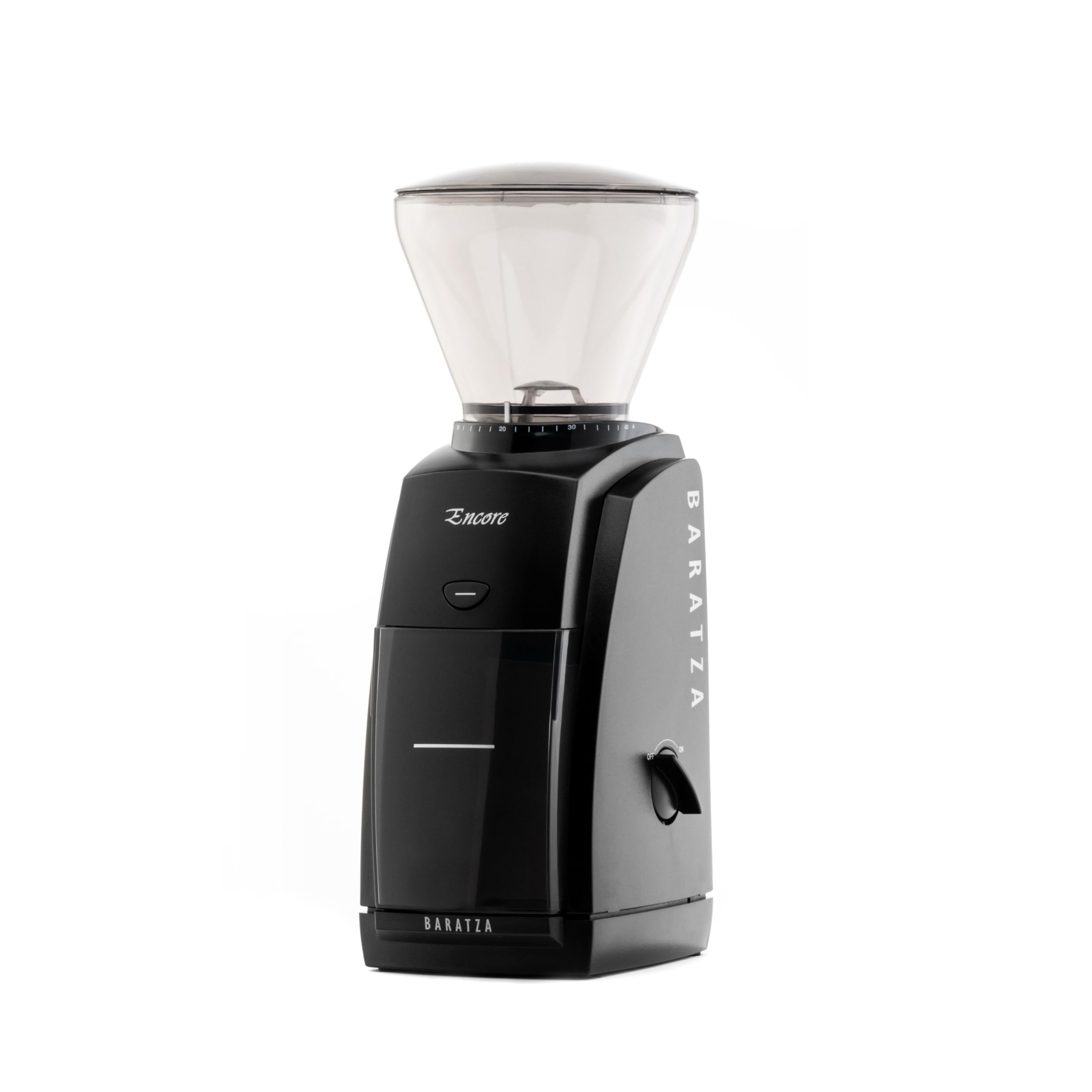
The plain, proven workhorse that made burr grinding normal in American kitchens
Baratza’s Encore is the grinder most home brewers graduate to, and the spec sheet shows why. It runs 40 mm commercial-grade conical burrs made from hardened alloy steel in Liechtenstein, driven by a DC motor, with 40 grind settings spanning espresso through French press. A front-mounted pulse button and a plain ON/OFF switch keep operation obvious. The hopper holds 5 oz of beans, the unit weighs 5.6 lb, and a 1-year warranty covers it.
What people consistently notice is that the grind itself is steady — drip, pour-over, and French press settings land where the dial says, and it needs no recalibration. Owners also praise Baratza’s support culture: when a power board quits, the company has a record of shipping a replacement or handling a flat-rate repair even outside warranty. That service reputation is a real part of the value here.
The honest downsides are noise and the occasional wear part. Owners find it loud enough to wake the house, and the ring burr holder’s plastic tabs can break under load, so a spare is a smart purchase. There is no timer either — you either weigh beans per batch or rig a smart plug. Static cling can send a few grounds outside the catch bin. A small group does report early failures, which is the main reason this sits behind the higher-scoring picks despite being the more famous machine.
Why it stays on the list: 40 settings, hardened alloy steel burrs, and genuine long-term parts support make it a safe, repairable choice rather than a disposable one. Solid enough for the brew methods most people actually use daily.
Where it stumbles: it is not an espresso grinder, it is loud, and the lack of a built-in timer means you manage dosing yourself.
Suits you if: you brew drip or pour-over most mornings and value a company that will keep your grinder alive for years.
Pass if: silence matters, or you plan to pull espresso shots at home.
6. Viesimple Gen 4 Electric Burr Coffee Grinder, Single Dose
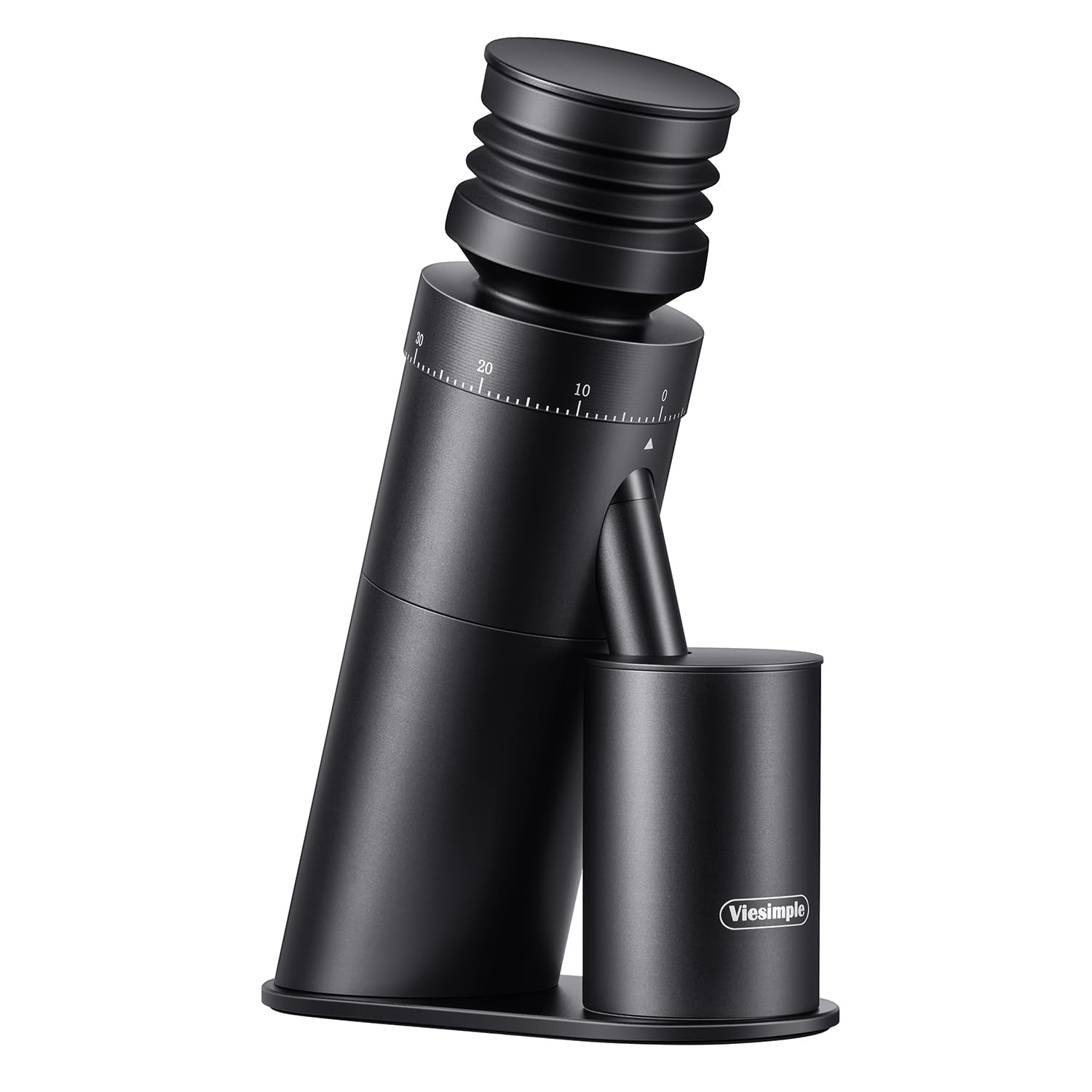
Single-dose espresso grinding you can run at midnight without waking the house
Here is the number that changes daily life: the Gen 4’s noise stays under 50 decibels, which is roughly a quiet conversation. That alone puts it in a different class from the Cuisinart above. It uses 48 mm conical burrs — the same size class found in several well-known espresso machines — set in a high-quality aluminum body that weighs just 3.4 lb. The sealed-lid catch cup keeps grounds from flying, a magnetic dosing cup snaps back into place, and a blow-out funnel clears the chute so less chaff ends up on your counter.
Single dosing is the other design idea here. You drop in the beans you want for one shot, grind, and walk away with almost nothing left behind. Anti-static coating on the food-grade surfaces keeps residue low, and an anti-clogging channel design pushes grounds through smoothly instead of packing them in. The motor is rated for over 10 years of use, and the 100-240V power supply works in other countries. A 2-year warranty backs it.
The size is a genuine surprise — smaller than the photos suggest, which people either love for a tight counter or grumble about when the hopper will not hold three full scoops. Plan to grind in two halves for a larger batch. Grind speed is steady rather than fast, and a few owners find the setting markers misaligned from the start. None of that stops it from delivering consistent, tasty espresso — it is simply a single-dose machine rather than a bulk hopper.
The pick for: espresso drinkers who make one or two shots at a time and want near-silent operation with minimal cleanup.
Skip if: you grind large batches for a drip pot, or you need a hopper that holds a full bag of beans.
7. MOKKOM 64mm Flat Burr Coffee Grinder
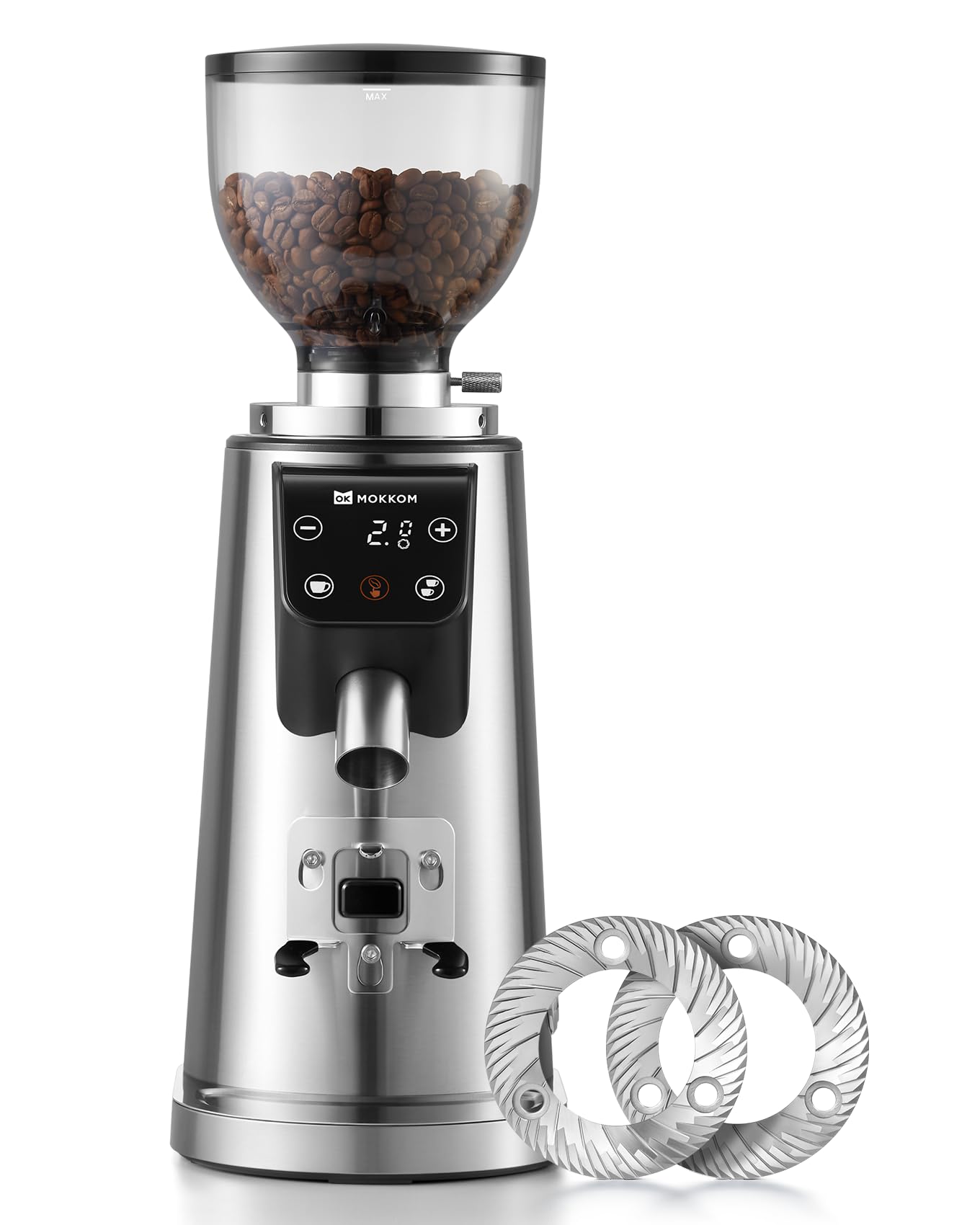
A full-metal flat burr machine that turns 18 grams into fluffy grounds in seconds
Speed is the headline here, and the numbers back it up. Owners mention 17 g in 5-7 seconds, 18 g in about 6 seconds, and 20 g of espresso in 7-8 seconds — faster than most conical grinders at this price. Underneath sit 64 mm stainless steel flat burrs, which shear beans into a more uniform particle than a cone and tend to suit espresso clarity. The 100 grind settings stretch from fine Turkish and espresso all the way to coarse cold brew and French press, switchable with a 0.1-second precision timer across single, double, top-up, and continuous modes.
The build is genuinely industrial: a stainless steel body, an aluminum alloy grinding chamber base, and a 7 mm brass grind adjustment ring. A plasma generator inside the exit chute kills static before grounds can cling — one of the main reasons this grinder feels clean to use. You get two hoppers in the box, a large 350 g / 12.35 oz one for bulk grinding and a silicone single-dose bellows with a lid for smaller batches. The upper burr, hopper, and a grounds press all come off for cleaning.
Where it is less than perfect: a minority note a wobbly portafilter holder, and there is no variable speed control if you like tuning RPM. The grind does not adjust in true stepless fashion on every unit, so you are working within its click stops rather than infinite positions. Quality and value are what owners rave about most, though — and against grinders costing two to three times as much, this one holds its own on consistency.
Why it stands out: 64 mm flat burrs, a plasma static killer, and sub-10-second grind times add up to a machine that feels engineered rather than assembled. Real 350 g capacity means fewer refills on a busy morning.
The trade-off: no variable speed, occasional portafilter-holder wobble, and a flat-burr flavor profile that leans bright rather than chocolatey.
Made for you if: you want flat-burr espresso results and speed, with a timer that nails the same dose every morning.
Not for: anyone who dislikes visible static-control gadgets or needs stepless micro-adjustment between clicks.
8. Breville BCG820BSS Smart Grinder Pro

The programmable espresso grinder that grinds straight into your portafilter basket
If you want one machine that handles both espresso and drip without fiddling, this is the one to beat. The Smart Grinder Pro offers 60 grind settings with a conical burr design, and it lets you grind directly into the portafilter, an airtight container, a gold-tone filter basket, or a paper filter — no transfer step. That flexibility is why it earns its spot near the top of the price ladder. A programmable digital timer adjusts in 0.2-second increments, which is roughly the resolution you need to hold a consistent dose across shots.
The dosing accuracy is the reason espresso drinkers stick with it. Customers note setting 15 doses about 1 gram per second, so once you learn your number, weight-by-time is predictable. The LCD shows grind setting, grind time, and how many shots or cups you have selected, so dialing in becomes a repeatable process instead of guesswork. Included accessories cover small portafilters of 50-54mm and large 58mm ones, so it fits most home machines. A 2-year limited warranty backs it.
It is also very quiet for a 165-watt grinder, and owners describe it as easy to clean with the removable bottom tray and cleaning brush. The 18 oz hopper holds a solid batch of beans. The catch cup is the weak point — plastic that generates static and sends grounds elsewhere, so many owners swap in their own container. Compared with the Baratza Encore, this is the more capable machine for espresso specifically, and the one to pick if your brew routine spans both espresso and drip.
Choose this if: you brew espresso and drip at home, want programmable dosing for repeatable shots, and grinding straight into the basket matters to you.
Look elsewhere if: you are a strict drip or pour-over drinker who does not need 60 settings or portafilter cradles.
9. 1Zpresso K-Ultra Manual Coffee Grinder with Carrying Case

The travel-ready hand grinder that delivers shots rivaling a full countertop machine
You pay more for the K-Ultra, but the parts show why. It has a stainless steel conical burr (the cutting cone that grinds beans) that is precision-engineered, and an external dial with over 100 clicks at 20 microns each — a micron is one-thousandth of a millimeter — so you can go from coarse French press to fine espresso in one smooth turn. A magnetic catch cup snaps on and holds 35 to 40 g of grounds, and a foldable handle pushes, twists, and tucks away to stop the grinder tipping over while you crank.
What makes it better than the TIMEMORE and KINGrinder above is calibration. Each burr is set at the factory to reduce wobble and shifting, and you can take it apart without tools for quick cleaning. The box comes with a cleaning brush, an air blower, and a travel case, so you can use it right away. At 1.5 lb it packs easily, and the burrs are rated for 100-200 kg of beans over their lifetime. A one-year limited warranty covers it.
The honest catch: this is a hand grinder at a price some buyers balk at, and it takes patience on first setup — light-roast espresso needs extra effort and the manual is not always clear on calibration. A few owners note that beans can stick and lose 0.2-0.5 g of grounds, and the folding handle feels awkward for some hand sizes. Still, what wins people over is the cup quality: the grounds are consistently better than many machines costing far more, and the portable case makes this the one serious espresso grinders can toss in a weekender bag.
Why the price makes sense: factory-calibrated burrs, over 100 clicks of 20-micron adjustment, a magnetic catch cup, and a travel case with accoutrements make this the premium hand grinder built to last. Consistent, articulate grounds across filter and espresso.
Who should skip it: anyone who wants the fastest possible workflow — this still asks you to crank, and a light-roast espresso pull can be physically demanding.
Buy this one if: you travel, want near-machine quality from a hand grinder, and appreciate knowing exactly what every click does.
Reconsider if: you mainly brew drip at home — the cheaper TIMEMORE covers that job for far less.
Understanding the Specs
Burr size and grind consistency
Burr size is measured in millimeters and describes the diameter of the crushing surface. The TIMEMORE uses a 38 mm conical burr, the SHARDOR uses a 40 mm, the Viesimple Gen 4 uses a 48 mm, and the MOKKOM uses a 64 mm flat burr. Larger burrs tend to grind faster and produce more uniform particles, which is why the MOKKOM turns out 18 g in seconds while smaller models take longer. Material matters too: steel burrs like the hardened alloy in the Baratza hold their edge longer than softer blades, so a grinder that lists its burr material usually has a longer working life.
Grind settings and what they control
Grind settings are not a marketing number — they are the actual range of coarseness you can dial in. The Cuisinart has 18, the SHARDOR has 51, the Breville Smart Grinder has 60, and the KINGrinder and MOKKOM go higher still. A fine setting suits espresso, where water is pushed through under pressure in under 30 seconds. A coarse setting suits a French press, which steeps for minutes before pressing. If your grinder cannot reach the grind you need, you cannot brew that method well no matter how good your kettle or beans are.
FAQ
Do I need a burr grinder or is a blade grinder good enough?
Will a manual hand grinder actually keep up with daily use?
Can these grinders make fine enough grounds for espresso?
How often do I need to clean a coffee grinder?
Do louder grinders mean lower quality?
Does static actually matter or can I ignore it?
Should I store beans in the hopper or grind single dose?
How long should a good coffee grinder last?
Are flat burrs better than conical burrs for espresso?
Do these grinders work with any brew method or are they single-purpose?
Final Thoughts: The Verdict
For most kitchens, the coffee bean grinder winner is the TIMEMORE Chestnut C2S because its 38 mm hardened conical burr delivers even, repeatable grounds across pour-over and French press without any power or noise. If espresso is your daily ritual and you want speed, the MOKKOM 64mm Flat Burr grinds 18 g in seconds with a plasma static killer built in. And for big drip pots, the Cuisinart Burr Grinder pulls a full cycle in one go. Whichever fits your brew method and counter space, moving from pre-ground to fresh-ground beans is the biggest single upgrade to your morning cup.
How We Picked
We do not accept paid placement. Every pick is matched to a real buyer and a real use-case; we do not hands-on test units.
Sources & Methodology
Specifications: manufacturer listings and product documentation. Review insights: verified customer reviews, as of September 2026. Pricing: not shown on this page (it changes often); check the current price via the retailer link.
As an Amazon Associate, KitchPrep earns from qualifying purchases. This does not affect which products we feature.
Related Guides
