
Specs are compiled from manufacturer listings and verified buyer reviews and can change over time — please confirm the key details on the product page before buying.
You already know the problem: rigid pipe snaps, cracks, and needs a fistful of elbow fittings every time a wall gets in the way. Bendable plumbing pipe fixes that — it curves around corners, runs in one continuous stretch, and skips most of the joints where leaks actually start. Below you’ll find nine real picks, sorted by what they’re genuinely good at, with the exact pressure ratings, diameters, and lengths that decide whether a coil is right for your job.
I’m Mohammad Maruf — the founder and writer behind KitchPrep. This guide is built by comparing the manufacturers’ published specifications and the patterns across verified customer reviews, so you get each pick’s real strengths and trade-offs instead of marketing spin.
Some coils here bend into a full circle without cracking, some are built for a buried main line, and a few are drain hardware rather than water supply. What matters is matching the material and pressure rating to your job before you unroll anything. This breakdown covers the full range of bendable plumbing pipe so you can pick with confidence.
Our Picks at a Glance


How To Choose The Best Bendable Plumbing Pipe
Flexible pipe is not one product. A 1/2-inch coil feeding a shower, a 3/4-inch main line coming in from the meter, and a flexible sink trap under a bathroom basin are three completely different jobs. Get the material family right first, then the size, and the rest sorts itself out.
PEX-A or PEX-B — the bend test
PEX-A is the more pliable of the two, and the difference shows up the moment you push a coil around a corner. PEX-A also has stronger “memory” — the ability to spring back to its original round shape after it’s expanded, which is how expansion fittings seal so tightly. PEX-B is a touch stiffer and its fittings usually crimp or clamp rather than expand. Both hold the same 160 psi rating in the sizes listed here, so the choice depends on your tooling and how tight your bends need to be.
Match the diameter to the flow you need
Half-inch pipe is the standard for individual fixtures — a shower, a sink, a toilet supply. Three-quarter inch feeds a whole branch or a main line where you don’t want pressure to drop when two taps run at once. One-inch is for long underground runs from a meter or well to the house, where volume matters more than anything else.
Can it go underground?
Several coils here are rated for direct burial, including under concrete, which means you can trench them straight in without conduit. That rating is not universal across flexible pipe, so check it on the specific coil before you dig. The pool-and-spa hose in this list is built for above and below ground use with PVC Schedule 40 solvent fittings — a different world entirely from potable-water PEX.
Quick Comparison
| Model | Best For | Length | Diameter | Max Pressure | Amazon |
|---|---|---|---|---|---|
| SharkBite 1/2 Inch x 50 Feet Blue PEX-B (U860B50)★ Best Overall | Everyday DIY water runs | 50 feet | 1/2 inch | 160 psi | Amazon |
| VIVIDA 1-1/2″ Flexible Sink Drain P-TrapEasiest Fix | Fixing an unaligned sink drain | 7.5″–17.7″ adjustable | 1-1/2 inch nut | — | Amazon |
| John Guest 3/8 Inch x 25 Feet LLDPE TubingBest for Filters | Water filters and RO lines | 25 feet | 3/8 inch | 150 psi | Amazon |
| VEVOR PEX-A Pipe 1/2 Inch, 2 x 100 Feet | Hot-and-cold radiant setups | 200 feet total | 1/2 inch | 160 psi | Amazon |
| EFIELD 1/2 inch 2 x 100 ft Pex-A Blue & Red | Whole-house repiping in two colors | 200 feet total | 1/2 inch | 160 psi | Amazon |
| Sealproof 1.5″ Dia Flexible PVC Pool Hose | Pool and spa plumbing | 50 feet | 1-1/2 inch | 70 psi | Amazon |
| SharkBite 3/4 Inch x 300 Feet Blue PEX-B (U870B300) | Long buried main lines | 300 feet | 3/4 inch | 160 psi | Amazon |
In‑Depth Reviews
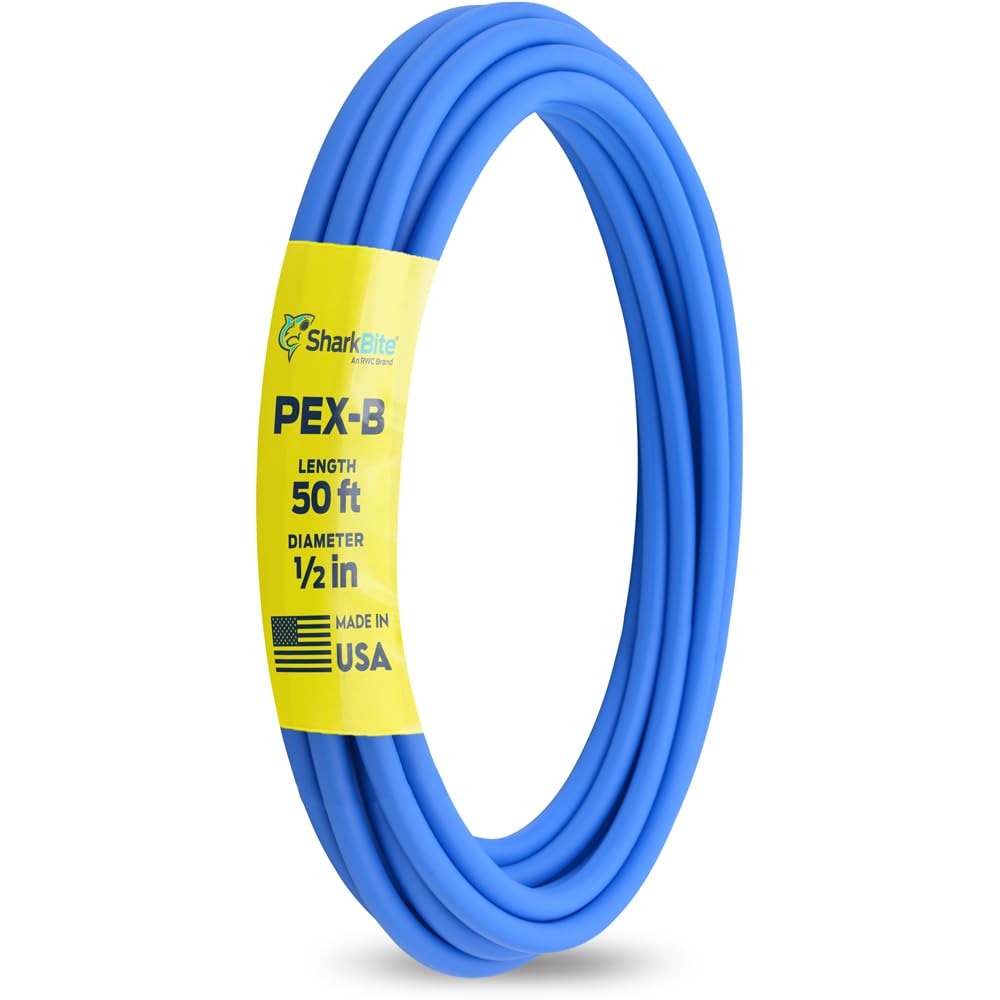
1. SharkBite 1/2 Inch x 50 Feet Blue PEX-B, Made in the USA, Flexible Water Pipe Tubing for Plumbing, U860B50
Our pick — over 4.5★ from 600+ verified ratings; the strongest balance of quality and price.
The 50-foot coil that turns a two-day copper job into an afternoon.
The number that earns this the top spot is 50 feet by 1/2 inch — enough to replumb a bathroom or run a fresh line to a spigot without splicing. At 160 psi maximum pressure it handles normal household water supply with room to spare, and the flexible body bends around corners without elbows, so you’re not cutting and soldering six joints where one curve would do. Freeze tolerance is built in too: the pipe expands slightly when water inside it freezes and contracts back once thawed, which is the difference between a spring thaw and a flooded crawlspace.
What wins people over is the quality of the material itself — it’s the thing owners bring up more than anything else. Buyers report swapping out decades-old copper in a vintage trailer, and one put it plainly: “Good quality pex B and at a good price. Fairly easy to work with. Nice upgrade from the old copper lines in my 1979 Avion.” The same coil has been used to replace a bent outdoor spigot line and a leaking indoor valve, and the review pages consistently land on the same note — it’s stiff enough to hold a straight run, strong enough to trust behind a wall, and simple enough that a first-timer gets a clean install.
Compatibility is wide: it works with PEX expansion (F1960), push-to-connect (ASSE 1061), plastic barb (ASTM F2159), and brass barb (ASTM F1807) fittings, and it’s suitable for direct burial including under concrete. Compare that to the John Guest LLDPE coil, which is a 3/8-inch line rated to 150 psi — this SharkBite carries a much larger 1/2-inch diameter for fixture supply, while the John Guest is sized for filters and small lines. Rated for six-month UV exposure and compliant with ASTM F2023 for oxidative tolerance, it’s built for the long haul.
What You’re Getting
- 50 feet of 1/2-inch PEX-B rated to 160 psi at 33°F–70°F
- Bends around corners without elbows, cutting fitting count and leak points
- Freeze-tolerant — expands slightly when frozen, contracts once thawed
- Works with expansion, push-to-connect, plastic barb, and brass barb fittings
- Made in the USA, rated for six-month UV exposure
Where It Has Limits
- PEX-B is stiffer than PEX-A, so very tight bends take more effort
- Push-to-connect fittings are sold separately and add to the parts list
- The 2.7-pound coil wants to stay wound — uncoil it slowly and let it relax
Reach for this if: you’re running fixture supply lines in a house, cabin, or RV and want one continuous run without elbows.
Think twice if: your project needs the tighter bend radius of PEX-A or a larger diameter for a main line.
2. VIVIDA 1-1/2″ Sink Drain Pipe, Flexible Kitchen Sink P Trap, White, 1-Pack
For a sink drain that refuses to line up, this is the two-minute answer.
This one is not a water supply line at all — it’s a drainage part, and that changes what its specs mean. The body adjusts anywhere from 7.5 inches to 17.7 inches, which is the whole point: when the tailpiece from your sink and the wall drain stub sit at slightly wrong angles, a rigid trap won’t seal, but this one just flexes into place. It fits both 1-1/2-inch and 1-1/4-inch sink drains, and the kit arrives complete — the flexible trap, two 1-1/4-inch adapters, an S-shaped fixed buckle, six sealing rubber rings, and sealing tape.
What gets this pick its spot is how often it simply makes a stalled project finish. It shines in exactly the situation buyers describe most: an awkward angle where standard fittings won’t line up, a new garage or utility sink where the existing piping sits fractionally off, a drain that takes five minutes to fix instead of an afternoon. The most common praise is that it does the job it was bought for, and the recurring note is the same one you’d expect from any flexible drain part — the occasional leaking complaint and the odd fit mismatch show up in the mix, which is why knowing your drain size before ordering matters so much.
Two things to know before you buy. First, the ends are not slip joints, so it only works with a male threaded sink drain or an adapter — it will not mate with a pipe that has no threads. Second, the material is PP plastic, which is thicker than ordinary plastic but is not PVC; if you specifically want PVC drain pipe, this isn’t that. The 1.77-inch outside diameter pairs with a 1-1/2-inch drain hole, and note that the “1-1/2 inch” figure refers to your sink’s drain hole size, not the pipe diameter.
The DIY-friendly angle: no cutting, no gluing, no calculating heights and angles — it slides and tightens into place, which is why it rescues so many misaligned sink jobs.
Thread check first: it needs a threaded drain or the supplied adapter. Measure your sink drain hole and confirm the threads before you order.
Best for: a kitchen or utility sink where the existing drain piping won’t line up and you want a fast, leak-tight fix.
Look elsewhere if: your drain uses slip-joint connections or you need a rigid PVC trap rather than flexible PP.
3. John Guest 3/8 Inch x 25 Feet LLDPE Tubing, Flexible Water Tubing for Plumbing, Blue, PE-12-EI-025F-B
The slim blue line that quietly fed every water filter you’ve ever used.
At 3/8-inch outside diameter, this is a fraction of the size of a full supply coil — only 0.38 inches across, compared to the 1.77-inch outside diameter of the VIVIDA drain trap above. That small size is deliberate. This is the line that snakes behind a cabinet to move a water filter, feeds a reverse-osmosis unit, or links a fridge to an RO system without a fat pipe in the way. It’s rated to 150 psi at 70°F and 90 psi at 150°F, covering cold supply and moderate hot water alike.
The linear low-density polyethylene is odorless, tasteless, and non-toxic, and it carries FDA-compliant material plus NSF 61 and 51 certification — the ones that matter for drinking water. The recurring theme in owner feedback is reliability once it’s installed: it’s used in restaurant water purification systems for years with no leaks or kinks, the push fittings grip it securely so lines don’t pop out, and it moves a sink filter to a new spot without drama. The one quirk worth planning around is that like any coiled tubing it arrives wound and needs to be uncoiled and laid straight before it runs clean.
This is also a genuinely different product class from the Sealproof PVC pool hose, which runs 50 feet at 1-1/2 inches for pool plumbing — the John Guest is 25 feet of 3/8-inch line for potable and filter work, and the two are not interchangeable. Order the 3/8-inch size to match most OD tubing connectors, and know that the 25-foot length covers a couple of under-sink relocations with room to spare.
Why it earns its place: FDA-compliant material and NSF 61 and 51 certification make this the safe, dependable pick for drinking-water and filtration lines, sized exactly for the fittings most filters use.
Pick this for: RO systems, water filters, fridge water lines, and hydroponic setups where you need a slim, food-safe line.
Skip the idea if: you’re running fixture supply or a main line — you need a larger diameter and a higher-pressure coil for that.
4. SharkBite 1/2 Inch x 100 Feet Blue PEX-A, Made in the USA, Flexible Water Pipe Tubing for Plumbing, UA60B100

Two 100-foot coils, red and blue, plus the cutter and clamps to start today.
Where the SharkBite PEX-B gives you 50 feet, this VEVOR kit hands you 200 — two 100-foot coils, one red and one blue, split so you can code hot and cold runs at a glance. It’s PEX-A with an EVOH non-oxygen barrier layer for hydronic radiant floor heating, meaning it keeps oxygen from seeping through the wall and corroding the metal parts of a heating loop. Rated to hold pressure across a wide temperature span — 160 psi at 73°F, 100 psi at 180°F, and 80 psi at 200°F — it also handles -40°C to 95°C (-40°F to 203°F), so the same coil works for hot water, cold water, and radiant circuits.
What sets this pick apart from the other PEX-A coils is what’s in the box. It ships with a pipe cutter and clamps, so a weekend installer isn’t hunting for a separate tool before the first cut. That value angle is exactly where owner feedback lands — the value-for-money notes run second only to quality, and the standout feature people describe is the pipe’s memory: bend it into a full circle and it still springs back without cracking, which is the property that seals expansion joints tight. One repeated caution from buyers: the included cutter is fine for light use, but a sharp aftermarket cutter makes cleaner, squarer cuts, and squarer cuts are what keep expansion fittings from weeping.
Because both coils are marked with imprint text on the pipe body — type, diameter, size, standards, and production date — you can identify a leftover length months later instead of guessing. It’s the same 1/2-inch, 160-psi foundation as the SharkBite PEX-A above, but the two-color barrier construction and bundled accessories aim it at radiant and hot-water builds rather than a simple fixture line.
Why Builders Like It
- 200 feet total in red and blue for clear hot/cold separation
- EVOH non-oxygen barrier suits hydronic radiant floor heating
- Handles -40°F to 203°F and up to 160 psi
- Cutter and clamps included for a same-day start
- Imprint markings identify type, size, standard, and production date
Watch-Outs
- The coils arrive tightly wound and need time to relax before they run flat
- The bundled cutter is basic — a sharper one gives squarer cuts
- Heavier bulk than a single coil, so it’s more to store
Suits you best if: you’re laying radiant floor loops or plumbing a new build hot-and-cold and want both colors plus tools in one box.
Overkill if: you only need one short fixture run — a single 50-foot coil does that without the extra roll.
5. EFIELD 1/2 inch 2 x 100 ft Pex-A Pipe/Tubing Blue & Red 200 ft Length

A whole-house repipe in one box, red and blue, with the cutter thrown in.
This is the coil you buy when you’re doing the entire house rather than one line. You get 1/2-inch blue PEX for cold and 1/2-inch red PEX for hot, 100 feet of each for a 200-foot total, plus a pipe cutter in the box. It’s formulated to the maximum-flexibility end of the PEX-A range, expands for the connection, and it’s built to push full water flow through expansion fittings — though, as the listing notes, those expansion fittings, rings, and tools are a separate order. It also accepts barb crimp, clamp, or sleeve connections if that’s your tool set.
The compliance sheet is where this pick earns its premium label. It meets ASTM F876, F877, F1807, F1960, F2023, F2080, and F2169 — a long list of standards covering everything from dimensional tolerance to oxidative resistance. The material is also chemical resistant to chlorine, which matters in a municipal water house where chlorine exposure is constant. Owners who repiped whole homes with it report no issues installing or crimping, clean cuts from the included cutter across an entire job, and one freeze event in a re-piped section that caused no damage.
The one thing to get right is your fittings. Because expansion mistakes are costly — a nick in the brass fitting while removing an expansion ring makes it unusable, and brass fittings aren’t the thing you want to re-buy mid-job — buyers stress confirming everything is PEX-A compatible before you start cutting. Sort that out up front and this coil carries a full repipe start to finish.
The honest trade-off: PEX-A expansion is the cleanest, tightest connection you can make, but the fittings and expansion tool are extra purchases — factor them in before you commit to this method.
Made for: a full-house or summer-home repipe where you want color-coded runs, long standard coverage, and a cutter included.
Not the one if: you’re doing a single shower line — the two-roll kit is more pipe than a small fix needs.
6. Sealproof 1.5″ Dia Flexible PVC Pipe, Swimming Pool and Spa Hose, Pool Plumbing Schedule 40 Tubing, Made In USA, 1-1/2-Inch, 50 FT, White

The big white hose that keeps a pool pump breathing when a hard line breaks.
This one is a completely different animal from the PEX coils, and its specs say so. It’s 1-1/2-inch diameter flexible PVC in a 50-foot length — far wider than the 1/2-inch PEX runs and rated at 70 psi, which is the operating range for pool and spa circulation, not household supply pressure. That lower rating is normal for this application, so don’t read it as a weakness. It handles temperatures from -10 to 150°F, uses standard PVC Schedule 40 fittings with listed solvent cements and primers, and has a rigid PVC spiral inside that resists crushing and impact.
What buyers value most is how far a single roll stretches. A 50-foot length covers most pool pump and filter layouts with fewer joints than rigid pipe, and the repeated story is using it to replace a broken pool line — often testing the run with temporary couplings before permanently cementing it. The flexibility itself is the mixed point: some describe it as flexible and others find it very stiff, which usually depends on temperature and how it’s routed. When in doubt, scuff the contact edges and cement it with hot PVC glue as the reviews suggest, and it locks in solid.
It’s made in the USA from virgin PVC compound, phthalate free, and complies with IAPMO PS 33-90 and IAPMO TSC 31-90. An independent lab also tested it for toxicity in aquaculture use, so pond and fish-system owners have documented backing. The outside diameter sits at 1.9 inches with a plus.020-inch tolerance — worth checking if it has to clear a tight fitting or trench wall.
Where it shines: long pool and spa runs that would otherwise be a maze of rigid pipe and elbows — one flexible roll gets you from pump to return with fewer fittings.
Get the connections right: it needs Schedule 40 solvent fittings and proper cement. The flexibility is genuinely stiff-to-flexible depending on the run, so plan the route before you glue anything.
Your best fit: pool, spa, pond, and aquaculture plumbing where you need wide-diameter flexible flow with crush resistance.
Wrong tool for: drinking-water supply lines — for anything potable, stay with a PEX or food-grade flexible line instead.
7. SharkBite 3/4 Inch x 300 Feet Blue PEX-B, Made in the USA, Flexible Water Pipe Tubing for Plumbing, U870B300
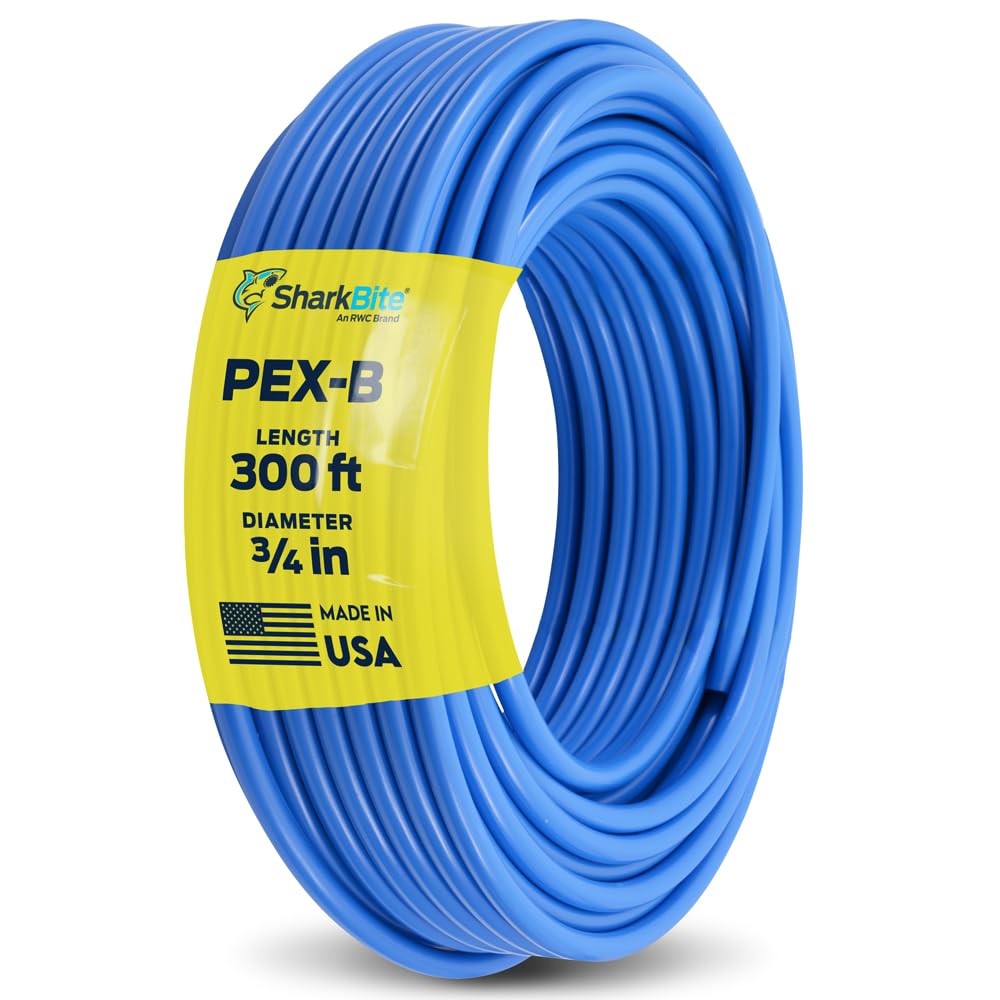
Three hundred feet of 3/4-inch line — enough to reach from the meter to the house.
Step up in both size and length here: 3/4-inch diameter and 300 feet, versus the 50-foot 1/2-inch top pick. The larger diameter moves more water at once, so it’s the right call for a main line where you don’t want pressure to sag when the shower and the washer run together. It carries the same familiar ratings as the rest of this SharkBite family — 160 psi max at 33°F–70°F, freeze tolerance through the pipe’s expansion-and-contraction behavior, and suitability for direct burial including under concrete. It carries a limited 25-year warranty, the longest in this guide.
Owners put this on main-line duty and the results line up. One described using it as a new main line coming in from the street to run a cabin, noting it was rated for direct burial and felt thick and well made. Another ran a fresh water line from the meter to a new house with length to spare. The quality of the pipe gets the most praise, and value-for-money runs a close second — it’s frequently cheaper than the local supply house and stocked online in a length the big-box stores don’t carry. The consistent caution is cold-weather installation: PEX stiffens in the cold, and bending it while it’s stiff risks kinks. Warm it up or wait for a mild day, and this run goes smoothly.
If you’re bridging a long distance underground, this is the size that does it in one pull rather than splicing two shorter coils. It works with PEX expansion (F1960), push-to-connect (ASSE 1061), plastic barb (ASTM F2159), and brass barb (ASTM F1807) fittings, and it’s compliant with ASTM F2023 for oxidative tolerance — ready for both potable supply and long buried runs.
The Case for It
- 300 feet in one coil covers a full meter-to-house run
- 3/4-inch diameter feeds whole branches without pressure drop
- Rated for direct burial including under concrete
- Limited 25-year warranty, the longest in this guide
- Compatible with expansion, push-to-connect, plastic barb, and brass barb fittings
Before You Dig
- Cold weather stiffens the pipe and raises kink risk — install warm
- A 300-foot roll is heavy and awkward to unroll solo; grab a second set of hands
- Kinked sections must be cut out, so measure and lay the route first
Ideal when: you’re running a buried main line from meter or street and want it done in one continuous, splice-free length.
More than you need if: your run is short — a smaller 50-foot coil handles a single branch without the bulk.
Understanding the Specs
Maximum Pressure (psi)
PSI stands for pounds per square inch — the amount of water pressure a pipe can hold without failing. A 160 psi rating covers normal household supply with headroom, while a 70 psi rating is standard for pool and spa circulation, which runs at lower pressure by design. Match the rating to your system: supply lines want 160 psi, pool plumbing is fine at 70. All the PEX coils here list 160 psi as their maximum at 33°F to 70°F.
PEX-A vs PEX-B
Both are cross-linked polyethylene, and both bend to route around corners without elbows. PEX-A is the more pliable grade and has stronger “elastic memory” — it expands to accept a fitting, then springs back to lock it tight, which is why it pairs with expansion connections. PEX-B is a bit stiffer and typically used with crimp or clamp fittings. If your bends are tight or you prefer expansion fittings, PEX-A is the one; if you’re crimping, PEX-B serves just as well.
Direct Burial
Some flexible coils are rated to go straight into the ground, including under concrete, with no conduit needed. That rating comes from the pipe’s material and wall thickness. On the coils here, the PEX lines carry it; always confirm it on your specific size before you trench, since not every flexible pipe is approved for burial.
Fitting Compatibility
Flexible pipe only works with the fittings it’s rated for. The PEX coils here accept expansion (F1960), push-to-connect (ASSE 1061), plastic barb (ASTM F2159), and brass barb (ASTM F1807) connections. The John Guest line uses OD tubing connectors, and the pool hose uses PVC Schedule 40 solvent fittings. Order fittings that match the pipe’s listed standards so the joint seals.
FAQ
Can PEX pipe really bend around a corner without fittings?
Is PEX-A better than PEX-B for plumbing?
Can bendable plumbing pipe be buried underground?
Does PEX pipe burst when the water inside it freezes?
What size PEX do I need for a main water line?
How long does flexible plumbing pipe last?
Can I use PEX for both hot and cold water?
Do I need special tools to install bendable PEX pipe?
Can I connect flexible PEX pipe to existing copper or brass pipe?
What’s the difference between a flexible sink drain pipe and flexible water supply pipe?
Final Thoughts: The Verdict
For most household jobs, the bendable plumbing pipe winner is the SharkBite 1/2 Inch x 50 Feet Blue PEX-B because it bends around corners without elbows, holds 160 psi, and comes in a length that covers a bathroom or a spigot run in one continuous piece. If you’re replumbing a whole house or routing through tight framing, reach for the SharkBite 1/2 Inch x 100 Feet Blue PEX-A for its softer bend and longer run. And when you need to move serious water underground, the SharkBite 3/4 Inch x 300 Feet Blue PEX-B carries a 3/4-inch main line the full distance from meter to house in a single coil. Match the material and pressure rating to the job, and any of these nine will outlast the rigid pipe they replace.
How We Picked
We do not accept paid placement. Every pick is matched to a real buyer and a real use-case; we do not hands-on test units.
Sources & Methodology
Specifications: manufacturer listings and product documentation. Review insights: verified customer reviews, as of September 2026. Pricing: not shown on this page (it changes often); check the current price via the retailer link.
As an Amazon Associate, KitchPrep earns from qualifying purchases. This does not affect which products we feature.
Related Guides
