
Specs are compiled from manufacturer listings and verified buyer reviews and can change over time — please confirm the key details on the product page before buying.
If your basement smells like a wet basement, the fix almost never starts with a dehumidifier — it starts under the floor. A basement sealing membrane is the thick plastic sheet or liquid coating that blocks ground moisture from ever reaching the concrete, and getting the thickness and coverage wrong is why so many people re-do the job twice. The picks below are sorted by what actually holds up: mil thickness, roll coverage, and whether the material resists puncture once you crawl across it.
I’m Mohammad Maruf — the founder and writer behind KitchPrep. This guide is built by comparing the manufacturers’ published specifications and the patterns across verified customer reviews, so you get each pick’s real strengths and trade-offs instead of marketing spin.
Below you’ll find nine membranes — sheet rolls, dimple matting, and liquid coatings — ranked so the durable ones come first and the cheap ones come last. Every pick is matched to a job: full encapsulation, drainage under a slab, or a single patch over a damp corner. The trick to a dry basement is matching roll width and mil thickness to your actual square footage, and the best basement sealing membrane is simply the one that fits your space without a dozen seams.
Our Picks at a Glance
How To Choose The Best Basement Sealing Membrane
Three numbers decide whether a membrane job lasts: the mil thickness (how thick the plastic is, measured in thousandths of an inch), the roll size in feet, and the material type. Get those wrong and you will be back under the house taping seams in a year.
Match the roll to your square footage before anything else
Walk your basement with a tape measure and write down length times width. A 10-foot by 100-foot roll lays down 1,000 square feet in one piece, so a 900-square-foot crawl space needs almost no seams. A 12-foot wide roll cuts seams even further. Fewer seams means fewer places moisture can sneak through the tape.
Thickness is your puncture insurance
You will be kneeling, dragging, and sliding material across gravel and rocks. A 6 mil sheet tears if you look at it wrong; 16 mil and 14 mil films shrug off rocks and even a dragged piece of lumber. If your floor is rough, thick film plus a dimple mat underneath is the combination that survives.
Sheet versus liquid — they solve different problems
A sheet membrane covers open ground and floors. A liquid membrane like a damp-proof coating paints onto concrete where no roll fits — under a floor covering, around a drain, or over a slab. Some jobs use both: sheet on the ground, liquid brushed at the penetrations.
Quick Comparison
| Model | Best For | Thickness | Roll Size | Coverage | Amazon |
|---|---|---|---|---|---|
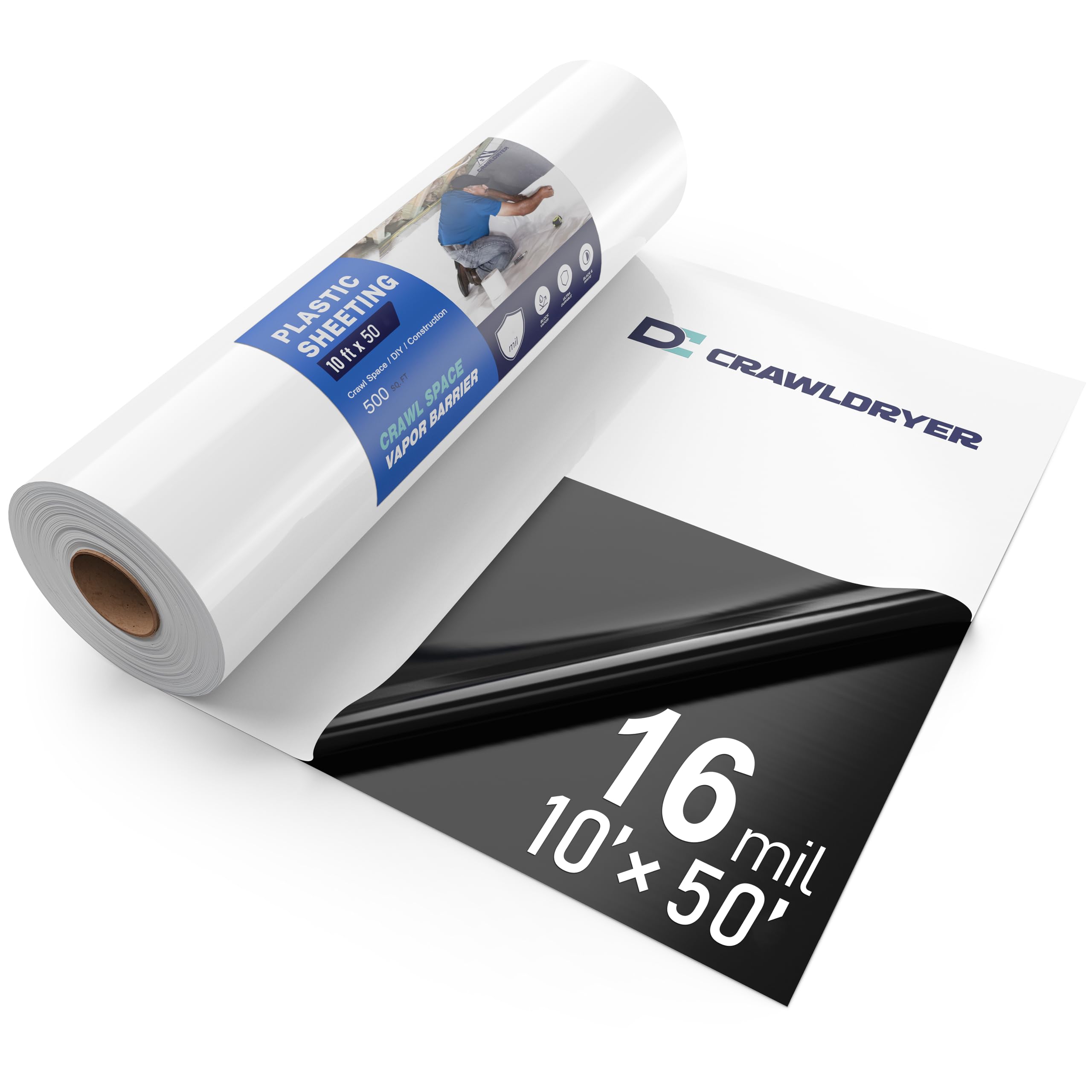
| Crawldryer 16 Mil 10′ x 50′★ Best Overall | Full encapsulation with double-sided film | 16 mil | 10′ x 50′ | 500 sq.ft. | Amazon |
| Whitecap Dimple Drainage MattingDrainage Layer | Drainage layer under a vapor barrier | HDPE dimple mat | 2′ x 50′ | — | Amazon |
| Meticuloso Waterproof MembraneBig Roll Value | Shower pans and wet-room floors | 23.6 mil (0.6mm) | 3.77′ x 98.5′ | 371 sq.ft. | Amazon |
| Durock Liquid Waterproofing Membrane | Painting around drains and corners | 0.38 perms at 20 mil dry | 1 gallon (2 pack) | — | Amazon |
| Purteria 10 Mil 10′ x 100′ | Big-area coverage on a moderate budget | 10 mil | 10′ x 100′ | 1,000 sq.ft. | Amazon |
| PureSpace Armor 14 Mil 10′ x 100′ | Thick film with a bright white finish | 14 mil | 10′ x 100′ | 1,000 sq.ft. | Amazon |
| Sika SikaBond Rapid DPM | Sealing subfloors before a wood floor | Liquid, 45-min dry | 5 litre bottle | — | Amazon |
| Spirecover 14 Mil 10′ x 100′ | All-new polyethylene on a wide floor | 14 mil | 10′ x 100′ | 1,000 sq.ft. | Amazon |
| Whitecap Woven 12 Mil 12′ x 100′ | Wide rolls that resist punctures | 12 mil woven | 12′ x 100′ | 1,200 sq.ft. | Amazon |
In‑Depth Reviews
1. Crawldryer Crawl Space Vapor Barrier 16 Mil 10′ x 50′
Our pick — over 4.5★ from 400+ verified ratings; the strongest balance of quality and price.
The double-sided 16 mil film that comes back from a crawl space without a single tear.
At 16 mil thick, this sheet is the heaviest plastic on the list — roughly the same stiffness as a stiff laminated menu. That thickness is the whole point: you drag it across rock, kneel on it for two hours, and it still holds. It unrolls at 10 feet wide and 50 feet long, covering 500 square feet of ground in one continuous piece, so a small to mid-size crawl space needs almost no taped seams. Coverage is where it separates from the biggest roll here: the Purteria brings 1,000 square feet to this roll’s 500, and the Whitecap woven roll spreads 1,200 square feet, so if your footprint runs past 500 square feet you would need two of these.
The black-and-white build is the detail most people overlook. The black face goes down and blocks light, which discourages growth and keeps the space dark the way encapsulation is supposed to be. The white face offers over 90% reflectivity (it bounces light back into the room), so a basement or crawl space with one bulb suddenly reads as bright instead of a pit. The film is rated waterproof and made from low-density polyethylene, the flexible grade that bends around pipes and corners instead of cracking. Owners who dragged lumber and drywall across it during a remodel report no tears afterward.
Here is the honest catch, and it comes up in a small share of the 405 ratings: the film is stiff, not floppy like the thin painter’s plastic people are used to. It ships folded, and because of the fold orientation you may end up with the black side facing up when you lay it out, which means re-folding the whole sheet before you climb into a cramped space. Thickness that saves the sheet also fights you on the install. Budget an extra person for the folding job if your access hatch is tight.
Where it earns its keep
- 16 mil thickness shrugs off rocks, lumber, and foot traffic during install
- Black side blocks light, white side reflects over 90% back for a brighter space
- 500 square feet in one piece means fewer taped seams to fail later
What to plan around
- Stiff film and folded shipping mean you may need to re-fold it before the crawl
- 500 sq.ft. falls well short of the 1,000-plus sq.ft. rolls if your footprint is large
Best for: anyone doing a full crawl space encapsulation who wants the toughest sheet available and does not mind a heavier handling day.
Look elsewhere if: your floor area runs past 500 square feet — you would be buying and seaming two rolls where a wide 1,200 square foot roll does it in one.
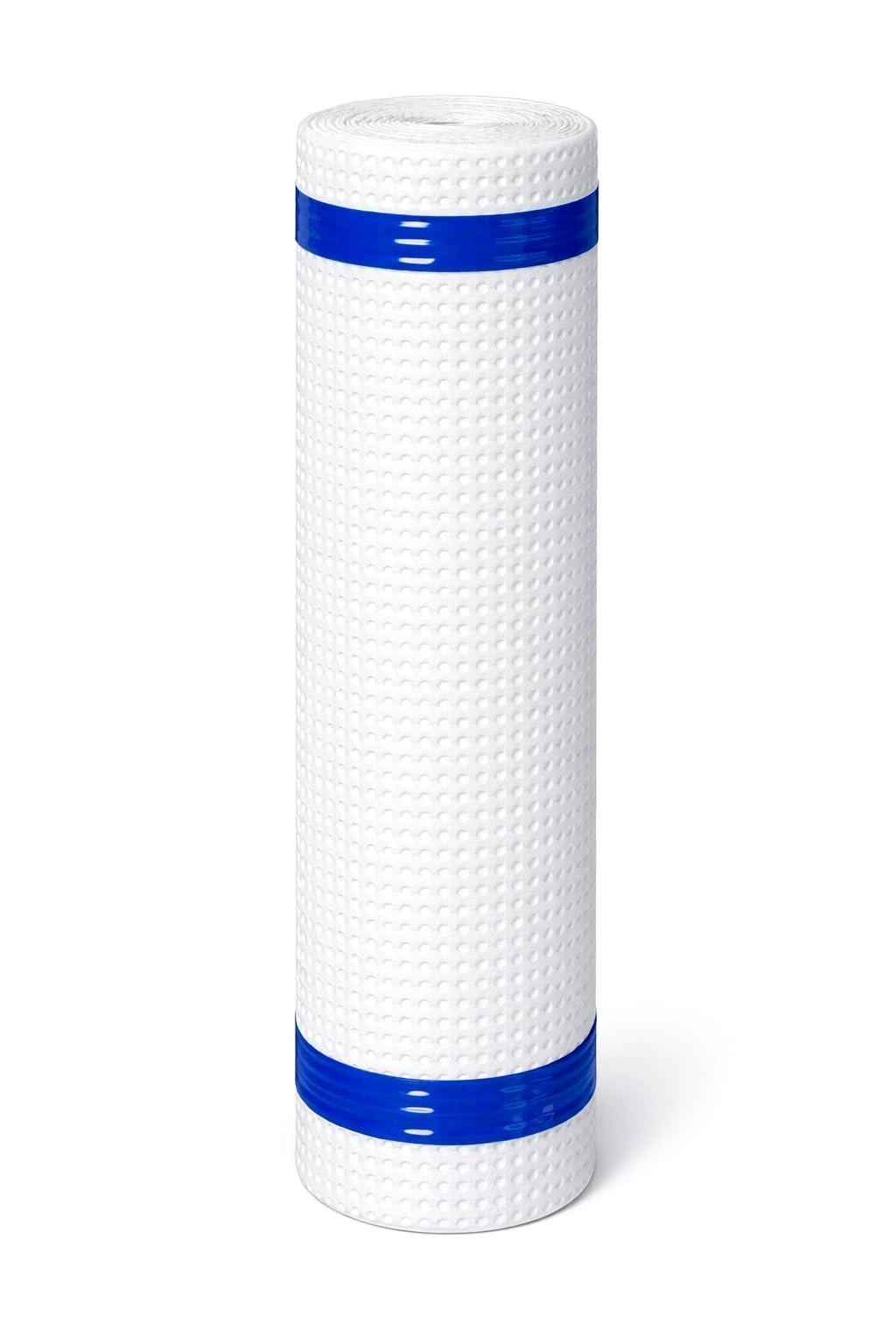
2. Whitecap Dimple Drainage Matting 2′ x 50′
Not a vapor barrier at all — it is the armor plate that keeps one alive.
Lay this under your vapor barrier and the plastic stops being the thing that fails first. The raised dimple surface (bumps molded into the sheet that hold it off the ground) creates a continuous air gap, and that gap channels water toward your drains or sump instead of letting it pool against the film. It is made from high-density polyethylene, the rigid plastic used in cutting boards, so it stays firm under load instead of sagging. At 2 feet wide by 50 feet long it is designed to run in strips, and at 11.32 pounds it is one of the easier rolls to haul through a hatch on your own.
Think of it as a two-for-one. It buffers your vapor barrier against concrete fragments and gravel so you do not get the puncture that ruins the whole encapsulation — owners crawling over rocky ground credit it directly for keeping their plastic intact. It also gives your knees something to kneel on, which sounds like a small thing until you have spent three hours under a house. Down the road, if a sump pump quits, the dimples still give water somewhere to travel instead of soaking into the dirt.
The trade-off is maneuverability. This is rigid stuff, and it does not bend much around tight corners or through a small hatch — plan your path in before you start dragging. It also is not a moisture barrier on its own; it is a platform and a drain, so pair it with a real film above it. Some buyers also find it runs dearer per square foot than plain plastic sheeting, which is fair, because you are buying puncture insurance, not coverage.
Why the extra layer pays: the thing buyers praise most here is simple confidence — the matting takes the abuse so the barrier above it survives, and humidity that would not budge with plastic alone starts dropping once the air gap is in place.
Where it strains: rigid HDPE and a 2-foot strip width mean more cutting and fitting around pipes, sump pits, and hatch openings than a single wide sheet would take.
Reach for this if your floor is rocky, uneven, or you have been through one punctured barrier already.
Pass on it if you just want cheap ground cover — this is the supporting actor, not the star, and it needs a film above it to do its job.
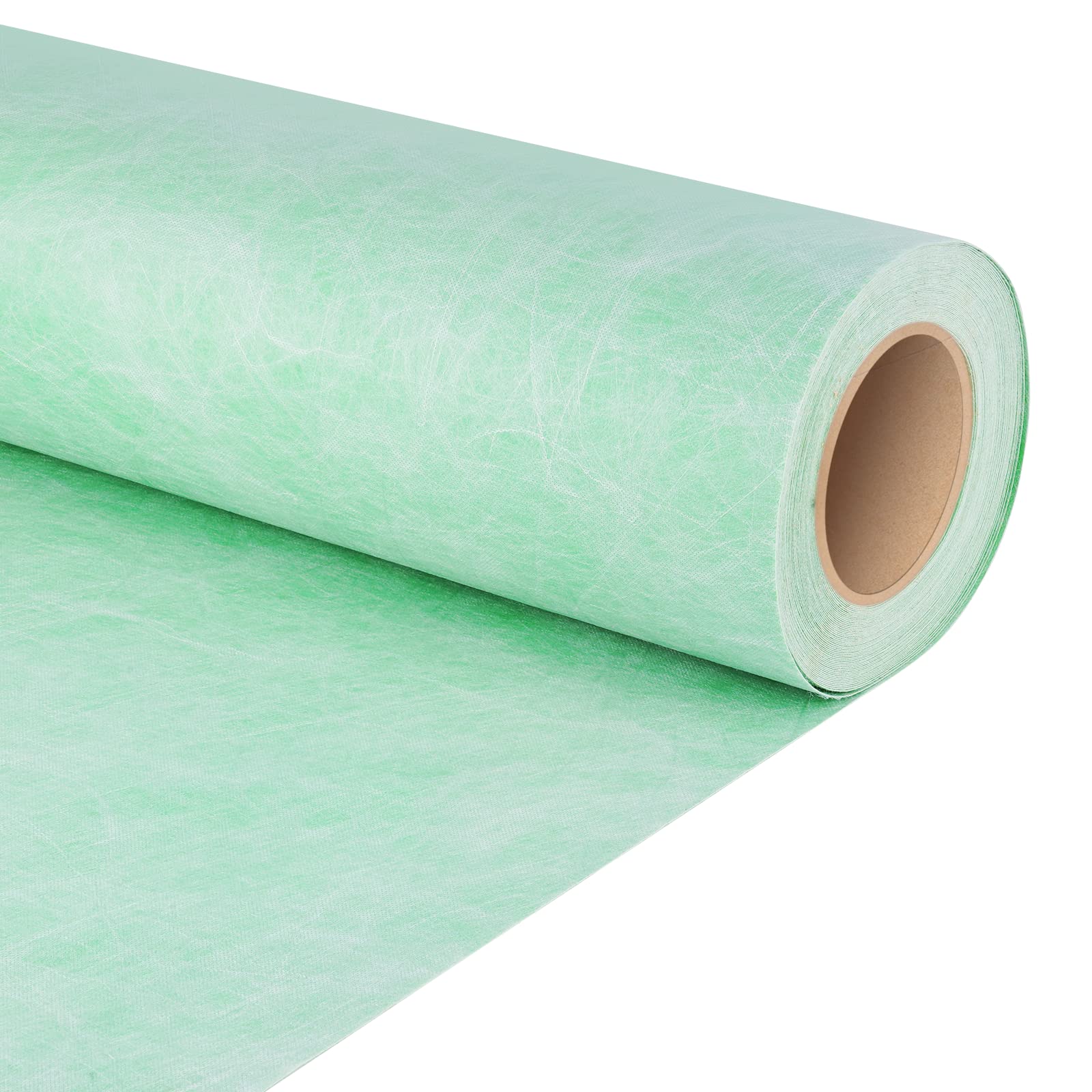
3. Meticuloso 3.77ft x 98ft Waterproof Membrane 371 sqft
The roll that trades width for length — 98.5 feet of reach in a skinny strip.
This is the longest roll on the list at 98.5 feet, roughly twice the 50 feet you get from the Crawldryer and the Whitecap dimple mat. That length is the reason it lands here: you can run a shower pan, a bathroom floor, and a patch by the basement stairs off one roll without splicing. It comes in at 371 square feet of coverage and 30.4 pounds, so it is the heaviest of the three roll-type picks by a wide margin — the Whitecap dimple mat weighs 11.32 pounds against this one’s 30.4, and you will feel that difference hauling it up a ladder.
The thickness figure is where this one surprises people. At 23.6 mil — or 0.6 mm — it is thicker than most of the plastic sheeting picks on this list, and the maker leans on that for its crack-bridging and tear resistance. The material is polypropylene, a tougher, less stretchy plastic than the polyethylene used in the standard vapor barriers.
What you give up is width. This roll measures 3.77 feet across, so covering a wide basement floor means laying multiple strips and taping the seams — the one drawback to a narrow roll. There is also a real install note worth heeding: the adhesion instructions have generated confusion about which mortar and which substrate the membrane needs, and one reviewer noted no response when they went looking for help. Do your homework on mortar type and set it over cement board rather than wood or sheetrock, and this one behaves. Skip that step and you may be re-doing it.
The value read: owners keep coming back to how far the roll stretches and how much it saves against the big-name shower membranes.
Fit note: a 3.77-foot width is the trade — this is a seam-taping roll, not a one-piece cover.
Suits you if you are covering a long, narrow footprint or multiple wet rooms and want the longest single run on this list.
Think twice if you need a wide sheet for a full basement floor — you would be taping seams all day where a 10- or 12-foot roll lays down in one pass.
4. Durock Liquid Waterproofing Membrane 1 Gallon (2 Pack)

Paint-on waterproofing for the corners, drains, and cracks no roll will ever fit.
Everything else on this list is a sheet. This one is a liquid you roll, brush, or trowel on, and it cures into a smooth skin that covers where membranes hate to go: around PVC and ABS drains, up walls, into corners. It is an acrylic polymer that bonds directly to stainless steel, PVC, and ABS drains, and it floats over concrete, masonry, and cement backerboard. The spread rate matters for planning — one coat on smooth vertical surfaces like Fiberock backerboard, two coats on rough ones like cement board and on every horizontal surface.
The technical headline is its low permeance rating of 0.38 perms at 20 mil dry thickness per ASTM E96 Procedure E. In plain words, that means almost no moisture vapor passes through once it dries, which lets it serve as a vapor retarder without an added film on the job. It also carries anti-fracture protection up to 1/8 in. (3 mm) over shrinkage and other non-structural cracks, and the maker states it works in continuous-use residential and commercial steam showers without additional vapor retarder. For a basement corner with a hairline crack, that bridging ability is the whole reason to own a liquid.
Two things to know before you pour it out. First, this is a two-gallon set — you cannot buy just one, and more than one buyer found a single gallon enough for a 3x4x8 shower at two coats. Second, it is messy and thin. It runs loose enough that rolling it carefully is the only way to keep it off the walls, and the coverage math caught at least one person short. Also worth saying plainly: this is a tile-and-wet-area product. It is not the wide-area ground cover you would buy for a whole crawl space — that is a sheet job.
Where it wins: one coat over a smooth vertical surface and it is ready for tile — the smooth bond over drains is something a roll simply cannot match.
Known friction: it goes on thin and messy, and the two-pack forces you to buy more than a single shower typically needs.
Pick this up if you are sealing a shower, a steam room, or a crack where a flat sheet cannot reach.
skip it if your goal is covering open basement floor — this is a detail product, and it is the wrong tool for square footage.
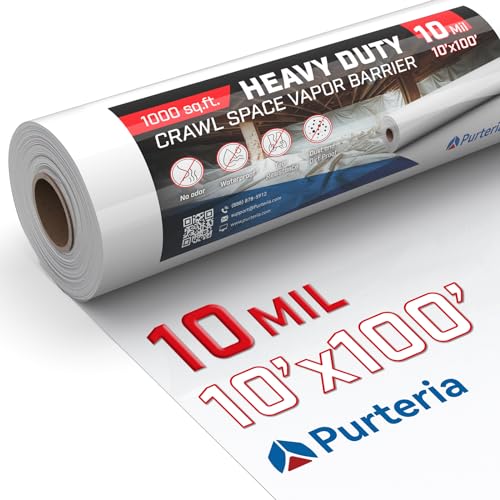
5. Purteria White Crawl Space Vapor Barrier 10mil 10′ x 100′
A thousand square feet of bright white film for the price of a single contractor visit.
If you are covering a whole basement floor in one pass, this is the roll that makes it possible. Ten feet wide by 100 feet long fully deploys to 1,000 square feet — double the Crawldryer’s 500 — so a typical crawl space goes down in one piece instead of three. The film is a true 10 mil polyethylene, meaning it is thinner than the 14 and 16 mil options here, but it is made from new material rather than recycled plastic, which is what you want on something that has to stay watertight for years. At 43.6 pounds you will want a second set of hands to get it through the hatch.
Thickness is the spec buyers check most here, and a lot of the reviews come back to how much thicker it feels in hand than the price suggests. But the white color is the sleeper feature — one roll turns a coal-black crawl space into something you can actually see in, and brightening the space is the sort of change owners notice the moment they flip the light on. The smooth surface wipes clean easily, and buyers report it unrolls without fighting them or cracking at the fold lines.
Where it separates from the Whitecap woven roll above is raw toughness. This is a flat 10 mil film, and the Whitecap is a 12 mil woven sheet that interlaced threads make harder to puncture — if your floor is littered with broken concrete or the job involves foot traffic and tools, the woven layer earns its price. On a smooth or lightly graveled floor, this one covers more ground for less. Match the film to the surface, not the other way around.
Reasons it tops the value column
- 1,000 square feet per roll means a full-floor cover with no seams to tape
- True 10 mil from fresh material, not recycled resin, and rated waterproof
- White finish makes a dark crawl space bright enough to inspect
Worth knowing before you buy
- 10 mil is thinner than the 14 mil and 16 mil films, so it is not the puncture champion
- 43.6 pounds on a single roll is a two-person lift through a tight opening
The budget pick that covers the most ground: it is the roll to take when square footage is the deciding number.
Reserve it for smooth floors: if your ground is rough or you will be moving gear across the barrier, step up to a thicker 14 mil sheet.
6. PureSpace Armor Crawl Space Vapor Barrier 14 Mil 10′ x 100′
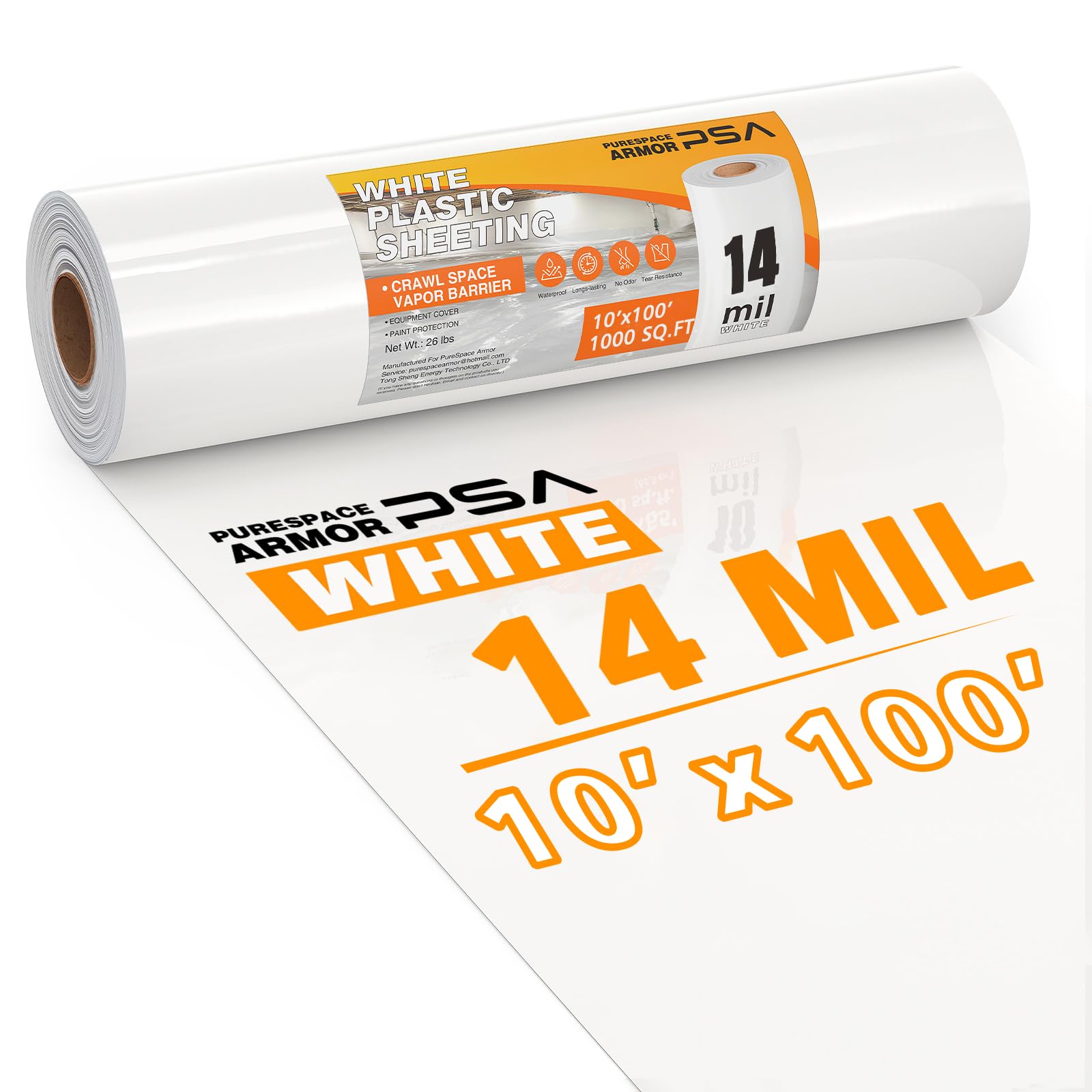
The heavyweight white film that adds thickness without giving up a thousand square feet.
This is the middle ground between coverage and toughness, and it is a smart middle. You get the 10-foot by 100-foot footprint that lays down 1,000 square feet in a single unbroken sheet — the same reach as the budget Purteria — but the film is 14 mil instead of 10, so it takes more abuse at the seams and edges where you tape. That combination is uncommon: several 14 mil films come in shorter rolls, so this one trades up in thickness without shrinking your coverage.
The material quality is the point owners keep returning to, and the 65.4-pound roll weight tells you why — there is real mass here, and the film resists tearing at the folds during install. It is rated for concrete vapor barrier and general moisture barrier duty, and its white color makes the space read cleaner after the job. Several buyers reused it to cover windows during a renovation, where the sheet blocked UV light on stored items.
The catch is brittleness in transit. A small share of owners, including one running it for passive radon reduction, received a sheet with a pinhole on a fold-line corner — easily sealed with tape, but worth a full walk-around inspection before installation begins. The film also arrives opaque white rather than clear, which bothered buyers using it to make car-door moisture barriers who wanted to see through it. Neither is a deal-breaker on a floor job, and the 4.5 rating across 282 buyers reflects that most people come away enthusiastic.
The encapsulation read: a 14 mil sheet over 1,000 square feet hits the balance — thick enough to survive rough ground, wide enough to avoid a stack of seams.
Inspect on arrival: give it the once-over for tiny fold-line holes before you commit it to a floor, and keep an eye on how it handles sharp corners long term.
This is yours if you want a 1,000 square foot roll with more heft than a budget film without paying for the woven upgrade.
Not for you if you need a see-through sheet — this runs opaque white, and clear film is a different product entirely.
7. Sika SikaBond Rapid DPM Liquid Damp Proof Membrane 5 Litre

The five-litre bottle that seals a subfloor in under an hour and adds zero floor height.
Floor height is the problem this solves. When you are laying a wood floor over a concrete slab and there is no room to lift the surface, a roll of plastic is out of the question. This is a ready-to-use liquid that goes on with a brush, roller, or squeegee and dries in roughly 45 minutes at 50% relative humidity and 20°C, so you can be laying flooring the same day. Because it cures into the concrete rather than sitting on top, you keep every millimeter of clearance you started with.
It is designed to sit under the maker’s own SikaBond wood floor adhesives and is compatible with all flexible SikaBond wood floor adhesives, which makes it the right call if your build is centered on a wood floor over a damp slab. It is also rated for use with underfloor heating, so a warm-floor setup does not rule it out. A five-litre bottle weighs 11 pounds and handles a normal renovation footprint — one owner used three coats to stop water migrating through a concrete slab in a new office, which is the kind of job this product is built for.
Two practical notes before you price it in. It goes on thin and cures hard on your tools, so plan for a fresh roller or brush per coat rather than trying to wash and reuse, and store the roller in a sealed bag between coats if you are applying more than one. The container lid has drawn complaints — the closure can gum shut once the product is opened, so transferring the rest to your own airtight five-litre container is a sensible move on a multi-coat job.
What it does well: it upgrades a damp slab into a floor-ready surface fast, and it is the only pick here that leaves your existing floor height completely alone.
What to budget for: messy application, throwaway brushes, and a lid that fights you on the second coat — all fixable with a little prep.
Best for: refurbishment projects over old concrete or leftover adhesive residue where a sheet cannot fit and adding floor thickness is not an option.
Think twice if: the open basement is your job site — that is a sheet-membrane task, and this liquid is the detail sealer, not the main cover.
8. Spirecover 14 Mil White Plastic Sheeting 10′ x 100′
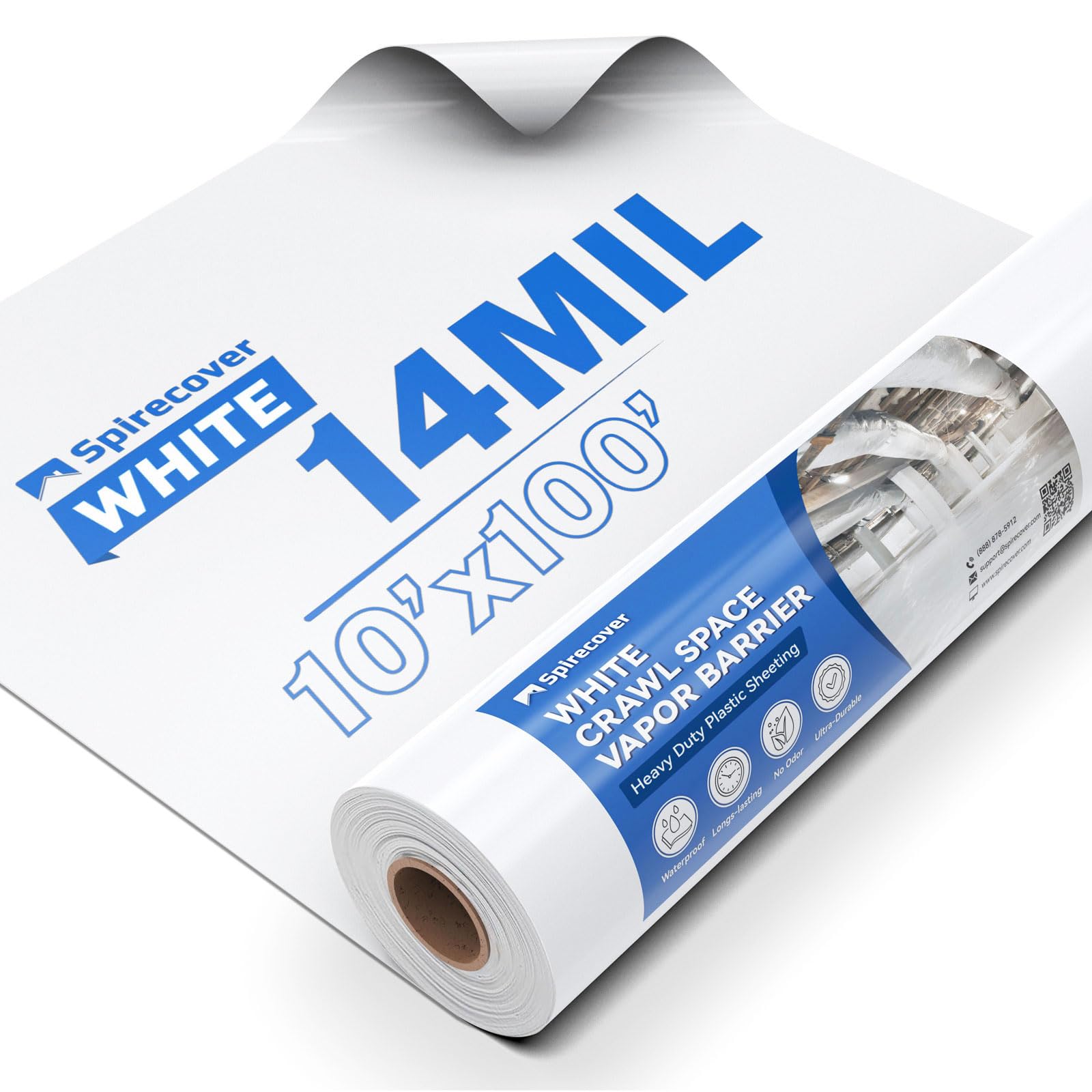
14 mil film made from all-new resin, rolled into a full thousand-square-foot cover.
What separates this from the other 14 mil rolls here is the material sourcing — it is a true 14 mil polyethylene film with no recycled content, which matters on a barrier that has to stay sealed for years. The roll measures 10 feet by 100 feet and covers 1,000 square feet, matching the PureSpace on coverage while weighing in at 61.3 pounds. If the other 14 mil sheet is the pick for someone who wants proven mass, this is the one for a buyer who cares that the film is built from fresh stock.
Durability holds up in the tough spots. The maker rates it odorless and reusable, and one buyer ran a 10×20 piece across a garage door opening for five months of wind without a pinhole. It blocks steam, is designed to reduce radon gas in the soil, and its white finish keeps the space bright. On the ground, the film cuts and rolls out cleanly enough that install frustration stays low.
The one measured quirk: at least one buyer found the actual width ran a shade under the stated 10 feet, which forced re-measuring on a job planned as four pieces at 10 by 14. It is a small discrepancy, but on a job where every inch of a piece matters, plan your cuts with a little slack. Depth and coverage are otherwise exactly what the label promises, and the roll arrives in carton packaging that protects it in transit.
The case for the fresh resin
- 14 mil polyethylene from entirely new material, no recycled resin blended in
- 1,000 square feet covered in one roll with no seams to tape
- Survived five months of wind exposure on a garage opening in one owner’s use
Measure twice before cutting
- The stated 10-foot width can run slightly narrow on arrival
- At 61.3 pounds it is a heavy solo lift through a hatch
Worth it for: a full-floor encapsulation where you want 14 mil thickness and a single-piece cover from brand-new resin.
Consider stepping up if: your ground is packed with rubble — the woven Whitecap roll fights punctures better than any flat polyethylene film here.
9. Whitecap Woven Vapor Barrier 12 Mil 12′ x 100′
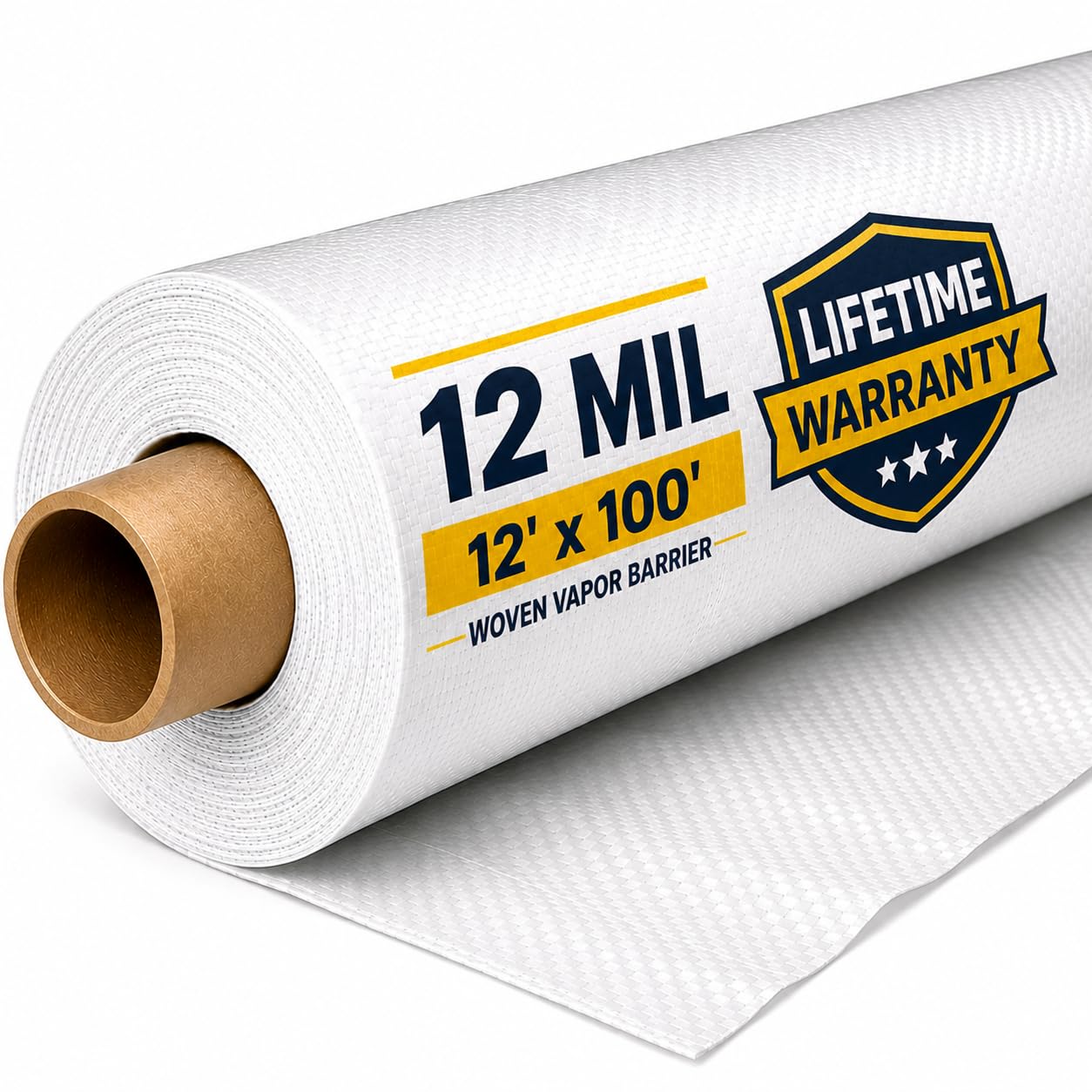
The widest roll here, and the only one with woven strands holding it together.
Woven polyethylene is a different animal from the flat plastic film the rest of this list is made of. The material is interlaced, so a tear does not run — the weave stops it the way the threads in a tarp do. That is why this is the sheet to buy when concrete fragments or a dragged tool would ruin a smooth film. It is a 12 mil construction, thinner on paper than the 14 and 16 mil films, yet it resists punctures better than standard plastic sheeting because the structure fights back at the point of impact.
Size is the other headline. At 12 feet by 100 feet, the roll covers up to 1,200 square feet — the most of any pick here, and the widest coverage means fewer seams and faster installs on a wide basement floor. The white surface is bright and helps you spot debris, moisture, or maintenance needs in a dark space. The maker lists a lifetime warranty and rates it for crawl space liner, basement moisture barrier, ground cover, and drop cloth duty.
Owners who have upgraded from plain film to this woven sheet keep making the same point: the difference shows up over time, not on day one. One has even gone all the way to a heavier woven 20 mil roll and calls the woven structure the reason. That said, at 70 pounds this is the heaviest roll on the page — plan for two people and a clear path. And 12 mil flat film will not beat 16 mil for pure thickness, so if puncture resistance is not your problem, you are paying for structure you may not need.
The standout: the widest roll here at 12 feet by 100 feet, which means a single pass covers more floor than anything else on this list.
Where it costs you: 70 pounds through a tight hatch is a genuine two-person job, and the woven premium is real next to flat films of similar number.
Choose this when your floor is rough, your access is wide, and you want one roll to finish the job — the 1,200 square foot coverage and woven tear resistance are built for exactly that.
Only reconsider if you are working solo through a small opening or your floor is smooth enough that plain film would do the same work for less.
Understanding the Specs
Mil Thickness, Explained Simply
A “mil” is one thousandth of an inch — so a 10 mil film is about the thickness of a few sheets of paper, and 16 mil is nearly twice that. It is the number that decides whether your membrane survives the install. Thin plastic tears on rock and along folds; thick film handles foot traffic and dragged lumber. Higher mil is almost always the tougher choice, but it also means a heavier, stiffer roll that fights you inside a cramped space.
Dimple Matting vs. Vapor Barrier
These two layers do different jobs and often go down together. The vapor barrier is the flat sheet that stops moisture vapor rising through the ground. The dimple mat is a rigid plastic with molded bumps that sits underneath it, holding the film off the soil and giving water somewhere to flow toward a drain or sump. Pair them and the barrier stops getting punctured; use the mat alone and you have drainage but no vapor seal.
FAQ
How thick should a basement sealing membrane be?
Do I need a dimple mat if I already have a vapor barrier?
Can I use shower membrane in a basement?
Is liquid membrane better than plastic sheeting?
How many square feet does one roll cover?
What is the difference between 10 mil and 14 mil vapor barrier?
Will a 12 foot wide vapor barrier fit through a crawl space hatch?
How do I stop a vapor barrier from getting punctured?
Does a vapor barrier help with radon in a basement?
How long does a crawl space vapor barrier last?
Final Thoughts: The Verdict
For most people sealing a basement or crawl space, the basement sealing membrane to buy is the Crawldryer 16 Mil because its thickness handles the rough ground and foot traffic that ruins thinner sheets. If you want the widest coverage in the fewest seams, the Whitecap Woven 12 Mil lays down up to 1,200 square feet in one roll. And if you need a liquid that fits around a drain or leaves floor height untouched, the Sika SikaBond Rapid DPM is the one to reach for. Whatever you choose, match the roll size to your measured floor area before you order — that single step prevents the seam-heavy install that causes most membrane failures.
How We Picked
We do not accept paid placement. Every pick is matched to a real buyer and a real use-case; we do not hands-on test units.
Sources & Methodology
Specifications: manufacturer listings and product documentation. Review insights: verified customer reviews, as of September 2026. Pricing: not shown on this page (it changes often); check the current price via the retailer link.
As an Amazon Associate, KitchPrep earns from qualifying purchases. This does not affect which products we feature.
Related Guides
