
Specs are compiled from manufacturer listings and verified buyer reviews and can change over time — please confirm the key details on the product page before buying.
You already picked your tile. Now pick the layer underneath it, because that hidden sheet is what decides whether your grout lines stay straight for years or start snapping within months. The job of every good backing board for tiling is to sit between your subfloor and your tile and absorb the tiny movements that would otherwise crack the tile above. Get it right and your floor absorbs seasonal expansion; get it wrong and you are re-tiling the same room.
I’m Mohammad Maruf — the founder and writer behind KitchPrep. This guide is built by comparing the manufacturers’ published specifications and the patterns across verified customer reviews, so you get each pick’s real strengths and trade-offs instead of marketing spin.
Below are the three uncoupling membranes that tile setters and first-timers reach for again and again, sorted by what each one actually does best. This shortlist covers the best backing boards for tiling.
Our Picks at a Glance

How To Choose The Best Backing Boards for Tiling
The single most common mistake first-timers make is treating the mat under the tile as an afterthought. It is not. It is the reason your tile survives the first winter and the third summer, and it is the reason a hairline crack in your subfloor never reaches your grout.
Match the roll to your room size
Coverage is the first number to check. A small roll is fine for a powder room or a single shower wall, while a bigger roll covers a full kitchen floor or a whole basement without a seam. Measure your floor area before you buy, because running short halfway across the room forces a seam that is harder to get flat.
Thickness changes the feel underfoot
A thinner membrane adds less height to your finished floor, which matters if your tile has to meet a hallway, a doorway, or a cabinet toe-kick. A slightly thicker mat gives a bit more padding between tile and subfloor, which is why people favor it in high-traffic rooms and under heavy furniture.
Do not skip the wet areas
Bathrooms, showers, and laundry rooms are where the waterproofing layer earns its keep. A membrane with a moisture barrier keeps water from seeping through the tile into wood or gypsum underneath, which is exactly what turns a small leak into a rotten subfloor. Dry rooms like a basement can often get away with less, but wet rooms cannot.
Plan your thin-set before you unroll
Every one of these membranes bonds to a modified thin-set, and the trick that bites most people is haste. Cut your sections first, keep a full batch of mortar mixed, and do not leave a bare patch of membrane sitting while you wait for more thin-set. That pause is how unevenness creeps into an otherwise clean install.
Quick Comparison
| Model | Best For | Coverage | Thickness | Roll Weight | Amazon |
|---|---|---|---|---|---|
| Schluter Ditra Uncoupling and Waterproofing Membrane★ Best Overall | Whole-room and wet-area installs | — | 1/8″ (15.4 in listing) | 10.67 pounds | Amazon |
| Drydiet 108 Sqft Uncoupling Membrane for Tile 1/8”(3mm), Blue | Small bathrooms and showers | 108 Sqft | 1/8″ (3mm) | 16.17 pounds | Amazon |
| Uncoupling Membrane, Tile Underlayment, Floor, 3.3′ x 98.5′ / 323 Sq Ft | Large floors on a tighter budget | 323 Sq Ft | 0.13 inches | 46.7 pounds | Amazon |
In‑Depth Reviews
1. Schluter Ditra Uncoupling and Waterproofing Membrane, 1/8″ Thickness
Our pick — over 4.5★ from 400+ verified ratings; the strongest balance of quality and price.
The membrane that stiffens your whole floor and handles wet-room duty.
This is the name the tile world keeps coming back to, and the reason is simple: it survives decades of jobs. It is a polyethylene uncoupling sheet, which means a plastic layer that separates your tile from whatever the subfloor is doing underneath it. That separation is what stops a crack in the concrete or plywood below from travelling straight up through your grout.
Your finished floor barely rises because this mat is only 1/8″ thick, so doorways and transitions stay simple. The roll weighs 10.67 pounds, light enough for one person to carry upstairs and unroll alone. Compare that to the Houseables roll at 46.7 pounds, and this is the easier lift by a wide margin, which matters if you are working solo in an upstairs bathroom. One reviewer noted: “After installing I was amazed at how much stiffer the subfloor was. I read that the combination of the membrane and schluter cement is the equivalent of adding 5/8” additional subfloor reinforcement. Just read the directions and install per guidelines.”
What wins people over most is build quality — it is the aspect owners single out more than any other, and it shows in how flat the mat holds and how well it grips thin-set. It also handles a spread of surfaces, from concrete and plywood to OSB and gypsum, and it plays nicely over heated floors. It carries a 10-year limited warranty against manufacturing defects when installed to the manufacturer’s handbook.
Where it earns its keep
- Polyethylene barrier keeps moisture away from plywood and OSB subfloors
- Barely any added height — 1/8″ and only 10.67 pounds to carry
- Works over concrete, plywood, OSB, gypsum, and heated floors
- Backed by a 10-year limited warranty against manufacturing defects
What to weigh first
- The most expensive pick here, and owners swing between calling it a great deal and pricey
- Flat, level subfloor prep is not optional — skip it and the install fights you
- Cut it into sections so you never run out of thin-set mid-run
Prep work is the catch. This membrane needs a level floor and punishes shortcuts. One owner ran out of thin-set mid-section and should have cut the mat into two pieces instead of continuing after the delay, which left a slight unevenness they had to fix during tiling. It also sits at the premium end of this group, so if budget is your gate, the options below will pull their weight.
Built for: whole-room floors, wet areas, and anyone who wants one membrane that covers concrete, plywood, OSB, gypsum, and heated floors without second-guessing it.
Think twice if: you are patching a single small bathroom and would rather keep the spend down — a full roll of this is more coverage than a small job needs.
2. Drydiet 108 Sqft Uncoupling Membrane for Tile 1/8”(3mm), Blue
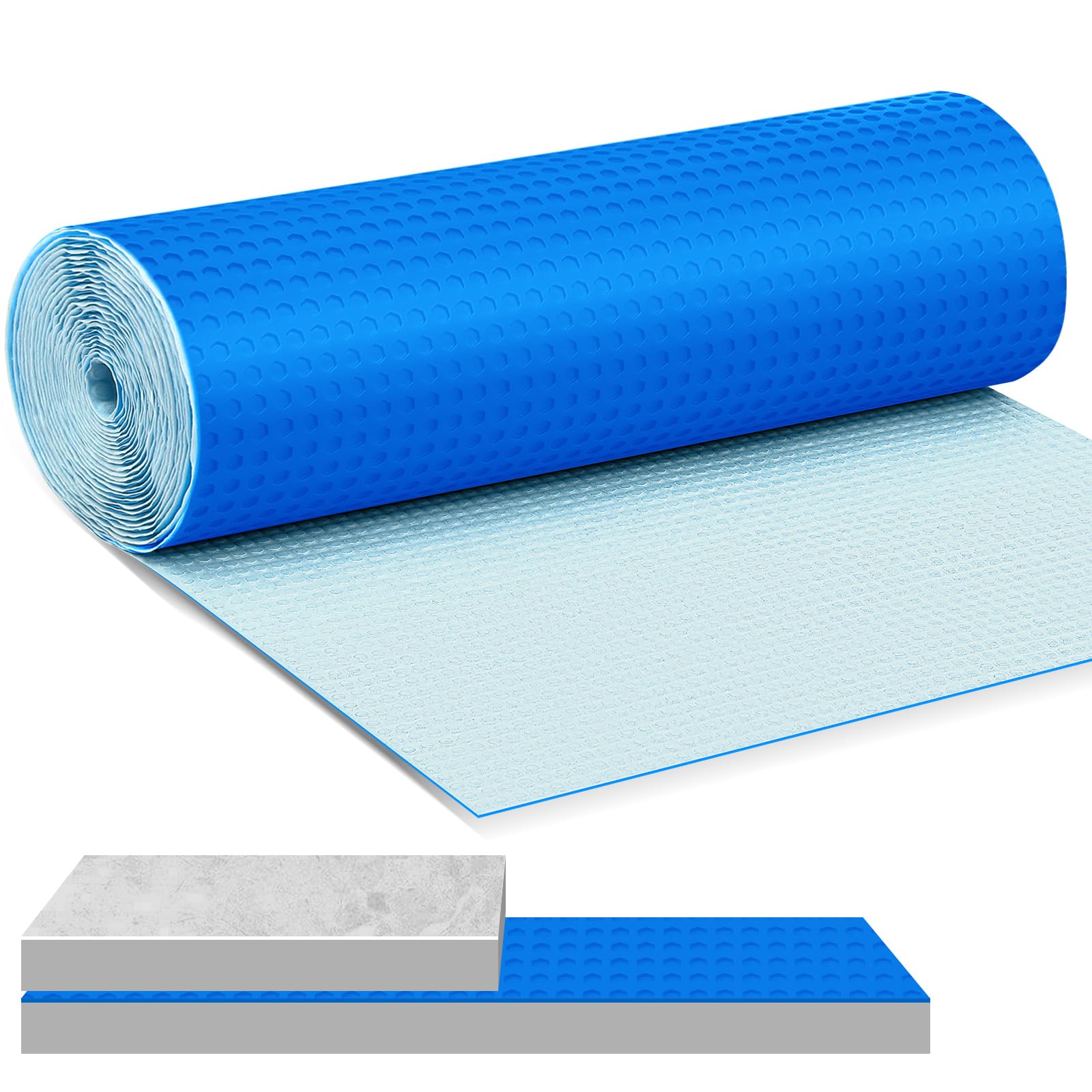
Cut-to-size blue mat sized for a first-time tiler’s bathroom.
Here is the pick for the bathroom you are doing yourself. The Drydiet roll covers 108 square feet at 1/8″ — the same 3mm you get from the Ditra up top — and it is light enough at 16.17 pounds to wrestle into place without help. Unlike the Houseables roll at 46.7 pounds, you will not need a second pair of hands to carry this one up the stairs.
A grid structure on the underside and a cotton anchoring layer are what hold the bond with modified thin-set, and the mat installs straight over a waterproof underlayment without waiting around for mortar to cure. Bathrooms, showers, kitchens, and basements are all fair game, and you can take it over plaster, drywall, or wood where those surfaces are the weak point. What buyers come back to most is the overall quality of the sheet itself — it is the top thing they bring up. Cutting is another quiet win; the mat slices clean with standard tools, so awkward shower niches do not turn into a fight.
The honest footnote is delivery. At least one buyer ran into a shipping delay on this roll and flagged it, though the membrane arrived and performed exactly as it should once it was in hand. The mat itself has not shown a pattern of problems — a buyer who had already used it wrote: “The product itself is excellent. We did not encounter any stiffness with this membrane. It installed as it should with no issues as far as quality.”
What makes it click: 108 square feet of 1/8″ waterproof membrane that cuts with standard tools and installs over modified thin-set without a curing wait — sized for a bathroom or shower, not a whole-house floor.
The one job to plan around: if lead times matter for your project date, order this roll early — shipping speed is the single variable buyers have flagged, not the mat.
Pick it when: you are tiling one bathroom, a shower, or a small kitchen and want a 1/8″ waterproof mat that keeps the spend sensible.
Skip the trade-off by: measuring your square footage first — a 108-square-foot roll is generous for one room and short for a whole open floor plan, in which case the bigger rolls above and below fit better.
3. Uncoupling Membrane, Tile Underlayment, Floor, 3.3′ x 98.5′ / 323 Sq Ft
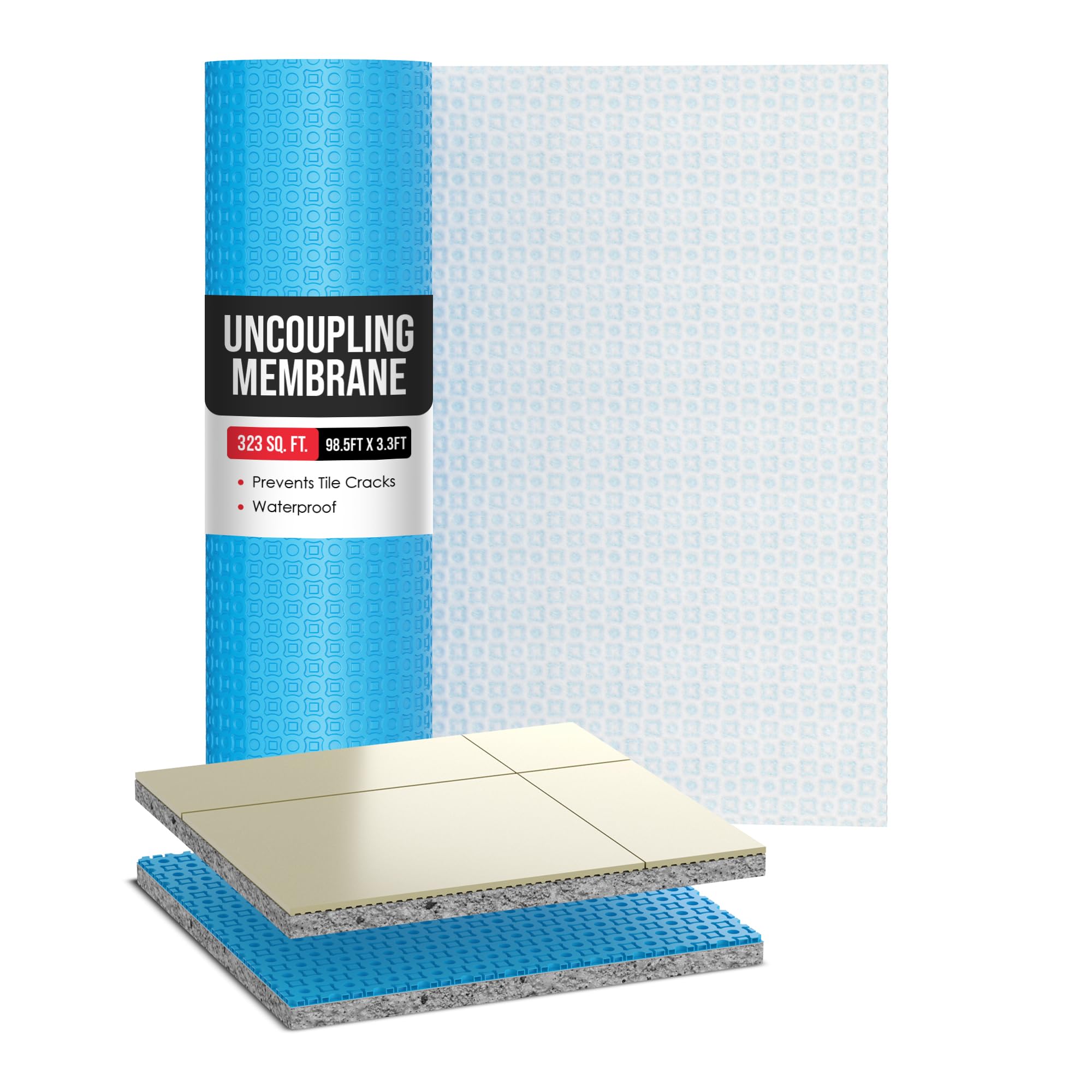
323 square feet on a roll — enough mat to finish a whole basement in one pass.
For a big room, this roll ends the shopping trip. It measures 3.3 feet by 98.5 feet for 323 square feet of coverage, roughly three times what the Drydiet roll gives you and the largest span in this group. At 0.13 inches thick it barely lifts your finished floor, so doorway transitions stay easy to work out. The mat is built from polyethylene and polypropylene — two plastics that keep water away from the wood or concrete below.
The install itself is the same simple rhythm every uncoupling mat uses: comb thin-set onto the subfloor, press the membrane into it, then tile right on top. First-timers report it going down without drama, with a tone that surprised even them — “10/10. First time tile installer. This stuff was SUPER easy to work with. Very impressed after doing a lot of research. Not sure how it compares to the big orange brand, but I don’t know how anything could be easier than this stuff. Very impressed.” That ease of use and reliable function are the two things owners bring up most about this roll.
Here is where honesty helps you buy right. This is a 46.7-pound roll, so it is the heaviest of the three and you will want a hand getting it inside. Owners also report some rigidity while working with it, plus a tendency for the edges to curl up before the thin-set locks it down. Treat the curl as a handling quirk to plan around rather than a deal-breaker: cut your sections, flatten them as you go, and roll the mat firmly into fresh mortar.
Why it wins on big floors
- 323 square feet from a single 3.3 ft x 98.5 ft roll — fewest seams on large floors
- 0.13 inches thin, so your finished floor height barely shifts
- Waterproof polyethylene and polypropylene keep moisture off wood and concrete
- Straightforward install that beginners report handling on their own
Plan around these
- 46.7 pounds — the heaviest roll here, and awkward for one person to carry
- Owners describe the mat as stiff and prone to curling at the edges before it is set
- Adhesion results draw a mixed response, so press it firmly into fresh thin-set
Reach for this if: you are covering a basement, an open-plan kitchen, or any floor where 323 square feet in one roll saves you stacking several smaller sheets together.
Look elsewhere if: you are tiling a single bathroom — a 323-square-foot roll is far more than one small room needs, and the lighter 108-square-foot Drydiet is the better-sized tool.
Understanding the Specs
Uncoupling and why it matters
An uncoupling membrane is a thin sheet that sits between your subfloor and your tile and lets the two move independently. Wood and concrete expand and contract with the weather, and tile does not — so without that layer, the movement below travels up and cracks the tile or the grout above. The membrane absorbs that motion instead, cushioning the floor and stopping cracks from cascading upward.
Waterproofing layer
A moisture barrier is the plastic sheet inside the membrane that keeps water from passing through your tile and grout into the subfloor underneath. In a shower, a bathroom, or a laundry room, that barrier is what stands between a small spill and a slow, hidden leak. In dry rooms like a basement, it is a bonus rather than the whole reason you bought the roll.
Roll thickness
Thickness decides how much height the membrane adds to your finished floor. A thinner mat like 0.13 inches keeps your tile close to its original level, which makes it easier to line up with a hallway or a doorway. A 1/8″ sheet gives a touch more cushioning between tile and subfloor, which people favor in busy rooms and under heavy furniture.
Coverage and roll weight
Square footage is the number that tells you whether one roll finishes the room. A 108-square-foot roll suits a bathroom or a shower wall, while a 323-square-foot roll covers a whole basement without seams. The roll’s weight tells you how hard it will be to carry and unroll, which matters if you are working solo on an upper floor.
FAQ
Can I lay tile directly on plywood without a membrane?
How much square footage do I need for one bathroom?
Does an uncoupling membrane work over heated floors?
What thin-set should I use for an uncoupling membrane?
Why is my membrane curling at the edges?
Is Schluter Ditra better than a budget uncoupling mat?
Can I install a membrane in a shower or wet room?
How long does an uncoupling membrane last under tile?
Do I need to seal the joints between membrane sections?
Can one person install a 323 square foot membrane roll alone?
Final Thoughts: The Verdict
For most floors, the best backing boards for tiling pick is the Schluter Ditra Uncoupling and Waterproofing Membrane. Its polyethylene barrier, 1/8″ profile, and cross-surface compatibility cover concrete, plywood, OSB, gypsum, and heated floors in one roll — It sits at 4.7 stars from 400+ owners. If you want a small, budget-friendly mat for one bathroom or shower, grab the Drydiet 108 Sqft Uncoupling Membrane, which cuts easily and installs over modified thin-set without a curing wait. And for a large floor where you would rather not piece several sheets together, the Houseables 323 Sq Ft Uncoupling Membrane is the one to reach for.
How We Picked
We do not accept paid placement. Every pick is matched to a real buyer and a real use-case; we do not hands-on test units.
Sources & Methodology
Specifications: manufacturer listings and product documentation. Review insights: verified customer reviews, as of September 2026. Pricing: not shown on this page (it changes often); check the current price via the retailer link.
As an Amazon Associate, KitchPrep earns from qualifying purchases. This does not affect which products we feature.
Related Guides
