
Specs are compiled from manufacturer listings and verified buyer reviews and can change over time — please confirm the key details on the product page before buying.
If your 2 1/2-inch hole saw skates across the surface, burns the teeth, or jams halfway through a countertop, the problem is almost never your drill. It is the bit. A 2 1/2-inch hole saw is the size that shows up in drain lines, faucet cutouts, conduit runs, dust-collection fittings, and grab-bar installs — and it is right at the edge where cheap steel starts flexing. Get the tooth geometry and the wall thickness right and the same job takes a minute instead of an afternoon.
I’m Mohammad Maruf — the founder and writer behind KitchPrep. This guide is built by comparing the manufacturers’ published specifications and the patterns across verified customer reviews, so you get each pick’s real strengths and trade-offs instead of marketing spin.
The picks below split into three jobs — bi-metal for wood and sheet metal, diamond for tile and stone, and carbide or tungsten for concrete and brick. The first thing to check is what the bit is actually designed to cut, because the wrong material match ruins the teeth before you finish your first hole. That single decision drives everything else in this 2 1/2-inch hole saw guide.
Our Picks at a Glance

How To Choose The Best 2 1/2-Inch Hole Saw
Two and a half inches is a forgiving diameter for a hole saw, which is exactly why so many of them still get ruined. The bit is wide enough that a dull tooth drags instead of slicing, and the extra surface area means heat builds faster than it does on a 1-inch saw. Pick the wrong edge material for the surface in front of you and the damage happens on the first hole.
Match the cutting edge to the surface, not to the price
Bi-metal edges — two different steels bonded together so the teeth stay sharp while the body stays tough — are the everyday choice for wood, plywood, plastic, aluminum, and sheet metal. Diamond-tipped edges are for tile, porcelain, granite, stone, and glass, and they need water running on the cut. Tungsten carbide tips are the ones that survive brick, block, concrete, and stainless steel, but they need low speed and steady coolant. If you are putting a hole in a kitchen countertop, you want diamond. If you are running conduit through a wall, you want carbide or tungsten. Reading the manufacturer’s compatible-material list is faster than guessing.
Cutting depth decides how many passes you make
Cutting depth is the distance from the teeth to the inside wall of the cup, meaning the thickest material you can go through before the saw bottoms out. A shallower cup forces you to drill from both sides or chisel out the plug, which is exactly where most imperfect holes come from. A deeper cup lets you sit at one angle and let the saw finish the job. If your material is a standard cabinet bottom or a joist, depth is the number worth checking before anything else.
The arbor has to match or nothing turns
The arbor is the threaded mount that holds the saw body and the pilot bit. Diameter sizing is standardized on these bits, but the arbor thread is not — some saws take a 5/8-18 thread, some pair with a Snap-Lock Plus system, and some ride an SDS Plus shank. Buy the saw before the arbor and you may find the pilot bit from your existing kit is too short for a deep cup. Confirm the connection on the bit you are looking at before you commit.
Quick Comparison
| Model | Best For | Edge Material | Cutting Depth | Compatible Surfaces | Amazon |
|---|---|---|---|---|---|
| Lenox Speed Slot 1772954★ Best Overall | All-round metal and dust-fittings | HSS cutting edge | 1-1/2 in | Metal | Amazon |
| Diablo Bi-Metal DHS2500Deepest Cut | Deep one-pass cuts in wood and laminates | Bi-metal | 2-3/8 in | Wood, plastic, aluminum, metal, stainless steel | Amazon |
| DKIBBITH 2-1/2″ Diamond Hole SawTile Specialist | Tile, porcelain and granite cutouts | Diamond tipped | 1-3/8 in | Ceramic, porcelain, granite, stone, glass | Amazon |
| Morse MHS40 | Steel plate and pipe saddles | Bi-metal | — | Metal | Amazon |
| DKIBBITH TCT Hole Saw Set | Stainless, copper and mixed hard metals | Tungsten carbide tipped | 1 in | Stainless steel, alloy steel, copper, iron, FRP, PVC, wood, plastic | Amazon |
| MaxTool CT00Y57R232 | Brick, block and concrete drilling | Tungsten carbide tipped | 2.25 in | Asphalt, brick, concrete, gypsum, limestone, tile, wood, MDF | Amazon |
| DECKRKAT Diamond Hole Saw | Granite and stone countertop cutouts | Diamond tipped | 1-3/8 in | Ceramic, granite, stone, glass, concrete countertops, brickwork | Amazon |
| DKIBBITH 2-1/2″ Concrete Hole Saw | Brick walls and mini-split line runs | Tungsten steel | 2.5 in | Hardy Plank, drywall, fiber cement siding, backer board, air brick, stucco, plasterboard | Amazon |
| Klein Tools 31870 | Stainless and sheet-metal panels | Carbide | — | Stainless steel, mild steel, iron, copper, brass sheets up to 3/16 in thick | Amazon |
In‑Depth Reviews
1. Lenox Speed Slot 1772954 Hole Saw, 2-1/2 in Dia, 1-1/2 in D Cutting, HSS Cutting Edge
Our pick — over 4.5★ from 550+ verified ratings; the strongest balance of quality and price.
The metal-cutting bit that does not care whether the job is a cabinet bottom or a steel plate.
The Lenox Speed Slot 1772954 is the one to buy if you are going to own exactly one 2 1/2-inch hole saw. It carries an HSS cutting edge — high-speed steel, the tooth material that holds up in metal without chipping — and a thicker wall that resists flexing when the saw bites. Lenox rates it 2X more durable with 50% longer life than its previous hole saws, and the tooth set bites into metal instead of rubbing it. At 4 ounces, it is light enough that you feel the cut, not the tool. Cut through 2×6 pine, 18-gauge steel, or a fiberglass boat dash with it and the blade comes out still usable.
What wins people over here is raw cutting performance. Owners put it through 2×6 pine, 18-gauge steel, and even a steel plate floor, and the verdict lands in the same place every time: it slices rather than grinds. As the review pages sum it up, “This hole saw cut thru the steel plate floor like BUTTER.” That Speed Slot staircase design exists for the moment after the cut, too — the stepped slot lets you pop the plug out instead of prying at it with a screwdriver while the bit is still hot.
The catch is heat management in dense hardwood. White oak takes patience with this bit, and slow feed pressure is the difference between a clean hole and a smoked edge. Feed it too hard and the steel tooth set loses its bite faster than the material does. Sized at 5.69″L x 3.31″W with a 1-1/2 inch cutting depth, it is not the deepest cup here — a standard joist or a thick laminated countertop may want two passes. For anything under an inch and a half of stock, though, this is the saw that just works.
What keeps it at the top
- HSS cutting edge stays sharp through pine, steel plate, and fiberglass
- Speed Slot staircase design ejects the plug without tools
- Increased wall thickness cuts down on tooth loss at the rim
- Only 4 ounces — the cut is felt, not the tool weight
What to plan around
- 1-1/2 inch cutting depth means thick stock may need two passes
- Dense hardwoods like white oak demand slow, light feed pressure
- Blade sharpness fades with aggressive drilling in hard material
Buy it if: you want one 2 1/2-inch bit that handles dust-collection fittings, metal panels, and cabinet bottoms without a second purchase.
Look elsewhere if: your material runs thicker than an inch and a half and you want a single-pass cut.
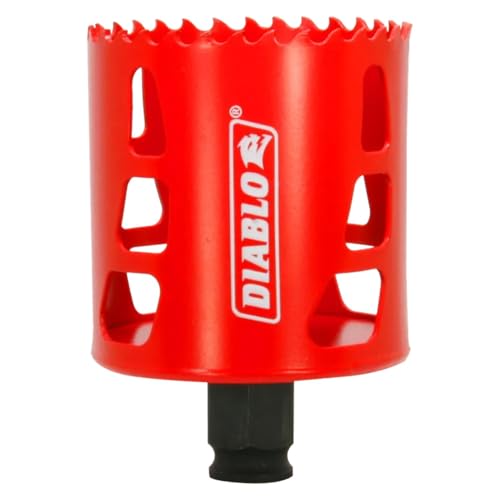
2. Diablo Bi-Metal Hole Saw – 2-1/2″ Diameter, 2-3/8″ Length
A 2-3/8 inch deep cup that swallows a joist in one pass instead of two.
Depth is the whole story with the Diablo DHS2500. It cuts 2-3/8 inches deep against the Lenox’s 1-1/2 inches, so standard joists and stacked layers go down in a single pass. Diablo rates that 40% deeper than standard hole saws, which is why it lands on framing and cabinet jobs where stopping halfway is not an option. Diablo builds it with a variable tooth design that cuts faster with less vibration, which matters on a 2 1/2-inch diameter where shake turns into a wallowed, oval hole.
Buyers report clean, smooth cuts and a plug that pops out without a fight. “This thing cut through 3/4″ plywood like it was butter,” goes one common note, and the kitchen-sink drain install through a cabinet bottom is exactly the job it was bought for. The mandrel story is equally specific: Snap-Lock Plus compatibility means you swap the saw body off the arbor in seconds when you move between sizes, and one arbor fits every Diablo saw from 5/8 inch up to 6 inches. Buy the mandrel if you do not already own one — the saw body alone will not spin.
The trade-off is that deep cup. The pilot bit from a standard kit may be too short to reach through 2-3/8 inches of body, so check your arbor’s pilot before you start. The aggressive tooth set also bites hard enough that a handheld drill needs a firm, clamped grip — this is a two-hand bit in thick stock. At 4 ounces and sized 6.75″L x 4.8″W, it is the widest body in this lineup, which is the price you pay for the extra depth.
The one-pass argument: if your project is a standard joist, a doubled-up cabinet bottom, or a laminated countertop substrate, 2-3/8 inches of cutting depth removes the second pass that ruins hole alignment — and it cuts 2-3/8″ where the DKIBBITH diamond saw stops at 1-3/8″.
Reach for this if: you drill thick wood or stacked layers and want one clean pass without flipping the workpiece.
Think again if: you do not own a Snap-Lock Plus mandrel and want to use an existing arbor setup as-is.
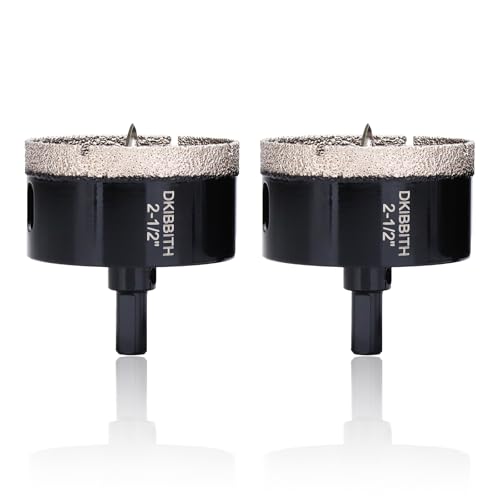
3. 2-1/2″ Diamond Hole-Saw With Pilot Drill Bit – 2.5″ Diamond Tipped Tile Hole Saws for Accurate Drilling in Porcelain, Ceramic, Pottery, Granite, Stone, Glass Bottles 65mm
For anyone who has ever watched a bi-metal bit skate off a porcelain tile and scar the glaze.
Tile is where a standard hole saw goes to die. The DKIBBITH diamond bit is the answer: a diamond-tipped rim — diamond grit bonded to the cutting edge, which grinds through hard surfaces instead of slicing them — that works on ceramic, porcelain tile, granite, stone, and glass bottles. The diamond runs 3/8 inch high with a total length of 2-1/2 inches, and it comes with the guiding pilot bit already installed, plus a spare, an Allen key, and a hex shank that seats firmly in a standard drill chuck.
What buyers keep coming back to is how well it handles porcelain. Owners have taken it through tile for grab-bar mounting and through ceramic with a water spritzer running for cooling and slag removal, and the recurring feedback is that it does the job with steady, controlled pressure. Diamond needs water — either a spray bottle or dipping the bit intermittently — or the grit glazes over and stops cutting. Expect to clear residue from inside the bit after each hole and to check the center point’s protrusion periodically to keep it from wandering.
The honest split is speed. Some buyers find it fast, others describe it as slow going, and that usually depends on how much water and patience the user brings. Durability lands mixed as well — plenty of owners mention no cracking or breaking, and just as many warn it will not last forever. Since a diamond bit grinds rather than slices, treating it as a consumable with a defined working life is the realistic expectation. Its 1-3/8 inch depth means thick countertops may need a flip or a chisel-out, unlike the deeper Diablo cup.
Where it earns its place
- Diamond-tipped edge cuts porcelain, ceramic, granite, stone and glass
- Ships with a pilot bit, a spare bit, and an Allen key in the box
- 3/8″ diamond height and 2-1/2″ total length give steady guidance
- Hex shank seats firmly in a standard drill chuck
The real-world strings
- Requires water cooling — dry cutting glazes the grit and ends the bit
- Cutting speed divides owners; it rewards patience over pressure
- Internal residue needs clearing after every hole to keep performance up
The bottom line: if your 2 1/2-inch hole is going through tile, stone, or glass, this is the material match you need — a bi-metal saw will not survive the attempt.
Heads-up: keep a spray bottle within reach, or the diamond grit is the first thing you lose.
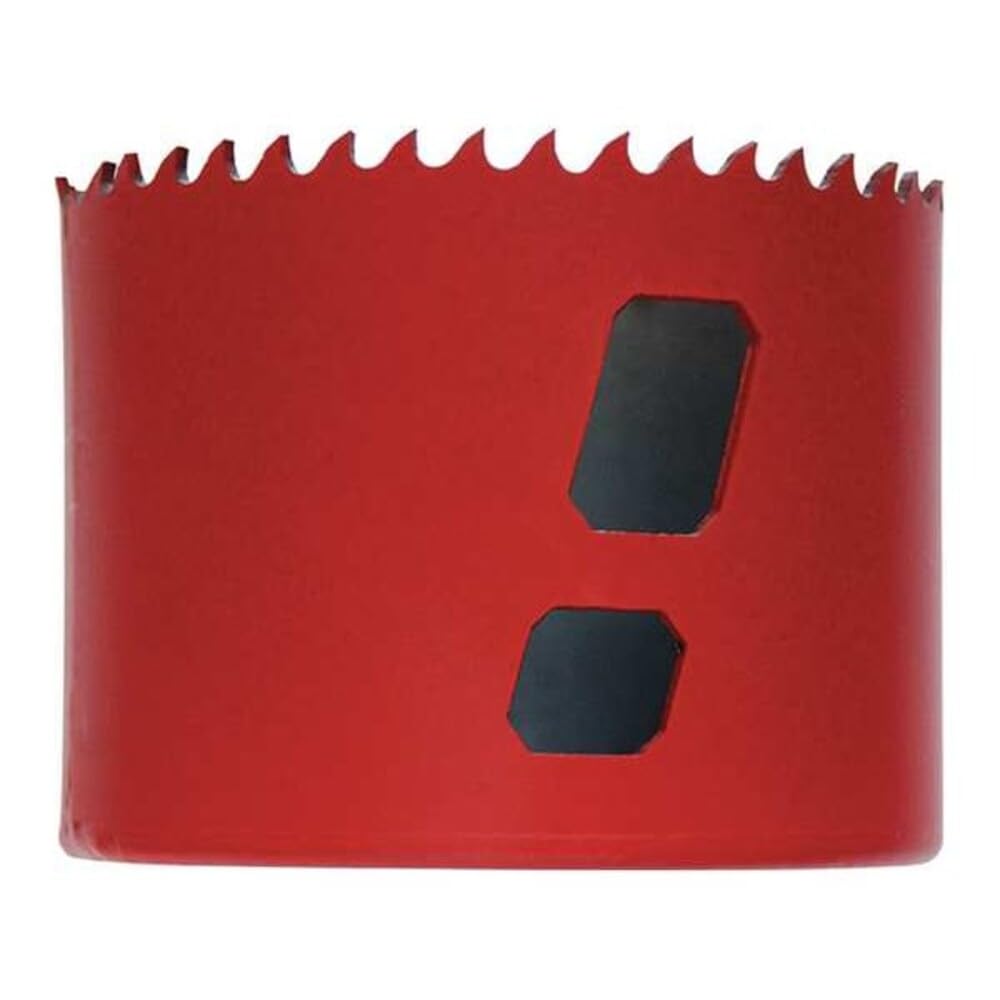
4. Morse MHS40 Bi-Metal Hole Saw, 2-1/2″ Diameter, 1 Piece
Built for steel that fights back — and thick enough not to flex while it does.
The Morse MHS40 is the steel-plate specialist here. It runs a.050 inch side wall — a thicker gauge than most consumer hole saws, which is what keeps the cup from deforming when teeth bite into steel — paired with a patent-pending tooth set designed to clear material fast. The red exterior coating cuts friction against the side wall, a new cap reduces runout and vibration, and a side slot gives you leverage for slug removal without prying at a hot bit.
What makes this pick interesting is how it compares against the biggest name in the category. Buyers who used the Morse against their Milwaukee sets kept coming back with the same read: perfect circles, accurate diameter, and very clean weld geometry. It slices through oak without trouble, cuts schedule 40 pipe with a solid drill and a jig, and holds an edge through repeated use in wood, steel, and plastics. Fits a standard arbor on a 5/8 inch x 18 thread, and the pilot-bit depth lets it handle thin stainless well.
The one thing to size up before you buy is how much pipe you need to go through. Owners working 2-3/8 inch oil field pipe found the cup too short to complete the cut in one go — the saddle cuts came out clean, but they had to work from both sides. Teeth can also produce fine chips in softer material, so running the bit backwards briefly can tame the bite. Treat it as a steel-first bit and it delivers; force it on thick-wall pipe and you will notice the ceiling.
Pick it when: your job is steel plate, pipe saddles, or stainless sheet and you want a bit that holds its shape through the whole run.
Consider the Diablo above if: your work is mostly thick wood and you need the full 2-3/8 inch depth in a single pass.
5. TCT Hole Saw Set, 2-1/2″(64mm) Heavy Duty Tungsten Carbide Tipped Hole Cutters for Stainless Steel Mild Steel Copper Iron Brass Plastic and More, with Titanium-Plated Pilot Drill Bits

Two carbide-tipped cutters for hard metals, plus the pilot bits and wrenches to keep them running.
Tungsten carbide tipped teeth — carbide being the material that holds an edge in hard steel longer than plain high-speed steel — are what let the DKIBBITH TCT set go after stainless, mild steel, copper, iron, brass, and FRP. It cuts to a depth of 1 inch, uses a 3/8 inch three-flatted shank so the chuck grips it without slippage, and the reinforced body has a chip-clearing hole at the base. Detachable pilot drill bits mean you swap the pilot when it wears instead of replacing the whole saw, and the kit ships oiled in a carrying case with Allen wrenches included.
Owners who matched it to its material came away impressed. Stucco exterior walls for a mini-split AC install went clean, felt like cutting through butter on one steel job, and cut through 3/8 hard steel well on another. Run it slow, let the tool do the work, and keep cutting oil moving — the maker’s instructions call for lower torque and lower speed with oil as lubricant, and that is exactly what the successful cuts had in common. The oiled-and-cased storage also helps the teeth resist rust between jobs.
The honest read is that this is a bit with a defined lifespan, and the higher the material’s hardness, the shorter it gets. Quality feedback splits: plenty of buyers call it very good, and others have watched carbide teeth shatter and one pilot bit snap in sheet metal. The 3/8 inch shank is meant for a standard drill or impact driver, so a set screw or chuck that slips will leave the bit spinning in place. Fit a proper chuck, cut at low RPM, and this is a hard-metal cutter that earns its keep.
Who it fits: anyone needing to punch 2 1/2-inch holes in stainless, copper, or alloy steel without paying for a dedicated professional set — the two cutters, wrenches, and pilot bits are enough to get through a short run of hard-metal holes.
How to get the life out of it: cutting oil on every hole, low RPM feeding, and a snugging set screw before you start. Skip any of those and the carbide does not survive long in the harder steels.
For the hard-metal job: this is the 2 1/2-inch cutter to grab when bi-metal is not enough and the surface is stainless, iron, or copper.
Pass if: you are drilling wood or plastic most days — the tungsten teeth are overkill there and want careful RPM control to last.
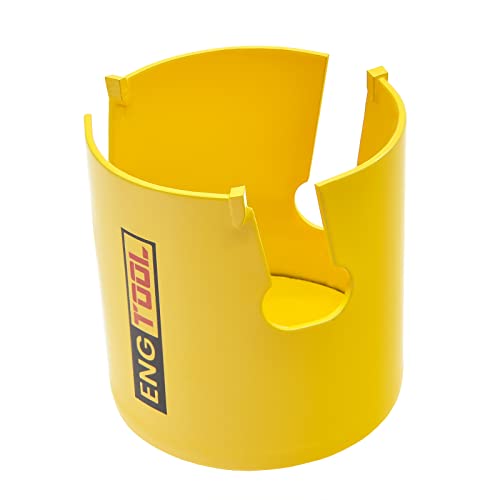
6. MaxTool 2-1/2″ TCT Hole Saw 64mm Carbide Tip Holesaw 2.25″ Deep with 5/8-18 Thread for Cutting Asphalt Brick Concrete MDF Tough Material; CT00Y57R232
Brick, block, and concrete — the deep-cut carbide bit for when the wall wins unless you bring the right teeth.
The MaxTool CT00Y57R232 is your 2 1/2-inch masonry answer, with tungsten carbide tipped teeth and a 2.25 inch cutting depth that goes deep into brick, block, or cement. It runs a standard 5/8-18 UNF thread so it fits most standard arbors, uses large carbide teeth with substantial gullets — the gaps that let chips clear so the bit does not gum up — and cuts asphalt, brick, concrete, gypsum, limestone, tile, wood, and MDF. It arrives in a coded cardboard box rather than loose hardware.
Owners who kept water flowing got clean cuts in concrete steps for handrails, ~4 inches of brick with teeth still usable, and stucco and cement block with minimal effort. The pattern in the good results is consistent: low RPM, a cordless drill with the hammer off, and a steady stream of water on the cut. The large tooth count means rough-cut quality — that is the design intent, per the maker’s framing, and buyers who wanted a fine finish went to a diamond bit instead. In softer masonry the depth lets it complete a hole in one pass instead of chiseling out the plug.
Where it needs the most honesty is tooth fragility. One buyer lost a tip on the second hole and still cut on; that is a real risk with carbide in hard aggregate. Running without water speeds up tooth damage dramatically. The 5/8-18 arbor thread means if you own a Snap-Lock Plus Diablo system, you will need an arbor change to use this saw. Sized 2.5″L x 2.5″W and weighing 237 g, it is heavier than the bi-metal bits here, which you will feel during a long brick run.
The masonry case: for anyone cutting through brick, block, or concrete where no wood-cutting saw will touch it, this carbide bit is the one to bring — its 2.25 inch depth finishes a wall pass in one go, and the 5/8-18 thread mounts on the standard arbors most pros already own.
The pick for: concrete steps, brick walls, and stucco where a water-fed carbide cut is the only practical route.
Not the one: if you are cutting smooth sheet metal or cabinet-grade wood — the rough tooth set is designed for masonry, not finish work.
7. DECKRKAT 2-1/2″Diamond Hole-Saw Bits with Pilot Drill Bit – 2-1/2″Diamond Tipped Tile Hole Saws with Guiding Bit Accurate Drilling for Porcelain Tile Ceramic Pottery Granite Stone Glass Bottles 65mm
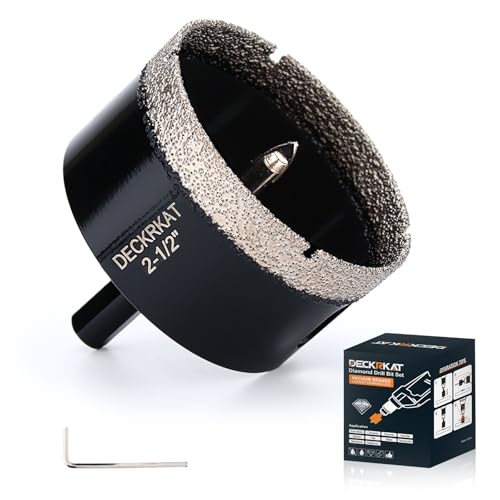
The countertop cutter that goes through 1-1/2 inch granite without the wobble.
If you are putting a faucet hole in a granite countertop, the DECKRKAT diamond bit is the one that gets there. Diamond grit is bonded to the cutting rim — grinding rather than slicing through hard surfaces, which is why it survives granite, porcelain, ceramic, stone, glass, and concrete countertops that would ruin a bi-metal saw. It carries a 3/8 inch triangle shank that grips the chuck without slipping, 3/8 inch diamond height, a 1-3/8 inch cutting depth, and a total length of 2-1/2 inches. A pilot bit is installed for initial positioning and comes out with the included Allen key once you are ready for the main cut.
Owners cut 4 holes through 1-1/2 inch granite for sink cutouts with a water feed and a plywood template as a guide, and the bit came out still usable. Concrete pavers for in-ground well lights, brick for irrigation plumbing, and one-off countertop work all show up in the same feedback. The pattern that runs through every successful cut is water. Spray a steady stream, drill slowly, and use a template or pilot hole to keep the bit perpendicular. Skip the water and the diamond grit glazes over before you finish the hole.
The trade-offs are real and specific. The 1-3/8 inch cutting depth means a deeper stone or countertop needs a flip, a chisel-out of the plug, or acceptance that the bit stops short. Working in brick and concrete, more than one owner has bypassed a thicker stone with a cement pilot bit instead of the supplied one. Short, work-hardened moments can flex the cup base — one owner reports a wobble after a hangup, likely straightenable but not guaranteed. At 0.2 kg, this is a light bit, and it comes with a plastic holder, a second saw, and an Allen key.
The pick if: you are cutting 2 1/2-inch holes in granite, stone, or glass and you are willing to feed water the whole way through.
Not for you if: your material is thicker than 1-3/8 inches and you want a single-pass cut with no mid-job rework.
8. 2-1/2″ Concrete Hole Saw, Tungsten Steel Core Bit for Cinder Block, Brick, Rock, Plank Walls for Pipes or mini Split Lines, with SDS Plus Shank and 2 Center Positioning Drill Bits.

For hard wall drilling — mini-split lines, exhaust runs, and pipe drops through cinder block and brick.
The DKIBBITH 2-1/2 inch concrete core bit runs on a 220mm SDS Plus connecting rod with two 110mm center positioning bits, and it is built with high-frequency welding and triple-edged teeth so it can take on Hardy Plank, drywall, fiber cement siding, backer board, air brick, stucco, and plasterboard. Tungsten steel body construction keeps the rim rigid through brick and block, and internal and external grooves route chips outward so the bit does not clog in the cut. It weighs noticeably more than any bi-metal bit in this list — this is not a cabinet-work tool.
In practice buyers have taken it through brick and mortar, 2-inch pavers, and even an 8-inch thick wall by drilling 2 inches at a time and chiseling out the core. The one tip owners keep giving is water — the maker’s instructions call for flowing water on high-hardness material to reduce abrasion, plus starting at a lower speed so the teeth do not snap on a cold start. The two included center positioning bits are your stability anchor, and if one falls out the spare and the set screws get you back to drilling quickly.
The one caution that comes with this kind of bit is the shank fit. This is an SDS Plus tool — if your drill is SDS Max, the bit will not lock in, no matter how new the chuck is, and one buyer with an SDS Max setup reported it sitting loose and unusable. Match the shank to your drill before you buy, keep water on the cut, and this is one of the few 2 1/2-inch bits that will go cleanly through an actual brick wall.
Why it stands out
- SDS Plus shank with 220mm rod fits standard SDS Plus rotary hammers
- Triple-edged teeth and chip channels speed up brick and block cuts
- Two 110mm center positioning bits stabilize the entry
- Handles Hardy Plank, backer board, fiber cement siding, and stucco
What to know before you buy
- SDS Plus only — will not seat or lock in an SDS Max setup
- Water feed during cutting is strongly recommended to slow abrasion
- Avoid marble, pebbles, and rebar per the maker’s usage guidance
Best matched to: a rotary hammer with an SDS Plus chuck and a wall that has to give — brick, cinder block, or concrete. The 2-1/2″ core size covers mini-split line runs and exhaust drops that other sizes cannot.
skip it if: your drill is SDS Max — the shank mismatch makes the bit unusable regardless of the rest of the build.
9. Klein Tools 31870 Heavy-Duty Hole Cutter, 2-1/2-Inch
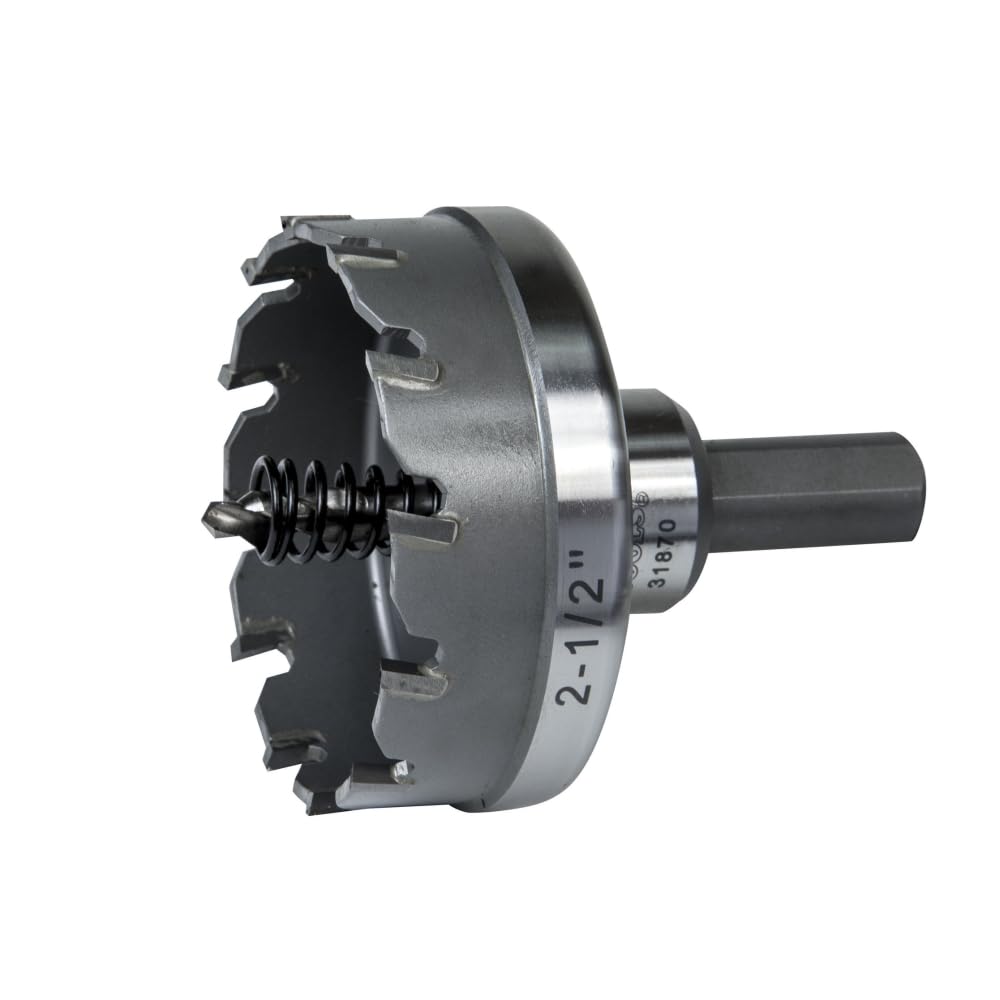
The stainless-steel specialist — carbide bit, split-point pilot, and a flange that stops you drilling past the sheet.
Klein Tools 31870 is built for sheet metal panels in stainless steel, mild steel, iron, copper, and brass up to 3/16 inch thick, and it is sized for 2 inch conduit and pipe runs. Where it differs from a standard hole saw is the pilot geometry — a split point pilot bit centers the cut and stops bit wandering on a smooth panel, and a built-in flange at the top of the cutter stops over-drilling once the saw passes through. Owners drilling 10 holes in 1/4 inch steel for marker lights say the 10th cut as easily as the first, and eight 3/4 inch holes in 1/2 inch carbon steel plate went fast with cutting oil as the only assist.
What earns it a place on this list is speed on sheet metal. Cutting oil and slow RPM are the two things every successful buyer had in common, and inside those conditions this bit cuts faster than a regular hole saw — that is the whole reason electricians and sheet metal fabricators reach for a carbide hole cutter in the first place. It also weighs 8 ounces, so it lands heavier than the bi-metal bits here, which is part of why it feels stable in a hand drill on a thin panel.
The honest limit is that this is a specialty bit shaped for thin stock, not a universal 2 1/2-inch saw. Two mixed signals show up: some owners say the pilot bit broke on them, and pricing on the 31870 makes it the most expensive bit in this list, so treat it as a tool you buy for a specific job rather than a general-purpose pick. If your work is stainless sinks, electrical panels, or conduit plates, this cutter is the right shape and material. If your holes are mostly in wood or drywall, one of the bi-metal bits above will serve you better for less. Compatible replacement pilot bits are available separately under the 31874 part number.
Buy it for: stainless steel, conduit plates, and sheet metal up to 3/16 inch — the split-point pilot and flange make it the cleanest cutter here on thin panels.
Look past it if: your work is wood or drywall — the carbide edge and 3/16 inch ceiling are built for a different job entirely.
Understanding the Specs
Cutting Depth (the number that decides passes)
Cutting depth is the distance from the teeth to the base of the inside cup — the thickest material you can cut before the saw bottoms out. The Diablo DHS2500 gives 2-3/8 inch, the MaxTool gives 2.25 inch, the Klein 31870 gives 3/16 inch of stainless stock at a time, and the diamond DKIBBITH and DECKRKAT bits give 1-3/8 inch each. If your material is thinner than the depth, you cut in one pass and stay square. If it is thicker, you either flip the workpiece or chisel out the plug — which is exactly where oval holes and damaged rims come from.
Edge Material (the number that decides what you can cut)
Edge material is the rim that does the cutting, and it is the single biggest compatibility decision. Bi-metal edges work on wood, plastic, aluminum, and sheet metal without coolant. Diamond tips grind through tile, stone, glass, and granite but require water. Tungsten carbide tips survive stainless, iron, copper, brick, and concrete but demand slow speed and lubricant. Match the edge to the surface and the saw survives; get it wrong and the teeth are gone by the second or third hole.
FAQ
Will a 2 1/2-inch hole saw fit my drill?
Do I really need cutting oil or water?
Can one 2 1/2-inch hole saw cut wood and tile?
Why does my hole saw walk across the surface?
How deep should my hole saw be for standard cabinets?
Will my SDS Max drill run this 2 1/2-inch concrete bit?
How many holes will a carbide-tipped bit cut before it dulls?
Is a bi-metal or tungsten carbide bit better for steel?
Can I drill through granite with a 2 1/2-inch bit?
What does the Speed Slot on the Lenox 1772954 do?
Final Thoughts: The Verdict
For most people buying one 2 1/2-inch hole saw, the Lenox Speed Slot 1772954 is the pick. It cuts metal, wood, plastic, and fiberglass, it ejects the plug without a fight, and it stays sharp across a job that mutters between materials. It is the crowd favorite at 4.7 stars across 500+ owners, and that is the honest reason it lands at number one. If your priority is deep wood or a joist or a thick cabinet bottom in a single pass, grab the Diablo Bi-Metal DHS2500 — its 2-3/8 inch depth beats the 1-1/2 inch on the Lenox for that specific job, and no second pass means no oval holes. For tile, porcelain, and granite, the DKIBBITH Diamond Hole Saw is the one to reach for, and its 1-3/8 inch cut depth is the right ceiling for countertops and grab-bar mounts. Hard-metal stainless and copper jobs want the DKIBBITH TCT Set. Brick, block, and concrete walls want the MaxTool CT00Y57R232 on a 5/8-18 arbor or the DKIBBITH Concrete Hole Saw on an SDS Plus drill. Stainless sheet and conduit plates are the Klein Tools 31870. Match edge material to surface, keep the coolant flowing, and stay slow, and any of these will hold up.
How We Picked
We do not accept paid placement. Every pick is matched to a real buyer and a real use-case; we do not hands-on test units.
Sources & Methodology
Specifications: manufacturer listings and product documentation. Review insights: verified customer reviews, as of September 2026. Pricing: not shown on this page (it changes often); check the current price via the retailer link.
As an Amazon Associate, KitchPrep earns from qualifying purchases. This does not affect which products we feature.
Related Guides
