
Specs are compiled from manufacturer listings and verified buyer reviews and can change over time — please confirm the key details on the product page before buying.
If you want one pin nailer that does nearly everything well, the DeWalt ATOMIC 20V kit is the safest money you can spend — it drives the widest range of pin lengths in this group and fires around 2,000 nails per charge. The catch every buyer hits first is the nail itself: these tools hate cheap, brittle pins, and half the “it jams” stories online start there.
I’m Mohammad Maruf — the founder and writer behind KitchPrep. This guide is built by comparing the manufacturers’ published specifications and the patterns across verified customer reviews, so you get each pick’s real strengths and trade-offs instead of marketing spin.
A battery pin nailer replaces the compressor, the hose, and the noise with a lithium-ion pack and a trigger — which is why so many finish carpenters now reach for one. Here is how each of these battery pin nailer picks actually behaves on real trim work.
Our Picks at a Glance


How To Choose The Best Battery Pin Nailer
A pin nailer fires headless 23-gauge pins — the thinnest fasteners in a finish carpenter’s kit, so thin you often need no putty at all. Going cordless means no compressor cycling in the next room and no hose dragging across your finished face frame.
Gauge and pin length first
Every tool here is 23-gauge, but they do not all accept the same pin lengths. Some stop at 1-3/8 inches; the DeWalt models take pins up to 1-1/2 inches. Short pins suit moulding returns and veneer, longer pins hold assembled joints. Decide your longest pin joint before anything else. A kit box is another real difference — some ship bare, some include battery and charger.
The jam question, answered honestly
Nailers jam for two reasons: the pin quality and the magazine feed. Cheap soft pins bend and stick to the driver, which is why the brands themselves tell you to run name-brand pins. A magazine that stops feeding with a few pins left means you lose time reloading — one Ryobi owner describes exactly that frustration.
Quick Comparison
| Model | Best For | Pin Length Range | Weight | Kit or Bare | Amazon |
|---|---|---|---|---|---|
| ATOMIC DCN623B (bare)★ Best Overall | Value DeWalt | 5/8 in. – 1-1/2 in. | 4.45 pounds | Bare tool | Amazon |
| DeWalt ATOMIC DCN623D1Also Great | Best Overall | 5/8 in. – 1-1/2 in. | — | Kit (battery, charger) | Amazon |
| Milwaukee M12 2540-20Top Performer | Compact M12 users | 1/2 in. – 1-3/8 in. | 3 pounds | Bare tool | Amazon |
| Bosch GNH18V-35N | AMPShare battery owners | 23-gauge pins | 3.7 pounds | Bare tool (2 no-mar tips) | Amazon |
| Craftsman V20 CMCN623C1 | First-time cordless nailer | 5/8 in. – 1-3/8 in. | 6.21 pounds | Kit (1.5Ah battery, charger) | Amazon |
| Metabo HPT NP1835DA | Complete kit out of one box | 5/8 in. – 1-3/8 in. | 3.6 pounds | Kit (2.0Ah battery, charger) | Amazon |
| RIDGID R09898B | Finish woodworking | 1-3/8 in. | — | Bare tool | Amazon |
| Craftsman V20 CMCN623B (bare) | Budget brushless | 5/8 in. – 1-3/8 in. | — | Bare tool | Amazon |
| Ryobi P318K combo | Ryobi owners needing a kit | 1/2 in. – 1-3/8 in. | — | Kit (battery, charger) | Amazon |
| Ryobi P318 (tool only) | Cheapest way onto 18V ONE+ | 1/2 in. – 1-3/8 in. | 3.9 pounds | Bare tool | Amazon |
| ONEAND PCL310B | Light hobby use | 23-gauge pins | 4.3 pounds | Bare tool | Amazon |
In‑Depth Reviews
1. ATOMIC 20V MAX Lithium Ion Cordless 23 Gauge Pin Nailer Tool Only (DCN623B)
Our pick — over 4.5★ from 900+ verified ratings; the strongest balance of quality and price.
Same ATOMIC nailer as our top pick, minus the battery and charger
If you already own DeWalt 20V MAX batteries, this is the ATOMIC pin nailer without the 2.0Ah pack and charger. It drives the same 23-gauge pins from 5/8 inch to 1-1/2 inch, runs the same high-output brushless motor, and hits the same 2,000 nails on average per charge. It shares the tool-free jam release, tool-free depth adjustment, and the low-nail lockout with its LED indicator.
DeWalt 20V batteries slot straight in, so your existing packs cover it — that’s the whole point of buying bare. Owners rate the quality and function highly and note that the finish is clean and the pin length flexibility is a real advantage. The recurring complaint is durability over the very long haul: a minority of owners describe jamming setting in after extended use, so treat the tool gently and keep the driver clean.
At 4.45 pounds it is a touch heavier than the Ryobi ONE+ 23-gauge, which comes in at 3.9 pounds. If weight is the deciding factor for overhead work, the Ryobi is easier to lift, but the DeWalt gives you the longer pin range.
Best for: a DeWalt-battery-owning carpenter who wants the ATOMIC pinner without paying for another battery.
Consider the kit instead if: you have no 20V MAX packs yet.
2. DEWALT ATOMIC Compact Series 20V MAX Brushless Cordless 23 Ga. Pin Nailer Kit (DCN623D1)
The 20V DeWalt that swallows longer pins and comes with everything in the box
The ATOMIC DCN623D1 arrives as a complete kit — the 23-gauge nailer, a 20V MAX 2.0Ah compact battery pack, and a charger — so you are nailing within minutes of unboxing. It accepts 23-gauge pins from 5/8 inch up to 1-1/2 inch, the longest range in this group, and a brushless motor (a motor with no carbon brushes, which runs cooler and lasts longer) is what lets it drive them consistently.
DeWalt rates it at 2,000 nails per charge — several full trim passes before you swap a battery. Loading is easy to learn, but here is the trick that trips beginners: the pins must slide fully to the top-left margin of the magazine — they do not self-adjust the way a stapler does. Once you load it correctly, it runs smoothly. One thing that makes this tool a pleasure on finished surfaces is the low-nail lockout and LED indicator — it tells you when to reload rather than dry-firing a blank.
What wins owners over is pin quality and consistency: set it flush and it leaves near-invisible holes that need little or no filling. It is also built for one-handed work. The setup is a bit heavy, though — a fair trade for the nail length range and the reliability.
Where It Earns Its Place
- Drives the longest pins of any pick here — 5/8 inch to 1-1/2 inch
- Around 2,000 nails per charge before a battery swap
- Tool-free jam release and tool-free depth adjust
The Fine Print
- Fiddly magazine loading until you learn the top-left alignment
- Occasional unit jams or wears out — treat it well and it holds up
- Heavier than the Ryobi 3.9-pound staple gun types
Reach for this if: you want one cordless pin nailer for mixed-length trim work with the battery and charger already in the box.
Look elsewhere if: you want the lightest possible tool or a complete 18V ONE+ system.
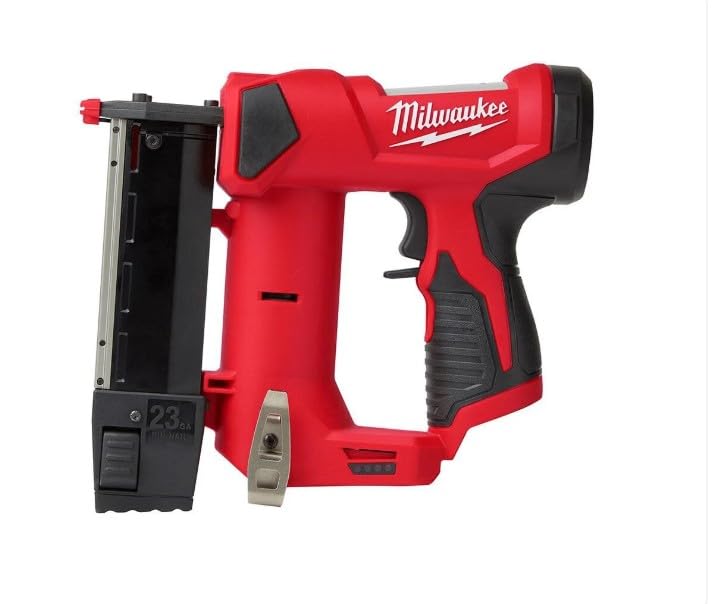
3. Milwaukee M12 23 Gauge Pin Nailer (Bare Tool)
Skinniest tool here, sized for overhead trim and drawer slides
At 3 pounds this is the lightest pin nailer in the group, and the M12 line (Milwaukee’s compact 12-volt system) makes it the easiest one to hold one-handed on a ladder or under a cabinet. It fires 23-gauge headless pins from 1/2 inch to 1-3/8 inch and runs a double-action trigger for sequential driving — pawl-and-press to fire one pin at a time. There is no pneumatic hose or gas cartridge to deal with, which is the entire point of going cordless.
The trade-off against the kit picks is battery life: Milwaukee rates it at up to 750 pin nails per charge, so a long casing run needs a spare M12 pack. If you are already invested in M12 tools, that is a non-issue. If you are not, this is a bare tool and you must add battery and charger separately.
Owners praise it precisely for the jobs it fits — small wood projects and finish detail — and note that it took a while to arrive. It is a specialist, not a do-everything tool.
The honest read: if you live in the M12 system and want a lightweight pinner for small joinery, this is the natural fit. If you need a complete tool from the start, the DeWalt kit is the better starter.
Pick this one if: you already run Milwaukee M12 batteries and want the lightest possible tool.
Hold off if: you are starting from zero — you would need to buy battery and charger on top.
4. Bosch GNH18V-35N 18V Brushless 23-Gauge Pin Nailer (Bare Tool)
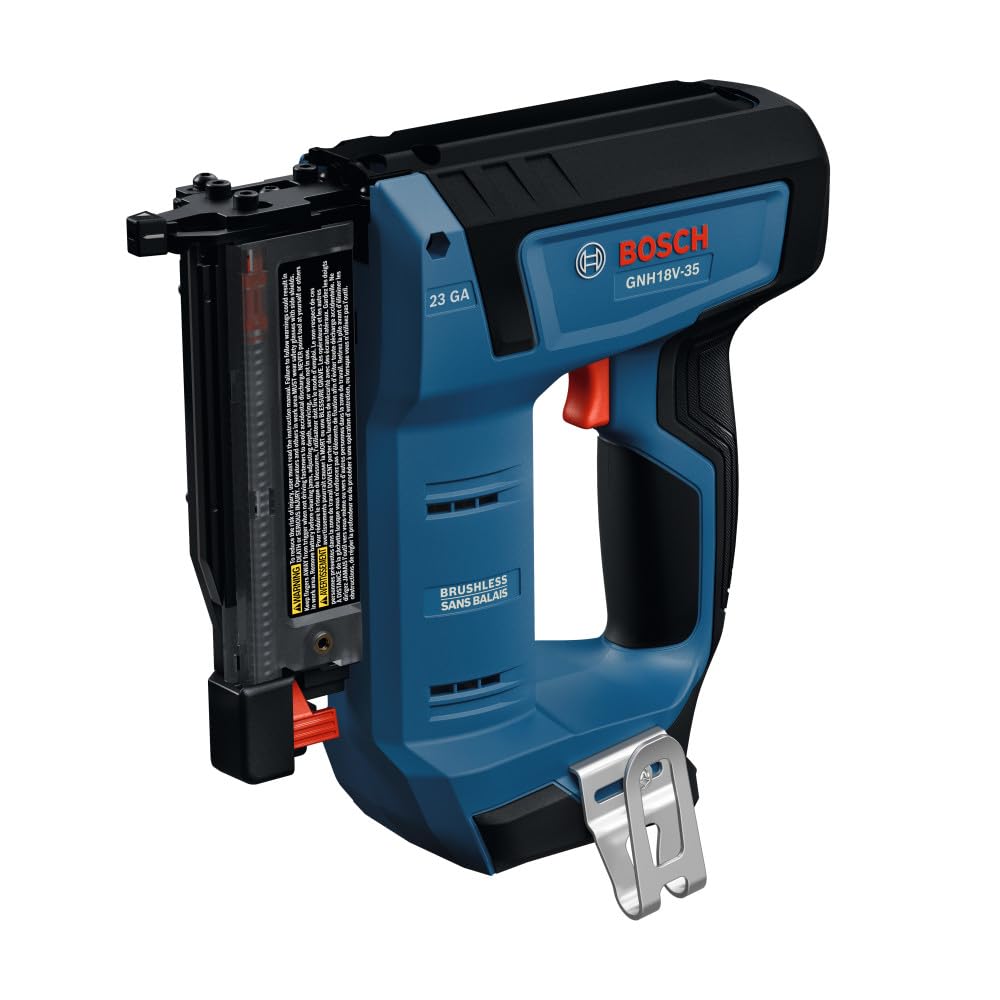
An 18V Bosch built for AMPShare owners who want pneumatic-like push without the compressor
The GNH18V-35N uses a brushless 18V motor and a coil spring drive (a wound spring that stores the firing energy) to sink 23-gauge pins without the compressor and hose a pneumatic needs. It ships as a bare tool with two no-mar contact tips that protect finished surfaces, an onboard LED, toolless depth adjustment, and a heavy-duty belt hook that mounts on either side. It is part of the AMPShare system, so it runs on any Bosch 18V battery and a growing list of other AMPShare brands.
The recurring gripe on this one is depth: buyers report it needs the deepest setting to sink pins flush, and even then some find it struggles to countersink longer 1-3/8 inch pins in hard woods. Bosch also uses a dry-fire lockout that stops firing at 4 nails to protect the workpiece. Once you get the depth dialed in, the build and ergonomics get credit — owners mention it sits well in the hand and the light helps in tight corners.
If depth adjustment is the whole reason you are shopping, note that buyers describe the adjustment as mostly useful only at its maximum. For that reason many finish carpenters looking for easy sinking still lean toward the DeWalt or a pneumatic.
Who it suits: an AMPShare household that wants cordless pin nailing and values the included no-mar tips and belt hook.
Who may want more: anyone whose job lives on 1-3/8 inch pins in dense hardwood.
Good match for: Bosch 18V / AMPShare users who want a trim pinner without hoses.
Think twice if: you need maximum flush-driving power in hard oak on the first try.
5. CRAFTSMAN V20 Pin Nailer Kit, 23 Gauge, Cordless, Battery and Charger Included (CMCN623C1)

The Craftsman kit that hands you batteries and charger in a single box
This is the V20 kit version of the Craftsman pin nailer — nailer, a 1.5Ah 20V battery, and a charger, boxed together. It shares the bare V20’s brushless motor and its 5/8 inch to 1-3/8 inch pin range, and includes tool-free jam release and an LED light. For someone stepping into cordless pin nailing for the first time, the “everything included” nature of this kit is its strongest argument.
Owners describe it as sturdy and easy to use, and several say it feels close to a DeWalt for less money. It weighs in at 6.21 pounds with the pack, noticeably heavier than the Metabo HPT’s 3.6 pounds, so it is better suited to bench work than overhead trim. The 1.5Ah battery is small, so plan on a second pack for larger jobs.
What to know before you commit: there is no safety lockout to stop the trigger being pulled when the tool is not against a surface, so store it carefully. And a few builders note the shortest 5/8 inch pins feed less reliably than the longer ones, so run full-length pins where you can.
Bottom line: a sensible first cordless pin nailer with the battery and charger handled. Best if you want a brand-name 23-gauge kit without a premium price tag, and you are working at a bench more than overhead.
Ideal for: DIYers stepping up from a compressor rig who value an all-in-one kit.
Skip if: you need the lightest tool for overhead work or live on 5/8 inch pins.
6. Metabo HPT 23 Gauge Pin Nailer, 18V Cordless Kit, NP1835DA
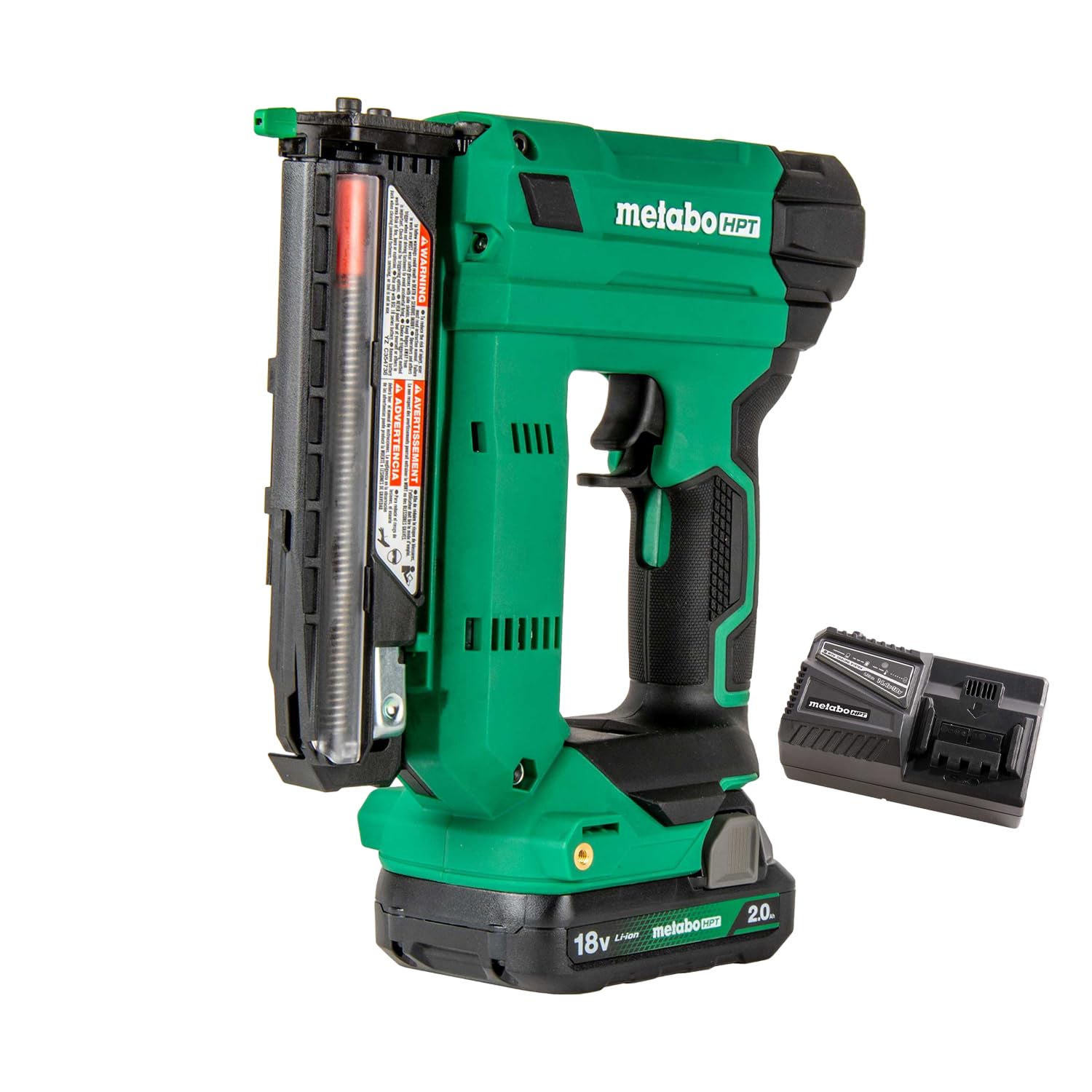
The kit that ships with a 2.0Ah battery and the longest shots-per-charge number here
Metabo HPT rates the NP1835DA at 2,700 nails per charge — the highest here — and includes a 2.0Ah 18V battery, charger, two no-mar caps, and safety glasses. The mechanical spring drive sinks up to 1-3/8 inch 23-gauge headless pins, and the fine-tip nose is shaped to reach into trim grooves that a blunt nose cannot. It also runs a dry-fire lockout, a double trigger for safety, a left-or-right belt hook, and rubber bumpers to protect the work.
The warranty is a standout: 5 years on the tool, 2 years on the battery, and 1 year on the charger — longer than the 30-day or 3-year coverage on other picks here. At 3.6 pounds it is the lightest kit in this group, so overhead casing goes easier on your wrist.
The honest catch is depth control: customers note the pins can leave small indentations in softwood, and some conclude that soft trim is not its home. In harder material it sinks consistently and the fine nose helps. Treat it as a hardwood-and-paint-grade tool and it does its job well.
What we value most: the 5-year warranty and the highest per-charge capacity — 2,700 nails — paired with a lightweight 3.6-pound body. If you want a kit that arrives fully equipped and stands behind itself, this is a standout.
Best for: buyers who want a complete kit and the confidence of a 5-year tool warranty.
Not for: soft-wood work where any surface dimple matters.
7. RIDGID 18V Cordless 23-Gauge 1-3/8 in. Headless Pin Nailer (Tool Only) R09898B

The RIDGID bare tool that owners call smooth and dependable for finish work
The R09898B is an 18V bare tool — no battery, no charger — so it is a fit only if you run RIDGID’s 18V system already. It fires 1-3/8 inch 23-gauge headless pins and earns its keep on small finishing jobs, where owners describe the action as smooth and the tool as dependable. RIDGID backs its cordless line with a lifetime service plan on the tool, a real safety net when you are buying bare.
It is a lighter build than some rivals — buyers call it “not too heavy” and easy to reload quickly, which matters when you are working through trim with a lot of short runs. The trade-off is that the magazine and driver demand care: pins need to be seated fully or you get protrusions, the same rule that applies to every nailer here.
If your RIDGID batteries are your reason for choosing it, that loyalty pays off. If not, the included-kit picks above will get you running faster.
Right choice if: you are already on the RIDGID 18V platform and want a smooth finish pinner with the brand’s service support.
Look at the kits if: you would be buying batteries fresh anyway.
8. CRAFTSMAN V20 RP Pin Nailer, 23GA, Bare Tool Only (CMCN623B)

The bare Craftsman with a brushless motor and a genuine 3-year warranty
Same 23-gauge pin nailer as the CMCN623C1 kit, sold bare without the 20V battery or charger. It runs a brushless motor for more runtime and better performance, takes 5/8 inch to 1-3/8 inch pins, and includes tool-free jam release and an LED light. The 3-year limited warranty beats the 30-day coverage on several rivals here.
Owners say it feels sturdier than expected, easy to use, and well worth the money for trim and small builds around the house — the “better than expected” tone comes up repeatedly. The recurring gripe from a subset of buyers is jamming, so pin quality matters: use name-brand 23-gauge pins and keep the magazine clean.
Realistically, this is a strong first brushless pin nailer for a DIYer already holding Craftsman V20 batteries, at a friendlier entry point than the DeWalt kit. If you have no V20 packs, the boxed kit is the better starting point.
Our take: an excellent value if you are already in the Craftsman V20 family — brushless performance plus a 3-year warranty at a bare-tool saving.
Main caveat: a minority report jams, so match it with quality pins.
Choose this if: you own Craftsman V20 batteries and want a durable entry-level brushless pinner.
Otherwise: spring for the kit version to get running immediately.
9. Ryobi 18-Volt ONE+ AirStrike 23-Gauge 1-3/8 in. Headless Pin Nailer Combo Kit (P318K)

The Ryobi that arrives with battery and charger, ready to nose into trim
This is the P318 pin nailer bundled with a lithium-ion battery and charger. It drives 1/2 inch to 1-3/8 inch 23-gauge pins, runs a double-action trigger for sequential driving, and includes a dry-fire lockout to extend tool life plus two non-marring pads to keep the work surface clean. A union carpenter who uses it in a commercial setting calls it surprisingly reliable for the price.
A story that recurs in the reviews: a homeowner’s hired carpenter used it on trim work and was impressed enough to buy his own, saying it outperforms the pneumatic guns he had run. That is the real-world vote of confidence for this tool — people who know nailers like how it fires.
The honest trade-offs: some buyers find it a little heavy, and it does not stand up on its battery — it tips forward when set down. The trigger safety also takes getting used to. Neither is a dealbreaker, but they are the things to expect.
Strongest case: a cordless-ready Ryobi ONE+ owner who wants a complete kit. The double-action trigger and included battery make it an easy first cordless pin nailer.
Worth it if: you want a complete Ryobi ONE+ kit with battery and charger included.
Look past it if: you need a nailer that stands upright on a bench or is lighter in hand.
10. Ryobi 18-Volt ONE+ AirStrike 23-Gauge 1-3/8 in. Headless Pin Nailer (Tool Only, P318)

The cheapest path onto the Ryobi ONE+ platform — if you already own the batteries
The bare-tool P318 is the everyday entry to Ryobi cordless pin nailing: it drives 1/2 inch to 1-3/8 inch 23-gauge headless pins, runs a double-action trigger, and carries the LED light and dry-fire lockout for visibility and tool life. At 3.9 pounds it is lighter than the DeWalt ATOMIC bare tool’s 4.45 pounds and its 4.3-pound stablemate, so overhead work takes less out of your wrist.
Performance and value are the two things Ryobi ONE+ owners come back to again and again — it sinks pins deep enough that very little putty is needed, and it lets you walk away from the compressor entirely. A finish carpenter uses it on baseboard and casing, occasionally with PVC trim, and rates the durability highly enough to survive a drop from a tool belt.
Two things to plan for: it needs the battery and charger separately, and it does not clear its magazine completely — it stops feeding with a handful of pins left, so keep a reload habit.
The value argument: if you already own Ryobi 18V batteries, this is the smart-money entry into cordless pin nailing — set up is instant and the tool does the everyday jobs without complaint.
Ideal for: Ryobi ONE+ households that just need the tool and already have batteries.
Not ideal if: you want a cordless pinner that runs the whole magazine down before stopping.
11. ONEAND 18V Cordless AirStrike 23-Gauge Pin Nailer Tool Only (PCL310B)
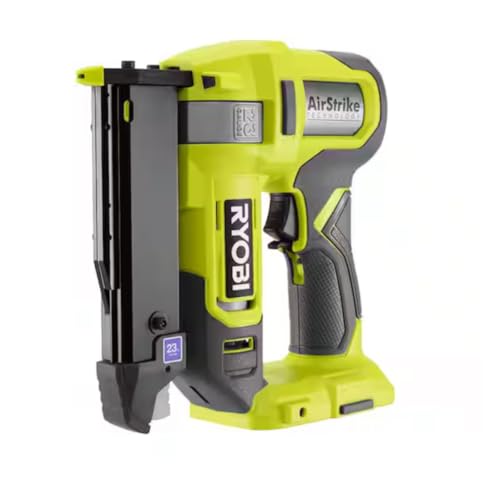
The light hobby pinner that is honest about being for occasional craft work
This is a Ryobi ONE+ 18V bare tool sold under a third-party listing, so it wears the Ryobi green and takes 18V ONE+ batteries — no charger here. It is aimed squarely at the occasional user, not the working carpenter. It fires 23-gauge pins and weighs 4.3 pounds, and buyers who use it for craft projects and small jobs report it goes in straight and true.
Where it makes sense: hobby crafts, small fixes, and light trim where the occasional misfire isn’t costly. A buyer who uses it that way describes a miss about every 20 to 30 shots — inconvenient, but acceptable when the tool has saved them noticeable time on the hobby bench.
The 30-day limited warranty is the shortest here, and a couple of reviews describe failures after limited use, so treat it as an occasional-use tool rather than a pro daily driver. If you use your nailer most days, one of the higher-rated picks is the smarter buy.
Fair fit for: the occasional hobbyist who already owns Ryobi 18V batteries and needs a cheap pinner for craft-scale projects.
Better to skip if: you rely on the tool professionally — the 30-day warranty and occasional misfires make it a light-duty choice.
Understanding the Specs
Gauge and Pin Length Range
Gauge is how thick the pin is — all the tools here are 23-gauge, the thinnest practical finish pin, around the diameter of a paper clip. Pin length range is the more practical spec: it sets the longest joint you can fasten. One tool accepts pins up to 1-1/2 inches, others stop at 1-3/8 inches or 1/2 inch. Longer pins hold thicker trim stacks; shorter pins suit delicate veneer where a long nail would split stock.
Shots Per Charge and Drive System
Shots per charge is the number of pins a full battery will fire — usefully, the range in this group runs from 750 to around 2,700. This is the number most likely to save you a walk to the charger mid-job. The drive system matters too: brushless motors on most of these tools run cooler and put more shots out per battery pack, while a spring-drive mechanism is what produces the smooth firing action without an air compressor.
FAQ
What pin lengths can a 23-gauge battery pin nailer fire?
Why do pin nailers jam so often?
Which battery pin nailer has the longest shots per charge?
Do I need a kit with a battery, or can I buy a bare tool?
Can I use a battery pin nailer for cabinet and trim work?
How long does a battery pin nailer last?
What is a dry-fire lockout on a pin nailer?
Is a battery pin nailer as strong as a pneumatic one?
Do these pin nailers include the battery and charger?
What safety features should a battery pin nailer have?
Final Thoughts: The Verdict
For most buyers, the battery pin nailer winner is the DeWalt ATOMIC DCN623D1 because it accepts the longest pins, fires steadily, and arrives with the battery and charger — a kit you can use the moment it lands. If you already run Milwaukee M12 batteries and want the lightest tool in hand, grab the M12 2540-20. And for the longest warranty and highest shots-per-charge, the Metabo HPT NP1835DA is the one to reach for.
How We Picked
We do not accept paid placement. Every pick is matched to a real buyer and a real use-case; we do not hands-on test units.
Sources & Methodology
Specifications: manufacturer listings and product documentation. Review insights: verified customer reviews, as of September 2026. Pricing: not shown on this page (it changes often); check the current price via the retailer link.
As an Amazon Associate, KitchPrep earns from qualifying purchases. This does not affect which products we feature.
Related Guides
