
Specs are compiled from manufacturer listings and verified buyer reviews and can change over time — please confirm the key details on the product page before buying.
A burst supply line or a corroded water heater can dump gallons into your home in minutes, and by the time you notice standing water, the drywall and flooring are already soaked. That is exactly the problem an automatic water shut-off valve and leak detection sensor system solves: a sensor touches water, the motorized valve closes, and your home is spared the expensive repair bill. This guide cuts through the confusion to show you which setups actually close the valve fast, how sensor coverage works, and where each pick fits your house.
I’m Mohammad Maruf — the founder and writer behind KitchPrep. This guide is built by comparing the manufacturers’ published specifications and the patterns across verified customer reviews, so you get each pick’s real strengths and trade-offs instead of marketing spin.
You will learn how valve size, sensor count, and app control work together to protect your plumbing. For most homes, a 3/4-inch full-port valve with at least two sensors covers the water heater and washing machine.
Our Picks at a Glance


How To Choose The Best Automatic Water Shut-Off Valve and Leak Detection Sensor
Picking the right system isn’t just about buying a valve; it’s about matching the device to your plumbing layout and your daily habits. You need to think about how the water gets in, how you want to get alerts, and what happens if the power goes out.
Pipe Diameter and Valve Port Size
Before you buy, check the diameter of your main water line. Most homes use either a 3/4-inch or 1-inch line, and ordering the wrong size means a frustrating return. The inner port of the valve is just as important as the outer threads — a full-port design lets water flow freely, while a reduced port can cut your water pressure noticeably. Some systems arrive with adapters for both common sizes.
Sensor Technology: Contact vs Ultrasonic
Cheaper units rely on contact sensors that sit on the floor and wait for water to puddle around them. These work fine for a water heater pan or a washing machine, but they can’t catch a leak inside a wall. Ultrasonic sensors measure water flow through the pipe and can spot a tiny drip (often as low as 0.01 GPM) that you would never see. A hybrid system combining both gives you the best coverage.
Connectivity and Offline Reliability
Do you want the system to work if the Wi-Fi drops? Cloud-only devices require a stable internet connection to send commands. Systems using LoRa (a long-range radio signal) or direct device-to-device pairing can still trigger the shut-off valve when the internet is down. If you live in an area with spotty service or want a backup for power outages, prioritize units with these offline capabilities.
Quick Comparison
| Model | Best For | Valve Connection | Sensor Count | Control Method | Amazon |
|---|---|---|---|---|---|
| YoLink Water Shutoff Kit★ Best Overall | Whole-home expandable ecosystem | — (Operator mounts to existing) | 4 | App, Voice | Amazon |
| U.S. Solid (3/4″ Brass)Budget Champion | Budget basement defense | 3/4″ | 3 | App | Amazon |
| U.S. Solid (1″ Stainless)Potable Water Safe | Potable water safety | 1″ | 3 | App | Amazon |
| High Eagle Dual Valve | Dual-line coverage | 3/4″ NPT | 2 | App | Amazon |
| iSpring LS43 | Whole-home value | 3/4″ NPT | 2 (Expandable to 8) | App | Amazon |
| YoLink FlowSmart | Long-range flow monitoring | 0.75″ | 0 (Flow based) | App | Amazon |
| Frizzlife LP365 | Precise usage tracking | 3/4″ & 1″ | 0 (Flow based) | App | Amazon |
| Frizzlife LPG365 | High-end dual protection | 3/4″ & 1″ | 3 | App, Remote | Amazon |
In‑Depth Reviews
1. YoLink Water Shutoff Kit: X3 Controller + EVO + 4-Pack Sensors + Hub
Our pick — over 4.5★ from 500+ verified ratings; the strongest balance of quality and price.
The expandable ecosystem that keeps protecting your home even when the power and internet go dark.
If you want a system that grows with your smart home, this is the one to beat. The YoLink kit pairs a motorized valve operator with four leak sensors, giving you coverage right from the start. What really seals the deal is the LoRa technology — a long-range radio signal that reaches up to a quarter mile. That range means your sensors can sit in a detached garage or a far basement corner and still talk to the hub.
Unlike simpler alarms that just beep, this system physically closes the valve. The shut-off trigger runs on device-to-device pairing, not the cloud. You don’t need the cloud or Wi-Fi to trigger a shut-off; the sensor talks directly to the controller. If your internet goes down during a storm, the system still works. The sensors run on included AAA batteries, and the kit is designed to survive power outages.
The setup is friendly for a confident DIYer. Users report mounting it on 1-inch copper before the meter without needing a plumber. The app is intuitive, and the included hub lets you add smart locks, lighting, or thermostats later. Just be aware that the valve operator needs a solid mounting spot; if your existing valve is stiff or hard to turn, the actuator might struggle. This is a premium setup that asks for a bit of planning before you install.
What Powers The Recommendation
- Works offline via LoRa and direct device-to-device pairing
- Includes four leak sensors for immediate coverage
- Scalable to 300+ devices on a single hub
- Voice control works with Alexa and Google Assistant
Where It Asks More Of You
- Requires a hub, which takes up an outlet and space
- Valve operator installation requires comfort with basic plumbing
The Ecosystem Leader: Choose this if you want a future-proof system that survives Wi-Fi outages and covers a large property.
Installation Reality: You need a standard motorized valve operator and a bit of DIY confidence to mount the actuator securely.
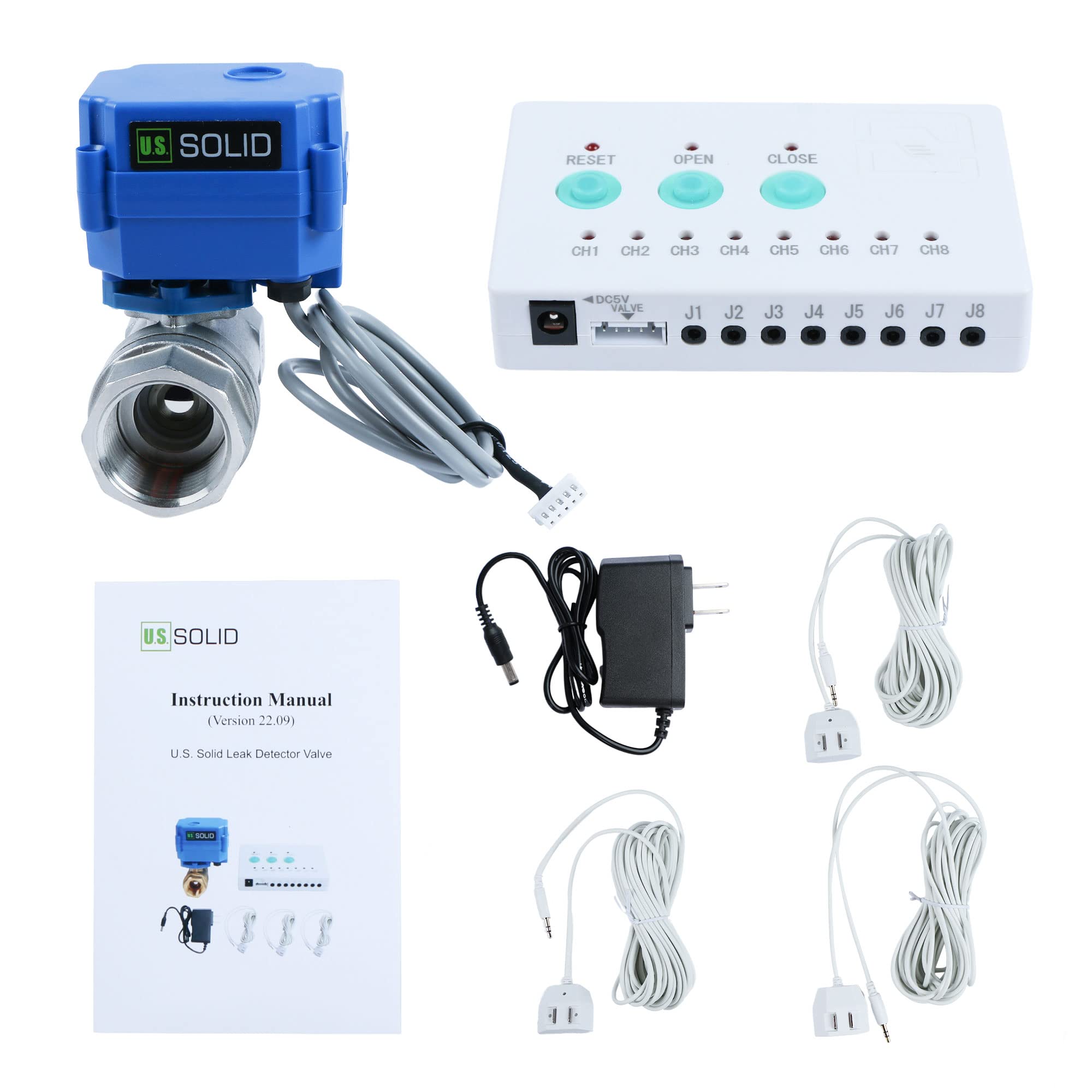
2. U.S. Solid Water Leak Detector with Auto Shutoff Valve, Sound Alarm, 3/4″ Motorized Brass Ball Valve & 3 Sensors
A no-nonsense brass valve that gets the job done without needing a Wi-Fi connection to save your basement.
This U.S. Solid unit is the definition of straightforward protection. It uses a heavy-duty 3/4-inch motorized brass ball valve, which is a material built for industrial-grade durability. The system includes three sensors with extra-long 20-foot cables, letting you stretch coverage across a laundry room and a water heater without buying extensions.
What makes this a standout pick for many is its simplicity. It doesn’t rely on an app or the cloud to function. The controller is a standalone brain that monitors the sensors and trips the valve when water is detected. The valve itself is rated IP65 — that’s a waterproof rating meaning it can handle spray and dust — and has a 50,000-hour lifespan. Buyers report that after a year of service, it prevented basement flooding by instantly shutting off a corroded tank.
The catch is the alarm. It has an integrated sound alarm that beeps until you clear the leak and reset the system. While effective, it’s a local alert; if you aren’t home, you’ll only know about the leak when you walk in, unless you pair it with a separate Wi-Fi sensor. Also, the manual is in German according to user feedback, though English support is available. It suits a homeowner who wants a brass ball valve and offline operation instead of app alerts.
Mechanical Grit: The brass valve and IP65 rating mean this unit is built to handle real plumbing pressure and damp environments without flinching.
The Connectivity Trade-off: It operates entirely offline, which is excellent for reliability, but you miss out on remote phone alerts unless you add a third-party sensor.
Reach For This If: You want rock-solid, automatic shut-off protection without dealing with apps or complex network setups.
Look Elsewhere If: You need immediate remote notifications on your phone when you are away from home.
3. U.S. Solid Water Leak Detector with Auto Shut-Off Valve & Sound Alarm, 1″ NSF Certified 304SS Motorized Ball Valve with 3 Sensors
The stainless steel upgrade for homes that need a wider pipe and certified safe materials for drinking water.
If your main line is a full 1-inch pipe, you need a valve that matches. This U.S. Solid model steps up to a 1-inch NSF certified 304 stainless steel ball valve. The certification matters because it verifies the material is safe for potable water — meaning the water you drink won’t pick up weird tastes or chemicals from the valve. The stainless steel construction resists rust and corrosion far better than standard brass, which is a big deal if you have aggressive water.
Like its smaller sibling, this unit includes three sensors with 20-foot cables. It uses a professional controller to manage your water network. Buyers often mention that this system costs significantly less than comparable units while offering more sensors. One reviewer noted it replaced an “expensive paperweight” from another brand. It also carries the IP65 waterproof rating and a 50,000-hour lifespan.
The trade-off here is the same as the other U.S. Solid units: it is a local alarm system. It doesn’t have built-in Wi-Fi. You get the loud beeping alarm, but you won’t get a text message. The 304 stainless body and IP65 rating prioritize durability and potable-water safety over app control. For a home with a 1-inch main line that wants certified safety, it’s a hard package to beat.
Material Matters: The NSF certified 304 stainless steel valve is the headline here, ensuring rust resistance and safe water quality.
Connectivity Limits: It lacks native Wi-Fi, so you are trading remote monitoring for a rugged, standalone mechanical system.
Best Match: Homeowners with 1-inch main water lines who prioritize certified safe materials and rust resistance.
Skip If: You require smartphone alerts and remote control capabilities built into the box.
4. Water Leak Detector, Automatic Water Leak Alarm System, with 2X 3/4″ NPT Shutoff Valves & 2 Sensors

A unique dual-valve setup that lets you guard two separate water lines with a single controller.
Most systems give you one valve. This High Eagle unit gives you two. It arrives with two 3/4-inch NPT brass valves and two sensors. This is ideal if you have a split setup — say, a main line plus a separate line for a rental unit or a detached garage. It saves you from buying two separate systems. The controller supports up to 8 sensors, so you can expand the detection net without replacing the brain.
The alarm is loud. It is rated at 110 decibels, which is roughly the volume of a rock concert or a chainsaw. You will hear this from anywhere in the house. Users note that installation requires solid plumbing expertise. It is not a beginner’s project. One buyer mentioned testing it on non-critical lines first to ensure no leaks or malfunctions before relying on it for the main supply.
The main drawback is that it doesn’t connect to Wi-Fi. It uses RF (radio frequency) signals to communicate only within its own network. So you get confidence when you’re home, but you won’t get a phone alert when you’re on vacation. It suits a two-line setup — main line plus garage or rental unit — where a 110dB local alarm is enough.
Double The Protection: Two valves in one box is a unique value proposition for protecting separate water lines.
DIY Difficulty: The installation demands real plumbing skill, and the 110dB alarm is local only.
The Multi-Zone Solution: Perfect for properties with two distinct water entry points that need independent shut-off control.
Know Before You Buy: This is a loud local alarm system; you won’t get remote phone notifications.
5. iSpring LS43 Water Leak Detector Alarm System, Automatic Shut-Off Valve and 2 Detection Sensors

A reliable whole-house defender that focuses on precise monitoring and loud, unmistakable alerts.
The iSpring LS43 is a sturdy system that installs on your main water line. It uses a 3/4-inch NPT (National Pipe Thread) automatic shut-off ball valve to cut the water supply when a leak is detected. what separates it is how much you can expand it. The controller unit can handle up to 8 water detection sensors, though it ships with 2. That means you can start with the water heater and washing machine, then add sensors for the dishwasher, basement, and bathrooms later.
Users consistently praise its reliability. One owner reported it cuts off the main water supply instantly, and another highlighted its ability to monitor high-risk areas precisely. The system includes a loud, high-decibel indoor alarm. If you are worried about false alarms from humidity, this system is designed to only trigger on standing water contact, avoiding the annoying chirps that plague some cheaper models.
The installation is described as easy, though it does require cutting into your main line. The system comes with a 5V/1A transformer and a ball valve with sound/light alarm. It isn’t the sleekest unit on the shelf, but it is a workhorse. If you want a trusted name in water filtration (iSpring) to handle your leak protection, this is a solid, no-frills choice that focuses on the core job.
Why It Stands Out
- Expandable up to 8 sensors for comprehensive coverage
- High-decibel alarm can be heard from the basement
- Focuses on reliable leak detection without false humidity triggers
- Backed by a 1-year warranty and lifetime support
What To Keep In Mind
- Only comes with 2 sensors from the start
- Lacks the advanced offline LoRa capabilities of higher-end kits
Trusted Brand Pick: A great choice for homeowners who want a reliable, expandable system from a company known for water treatment.
Installation Note: You need to cut into the main water line, so factor in a plumber or a solid DIY skillset.
6. YoLink FlowSmart All-in-One Ultrasonic Water Meter, 0.75″, YS5018
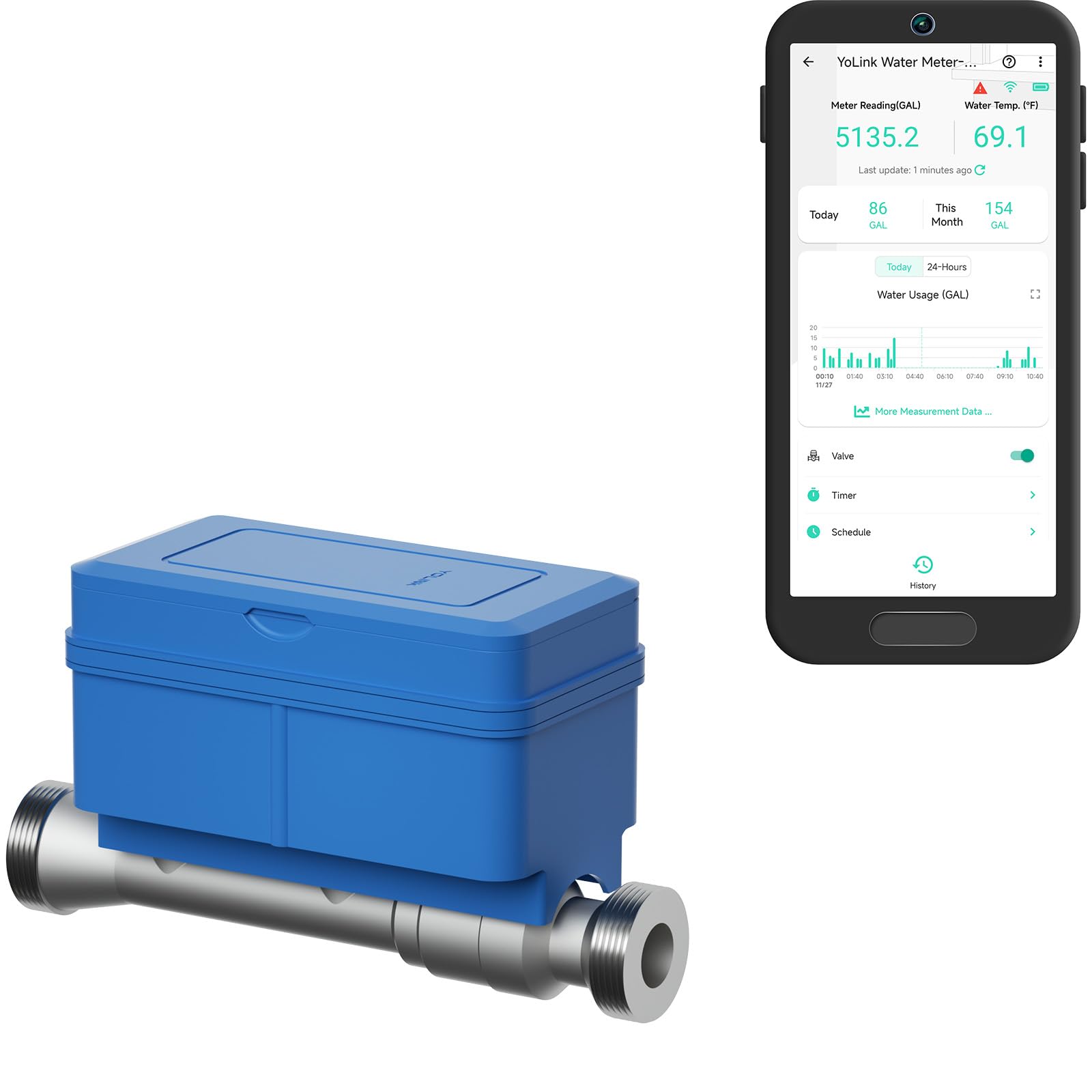
The ultrasonic meter that watches your flow, tracks your usage, and cuts the water without ever touching a paddle wheel.
This is a different beast. The YoLink FlowSmart is an all-in-one ultrasonic water meter and motorized shutoff valve. Instead of relying on sensors sitting on the floor, it measures the flow of water through the pipe itself. It can detect leaks and abnormal use, closing the valve automatically. The ultrasonic measurement tube is intentionally smaller inside to meet accuracy standards, so water flows through a narrower channel to stabilize readings.
It features a 10+ year battery design and works with the YoLink ecosystem. The range is impressive — LoRa protocol reaches up to a quarter mile. Buyers have used it outdoors for irrigation, though long-term durability in harsh weather is a question mark. It integrates with Home Assistant and offers real-time usage tracking, which helped one user identify a hidden leak that was wasting water.
There is an important caveat regarding flow. The valve takes about 20 seconds to fully close, which is slower than a standard ball valve. Also, the internal port is smaller than the nominal pipe size, which can reduce flow. If you have a high-demand home or a sprinkler system, this might throttle your pressure. It monitors flow precisely, but the reduced internal port is not full-port.
The Smart Meter Advantage
- Ultrasonic technology detects tiny leaks without moving parts
- Provides real-time usage logs and flow rates
- 10+ year battery life reduces maintenance hassles
- LoRa range up to a quarter mile
The Flow Trade-off
- Valve takes about 20 seconds to close
- Internal port is smaller than pipe size, potentially reducing flow
Data-Driven Pick: Ideal for tech-savvy owners who want detailed water usage analytics and long-range connectivity.
Flow Warning: If your home has high water demands or low pressure, the slower valve and reduced port might be a dealbreaker.
7. Frizzlife LP365 Smart Water Monitor and Automatic Shutoff Valve – 0.01GPM Ultrasonic Micro Leak Detection
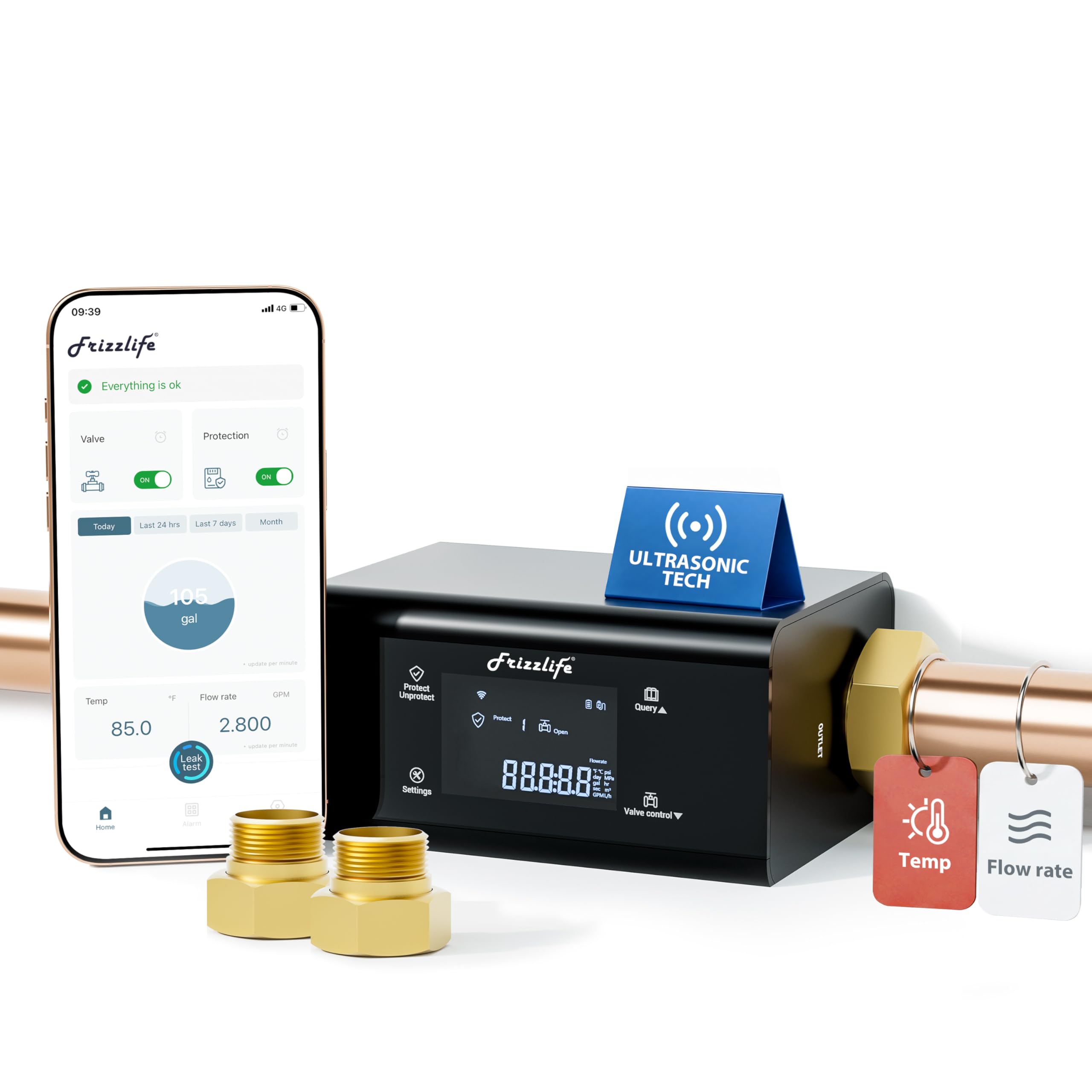
A precision instrument that can smell a drip as small as 0.01 gallons per minute.
The Frizzlife LP365 is built for homeowners who want to know exactly where their water is going. It uses patented ultrasonic micro leak detection to monitor flow rates down to 0.01 GPM. This is incredibly sensitive. It can catch a slow drip from a running toilet or a faucet left slightly open, issues that often go unnoticed until the bill arrives. It fits both 3/4-inch and 1-inch pipes with the included adapters.
The system is NSF/ANSI 61 & 372 certified, meaning it is approved for potable water. The app is the command center here. It provides real-time flow, temperature, and usage reports. Users report it connects stably to Wi-Fi and works with SmartThings. You can set personalized leak protection based on your family size and schedule, which helps cut down on false alarms. It sends alerts via SMS, phone call, and app notification.
One quirk to note: the brass adapters lack flats, so getting a wrench on them for installation is tricky. You have to be careful not to strip them. Also, the valve takes about 20 seconds to close, which is slower than a mechanical ball valve. But for pure monitoring and data, it is tough to top. If you want to see a graph of every gallon you use, this is the pick.
Micro-Leak Hunter: The 0.01 GPM sensitivity is the standout feature here, catching drips that would otherwise waste thousands of gallons.
Installation Friction: The adapter design and the slow closing speed are the main compromises you make for this level of data.
The Analyst’s Choice: Pick this if you want granular data on your water usage and the ability to catch the smallest leaks.
Avoid If: You need a fast-closing valve for a high-pressure system or prefer hardware that is easy to wrench tight.
8. Frizzlife LPG365 Smart Water Auto Shutoff Valve W/ 3 Leak Sensors
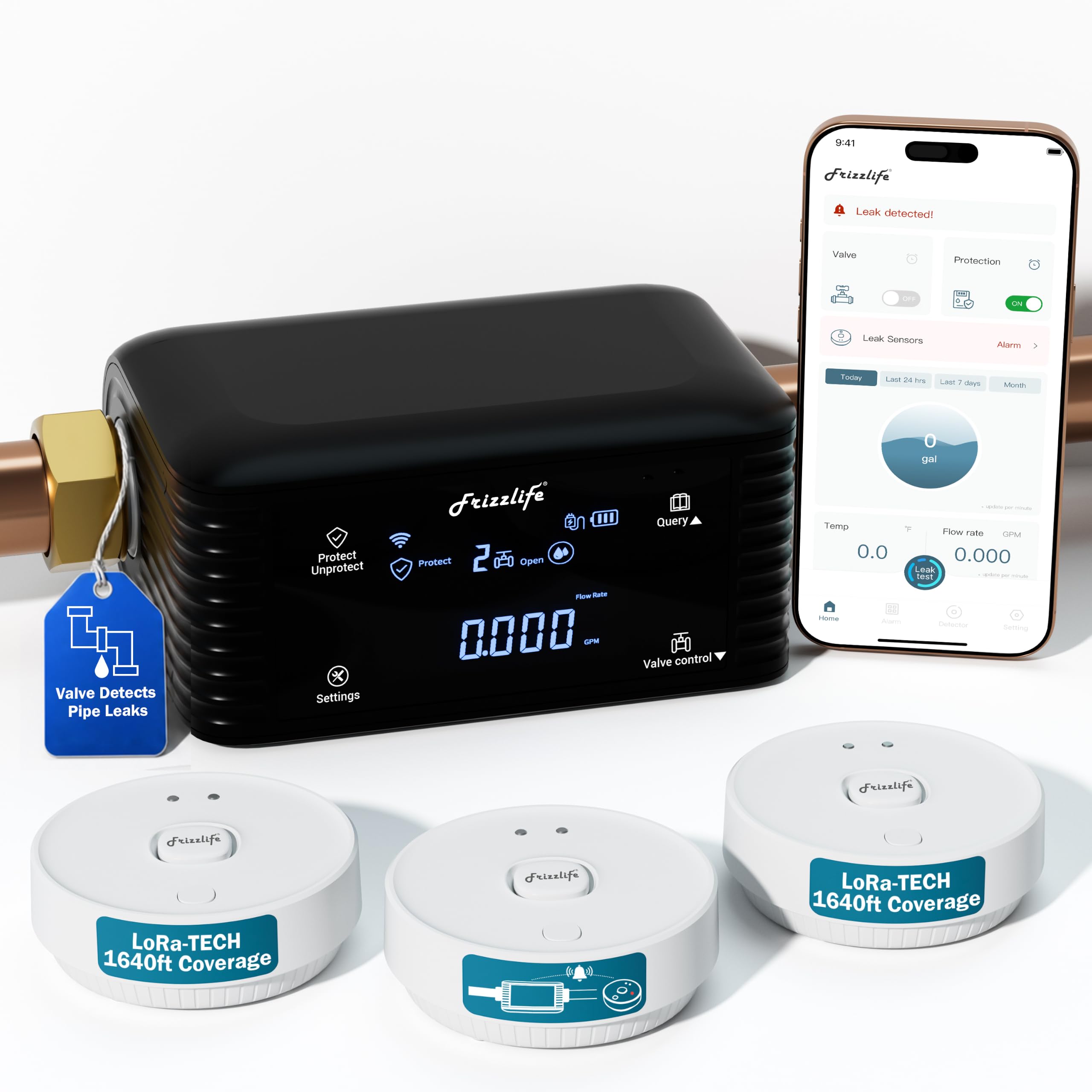
The ultimate belt-and-suspenders system: ultrasonic flow monitoring plus three wireless sensors.
The Frizzlife LPG365 takes everything good about the LP365 and adds physical sensors. It combines the 0.01 GPM ultrasonic flow monitoring with three wireless leak sensors that use LoRa technology. These sensors have a range of 1/3 mile, meaning they can sit in a far laundry room or basement and still signal the main valve to close. This dual-detection approach is the most comprehensive protection you can buy.
The system is NSF/ANSI 61 & 372 certified and fits 3/4-inch or 1-inch pipes. It includes a touch display on the valve itself, which is a nice tactile addition. Users report it detected a crawl space leak within 30 minutes of installation. The sensors work without internet or power, providing critical backup. The valve also has a battery backup that closes it during an outage.
The only real hurdle is the price point, which places it at the top of this list. It is an investment. But for that cost, you get the precision of ultrasonic monitoring paired with the reliability of physical sensors. For a large home or vacation property, that redundancy is the closest thing to guaranteed coverage.
Total Coverage: Combining ultrasonic flow monitoring with three long-range sensors provides unbeatable redundancy.
Top-Tier Investment: The price reflects the dual-technology design, which may be more than you need for a small apartment.
Maximum Protection: The definitive choice for large homes or vacation properties where you can’t risk any water damage.
Budget Check: If you have a small condo with visible plumbing, this level of redundancy might be overkill.
Understanding the Specs
Valve Size and Port Diameter
The valve size tells you what pipe it connects to. You must match your existing pipe — typically 3/4-inch or 1-inch. However, the port diameter inside the valve matters more for performance. A “full-port” valve matches the pipe size internally. A “reduced-port” valve has a smaller internal opening. Reduced ports can drop your water pressure, especially if you have multiple fixtures running. Always check the specs for the port size if pressure is a concern.
Sensor Count and Connectivity
Sensors are your eyes on the water. Count how many you need: one for the water heater, one for the washing machine, one for the kitchen sink. Systems vary from 2 to 8+ supported sensors. Connectivity is the other half. Wi-Fi is easiest for setup but fails if the internet drops. LoRa is a long-range radio that works without internet, allowing sensors to communicate directly with the valve. For reliable protection, look for offline backup capabilities.
FAQ
Do I need a professional plumber to install an automatic water shut-off valve?
What happens if the power goes out or the Wi-Fi drops?
Will an automatic shut-off valve reduce my water pressure?
Can I add more sensors to my system later?
How do I know if the system is compatible with my smart home setup?
What is the difference between a contact sensor and an ultrasonic sensor?
How long do the batteries last in these leak detection systems?
Can these systems detect a slow drip inside a wall?
Will the alarm be loud enough to hear if I am sleeping?
Do these valves work with well water systems?
Final Thoughts: The Verdict
The winner for most homes is the YoLink Water Shutoff Kit. It pairs reliable LoRa connectivity with a 4-sensor kit and works offline, so it protects your home even when the Wi-Fi drops. If you prefer a traditional mechanical valve with a stainless steel body, the U.S. Solid 1″ NSF Certified unit is a rock-solid choice for potable water safety. And for the ultimate in leak detection technology that catches drips as small as 0.01 GPM, the Frizzlife LPG365 offers a dual-detection system that leaves no drop unmonitored.
How We Picked
We do not accept paid placement. Every pick is matched to a real buyer and a real use-case; we do not hands-on test units.
Sources & Methodology
Specifications: manufacturer listings and product documentation. Review insights: verified customer reviews, as of September 2026. Pricing: not shown on this page (it changes often); check the current price via the retailer link.
As an Amazon Associate, KitchPrep earns from qualifying purchases. This does not affect which products we feature.
Related Guides
