
Specs are compiled from manufacturer listings and verified buyer reviews and can change over time — please confirm the key details on the product page before buying.
If you want a bedroom that feels like two rooms, the fastest fix is a folding panel screen you can open, shift, and tuck away without touching a single wall. The picks below range from a 6-panel fabric divider that covers 122.4 inches of floor to a light 3-panel woven screen you can move with one hand. Each one solves a different part of the same problem: carving out privacy in a space that was never built for it.
I’m Mohammad Maruf — the founder and writer behind KitchPrep. This guide is built by comparing the manufacturers’ published specifications and the patterns across verified customer reviews, so you get each pick’s real strengths and trade-offs instead of marketing spin.
Panel count, hinge direction, and packed weight decide whether a divider fits your gap and stays upright — the fabric pattern does not. This walkthrough breaks down the real differences so you can pick the right bedroom divider wall the first time.
Our Picks at a Glance


How To Choose The Best Bedroom Divider Wall
Measure the floor gap before you look at the finish. A divider only works if its open width covers your gap and its frame stays put once unfolded. Three specs decide it: panel count, hinge type, and frame weight.
Panel Count Sets Your Coverage
Each panel is a fixed slice of width, so count is the first number to check. A 3-panel screen covers a doorway or a corner, while a 6-panel or 8-panel divider spans a whole shared wall. The VEVOR 6-panel unit reaches 122.4 inches wide with 22-inch panels, and the VEVOR Japanese screen covers 95.3 inches, so measure your gap before you buy.
Hinge Type Decides How It Folds
Look for hinges that swing both ways, not just in a Z. Panels that fold in only one direction stand in a zigzag and nowhere else. Panels on two-way hinges let you flatten the screen, wrap it around a corner, or fan it out to steady itself.
Frame Material And Weight Matter On Carpet
A light frame is easy to move but tips on thick pile. A heavier frame stays put but is a two-hand job to reposition. Materials split into solid wood, engineered wood, and metal — the heavier solid builds hold their footing better, while lightweight builds suit renters who move the screen often.
Quick Comparison
| Model | Best For | Panels | Open Width | Weight | Amazon |
|---|---|---|---|---|---|
| VEVOR 6 Panel Room Divider★ Best Overall | Widest coverage for the money | 6 | 122.4 in | — | Amazon |
| JOSTYLE 4 Panel Woven BambooBest Looking | Decor-first storage hiding | 4 | 79.9 in | 15.4 lb | Amazon |
| HOMCOM 3 Panel Room DividerBest for Small Rooms | Small rooms and quick moves | 3 | 47.25 in | 6.4 lb | Amazon |
| GIANTEX 3 Panel Boho | Statement piece for open plans | 3 | 48 in | 32 lb | Amazon |
| JOSTYLE 6 Panel Shoji | Full-wall Japanese styling | 6 | 103.8 in | 24.3 lb | Amazon |
| Svimi 4 Panel Carved Wood | Renters who never want a drill | 4 | 60 in | — | Amazon |
| VEVOR Japanese 6 Panel Black | Zoning a studio apartment | 6 | 95.3 in | 19.5 lb | Amazon |
| HALLYBEE 8 Panel | Dividing a room between roommates | 8 | 128 in | 20.7 lb | Amazon |
In‑Depth Reviews
1. VEVOR Room Divider, 6 Panel Folding Privacy Screen, Grey
Our pick — 4.5★ from 700+ verified ratings; the strongest balance of quality and price.
The 6-panel screen that swallows the most floor space for the least money.
Wall-to-wall coverage is the whole point of this one. Six panels at 22 inches each unfold to 122.4 inches wide and 71.1 inches tall, which is more than double the 47.25-inch reach of the HOMCOM 3-panel screen and taller too at 71.1 inches against 67 inches. Fold it back down and the whole thing collapses to 17.7 inches of depth, so it tucks into a closet corner when guests are gone.
What wins people over is how solid it feels once it is standing. The frame is iron rather than wood, and the panels are stretched Oxford fabric — a tight-woven synthetic cloth — so it blocks light instead of letting it through. Owners use it as a balcony privacy fence, a basement partition for holiday guests, and a sun blocker for plants, which tells you the fabric holds up across rooms. Buyers do report the odd unit arriving with missing feet plates, so open the box and lay the hardware out before you start.
Setup lands around 15 minutes and the maker suggests two people, mainly because you are driving 24 M6 screws by hand. A power drill with a matching hex bit cuts that down. Once assembled, slightly fold the W-shaped sections rather than stretching the screen flat — that fold is what keeps it from tipping.
Where It Wins
- 122.4-inch open width covers a full alcove or shared wall
- Fabric panels block light, not just sightlines
- Folds to 17.7 inches deep for closet storage
What To Expect
- Roughly 15-minute build with 24 screws, easier with two people
- Stands best when the W-sections stay slightly folded
- Instruction sheet is thin on detail
Go for it if: you need maximum coverage from a single screen and want a metal frame rather than wood.
Think twice if: you want zero assembly — this one arrives as a kit.
2. JOSTYLE 4 Panel Folding Privacy Screen, Woven Bamboo, Beige
The one that looks like furniture first and a partition second.
Four hinged bamboo panels stretch to 79.9 inches wide and stand 70.9 inches tall, with each panel 19.8 inches across — a touch narrower per panel than the VEVOR’s 22 inches, but with a warmer face. The frame is FSC-certified wood with a matte finish, and the woven surface is exactly what the marketing photos show. As owners put it: “This screen is bamboo and is exactly as pictured.”
The thing everyone raves about is the look, and buyers also flag the value — many use it to hide a furnace, a water heater, or a litter box in a utility corner. No tools, no hardware, no instructions to decode: it arrives ready and opens in seconds. Weighing 15.4 pounds, it is a two-hand carry rather than a drag, and the stainless steel hinges swing both ways so you can angle it around a doorway.
The honest catch is see-through. Privacy on this screen gets mixed feedback because the woven panels read as somewhat transparent, so plan for a screen that softens a room rather than seals it.
Design That Earns Its Spot: the bamboo weave and arched silhouette make this the pick you leave out on purpose instead of folding away.
Know Before You Buy: treat it as a soft partition, not a solid wall — light and silhouettes still pass through.
Reach for this if: you want a divider that doubles as decor and never want to touch a screwdriver.
Look elsewhere if: your room needs a full block-out rather than a visual softening.
3. HOMCOM 3 Panel Room Divider, Folding Privacy Screen, 5.6′, White
At 6.4 pounds, this is the screen you nudge into place with one hand.
Three panels, 47.25 inches across and 67 inches tall, built on a solid wood frame with double-sided woven paper over bamboo sticks. That 6.4-pound total is dramatically lighter than the GIANTEX at 32 pounds — the difference between shifting a screen to vacuum and needing help to move it. Folded, it compresses to 15.5 inches wide and 2.25 inches deep, thin enough to slide behind a door.
You can see straight through it, deliberately. The weave lets air move and light pass while blurring whatever sits behind, so a porch or a hallway gets separation without going dark. Buyers mount it with zip ties to eye screws, hinge it open to a wall, and use it to keep cats on one side while still letting them see. It ships ready to use — no assembly, no tools.
Stability is where this screen splits opinion. Thinner panels and a light frame wobble on bare floors and tip if they sit at a bad angle, and a few owners note loose strings or debris on arrival. Nail it to a post, weigh the feet, or fold one panel out for a wider base and it settles down. There is a 1-year warranty against manufacturer defects if anything goes wrong.
The Lightweight Play: under seven pounds means you can clear the floor and reset the room in seconds.
The Trade Off: stability needs a little help on smooth floors, so plan a weighted base or a wall-adjacent angle.
Pick this one when: your gap is a doorway, a porch, or a tight hallway and you want a screen that moves without a struggle.
Pass if: you need something that can be leaned on without tipping.
4. GIANTEX 3 Panel Boho Room Divider with Carved Palm Leaf Pattern
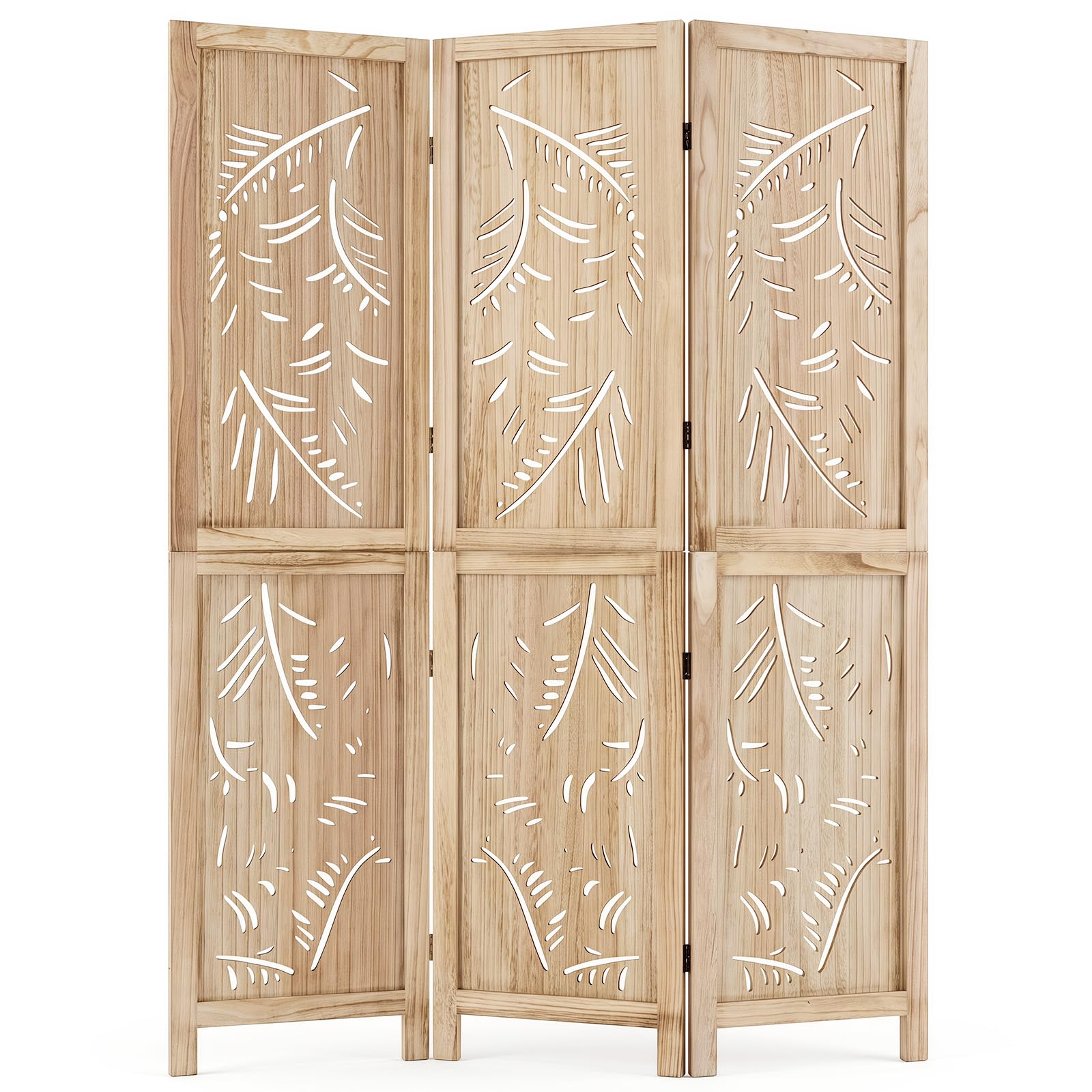
Hollow-cut palm leaves throw patterned shadows across the whole room.
This is the one you notice before the furniture. Three hinged panels of solid paulownia wood, 48 inches wide and 67 inches tall, carved with hollow palm-leaf cutouts so light lands on the floor in a pattern instead of a flat shadow. The frame carries rust-resistant cold-rolled steel hinges and protective foot pads that guard your flooring.
This divider arrives in two tiers and bolts together with the included hardware, so it is a roughly 30-minute assembly rather than a ready-to-use screen. At 32 pounds it is the heaviest divider on this list by a wide margin — the JOSTYLE 4-panel bamboo screen weighs less than half of it — and that mass is exactly why it does not shift around. Once it is up, the double-action hinges (hinges that fold both ways) let you zigzag it or swing it into an L-shape against a wall.
What buyers respond to is how much it changes the room. Functionality and privacy both lead the feedback, and owners use it to carve a reading corner out of a dining space, hide clutter in an apartment, or set a photography and video-call backdrop. A smoky scent from the etching lingers about a week during the break-in. Color can vary panel to panel, with a few reporting faded patches.
Why It Stands Out
- Carved cutouts create real light-and-shadow texture
- At 32 pounds, it holds its ground without weights
- Hinges fold both ways for zigzag or L-shape layouts
The Honest Downsides
- Arrives in two tiers, about 30 minutes of assembly
- Distressed finish means color varies from panel to panel
- Etching has a smoky scent for roughly a week
The right fit: a design-led space where the divider is meant to be seen and the heavier frame is part of the appeal.
Wrong fit: a tight budget corner or a room where you plan to fold the screen away nightly.
5. JOSTYLE 6ft Japanese Room Divider Wall, 6-Panel Shoji Privacy Screen, 104″ W
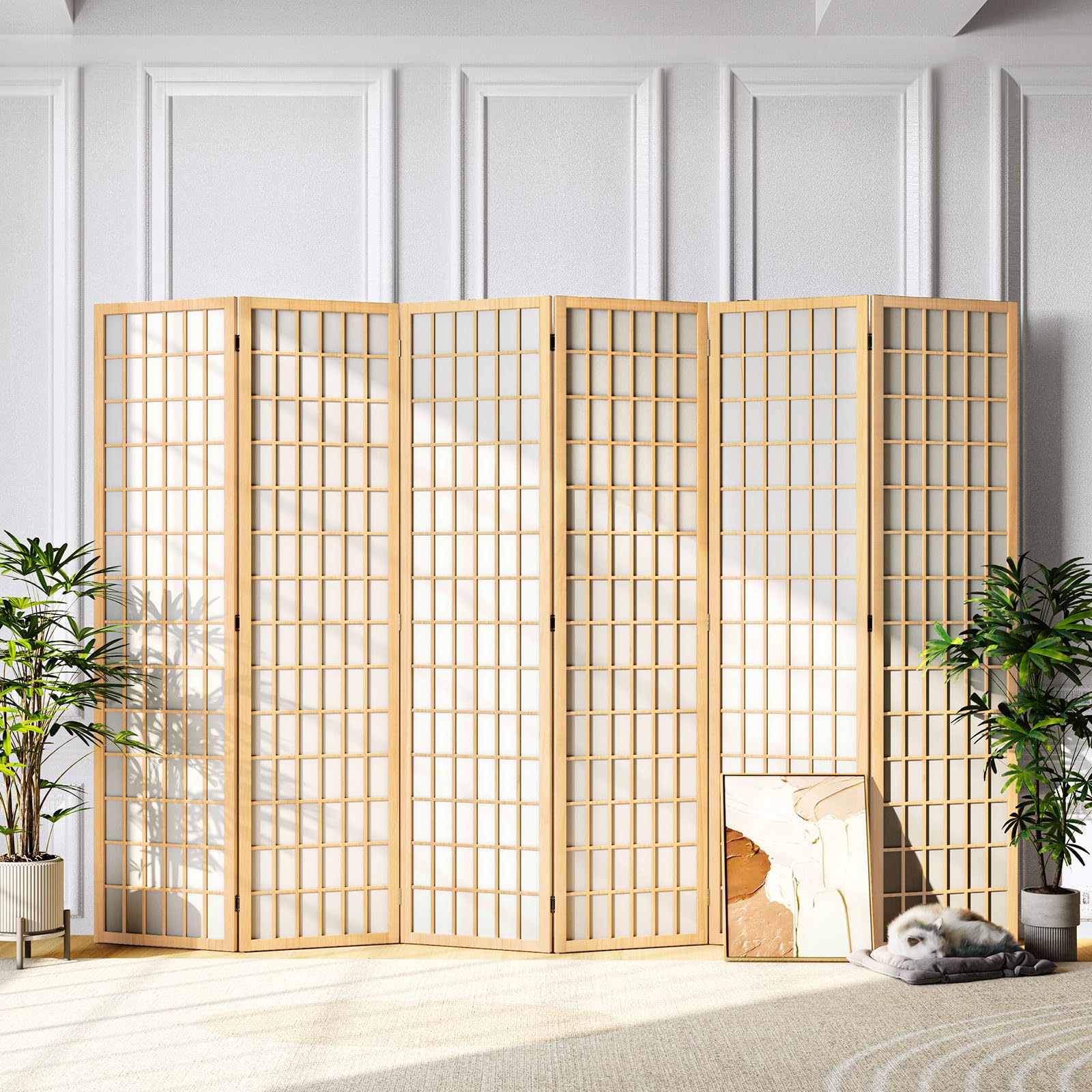
Full-wall Japanese styling that arrives already put together.
Six shoji-style panels span 103.8 inches wide and 70.86 inches tall, with each panel 17.3 inches across. The frame is pine wood behind a lattice screen of non-woven fabric, and the stainless steel hinges open a full 180 degrees. Nothing to bolt, nothing to line up — this one is freestanding from the moment it leaves the box, and the whole screen weighs 24.3 pounds.
Buyers report that the panels fold smoothly, the frame stays flat, and the screen reads as clean and authentic rather than printed-on. Light filters through the lattice (the crisscross wooden strips) while keeping the room behind it private, which is why it works so well behind a standing desk — one owner at 5’6″ with a camera around 6’4″ reports the screen covers the full background.
Two honest notes. Sturdy as the frame is, a couple of owners wish the legs were taller — the wood can feel short against a thick rug. And the fabric is light-diffusing rather than opaque, so figures moving behind it cast faint shadows. Standing next to the wider VEVOR 6-panel screen, this one runs four inches taller at 70.86 inches versus 66.9 inches, and the shoji look is a different style entirely.
Why It Leads on Style: the 104-inch span and lattice design make it read as a built-in wall, not a temporary screen.
Not For Everyone: it diffuses light rather than blocking it, so a pitch-dark sleep corner needs a different build.
Best for you if: you want a full-width, no-assembly statement screen with a Japanese look.
skip it if: you need opaque coverage for sleeping in daylight.
6. Svimi Room Divider, 4 Panel Wood Carved Folding Screen, White

A carved louvered screen that opens the moment you pull it from the box.
Four panels of paulownia wood, 60 inches wide and 67 inches tall, split into a carved top section and a louvered bottom. Paulownia is roughly 40 percent lighter than common wood, so this large screen stays a manageable move without the bulk you would expect from a 60-inch piece. Two-way metal hinges at each joint let you fold the whole thing flat or angle individual panels.
Setup is genuinely nothing — unfold and use. The manufacturer notes that the white finish can shift under different lighting, from bright white in daylight to a warmer tone indoors, so view it in your own room before deciding on a color match. Wipe it clean with a dry cloth and it stays looking sharp.
The piece people describe most often is the carved top, with the cutouts letting light flow through so the screen brightens a room instead of closing it off. Sturdiness is the part to plan around: a few owners find it falls easily and end up adding weights to the feet or bracing it against a wall. On a bare floor it is best used as an accent partition in a corner or behind a desk, not as a screen you lean on. If a panel arrives damaged, the seller has replaced entire screens, and owners call that service out specifically.
Where It Delivers
- Assembles in zero minutes — unfolds ready to use
- Paulownia build keeps a 60-inch screen movable
- Carved cutouts pass light through rather than blocking it
Where It Needs Care
- Light frame tips on smooth floors unless weighted
- White finish reads differently under indoor and daylight
- Not intended as a screen you can push against
Suits you if: you want a wide carved accent screen with no setup at all.
Doesn’t suit you if: you need a solid, plant-still partition for a busy walkway.
7. VEVOR 6 Panel Japanese Room Divider, Folding Privacy Screen, Black
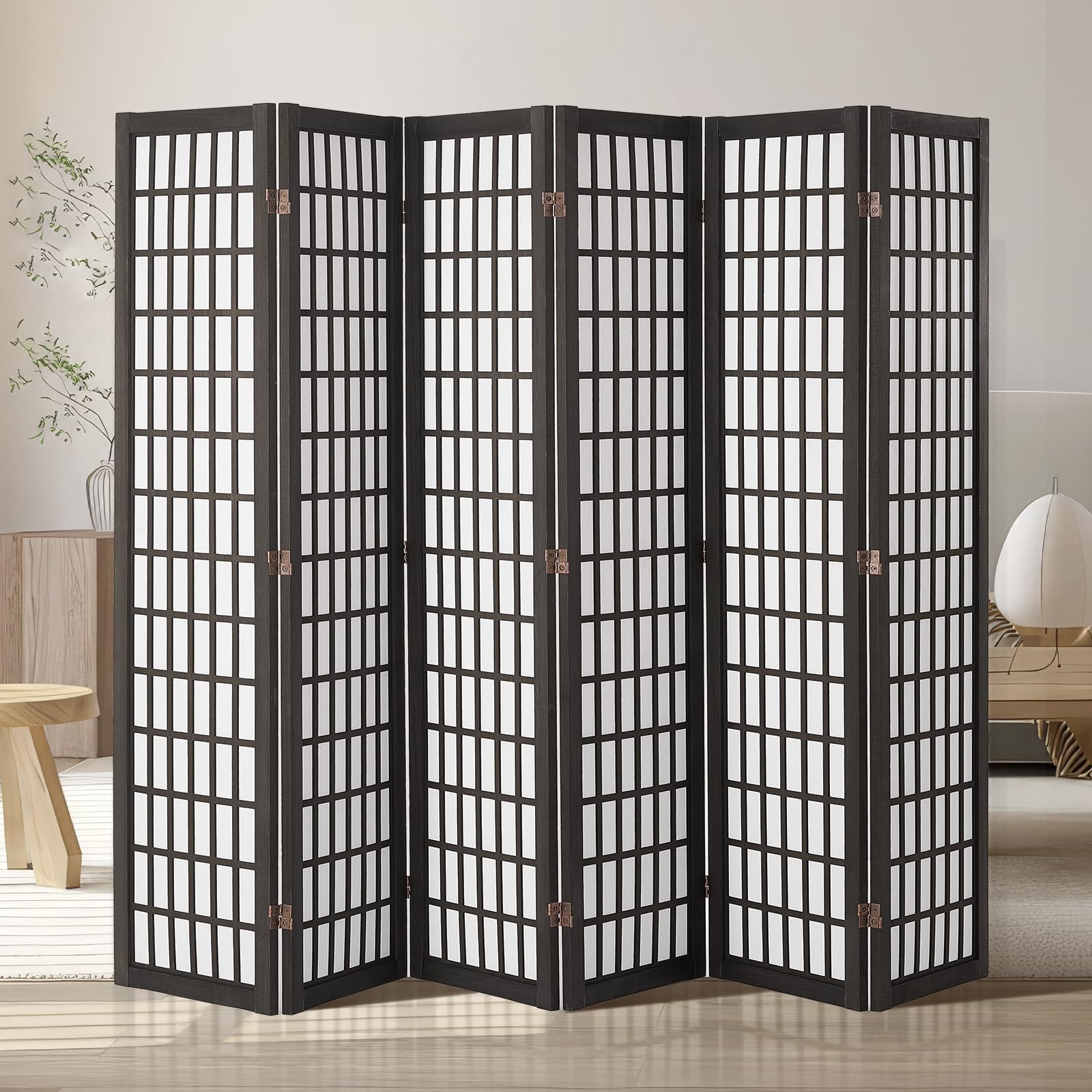
Three panels of black Japanese grid that turn a studio into separate zones.
Picture a single room split four ways without a single nail. This screen spans 95.3 inches wide and 66.9 inches tall with a black wooden grid frame, and the non-woven fabric panels block sightlines while letting air move. Each panel joins on three flexible bidirectional hinges, so it rotates a full 360 degrees and folds in any direction you push it.
No assembly at all — lift it, position it, arranged in a zigzag for extra support. At 19.5 pounds it is light enough to reposition alone, and the water-based paint finish is smooth to the touch with no splinters. It sets up as a photo or video-call backdrop as easily as it does a room partition, and buyers use it to soften harsh window light.
The honest caveat is the panels themselves. Several reviews call them thin, and one notes the center panel is pressed composite rather than solid wood, so the finish reads better from across a room than from inches away. The frame can also drift on thick carpet because the base is light — a zigzag stance fixes most of that. Measure carefully, because the exact fit is what makes this screen work in a tight apartment.
What Makes It Flexible: 360-degree hinges on every joint let you fan, zigzag, or wrap the screen around a corner without hardware.
The Honest Limit: thin panels and a light base suit a carpeted corner better than a high-traffic walkway.
Made for: studio and one-room living where you want to carve out a desk, a kitchenette, and a sleep corner from the same floor.
Not made for: anyone expecting solid-wood heft or close-up furniture-grade finish.
8. HALLYBEE 8 Panel Room Divider, Diamond Weave, Dark Mocha
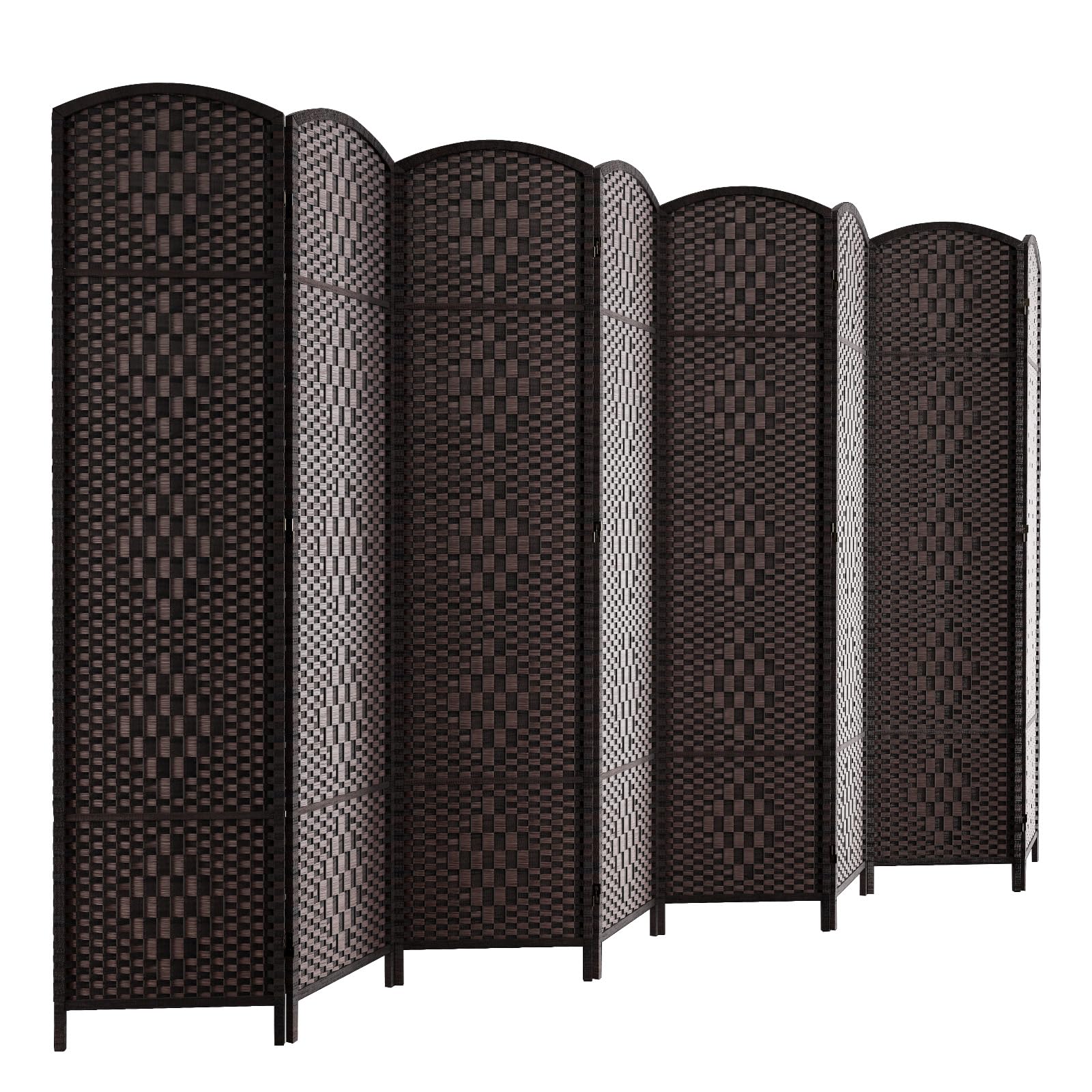
Eight panels of diamond weave that wall off a whole side of a room.
When a standard screen is not enough, this one goes longer. Eight panels at 128 inches wide and 71 inches tall stretch wider than the VEVOR 6-panel at 122.4 inches and taller than the HOMCOM at 67 inches. The frame is a blend of bamboo, paper, and pine wood in dark mocha with a diamond weave pattern, and two-way hinges let every panel fold in both directions rather than locking into a single zigzag.
At 20.7 pounds it is easier to move than its size suggests, folding completely for storage. Everybody notices the weave first — the paper material reads warmer and more durable than synthetic canvas, and it lets light through while still blocking sightlines. It is at home on a patio as much as a bedroom, and the taller profile means you cannot see over it.
The main thing to inspect on arrival is the panel surface. A few units show cracked sections of material from the start, though the divider still does its job. Since it is freestanding and folds up, storage between uses is simple — just keep it out of a doorway where feet catch the edges.
Why Eight Panels Win: the extra span and 71-inch height give shared-space privacy that smaller screens cannot match.
What To Check First: run your hand across the weave when it arrives — a rare unit shows cracks, and it is easiest to flag right away.
Buy it if: you are splitting one room between two people and need the widest, tallest coverage available.
Leave it if: your space only needs a doorway-sized screen.
Understanding the Specs
Panel Count and Open Width
Panel count is just a headcount — open width is the number that has to fit your gap. Each panel adds a fixed slice, so a 6-panel screen with 22-inch panels reaches 122.4 inches, while a 3-panel screen tops out around 47.25 inches. Measure the gap you want covered, then add a little extra so the screen can angle for stability. A screen that matches the gap exactly is harder to arrange than one with a few spare inches.
Hinges and Fold Direction
Hinges decide how many ways the screen can stand. One-way hinges fold only in a Z and leave you limited to a zigzag stance. Two-way hinges let panels fold both directions, so you can wrap a corner, flatten the screen for storage, or fan it into a wider base. If you plan to move the divider often, two-way hinges save real effort every time.
Frame Material and Weight
Weight and stability travel together: a 6.4-pound screen tips on smooth floors, a 32-pound solid-wood screen stays planted. A 6.4-pound screen shifts easily but tips if it is nudged on a smooth floor; a 32-pound solid-wood screen stays planted but takes two hands to move. Solid wood and metal frames generally resist wobble better than thin engineered panels. Match frame weight to how often you will reposition the screen: light builds for renters who move it weekly, heavy solid wood for a screen that stays put.
Panel Opacity
Opacity decides whether a screen blocks light or just softens it. Woven paper, bamboo, and non-woven fabric panels filter light and let air through, keeping a room airy while blurring what is behind. Tight Oxford fabric blocks more light for darker separation. If you are covering a bedroom window gap, choose the denser fabric; for a work corner, a light-filtering panel keeps the space bright.
FAQ
How wide should a bedroom divider wall be for a full wall?
Do room dividers tip over easily on carpet?
Can a folding privacy screen block light for sleeping in daylight?
Which room dividers need no assembly at all?
Is a 6-panel room divider different from a 3-panel one?
Can I use a bedroom divider wall in a shared apartment or basement?
Does a room divider hold up outdoors on a patio or balcony?
How do I keep a folding room divider from tipping over?
What material is best for hiding clutter or utility areas?
Do these screens arrive with the hardware I need?
Final Thoughts: The Verdict
The VEVOR 6-panel fabric divider earns the top spot because it covers 122.4 inches of floor, stands 71.1 inches tall, and folds down to 17.7 inches deep — more coverage and more light blocking than anything else in this price band. If a softer look fits your room better, the JOSTYLE 4 Panel Woven Bamboo opens with zero assembly and looks like a piece of furniture. For a full wall of Japanese styling, the JOSTYLE 6 Panel Shoji spans 103.8 inches without needing a single tool. If you are splitting one room between two people, the HALLYBEE 8 Panel gives you 128 inches at 71 inches tall so nothing shows over the top. And if you are covering a small doorway porch or hallway, the HOMCOM 3 Panel at 6.4 pounds will move as often as you need.
How We Picked
We do not accept paid placement. Every pick is matched to a real buyer and a real use-case; we do not hands-on test units.
Sources & Methodology
Specifications: manufacturer listings and product documentation. Review insights: verified customer reviews, as of September 2026. Pricing: not shown on this page (it changes often); check the current price via the retailer link.
As an Amazon Associate, KitchPrep earns from qualifying purchases. This does not affect which products we feature.
Related Guides
