
Specs are compiled from manufacturer listings and verified buyer reviews and can change over time — please confirm the key details on the product page before buying.
When the grid goes down, you want the lights, the fridge, and the furnace to keep running without hauling gasoline cans into a storm. A natural gas backup generator does that job. It sits outside your home, taps the same gas line that feeds your furnace, and starts itself the moment utility power drops. Three Generac Guardian standby units are worth your attention here. The 26kW Guardian is the strongest all-round choice for most homes. The 10kW is the smart pick for smaller houses and tighter budgets. The 22kW sits in the middle for buyers who want capacity headroom.
I’m Mohammad Maruf — the founder and writer behind KitchPrep. This guide is built by comparing the manufacturers’ published specifications and the patterns across verified customer reviews, so you get each pick’s real strengths and trade-offs instead of marketing spin.
A standby generator is a big-ticket, permanent install. So the details that matter are fuel type, wattage, transfer switch amperage, and whether the install crew can reach your gas meter. This breakdown of the best natural gas backup generator covers every spec you need before you call an electrician.
Our Picks at a Glance
How To Choose The Best Natural Gas Backup Generator
A standby generator is a permanent appliance, not a portable unit you wheel out of the garage. It gets wired into your home’s electrical panel, plumbed into your gas line, and bolted to a concrete pad outside. Get the size wrong and you either waste money on capacity you never use, or you find out the hard way that the air conditioner won’t start. Here is what actually drives the decision.
Size the generator to your real load, not your square footage
The kW rating (kilowatts, the measure of how much electrical power the unit can produce continuously) decides which appliances survive an outage. A 10kW unit covers the essentials — fridge, freezer, furnace, lights, internet, and a few outlets. It will not run central air conditioning alongside everything else. Step up to a 22kW or 26kW unit and you gain the headroom to run larger loads like a well pump, an electric range, or a multi-zone AC system. The honest way to choose: list your critical appliances, add up their starting and running watts, then buy the next size up from that total.
The transfer switch amperage has to match your panel
The transfer switch is the automatic box that disconnects your home from the utility grid and connects it to the generator the instant power fails. Its current rating in amps (A) must line up with your home’s main electrical service. A 200A transfer switch suits a modern home with a 200-amp service panel. A 100A switch fits smaller homes and older panels. If the amperage does not match, your electrician has to make adjustments that add cost and complexity to the install. Check your panel’s main breaker rating before you buy anything — it takes two minutes and saves a lot of headaches.
Natural gas vs liquid propane: pick your fuel line
All three units here run on natural gas or liquid propane, which is a genuine advantage. Natural gas means no fuel deliveries, no tanks to refill, and no fuel going stale. The generator draws straight from your home’s existing gas supply, so it can run indefinitely as long as the gas line stays pressurized. Liquid propane needs a storage tank on your property but produces slightly more power per unit of fuel, and it works in areas without a municipal gas hookup. If you already have a gas meter, natural gas is the simpler long-term choice. If you live rurally with no gas service, propane is your path.
Installation realities: gas meter distance and concrete pad
Two site conditions drive most of the surprise costs. First, how far the generator sits from your electrical panel and your gas meter — longer runs of electrical conduit and gas pipe mean more labor and more material. Second, the concrete pad the unit bolts onto, which has to be level and sized for the footprint. Generac recommends installation by a certified and licensed electrician for all three of these units. Reviewers consistently say the install quote matters as much as the sticker on the machine. Talk to your electrician and plumber before you order, not after the crate arrives on your driveway.
Quick Comparison
| Model | Best For | Power Output | Transfer Switch | Engine Displacement | Amazon |
|---|---|---|---|---|---|
| Generac Guardian 26kW★ Best Overall | Large homes, heavy loads | 26 KW | 200 A | 999 cubic centimeters | Amazon |
| Generac Guardian 22kW | Mid-size homes, quiet self-test | 22 KW | — | 999 cubic centimeters | Amazon |
| Generac Guardian 10kW | Smaller homes, essentials backup | 10 KW | 100 A | 460 cubic centimeters | Amazon |
In‑Depth Reviews
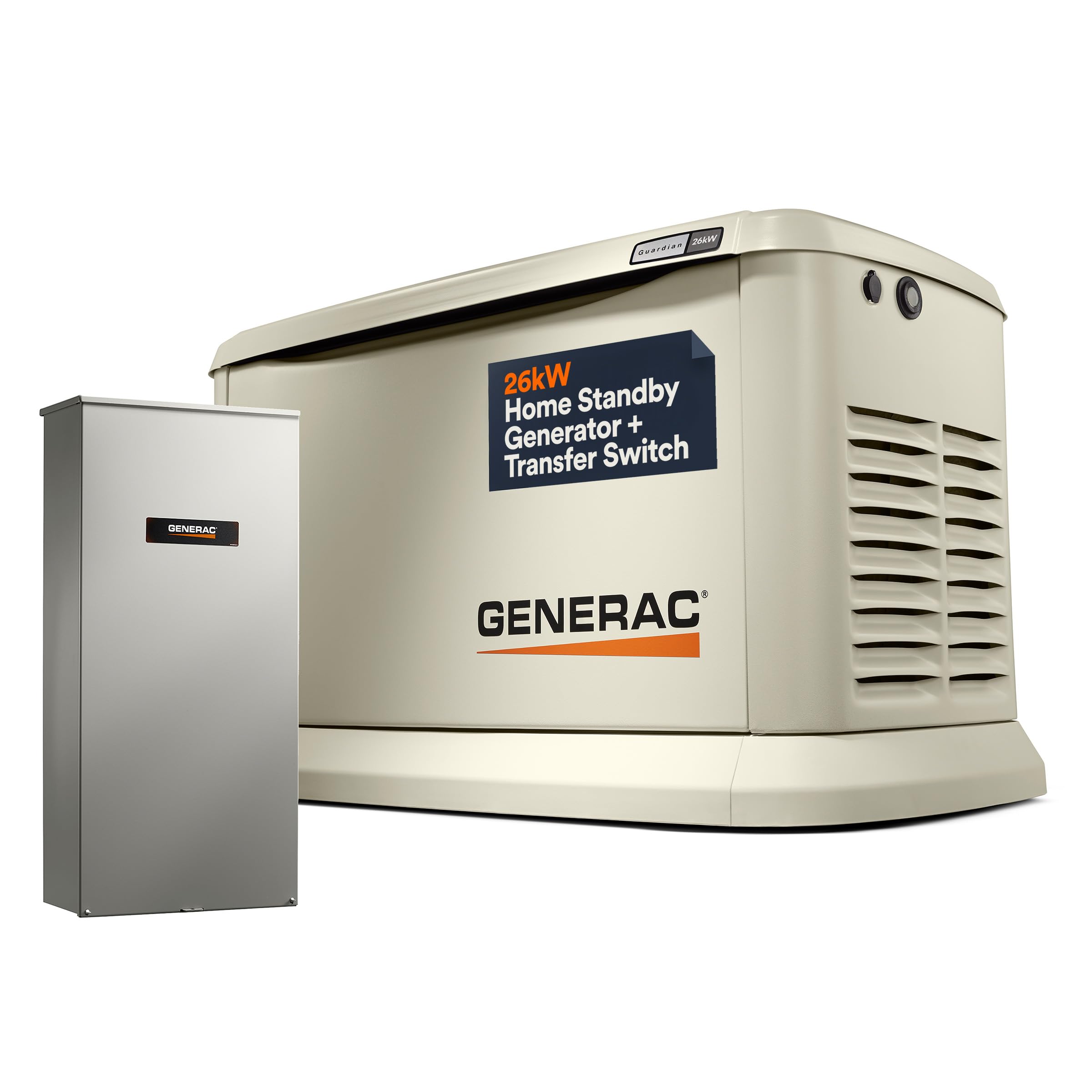
1. Generac Guardian 26kW Home Generator, Transfer Switch & WiFi Monitoring
Our pick — over 4★ from 50+ verified ratings; the strongest balance of quality and price.
The eight-cylinder workhorse that keeps a full-size home lit through a multi-day blackout.
This unit earns the top slot because it makes 26,000 watts — more than any other pick here — so a big house can run central air, a well pump, and a kitchen full of appliances at the same time. That output means you stop choosing which appliances to shed during an outage. Generac’s True Power Technology delivers that power with under 5% harmonic distortion. Harmonic distortion is a measure of how clean the electrical signal is. Clean power matters because sensitive electronics, such as a modern furnace control board or a fridge compressor, last longer on it.
The gap between this unit and the 10kW model is not subtle. The G-Force 1000 Series engine displaces 999 cubic centimeters, more than double the 460 cubic centimeters of the smaller 10kW unit. A bigger engine holds steady under heavy simultaneous load instead of straining, so your lights do not flicker when the AC kicks on. The bundled transfer switch is rated at 200 amps, double the 100-amp switch that comes with the 10kW, so it suits a modern home with 200-amp service. Even the cabinet footprint differs slightly, measuring 48.5 inches long by 25.1 inches wide by 28.6 inches tall — a touch wider than the smaller models, so it needs a little more pad space.
The recurring trade-off is cost and installation, not reliability. One reviewer noted that Generac pushes an extended warranty hard after the sale. A handful of owners also flagged that the included transfer switch box arrived with damage, or that coaxing the smartphone app into a working state took patience. None of that changes what the machine does once it is running. It starts itself, and the app lets you schedule test runs that lubricate the engine and reports faults straight to your phone.
What earns it the top slot
- 26,000 watts of continuous power with under 5% harmonic distortion for clean, stable current
- 999cc G-Force 1000 Series engine — the largest displacement in this lineup for sustained heavy loads
- 200-amp transfer switch matches modern whole-home electrical service
- WiFi monitoring tracks performance and maintenance alerts from anywhere
- Runs on natural gas or LP gas, plus a 5-year limited warranty
Where it demands planning
- Installation is a real budget line — owners mention tech install running into the thousands
- Needs a poured pad and Generac recommends a certified licensed electrician
- Occasional reports of transit damage to the transfer switch enclosure
Built for: large homes running central air, well pumps, and full kitchens through extended outages, where capacity headroom is worth the extra install cost.
Think twice if: your service panel is only 100 amps or your load list is modest — you would be paying for capacity you never draw.
2. Generac Guardian 22kW Home Standby Generator, WiFi Monitoring
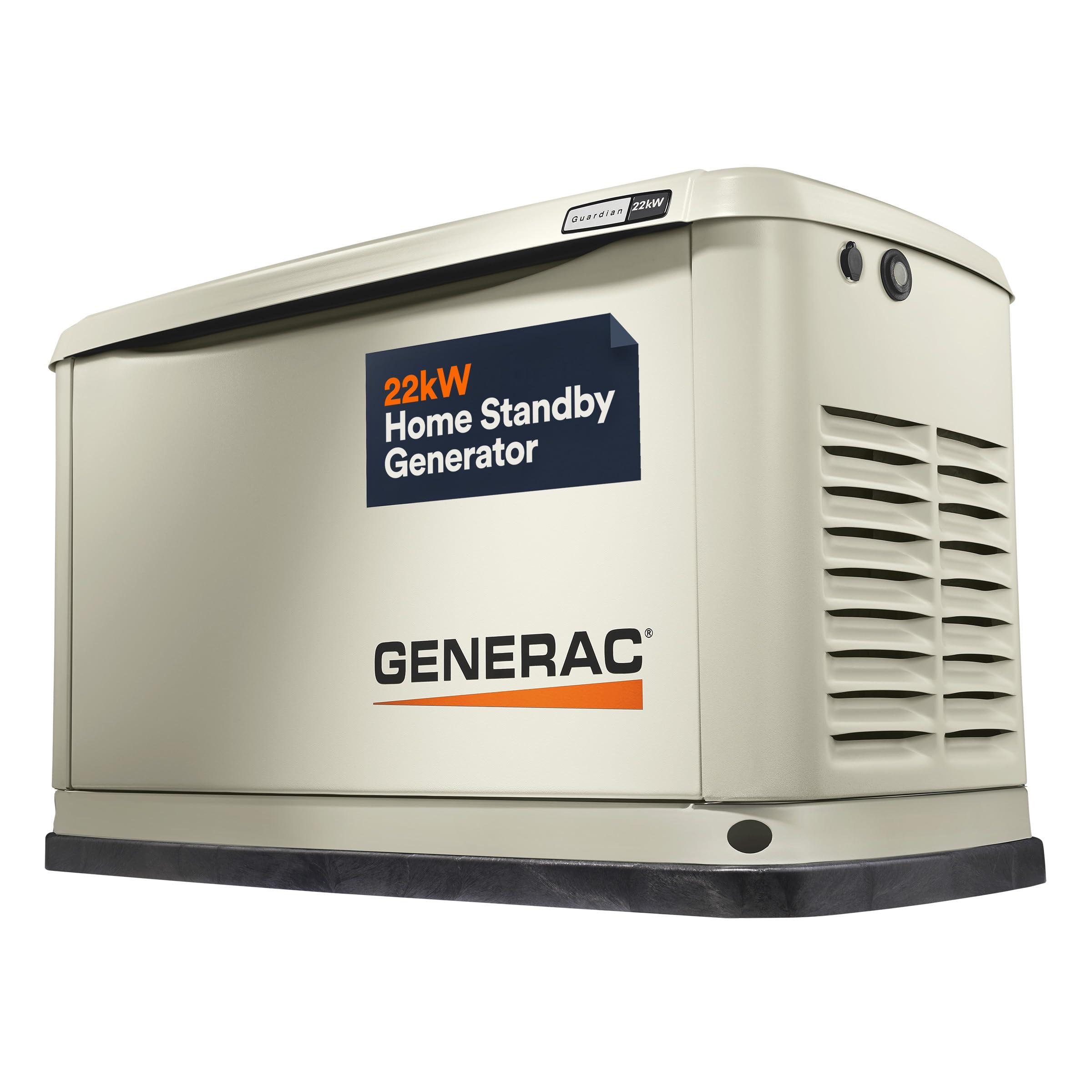
The middleweight that tests itself quietly every week so the neighbors barely notice.
Its weekly self-test runs at lower RPM, which is why this 22kW unit sits on the list. That slow exercise cycle, called Quiet-Test, keeps the sound down in your yard and, according to Generac, saves fuel compared to how other brands test. You get that quiet routine plus 22,000 watts of output. It shares the same 999 cubic centimeter G-Force 1000 Series engine found in the 26kW model, so it carries the same displacement advantage over the 460cc 10kW without matching the flagship’s output. True Power Technology keeps harmonic distortion under 5% here too, meaning the same clean power for sensitive electronics.
Owners describe the noise honestly: running under load it sounds like a power mower outdoors, but is quiet enough inside the house that you can sleep through it. Placement does a lot of work here, so pick a spot where a fence, hedge, or the far side of the house can soak up sound. The convenience of automatic operation is what buyers keep coming back to. The unit auto-triggers itself during storms, and one long-time owner’s 15-year-old Generac 17kW Guardian ran continuously for five days after Hurricane Laura.
The trade-offs to weigh are install cost and the value of the app. Distance from your electrical panel and gas meter has a big effect on the install quote, so consult your electrician and plumber before buying. Setting up the WiFi connection is fiddly enough that some owners never get it working, and a few buyers recommend printing your order page and your card statement to compare them after purchase. At 466 pounds, it needs a proper pad, and an occasional unit has shown up with a dented rear panel straight out of shipping.
What wins people over: the combination of 22kW capacity, the large 999cc engine, and a self-test cycle engineered to run quieter while saving fuel.
The honest catch: it costs meaningfully more than the 10kW yet gives up the 200-amp transfer switch and the full 26kW of the flagship — it is a middleweight, not a flagship, and the WiFi setup frustrates a portion of buyers.
Choose this one over the 26kW if: a mid-size home wants near-whole-house coverage, a lower-RPM weekly test, and a generator you forget about until you need it.
Reconsider, however, if: you want the highest transfer-switch capacity or the confidence that comes from the larger 26kW output.
3. Generac Guardian 10kW Home Generator, Transfer Switch & WiFi Monitoring

The essentials-only pick that keeps the fridge cold and the furnace burning for the smallest footprint.
You do not need to run the central air to survive a storm. This 10,000-watt unit keeps the refrigerator, freezer, furnace, lights, and internet alive through an outage, without paying for capacity you will never use. It produces 10,000 watts with the same under-5% harmonic distortion as the larger models, so the power quality is clean even if the quantity is smaller. It comes bundled with a 100-amp transfer switch and a 16-circuit panel, which fits smaller homes and older service panels where a 200-amp switch simply would not apply.
Durability is the quiet story here. One buyer’s previous Generac ran 24 years before needing replacement. The G-Force 400 Series engine displaces 460 cubic centimeters, less than half the 999cc of the 22kW and 26kW units — which is exactly why it costs less and sips fuel while it runs. As with the larger models, it runs on natural gas or LP gas, so you can plumb it into an existing gas line and let it draw fuel endlessly, or feed it from a propane tank on a rural property.
What you give up is headroom, and you should go in clear-eyed about that. A 10kW unit covers the essentials but will not start central air conditioning or run an electric range while other loads are going, so it belongs in a home with a lean load list. The other gripes are small: WiFi setup asks for patience, and more than one buyer has noted that the shop which handled warranty service would not do additional work — even paid work — unless the unit had been bought through them. A little homework on your local service options before ordering goes a long way.
The value read: a clean-burning, low-maintenance 10kW machine with a 100-amp/16-circuit transfer switch aimed squarely at smaller homes, at a price that still leaves room in the budget for the install.
The size caveat: the 460cc engine and limited output mean you have to pick which appliances matter — this is an essentials generator, not a whole-house flagship.
Reach for it if: you have a compact home or a 100-amp panel and want reliable essentials backup without paying for unused capacity.
skip it if: you need central air, a well pump, or an electric range to run at the same time — you will want the 22kW or 26kW instead.
Understanding the Specs
Engine power output (kW)
The kW rating — kilowatts, the measure of continuous electrical power the generator can deliver — is the single number that decides how much of your home stays alive during an outage. A 10kW unit produces 10,000 watts and handles the essentials: fridge, freezer, furnace, lights, and internet. A 22kW unit produces 22,000 watts and a 26kW unit produces 26,000 watts, and those higher outputs let you stack on central air, a well pump, or an electric range. When in doubt, size to your critical appliance list and buy the next step up, because starting currents on motors can spike far above their running draw.
Engine displacement (cubic centimeters)
Displacement measures the total volume of the engine’s cylinders, and it tells you how much physical muscle the motor has to carry a load. The 26kW and 22kW units use the larger G-Force 1000 Series engine at 999 cubic centimeters, while the 10kW unit uses the smaller G-Force 400 Series at 460 cubic centimeters. A larger engine holds its RPM steadier when several appliances kick on at once, which means less strain and more consistent voltage. That is why the bigger-displacement units are the ones built for whole-house duty, while the smaller engine suits an essentials-only load list.
Transfer switch amperage (A)
The transfer switch is the automatic control that flips your home from utility power to generator power the instant the grid fails. Its amp rating must line up with your home’s main electrical service. The 26kW unit ships with a 200-amp transfer switch, matching a modern 200-amp service panel, while the 10kW ships with a 100-amp switch and a 16-circuit panel for smaller homes. Get the pairing wrong and your electrician has to add hardware and labor to bridge the difference. Check your main breaker’s rating before you buy — it is a two-minute check that prevents a costly surprise.
Harmonic distortion and clean power
Harmonic distortion measures how closely the generator’s electrical output resembles the smooth sine wave a utility delivers; lower is better, and Generac’s True Power Technology keeps all three of these units under 5%. Why should you care? Because sensitive household electronics — a furnace control board, a modern fridge compressor, a computer power supply — tolerate dirty power poorly, and clean output helps them run correctly when they are running off a generator. It is one of those specifications that never shows up on a sales sticker but matters the moment an expensive appliance is plugged into the wall behind it.
FAQ
Will a 10kW generator run my air conditioner?
What does the transfer switch do and why does the amperage matter?
Can these generators run on natural gas and propane both?
How far from my electrical panel and gas meter can the generator sit?
Does the generator start automatically when the power goes out?
Do I still need a concrete pad and a permit?
How loud are these units when they run?
How long do these Generac standby generators last?
Is the transfer switch included with each generator?
Can I run the generator on a propane conversion kit I already own?
Final Thoughts: The Verdict
For most homes, the best natural gas backup generator is the Generac Guardian 26kW — it carries the biggest engine at 999cc, the highest output at 26,000 watts, and the 200-amp transfer switch that matches modern service, and buyers describe it as the unit that keeps the house lit through bad weather. If quiet weekly self-tests and near-whole-house coverage matter more to you than raw output, the 22kW Guardian with its lower-RPM Quiet-Test mode is the one to reach for. And for a smaller home or a 100-amp panel where essentials backup is all you need, the 10kW Guardian is the value pick — one buyer’s previous unit ran 24 years before replacement.
How We Picked
We do not accept paid placement. Every pick is matched to a real buyer and a real use-case; we do not hands-on test units.
Sources & Methodology
Specifications: manufacturer listings and product documentation. Review insights: verified customer reviews, as of September 2026. Pricing: not shown on this page (it changes often); check the current price via the retailer link.
As an Amazon Associate, KitchPrep earns from qualifying purchases. This does not affect which products we feature.
Related Guides
