
Specs are compiled from manufacturer listings and verified buyer reviews and can change over time — please confirm the key details on the product page before buying.
If your room sounds hollow, your video calls boom, or your TV rattles the neighbours, the fix is not more furniture — it is surface area with the right material behind it. This guide covers eight acoustic panels that real buyers actually keep on their walls, from budget foam pyramids to wood-slat feature walls that double as decor.
I’m Mohammad Maruf — the founder and writer behind KitchPrep. This guide is built by comparing the manufacturers’ published specifications and the patterns across verified customer reviews, so you get each pick’s real strengths and trade-offs instead of marketing spin.
Below you will find the practical differences between foam, polyester fiber, and wood-look slat construction — plus which acoustic panels suit a studio, a home office, or a rented apartment you cannot drill into.
Our Picks at a Glance


How To Choose The Best Acoustic Panels
Acoustic panels do not make a room silent. They soak up the reflections that bounce around a hard room, which is what makes a voice sound thin and a TV sound muddy. Pick the wrong thickness or material and you will spend a weekend sticking squares on a wall for almost no audible payoff.
Thickness decides which frequencies you actually tame
Thin tiles in the 0.4-inch range mostly catch the high stuff — sharp echoes, keyboard clatter, the ring of an empty room. Thicker panels in the 2-inch range and up start working on the warmer middle frequencies where voices and drums live. If your problem is a neighbour’s bass, no foam panel on this list is a full answer; you are treating echo and reverb, not structural sound transfer.
Coverage in square feet is the number most buyers get wrong
A pack description tells you how many panels and how big each one is. Multiply it out before you order. A four-panel wood set covering about 31 to 33 square feet dresses a feature wall nicely, while a six-panel set at roughly 3,348 square inches spread over 558 square inches per panel covers a wider band. A twelve-pack of small tiles covering about 7.5 square feet is decorative accent territory, not whole-room treatment.
Your wall type picks the mounting method for you
Self-adhesive backing is the fastest route but it is genuinely permanent on painted drywall. Nano tape is repositionable during setup, which renters prefer. Brick, fabric partitions and textured surfaces need hook-and-loop strips, T-pins or screws instead, and every listing assumes a flat smooth wall. Check how you will hang it before you fall in love with the finish.
Quick Comparison
| Model | Best For | Thickness | Coverage | Pack Size | Amazon |
|---|---|---|---|---|---|
| NeatiEase Wood Slat Wall Panels★ Best Overall | Feature-wall centerpiece | Wood slat on felt backing | About 33 sq.ft. | 4 panels, 96″ x 12.6″ | Amazon |
| Saiqiang 24 Pack Pyramid Foam PanelsBudget Volume Pick | Home studios and gaming rooms | 2 inches | 24 sq.ft. | 24 panels, 12″ x 12″ | Amazon |
| Dailycooper Self-Adhesive Y-Lined PanelsBest for Renters | Renters who cannot drill | 0.4 inches | 7.5 sq.ft. | 12 panels, 12″ x 10″ | Amazon |
| PINWELIFE Masterpiece Acoustic Art Panels | Zoom-call backgrounds | 9 mm | About 10.3 sq.ft. | 8 tiles, 12″ x 16″ | Amazon |
| TONOR Dual-Layer Thickened Panels | Apartment door and wall coverage | 0.72 inches | 4 panels, 47.2″ x 23.6″ | 4 panels | Amazon |
| Wood-Look Polyester Panels, Walnut | Bathrooms and humid rooms | Rigid polyester with veneer skin | 6 panels, 47.2″ x 23.6″ | 6 panels | Amazon |
| Soon Global Arcadian Vortex | Big open rooms and commercial walls | Groove-patterned polyester fiber | 3,348 sq.in. total, 558 sq.in. per panel | 6 panels, 23.62″ x 23.62″ | Amazon |
| Art3d Fluted Wood Slat Panels | Warm wood-look rooms | 0.83 inches | 31 sq.ft. | 4 panels, 47.2″ x 23.6″ | Amazon |
In‑Depth Reviews
1. NeatiEase Wood Panels for Wall, 4-Piece 96″ x 12.6″ Soundproof Wood Slat Wall Panel (Teak)
Our pick — over 4.5★ from 550+ verified ratings; the strongest balance of quality and price.
Four tall teak slats that turn a bare wall into the nicest thing in the room.
Buy this one if you want the acoustic upgrade and the visual upgrade in a single purchase. Each panel is a tall 96″ x 12.6″ slat assembly, and four of them cover about 33 square feet — enough for a genuine feature wall rather than a strip of tiles behind a desk. That is roughly three and a half times the coverage you get from the twelve-pack of small self-adhesive tiles further down this list.
What wins people over is the look. Owners describe a warm cherry-toned veneer over a thick felt backing, and the panels get mounted horizontally, vertically, or cut to shape around a light switch. Hanging them is a drywall-screw job, and the construction forgives a slightly wavy wall once the screws pull it flat. A circular saw cuts them cleanly with no chipping, which matters because you will almost certainly need one panel cut to length.
The honest caveat is the smell. The panels off-gas a noticeable odor at first that takes a while to fade, so if the room has no airflow, plan to let them air out before you spend an evening in there. The other thing to know is that this is a wood-look veneer over fiber, not solid timber — and it is not a sound barrier, it is an absorber. It kills echo and reverberation; it will not stop noise passing through a shared wall.
What earns the top spot
- About 33 sq.ft. of coverage from four 96″ x 12.6″ panels transforms a whole wall, not a corner
- Warm teak veneer over thick felt reads as designer decor, and hides a light switch when mounted right
- Cuts cleanly with a circular saw — no chipping along the cut edge
- Mounts horizontally, vertically or in a custom shape, on walls or ceilings
The trade-offs to weigh first
- A strong odor at first that takes time to dissipate in a closed room
- It is a wood-look veneer, not real wood slat, and not a sound-blocking barrier
- Screws are the practical mount — renter-unfriendly unless you patch afterward
Reach for this if: you want one wall that looks deliberately designed and audibly calmer, and you are happy to drive a few drywall screws.
Think twice if: you need a permanent-free mount or you are treating a strong odor sensitivity in a small windowless room.
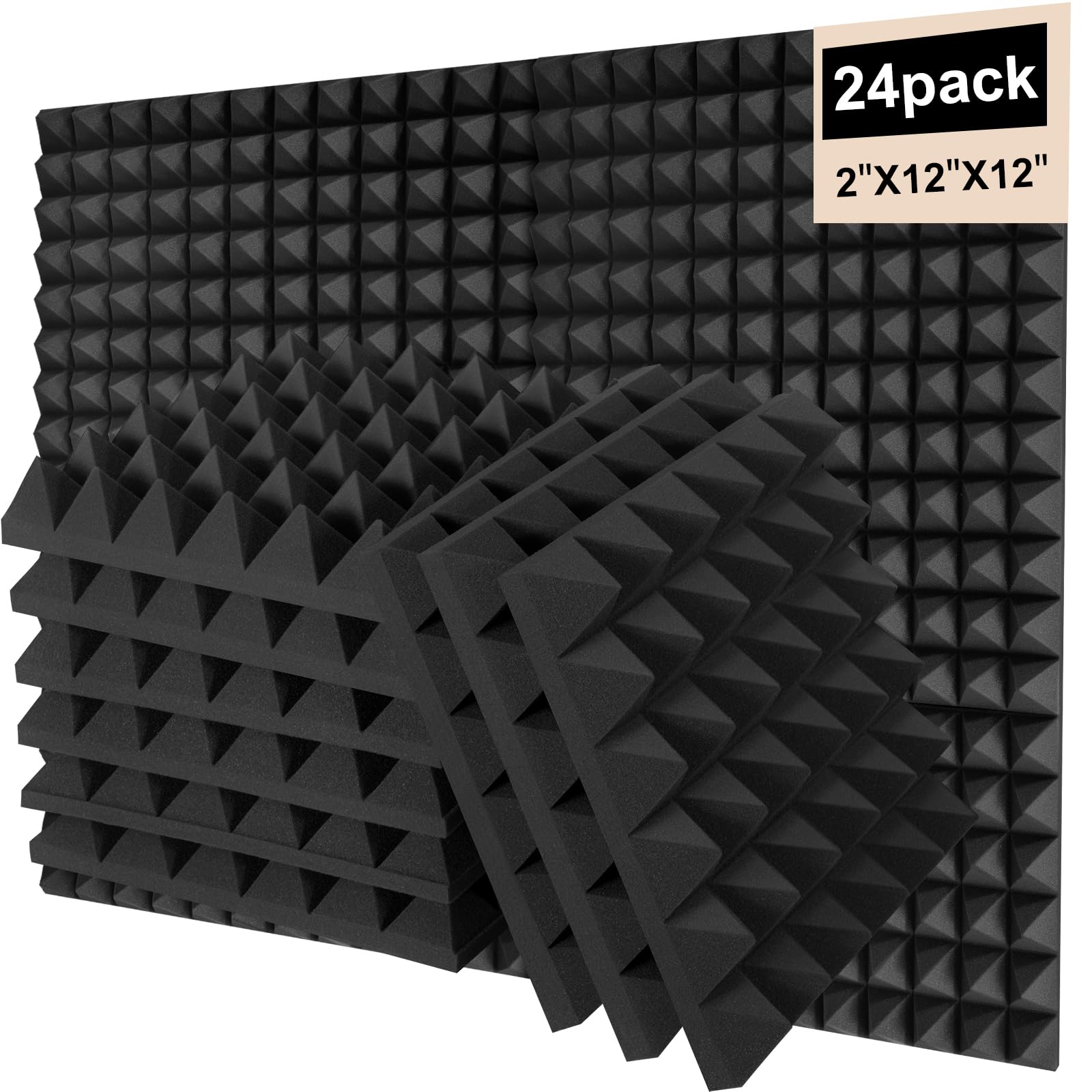
2. Saiqiang 24 Pack Sound Proof Foam Panels, 2″ x 12″ x 12″ Pyramid Design
Twenty-four two-inch pyramids that quietly fix the boxy sound of a small recording corner.
If your home studio, podcast corner or gaming room has hard walls and obvious echo, this is the pick. You get 24 panels, each 2 inches thick and 12 inches square, covering 24 square feet of wall. That is five times the thickness of the thin self-adhesive tiles in this guide and more than three times their coverage, so more of the room’s mid-range ring disappears.
The pattern is a pyramid cut, a wedge shape that breaks up a bouncing sound wave instead of reflecting it straight back. Buyers report richer sound from speakers placed in front of them and a quieter adjacent room once the wall behind the shelf is covered. The foam expands to full size after shipping compression, and a few minutes in a dryer speeds that along if a panel looks flat on arrival.
Plan your mounting before the box arrives, because there is no adhesive on the back. You supply double-sided foam tape or pins yourself, and the sticky dots some kits include tend to separate from their backing badly and can lift paint. Treat this as a permanent install and budget the tape into the job.
Value math: 24 square feet of 2-inch foam makes this the cheapest way on the list to cover a meaningful wall area in the thickest profile here, which is exactly why small studios keep buying it in multiples.
Know going in: it deadens reflections, it does not soundproof a room — an apartment neighbour’s bass will still come through, and the panels arrive compressed and need time to puff back up.
The right call if: you are treating a dedicated recording or gaming room and you already own the tape to stick it up.
Look elsewhere if: you want peel-and-stick simplicity or you are trying to block noise rather than absorb echo.
3. Dailycooper 12 Pack Self-Adhesive Acoustic Panels, 12″ x 10″ x 0.4″ Y-Lined
Peel, press, done — the twelve-pack that makes a rented room look deliberate in an afternoon.
The adhesive backing is the whole pitch here, and it is a big one. Twelve panels in a 12″ x 10″ x 0.4″ size stick straight to a painted wall with no tape, no glue and no drill, which is what people who cannot put holes in a wall actually need. The beveled Y-lined edge is cut so adjacent tiles line up into a continuous pattern, and they hang like artwork rather than like studio foam.
A firm press after positioning is the trick — the panels grip well once seated, and a spirit level on the first panel saves you a crooked run across the wall. What buyers notice most is the overall quality and finish, with the futuristic look under different lighting coming up repeatedly. The 9.4 lb/ft³ density is on the spec sheet if you want to compare it against the lighter foams on this list.
Be realistic about what 0.4 inches of polyester can do. It softens the sharp edge of an echo and cleans up a home office or a small studio corner, and one owner found the panels thin enough that sound isolation was doubtful in a game room. Coverage is about 7.5 square feet for the full pack — enough for an accent arrangement, not a whole wall. Order more than one pack if you have a serious echo problem, because three packs is where people start seeing the real effect.
Made for: renters, home-office setups and accent walls where drilling is off the table.
Wrong pick for: anyone expecting a 0.4-inch tile to stop noise travelling between rooms.
4. PINWELIFE Masterpiece Acoustic Art Panels, 8-Pack 12″ x 16″
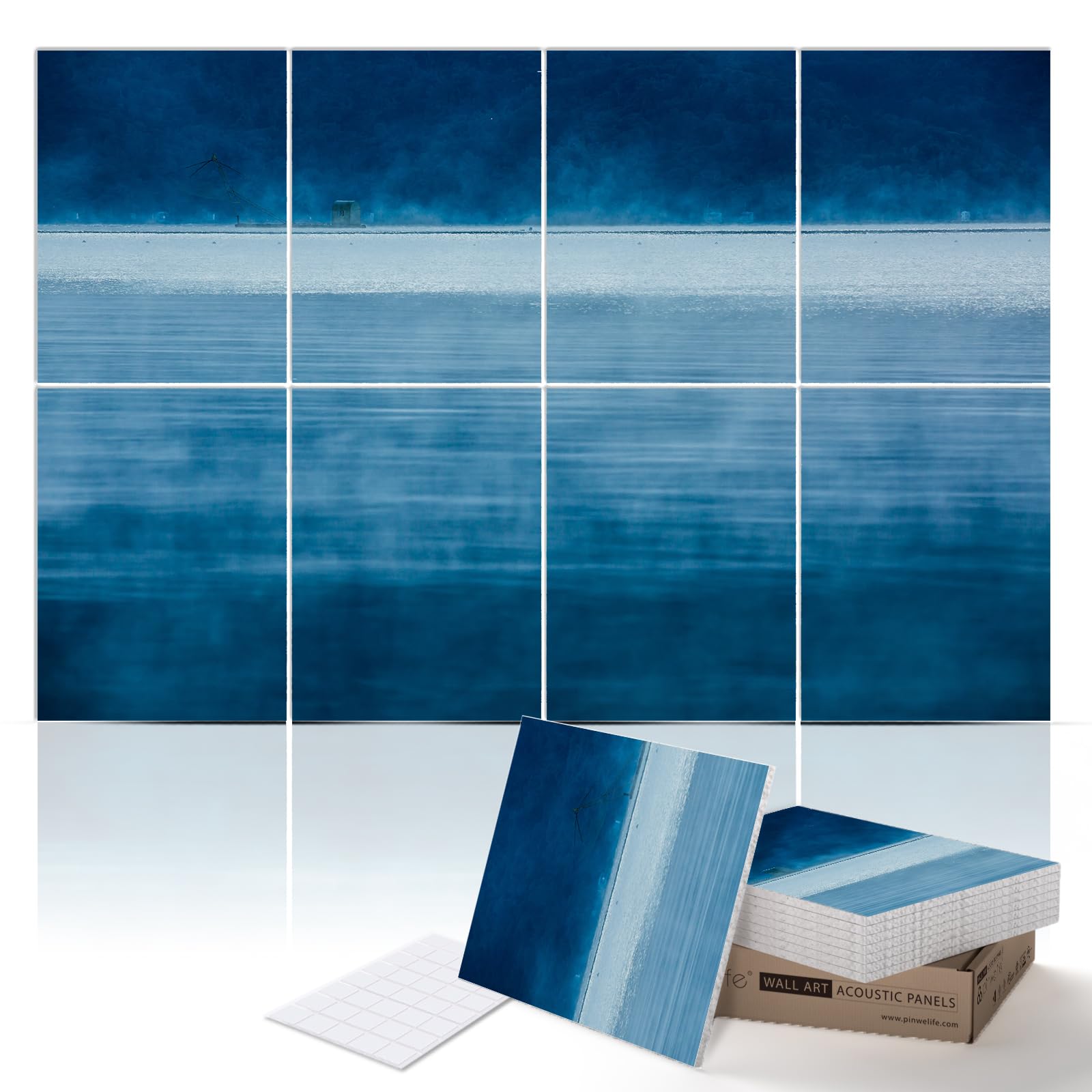
Eight printed tiles that do a convincing impression of a designer mural while softening the room.
If a bare foam wall would look out of place in your living room, this is the workaround. Eight tiles at 12″ x 16″ with a high-definition sublimation print (a printing method that dyes the image into the surface) line up into a continuous scene that reads like wallpaper, and the surface wipes clean with a damp cloth. Behind the print sits a 9 mm polyester fiber core, and the maker publishes an NRC up to 0.95 from ASTM testing — the NRC (Noise Reduction Coefficient) is a number from 0 to 1 that describes how much sound the panel absorbs rather than reflects, so a higher figure means more of the sound that hits it disappears instead of bouncing back.
Owners talk about the look first and the sound second, and the sound still delivers. One home-office setup with a hard, clinical-sounding room got noticeably warmer call audio, and a voiceover user reported a real drop in reflections. Nano tape ships in the box for a tool-free, renter-friendly install, and you can reposition tiles during alignment instead of committing on the first press.
Read the mounting note before you buy. The tape holds on smooth painted walls, but on a fabric partition you will need hook-and-loop strips or T-pins instead. And once the nano tape cures, it is genuinely hard to remove — plan the layout on the wall with painter’s tape first, because pulling a tile off takes paint with it.
Where it shines: it is the only pick here that doubles as art, which means it earns its wall space in a room where plain panels never would.
The catch: about 10.3 square feet of coverage from one pack is accent scale, so a large echoey room needs several sets.
Pick this one when: the wall is visible on video calls and you need it to look good, not just sound better.
Skip the idea if: you are covering a large studio wall — the printed format is more art than bulk treatment.
5. TONOR Dual-Layer Thickened Acoustic Wall Panels, 4 Pack 47.2″ x 23.6″ x 0.72″

Four large felt-style slabs built for the one wall every apartment dweller cares about.
Each panel is 47.2″ x 23.6″ and 0.72 inches thick, and there are four per pack — so a single order covers a serious chunk of wall with no cutting at all. The construction is a dual-layer reinforced dense polyester, and it shows: the panels feel substantial in the hand and cut cleanly with a utility knife when you do need to trim around an outlet.
The flexibility is the real draw. These work stuck inside an apartment door, mounted across a shared wall, or wrapped around a laundry area where a washer drum rattles the room. Owners mention enough reduction to watch TV or play music without disturbing the neighbours, and one sewing-machine setup described excellent control of the acoustics. The peel-and-stick backing means no extra tape to buy, and reinforced corners protect the edges in transit.
Two things to know. First, this is dense but it is not professional-grade isolation — it absorbs and dampens, and a full wall-and-ceiling install is where customers note the biggest difference. Second, with it being thicker and heavier than thin tiles, stick to one firm placement rather than repositioning repeatedly, because the adhesive is designed to stay put.
Why apartment dwellers like it
- 4 large 47.2″ x 23.6″ panels cover real wall area straight from the start, no trimming for the main run
- Dual-layer 0.72-inch dense polyester handles mid-range room ring better than thin decorative tiles
- Self-adhesive backing means zero extra hardware, and the felt-look finish reads as intentional decor
- Two-year manufacturer warranty
Set your expectations here
- Dampening, not isolation — a neighbour’s bass will still find its way through the structure
- Thicker and heavier than peel-and-stick tiles, so the first placement really is the placement
The fit: an apartment or shared-wall room where you want maximum coverage with the least fuss, and the felt finish suits your decor.
Not the fit: a studio chasing low-frequency control — that needs thickness and air gap this panel does not have.
6. 6 Pack Acoustic Panels, 47.2″ x 23.6″ Wood-Looking Surface, Walnut Color
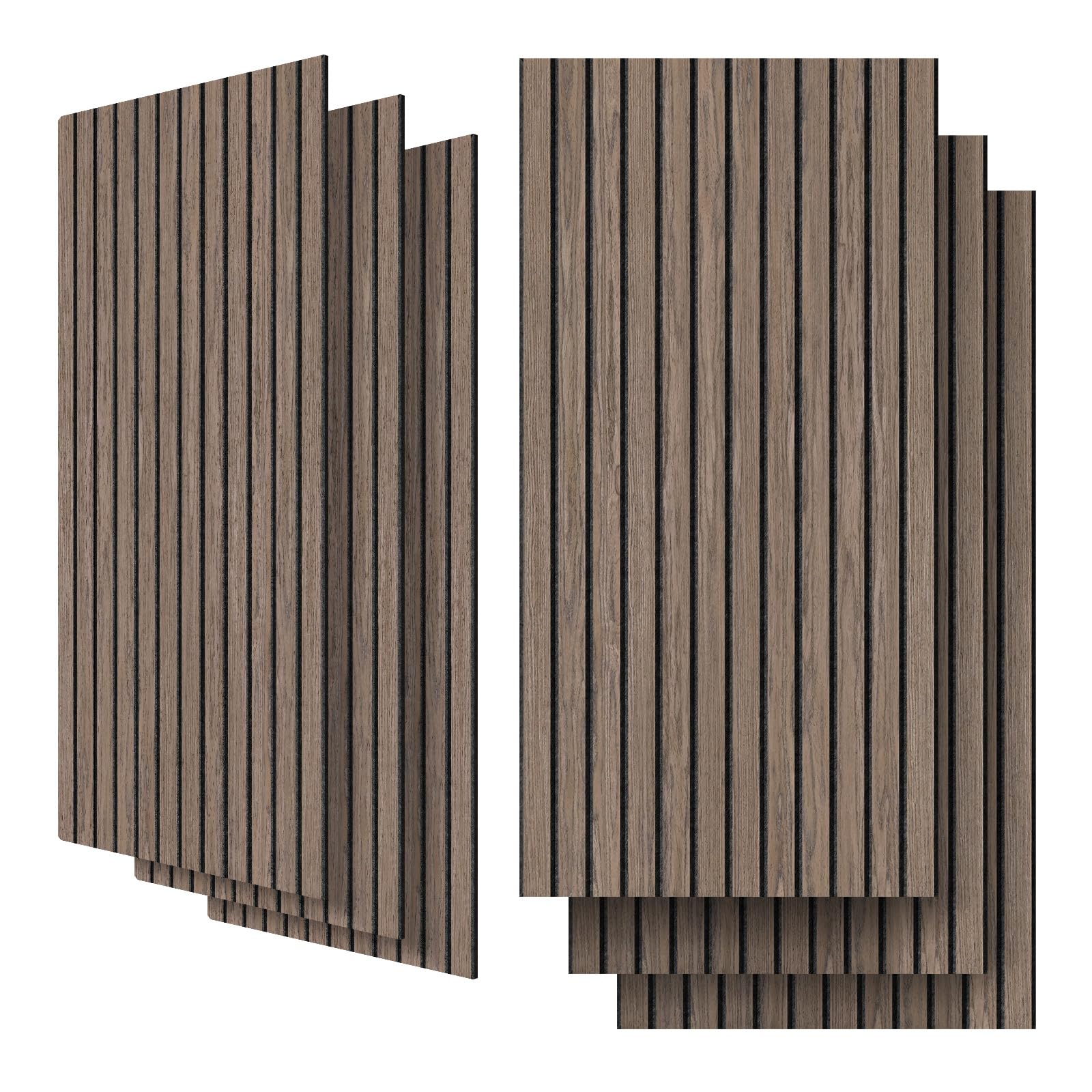
The wood-look panel that bends around a corner instead of cracking at it.
Six large panels at 47.2″ x 23.6″ with a walnut wood-look veneer over a 100% polyester fiber core. Because the core is fiber rather than rigid board, the whole panel flexes and curves — so it wraps a column, follows a curved wall, or runs into a recessed corner without a fight. That flexibility is also what makes it forgiving to cut to any size you need.
Owners put these up in humid spots where genuine wood would not survive, including a bathroom installed with strong adhesive plus a small center nail per panel and holding up well over time. Others mounted them to drywall with hook-and-loop command strips that were still holding after six or seven months, including on one panel pulled off and replaced regularly. A utility knife cuts through cleanly, though you will want spare blades because the felt core dulls them.
Be clear on what the surface is: it is a wood-looking veneer over polyester fiber, not a wood slat panel, so the texture is printed rather than milled. Expect it to stop echoes and reduce how much sound travels through a partition — it will not soundproof a room. The black felt dust from cut edges is messy, so lay a drop cloth and wear something you do not mind dusting off.
Best-in-list flexibility: the bendable fiber core is the only build here that can follow a curved surface, which open up spots a rigid slat panel simply cannot go.
The expectation to drop: it muffles and stops echoes rather than soundproofing, and the finish is a veneer print, not real wood.
Worth your money if: you have a shape that is not a flat rectangle — a curved wall, a column, a recessed niche — and you want it to look like wood.
Better to pass if: you specifically want the milled texture and depth of real wood slats.
7. Soon Global Acoustic Wall Panels, Arcadian Vortex
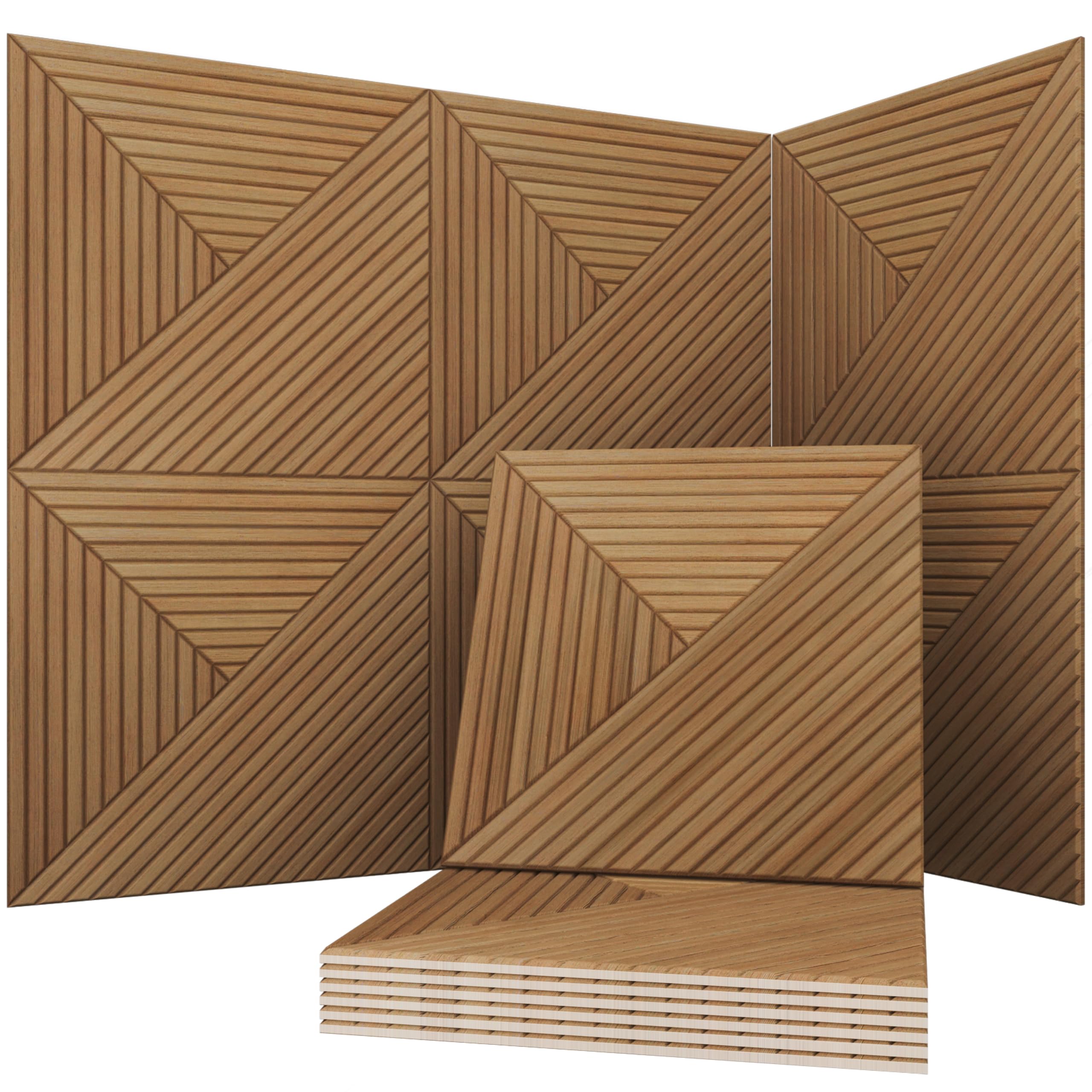
Six squares of groove-patterned wood-look fiber that flow into one continuous wall.
Coverage is the number that defines this one: 3,348 square inches across the six-pack, which works out at 558 square inches per 23.62″ x 23.62″ panel. The continuous groove pattern and matching wood-texture print run across adjoining panels, so a large installation reads as a single uninterrupted surface rather than six separate squares — exactly what you want on a big open wall where seams would be obvious.
Tool-free mounting is built in. Each six-pack ships with 30 transparent double-sided adhesive squares, so you can arrange the panels in any grid or offset configuration without nails or drills. The adhesive pads hold fine on drywall; on brick you will want a different tape, since the surface is too uneven for the included squares. The high-density polyester core is dense enough to read as a solid material rather than cheap foam, and it cuts around outlets cleanly with a sharp blade.
One practical note on color. The finish runs a touch darker in person than some photos suggest, and owners in shadowed rooms have added a lamp to bring out the pattern. Plan your lighting before you commit to a full wall, especially on a north-facing room.
What stands out
- 3,348 square inches across six panels — the widest coverage of any six-pack here, at 558 square inches per panel
- Continuous groove print across adjoining panels creates a smooth feature wall
- 30 adhesive squares included, so there is nothing else to buy for a drywall install
- Dense polyester fiber holds shape and cuts cleanly around outlets
What to plan around
- Included adhesive squares will not hold on brick — budget for a different tape on uneven surfaces
- The finish reads darker in low light than product photos
- No manufacturer warranty on the listing
Chosen by: anyone dressing a large open wall — a studio, a commercial space or a big living room — who wants the coverage from one order.
Not chosen by: anyone mounting to brick, who will need their own adhesive solution.
8. Art3d 4-Pack Fluted Acoustic Wood Slat Wall Panel, 47.2″ x 23.6″, Teak
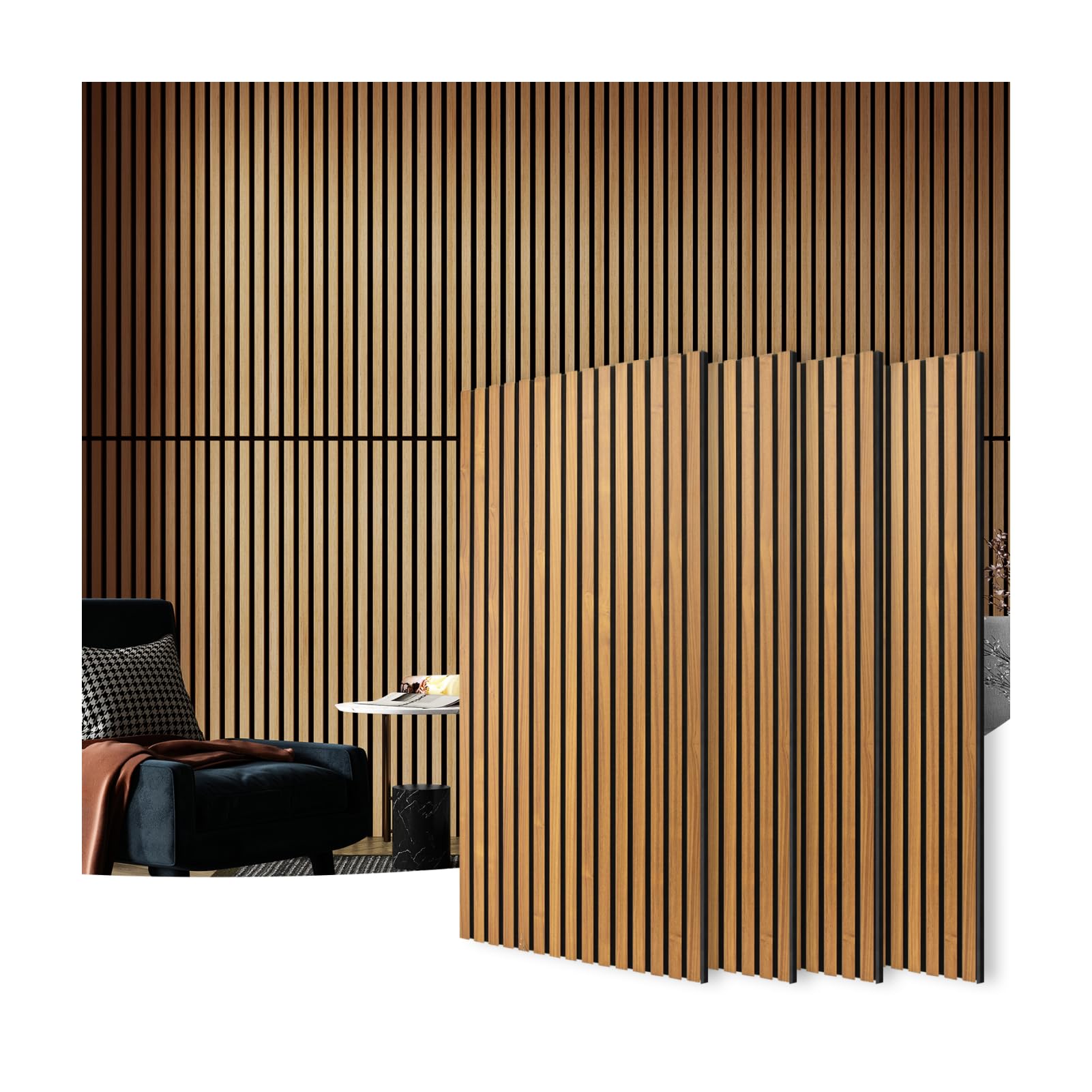
Fluted teak slats with real thickness behind them, for the room that has to look finished.
Four panels at 47.2″ x 23.6″, each 0.83 inches deep, covering about 31 square feet. That thickness is the physical difference between this and the thin decorative tiles — there is actual material behind the slat face to absorb sound rather than a layer of print on a board. Behind the fluted face sits a real MDF slat profile over a high-density polyester fiber core, with low TVOC levels.
Owners describe the echo dropping the moment the panels go up, with the room feeling calmer without losing its warmth. Install takes a couple of hours with basic tools, mounted with glue and nails or with screws if you expect to remove them later. A circular saw and a jig saw get you clean 45-degree corners and outlet cutouts, and the color matches the listing photos closely.
The honest trade-off is handling. Cut edges of the MDF face are sharp and can catch your skin, so wear gloves while installing — and where a cut edge meets the wall, staples can pull through, so glue is the safer fix there. A few panels have arrived with small dents on the corners, which does not affect function but is worth checking before you mount.
The case for it as your last panel purchase: at 0.83 inches thick with a real slat profile, this is the panel in this guide that looks and feels like permanent architecture rather than temporary treatment.
The handling note: wear gloves, glue rather than staple at cut edges, and inspect corners on arrival.
Commit to this one if: the room is finished, furniture is in, and you want the wall to be part of the design rather than an accessory.
Hold off if: you are still testing layouts — the maker suggests sampling the finish first, and the install is not a peel-and-stick undo.
Understanding the Specs
Thickness and the NRC Rating
Thickness, measured in inches or millimetres, sets the lowest frequency a panel can absorb. Thin tiles in the 0.4-inch range catch sharp high-frequency reflections; thicker builds from 0.72 inches up begin working on the warm middle frequencies where voices and acoustic instruments sit. A related spec is the NRC, or Noise Reduction Coefficient — a number from 0 to 1 that describes the fraction of sound energy a surface absorbs rather than reflects, so a higher figure means more of the sound that hits the panel disappears instead of bouncing back.
Coverage in Square Feet and Density
Coverage tells you how much wall a pack actually treats — it is the panel count multiplied by the face area of each panel, and it is the number to check before ordering. Density, measured in pounds per cubic foot, describes how much material is packed into the foam; a denser panel resists compression better and absorbs more per inch of thickness. For every product above, compare coverage against the wall you plan to treat, because partial wall coverage always delivers partial results.
FAQ
Do acoustic panels actually soundproof a room?
How many acoustic panels do I need for a small room?
Will acoustic foam panels stick to a painted wall without falling off?
Can acoustic panels be cut to fit around outlets and corners?
Do the panels leave marks or damage the wall when removed?
Is the wood-look acoustic panel real wood?
How do I hang acoustic panels on a ceiling?
Do cheap acoustic panels work as well as expensive ones?
Do acoustic panels help with echo on video calls?
How long do acoustic panels last and do they need cleaning?
Final Thoughts: The Verdict
The winner among these acoustic panels is the NeatiEase Wood Slat Wall Panel — four 96″ x 12.6″ teak slats covering about 33 square feet that absorb echo and finish the wall at the same time, and the one owners rave about is that look. If you want a dedicated recording corner on a budget, grab the Saiqiang 24 Pack Pyramid Foam Panels, where 24 square feet of 2-inch foam does the heavy lifting for a fraction of a slat wall. And for a rented apartment where you cannot drill and want maximum wall coverage from one order, the TONOR Dual-Layer Panels are the ones to reach for, with four large self-adhesive slabs and a two-year warranty behind them. Whichever you choose, measure the wall first — the panels that disappoint are almost always the ones ordered one pack short.
How We Picked
We do not accept paid placement. Every pick is matched to a real buyer and a real use-case; we do not hands-on test units.
Sources & Methodology
Specifications: manufacturer listings and product documentation. Review insights: verified customer reviews, as of September 2026. Pricing: not shown on this page (it changes often); check the current price via the retailer link.
As an Amazon Associate, KitchPrep earns from qualifying purchases. This does not affect which products we feature.
Related Guides
