
Specs are compiled from manufacturer listings and verified buyer reviews and can change over time — please confirm the key details on the product page before buying.
Carbon monoxide is the one household danger you cannot see, smell, or taste — and the alarm that catches it needs to keep working when your power does not. That is the whole point of a battery powered carbon monoxide detector: it runs on its own batteries, so a blackout, a tripped breaker, or an unplugged outlet never leaves you unprotected. This guide sorts the crowded field down to the eight units worth your money, and tells you plainly which one fits your hallway, your garage, or your RV.
I’m Mohammad Maruf — the founder and writer behind KitchPrep. This guide is built by comparing the manufacturers’ published specifications and the patterns across verified customer reviews, so you get each pick’s real strengths and trade-offs instead of marketing spin.
You do not need to be an electrician to choose well, and you do not need to spend the most to get the best protection. The sections below walk through the specs that actually matter, then break down each unit in plain English. Every pick here earns its place as a genuinely strong battery powered carbon monoxide detector.
Our Picks at a Glance


How To Choose The Best Battery Powered Carbon Monoxide Detector
The single biggest decision facing you is not the brand — it is who changes the batteries, and how often. Get that one call right and everything else about this purchase falls into place.
Sealed ten-year battery versus user-replaceable AA or 9V batteries
A sealed-battery unit hides a lithium cell inside and never asks you to buy replacements — the alarm itself is designed to be discarded and replaced at the end of its service life. That design decision matters because the most common way people die from CO is a detector sitting unwatched with dead or missing batteries. When the power supply is sealed, nobody can quietly borrow the battery for a video game controller or skip a replacement cycle because life got busy.
Replaceable-battery models cost less up front and let you swap in fresh cells any time. The trade-off is a recurring job: you have to actually do it. If you buy this type, mark your calendar and keep spare cells on hand.
Why the 85-decibel alarm rating is the number to look for
An 85-decibel alarm (a sound level as loud as a garbage truck passing close by) is loud enough to wake a sleeping adult from down the hall. Anything quieter risks you sleeping right through a real carbon monoxide event, which is precisely when you cannot afford to miss it. Every unit in this guide meets that 85-decibel benchmark, so treat it as your baseline rather than a bonus.
Where you place a CO-only detector matters
Carbon monoxide mixes with air rather than pooling on the floor, so a detector works best in any room with a fuel-burning appliance — a furnace, a gas water heater, a fireplace, or an attached garage. Battery power means you can mount it on a wall or simply stand it on a shelf, with no outlet or wiring run required. If you are covering a bedroom, choose a unit whose status light will not flash in your eyes all night.
Quick Comparison
| Model | Best For | Power Source | Detection Type | Alarm / Sensor | Amazon |
|---|---|---|---|---|---|
| Kidde KN-COB-LP2★ Best Overall | Overall value | 2-AA batteries | CO only | 85dB / electrochemical | Amazon |
| First Alert CO400Best for Travel | Travel and cars | 9V battery | CO only | 85dB / electrochemical | Amazon |
| Kidde C3010Zero-Maintenance Pick | Zero-maintenance homes | Sealed 10-year lithium | CO only | 85dB+ / electrochemical | Amazon |
| SITERWELL GS828A | Real-time readouts | 2-AA alkaline | CO only | 85dB / electrochemical | Amazon |
| First Alert CO410A | Workshops and garages | Battery powered | CO only | 85dB / electrochemical | Amazon |
| First Alert CO710A | Room temperature checks | Sealed 10-year lithium | CO only | Audible / electrochemical | Amazon |
| First Alert SC5 | Nest homes | 3V CR123A lithium | Smoke + CO | Audible / smart | Amazon |
| X-Sense SC06 5-Pack | Whole-home coverage | 10-year sealed lithium | Smoke + CO | Audible / photoelectric + electrochemical | Amazon |
In‑Depth Reviews
1. Kidde Carbon Monoxide Detector, Battery Powered CO Alarm with LEDs
Our pick — over 4.5★ from 36,000+ verified ratings; the strongest balance of quality and price.
The best-selling CO detector on this list, with 4.7 stars across 36,000+ ratings.
Start with the thing that wins people over: this unit simply works, and thousands of owners have voted with their wallets. It is the crowd favorite at 4.7 stars across 36,000+ ratings, the strongest feedback record of anything on this list. It runs on two AA batteries that come in the box, so it keeps working through a power failure, and it uses an electrochemical sensor (a cell that reacts chemically when carbon monoxide touches it) to catch the gas itself.
Installation is a screwdriver job and nothing more. Mount it on a wall or just stand it on a tabletop, then watch the status at a glance: a green LED (a small indicator light) means it is powered, and a red LED with an 85-decibel alarm — loud enough to wake you from another room — means carbon monoxide is present. Event Memory is the feature that earns its keep over years, because it records the last time the unit detected CO or was last tested, so you always know the history.
What draws the most appreciation is functionality, with value for money a clear second — this delivers the performance of pricier units without the premium. The honest catch: battery life is the most-debated topic in the review pages. Some owners get a long service run, while others find themselves swapping cells earlier than expected, so keep a pair of spares in a drawer. One smart angle owners lean on is placing a unit in every sleeping space, since CO can build up while everyone is asleep.
What buyers talk about
- Two AA batteries included and ready to run — works when the power is out
- Adjustable placement: wall-mounted or standing on a tabletop, no wiring
- Event Memory keeps a record of the last CO detection and last test
Where it asks a little of you
- Battery life is the one topic owners geniunely disagree on
- Covered by a 10-year limited warranty, not a sealed-life design
Made for: anyone who wants one dependable CO detector at the lowest fuss per dollar — especially renters and first-time buyers covering a single apartment.
Look elsewhere if: you would rather never touch a battery again, in which case the sealed-cell Kidde C3010 below is the better fit.
2. First Alert Battery Carbon Monoxide Alarm
An 11.2-ounce CO alarm that runs on a 9V battery, so it travels without an outlet.
Weigh the two most popular picks side by side and the difference is tangible: this First Alert tips the scale at 11.2 ounces, against 4 ounces for the sealed-battery Kidde C3010 — a 2.8x gap in the Kidde’s favor. That said, this unit stays compact enough that owners treat it as genuinely portable. It puts out an 85-decibel alarm when CO levels reach a dangerous point, and it runs on a 9V battery that ships with the alarm, so it keeps monitoring even when the power fails.
The sensor here is the same advanced electrochemical type used across the category, reading CO accurately no matter where in the room the unit sits. Placement is flexible: wall-mount it with the included bracket, or set it on a counter. An end-of-life chirp separates it from cheaper no-name units — the alarm tells you when it is time to replace the whole device rather than leaving that to memory.
Owners clearly reward that longevity. As buyers report, one simply put it: “We had this exact one for YEARS and it finally died on us. Got another one and it’s doing its job well once again.” The recurring gripe is the out-of-box battery — some units arrive with a dead or weak 9V, so test it the moment you unbox. Set that aside and it is a rock-solid piece of equipment that mounts in minutes without an outlet anywhere near it.
Real-world reach: owners run these in bedrooms, basements, and even a car winter kit, because the battery-powered format travels anywhere a cord cannot reach.
Reach for this if: you want a detector you can carry between a hotel room, a rental cabin, and your own hallway without hunting for an outlet.
skip it if: a single battery that needs periodic swapping feels like one chore too many — the sealed-battery models handle that for you.
3. Kidde low-maintenance Carbon Monoxide Detector Alarm with 10 Year Sealed Battery, Model C3010
A sealed lithium cell powers this CO alarm for ten years with no battery changes.
If you want the single feature that ends battery anxiety for good, this is it. A sealed lithium cell powers the unit for ten years with no replacement required — 87,600 hours of continuous protection built into the device. There is no battery door to open, which means nobody can quietly remove the cells. Set it and the alarm handles the rest, self-activating the moment it slides onto the mounting bracket.
Installation is the aspect owners praise most, and it is easy to see why — as one buyer put the experience: “Once you install the bracket and slide the detector in place it automatically turns on.” No downloads, no setup menus, no troubleshooting. Mounting is dead simple, thanks to a footprint owners describe as compact enough for creative placement, and the back slots matched older Kidde mounts for anyone upgrading.
The status system is genuinely useful. A green LED flashes every 30 seconds to show normal operation, and a red LED pulses during an alarm, while an amber LED signals a fault. Event Memory keeps a running alert if high CO was detected in the last 14 days — a feature that tells you something happened even if you were away when it did. The one asterisk: those flashing lights and the alarm are loud, which is exactly what you want in a hallway but can be a bit much in a small bedroom.
Strengths that hold up
- Sealed ten-year lithium battery — no replacement, ever
- Auto-activates on the bracket with zero configuration
- Event Memory flags CO detected in the last 14 days
Points to weigh
- It is heavy on noise — some owners find it very loud
- Flashing status lights can be distracting in a small dark room
The clean verdict: for a landlord, a guest room, or anyone who wants protection without a maintenance calendar, this is the one to hang and forget.
But note: it trades away the flexibility of user-swappable batteries — when the ten-year cell is done, the whole alarm is replaced.
4. SITERWELL Carbon Monoxide Detector 7 Year Product Life CO Detector
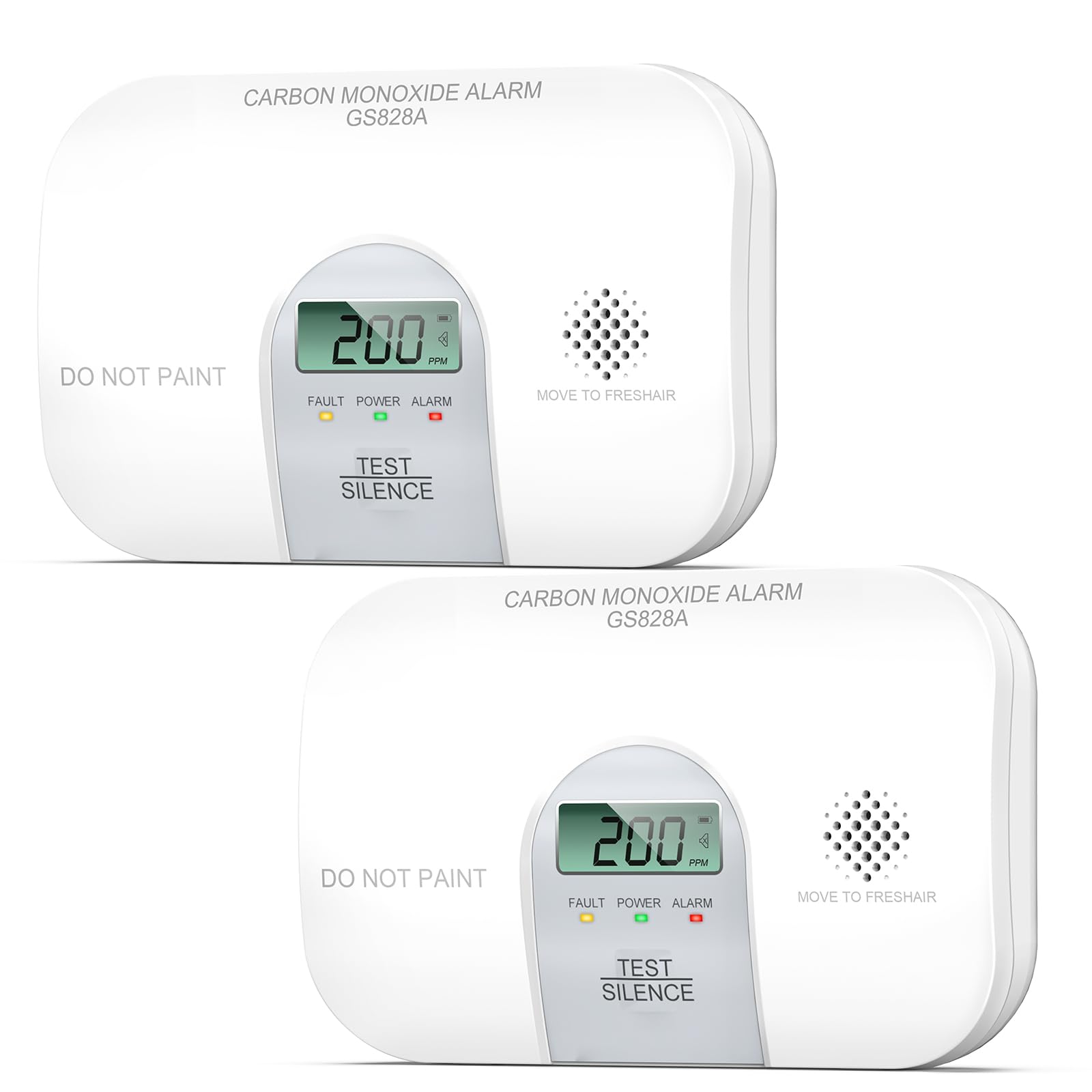
An LCD shows real-time CO levels in ppm, so you can watch a reading move before the alarm fires.
For buyers who want to know what the air is actually doing, this one shows you. An LCD displays real-time carbon monoxide levels, so you can watch a reading move rather than only learning about trouble when the alarm fires. That screen pairs with a three-color LED system — red for alarm, green for power, and yellow for a fault — so the unit’s status is legible at a glance. It is also ETL listed, meaning an independent lab has tested it to published safety standards.
The detection side is built around an advanced electrochemical sensor (a cell that reacts chemically when carbon monoxide touches it) tuned to respond quickly, and when it does, the alarm rings in at no less than 85 decibels at three meters — loud enough to carry through a home. Placement is among the most flexible here: wall-mount it or simply stand it free. The built-in 2 AA batteries are already installed, so pull the tab and it runs a short air-sampling startup before going to work.
What buyers value most is reliability, and the setup earns strong marks too — two of the top three themes in owner feedback. It weighs 13.44 ounces against 4 ounces for the sealed Kidde, so treat it as a unit that sits in place rather than one you carry around. The blunt caveat: this model’s stated life is seven years and a few owners have had units arrive defective, so test yours the day it lands. It does carry a three-year limited warranty, which softens that risk.
The screen’s real payoff: a live ppm reading is genuinely handy in a workshop, garage, or basement where you want proof the space is clear, not just an absence of beeping.
Choose this if: you want to see real-time CO numbers and value a fault indicator that tells you when something is wrong with the unit itself.
Pass if: you would rather have the longest possible sealed lifespan — seven years here versus a decade on the C3010 and the X-Sense pack.
5. First Alert 1039724 Battery Operated Carbon Monoxide Alarm with Backlit Digital Display

A battery-operated CO alarm with a backlit display you can read under shop lights.
Where this unit separates itself is the jobsite. Owners run these in a semi-truck shop where real-time readings matter, and the backlit digital display means you can read the CO level without squinting or hunting for a flashlight. It pairs that screen with an advanced electrochemical sensor and an 85-decibel alarm, so the moment CO climbs you are both warned and able to see the number that triggered it.
Battery operation is what makes it genuinely useful in a workspace — no outlet needed, so it tags along to whatever corner of the shop needs watching. It also moves between rooms without a fuss, which owners call out as a real convenience. The unit is a legitimate model CO410A from First Alert, carrying a seven-year limited warranty.
Here is the practical snag: this model’s wall-mounting screw spacing does not match the older version it replaced, so if you are swapping out a prior First Alert, expect to relocate the screws and patch the old holes. That is a one-time annoyance, not a flaw in the detector itself. For the shop, the garage, or any space where you want a reading on demand, the trade is well worth it.
Built to move: unplug-and-go is the whole idea — carry it from the bay to the storage room and it keeps monitoring the moment you set it down, no cord trailing behind.
Right for you if: you need a display you can read under shop lights and the freedom to relocate the detector as your workspace changes.
Think twice if: you are replacing an older CO410 and expect the bracket holes to line up — they will not.
6. First Alert Carbon Monoxide Detector with Temperature Display, 10-Year Battery

A sealed 10-year CO alarm whose backlit display also shows ambient room temperature.
A sealed ten-year lithium battery means this one arrives ready for a decade of service with no replacement cycle to track. The multi-function backlit display flips between live CO levels and the ambient room temperature, which is a genuinely handy extra in a nursery or a basement where you are already curious about the conditions. The peak-level feature retrieves the highest carbon monoxide concentration the unit has measured, so you can see the worst reading on record even if it happened while you were out.
Placement is as easy as it gets — the compact modern housing sits on a tabletop or mounts to a wall, so it slips into a spot without needing a plug. There is a genuinely useful backup in that flexibility: it works during a power failure, which is the whole reason to choose a battery unit in the first place. Setup earns praise for its simplicity, and the ten-year expected life is exactly the kind of long-term reassurance buyers in this category are looking for.
Now the caveat that keeps coming up: the temperature display is locked to Celsius. That is a real frustration for a lot of U.S. buyers who expected Fahrenheit based on the product images, so if a readable Fahrenheit thermometer matters to you, plan for a conversion. The CO detection itself and the sealed battery do their job regardless, which is what this unit is really for.
Reasons it earns its spot
- Sealed ten-year lithium battery — no swaps, no chirps
- Display flips between CO level and room temperature
- Peak level memory stores the highest CO reading seen
The honest caveats
- Temperature reads only in Celsius — no Fahrenheit option
- Premium-tier pricing for a CO-only unit
A strong match for: a nursery, a basement, or any room where you want carbon monoxide coverage plus a temperature readout from one compact housing.
Reconsider if: a Fahrenheit display is a must-have for you — this model locks you into metric.
7. First Alert SC5 Battery Smart Smoke & Carbon Monoxide Alarm
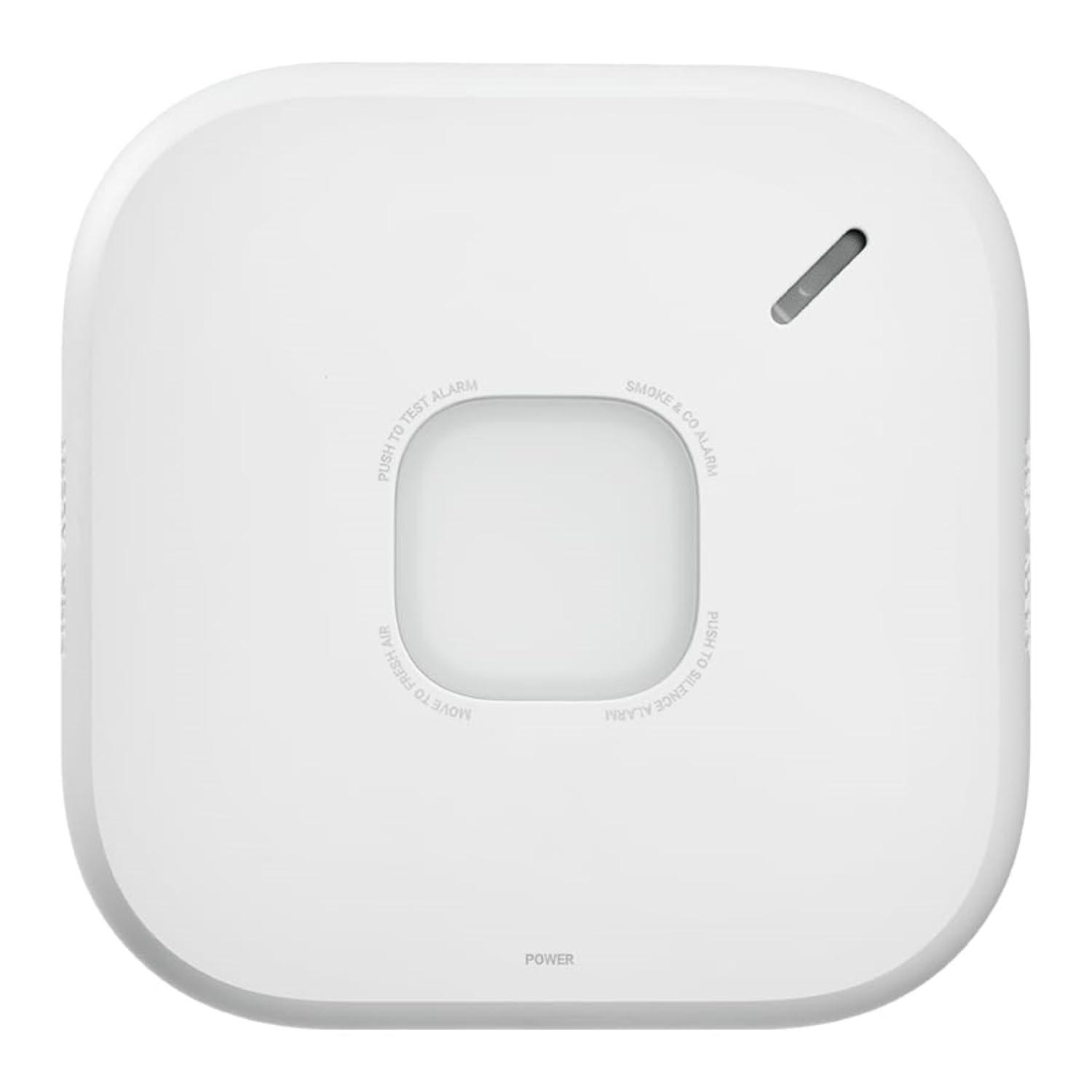
A smoke-and-CO combo that pairs with Google’s Nest Protect Alarm and pushes alerts to your phone.
If your home already lives in the Google Nest world, this is the unit built to fit into it. It is compatible with Google’s Nest Protect Alarm, sends alerts to your phone through the First Alert app when smoke or CO is detected, and it interconnects so one alarm triggers the others in the house. That connectivity is what buyers value most, and for anyone who has watched Nest Protect units hit their ten-year expiration, it is a sensible path forward.
Beyond the app link, it layers on real usability. Voice alerts with Heads-Up warnings tell you the type and location of the danger — smoke in the kitchen, CO in the basement — so you know exactly what and where before you move. It also notifies you when batteries are low, which kills those late-night chirps before they start. The unit is powered by 3V CR123A lithium batteries and uses Precision Detection Technology intended to reduce nuisance alarms.
Be realistic about the fit, though. This is a smoke-plus-CO combo at a premium-tier price, and it draws a genuinely split reaction from owners — some love the Nest integration, while others report connectivity drops or false alarms. For comfortable Nest users who want the app link and the interconnect feature, it earns its keep. For anyone wanting a straightforward CO-only alarm, the simpler picks above are the smarter spend.
Designed for one ecosystem: this is the licensed First Alert take on Nest technology, so it slots into a Nest household naturally — but it does not try to serve buyers outside that setup.
Buy this when: you are deep in the Google Nest ecosystem and want a licensed replacement that pairs with your existing setup and phone.
Skip it when: you just need reliable CO protection — the Kidde C3010 gives you that at a fraction of the complexity.
8. X-Sense Smoke & Carbon Monoxide Alarm, SC06, 5-Pack
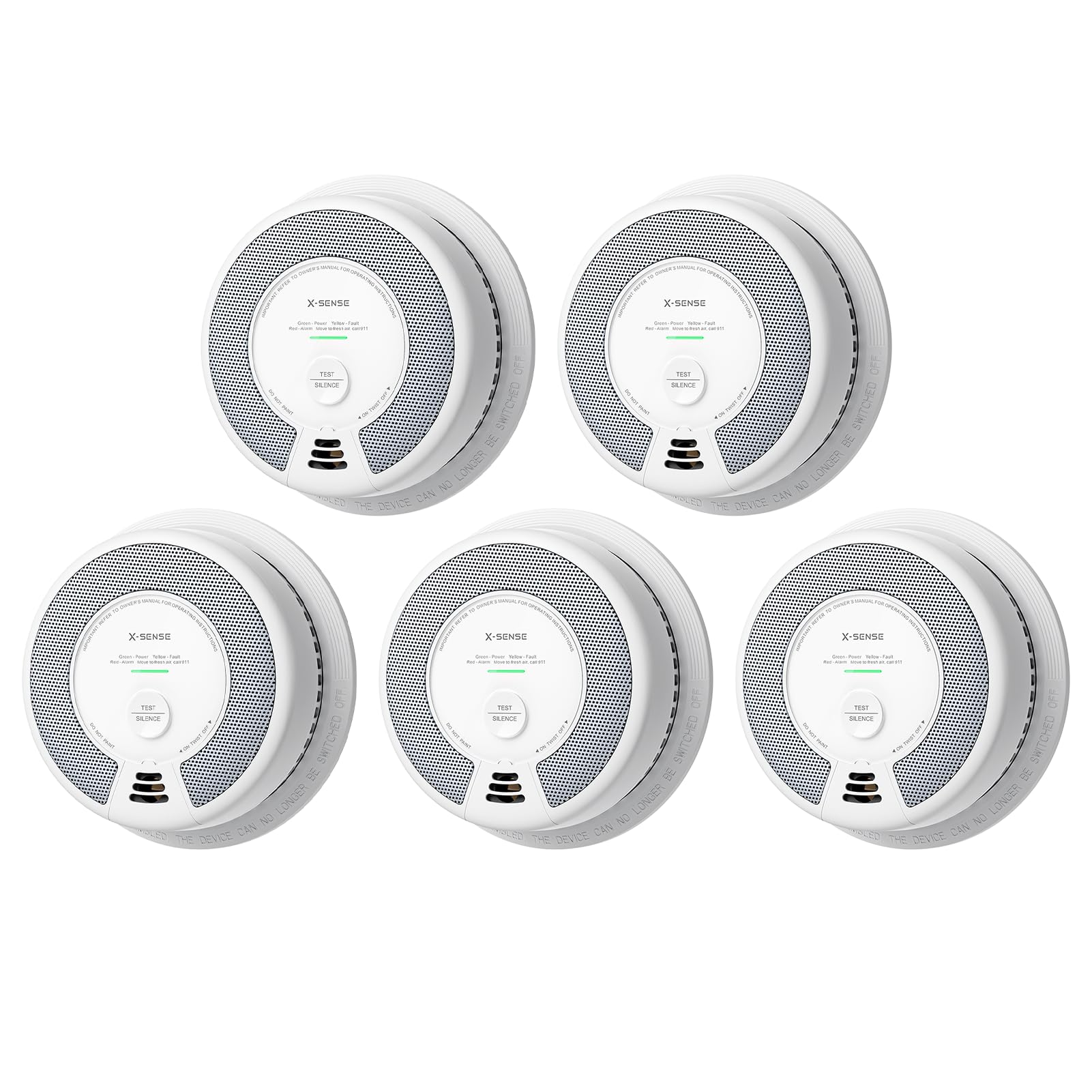
Five smoke-and-CO combo alarms in one box, each with a sealed 10-year lithium battery.
If you are outfitting a whole home, buying five separate units gets old fast. This pack bundles five combination alarms, each with both a photoelectric smoke sensor (a light beam broken by smoke particles) and an electrochemical CO sensor, so a single device handles both threats. Each one is ETL listed and meets the UL 217 and UL 2034 safety standards, and the built-in 10-year lithium battery is sealed in, so there is no cell to replace for a decade.
A large LCD on each unit shows real-time CO levels alongside battery level and working status, so you can check the reading without climbing up to inspect. Installation needs no rewiring — the included bracket, screws, and anchor plugs let you mount on any wall or ceiling. On size, each unit measures 5.7 inches across, and at 11.04 ounces it is a substantial piece of hardware once it is on the wall.
What earns praise is quality and the ease of setup. Owners say the build feels far beyond the price and call out the sealed battery in particular — as one put it, the sealed cell means the alarm prompts you when it finally needs replacing, and “it lasts TEN years.” The honest catch is long-term confidence: an occasional unit is reported to fail early, and packaging can arrive battered, so test each one after unboxing. A few have flagged that they cannot confirm the durability over time.
Made for: landlords, bigger homes, and anyone covering multiple bedrooms, a basement, and a hallway without buying each detector separately.
Look past this if: you only need one or two detectors — a smaller single-unit pick makes far more sense at that scale.
Understanding the Specs
Electrochemical sensor
This is the heart of any carbon monoxide detector. An electrochemical sensor is a small cell that chemically reacts when CO touches it, generating a tiny electrical signal that the alarm reads as a concentration. It is chosen over older sensor designs because it responds quickly and uses very little power, which is why it fits neatly into battery-operated units. When you see “electrochemical sensor” on the box, you are looking at the current standard for residential CO detection.
85-decibel alarm
An 85-decibel alarm is roughly as loud as a passing garbage truck, and it is the threshold that matters most for a device meant to wake you from sleep. Anything that rings this loud is designed to reach a sleeping adult behind a closed bedroom door. Every detector in this guide meets or exceeds that 85-decibel benchmark, so treat it as your baseline rather than a premium feature worth paying extra for.
FAQ
How long do the batteries last in a battery powered carbon monoxide detector?
Can I use a carbon monoxide detector during a power outage?
How loud is the 85-decibel alarm on these detectors?
Where should I mount a battery powered CO detector?
Is a 10-year sealed battery better than replaceable batteries?
Will a carbon monoxide detector detect natural gas leaks?
How often should I test and replace my detector?
Should I choose a CO-only detector or a combination smoke and CO alarm?
Is a smart CO alarm worth it over a basic one?
Does the temperature display on a CO alarm show Fahrenheit?
Final Thoughts: The Verdict
If you are buying one detector and want the easiest decision, the Kidde KN-COB-LP2 at 4.7 stars across 36,000+ ratings is the safest single pick — it installs without wiring, works through a power failure, and includes its own AA batteries. For anyone who never wants to think about a battery again, the Kidde C3010’s sealed ten-year cell turns this into a hang-it-and-forget-it purchase. And if you are covering a whole house in one move, the X-Sense SC06 five-pack puts a combo smoke-and-CO unit in every room at once.
How We Picked
We do not accept paid placement. Every pick is matched to a real buyer and a real use-case; we do not hands-on test units.
Sources & Methodology
Specifications: manufacturer listings and product documentation. Review insights: verified customer reviews, as of September 2026. Pricing: not shown on this page (it changes often); check the current price via the retailer link.
As an Amazon Associate, KitchPrep earns from qualifying purchases. This does not affect which products we feature.
Related Guides
