
Specs are compiled from manufacturer listings and verified buyer reviews and can change over time — please confirm the key details on the product page before buying.
When the grid drops, the question that matters is simple: which backup will actually keep your fridge cold, your router alive, and your phone charged until the power comes back? The answer depends on what you need to run — a few essentials for two hours is a very different job from holding a whole fridge overnight. This guide sorts the strongest battery backups for power outage use by capacity, output, and how fast they refill, so you can match one to your real household instead of guessing.
I’m Mohammad Maruf — the founder and writer behind KitchPrep. This guide is built by comparing the manufacturers’ published specifications and the patterns across verified customer reviews, so you get each pick’s real strengths and trade-offs instead of marketing spin.
When the power drops, your fridge, router, and phone chargers stop — and that is the moment you want a battery already charged and ready. Below you will see how much energy each unit stores, how much load it can carry, and the honest catch behind every model before you commit. A small plug-in box can keep your internet gear alive, while a rolling powerhouse can carry the whole house; the right battery backup for power outage for your situation is here.
Our Picks at a Glance


How To Choose The Best Battery Backup for Power Outage
Start with what you actually need to keep running. A router and a modem pull very little, while a fridge or a space heater pulls a lot. That single difference decides whether a small plug-in box or a rolling powerhouse is the right buy.
Match capacity to the load you cannot lose
Capacity is measured in watt-hours (Wh) — think of it as the size of the fuel tank. A bigger number means more hours before you have to recharge. If you only need to keep internet and phones alive, a modest tank works. If you want a fridge to ride out an overnight outage, you need real storage behind it.
Check rated watts and surge watts together
Rated watts is the steady power a unit can deliver; surge watts is the short burst it can handle when a motor starts. Fridges, freezers, and power tools all kick hard at startup, so a unit with a healthy surge rating starts them without tripping offline.
Decide how fast you need to refill
When the power is out for days, recharge speed matters as much as capacity. Some units refill from a wall outlet in under an hour; others take a full night. If you plan to top up from solar, check the maximum solar input so a cloudy day still makes progress.
Quick Comparison
| Model | Best For | Capacity | Rated Output | Weight | Amazon |
|---|---|---|---|---|---|
| Anker SOLIX C2000 Gen 2★ Best Overall | Whole-home essentials | 2,048Wh (expandable to 4kWh) | 2,400W rated, 4,000W peak | 41.7 lb | Amazon |
| GOLDENMATE 1000VA/600W UPSBest for Network Gear | PC and network gear | 153.6Wh | 600W | 4.8 kg | Amazon |
| BLUETTI Elite 100 V2Best for Camping | Camping and light backup | 1024Wh | 1800W rated, 3600W surge | 25 lb | Amazon |
| DJI Power 2000 | Tools and RV power | 2048Wh | 3000W | 21.72 kg | Amazon |
| Jackery Explorer 2000 v2 | Fridge and freezer backup | 2042Wh | 2200W | 39.5 lb | Amazon |
| EF ECOFLOW DELTA 3 Max | High-demand appliances | 2048Wh | 3400W X-Boost | 48 lb | Amazon |
| BLUETTI Elite 300 | RV and home backup | 3014Wh | 2400W rated, 4800W surge | 58 lb | Amazon |
| ABOK Ark3600 | Long outages, big loads | 3840Wh (expandable to 11520Wh) | 3600W rated, 4500W peak | 92 lb | Amazon |
| Anker SOLIX F3000 | Expandable home system | 3,072Wh (expandable to 24kWh) | 120/240V output | 91.5 lb | Amazon |
| Jackery HomePower 3000 | Whole-house essentials | 3072Wh | 3600W, 7200W surge | 59.5 lb | Amazon |
| EF ECOFLOW DELTA Pro | Heavy-duty home backup | 3600Wh (expandable to 25kWh) | 3600W AC output | 99 lb | Amazon |
In‑Depth Reviews
1. Anker SOLIX C2000 Gen 2 Portable Power Station
Our pick — over 4.5★ from 650+ verified ratings; the strongest balance of quality and price.
The two-kilowatt box that refills before your coffee finishes brewing.
If you want one unit that covers a real overnight outage in a normal home, this is the pick to beat. It stores 2,048Wh (watt-hours, the total energy it can deliver) and can grow to 4kWh with an expansion battery. That first figure already runs a dual-door fridge for up to 32 hours, and the second stretches that to 64 hours.
Output is just as strong as storage. With 2,400W rated and 4,000W peak, it starts and runs window or RV air conditioners without balking. And it barely sips power when idle — just 9W on standby, so it is not quietly draining itself on the shelf. Need it back to full fast? AC and solar together reach 100% in 58 minutes, and an 800W alternator charges it to full in 3 hours on the road, eight times faster than a standard car socket.
Buyers report using it for exactly the jobs this guide covers. One set-up keeps a 30A trailer, coffee maker, microwave, and Starlink running all night, and picks up 10% or more per day on a 200W solar panel (a panel that turns sunlight into power); that same rig runs a 13,500 BTU air conditioner (a unit that cools a small room) for roughly 90 minutes. Plugged in as an indoor generator, it keeps a fridge and devices alive through outages with no gas, no fumes, and no noise. The one catch worth knowing: when AC input is connected it caps output at 1,800W and overrides charge settings, so heavy loads can overload while it is plugged in.
Where it pulls ahead
- 2,048Wh stores enough to run a dual-door fridge up to 32 hours
- 58-minute full recharge on AC plus solar keeps it ready fast
- 4,000W peak starts air conditioners and other motor loads
- 41.7 lb and 25% lighter than similar units, so it moves easily
What to plan around
- Idle draw supports a fridge for hours, but weight still draws mixed remarks
- AC input caps output to 1,800W and overrides charge settings
- An occasional unit arrives damaged in transit, though support replaces it
Reach for this if: you want a single, manageable station that runs a fridge, router, and small AC through an overnight outage.
Look elsewhere if: you need to run big loads while it is plugged into AC at the same time.
2. GOLDENMATE 1000VA/600W Lithium UPS Battery Backup & Surge Protector
The compact desk-tower box built to keep the internet alive when everything blinks off.
This is a different animal from the rolling power stations here. It packs just 153.6Wh, which is a fraction of the Anker SOLIX C2000 Gen 2’s 2,048Wh — a 13.3x gap that tells you it is not for running a fridge. What it does is protect a small rack of always-on gear: computers, workstations, network devices, and telecom equipment.
Owners mention the router-and-NAS job is where this unit earns its keep, with one load of a cable modem, WiFi 7 router, T-Mobile home WiFi, and a four-drive Synology NAS (a box that stores files for your whole network) running about two hours of backup. Set-up is genuinely plug-and-play; a USB cable links the UPS (an uninterruptible power supply, a battery that kicks in the instant wall power fails) to a Windows PC, Mac, or NAS with no extra software, and a communication port triggers a safe automatic shutdown through your system settings. The pure sine wave output (a clean, smooth AC shape that sensitive electronics prefer) keeps that gear running without the jitter cheaper backups can introduce.
It runs quiet, with a fan that sits below 50 dB and only spins up when the battery is working hard. The lithium iron phosphate (LiFePO4) cell is rated for over 10 years and more than 5,000 charge cycles, and the maker claims it cuts total cost of ownership by over 40% versus lead-acid. The real limit is headroom: at a strictly 600W rating, a gaming PC’s spikes can push past it, and the display does not stay lit constantly. Verify your outlet sits in the 90–140V range before you plug in.
The clean-power case: pure sine wave output plus an upgraded communication port makes it a natural fit for routers, modems, and NAS boxes that hate hard shutdowns.
The honest ceiling: 600W rated and 153.6Wh mean it is a small-gear UPS, not an appliance backup — high-draw PCs and power tools are out of its league.
Pick this for: keeping your modem, router, and desktop rig from rebooting during short blips and brownouts.
Not the tool for: running a fridge, space heater, or anything above its 600W line.
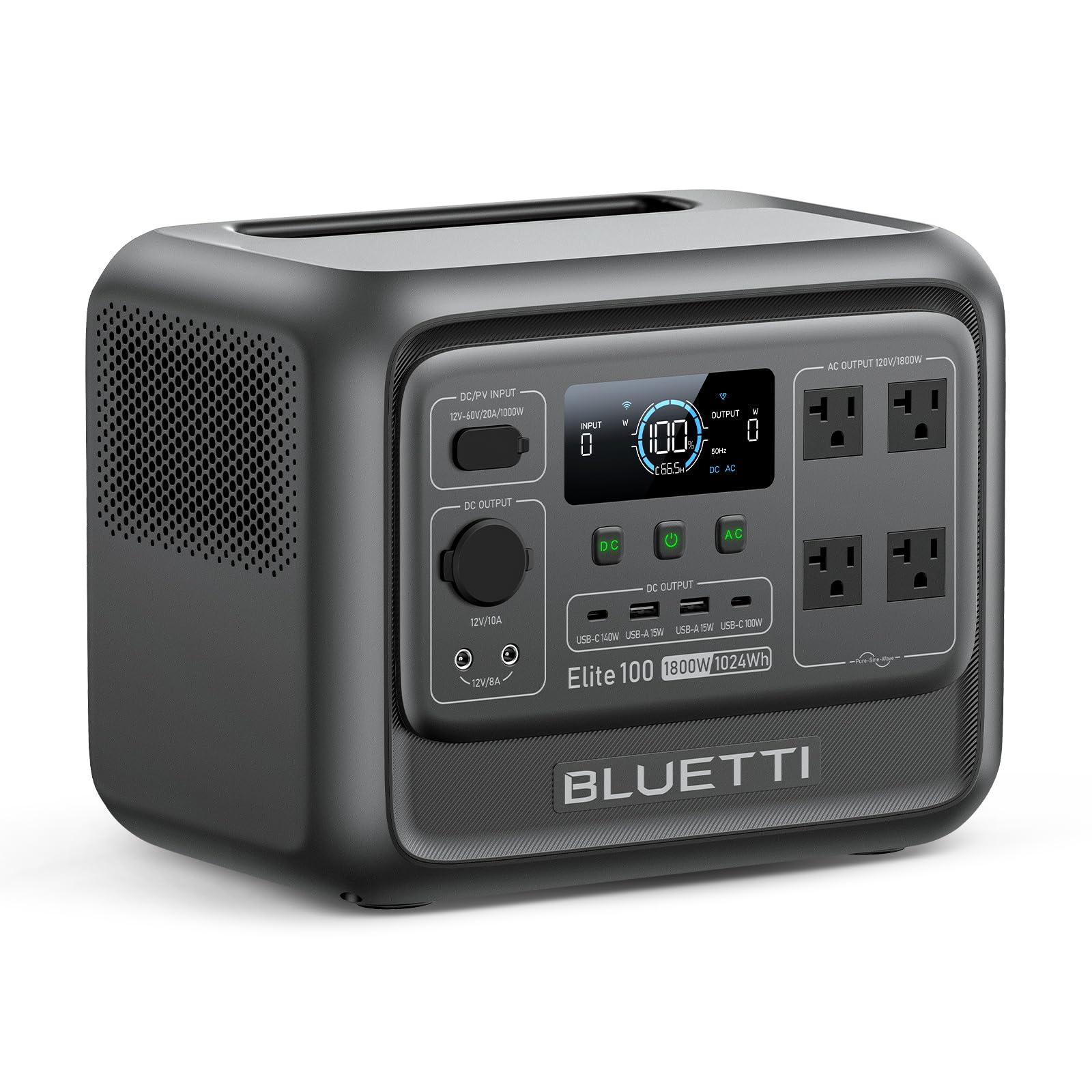
3. BLUETTI Elite 100 V2 Portable Power Station
A one-kilowatt station light enough for one hand, fast enough to refill before a road-trip lunch.
For camping, tailgates, and apartment outages, the size-to-power math here is the point. It holds 1024Wh and pushes 1800W rated with a 3600W surge, enough to cover up to 90% of everyday appliances through its 11 ports. It also runs as a 10ms UPS, keeping a router and PC alive through a blackout.
Two features separate it from heavier rivals. With 1200W TurboBoost AC charging or up to 1000W of solar, it refills to full in about 70 minutes, and its 1000W solar input is the fastest in its class for a 1kWh station. Then there is the quiet: in silent mode it drops to just 30dB, which the maker rates 50% quieter than other 1kWh units — calm enough to sit beside you overnight. At 25 lb with a hidden carry handle, the Elite 100 V2 is 35% smaller and 30% lighter than comparable stations, light enough to carry one-handed. The LiFePO4 battery is rated for over 4,000 cycles to 80% capacity, roughly a 10-year life.
Owners describe genuine capacity and dependable runtime, with an astrophotographer rig running a telescope mount, two cameras, a mini PC, tablet, and phone at 34–50W draw for 6.5 to 8 hours on a single charge. The fair caveat is honest weight — a few note it is heavier than “portable” implies. For a smaller one-kilowatt job, this is the easiest of the mid-tier picks to actually carry and refill.
Best matched to: campers, road-trippers, and apartment dwellers who want fast refills and true one-hand carry.
Skip if: you need to run a full-size fridge or a whole home through a multi-day outage.
4. DJI Power 2000 Portable Power Station
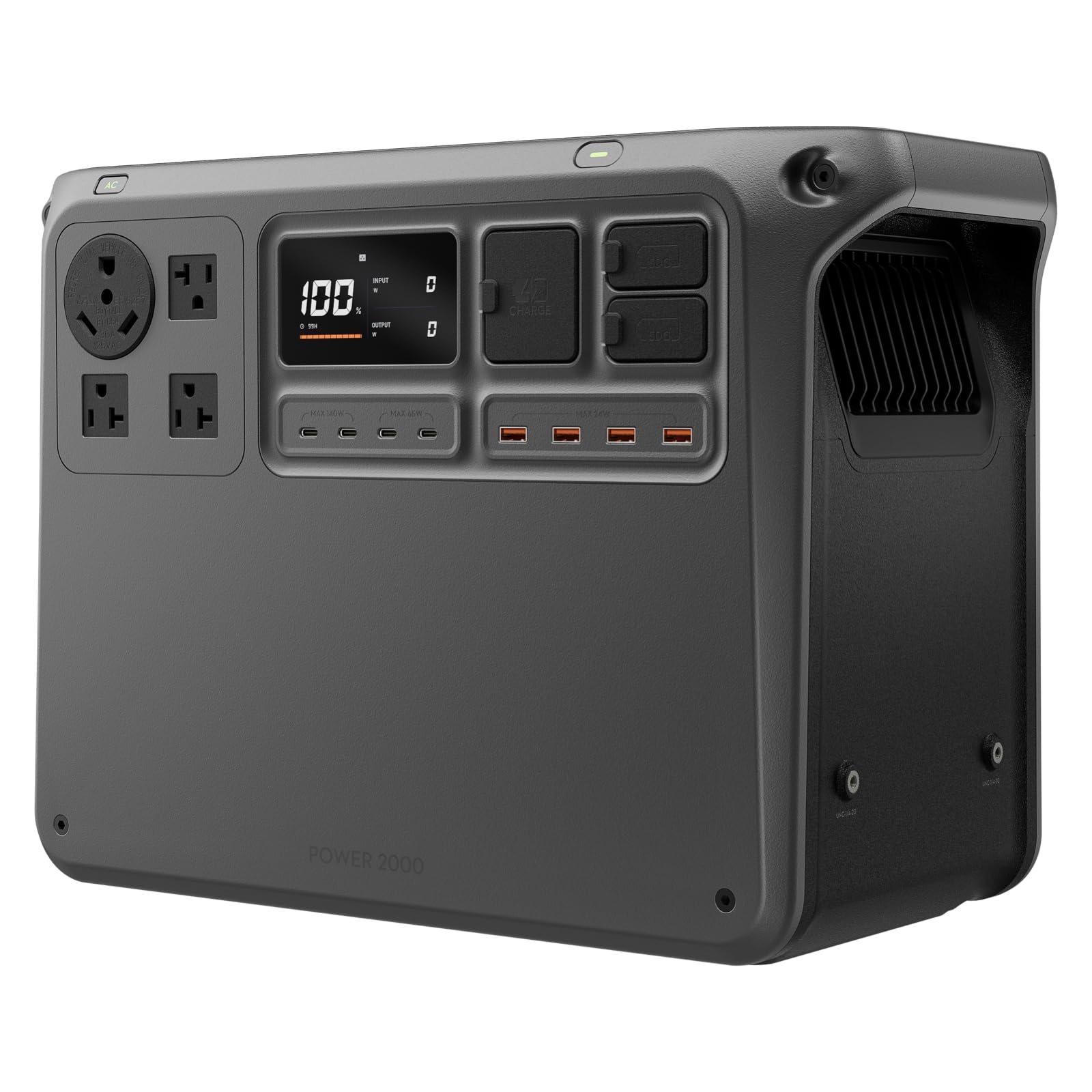
Built to power a jobsite by day and stay whisper-silent in an RV by night.
The DJI Power 2000 matches the Anker SOLIX C2000 Gen 2 on storage at 2048Wh, but pushes 3000W of output instead of 2,400W. That extra headroom is why it handles kettles, electric saws, and impact drills that would stall a smaller inverter. A 2048Wh LFP (lithium iron phosphate) battery, smart battery management, and a flame-retardant housing make it a durable pick for messy, outdoor conditions.
For overnight use, this is one of the quietest picks here. The unit runs as low as 30 dB (about the level of a whisper), so it will not keep you awake in a camper, and its UPS switchover lands at 10 ms (the gap before battery power takes over) — twice as fast as the brand’s Power 1000, which matters when you are protecting a desktop or router. Around the outside are 15 ports, including dual full SDC ports, so four or five people can charge phones, lights, fans, and laptops at once. It even recharges to 80% in 55 minutes for road trips and storm prep.
For all that, the honest caveats are real. Owners are split on recharge speed and on price — some call the value unbeatable, others say it is on the high side, which is why both aspects land as mixed. More importantly, you cannot add DJI’s own solar or car fast-charging modules without buying a compatible adapter, and supply of those peripherals has been a sticking point. A few also notice a mild odor early on. Treat the base unit as the star.
Who it serves best: contractors and RV owners who want strong output, spread-out ports, and a quiet night’s sleep from one box.
The caveat to weigh: the brand’s own solar and car fast-charge modules are not built in and need a separate adapter, so plan the accessories up front.
Great for: powering tools and appliances on the go while keeping the campsite quiet.
Think twice if: you want a fully plug-and-play solar set-up with everything in the box.
5. Jackery Explorer 2000 v2 Portable Power Station

A two-kilowatt station that hits 80% in 66 minutes and slides into the car without a fight.
If your priority is a fridge, freezer, and router that never notice the grid fell, this is a strong fit. It carries a 2042Wh capacity and three AC ports totaling 2200W, so it meets home-backup, camping, and small-business needs. Hop in the car with it? At 39.5 lb — billed as 41% lighter and 34% smaller than typical 2kWh LiFePO4 stations — it is easy to move for its capacity.
Recharging speed is where this unit stands out. AC Fast Charging gets it from 0 to 80% in 66 minutes, a full charge takes 102 minutes in Emergency Super Charging mode through the app, and 400W of solar (panels that turn sunlight into power) brings it back in as few as 6 hours. Silent Charging mode tops it up in 5 hours at just 30dB, so an overnight refill stays quiet. The LiFePO4 battery is rated to last up to 10 years, and a 20ms UPS keeps essentials running through outages.
What buyers notice most is the real-world runtime. One owner kept a fridge running for 21.3 hours on a charge and praised the smooth pass-through charging at around 1500W (power flows straight through to your gear while the battery tops up). Another rode out a 30-hour outage on a single fill driving a fridge, fans, and chargers. The one flag to know: an electrical-engineer review measuring about 600Wh of effective output against the 2042Wh rating suggests a possible capacity fault on that particular unit, though the follow-up test came closer to expected. The rating holds its value.
Why it earns a spot high up
- 2042Wh keeps a fridge running for around 21 hours in real use
- 0 to 80% in 66 minutes; full in 102 minutes via the app
- 41% lighter and 34% smaller than typical 2kWh rivals
- 20ms UPS safeguards essentials through outages
The trade-offs to note
- One measured unit showed lower-than-rated effective output
- An occasional unit arrives with no charge and no AC output
- Long-term battery life remains unproven since the model is new
Ideal for: anyone who wants a light two-kilowatt station that recharges faster than they can drink a coffee.
Less suited to: households needing to run several large motor loads at once.
6. EF ECOFLOW DELTA 3 Max Portable Power Station
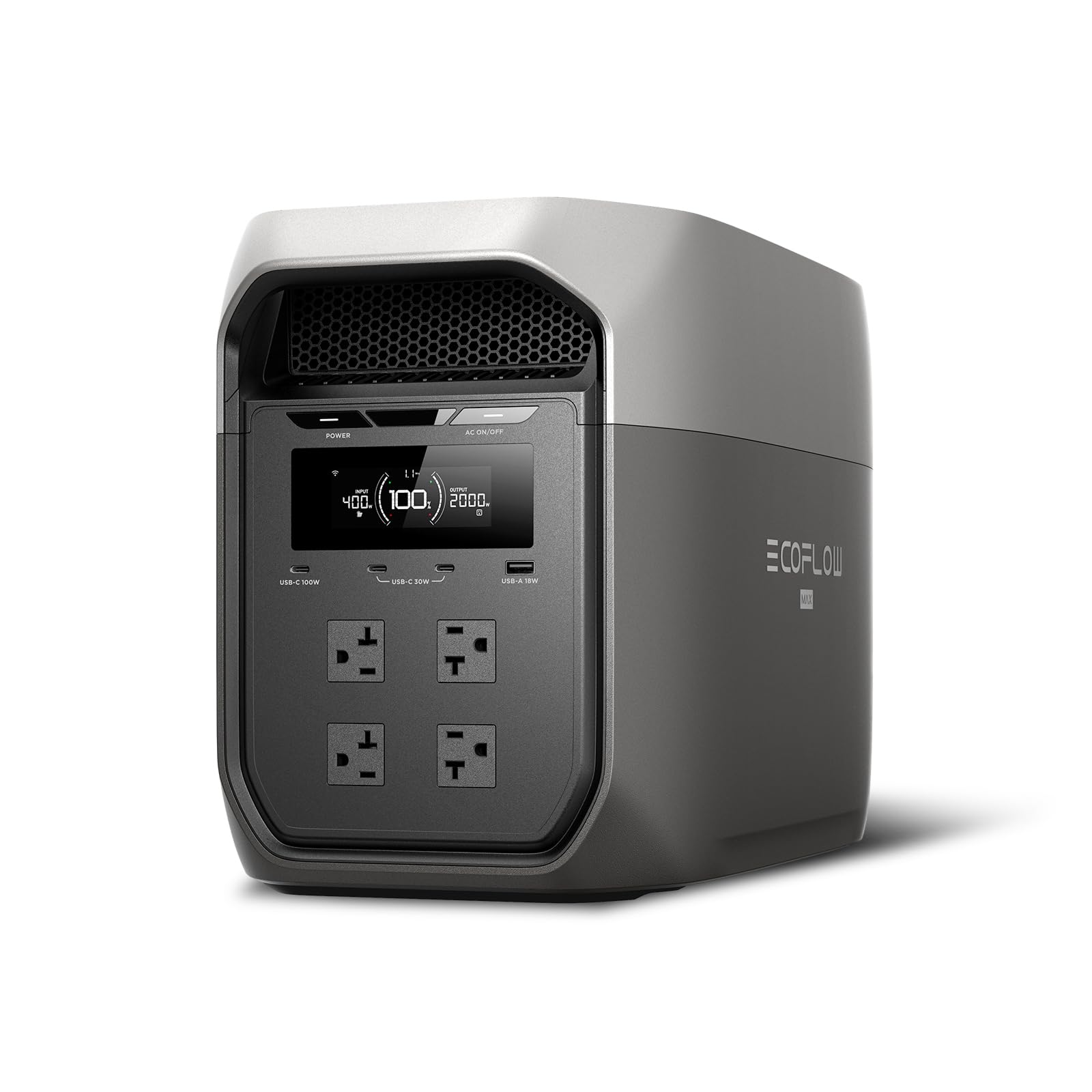
The mid-size box that swallows fridge, microwave, and power tools without flinching.
Here is the standout number: 3400W of X-Boost output. If you want one box that starts a microwave or a power tool while holding a 2048Wh LFP battery designed for long daily use, this is the one to compare against the DJI Power 2000.
The speed story is just as tight. EcoFlow’s X-Stream tech takes it from 0 to 80% in about 1.13 hours, so a blackout warning and a strong outlet are all you need to get ahead of a storm. It runs with a transfer time under 10ms, keeping sensitive electronics safe from the blip, and it stays quiet enough for overnight use. The app lets you schedule charging and discharging to dodge peak rates, and the unit is built around a LiFePO4 battery with an extended 5-year service.
Owners put it to hard work. One family dessert business runs a waffle iron and two freezers off it, leaning on the strong surge for several seconds at 2400W continuous, and reports the cooling vents let them position it flexibly near the handles. A handy bonus: it ships with a hand truck for moving its 48-lb body. The thing to plan for is the app — it is capable but not obvious, and Wi-Fi is needed for some set-up, so budget a few minutes of exploration.
Choose this if: you need extra output headroom for high-draw appliances and want a battery rated for years of daily use.
Consider a lighter pick if: you would rather not spend set-up time poking around an app.
7. BLUETTI Elite 300 Portable Power Station for RV & Home Backup
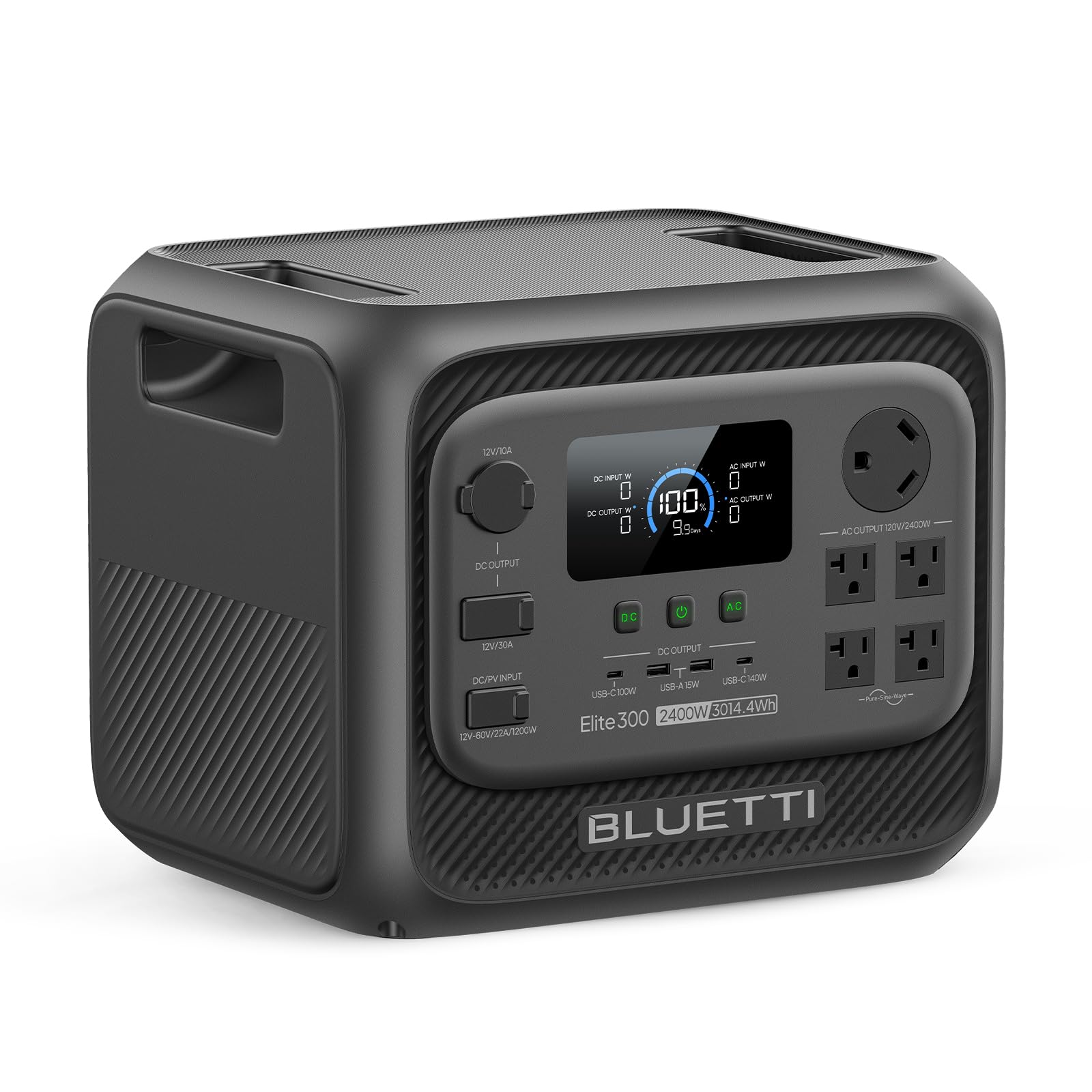
Three kilowatt-hours in a body small enough to fit through a camper doorway.
For RV owners who are tired of gas generators, this unit speaks their language. It holds 3014Wh and delivers 2400W with a 4800W surge, enough to run fridges, routers, lights, and TVs through an outage. The RV-specific touches are the real draw: a TT-30 RV outlet and a high-current 12V/30A DC output let you run 12V fridges, water pumps, and diesel heaters without adapters.
The headline is size. BLUETTI packs that full 3014Wh capacity into a design it calls nearly 59% smaller than traditional large power stations, and it was recognized by Frost & Sullivan as the world’s smallest 3kWh portable power station. A fast 10ms UPS keeps computers and routers running when the grid drops, recharge comes from AC, solar, or a car charger, and it gets from 0 to 80% in as little as 78 minutes. The LiFePO4 battery is rated for 6000+ cycles.
Customers note it running a 12,000 BTU air conditioner all night and powering a weekend of gear on a single charge, with one calling it the size of two ammo cans and the weight of a truck battery. The recurring theme is capability in a small footprint. The limits are honest ones: solar input is capped at 60V/20A, so going over the open-circuit voltage can strain the MPPT charge controller, and there is no battery-expansion path. Plan your panels within that ceiling.
The RV-ready edge: a dedicated TT-30 outlet and 12V/30A DC output make camper and diesel-heater hookups a direct plug-in.
The boundary to respect: keep your solar array within the 60V/20A input limit, and accept that you cannot expand this unit later.
Built for: RV travelers and home users who want maximum capacity per inch of storage space.
Not for: anyone planning to chain extra batteries for more capacity down the road.
8. ABOK Ark3600 Portable Power Station with 200W Solar Panel
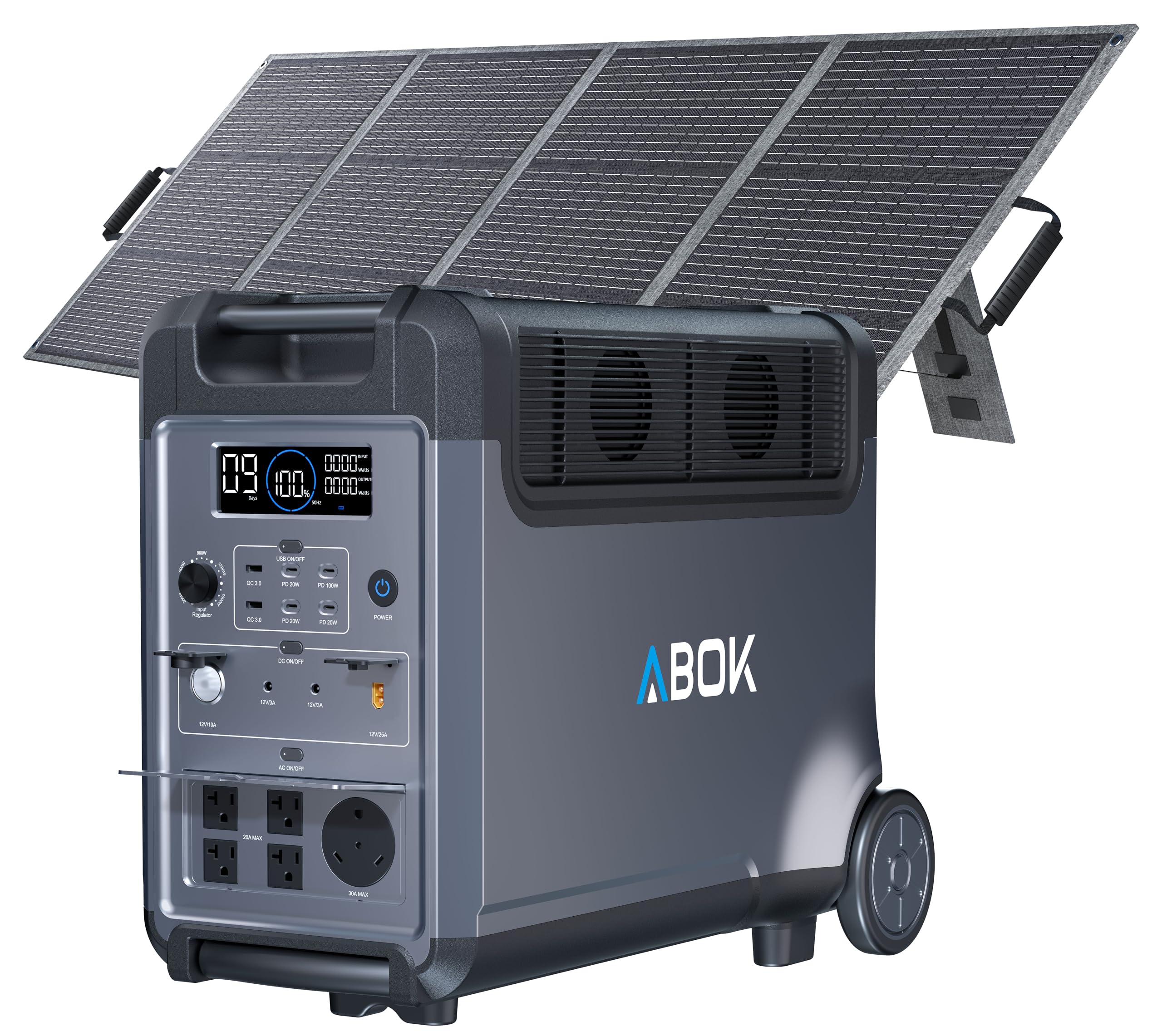
A rolling powerhouse that starts at 3840Wh and can grow to 11520Wh for long outages.
When an outage drags on for days, capacity and mobility both matter — and this unit leans into each. It starts at 3840Wh and expands to 11520Wh with additional batteries, enough for extended backup. The wheels and extendable telescoping handle let you roll all 92 lb of it across a driveway instead of dead-lifting it, and EV-grade LiFePO4 cells are rated for over 4,000 cycles and roughly a 10-year lifespan.
Contractors take notice of the output. With 3600W rated and 4500W peak (peak is the short burst it can handle at startup), it is built to run power tools and most household appliances, and it can partly recharge from AC, PV (solar panels), or a car. Charging is quick when it matters: 1.29 hours to full with AC and solar combined, or 3 hours on AC alone. Around the body sit 15 output ports — including a 30A AC outlet, USB-C PD up to 100W (a fast-charging USB standard), and an XT60 port — so several devices can run at once, and a Bluetooth app lets you monitor it remotely.
Owners run it hard. One contractor powered a wetvac, a heatgun, and an SDS-Max drill simultaneously plus tool-battery and phone charging, ending the day at 22% — a workload most stations this size could not hold. Another reports it as silent and push-button with no gas or cord, which is exactly why it replaces a gas generator for indoor-safe backup. Weigh the mobility versus the bulk: at 92 lb it is a roll-around, not a carry. Owners also note the app could use clearer documentation, and one wanted a 240V outlet.
Where the value lands
- 3840Wh base capacity expands to 11520Wh for multi-day backup
- 3600W rated and 4500W peak run tools and large appliances
- 15 ports, including a 30A AC outlet and USB-C PD up to 100W
- Wheels and a telescoping handle make the 92 lb body movable
The honest limitations
- At 92 lb it is a roll-around unit, not one to carry up stairs
- The companion app lacks thorough documentation
- Solar input can be damaged if you exceed its voltage limit
Suits: homeowners, contractors, and off-grid users who need big, expandable capacity that can be wheeled into place.
Skip if: you want something light enough to lift one-handed or a unit with built-in 240V output.
9. Anker SOLIX F3000 Portable Power Station
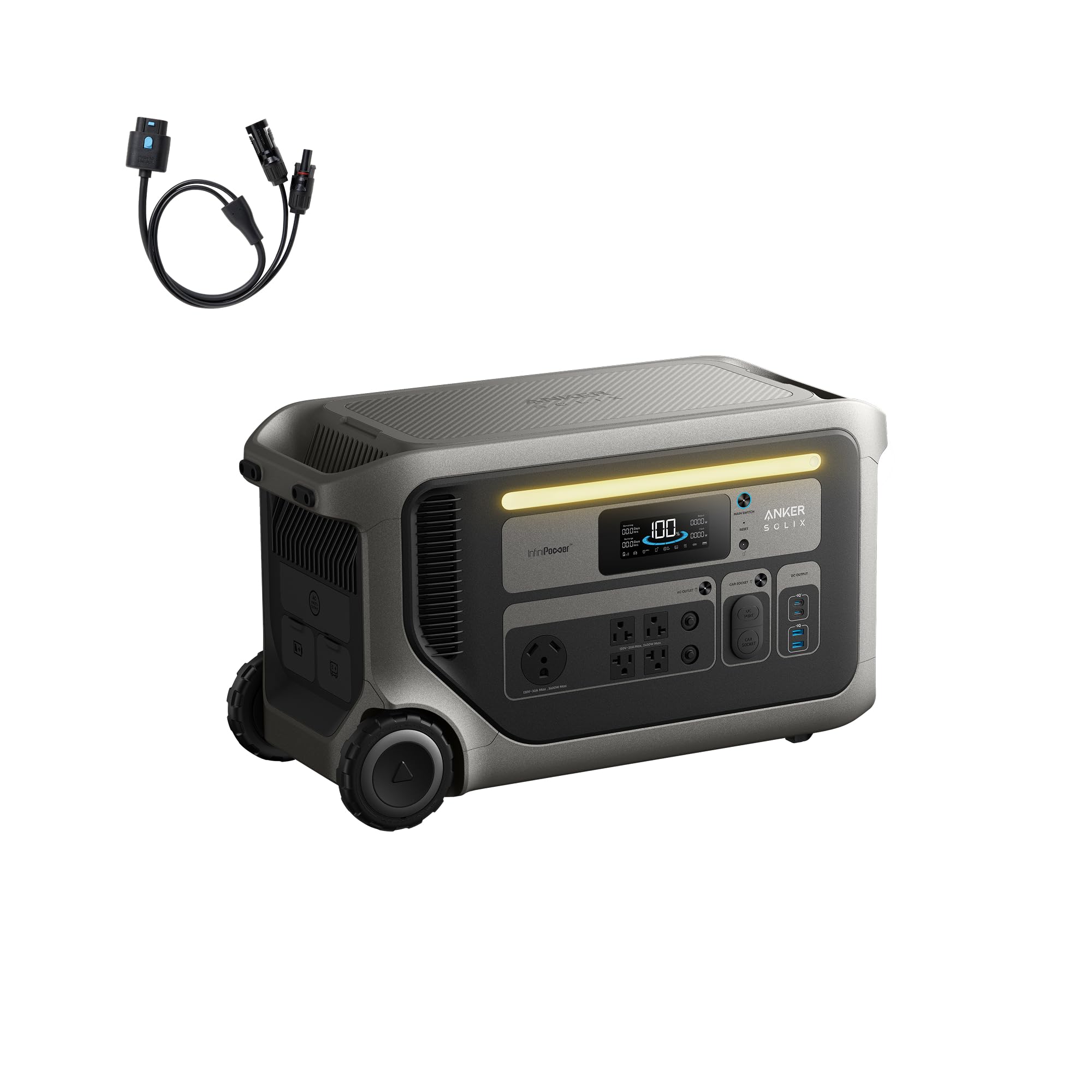
The home-scale station that pairs for 240V and stretches backup into the hundreds of hours.
This is a step up into whole-home territory. The F3000 holds 3,072Wh and expands to 24kWh with additional batteries, and Anker pairs that with genuinely low idle draw — it claims 125 hours of AC standby time or a 190W fridge running for 42 hours. If you want a station that treats a fridge as a light load rather than a stretch, start here.
Output flexibility separates it from the mid-tier picks. It delivers 120V for your everyday essentials, or you can pair two units to reach 240V for heavier appliances (240V is the higher voltage big appliances like dryers need) — a level the smaller stations simply do not offer, and one reason to compare it against the C2000 Gen 2 rather than the Jackery Explorer 2000 v2. It also handles 3,600W pass-through charging, so you can run appliances at full power from a 120V generator without interruption. Solar fans get up to 2,400W of input through the 165V or 60V ports, and in an emergency you can hit 6,000W of combined fuel-generator-and-solar recharging.
Owners value the build and reliability, with one rig powering a 13k Coleman roof air conditioner for 6 to 7 hours on low cool and rolling on smooth 6-inch wheels. An adjustable charge rate lets you avoid tripping a household breaker, and a 30A input brings it to full in about 90 minutes. That said, repeated Wi-Fi drops come up, and it is undeniably heavy — two aspects several owners flag. Plan for a firm spot to keep it and a stable connection for the app.
Right for you if: you want a station that can grow to cover most of a home and pair for 240V appliances.
Give it a pass if: you need a grab-and-go unit — the weight and size are firmly in whole-home territory.
10. Jackery HomePower 3000 Portable Power Station
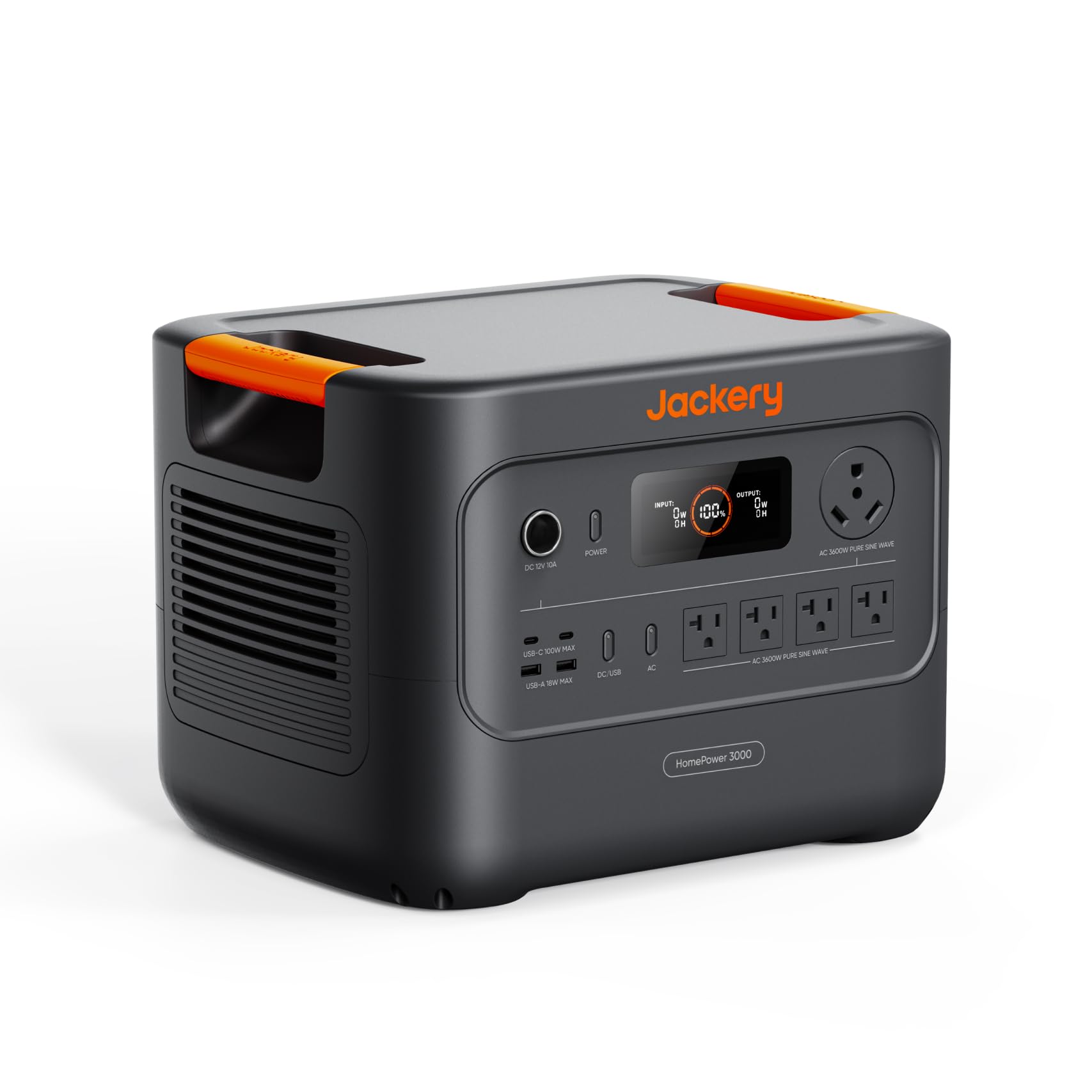
A 3600W household box with a 30A RV outlet and enough to run essentials for up to 15 hours.
If you want one unit that covers your home’s basics and doubles for camping, this is a strong middle premium pick. It carries a 3072Wh capacity and 3600W output with a 7200W surge, enough to run a household for up to 15 hours or a refrigerator for 1 to 2 days. A UL-certified UPS switches within 20ms to keep security cameras, medical refrigerators, Zoom calls, and pet feeders running without a stumble.
Recharging is flexible and fast. A hybrid AC-and-DC fill takes 1.7 hours, pure AC takes 2.2 hours, and two SolarSaga 200W panels bring it to 80% in 9 hours. It also charges from a 12V car charger or a gas generator. The build uses ChargeShield 2.0 with AI algorithms to speed charging and stretch battery life, and the LiFePO4 cells are rated for 4,000 cycles while keeping 70% of capacity. As the maker’s first 3kWh station with CTB technology, it claims 47% smaller and 43% lighter than comparable-capacity units, and the dual 100W USB-C PD ports batch-charge phones, tablets, and drones.
What wins people over is raw capability — running office gear for days and a 30-ft travel trailer through the 30A outlet without adapters. The recurring gripes are weight and fan noise: it sits near 60 dB under load, which is why some would not use it as a daily UPS. At 59.5 lb, it is a settle-and-leave unit rather than a carry-along. For whole-home essentials, the trade is worth understanding before you buy.
What it does best: keeps a house’s core loads breathing for up to 15 hours, with a 30A RV port and dual 100W PD ports in the mix.
What to accept: a fan noise near 60 dB and a 59.5 lb body mean it is a fixed station, not a grab-and-go.
A strong match for: homeowners and RVers who want serious output and fast hybrid recharge in one unit.
Not ideal if: you need silent operation in a shared room or a compact station to move often.
11. EF ECOFLOW Portable Power Station 3600Wh DELTA Pro
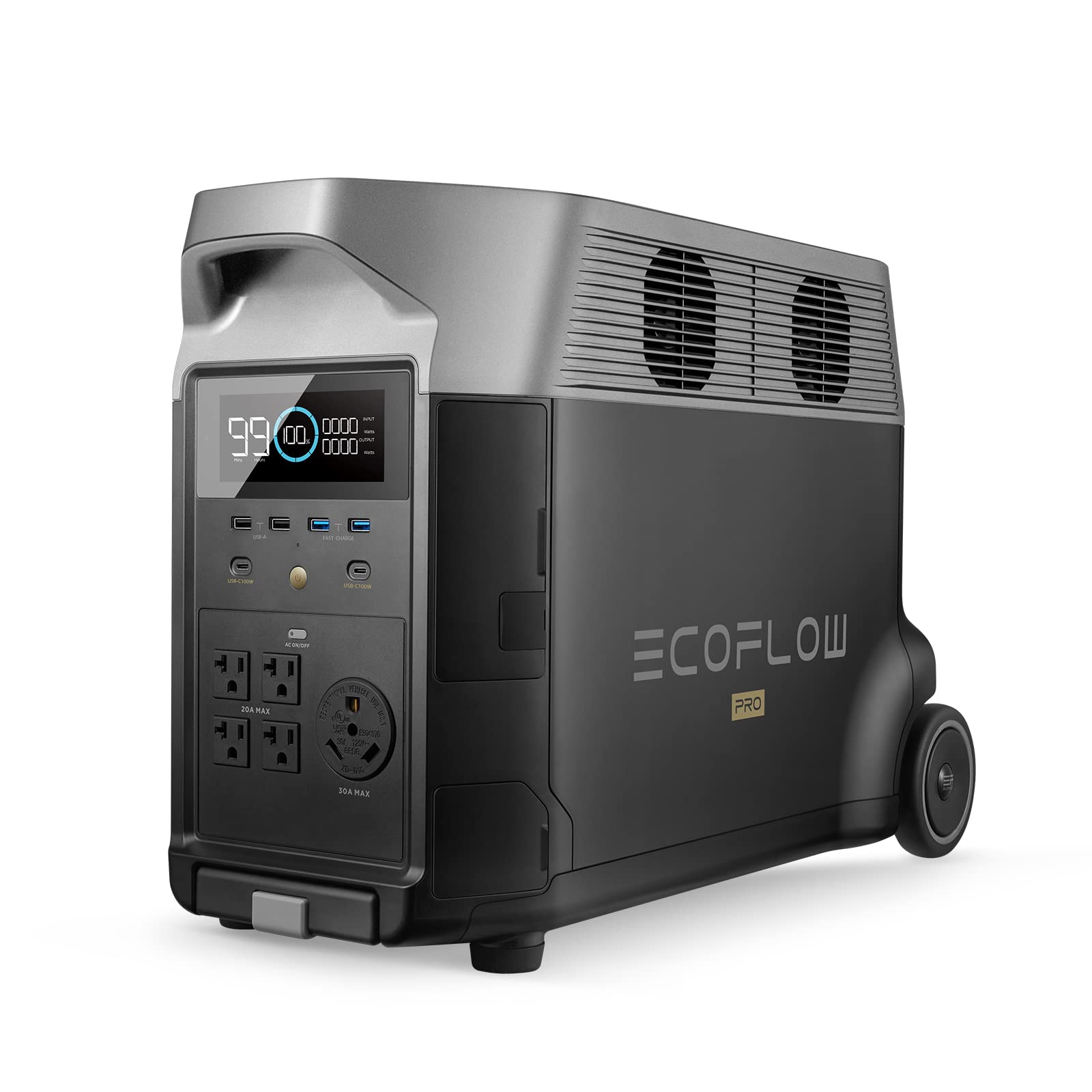
The veteran flagship built for whole-home backup, with capacity that can climb to 25kWh.
For serious whole-home backup, this is the most established name in the premium tier. It packs a 3600Wh LFP battery that expands to 25kWh with extra batteries or smart generators — a level of headroom that turns a multi-day blackout into a mild inconvenience. A single unit puts out 3600W of AC, which climbs to 4500W with X-Boost, and two units can be paired for 7200W to drive the heaviest household loads.
Its connectivity is the widest of the group, with 15 output methods including five AC outlets, USB-C at 100W, a car power output, and an Anderson port, so a whole desk of devices can run at once. Recharging is quick for a unit this big: about 1.8 hours on 240V outlets at 3000W, around 2.7 hours on standard 1800W wall outlets, and solar-charged in about 2.8 hours with four 400W panels. The EcoFlow app lets you watch charge level, temperature, and charge times, and tune input and output settings.
Owners put it to work in power-prone regions, running a fridge, propane furnace blowers, lights, internet, and computers for roughly 15 hours, then refilling in about 2 hours from a gas generator to cut fuel costs. A mobile business runs a heat press off it with no voltage drops across five 120V outlets. The fair catch is weight — at 99 lb it takes an extendable handle to move, and one owner tripped a breaker on the first outlet while charging. Plan your outlet choice and you will get along fine.
What makes it the flagship
- 3600Wh capacity expands to 25kWh for extended backup
- 3600W output scales to 4500W with X-Boost; two units reach 7200W
- Recharges in about 1.8 hours on 240V or 2.8 hours on four 400W solar panels
- 15 output methods cover a full desk of gear at once
What to weigh first
- At 99 lb it needs a handle or two people to reposition
- Charging on a shared household outlet can trip a breaker
- Solar input is capped at 15A, which limits panel expansion
Worth choosing if: you want maximum capacity that can grow to whole-home scale and accept a heavy, fixed station.
Look lighter if: you need to move your backup around or want to expand solar beyond its 15A input.
Understanding the Specs
Watt-Hours (Wh): Your Fuel Tank
Watt-hours measure how much total energy a battery stores — think of it as the size of the fuel tank. A higher number means more hours before a recharge. The catch buyers miss is that runtime scales with the load: a router sips power and can run for days, while a heater drains the same tank in a fraction of the time. When you compare picks, weigh Wh against what you plan to plug in.
Rated vs Surge Watts: Steady Power and Starting Kick
Rated watts is the steady power a unit delivers; surge (or peak) watts is the short burst it can handle when a motor starts. Fridges, freezers, and power tools all kick hard at the instant they power on, so a generous surge rating is what lets a station start them without tripping offline. Match both figures to your biggest appliance, not just the total you plan to run.
LiFePO4: The Long-Life Battery Chemistry
Lithium iron phosphate (LiFePO4) is a battery chemistry rated for thousands of charge cycles, far longer than the lead-acid cells in older backups. Where a unit lists a cycle rating such as 4,000 or 6,000, that is the number of times it can be drained and refilled before losing a chunk of capacity. More cycles usually means a longer service life and fewer replacements.
UPS Switchover: Keeping Sensitive Gear Alive
A UPS (uninterruptible power supply) function hands off to battery the instant the grid fails. The switchover time, measured in milliseconds, is how long that gap lasts. A shorter figure — under 10ms, for example — is smoother for computers, routers, and medical gear, while a longer one may let some sensitive electronics flicker or reboot.
FAQ
What is the difference between a UPS and a portable power station?
Can I run a window air conditioner on a battery backup?
What is 10ms UPS switchover and why does it matter?
How fast can these units recharge after an outage?
Can I charge a battery backup with solar panels?
Is a battery backup safe to use indoors during a power outage?
How long does a LiFePO4 battery backup last before it needs replacing?
How much output do I need to run power tools off a backup?
Can I expand a battery backup later for more capacity?
Final Thoughts: The Verdict
For most homes, the battery backup for power outage winner is the Anker SOLIX C2000 Gen 2 because it pairs 2,048Wh (watt-hours, the total energy it stores) with a 58-minute recharge and 4,000W peak, and buyers report running a full trailer, coffee maker, microwave, and Starlink through the night. If you want the most headroom for heavy appliances, grab the EF ECOFLOW DELTA 3 Max with its 3400W X-Boost output (a mode that lets it run appliances drawing more than its base rating). And for a small rack of always-on network gear, the GOLDENMATE 1000VA/600W UPS is the tidy, plug-and-play one to reach for.
One practical nudge as you decide: the Anker SOLIX C2000 Gen 2 carries a 4.7-star rating across 600+ owners, and its low standby draw (the small amount of power it sips while idle) keeps it useful on quiet days between storms — a strong pick if fast refills and easy carrying are what you value most. Match capacity and surge (the short startup burst an appliance needs) to your biggest appliance, respect each unit’s recharge limits, and you will pick a backup you can trust when the lights go out.
How We Picked
We do not accept paid placement. Every pick is matched to a real buyer and a real use-case; we do not hands-on test units.
Sources & Methodology
Specifications: manufacturer listings and product documentation. Review insights: verified customer reviews, as of September 2026. Pricing: not shown on this page (it changes often); check the current price via the retailer link.
As an Amazon Associate, KitchPrep earns from qualifying purchases. This does not affect which products we feature.
Related Guides
