
Specs are compiled from manufacturer listings and verified buyer reviews and can change over time — please confirm the key details on the product page before buying.
If your garage only has a standard wall outlet, the welder that actually finishes your project is the one that runs on it without tripping a breaker halfway through a bead. That single limit decides everything else — how thick a plate you can fuse, how long you can weld before the machine needs to cool, and whether you can roll it out to a fence post in the backyard. So the picks below are sorted by what they genuinely do on household power, not by a spec sheet’s biggest number.
I’m Mohammad Maruf — the founder and writer behind KitchPrep. This guide is built by comparing the manufacturers’ published specifications and the patterns across verified customer reviews, so you get each pick’s real strengths and trade-offs instead of marketing spin.
Nearly every machine here plugs into an ordinary outlet, but they split sharply on thickness, duty cycle, and how much setup a beginner has to survive. The list ahead covers that whole spread, from a fifteen-pound Lincoln with a 4.7-star record across 500+ ratings to a 135A three-in-one kit that arrives with a helmet and gloves already in the box, so you can match a machine to your actual shop instead of guessing. If you want the short answer on the 110v welder that fits most home garages, the Lincoln 90i FC at the top of this list is where I would start.
Our Picks at a Glance
How To Choose The Best 110V Welder
A 110V welder is a machine that runs on the ordinary household outlet in your garage — 110 volts or 120 volts, the same socket your shop light uses. That one limit shapes everything a beginner gets wrong about buying one. Here is what actually decides whether a machine earns its place on your bench.
Start With What Your Outlet Can Actually Deliver
The amps printed on the box describe the welding current, not what the wall can supply. On a 110V household circuit, most of these machines pull a real, usable arc on thinner steel — that is the whole point of the category. Running a demanding bead on a standard outlet will eventually trip the breaker, so plan for short, deliberate passes rather than one long continuous weld. If you have genuine need for thick plate and sustained output, the dual-voltage machines here that also accept 220V are the smarter buy.
Duty Cycle Tells You How Long You Can Weld
Duty cycle is the percentage of a ten-minute window a machine can weld before it needs to cool — a 60% rating means six minutes of welding, four minutes resting. Higher duty cycle means fewer interruptions on a longer job. It is the single most overlooked number on a welder’s label, and it matters far more than peak amps once you are working on anything bigger than a repair.
Flux Core Versus Solid Wire
Flux-cored wire has its shielding flux built into the wire itself, so you weld without a gas bottle — that is what makes flux core practical in a garage or outdoors in wind. Solid MIG wire needs a shielding gas cylinder and regulator to work cleanly, producing less spatter and neater beads. Almost every machine in this list runs flux core; several also accept solid wire if you add gas later.
Process Count And What It Really Gets You
Three-in-one machines add stick and lift TIG alongside MIG, letting one box cover repairs from a lawn mower deck to a stainless exhaust. Lift TIG uses a light touch of the tungsten to start the arc — quieter and more precise than stick. Note that on nearly every multi-process welder here, the TIG torch is sold separately, so budget it before you commit.
Quick Comparison
| Model | Best For | Max Thickness | Input Power | Weight | Amazon |
|---|---|---|---|---|---|
| Lincoln Electric 90i FC★ Best Overall | Thin steel, home repairs | 1/4″ | 120V | 15 lbs | Amazon |
| BESTMIG 135ABest Value | Beginners who want the full kit | 1/8″ | 110V | 10.71 lbs | Amazon |
| Bestarc MIG145 9GENCompact Pick | Garage, workshop, and farm use | — | 110/220V | 13.7 lbs | Amazon |
| FEMEROL MIG 250PRO | Home owners and farm repairs | 1/4″+ plate | 110/220V | 32.6 lbs | Amazon |
| ARCCAPTAIN MIG200 | Farm and road equipment | — | 110/220V | — | Amazon |
| Lincoln Electric 90i MIG | Mobile maintenance work | 1/4″ flux / 3/16″ solid | 120V | 15 lbs | Amazon |
| ARCCAPTAIN MIG250 | Thick steel on dual voltage | 1/2″ | 110/220V | 32.7 lbs | Amazon |
| PrimeWeld MIG180 | Fabrication and aluminum work | — | 110/220V | 55 lbs | Amazon |
| Weldpro TIG200 | Aluminum TIG and precision work | — | 110/220V | 61.8 lbs | Amazon |
In‑Depth Reviews
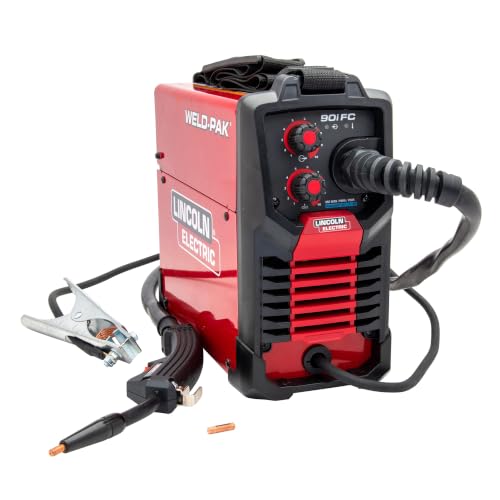
1. Lincoln Electric 90i FC Flux Core Wire Feed Weld-PAK Welder, 120V
Our pick — over 4.5★ from 550+ verified ratings; the strongest balance of quality and price.
A 15-pound flux-core wire feeder that welds 1/4″ steel on a 120V household outlet.
If your workspace is a garage, a driveway, or the back of a truck, this is the machine you will actually reach for. The Lincoln 90i FC runs on 120V (standard household power, the same socket as any wall outlet) and welds steel up to 1/4″ thick — thick enough for trailer repairs, gate hinges, and lawn equipment. It weighs 15 pounds with a shoulder strap included, and the whole unit lives in a protective metal case that keeps it safe in a truck bed or a humid shop. The weld-Pak survives real traveling abuse, which is why it earns the top spot here.
What wins people over is the outright performance — this machine welds thin stainless and 14-18 gauge sheet instead of forcing you to drag out a big welder for small jobs. Inverter power (a design that converts the wall current internally for a steadier arc) gives it smoother weld characteristics than an older transformer machine. Two knobs control wire speed and voltage, and the voltage is infinitely adjustable, so you can fine-tune the arc instead of picking from preset steps. The cold feed switch makes spool changes easy without live wire spitting out.
One thing to plan around: hobbyists welding on an old 15A household circuit report getting roughly an inch of full-power weld before needing a cooldown, and short beads are the honest way to run it on a standard outlet. That is the 110V reality, not a flaw in this machine. The durability here is also real — the housing and drive assembly hold up to years of moving between jobs, and the company backs the machine with a 12-month manufacturer warranty.
The reasons owners keep it
- Welds up to 1/4″ steel off a plain 120V household outlet — no special wiring
- 15 pounds with shoulder strap and metal case, so it travels to the job
- Infinite voltage adjustment gives smoother arc control than stepped dials
- Cold feed switch lets you feed wire safely during spool swaps
What to expect on a standard circuit
- Full-power beads on an old 15A circuit run about an inch before cooldown
- Flux core only from the start — solid MIG wire is a separate purchase
Reach for this one if: you want a genuinely portable 120V wire feeder with a long-proven metal case and top-shelf weld quality on sheet metal.
Look elsewhere if: you need long continuous welds on thick plate — step up to a dual-voltage machine that accepts 220V.
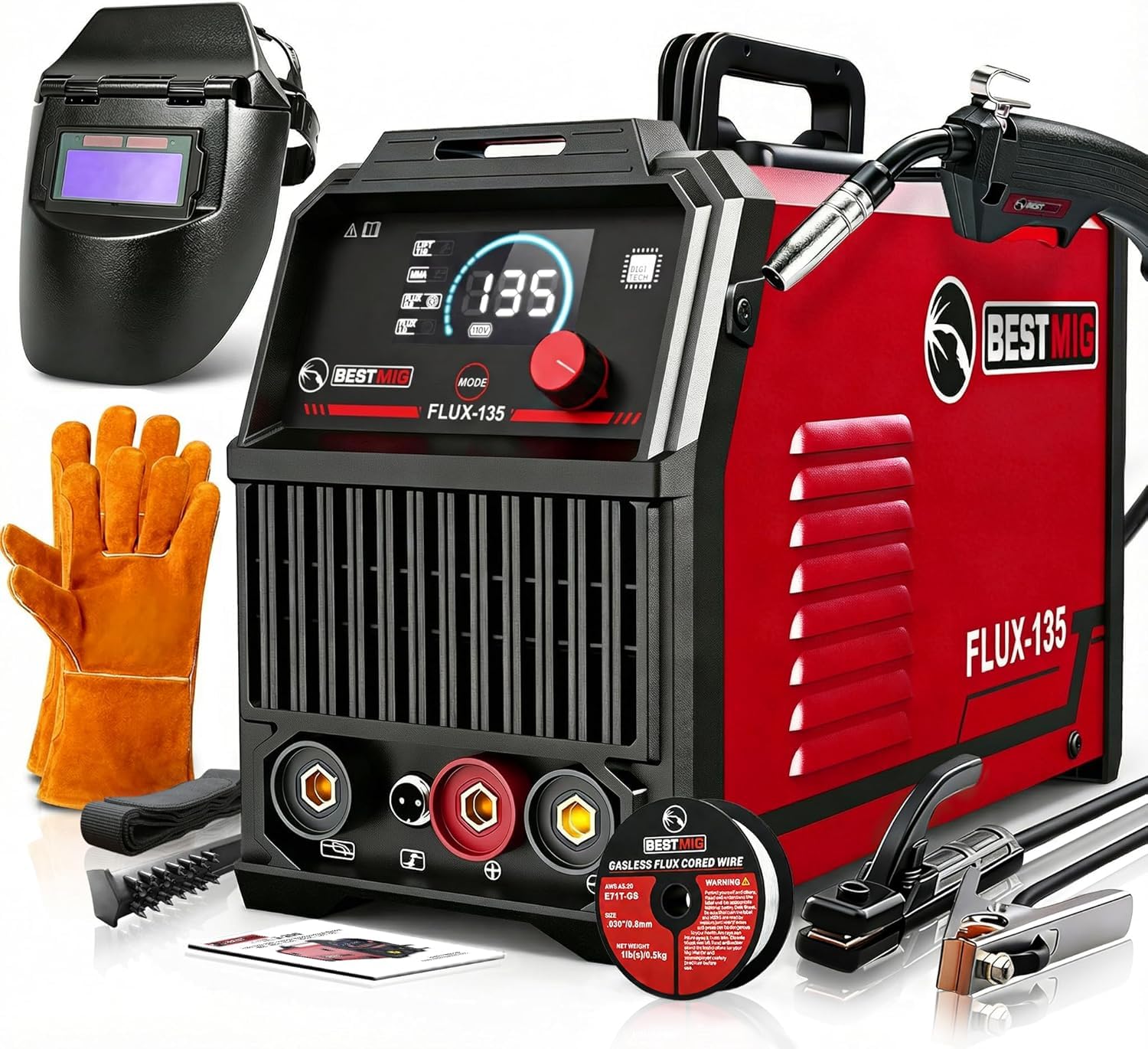
2. BESTMIG 135A MIG Welder — 3-in-1 Flux Core, MIG/Lift TIG/Stick
A 135A 3-in-1 kit that ships with an auto-darkening helmet, leather gloves, and a spool of flux-core wire.
Open the carton and you can start welding the same afternoon. The BESTMIG FLUX-135 delivers a true 135A of welding current and handles material up to 1/8 inch thick, which covers railings, brackets, and household repairs comfortably. It runs three processes — gasless MIG, Lift TIG, and Stick — off 110V household power (standard wall outlet voltage). The included kit is the real story: an auto-darkening helmet that converts to goggles, a pair of leather gloves, ground clamp, electrode holder, torch, wire brush, and a spool of flux-core wire. That is the whole first-project shopping list in one box.
The control side is genuinely beginner-friendly. An all-in-one digital system (digital control that reads your settings and adjusts the machine automatically) sets the parameters for you, so you load the wire, connect the torch, plug it in, and go. A full-color LED display shows your welding parameters in real time while you work. Flux-core wire between 0.030″ and 0.040″ runs without a gas bottle, which makes it ideal for outdoor work in wind where a gas-shielded arc would blow away.
The honest limit is scale. This is a home-and-garage machine, and its clean welds come from running the correct process on the correct material rather than brute output. It weighs 10.71 pounds, keeps portability high, and works for both first-timers and someone who has welded before. The TIG torch is sold separately if you want to pursue that mode later.
Where the value sits: the accessory kit alone justifies the price tag — you get helmet, gloves, and the safety gear up front rather than buying them piecemeal.
The one trade-off: 1/8″ is the ceiling here, so anything heavier needs a dual-voltage machine with more headroom.
Best fit: a first-time welder who wants one box that covers the safety gear, the wire, and three welding modes without a second order.
Not the pick for: anyone routinely welding 1/4″ plate or heavier, where a 200A-class machine is the real answer.
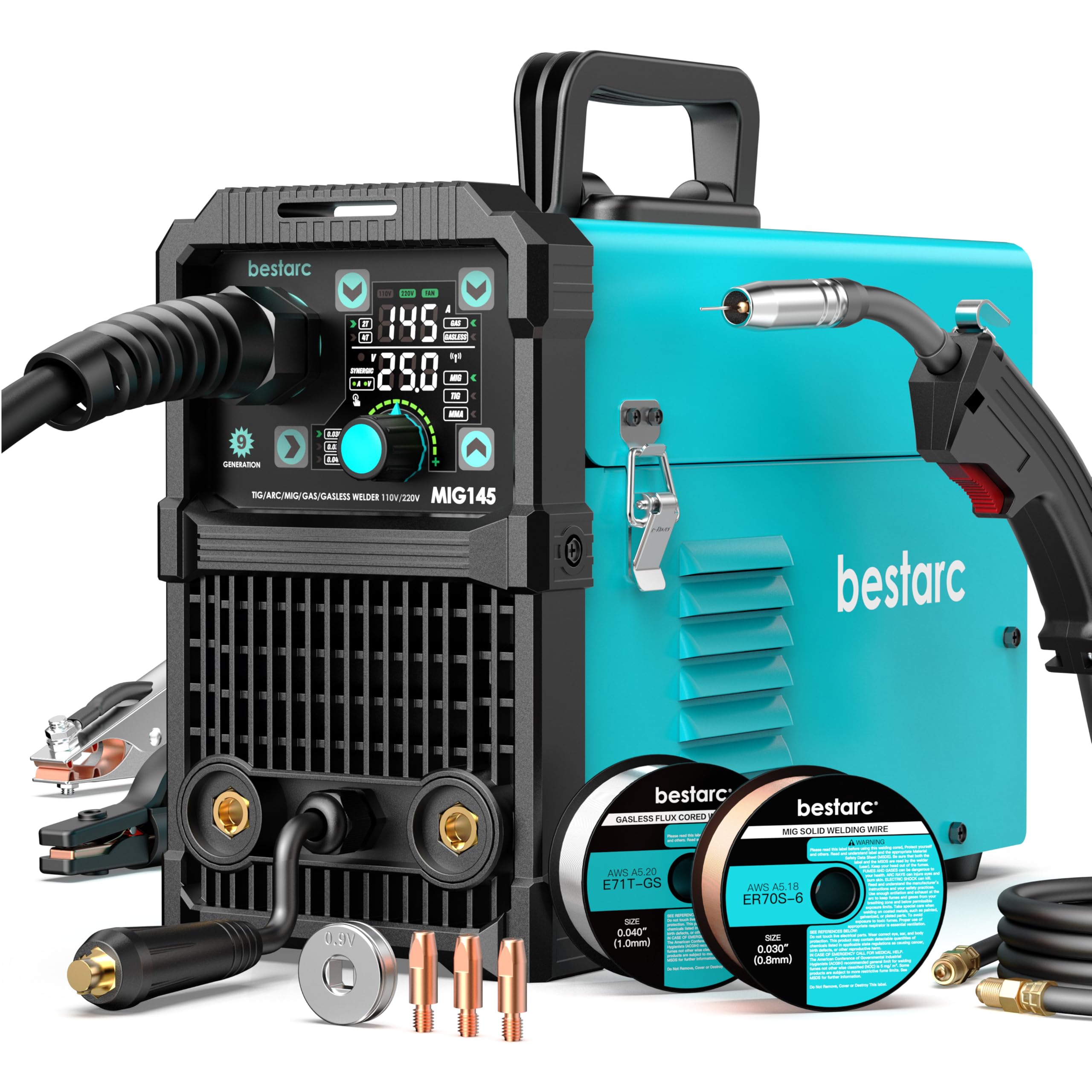
3. ARCCAPTAIN 135A Flux Core MIG Welder 110V 3-in-1
A 145A 4-in-1 that auto-detects 110V or 220V and shows the selected voltage on the panel.
Dual input voltage is the reason to pick this over a 110V-only machine. The Bestarc MIG145 reads the outlet it is plugged into, automatically switches between 110 and 220 volts, and displays the selected voltage right on the front panel — so it works as happily at a home garage bench as at a farm building wired for 220. That flexibility is a real upgrade if you ever plan to move to a heavier circuit. It runs four processes: gas MIG, gasless flux core MIG, Lift TIG, and Stick — all with a 145A output and synergic control that picks the recommended voltage and wire feed speed based on the wire you have loaded.
The wire compatibility is broad. It runs E71T-GS flux-core wire and ER70S-6 solid wire, and takes 0.030″, 0.035″, and 0.040″ flux-core wire along with 0.030″ solid wire. Fine-tuning runs from -3V to +3V, giving an experienced welder room to dial in the arc. It weighs 13.7 pounds with a shoulder strap for carrying to job sites, and the bundle is complete: MIG welder, torch, earth clamp, stick holder, both wire spools, contact tips, wire feed rollers, hose, and the 220V-to-110V wire adapter.
Where it asks for some editing is the included lead lengths and drive-roll choices. The 5.5-foot gun lead is short for reaching across large frames, and the machine ships with V-groove drive rolls only — running flux core cleanly usually wants knurled rolls, which you buy separately. A knurled roll has teeth that bite into the softer flux wire instead of sliding. It does not include a gas regulator, which you will need if you intend to weld with shielding gas rather than flux core.
Where it excels
- Auto-detects 110V or 220V and displays the voltage on the panel — one machine, two jobs
- Four processes in one: gas MIG, gasless flux core, Lift TIG, and Stick
- Fine-tune voltage from -3V to +3V for arc precision
- Full accessory bundle including both wire spools and a 220V-to-110V adapter
What to buy alongside
- 5.5-foot gun lead is short — plan a longer lead if your work spans large frames
- Gassless flux core runs better with knurled drive rolls, which are not included
- No gas regulator in the box if you want to MIG weld with gas later
A smart pick for: RV owners, farm operators, and home workshop welders who want the option of 220V if they ever have the circuit.
Not enough if: you want a complete gas-welding package from the start — budget for a regulator and knurled drive rolls.
4. FEMEROL 250A MIG Welder — 6-in-1 Gas MIG/Gasless Flux Core/Stick/Lift TIG/Spot/Aluminum

A 250A 6-in-1 that adds spot welding and spool-gun aluminum to MIG, flux core, stick, and Lift TIG.
Six processes is more than any machine higher up this list. This FEMEROL runs gas MIG, gasless flux core MIG, Stick/MMA, Spot welding, Lift TIG, and supports a spool gun for aluminum. It has a 250A output that can weld mild steel up to 14.0mm plate, and a duty cycle of 60% — a majority of a ten-minute window spent welding — which pleases anyone doing longer runs than a home hobbyist. The synergic control matches current and wire feed speed once you select wire diameter and material, then hands manual control back to you for fine adjustments.
What this machine adds for the heavier buyer is the aluminum capability. Installing the teflon wire feed tube or attaching a spool gun lets you weld aluminum — stainless steel, alloy steel, and iron are all on the list too. The wire menu takes a wide range:.023″,.030″, and.035″ solid wire,.023″,.030″, and.035″ flux core wire, and.035″,.040″, and.045″ aluminum wire. Overload, over-voltage, over-current, and over-heating protections are all built in, and the machine is covered by a two-year guarantee.
The honest friction points worth knowing. The manual is thin, and the machine has a couple of ergonomic quirks — an awkward spool holder and a barbed gas inlet. One recurring theme is the fan running continuously rather than intermittently, which is louder than the intermittent-fan machines above. It also ships with a 120V plug kit that is on the light side for a machine of this output, so if you plan to push it, upgrade that or run it on 220V for the full range.
The decisive extra: aluminum welding is the standout — spool gun or teflon liner lets this do jobs that no 135A machine on this list can touch.
Honest caveat: a thin manual and a continuously running fan mean you will be figuring some things out yourself and living with the noise.
Best fit: home owners and farm operators who want one welder capable of MIG, stick, TIG, spot welding, and aluminum.
Think twice if: you want a slim, quiet machine for small jobs — the constant fan and the deeper setup make it feel substantial.
5. ARCCAPTAIN 200A MIG Welder 110V 220V 6-in-1 Aluminum Welding Machine MIG200
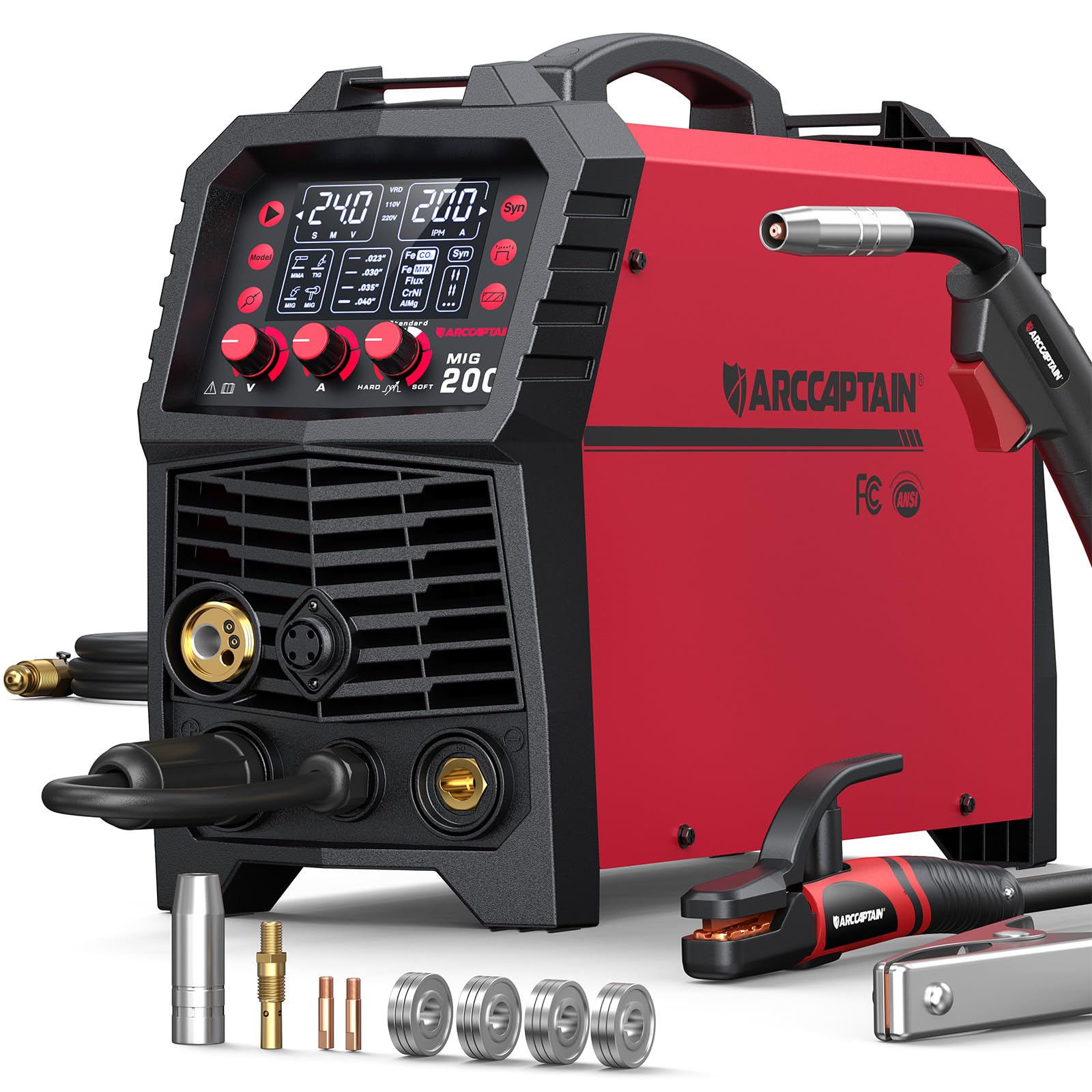
A 200A 6-in-1 with 10 saved parameter presets and an intermittent cooling fan.
The 200A ceiling puts this squarely in professional-workshop territory while the weight stays manageable. It runs six processes — Gas/Solid Wire MIG (GMAW), Gasless Flux Core MIG (FCAW), Stick/MMA, Spot welding, Lift TIG, and it accepts an optional spool gun for aluminum. Wire range is broad:.023″,.030″, and.035″ solid wire,.030″ and.035″ flux core wire, and.035″ and.040″ aluminum wire (the.023″ and.040″ rollers are a separate purchase). It travels well with a handle or the included shoulder strap, and is built for outdoor maintenance, farm work, and home DIY.
The feature set is a step up in control. Synergic MIG (digital control that matches recommended current and wire feed speed once you name the wire diameter) works for beginners, and you can adjust welding current to your own habit if you are experienced. Beyond the basics, you get adaptive crater, burn-back adjustment, and pre-flow/post-flow — all of which shape how the weld starts and stops cleanly. The 2T/4T trigger modes and the ability to save 10 preset settings — ten groups of parameter data you can call back up — make repeat jobs faster.
The display deserves its own mention. An exclusive human-computer interaction LED screen shows accurate data clearly enough that you can read it without lifting your helmet. Cooling is handled by a fan that only spins up when it needs to, so it stays quiet between welds. Safety runs on VRD (voltage reduction device, which drops idle voltage to a lower level while you reposition) plus over-current, over-voltage, over-load, and over-heating protection. One manufacturer caution to know: don’t switch between 110V and 220V while the screen is still on — wait for it to turn off. Covered by a 2-year manufacturer warranty.
What sets this one apart
- 200A output in a six-process machine that also does aluminum via spool gun
- Store 10 preset parameter groups for each welding mode — fast repeat jobs
- Intermittent cooling fan rather than a constant one — quieter than some rivals
- VRD and full electrical protections built in
Things to plan around
- .023″ and.040″ drive rollers need to be purchased separately
- TIG torch and spool gun are extra purchases if you want those modes
Perfect for: a workshop that wants repeatable multi-process capability with saved programs and a proper 200A ceiling.
Overkill if: you only repair thin sheet metal and never expect to need aluminum or heavy plate work.
6. Lincoln Electric 90i MIG and Flux Core Wire Feed Weld-PAK Welder, 120V

A 120V Lincoln that welds 1/4″ flux core or 3/16″ solid MIG and includes a Harris gas regulator and dual drive rolls.
The 90i MIG is the more capable sibling of the top pick, and the extra kit is why. It welds 1/4″ max thickness with flux-cored wire or 3/16″ max thickness with solid MIG wire, and runs on 120V household power. The bundle includes a welding gun with 10-foot cable, three contact tips (.025″,.030″,.035″), both a gasless nozzle and a gas nozzle, dual track drive rolls for MIG and flux-cored welding, and a Harris gas regulator. So if you want to weld solid wire with shielding gas on day one, this machine is ready — the accessory list saves a shopping trip.
Two knobs control wire speed and voltage for simple operation, and the inverter power source (a design that converts current internally for a steadier arc) delivers smoother weld characteristics than an older transformer machine. Weight is 15 pounds with a shoulder strap for mobile work, and a metal case protects everything from weather and travel damage. Interior reference guides help experienced welders dial in, while the machine is still approachable for a first-timer. That combination — smooth arc, compact frame, and full accessory kit — is why this is often the second Lincoln a hobby shop buys after the 90i FC above.
Two things worth weighing before you decide between this and the 90i FC. First, solid MIG on this machine wants sheet metal — one owner’s advise is that the solid-wire MIG mode is best for thin sheet, not heavy plate. If you only work in flux core, the 90i FC above does the job for less.
The reason to step up: the included gas regulator and dual drive rolls mean you can run solid MIG from the start — no extra purchases to start clean welding.
Budget check: if flux core is all you will ever use, this is more welder than the job requires; the 90i FC above covers that need for less.
The right call for: a buyer who wants the brand-name reliability and a full solid-MIG kit without ordering anything extra.
Consider the simpler model instead if: your work is entirely flux core on thin sheet and you would rather save the difference.
7. ARCCAPTAIN 250A MIG Welder 110V 220V 6-in-1 MIG250
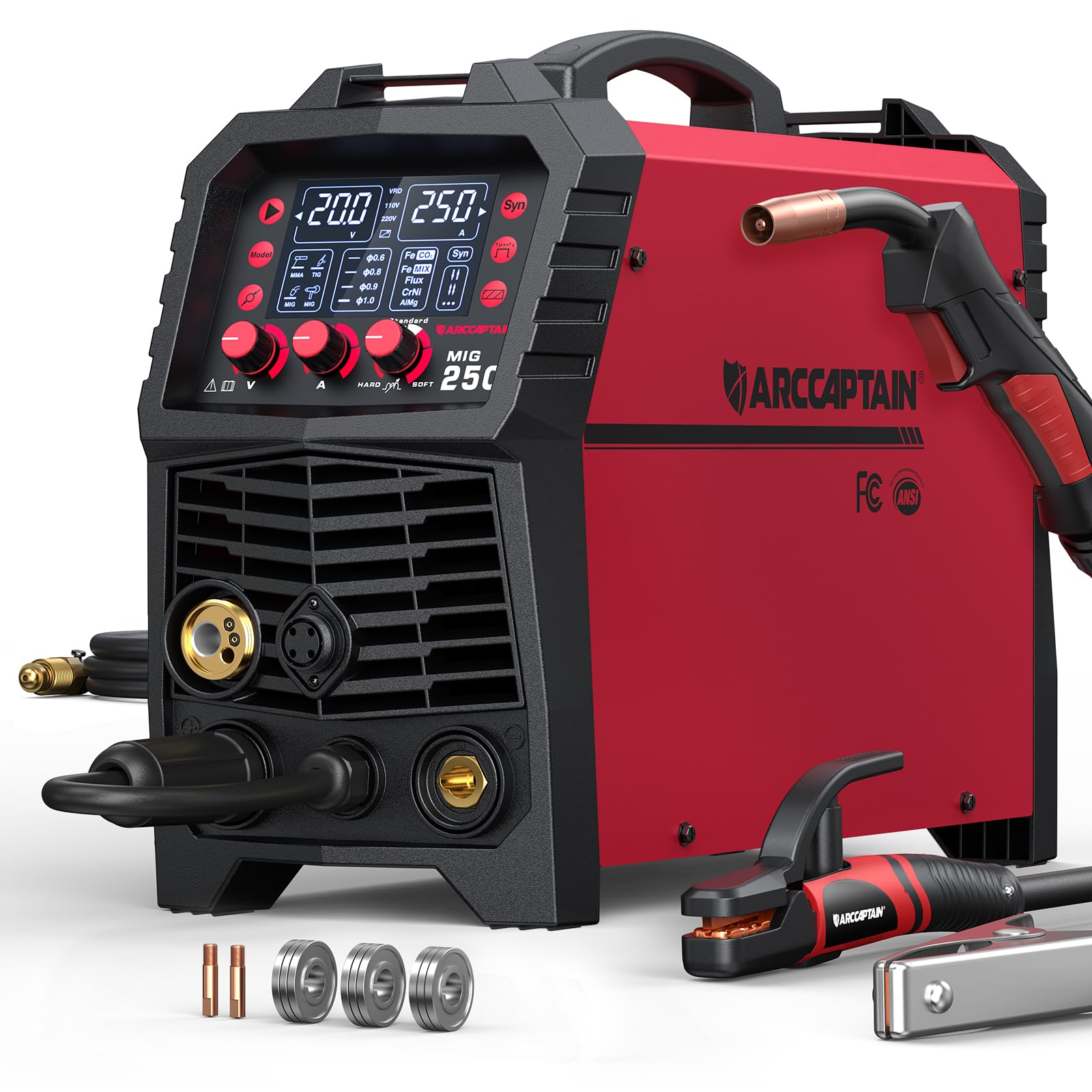
A 250-amp six-in-one built to handle 1/2″ thick steel — but read the power note first.
This is the machine for a buyer who genuinely welds thick plate. The ARCCAPTAIN MIG250 puts out 250 amps and takes six processes — Gas MIG, Gasless MIG, Lift TIG, MMA, Spot, and Spool Gun (with a note that the Lift TIG torch and spool gun are extra purchases). Metal range covers mild steel, carbon steel, stainless steel, and aluminum. This machine is a serious step up in welded thickness, and it works on both 110V and 220V inputs, so you can plug into the household garage outlet for lighter work or a 220V circuit for the heavy lifting.
Control is the other half of the story. Synergic MIG automatically matches the recommended current and wire feed speed to your chosen wire diameter and gas material — easy for a beginner. Manual MIG lets you set values yourself — the better option once you know your own weld style. A fully digital MCU and high-integrity circuit design keep welding stability high, and the intelligent fan runs harder as the machine heats up, extending its service life. Special features include adaptive crater, burn-back adjustment, and pre-flow/post-flow for cleaner starts and stops.
There is one manufacturer caution that matters big: do not power on or switch voltage until the screen has turned off and the fan has fully stopped. That is not a suggestion, it is what keeps the electronics safe. A second thing for readers to note — the machine’s spec sheet lists 220 volts as its input voltage while the description confirms it works on both 110V and 220V via adapter, which is common on dual-voltage welders of this size.
Why fabricators choose it
- 250A output handles 1/2″ thick steel with room to spare
- Six processes in one box, dual voltage 110V/220V
- Synergic MIG for beginners and manual MIG for experienced welders
- Adaptive crater, burn-back adjustment, pre-flow and post-flow
What to know before ordering
- Lift TIG torch and spool gun are separate purchases for those modes
- Must shut down completely between voltage switches — do not switch live
The pick for: fabrication work that regularly sees thick steel and demands the 250A ceiling.
Not the right size if: you only weld thin sheet on 110V at home — a 135A or 145A machine covers that for far less bulk.
8. PrimeWeld MIG180 MIG Welder, 180 Amp, Dual Voltage 220V/110V

A shop-grade 180-amp MIG with real aluminum capability and US-based support behind it.
This is the machine you buy when you are done replacing welders. The PrimeWeld MIG180 is an 180A wire-feed welder running dual 120/240 volts input, and it covers three processes: DC stick (MMA), flux core (FCAW), and MIG (GMAW), with the option of aluminum welding via its own spool gun. That spool gun exists to solve the classic problem with welding aluminum — wire feeding through a long standard torch tends to kink or jam, and the dedicated spool gun cuts that path short. Drive rollers for both MIG and flux are included, along with a dash of brand reliability: the machine accepts standard Tweco consumables.
The PrimeWeld’s promise is the other half of what buyers choose. All employees, parts, and customer service are located in the USA, and the manufacturer offers a straightforward approach — if something is not right, reach out and they will make it right. Spool changes are quick, and the machine runs wire smoothly with a steady feed. It ships ready to use right from the start with the drive rollers already for MIG and flux.
What to know before committing: the MIG180 weighs 55 pounds, so it belongs on a bench rather than being carried up a ladder. And in the honest pattern across reviews, most use happens on 220V with a spool gun or full-power MIG work — owners frequently mention running 220V rather than 110V for the heavier jobs. For 110V-only users, this machine will happily run flux core and stick; for anyone with access to 220V, it is close to a full shop welder.
What sets it above: real spool-gun aluminum capability, standard Tweco consumables, and US-based parts and support.
The trade-off: 55 pounds and a top-end appetite that lives on 220V — it is a bench machine, not a travel welder.
Exactly right for: a fabrication bench doing mixed mild steel and aluminum work with access to a 220V circuit.
Better to look at something lighter if: you weld from the truck bed and want to move it by hand.
9. Weldpro 200A AC/DC TIG Welder with Pulse, 110V/220V Dual Voltage
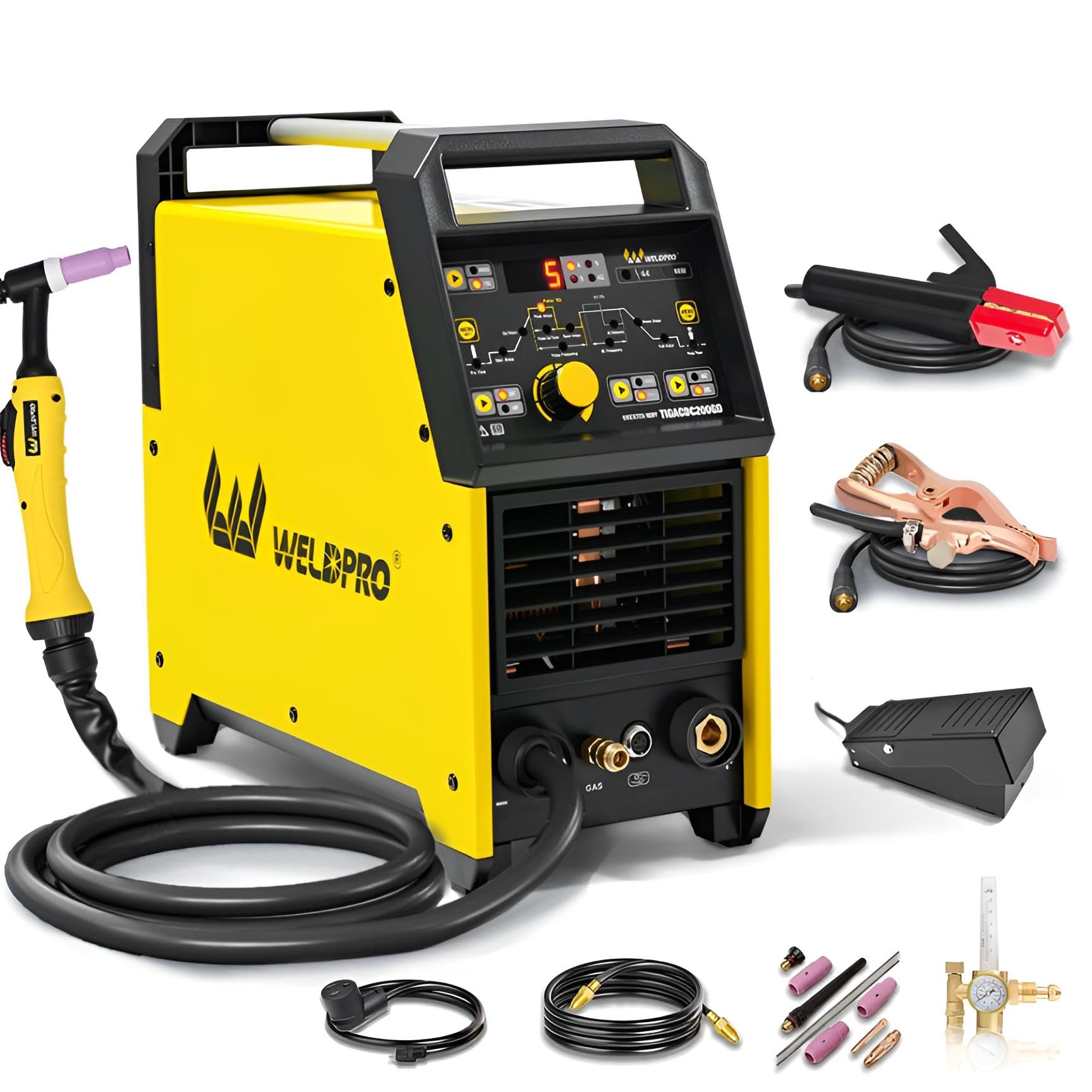
Five TIG and stick modes with a foot pedal in the box — the machine for aluminum and precision work.
This is a different animal from everything above. The Weldpro TIG200 is an AC/DC TIG welder built around aluminum and precision work rather than wire-feed fabrication. It packs five modes into one frame: High-Frequency AC TIG, DC TIG, AC Pulse TIG, DC Pulse TIG, and Stick MMA. It runs on 110V/220V dual voltage with automatic detection and switching, so it works off a household outlet or an industrial 220V supply. The included kit is genuinely complete — TIG torch, rocker-style foot pedal, 300A ground clamp, stick electrode holder, gas hose and flow meter, tungsten electrodes, ceramic nozzles, collets, back caps, and a detailed manual.
The two features serious aluminum welders care about are the AC balance and the pulse control. Fully adjustable AC balance, frequency, and pulse settings let you tackle thin and thick aluminum, magnesium, and other non-ferrous metals. The pulse function cycles the arc on and off rapidly — controllable from 0.5Hz to 200Hz — which limits the heat that builds in the part, reducing distortion and burn-through on thin sheet. Adjustable peak amperage, upslope/downslope, and 2T/4T trigger modes round out the control. High-frequency non-contact arc start means you do not need to touch the tungsten to the workpiece to start the arc, which reduces tungsten wear and keeps your work cleaner.
Where this machine shows its class is in the hands-free control. The included rocker foot pedal gives you real-time amperage adjustment without stopping — you can ramp the heat down as a bead runs into a thinner section without letting go of the torch. A 40% duty cycle at the full 200A output means you can weld four minutes out of ten at the top end before cooldown, which is real continuous capacity for a home machine. The large high-contrast LED display shows all parameters in real time, readable in bright or low light, and the panel is simple enough that a beginner can learn it while an experienced welder can fine-tune quickly. IGBT inverter technology (a modern power conversion design) delivers a stable arc, minimal spatter, and it runs on VRD-based overheat, over-current, over-voltage, and under-voltage protection.
What makes it different: AC TIG plus adjustable pulse and a foot pedal set this apart from every wire-feed machine here — it does precision work they physically cannot.
Know going in: this is a TIG process machine, so learning curve is real; and its 61.8-pound frame stays on the bench rather than traveling.
Built for: an aluminum-focused fabricator, an exhaust specialist, or a welder who wants genuine pulse TIG precision at home.
Wrong tool if: your jobs are quick repairs on rusty steel — a flux-core MIG machine will get there considerably faster.
Understanding the Specs
Why 110V Is A Real Ceiling, Not A Marketing Point
Running on 110V household power — the standard wall outlet — is what makes these machines usable in a home garage, on a driveway, or from a small generator. That convenience comes with a ceiling. The outlet itself can only deliver so much, so most of these welders operate comfortably on thinner steel and get drawn back by the breaker on long, hot, full-power passes. What that means for you: plan short, deliberate beads rather than one continuous weld, and give the machine a cool-down between heavy runs. If you find yourself wanting long continuous welds on thick plate, the dual-voltage machines that also accept 220V are the real answer rather than pushing a 110V machine past its limit.
Duty Cycle And Why It Matters More Than Peak Amps
Duty cycle is the percentage of a ten-minute window a welder can weld before it needs to cool. A 60% rating means six minutes of welding, four minutes of rest — genuinely continuous for many home jobs. A lower rating means shorter bursts before the machine shuts down to protect itself. In use, a duty cycle that matches your job length matters more than a bigger peak amp number you never fully use. Two machines can have the same top amps but wildly different duty cycles, and the one that lets you keep working without frequent pauses is the one that will feel stronger day to day.
Flux Core Versus Solid Wire And Shielding Gas
Flux-core wire contains its own shielding flux, so you do not need a gas bottle and the arc holds up even outdoors in wind. That makes it the practical default for a garage or a driveway. Solid MIG wire needs a separate shielding gas cylinder and a regulator to produce its cleaner, lower-spatter beads. Most machines in this list run flux core from the start; several also accept solid wire once you add gas. The trade is straightforward — flux core is more forgiving and ready to go, while solid wire with gas delivers neater, cleaner welds when you are set up for it.
Synergic Control And Preset Memory
Synergic control means the welder matches its current and wire feed speed to the wire diameter and material thickness you select, so you do not have to dial numbers in from scratch. That is what makes a modern machine approachable for a first-timer. Higher-end machines in this list go further with saved preset groups — up to ten stored parameter sets — so repeat jobs start from a known-good setting. Manual override is still there for experienced welders who want their own arc. In practice, synergic control gets you welding faster while manual control lets you fine-tune once you know what you like.
FAQ
Can a 110V welder weld steel thicker than 1/8 inch?
Do I need a shielding gas bottle for a 110V welder?
What thickness can a 135A welder handle?
Will a 110V welder trip my garage breaker?
Is a 3-in-1 welder worth it over a single-process machine?
What is the difference between 110V and 220V welding?
Can a 110V welder weld aluminum?
How do I know if a welder is really 110V compatible?
What accessories come in the box and what do I still need to buy?
Is Lift TIG the same as regular TIG welding?
Do I have to switch the power off before changing voltage on a dual-voltage welder?
Final Thoughts: The Verdict
For most home garages, the 110v welder winner is the Lincoln Electric 90i FC because it welds 1/4″ steel off a plain 120V outlet in a fifteen-pound frame, and the customer response backs it up — the crowd favorite at 4.7 stars across 500+ ratings. It is the machine that shows up, does the job, and goes back in the truck without ceremony. If you would rather have the safety gear bundled in and are new to welding entirely, grab the BESTMIG 135A — regardless of being the lowest-priced pick here, its 4.5 stars across 400+ ratings and 10.71-pound frame make it the easiest on-ramp in the group. And if your work runs to aluminum, thick plate, or precision TIG on thin sheet, the Weldpro TIG200 is the pick to reach for — its AC/DC TIG modes with adjustable pulse and the included foot pedal do jobs none of the wire-feed machines here can. Whichever you choose, buy for the thickness and duty cycle your actual jobs demand, not the biggest amp number on the box, and match the process to your shop before you plug in.
How We Picked
We do not accept paid placement. Every pick is matched to a real buyer and a real use-case; we do not hands-on test units.
Sources & Methodology
Specifications: manufacturer listings and product documentation. Review insights: verified customer reviews, as of September 2026. Pricing: not shown on this page (it changes often); check the current price via the retailer link.
As an Amazon Associate, KitchPrep earns from qualifying purchases. This does not affect which products we feature.
Related Guides
