
Specs are compiled from manufacturer listings and verified buyer reviews and can change over time — please confirm the key details on the product page before buying.
If you have ever watched a laptop battery drop into the red on a long drive, or wanted to run a small fan, a CPAP machine (a machine that helps you breathe at night), or a light at a campsite with no hookup, a 200 W power inverter is the small box that turns your car’s 12 V socket (the round power port, like the one for a phone charger) into a real household-style wall outlet. This list covers nine inverters that all land in that same roughly 180-to-250-watt class, so the numbers on the box are close but not always identical — which is exactly why a closer look matters before you buy.
I’m Mohammad Maruf — the founder and writer behind KitchPrep. This guide is built by comparing the manufacturers’ published specifications and the patterns across verified customer reviews, so you get each pick’s real strengths and trade-offs instead of marketing spin.
The picks below split into two families: units that plug into your car’s cigarette lighter socket and units that clip onto a power-tool battery you already own. Both solve the same problem, and this roundup of the 200 w power inverter options shows you which one fits your own setup best.
Our Picks at a Glance

How To Choose The Best 200 W Power Inverter
Buying in this size class is less about shopping for the biggest number and more about matching three things: where you will plug it in, what waveform your gear needs, and how many ports you want to share. Get those three right and the rest is comfort.
Socket or battery clamps
A cigarette lighter plug is the easiest way to get started, but most car sockets are only rated for around 150 W continuous (the steady power they can supply without overheating) — a 200 W inverter running hard through the plug can trip your car’s own fuse. Direct battery clamps bypass that limit and can pull the full continuous rating, so if you plan to run a laptop brick (the power adapter block), a small compressor, or anything near the top of the range, choose a model that comes with clamps.
Waveform and what it means for your devices
A modified sine wave output is a simplified alternating-current shape — fine for phone chargers, laptops, fans, and simple electronics. A pure sine wave output mirrors the smooth household wave more closely and tends to suit sensitive audio gear and medical devices like CPAP machines better. If your load is simple, modified works; if you plug in anything delicate, pure sine is the safer pick.
Ports and charging speed
USB-C PD (Power Delivery, a fast-charging standard that can push higher wattage to laptops) is the port that matters most on newer gear. A 30 W or 65 W PD port can top up a laptop, while plain Quick Charge ports handle phones. More ports simply mean fewer arguments in the car when everyone wants to charge at once.
Cooling, noise, and how long it lasts
Every inverter in this class runs a cooling fan, and how loud that fan gets is a genuine comfort factor on a quiet road trip. A smart thermostat that only spins the fan under load keeps things quiet when you are not drawing much. Give any inverter breathing room and keep it out of direct sun to help it survive long term.
Quick Comparison
| Model | Best For | Output Power | Input Voltage | Waveform | Amazon |
|---|---|---|---|---|---|
| Vansoet 200W Car Power Inverter (PD 65W/30W)★ Best Overall | Cars, road trips, camping | 200 W | 12 V DC | Modified Sine Wave | Amazon |
| Ecarke DeWalt 20V Battery InverterMost Versatile | Job sites, emergency backup | 200 W (peak 250 W) | 20 V DC | Pure Sine Wave | Amazon |
| VoLtTech Milwaukee 18V Battery InverterTop Performer | Camping, trades work | 200 W (peak 250 W) | 18 V DC | Pure Sine Wave | Amazon |
| PlantPalGear 220W DeWalt Inverter | Camping, travel, outages | 220 W (peak 440 W) | 20 V DC | Pure Sine Wave | Amazon |
| NDDI 200W Car Power Inverter | Fans, small tools, solar setups | 200 W (peak 400 W) | 12 V DC | Modified Sine Wave | Amazon |
| BYGD 200W Car Power Inverter | Family trips, many devices | 200 W | 12 V DC | Modified Sine Wave | Amazon |
| AUCARAUTO 7-in-1 Car Power Inverter | Car cup-holder use, laptops | 200 W | 12 V DC | — | Amazon |
| Leesky 200W Pure Sine Wave Inverter | Trucks, RVs, CPAP | 200 W | 12 V DC | Pure Sine Wave | Amazon |
| Leesky Pure Sine Wave Car Inverter | Off-grid solar, RVs, boats | 200 W | 12 V DC | Pure Sine Wave | Amazon |
In‑Depth Reviews
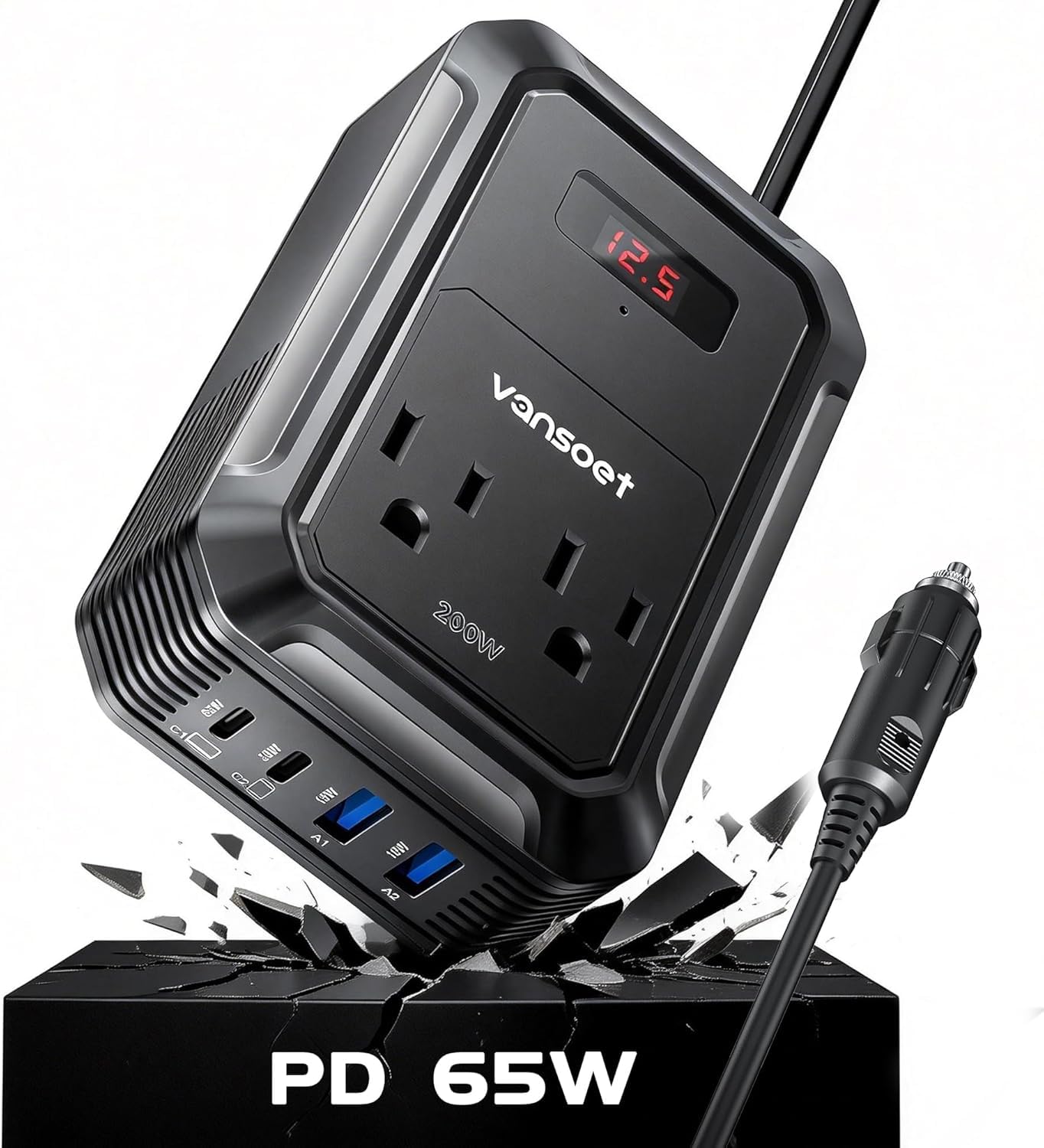
1. Vansoet 200W Car Power Inverter with PD 65W/30W USB-C Ports
Our pick — over 4.5★ from 200+ verified ratings; the strongest balance of quality and price.
Five ports, a digital readout, and enough USB wattage to fast-charge a laptop from the passenger seat.
For anyone who lives out of a car — delivery runs, road trips, the daily commute — this is the pick that covers the most ground. It puts 200 W of continuous power, 2 AC outlets, and 4 USB ports into a single compact box, and the USB side alone pushes a total of 131 W. The headline port is a PD 65W Type-C, with a second 30 W Type-C and two Quick Charge 18 W ports alongside it, so a laptop, a tablet, and two phones can all top up at once.
What wins people over here is raw performance — owners consistently say it simply works, whether it is keeping a laptop fully charged for someone working from the car or quietly running a phone and speaker at a job site. The smart fan is a real comfort, too: it only spins up as load and heat climb, so it stays quiet during light use. The 23.8-inch cord with cigarette lighter plug gives you slack to reach a rear socket, and an LCD display (a small screen that shows the numbers) shows what is happening at a glance.
The honest catch is the socket itself. Most car 12 V outlets are only good for around 150 W continuous, so anything near the 200 W peak needs care — push it hard through the plug and your car’s own fuse may trip first. Also worth knowing: the output is a modified sine wave (a simplified AC shape), which is fine for chargers, laptops, and fans but not the ideal match for very sensitive audio gear. If you need to run heavier loads, weigh it against the Leesky pure sine wave unit below.
What Earns Its Place
- 200 W continuous with PD 65W Type-C fast charging for laptops
- 2 AC outlets plus 4 USB ports (131 W total) for charging everything at once
- Smart cooling fan stays quiet at low load and only speeds up when needed
- ETL-certified build with an 18-month replacement warranty
Where It Asks Patience
- Modified sine wave is not ideal for sensitive audio or medical gear
- Cigarette lighter plug caps most cars near 150 W, so heavy loads can trip a fuse
Best everyday inverter: ideal if your car socket is your main power source and you charge laptops and phones on the go.
Think twice if: you need pure sine wave output for delicate audio equipment — step up to a pure sine model instead.
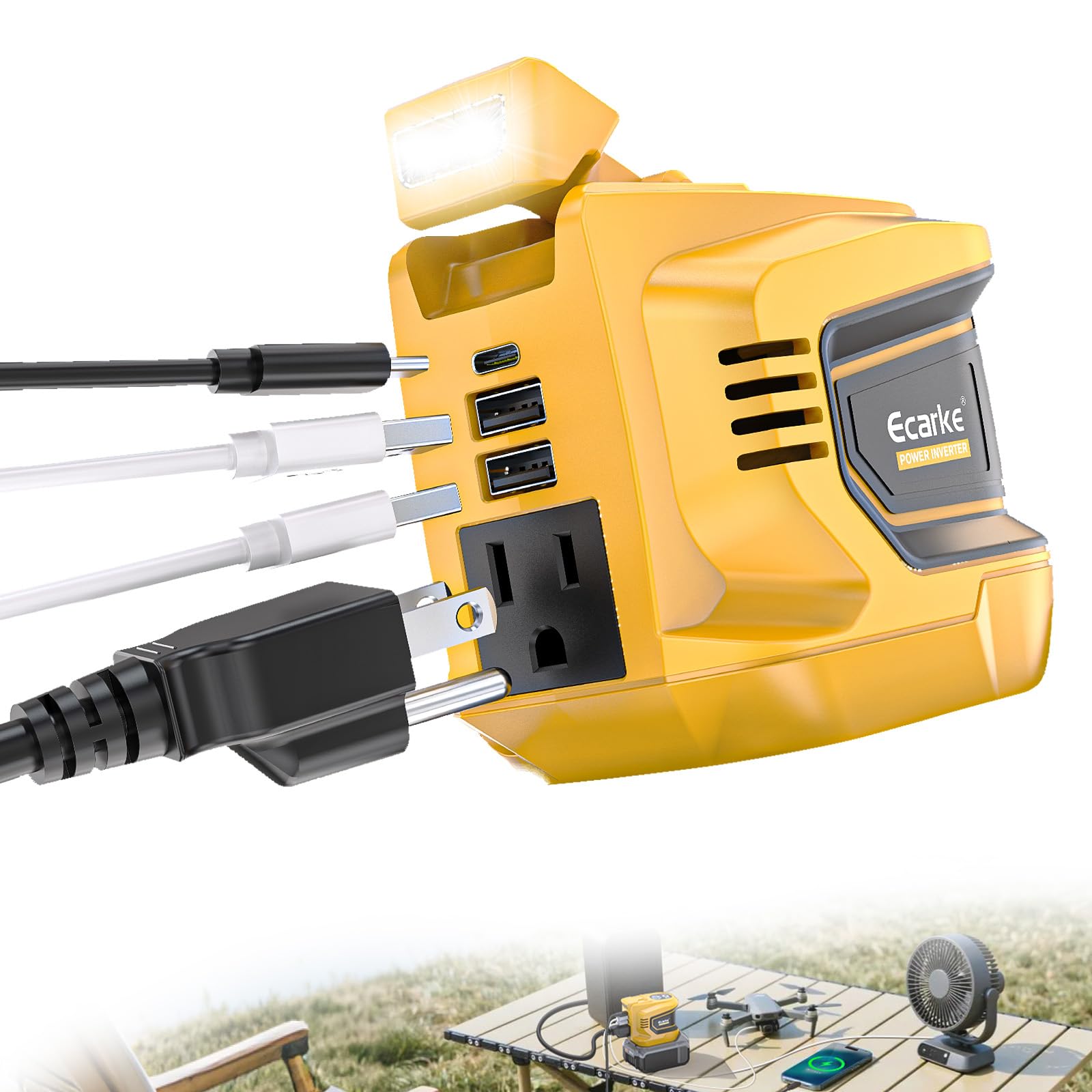
2. Ecarke 200W Power Inverter for DeWalt 20V Battery
Turn the DeWalt batteries you already own into a portable wall outlet for the job site.
If you already carry DeWalt 20 V lithium-ion packs — the DCB200 through DCB206 line and their “–2” variants — this converts one straight into a 110 V AC source with no extra adapter. That is a fundamentally different proposition from a car-socket unit: it lives in your toolbox and travels anywhere, from a night repair on the roadside to a campsite that never saw a power pole. Output is a real 200 W continuous with 250 W peak.
The build adds two things the plug-in models do not. A built-in 200 LM LED work light with three brightness modes and a 120° adjustable head handles hands-free lighting — genuinely useful for roadside work after dark. And the output is a pure sine wave (a smooth, household-style AC shape), which suits sensitive gear far better than the modified wave you get on most budget car units. A smart fan-cooled design and multi-layer safeguards cover overheating, overload, short circuits, and battery over-discharge.
One thing real owners hit: navigating the on/off button takes a moment — some needed to watch a video before getting it going, so read the instructions before you are standing in the dark. It is also a slightly different power math than the car units: this one runs on a 20 V battery input, while a 12 V car inverter draws from your vehicle’s socket. If your tools are Makita instead, the Ecarke itself is not the right match.
The light changes the math: pairing a 3-mode LED work light with a true 200 W outlet makes this a two-in-one tool, which is why it earns the versatility crown.
The short version: top pick if you are already deep in the DeWalt 20 V ecosystem and want portable AC power without a car socket.
Reach for this if: you own DeWalt 20 V batteries and want power plus light on the job site or in an outage.
Look elsewhere if: your tool batteries are a different brand, or you would rather plug into a car socket.
3. VoLtTech 200W Power Inverter for Milwaukee 18V Battery
A Milwaukee M18-powered pocket generator with a work light and holiday-display duty written all over it.
This is the pick for Milwaukee M18 owners who want a plug-anywhere power source that slips into a bag at 11.2 ounces. It converts DC 18 V into AC 110 V with a real 200 W continuous output and 250 W peak, so it can push small appliances, lights, or a laptop without breaking a sweat. The compact fan and ventilation openings keep air moving, and a full set of safeguards covers short circuits, over-current, under-voltage, and overheating.
The bonus feature here is the 200 LM LED with three brightness levels and a flexible head, which turns it into a light plus a charger in one. That dual role is why owners put it to work in places as varied as an RV water pump, a 120 V light, and holiday light displays where no outlet is nearby. It is a genuinely useful companion for camping, remote job sites, and on-the-go power.
That said, it is the pick where owners split. Some say it has become a daily-use favorite that is durable and functional; others report inconsistent power delivery, and a couple mention battery drain speeding up after a few months of use. Treat it as a dependable light-load tool for camping and small jobs rather than a heavy continuous supply. The cooling fan also gets loud for a quiet room, and the size is a little bulky for a pocket tool.
Why It Shines
- Powers up to 200 W continuous on any Milwaukee 18 V battery (batteries not included)
- Two USB ports plus a 20 W Type-C output for phones, tablets, and small devices
- Ultra-compact at 11.2 oz. with a 200 LM work light built in
Before You Commit
- Power output and reliability draw mixed feedback depending on load
- Cooling fan is loud for quiet environments, and the body is bulky-ish
Great for trades and campers: buy it if you are already running Milwaukee M18 batteries and want light power plus light on demand.
Not for constant draw: if you plan to run sustained heavy loads, its mixed power-output notes make a plug-in model the safer bet.
4. PlantPalGear 220W Power Inverter for DeWalt 20V Battery
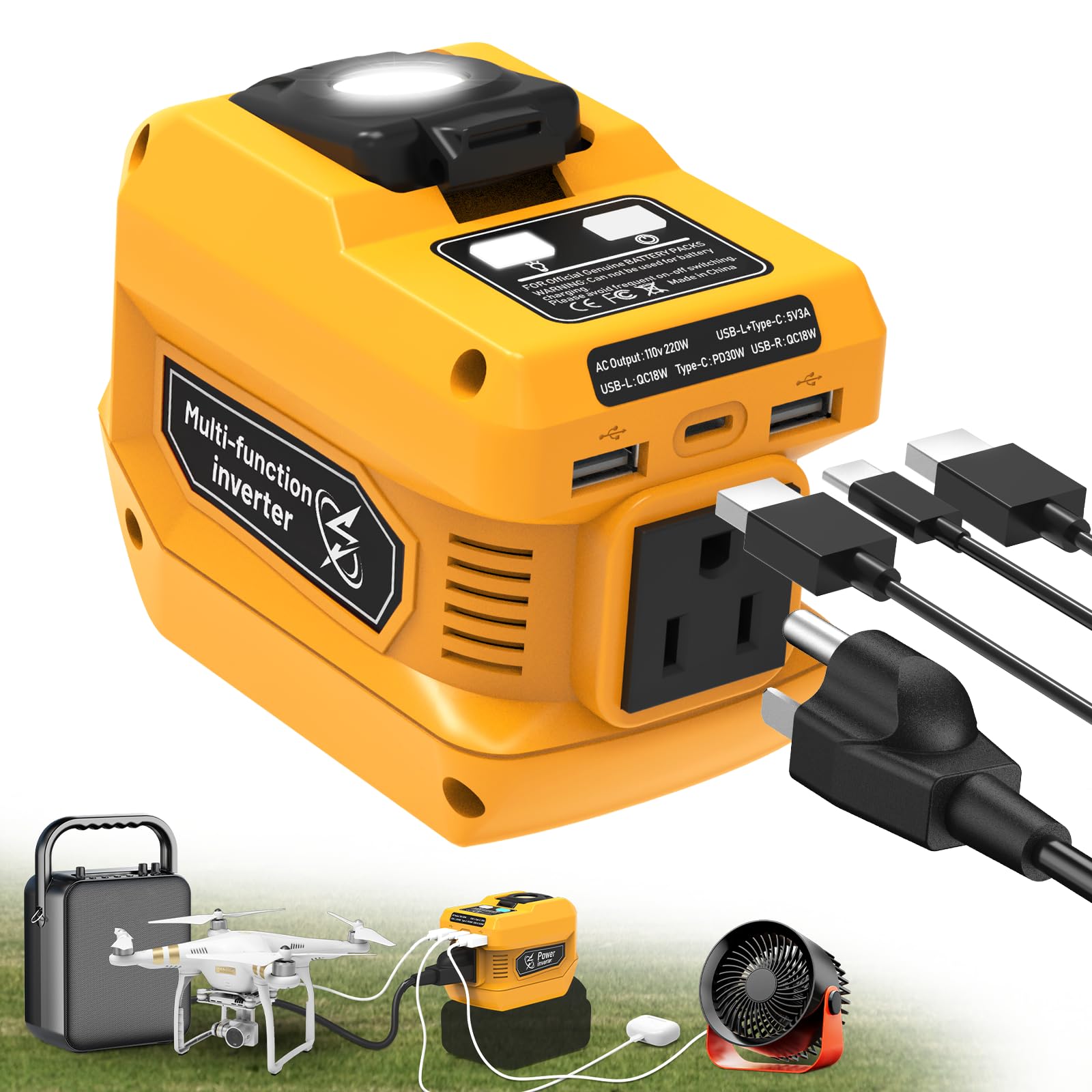
The brightest of the battery-powered bunch, with a 400 LM pop-out light and a 220 W output.
Campers who count on a DeWalt 18 V or 20 V battery pack should stop here. This unit runs a 220 W output with a 440 W peak (a short burst of extra power for startup) — a touch more headroom than the other battery inverters — and its star feature is a 400 LM multi-function LED (a light measured in lumens, the standard unit of brightness) with a 3-level adjustable brightness, a strobe mode, and a 90° adjustable angle. For pitching a tent in the dark or working under a hood after dinner, that light is the reason it stands out.
Charging is well sorted: one AC outlet, two 18 W Quick Charge USB ports, and a 30 W PD Type-C port mean you can fast-charge a laptop and phones at the same time. Owners are fans of the adjustable pop-out LED, calling it far brighter than expected, and several note the light alone makes it a cheaper alternative to a big-name top-off style battery, with more features to boot. A built-in cooling fan and layered protections cover short circuits, overcurrent, low voltage, overheating, overload, and over-discharge.
The one nagging detail owners mention is fit: several say the unit is awkward to push onto a DeWalt battery and even harder to pry back off, so budget a moment for removal. It runs on a 20 V battery input, so it is a natural sibling to the Ecarke above — both take DeWalt packs, but this one trades a smaller light for more brightness and a bit more peak wattage. If you want a work light first and a charger second, this is your pick.
The camping verdict: the combination of a 220 W outlet and a 400 LM pop-out light makes it the most outdoor-ready of the battery inverters.
Know this going in: attaching and releasing a DeWalt pack can be stiff — owner notes on fit are the one recurring soft spot.
Suits campers and roadside work: anyone with DeWalt 20 V packs who wants bright light plus real AC power in one box.
Less ideal if: nimble on-off battery swapping is a priority for you.
5. NDDI 200W Car Power Inverter 12V DC to 110V AC

Two ways to connect — socket or battery clamps — so you can run tools a plug alone could never handle.
This is the inverter for buyers who want options. It delivers 200 W continuous with a 400 W peak, and it ships with both a cigarette lighter plug and a pair of alligator battery clips. Two USB ports at 3.1 A cover your phones and tablets along the way.
Owners put those clamps to real work. One owner runs a yard water feature on a 100 W solar panel and a couple of batteries, and it held up through the winter. Others use it for a lunchtime fan, a portable air compressor, a Sawzall, or a circular saw off a truck battery, and report it is quiet with a decent cord length. The lightweight build (1.2 lb) makes it easy to stash between trips.
The trade-off is durability under stress. This is a modified sine wave unit with dual internal fuses, which is fine for the tools and fans above but not the first choice for sensitive electronics. One owner reports a fuse blowing repeatedly before the unit stopped working, a risk when running near the 200 W ceiling. Keep loads sensible, swap the fuses when they pop, and it should serve you for years of light-to-medium duty.
Best with the clamps: for anyone whose loads exceed the car socket limit, the included battery clips open up the full 200 W continuous and 400 W peak.
Fair warning: it is a modified sine wave unit with fuses — ideal for fans, pumps, and tools, not for delicate gear or constant max-load running.
Ideal for tinkerers and truck owners: pick it if you want to clamp straight onto a battery for tools, pumps, or solar setups.
Skip if: you need pure sine wave output or mostly lighter socket-powered duties.
6. BYGD 200W Car Power Inverter with Dual AC Outlets and 4 USB Ports

A family-car workhorse with two AC sockets and five USB ports to keep everyone charging.
Big families and anyone with a car full of screens should look here. This inverter brings 200 W output, two 110 V AC sockets, four 2.4 A USB ports, and one Type-C port — enough sockets that nobody has to wait their turn. It is the kind of unit that just lives in the console, ready for a camping weekend, a party, or an emergency, and it covers phones, laptops, tablets, cameras, and game consoles with equal ease.
Owners lean on its convenience. The scene that keeps coming back is a grandparent driving a car full of grandkids, all needing a charge at once — and the inverter keeping up, with low noise and a rugged build. The inline shape also fits neatly between the seats, which is a bigger deal than it sounds in a full car. Protection is thorough: an ABS fire-resistance material body, an isolating transformer between the primary and secondary circuit, and safeguards against overheating, overvoltage, short circuit, overload, and overcharge.
The catch is the power switch. It is not a physical toggle — you long-press the power button for a few seconds to turn it on or off, and it needs a manual restart after the ignition cuts. If you drive with the ignition cycling often, that means a quick button press each time, and the button can be hard to find by feel. It is a modified sine wave unit too, so it is at its best with chargers and mainstream electronics rather than high-end audio.
What Buyers Love
- Two AC sockets plus four 2.4 A USB ports and one Type-C — plenty for a full car
- Rugged build with an isolating transformer and ABS fire-resistance material
- Runs quietly and the inline shape slots between seats
The Trade-Off
- Power button is not a physical toggle and needs a manual restart after ignition off/on
- Modified sine wave output limits its appeal for very sensitive gear
Made for packed cars: the pick for families who need a lot of sockets and value convenience over specialty waveforms.
Not the one for you if: you want a physical on/off switch you can find by touch.
7. AUCARAUTO 7-in-1 Car Power Inverter 200W DC 12V to 110V AC
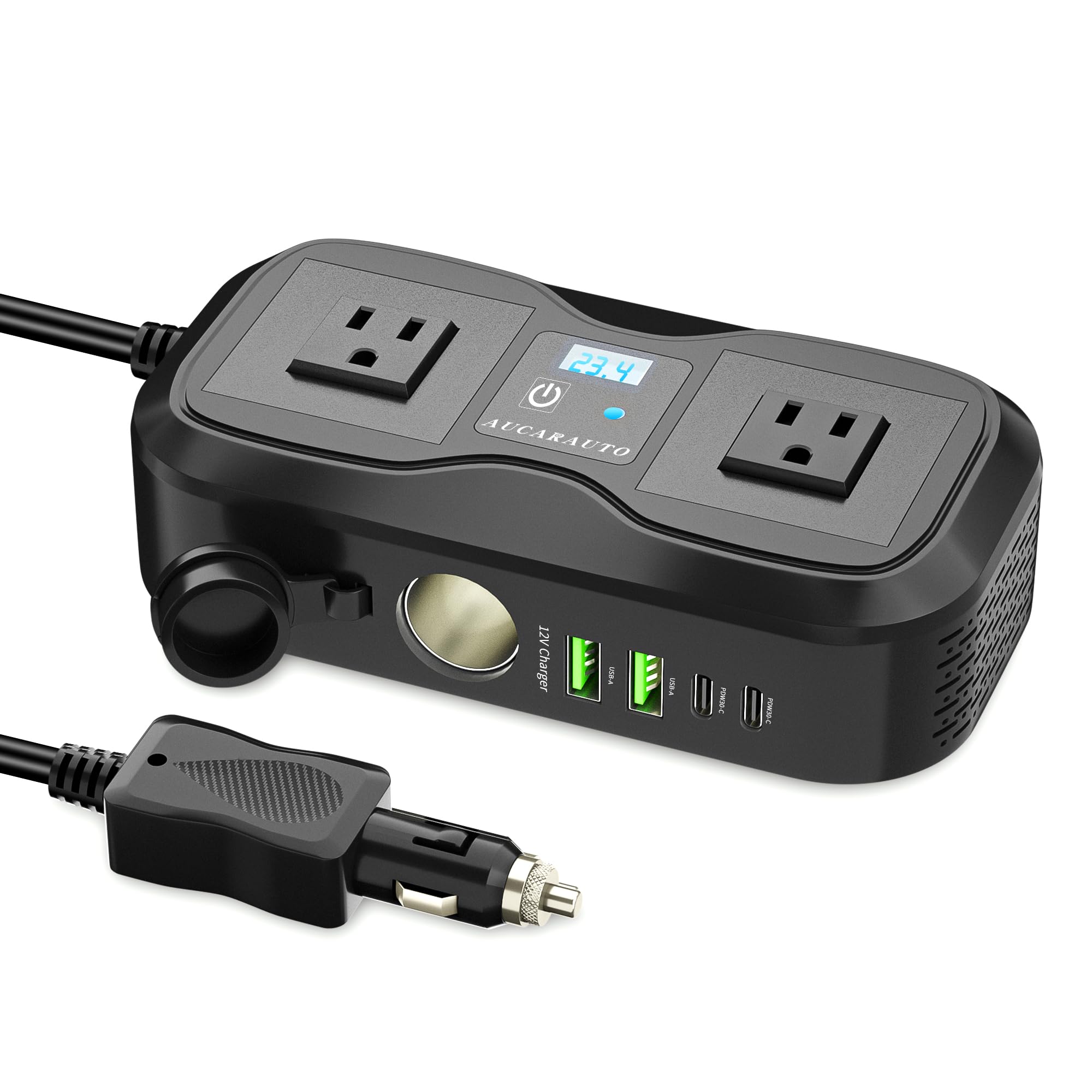
A cup-holder-shaped inverter that adds a spare 12 V socket instead of eating one.
Compact-car owners, this one was designed for you. It drops into your cup holder, so it takes up zero console space while delivering 200 W of 12 V to 110 V conversion. The clever part is the built-in 12 V cigarette lighter socket: rather than stealing your car’s original outlet, it passes that socket through, so your GPS, dash cam, or vacuum keeps its power. Alongside, you get two AC outlets, dual PD 30W USB-C ports, and an 18W USB QC port — that is six devices at once from a single cup-holder footprint.
Reliability is what earns owners’ trust here; the unit keeps working trip after trip, and people report running phones, laptops, and even a CPAP machine without fuss. The 12 V pass-through socket is genuinely handy for anyone who has ever unplugged a dash cam to charge a phone. A cooling fan reduces energy use and noise, and an automatic shutdown function protects the unit and your devices if it senses overvoltage, undervoltage, overload, overcurrent, or overheating.
Two things to note. It is only compatible with 12 V cars, so trucks and vehicles with a 24 V system are out. And one owner finds it on the bulky side for a cup-holder accessory, so measure your holder if space is tight. For a small car with limited real estate, though, this is the neatest way to add power without adding clutter.
Space-saving design win: the 12 V pass-through socket preserves your original outlet while the cup-holder bodies add AC and fast USB in a spot you were not using anyway.
The fine print: 12 V cars only, and the body may feel bulky depending on your holder size.
Best for compact cars: fits drivers who want more power without sacrificing console space or their existing 12 V socket.
Wrong fit if: your vehicle runs a 24 V electrical system.
8. Leesky 200W Pure Sine Wave Power Inverter 12V DC to 110V 120V AC
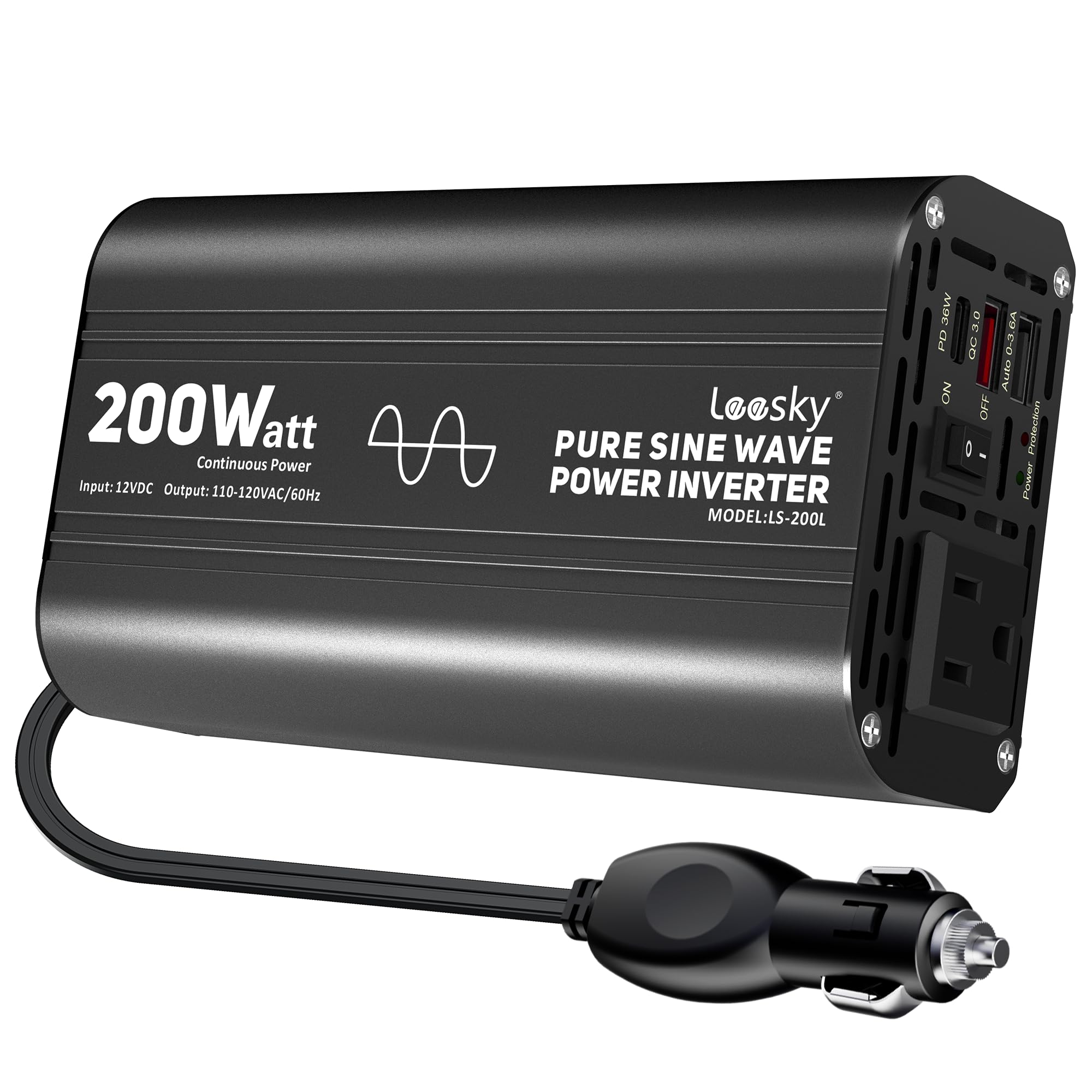
Clean pure sine wave output from a truck-friendly box, ideal for the devices that need the smoothest power.
When a modified sine wave will not do — think sensitive electronics or a CPAP machine on the road — this Leesky is the model to trust. It delivers 200 W of pure sine wave output, which mirrors household AC far more closely than a modified unit. A 30 W Type-C PD port handles laptops, two Type-A USB ports support QC 2.0/QC 3.0 at up to 3.6 A each, and one AC socket covers the rest. The aluminum housing shrugs off drops and bumps.
What owners praise most is the power performance: it holds 200 W as a true continuous figure rather than a peak number that evaporates under load. That matters for RV and solar users who need to top up a laptop without firing up a big power-hungry inverter. It is compact and easy to store, with a 28.3-inch cable, and it comes with a 36-month warranty backed by 24/7 service. One driver powers an electric blanket from a stepped-down truck battery in winter.
The honest limitations: the mounting holes are basically useless for some owners, since adhesive strips and Velcro will not stick to car plastics, and the cord can feel short depending on your socket location. One owner reports a unit failing a few weeks in, which the 36-month warranty covers. Point it at laptop charging and routine devices and it does the job; just do not expect the mounting hardware to save you.
For context, this is a pure sine wave upgrade over the Vansoet at the top — same 200 W class, but with the smoother output that sensitive gear needs and a longer warranty cushion.
Why it earns the pure sine title: true continuous 200 W pure sine wave output, which suits laptops, CPAP machines, and delicate gear where a modified wave falls short.
Set expectations: mounting holes are ineffective on most vehicles, and one owner reported an early failure — the 36-month warranty is real confidence.
Go for it if: you run sensitive devices like a CPAP or laptop and want pure sine wave power with a long warranty.
Pass if: you need a well-anchored mount — plan on finding your own location instead.
9. Leesky 200W Pure Sine Wave Car Inverter 12V DC to 110V 120V AC
A dependable pure sine wave starter that keeps a pellet stove alive when the grid drops out.
For off-grid and storm-prone homes, this is the practical entry into clean 200 W power. It converts 12 V DC to 110 V/120 V AC with a genuine pure sine wave output, and pairs a single 30 W Type-C PD port and two up-to-3.6 A Type-A ports with one AC outlet. The aluminum housing protects against drops and bumps, and it ships with a 28-inch cigarette lighter cable plus an 18-month warranty.
Buyers who have actually leaned on it are the best signal here. One owner runs a pellet stove for six hours off a boat battery during an outage. Another pairs it with a laptop and finds it perfect for powering small loads without calling on a much larger inverter. The quality of cables and build get the strongest praise from owners.
Where it asks for care: this is a pure sine wave unit (a smooth, household-style power output) with mixed reliability notes, and one buyer felt the cigarette plug oversold the wattage — so keep steady loads moderate and plug into a socket that can handle them. There are also a couple of notes about the cooling fan being noisy for quiet settings. Treat it as a budget-friendly first step into pure sine wave power for camping, RVs, and outages, not a hard-running industrial unit.
The Strong Side
- Genuine pure sine wave output for sensitive gear like pellet stoves and electronics
- Aluminum housing with full input/output protection and 18-month warranty
- Compact travel-size with a 28-inch cigarette lighter cable
The Catch
- Reliability and noise level both receive mixed feedback from owners
- Cigarette plug output is limited — keep steady loads moderate
Best budget entry: for buyers who want clean pure sine wave power without stepping up to a premium price tier.
Not the pick if: you plan to run heavy, sustained loads on a regular basis.
Understanding the Specs
Continuous vs Peak Power
Manufacturers list two numbers, and the one that matters is continuous. A 200 W continuous rating means the inverter can run at that level hour after hour — that is the number to note. The peak figure (often 250 W or higher) is the brief ceiling it can hit for a surge, like a motor starting up. A unit advertising a big peak with a small continuous figure will disappoint. The battery inverters here pair 200 W or 220 W continuous with 250 W or higher peaks, which is a healthy gap that gives you headroom for startup. The plug-in units lean on the cigarette socket, which usually caps out lower — a detail worth respecting if you plan to run near the limit.
Pure vs Modified Sine Wave
A sine wave is the shape of the alternating current (the type of power that comes out of a wall outlet) coming out of the inverter, and it affects what you can plug in. A pure sine wave output mirrors the smooth household wave and best suits sensitive devices — CPAP machines, audio gear, and anything with a delicate power supply. A modified sine wave is a stepped approximation, perfectly fine for chargers, laptops, fans, and most mainstream electronics, but less comfortable for the picky stuff. Several picks here are pure sine wave and several are modified, so the choice depends on what you will actually plug in. Match the waveform to your most sensitive device, not your most common one.
FAQ
Can I run a CPAP machine on a 200 W power inverter?
Will a 200 W inverter work through my car’s cigarette lighter socket?
What is the difference between pure sine wave and modified sine wave?
Can I connect a 200 W inverter directly to a 12 V battery?
How long can a 200 W inverter run on a standard car battery?
Will a 200 W inverter run a laptop charger?
Are tool-battery inverters as powerful as plug-in car inverters?
Do I need pure sine wave for a pellet stove or a fan?
Can a 400 W peak inverter handle a device that starts with a surge?
Is a modified sine wave inverter safe for charging phones and tablets?
Final Thoughts: The Verdict
For most people shopping the 200 w power inverter category, the Vansoet 200W Car Power Inverter is the clear winner: 200 W continuous, a PD 65W Type-C port (a fast-charging USB-C port) for laptops, and four USB ports total to share across a car full of people. If you already own power-tool batteries, the Ecarke battery inverter turns a spare DeWalt pack into portable AC power (household-style power) with a 200 LM light built in. And if sensitive devices like a CPAP machine are your priority, the Leesky pure sine wave model delivers the cleaner waveform and a 36-month warranty — the safest all-round pick for delicate gear.
How We Picked
We do not accept paid placement. Every pick is matched to a real buyer and a real use-case; we do not hands-on test units.
Sources & Methodology
Specifications: manufacturer listings and product documentation. Review insights: verified customer reviews, as of September 2026. Pricing: not shown on this page (it changes often); check the current price via the retailer link.
As an Amazon Associate, KitchPrep earns from qualifying purchases. This does not affect which products we feature.
Related Guides
