
Specs are compiled from manufacturer listings and verified buyer reviews and can change over time — please confirm the key details on the product page before buying.
A winter storm knocks out the grid, and your pellet stove goes cold within seconds. The auger motor (the part that feeds pellets into the fire) and the room blower both stop the moment power drops. A battery backup for a pellet stove fixes exactly that: a rechargeable box that keeps the auger feeding and the blower pushing warm air until the utility comes back. Add up your stove’s auger and blower watts, match that to a station’s continuous output, then pick watt-hours for the hours you need.
I’m Mohammad Maruf — the founder and writer behind KitchPrep. This guide is built by comparing the manufacturers’ published specifications and the patterns across verified customer reviews, so you get each pick’s real strengths and trade-offs instead of marketing spin.
The picks below run from a 9-pound UPS that many pellet stove owners wire in for short outages to a 58-pound, three-kilowatt-hour station that can carry your whole house through a multi-day storm. Each unit here puts out enough continuous power to run a stove’s auger and blower. Your choice depends on runtime, weight, and if you want to add solar later. The crowd favorite is the EF ECOFLOW Delta 2, at 4.7 stars across 5,000+ ratings — a signal that it holds up in real outages and delivers on its promises.
Our Picks at a Glance


How To Choose The Best Battery Backup for a Pellet Stove
A pellet stove has an auger motor that feeds pellets, a combustion blower (the fan that pulls air through the fire pot), and a room blower that pushes heat into your house. All three need steady, clean power at the same time. The stove’s control board (the circuit board that runs the burn cycle) is delicate enough that dirty power can damage it.
Add Up Your Stove’s Real Draw
Find the wattage rating on your stove’s data plate, usually on the back or under the hopper lid. Most stoves list a total running watts figure. That number is your target. A backup station needs a continuous output rating at or above it. If your stove pulls around 400 watts while running, a 450W continuous UPS covers it. A station rated 1800W or 2400W gives you comfortable headroom. Size too tight and the auger stalls when the blower kicks on.
Match Capacity to Overnight Hours
Capacity is measured in watt-hours (Wh) — think of it as the size of the fuel tank. A 1024Wh station running a 400W load gives you roughly two and a half hours before it is empty. A 2048Wh or 3014Wh unit stretches that to five hours or more, enough to cover a full overnight outage. Expect multi-day storms and you should pick the largest capacity you can move, or a station that accepts extra batteries later.
Check the Output Type and Transfer Speed
Pure sine wave output is power that matches the smooth wave from a wall outlet, and it is the safe choice for a stove’s control board. Modified sine wave can cause buzzing, overheating, or control faults. Transfer time matters too. A UPS (uninterruptible power supply — a battery that switches on the instant the grid drops) moves to battery in milliseconds. A brief flicker then never shuts down the burn cycle and forces a manual restart.
Quick Comparison
| Model | Best For | Continuous Output | Capacity | Weight | Amazon |
|---|---|---|---|---|---|
| EF ECOFLOW Delta 2★ Best Overall | All-round home backup | 1800W | 1024Wh | 27 lb | Amazon |
| Eaton Tripp Lite ECO750UPSTAABudget Champion | Short outages and flickers | 450W | — | 9 lb | Amazon |
| AFERIY P210 | Overnight storm coverage | 2400W | 2048Wh | 54 lb | Amazon |
| PECRON E1500LFP | Solar-charged off-grid use | 2200W | 1536Wh | 39.8 lb | Amazon |
| BLUETTI Elite 200 V2 | Long-life premium backup | 2600W | 2073.6Wh | 53.4 lb | Amazon |
| BLUETTI Elite 300 | Multi-day whole-home backup | 2400W | 3014.4Wh | 58 lb | Amazon |
In‑Depth Reviews
1. EF ECOFLOW Portable Power Station Delta 2, 1024Wh, 1800W, LiFePO4 Battery
Our pick — over 4.5★ from 5,000+ verified ratings; the strongest balance of quality and price.
The 27-pound all-rounder that refills from a wall socket before you finish a cup of coffee.
The Delta 2 wins its spot on charge speed: it goes 0-80% in just 50 minutes and 0-100% in 80 minutes from a standard AC wall outlet. That means you can top it up the night before a forecast storm and it is ready before bedtime. It holds 1024Wh of usable energy and pushes 1800W of continuous output through 15 outlets. That runs a stove’s auger and blower with room to spare for a fridge or a router on the same circuit.
Battery chemistry is the second reason it earns this slot. EcoFlow uses LiFePO4 (lithium iron phosphate, a battery type that holds many more charge cycles than standard lithium), rated for a 3000+ cycle life. Weigh that against the AFERIY P210 in this guide: that unit carries a 3500+ cycle rating, so the Delta 2 trails slightly on that one figure but still delivers years of service. At 27 pounds it is lighter than both the AFERIY P210 at 54 pounds and the BLUETTI Elite 200 V2 at 53.4 pounds. One person can move it from the garage to the stove room without a second set of hands.
Buyers report reliability above all else, followed closely by value and raw power. One owner used it to keep a refrigerator running during gas generator outages. Another notes the panel-to-station cable is short enough that you need an XT60 extension for outdoor solar panels. That is the real trade-off: the stock cable works fine for wall charging but is too short for a rooftop solar setup. Want portable panels outdoors? Budget for that extension up front.
Where It Shines
- 0-80% charge in 50 minutes and 0-100% in 80 minutes from a wall outlet
- 1800W continuous output runs the auger, blower, and a fridge at the same time
- LiFePO4 battery rated for 3000+ cycles
- 27 pounds — the lightest true power station on this list
- Expandable from 1kWh up to 3kWh with add-on batteries
Where It Falls Short
- Solar input capped at 500W, slower than the PECRON’s 1000W panel ceiling
- Stock panel-to-station cable is short, so outdoor solar panels need an XT60 extension
- 1024Wh gives you fewer overnight hours than the larger stations here
Reach for this if: you want one dependable station that covers stove backup, camping, and fridge duty without breaking your back moving it.
Think twice if: you plan to run a pellet stove through back-to-back outage days or add solar outdoors without extra cables.
2. Eaton Tripp Lite ECO750UPSTAA 750VA UPS 450W Battery Backup Surge Protector
The 9-pound desk UPS that punches far above its weight for a pellet stove’s brief outages.
At 9 pounds, this Eaton Tripp Lite unit is the lightest pick here — a fraction of the AFERIY P210’s 54 pounds — and that is exactly what makes it useful in a tight stove corner. It delivers 450W of continuous output from a 750VA standby UPS. That covers the auger and control board on many pellet stoves. Check that 450W number against your own stove’s data plate. If your stove pulls near 400 watts while running, this unit handles it. Add a room blower plus a distribution fan and you need more headroom.
Output type is the critical spec for a stove’s delicate circuit board. Tripp Lite specs it as 99% line mode efficiency with pure, clean AC during outages, so a brief flicker does not force a manual restart of the burn cycle. Owners mention running pellet stoves on it, and one notes a stove manufacturer recommended it. The battery is replaceable, so the case keeps running for years.
Do the honest math first. A 450W continuous rating cannot run a large pellet stove plus a fridge plus a space heater all at once. This is not a station that carries you through a multi-day storm. What it does extremely well is bridge the short outages that reset every clock in the house. It includes 12 outlets and is wall-mountable, so it can live mounted next to the stove instead of on the floor taking up space.
The real story: this is the low-cost, low-effort answer for anyone whose stove only needs the auger and blower carried through a flicker or a few-minute outage. It is not a whole-home backup and does not pretend to be one.
The smart buy for: a well-insulated home where the stove only needs to survive the short outages that trip everything else off.
Not the pick for: multi-day storms or a stove that also runs a heated distribution fan — you will want higher continuous wattage.
3. AFERIY P210 Solar Generator 2048Wh Portable Power Station 2400W

Double the capacity of the Delta 2 and enough sine wave purity to protect a stove’s control board.
Here is the number that decides a storm night: 2048Wh. Against the EF ECOFLOW Delta 2, that is roughly double the stored energy — 2048Wh versus 1024Wh. Double the stored energy means double the run time on the same load. If your pellet stove draws around 400W, the Delta 2 gives roughly two and a half hours while the AFERIY P210 stretches that to five or more. That difference is the whole ballgame for an overnight outage.
Output is where the P210 pulls ahead. It pushes 2400W of continuous power (or 4800W in a short burst) through six AC outlets. The Eaton, by contrast, is capped at 450W — over five times less continuous AC capability. That is enough to run your stove plus a fridge and a couple of lights at once, no juggling. It pairs that output with a UPS mode rated under 10ms. That switch time is so short the stove’s control board never notices the grid went down.
Charging is fast and flexible. Refill it from a wall outlet, from solar panels, or both at once. The charge rate is adjustable — a real feature if you have ever tripped a breaker charging a big station on a 15A household circuit. Reviewers mention build quality first, and the app is gaining traction too. You get 16 ports total including four USB-C (up to 100W), two DC5521, a car outlet, and an XT60 solar input. Cycle life is rated 3500+, which edges ahead of the Delta 2’s 3000+ rating for long-haul durability.
The catch worth knowing: UPS mode cannot be switched off on this unit — when AC input is connected, it enters bypass mode and limits output to 1100W no matter what. For a pellet stove running on battery that is irrelevant. If you plan to power heavy loads while simultaneously charging from an AC wall socket or generator, you will need to recharge via solar or DC instead.
Who it suits: owners who want double the capacity of the Delta 2 for roughly the same footprint, with enough output headroom to run the whole backup circuit.
Buy this when: you need cover through a full night’s outage and want room to run a fridge and lights alongside your stove.
Consider the PECRON instead if: you rely on AC-recharge while running heavy loads — that quirk in UPS bypass mode may annoy you.
4. PECRON Portable Power Station E1500LFP 1536Wh/2200W with 200W Solar Panel
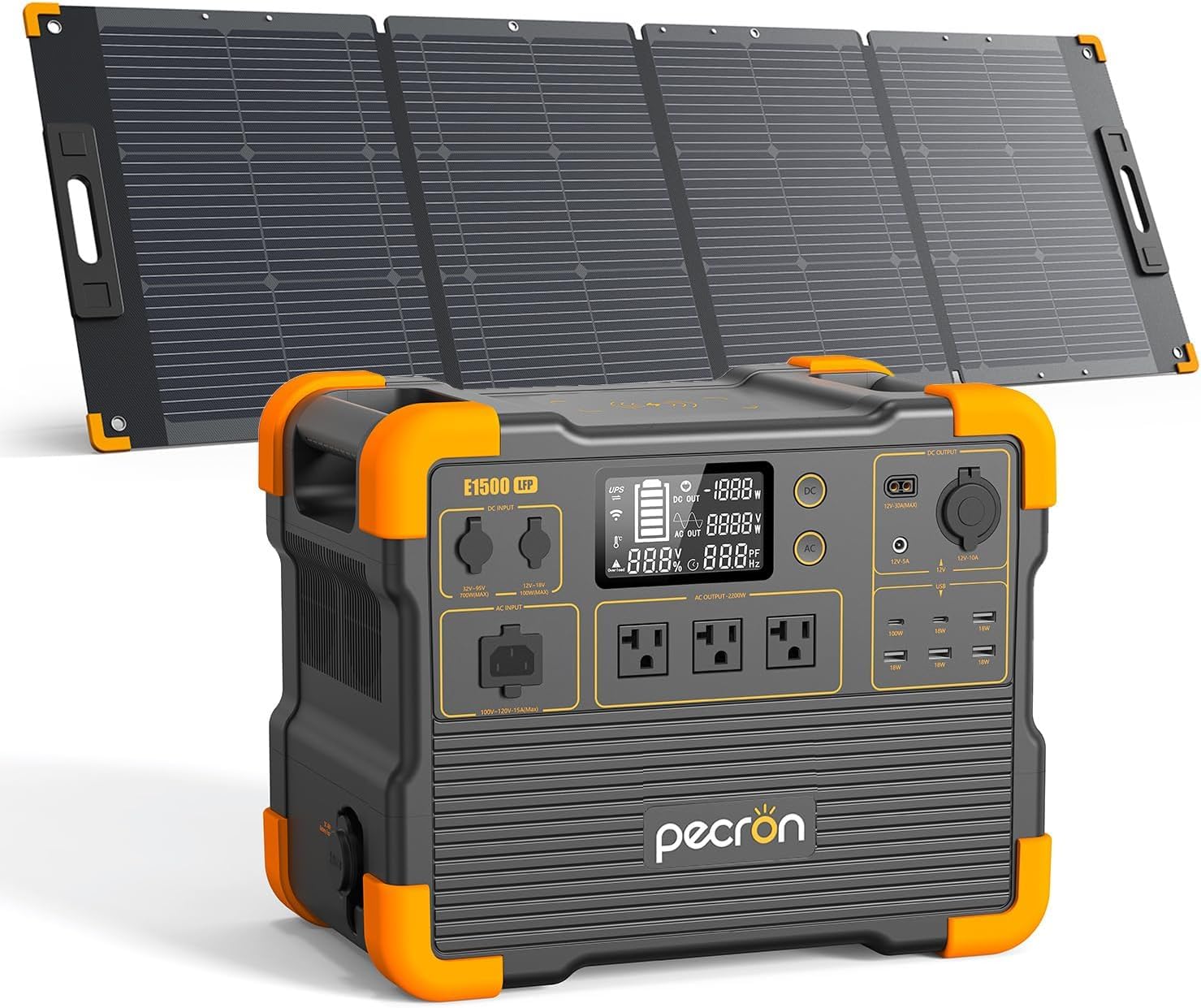
The only kit on this list that ships with a solar panel in the box.
A 200W solar panel comes in the box with this PECRON, so you can recharge off-grid the day it arrives. That places it in a different category from the AFERIY P210, which lists the solar panel as optional. Capacity sits at 1536Wh with 2200W of continuous AC output and 12 dedicated output ports, including four 2200W AC outlets and USB ports that push up to PD 100W. That leaves a comfortable margin above the ~400W a stove needs during a burn.
Charging speed is where it earns its place. From a wall outlet it hits 80% in under an hour — about 54 minutes — and full charge in 1.8 hours. From solar, the 200W panel fills it in roughly a day of decent sun. You can also push up to 1000W of solar input for a faster fill in 2.5 hours. The battery is LiFePO4 with built-in BMS (battery management system — circuitry that guards against short circuits, overloads, and overheating), and the AC output is pure sine wave so your stove’s electronics run clean.
Read the warranty structure closely. This unit claims a 2-year base warranty extendable to 5 years if you register within 30 days of purchase — but accessories, chargers, and solar panels are not covered by that extension. A full five-year guarantee really applies only to the power station itself. Reviewers rate reliability above build quality. One caution worth flagging: the station and the solar panel ship separately, so they may not arrive the same day even if Amazon marks the order delivered. Buyers also note charging accuracy at very low state of charge is something to watch, so plan your night’s burn conservatively.
The verdict in one line: the best value here if you want an off-grid solar-ready setup without buying pieces separately, with expandable capacity up to 9216Wh if you add the brand’s external batteries.
Perfect for: off-grid cabins, boondocking setups, or anyone who wants the panel included from day one.
Pass on it if: you want the smallest, lightest single box for indoor-only emergency backup — the separate panel adds hassle for pure at-home use.
5. BLUETTI Elite 200 V2 Portable Power Station 2073.6Wh 2600W Solar Generator

The longest-lasting battery here, built for owners who plan to keep it a decade or more.
BLUETTI rates this battery at over 6,000 cycles and a claimed 17-year lifespan, and calls it the industry’s first CNAS-certified automotive-grade LiFePO4. Compare that with the EF ECOFLOW Delta 2’s 3000+ rating or the AFERIY P210’s 3500+ rating — over twice the cycle count of the Delta 2. Capacity is 2073.6Wh with 2600W of continuous AC power, and it can briefly lift up to 3900W to start appliances that need a surge to get going.
That output headroom is a real advantage for a stove that runs alongside other home essentials. The Eaton is capped at 450W and the PECRON at 2200W. This 2600W unit can run a stove, a fridge, and a coffee maker at the same time without any load-shuffling, and it supports up to 9 devices simultaneously. Transfer to backup takes under 15ms, so a stove’s control board keeps its burn cycle. Standby draw is 10W, which BLUETTI says is three times lower than similar stations in this class. A charged unit then holds its reserves longer between outages.
Recharging is quick when you need it. From dual AC and DC inputs it hits 80% in 50 minutes, and a full charge takes about 2 hours on BLUETTI’s 1200W alternator charger. Solar input at 1000W fills the battery in about 2.4 hours — twice the 500W cap on the EF ECOFLOW Delta 2. That makes it the stronger long-term pick if renewable recharging is on your list. It weighs 53.4 pounds, and owner reports note it runs 8-12 pounds lighter than some competing units in this class. BLUETTI also says it is 40% more compact than its larger stations.
What’s Worth Celebrating
- 6,000+ cycle life with a claimed 17-year lifespan — nearly double the Delta 2’s cycle rating
- 2600W continuous, plus 3900W power lifting to start surge-hungry appliances
- Under 15ms UPS transfer keeps a stove’s control board running smoothly
- Standby power draw as low as 10W, about three times lower than similar stations
- 1000W solar input ceiling — twice the Delta 2’s 500W cap
What to Keep in Mind
- 53.4 pounds — heavier than the PECRON at 39.8 pounds and the Delta 2 at 27 pounds
- No battery expansion option mentioned, unlike the Delta 2 and PECRON
- Costs more than the mid-range options for a similar size capacity
The right call for: long-term owners who want one purchase to cover many winters and value cycle life over lowest entry cost.
Shop mid-range instead if: you plan to add extra batteries later — this unit does not support expansion.
6. BLUETTI Elite 300 Portable Power Station for RV & Home Backup 3014.4Wh
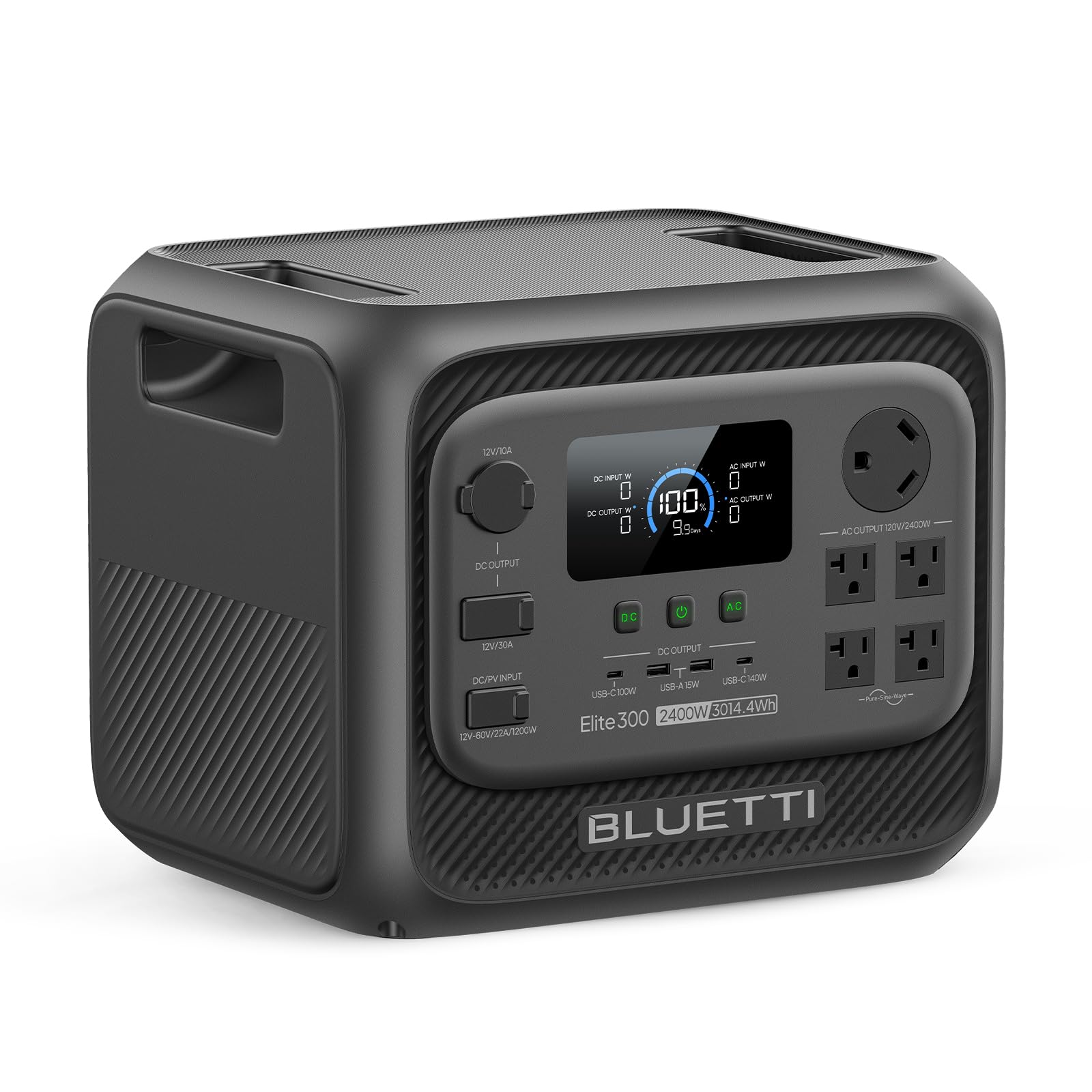
A three-kilowatt hour station the size of two ammo cans — the biggest reserve here.
The Elite 300 packs 3014.4Wh into a chassis measuring just 14.4 x 12 x 11.7 inches. BLUETTI says it is roughly 59% smaller than traditional large power stations and cites Frost & Sullivan recognition as the world’s smallest 3kWh portable power station. It holds 70% more capacity than the Elite 200 V2 in this guide — 3014.4Wh vs 2073.6Wh — yet the case is still small enough to tuck in a garage corner or slide under a workbench.
Continuous output is 2400W with a 4800W surge, and that surge matters for appliance startup. A compressor fridge, a well pump, or an AC unit pulls a large burst when it kicks on, and this station handles that spike without tripping into protection mode. The 3014.4Wh capacity means an overnight burn plus morning wake-up is comfortable. Customers note real-world mileage: running a 12,000 BTU air conditioner overnight, keeping a fridge, fans, and a phone charged for a full day, and carrying CPAP machines through a weekend on a single charge.
RV-ready wiring is the specific value here. It has a TT-30 RV outlet and a high-current 12V/30A DC output, which is exactly what a 12V fridge, water pump, or diesel heater needs. The UPS transfer happens in 10ms, so the control board never flickers. Recharge is fast — 0 to 80% in 78 minutes — from AC, solar, or a car charger. Weight is the obvious trade: at 58 pounds it is the heaviest unit in this guide, and there is no battery expansion option, so 3014.4Wh is the ceiling. Owners also flag that the solar input is limited to 60V/20A, so some 1200W panel setups can step past that limit and need care in matching.
Bottom line: if your goal is to keep a house warm and appliances running through a multi-day ice storm with the largest possible single-box reserve, this is the safest answer here. If you want something you can carry up stairs by yourself, look at the Delta 2 or PECRON instead.
An honest note on value: you are paying for the highest capacity-to-footprint ratio in this guide, not the lowest entry cost.
The ultimate pick for: RV owners, prepared households, and anyone whose stove needs to run for days, not hours, without recharging.
Look elsewhere if: you need portability first — 58 pounds and no expansion slots make this a home-and-rig tool, not a carry-along.
Understanding the Specs
Continuous Output Watts
This is the steady power a station can deliver second after second without shutting down, and it is the number you check against your pellet stove’s data plate. A 450W unit like the Eaton Tripp Lite ECO750UPSTAA covers small stoves that only pull the auger. A 2400W or 2600W station from AFERIY or BLUETTI runs the stove plus a fridge, lights, and a router on the same circuit. Check the continuous figure, not the surge number — a stove runs for hours and cannot rely on a brief peak.
Watt-Hour Capacity
Watt-hours measure total energy — think of it as a fuel tank size. To estimate runtime, divide the capacity by your load. A 1024Wh station running a 400W stove gives roughly two and a half hours. A 2048Wh or 3014Wh station stretches that to five or more. Match the capacity to how long your typical outage lasts, so you do not run dry at 3 a.m. on the coldest night of the year.
Pure Sine Wave Output
Pure sine wave is power that matches the smooth wave that comes out of a wall outlet. Pellet stoves use a sensitive control board, and pure sine wave output protects it from the buzzing and overheating that modified sine wave can cause. Every station in this guide produces pure sine wave output, which is why they are safe to run your stove through.
UPS Transfer Time
UPS stands for uninterruptible power supply. When the grid fails, a UPS switches to its battery in milliseconds so the connected device never notices the gap. The AFERIY P210 transfers in under 10ms, the BLUETTI Elite 300 in a stated 10ms, and the Elite 200 V2 in under 15ms. Those numbers are fast enough that a stove’s burn cycle continues uninterrupted during a brief flicker.
FAQ
How many watts does a pellet stove need to run on a battery backup?
Can I plug a pellet stove directly into a portable power station?
How long will a 1024Wh power station run a pellet stove?
Will a UPS keep my pellet stove running or just give me a few minutes?
Is it safe to run my stove on a portable power station overnight?
What is the difference between the BLUETTI Elite 200 V2 and the Elite 300?
How do I recharge these stations if the power is still out?
How many years do these batteries typically last?
Can I charge a power station from a wall outlet while it powers the stove?
What size battery backup do I need for a multi-day outage?
Final Thoughts: The Verdict
For most pellet stove owners shopping for the best battery backup for a pellet stove, the EF ECOFLOW Delta 2 is the pick to beat. It is the lightest true power station here at 27 pounds, it delivers 1800W of continuous output with a 1024Wh reserve, and it refills from a wall socket in about 80 minutes — fast enough to be ready before a storm hits. If you need enough reserve to run a stove plus a fridge through a full overnight outage, the larger capacity and higher output of the AFERIY P210 or the BLUETTI Elite 200 V2 are worth the extra weight. And if you want the single biggest reserve you can tuck in a corner for a multi-day storm, the BLUETTI Elite 300 is the one to reach for. Check your stove’s data plate before you buy, match continuous watts to that number, and pick the capacity that covers your longest typical outage.
How We Picked
We do not accept paid placement. Every pick is matched to a real buyer and a real use-case; we do not hands-on test units.
Sources & Methodology
Specifications: manufacturer listings and product documentation. Review insights: verified customer reviews, as of September 2026. Pricing: not shown on this page (it changes often); check the current price via the retailer link.
As an Amazon Associate, KitchPrep earns from qualifying purchases. This does not affect which products we feature.
Related Guides
