
Specs are compiled from manufacturer listings and verified buyer reviews and can change over time — please confirm the key details on the product page before buying.
At the top of a staircase, the wrong baby gate is worse than no gate at all. A gate that wobbles, swings the wrong way, or leaves a bar across the step gives a toddler exactly what they need to tumble. The single most important thing you can do is buy a gate made for stairs — hardware-mounted into the wall or banister — not a pressure-fit gate borrowed from a hallway. Below you get the picks that hold firm, the specs that actually matter, and the trade-offs nobody puts on the box.
I’m Mohammad Maruf — the founder and writer behind KitchPrep. This guide is built by comparing the manufacturers’ published specifications and the patterns across verified customer reviews, so you get each pick’s real strengths and trade-offs instead of marketing spin.
Every gate below mounts with screws and clears the floor at the step-over, so let’s walk through the baby gate for stairs that fits your opening and your family best.
Our Picks at a Glance


How To Choose The Best Baby Gate for Stairs
Buying a stair gate is not like buying a playpen gate. A playpen gate only has to keep a baby in. A stair gate has to hold a baby back from a drop, and it has to survive an adult leaning on it while carrying a laundry basket. That difference changes almost every spec that matters.
Mounting type is the first decision, not a detail
Pressure-mounted gates wedge between two walls using tension. They are quick to install and leave no holes, and they are fine at the bottom of a staircase or in a hallway doorway. At the top of stairs, tension is the wrong tool — a gate that pushes out under weight is a gate a determined toddler can work loose. Hardware-mounted gates screw into the wall or into banister posts, and the makers of every gate here call that out as the stair-safe option. The Cumbor gate gives you both, with the hardware route for stairways and high-traffic areas.
The bottom bar question
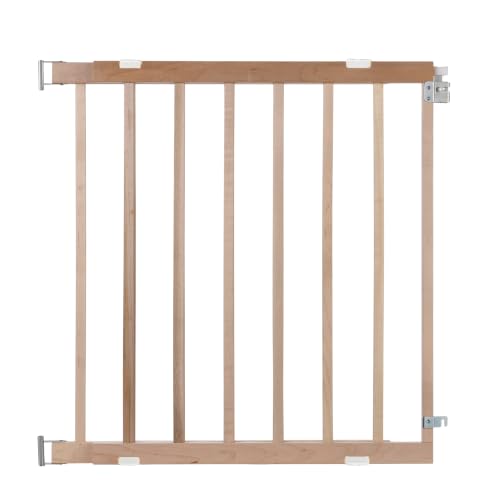
Many pressure gates run a horizontal support bar across the floor of the opening. That bar is a step-over, and a step-over beside a staircase is a hazard for grandparents, night-time trips, and anyone carrying a child. A “no bottom bar” gate, also called no-threshold, clears the entire floor of the doorway. The KidCo Safeway, the Babelio, and the Toddleroo wooden gate all take that approach, so your foot meets floor and nothing else.
Height and the climber in your house
Most standard gates sit around 30 inches tall. The Mumeasy runs 36 inches and the Ingenuity runs 38 inches — that extra height matters if your dog jumps or your toddler has figured out how to get a foot on the frame. A taller gate also means less bending at the waist every time you pass through, which is the exact reason tall gate buyers are so loyal to them.
Measure the opening twice, at the top and at the bottom
Stairwells taper. The gap between a newel post and a wall at the top step is usually a different number than the gap one step down. Makers publish a width range for each gate and most of them tell you to measure both spots before ordering. If your numbers sit just outside the range, the gate will not latch square, and you will spend more time shimming than installing.
Quick Comparison
| Model | Best For | Mounting | Width Range | Height | Amazon |
|---|---|---|---|---|---|
| Cumbor 30-46″ Baby Gate for Stairs★ Best Overall | All-round stair gate for kids and pets | Pressure / Hardware | 30″–46″ | 30.5″ | Amazon |
| Toddleroo by North States Stairway SwingBest Value | Angled or irregular stair openings | Hardware | 28″–42″ | 30″ | Amazon |
| Retractable Baby Gate with Cat DoorBest for Cats and Dogs | Cat-owning homes that need a dog barrier | Screws | 0″–55″ | 33″ | Amazon |
| Summer Infant Everywhere Extra Tall & Wide | Toddlers and larger dogs at stairs | Pressure & Hardware | 28.75″–39.75″ | 36″ | Amazon |
| KidCo 24.75-42.5″ Safeway Walk Through | Tight and narrow stair openings | Hardware | 24.75″–42.5″ | 30.5″ | Amazon |
| Babelio Removable Baby Gate | Wide stairways and occasional use | Hardware | 29″–43″ | 30″ | Amazon |
| Mumeasy 36″ Extra Tall Dog Gate | Jumpers, climbers, and tall handlers | Pressure / Hardware | 29.6″–40.5″ | 36″ | Amazon |
| Ingenuity Extra Tall & Wide Gate | Very wide stair and doorway openings | Pressure / Hardware | 29.5″–53″ | 38″ | Amazon |
| The Stair Barrier Fabric Gate | Banister-to-banister openings with no drilling | No drill | 36″–42″ | 32″ | Amazon |
In‑Depth Reviews
1. Cumbor 30-46″ Baby Gate for Stairs, Auto Close Dog Gate for Doorways White
Our pick — over 4.5★ from 21,000+ verified ratings; the strongest balance of quality and price.
The gate that closes itself behind you while your hands are full of baby and laundry.
If you want one gate to cover a hallway doorway now and the top of the stairs later, this is the one to start with. It is the crowd favorite here — 4.6 stars across 21,000+ ratings — and the reason is simple: it does two jobs. Pressure-mount it in a doorway with no drilling, then switch to the included hardware kit when you move it to a stairway. It stands 30.5 inches tall and adjusts from 30 to 46 inches wide, so it covers the openings most homes actually have.
The auto-close is what wins people over. Let the door go and a spring-loaded hinge pulls it shut behind you, so you are never the parent who forgot. The double-lock release needs a thumb-press plus a lift, which is the combination a toddler cannot work out but you can manage one-handed. Buyers report it held up to real testing at home: “Sturdy, no-screw gate; passed 1-year-old and 6-lb dog test.”
The install kit is unusually complete for the price tier — a support foot, banister angle adapters, wall cups, baseboard spacers, and a drill template. The catch worth knowing: the warning stickers on the handle and door frame are stubborn. Plan on a few extra minutes with a plastic scraper so you do not dull the white finish. It weighs 13.5 pounds of carbon steel, which is the heft that makes it feel like furniture rather than a temporary barrier.
What Earns It First Place
- Pressure mount for doorways, hardware mount for stairs — one gate, two jobs
- Auto-close hinge means it shuts itself while your hands are full
- Double-lock release is toddler-resistant but one-hand friendly
- Adjusts 30″–46″ wide at 30.5″ tall, with a 13.5 lb carbon steel frame
- Includes Y-bolt adapters, drill template, support foot, and ramp accessory
The Honest Catch
- The warning stickers on the handle and frame resist removal
- Measure both the top and bottom of your opening before ordering
- It is heavier than a retractable gate, so this is a permanent fixture
Best fit for: households that want one gate to handle a doorway today and a staircase tomorrow, with a self-closing door.
Think twice if: you rent and cannot put four screw holes in a stairway wall — the Toddleroo or the Stair Barrier below suit that better.
2. Toddleroo by North States – Stairway Swing Wooden Baby Gate
A solid wood gate that swallows awkward stair angles other gates cannot reach.
Here is the awkward problem this gate solves: your wall and your banister are not parallel, and a rigid rectangle cannot bridge a slanted gap. This wooden gate is hardware-mounted, swings both directions, and it lives on the door frame rather than the floor, so it sits at the top or the bottom of a staircase with nothing in your path. It fits openings 28 to 42 inches wide, stands 30 inches tall, and the maker builds in a climb resistance that most toddlers do not beat.
Unlike the Cumbor above, this one needs screws — there is no pressure-mount option — so it is a committed installation. The trade is that it holds a slanted opening the Cumbor would fight. Owners mention the angle is exactly why they bought it: “This was perfect for the top of our stairs. We needed something that would work at a slight angle and this did the trick! Easy to install.”
Two things to know before you click. It requires drilling, and there are no stair-specific directions in the box — a few owners added wood blocking behind the latch to get a square mount on a newel post. Also, the top and bottom slats are soft pine, so a sealing coat of finish will protect them for the long haul. It is a JPMA-certified gate made in the USA, which is a meaningful label to hold for a product standing between a toddler and a staircase.
Where it pays off: the swing-both-ways hardware design plus a no-threshold base makes this the natural pick for a top-of-stairs spot that no pressure gate can grip.
Fair warning: the bottom hook latch takes practice, and one owner’s one-star review flags a squeaky latch. Plan on two hands for the first week and you will have it down.
Reach for this if: your stair opening sits at an angle and you can drill into the wall or a newel post.
Look elsewhere if: you need a tool-free install — the pressure-mount options elsewhere on this list are your easier starting point.
3. Retractable Baby Gate with Cat Door 55″ Wide Retractable Baby Gate for Stairs
A mesh gate with its own cat door, so the cat eats in peace and the dog stays out.
The scenario that drives this buy: the dog raids the cat’s bowl, or the cat cannot get to the litter box. This gate answers it with a cat door cut into the mesh. The opening is 6 by 7 inches — wide enough for a cat, small enough that a mid-size dog cannot follow. Owners running the numbers found the split works exactly as advertised: a 7 lb cat slips through without fuss while a 20 lb dog does not.
At 55 inches wide and 33 inches tall, this is the widest gate here — 20% more opening than the Cumbor’s 46-inch maximum, and 10% more height than the Toddleroo at 30 inches. It mounts with screws rather than pressure, and unlike the Cumbor, it rolls away to nothing when you are not using it, so a hallway stays a hallway. The mesh is soft, so a crawling baby meets fabric and not metal when they bump it.
The one honest friction is the latch. It is designed for one-hand use, and it usually delivers, but a few owners have found the loops and hooks misalign and leave a little slack after closing. Some of them end up stepping over the gate instead of unlatching it. The plastic mesh body weighs under 5 pounds, so it is genuinely portable when you need to move it between a stairway and a porch.
The design payoff: a built-in pet door plus a 55-inch span makes this the only pick on the list that solves the cat-and-dog problem in one piece of hardware.
Size caveat: the review pages flag fit as the recurring friction point, so measure your opening — a retractable gate that runs out of span will not pull taut.
This is your gate if: you run a multi-pet household and need the cat to keep their own route through the house.
Not the pick for: anyone who wants a rigid metal barrier at the very top of a staircase — mesh flexes by design, whereas a steel gate holds its line.
4. Summer Infant Everywhere Extra Tall & Wide Pet and Baby Gate, 28.75″ – 39.75″ Wide, 36″ Tall

The white metal gate a Boxer could not break and a toddler could not out-think.
Strong counts for something at the top of a landing, and this gate is the one buyers write about when a dog has already destroyed a cheaper model. It stands 36 inches tall — six inches above the standard 30-inch gate — and spans 28.75 to 39.75 inches wide. The 19.5-inch walk-through door clears the way without a step-over, and the included door stopper stops the door swinging outward over a staircase, which is the exact configuration you want at the top step.
The latch is the security story. It takes a two-part motion that a toddler cannot repeat, so your child cannot copy the open. Buyers who needed a dog-proof gate got one: a Boxer that had snapped open a previous gate could lean, push, and bark on this one without budging it. Another owner bought two, one at each end of a staircase, and reported their child shakes them like a prisoner — the gate just does not move. You can install with the included hardware kit for stairs, or pressure-mount with wall cups (the round cups that spread the pressure against the wall) in a doorway.
Two things to plan for. The closing action is loud — the metal-on-metal sound of the door latching is the most common complaint, and it is worth knowing before you mount it outside a bedroom. The other is that the manual is dense; the install itself is easy, but the instructions overcomplicate it. One owner almost returned the gate because they could not get it open until they worked out that you gently lift the door.
The standout spec: 36 inches of gate with a 19.5-inch walk-through door and a stopper that blocks outward swing over the stairs — the combination that makes it earn its Top Performer badge.
Trade-off to accept: it clanks when it shuts, and the manual makes a simple install read like a puzzle. Both are small prices for a gate that stays put.
Best for: a house with a large dog or an ambitious toddler at the stairs, especially where a cheaper gate has already failed.
skip it if: you need a silent gate outside a nursery — the Toddleroo wooden gate or the KidCo run much quieter.
5. KidCo 24.75-42.5″ Safeway Walk Through Baby Gate for Stairs and Doorways
The gate for a stair opening too tight for anything else on this list.
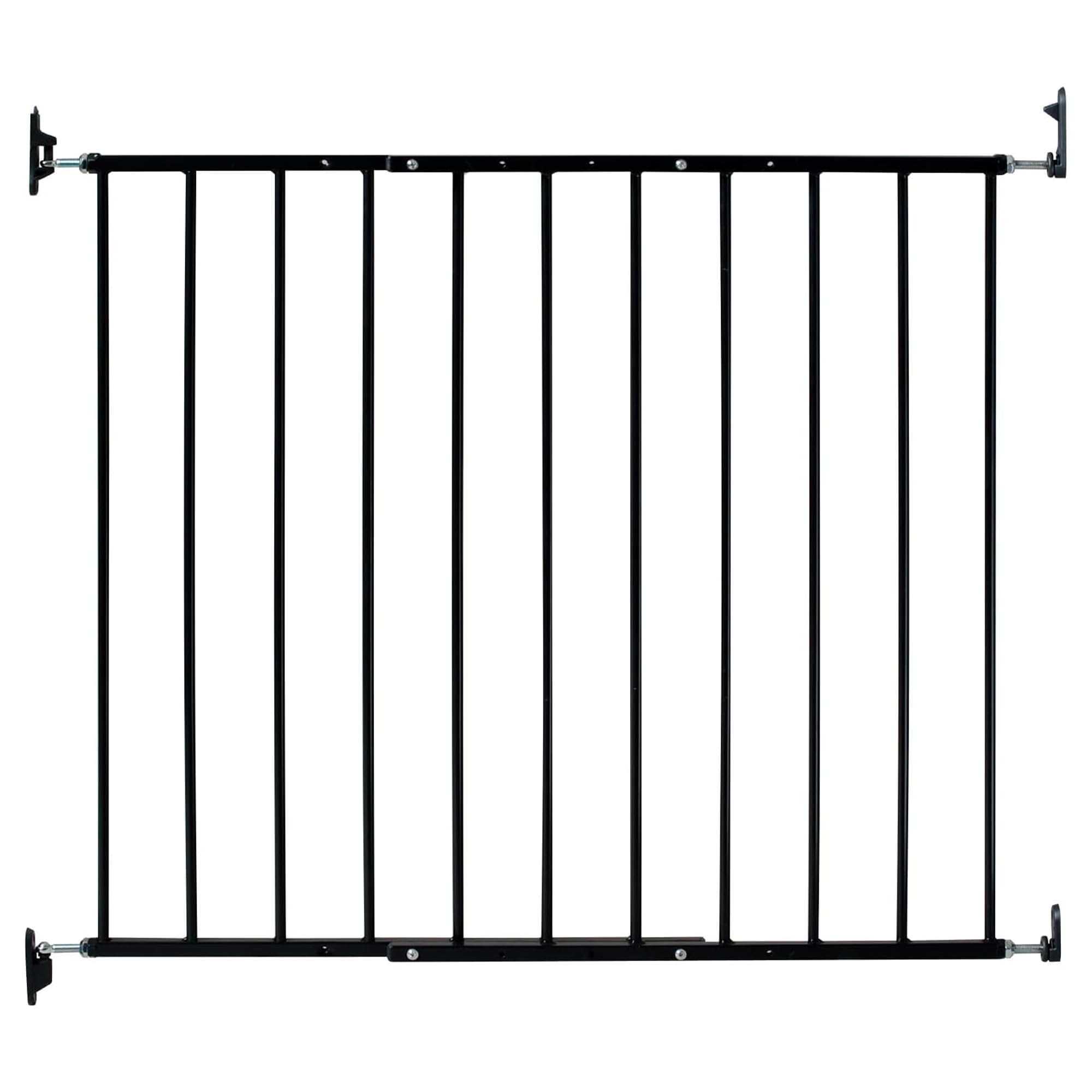
Most stair gates bottom out around 28 or 29 inches. This one starts at 24.75 inches, which is the number that matters if your banister and wall pinch close together — a narrow gap that most gates cannot fit. It runs up to 42.5 inches wide and stands 30.5 inches tall. There is no bar across the floor, so nothing to trip over on the landing, and the stop pin (a small peg that blocks the gate from swinging the wrong way) is designed to prevent the dangerous outward swing over a staircase — the exact failure mode that makes the top of stairs different from any other opening.
The whole gate opens, not just a middle section, which is the design choice owners single out most: it feels like a doorway rather than a hatch. The quick-release hardware means you can lift the gate off its mount for storage while leaving only the small brackets on the wall. It is metal throughout, finished in black, and it operates quietly enough that it will not announce itself at nap time.
The recurring gripe is the installation hardware itself — specifically a plastic mounting bracket that a few buyers found flimsy, with one reporting the top piece broke. KidCo’s own customer service gets frequent credit for replacing parts quickly on older models, so the support path exists if you need it. Meanwhile, the two-month mark is where several buyers confirmed their gate is still solid with two dogs leaning on it, swinging flat against the wall when open.
Why It Earns Its Slot
- Adjusts down to 24.75″ — the narrowest low end on this list
- No bottom bar means no threshold to trip the whole width of the opening
- Stop pin blocks the outward swing over stairs
- Quick-release mount leaves only minimal hardware when removed
- Metal body with a chip-resistant black finish that matches other fixtures
Know Before You Buy
- The plastic mounting bracket is the weak point for some owners
- Level and square surfaces are required for the cleanest install
- For uneven or decorative stairs, KidCo’s separate K12 kit is needed
Worth it if: your opening is narrow, you want no bottom bar, and you value a full-width opening over a hatched panel.
Second-guess it if: your stair surfaces are noticeably uneven or decorative — that job needs the separate KidCo adapter kit.
6. Babelio Removable Baby Gate for Stairs No Bottom Bar, 29-43″, 30″ H, White

The gate you can lift off the wall and stash when the grandkids head home.
This gate is built for households that do not need a stair barrier every day. It mounts to hardware in three simple parts — two vertical bars, one door frame, plastic pads to fit the skirting, and screws — and comes off the opening just as fast. If your main use case is the occasional visit rather than a toddler living in the house, that removable design is the whole point. It fits openings 29 to 43 inches wide at 30 inches tall.
The door is the standout. It swings the full width of the opening rather than a hatched middle panel, and one owner using a wheelchair found that full-width clearance with no bottom bar made the gate genuinely usable. That same owner runs a 60 lb dog against it. The auto-close brings the door gently shut when you release it, and a stay-open position holds it wide when your arms are full. Double-lock design with all-steel construction and a CPSIA test pass sits behind the safety story.
There is one design quirk to expect — the latch takes two motions, with a slider on top and a button underneath, and a few customers note needing both hands at first. It usually resolves as you learn the motion. The rails sit close enough together that a 16 lb dog cannot squeeze through, and one owner running a 55 lb dog on a deck reports no rust.
Where it shines: the removable frame design plus a full-width walk-through door makes this the most flexible gate here for households who only need a stair barrier part-time.
Small learning curve: that double-motion latch is genuinely two hands until you have the rhythm, and one owner found the auto-close does not always carry the door all the way to a latch.
Pick it if: you want a stair gate you can take off its hardware and store between visits rather than live with all year.
Pass if: you need a permanent, always-mounted barrier with a one-touch latch — the Cumbor or the Summer Infant fit that better.
7. Mumeasy 36″ Extra Tall Dog Gate, 29.7″-40.5″ Baby Gate for Stairs & Doorways
Eight inches of extra height that stops the dog jumping and the baby climbing.
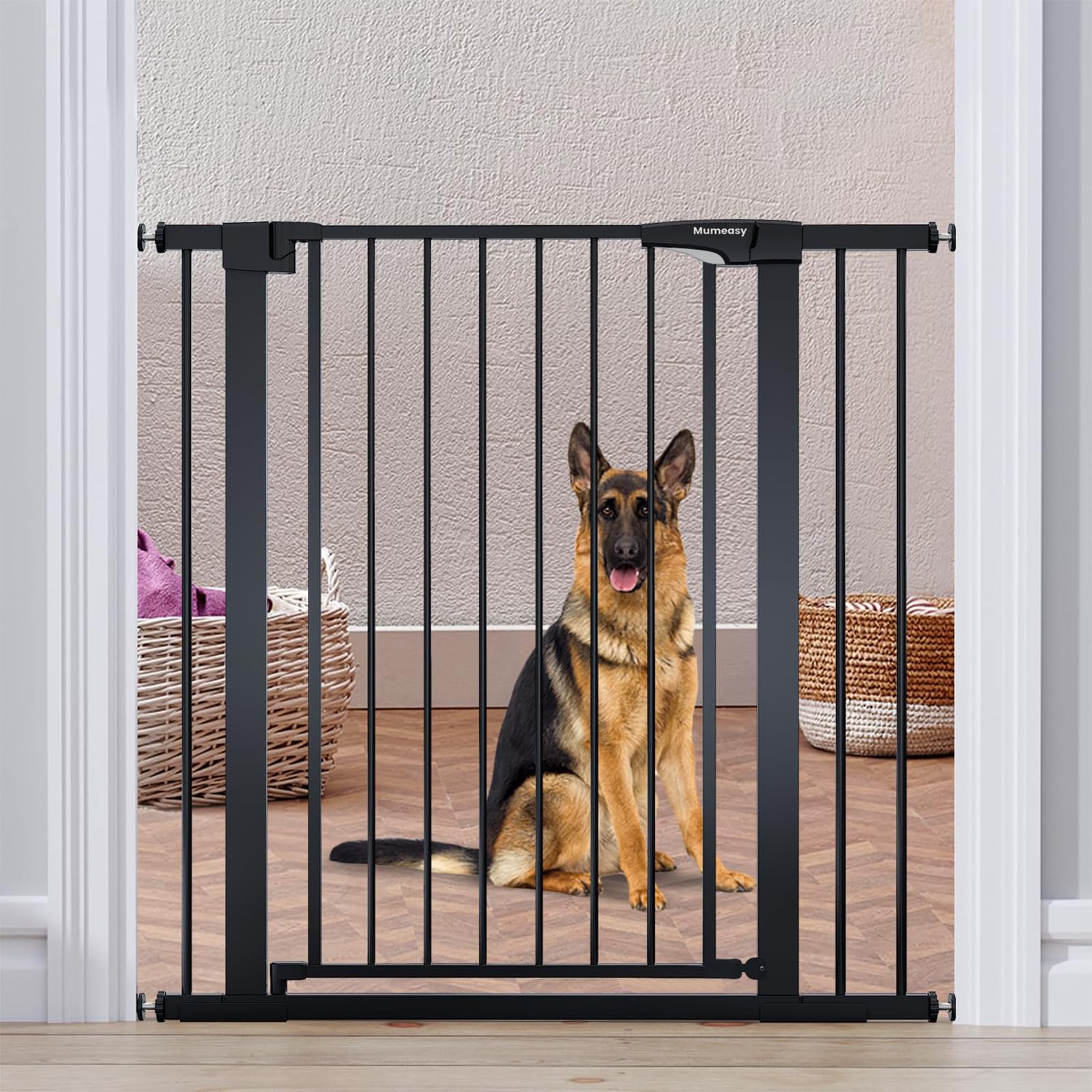
The Mumeasy runs 36 inches tall — eight inches above the standard 28-inch gate — and that dimension is the entire reason people buy it. It fits openings 29.6 to 40.5 inches. Where the 30-inch KidCo Safeway lets a jumping dog go over the top, this gate’s height keeps them on their side. The dual safety lock adds a second motion to open, so a smart dog or toddler gets nowhere near unlatching it. A Mom’s Choice Award sits behind the design, and it comes with a 3-year warranty and a 24/7 support line.
You have both install routes. Pressure mount for a doorway — no tools, no holes, quick removal for storage. Or screw it to the wall for a stronger fit at the top or bottom of a stairway, where the extra stability is worth the drilling. Either way, the door closes behind you automatically and opens one-handed with a baby on your hip.
Two install details will save you a headache. The gate ships with its latch spring compressed under zip ties — after you cut them, freeing the mechanism takes effort, and a few owners have needed strong arms to reset it. Separately, the extension kit needs handrails and baseboards that sit roughly flush. If your handrails wrap past the baseboard, the extensions will not seat and you will be modifying the fit rather than installing it. It weighs 14 pounds and the black metal finish suits a porch or an indoor staircase alike.
The extra-tall argument: 36 inches of gate plus a dual-action lock is what keeps a German Shepherd or a climbing toddler on the safe side of the stair.
Measure your trim first: handrails that overhang the baseboard will fight the extension pieces, so check the gap before you order.
Choose this if: your dog jumps the standard gate or your toddler has learned to climb the frame.
Look at alternatives when: your railings are decorative and overhang the wall — that geometry favors a hardware-mount setup like the Summer Infant instead.
8. Ingenuity Extra Tall & Wide Safety Pet and Baby Gate, 29.5″-53″ Wide, 38″ Tall
A 53-inch span and 38 inches of height for stair openings the others cannot close.
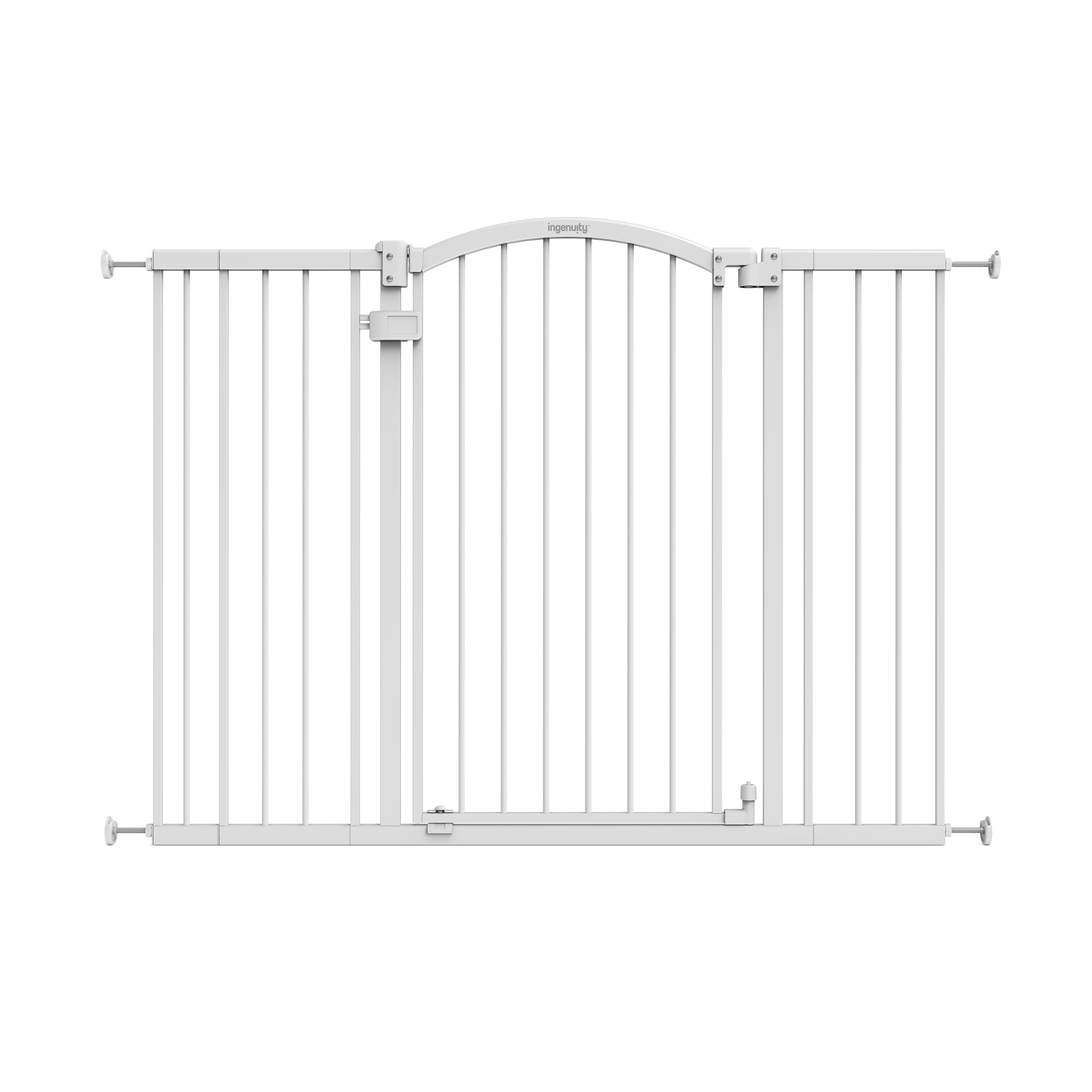
If your stairwell opening runs wider than 42 or 46 inches, this is where the list resolves. The Summer-built gate fits openings from 29.5 up to 53 inches wide and stands 38 inches tall — the tallest and widest on this list. That reach is what makes it the answer for a wide landing or an open stairway with a lot of space to bridge. Mounting is pressure-fit with wall cups for doorways, or hardware for walls and flat banisters, which includes the stairway configuration.
The 20-inch door swings both directions and drives its own behaviour by angle: past 90 degrees it stays open, and under 90 degrees it auto-closes. A stopper stops the door swinging over the stairs when you install it at the top of a staircase. Narrowly spaced bars stop babies and pets squeezing through. One owner who runs it across a 49-inch kitchen-and-foyer opening reports easy installation and a latch that took a bit of practice but soon got quick.
Two details to note. The gate can look bent from the start — that is a normal state of the pressure hardware, and it corrects when you install it correctly with the adjustments. Also, the maker lists a set of openings this gate cannot fit without careful shimming: 33 to 33.5 inches, 37 to 37.5, 41 to 41.5, 45 to 45.5, and 49 to 49.5. Measure your gap, and if you land inside one of those narrow windows, look at the Mumeasy or the Babelio instead.
The wide-opening answer: 53 inches of maximum span and 38 inches of height make this the only pick here that closes a genuinely wide stair landing in one unit.
Measure carefully: the accepted-width exclusions are real, so guide the tape measure to a range number rather than eyeballing the landing.
The right call if: your opening exceeds roughly 42 inches and you want extra height without buying extension pieces.
Wrong tool when: your opening lands in one of the excluded narrow windows — a different mount type will fit more cleanly.
9. The Stair Barrier First Fabric Banister to Banister Baby Gates for Stairs
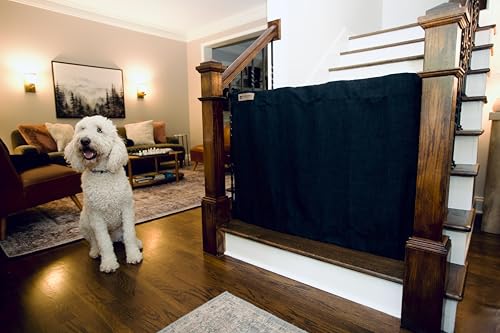
The fabric barrier that clips banister to banister with no drill and no wall damage.
Two banister posts, no drill allowed, nothing on the wall — that is the situation this gate exists for. It is a reinforced fabric panel that straps between two banisters, spans 36 to 42 inches wide, and stands 32 inches tall. Setup takes about 30 seconds according to the makers, and owners describe the straps attaching firmly and tightly. When your child grows out of it, the whole thing rolls neatly to one side and stows. The fabric is machine-washable, and the makers describe it as climb-proof reinforced fabric rather than a curtain.
It handles spots a rigid gate cannot. Owners have run it on open stairways with two banisters and on curved staircases with scrolled handrails and wooden posts. On those, it clips to both posts and the adjustable straps sit snug against the second step — no wall anchoring, no holes, and no damage to a rented home. It also meets ASTM safety standards and is designed in the USA.
That said, location matters enormously here. On a lower staircase it works well and one owner on a curved stair with a top landing swears by it. On the top of a staircase — where a toddler could get under the bottom edge — a few owners found it never tightens enough to make them comfortable, and they recommend it for the bottom of the stairs or for blockading a room instead. Also expect a routine: one owner counts six buckles to snap and straps to readjust on every use, and the fabric’s reinforcement slat can wear thin over time. It requires patience at the doorway, but it delivers what nothing else on this list does — a barrier with zero drilling at all.
Where It Wins
- Banister-to-banister mount with no drilling in walls at all
- Rolls to one side for storage and machine-washes clean
- Works on open, curved, and angled staircases where rigid frames struggle
- Setup in about 30 seconds per the maker, with straps that hold firm
- Meets ASTM safety standards and is designed in the USA
What to Weigh
- Not at its best at the very top of stairs — reviewers point out it may not pull taut enough there
- Six buckles and straps need resetting on each entry and exit
- The thin reinforcement slat is the wear point over time
- Value-for-money is the mixed note in the review pages
The one to grab if: you rent, cannot drill, and your opening runs banister to banister on an open or curved staircase.
Choose something else when: the gate has to sit at the very top of the stairs — a hardware-mounted steel gate holds more securely there.
Understanding the Specs
Mounting Type: Pressure vs Hardware
Pressure mount relies on tension between two surfaces — no holes, quick to move, and best at the bottom of stairs or in a doorway. Hardware mount uses screws into a wall or a banister post. That fixed connection is what makes a gate appropriate at the top of a staircase, where a pressure gate can shift under a lean. Some gates on this list, like the Cumbor and the Summer Infant, offer both, so you can pressure-fit today and switch to hardware when you move it to the stairs.
Width Range and Why You Measure Twice
Every gate lists a width range — from a minimum to a maximum opening. The minimum matters when your banister and wall sit close together, and the maximum matters when the opening is broad. Stairwells taper, so the gap at the top step is usually not the same number as the gap one step down. Measure both spots, then match the tighter number to a gate whose range covers it, or the gate will not latch square.
Height: What 30, 33, 36, and 38 Inches Change
Standard gates sit around 30 inches tall. Extra-tall gates run 36 to 38 inches. If your dog jumps or your toddler climbs, that extra height is the difference between a barrier that works and one that does not. Taller gates also save on bending at the waist every time you pass through, which is a comfort gain for parents and for anyone with back or mobility limitations.
No Bottom Bar and the Walk-Through Door
A bottom bar runs across the floor of the opening and creates a step-over exactly where a step-over is risky. A no-bottom-bar design clears the whole floor. Walk-through doors come in two styles: a hinged panel in the middle, or a full-width door that opens the entire gate. The full-width style is the easier pass with a laundry basket in hand and the safer one at the top of a staircase.
FAQ
Can I use a pressure-mounted gate at the top of the stairs?
How do I measure a stairway opening for a gate?
Is a no bottom bar gate actually safer on stairs?
What gate height stops a dog from jumping over?
Do I need a drill to install a stair gate?
How do stair gates attach to a banister post?
Can a baby gate be used for pets instead of children?
Will a stair gate hold a toddler’s weight if they lean on it?
How long should a stair gate last?
What is the difference between a hardware-mounted gate and a no-drill gate?
Final Thoughts: The Verdict
The right baby gate for stairs depends on one thing above all else: where the gate goes. At the top of a staircase you want screws in the wall, a stopper that blocks outward swing, and a latch a toddler cannot solve. At the bottom or in a doorway you have far more freedom. The Cumbor 30-46″ gate is the pick that covers both jobs — pressure mount for a doorway, hardware mount for the stairs, with a self-closing door and a double-lock release. It is the crowd favorite for a reason and the one gate most families should start with.
If your stair opening sits at an awkward angle and you can drill, go with the Toddleroo Stairway Swing — it holds a slanted wall-to-banister gap that rigid gates fight. For a wide landing that no standard gate can reach, the Ingenuity Extra Tall & Wide spans up to 53 inches and stands 38 inches tall.
And if drilling is off the table entirely, the Stair Barrier fabric gate clips banister to banister in about 30 seconds with no holes at all — keep it to the bottom of the stairs or a doorway rather than the top step and it earns its place. Whichever you choose, measure the gap at the top step and one step down before you order.
How We Picked
We do not accept paid placement. Every pick is matched to a real buyer and a real use-case; we do not hands-on test units.
Sources & Methodology
Specifications: manufacturer listings and product documentation. Review insights: verified customer reviews, as of September 2026. Pricing: not shown on this page (it changes often); check the current price via the retailer link.
As an Amazon Associate, KitchPrep earns from qualifying purchases. This does not affect which products we feature.
Related Guides
