
Specs are compiled from manufacturer listings and verified buyer reviews and can change over time — please confirm the key details on the product page before buying.
If your roof coating peeled within two summers, the problem usually is not the brand you bought — it is coating thickness and surface prep. A thin acrylic layer chalks, cracks, and lets UV through to the substrate underneath. This guide sorts the eight coatings worth your weekend, and it tells you which one fits your roof type and how many coats you will actually need.
I’m Mohammad Maruf — the founder and writer behind KitchPrep. This guide is built by comparing the manufacturers’ published specifications and the patterns across verified customer reviews, so you get each pick’s real strengths and trade-offs instead of marketing spin.
Every pick below was checked for how it holds up through a full summer of UV without peeling. Every pick below was checked for coverage per gallon, dry time, surface compatibility, and how it holds up in heat, so you can choose the right acrylic roof coating without wasting money.
Our Picks at a Glance


How To Choose The Best Acrylic Roof Coating
To pick the right coating, you need to know three things: what your roof is made of, how many square feet you are covering, and how much sun it gets. Those three answers narrow the field to one or two products.
Match the coating to your roof surface first
Metal, rubber, concrete, and foam roofs each pull a coating differently. A product designed for metal RV roofing may not bond to EPDM rubber, and a coating made for rubber may not hold on a flat commercial roof. Read the compatibility line before anything else. Some products tell you exactly what not to use them on, and that warning is the most useful sentence on the label.
Work out real coverage, not bucket size
Coverage is stated per gallon at a recommended thickness, and two coats is the standard. A five-gallon bucket that covers 500 square feet per coat handles a large mobile home; a one-gallon can at 50 to 70 square feet per coat handles a camper roof. Multiply before you buy, because running short mid-job means a visible seam where the dry edge meets the new coat.
Understand reflective white and heat
A reflective white finish bounces solar heat away from the roof deck instead of absorbing it. That keeps the surface cooler to the touch and reduces how hard your cooling system works. Reflectivity only works while the coating is clean and intact, so a chalking or peeling layer loses most of its benefit.
Plan around dry time and weather
Acrylic coatings are water-based, so they need warm, dry conditions to cure properly. Most manufacturers specify a minimum application temperature and a window before rain. If overnight temperatures drop below the stated minimum within the first day, the film may not set correctly. Check the forecast before you open the bucket.
Quick Comparison
| Model | Best For | Volume | Dry Time | Coverage | Amazon |
|---|---|---|---|---|---|
| Gardner Sta-kool Elastomeric Roof Coating★ Best Overall | Large single-wide and metal roofs | 5 gallons | 365 days to full cure | 5 | Amazon |
| Kool Seal Premium 10 Year Elastomeric Roof CoatingBest Value | Small trailer and cargo roofs | 1 gallon | 24 hours | More than standard coverage | Amazon |
| Gardner-Gibson Black Jack Elasto-Kool 1000Thickest Build | Sheds and patio covers | 1 gallon (3.6 quart) | — | — | Amazon |
| Dicor RP-MRC-1 Acrylic Elastomeric Coating | Metal RV roofing | 1 gallon | 6 hours | 200 SQ. FT. | Amazon |
| Marlin Acrylic Top Coat RV Roof Coating | Mixed-surface roofs and RV rubber | 1 gallon | — | 60 sq ft per gallon | Amazon |
| BEEST RV Roof Coating White | Leak repair on campers and trailers | 1 gallon | 48 hours to fully cure | 50 sq ft (2 coats) | Amazon |
| STA-Kool SK-7705 Traditional Acrylic Elastomeric | Large mobile home roofs | 5 gallons | 4 hours | — | Amazon |
| Jetcoat Cool King 5-Year Reflective Roof Coating | Rubber, foam, and modified bitumen roofs | 4.75 gal | 2-3 hours to the touch | 50-70 sq ft per coat | Amazon |
In‑Depth Reviews
1. Gardner Sta-kool Elastomeric Roof Coating, White, RV Roof Coating 5 Gallon
Our pick — over 4.5★ from 600+ verified ratings; the strongest balance of quality and price.
The five-gallon bucket that turns a scorching single-wide into a cool, dry shell
This is the one to buy if you are coating a whole mobile home roof or a long run of metal. The five gallons of volume sits against the one-gallon Dicor further down the list — a five-times-larger container for a similar job. Gardner builds it on a white acrylic latex base enhanced with silicone, which is what gives it the improved water resistance and adhesion the label claims.
The reflective side is the headline: an 87% reflective finish that bounces solar heat instead of soaking it up. Owners of single-wide trailers describe the house staying noticeably cooler and staying leak-free after the job. It is also flexible enough to expand and contract up to 300x with the roof’s own movement, which is what keeps a rigid film from spider-cracking over a metal seam.
Silicone in the formula means it can feel slick and slow to set on a cold morning, and you will want a half-inch nap roller and a good brush for the trim work. If your roof surface is sound and you apply it heavy, it behaves.
What it does best
- Five gallons of volume at a workable price per square foot
- 87% reflective finish aimed squarely at heat and UV
- Expands and contracts up to 300x with roof movement
- Silicone-enhanced acrylic latex for water resistance and adhesion
Where it takes work
- Expect weeks before it reaches a full cure, especially on cool days
- You must roll it thick — a thin first coat is the most common mistake
Best for: the homeowner coating a full single-wide trailer, long metal run, or large camper roof in one order
The honest trade-off: it wants a heavy hand — buyers report that rolling it on as thick as you possibly can and following with two full coats is what actually seals a rough roof
2. Kool Seal Premium 10 Year Elastomeric Roof Coating, White, 1 Gallon
A single pail that pampers cargo trailers, pop-ups, and any small roof you can reach in an afternoon
Kool Seal is the small-job specialist. One gallon is the right size for a 12-foot cargo trailer roof or a small camper, and the formula is backed by a 10-year warranty. Its 24-hour listed dry time is the slowest figure of the acrylic cans here — the Dicor listed above sets in 6 hours, which is a four-times gap when you are racing weather.
What wins people over is how it lays down. Buyers describe it rolling on like paint, bright white and reflective, with one long-time user getting two thin coats on a 16-foot travel trailer from a single can. On an enclosed trailer the surface goes from too hot to stand on to merely warm in direct sun, and one owner cut the rain noise on a metal cargo roof noticeably while stopping the edge leaks.
The honest catch is thickness. This is a thin product, and a thin acrylic needs more coats than you would guess to build a real film — most people run two, some three. Get the surface clean and dry first, and it rewards the extra pass.
Why buyers reach for it
- Bright white reflective finish at a single-pail price point
- Roller-applied easily, and it cures non-tacky in about two hours in mild 60-65°F weather
- 10-year warranty on the label
- Easy soap-and-water cleanup while wet
Where it asks more of you
- Genuinely thin — plan on two to three coats for a real seal
- Lids have arrived popped open in shipping, so check the pail before the return window closes
Buy it when: your roof is small enough that one pail finishes the job and you have a spare afternoon for a second coat
Look elsewhere if: you want a thick, high-build film straight out of the can without multiple passes
3. Gardner-Gibson Black Jack Elasto-Kool 1000 Gloss White Acrylic Roof Coating 1 gal.
Thick, rubberized, and built to stay put where water pools against a seam
If you have ever tried to waterproof a shed roof with a coating that ran like milk, Elasto-Kool 1000 is the answer to that frustration. It is a flexible white acrylic that resists cracking and peeling and stretches up to 350% to stay with the surface through temperature swings. Buyers describe it as a rubberized paint that rolls on thick with great coverage — a genuinely different feel from a thin coating.
Quality sits at the center of the equation here. Owners come back to it year after year for sheds and patio covers, and it pairs cleanly with seam tape on the joints where leaks actually start. That 350% elasticity figure is the number to remember if your roof moves, since a film that cannot flex will split at the edge of every panel.
The catch is that a heavy, flexible film takes longer to lay down evenly, and it is not designed as a one-coat shortcut — build it in layers. A few buyers have also had the lid pop in transit, so look at the can before you start.
Where it earns trust: the 350% stretch and crack-resistant acrylic are the real story — this is a coating you apply when the surface under it moves and you do not want a brittle layer fighting it.
Reach for this: sheds, patio covers, and small roofs where the joints need a thick, flexible seal that clings to the panel edges
Look at Dicor instead: if your roof is metal RV decking and you want a faster-set film with a thinner build
4. Dicor RP-MRC-1 Acrylic Elastomeric Coating, Metal RV Roofing, White

The metal-roof specialist that flips from too-hot-to-touch to walkable in two coats
Dicor makes one thing very clear on the label: this coating is for metal RV roofing only, and it is not recommended for EPDM rubber or TPO roofing. That narrow focus is a feature, not a limitation. On the right surface it delivers a 200 square-foot coverage per gallon and sets up in 6 hours — the fastest listed dry time of any acrylic here, and a four-times speed advantage over the 24-hour Kool Seal.
The reflectivity result is what owners talk about. An aluminum RV roof that was too hot to stand on becomes touchable even at 90°F after two thin coats, with the interior noticeably cooler. The finish is a matte white that softens the look of an old roof rather than screaming for attention. Its 6-hour set time also matters on a job where weather is closing in.
Watch two things. It cures slowly enough that on unusually hot days a heavy coat can run down the sides before it sets, so apply thin layers and let them tack. And it will not bond through silicone, so any old silicone sealant around a vent has to come off first.
What separates it: that 200 square-foot-per-gallon coverage combined with a 6-hour dry time makes it the efficient choice for a metal roof you need to finish and walk away from.
Pick it for: metal RV and trailer roofs where fast set time and high reflectivity matter more than coating flexibility
skip it if: your roof is EPDM rubber or TPO — Dicor tells you plainly that this formula is not made for those surfaces
5. RV Roof Coating – Premium Acrylic Elastomeric Waterproof Sealant (White, 1 Gallon)

One coating that will sit on rubber, metal, foam, PVC, or concrete without blinking
The Marlin Acrylic Top Coat earns its spot on the strength of a compatibility list that runs from EPDM rubber through TPO, spray polyurethane foam, PVC, wood, concrete, metal, and even primed asphaltic surfaces. That breadth is unusual. A single gallon covers about 60 square feet, and the manufacturer recommends a minimum of two heavy coats for proper cured thickness.
It is a plasticizer-free, single-component acrylic that forms a flexible membrane meant to stay flexible through hard weather. The formula is built for UV resistance and solar reflectivity while still letting trapped moisture escape — a breathable waterproofing layer rather than a sealed plastic sheet. On a 33-foot travel trailer with three slides, owners mention needing a little over two gallons to cover the roof.
You can apply it with a brush, a roller with a 1 ¼ nap (the thickness of the roller cover), or a sprayer. The temperature rules are strict: pass on it if rain is expected or the temperature will drop below 32°F within 24 hours, and 50°F or above is the ideal window. That weather sensitivity is the one real constraint on a flexible, multi-surface product.
Strengths worth knowing
- Works across EPDM, TPO, metal, foam, PVC, wood, and concrete
- 100% acrylic, plasticizer-free, single-component formula
- Breathable membrane lets trapped moisture escape
- Brush, roll, or spray apply
Constraints to plan around
- Weather window is narrow — no rain and no sub-32°F nights within 24 hours
- Needs a minimum of two heavy coats for a proper cured thickness
Go with this if: your roof is an odd mix of materials and you want one product that will not fight the surface
Check your calendar first: the ideal application window is above 50°F, so a cold snap can push the job back
6. BEEST RV Roof Coating White, 1 Gallon, Solar Reflective & Waterproof Sealant
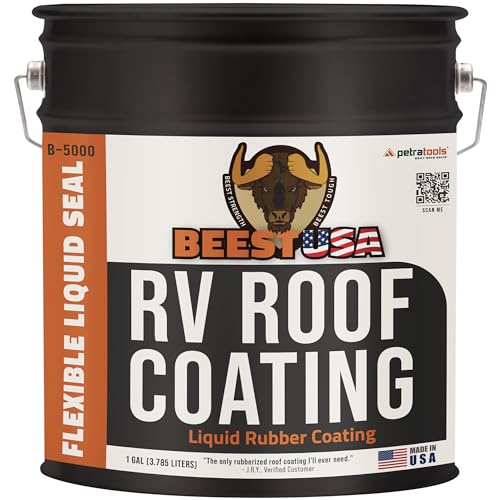
The thick liquid-rubber sealant that stops a leaking pop-up from ruining a trip
BEEST built this for the person whose roof is already leaking, not just fading. It is an acrylic elastomeric waterproof coating that goes on thick and stays put. Coverage is listed at 50 square feet per gallon for two coats, and a 5-gallon pail covers RVs up to 30 feet long. It takes 48 hours to fully cure at temperatures between 40-90°F.
What wins people over is the sealing performance. Customers note this thick, non-runny coating adhering tightly and covering well where thinner products have failed, and one person who had been chasing a leaking trailer roof says the problem stopped entirely after application. It is solvent-free and ultra-low VOC, so it stays safe to use around people and pets, indoors or out.
Two things matter before you start. EPDM roofs must be primed, and BEEST recommends its own cleaner and primer before sealing for best results. There is also a 4-hour wait between coats — so those two coats are a full day’s work, not an afternoon rush.
The standout quality: a rubbery, thick consistency that clings to a roof surface without running, which is exactly what you want when the membrane has to bridge a vulnerable seam.
This is for you if: you have an active leak on a camper or trailer roof and you want a thick, forgiving coating that builds real depth across a seam
Look elsewhere if: you want a light, quick-set single coat for a cosmetic refresh — this one is built for depth, not speed
7. STA-Kool SK-7705 Traditional Acrylic Elastomeric Roof Coating, 5 Gallon
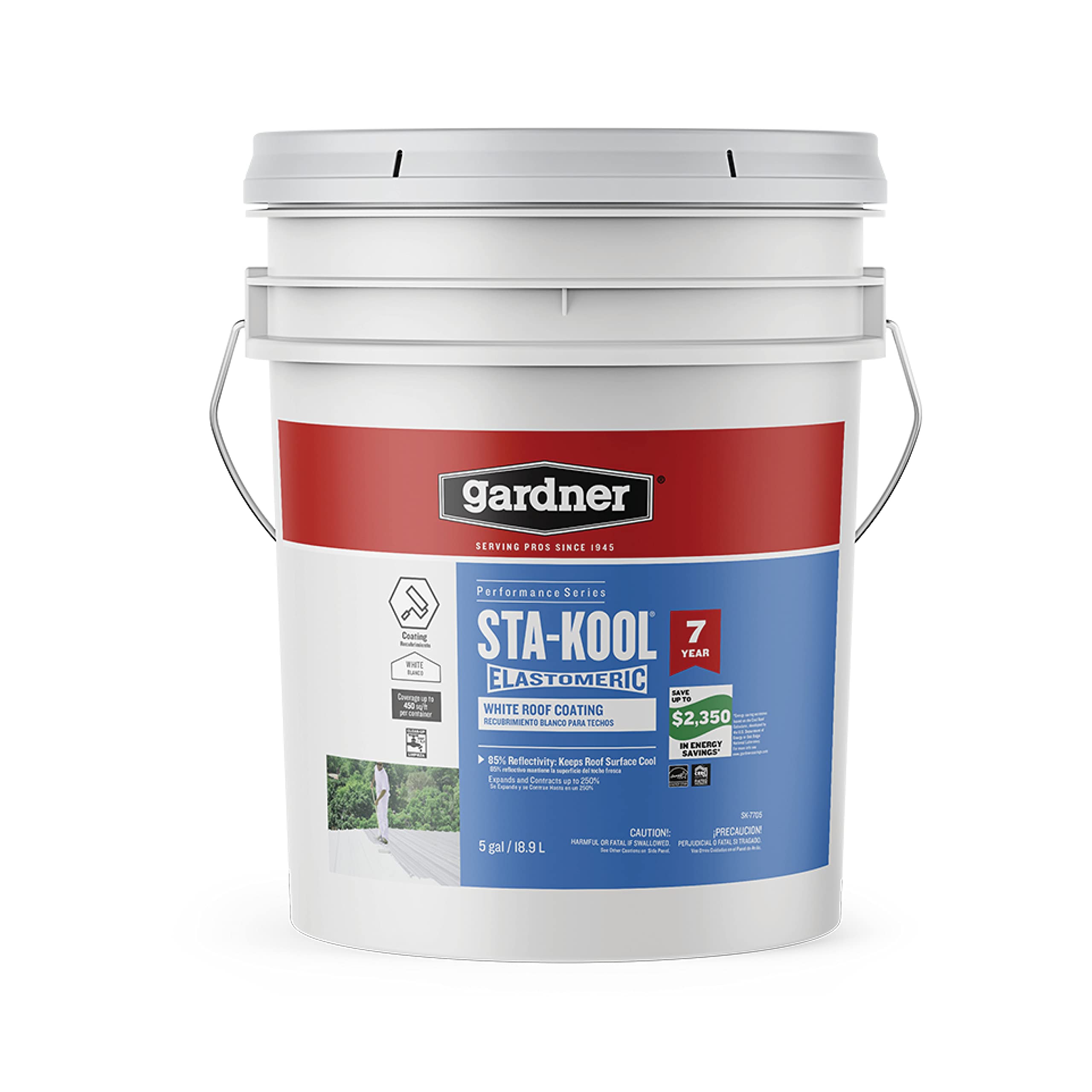
Five gallons for the very large roof, and it dries fast enough to double-coat in one day
For a mobile home or a big commercial roof, this is the large-container pick. Five gallons of traditional acrylic elastomeric coating (a flexible, rubber-like acrylic) covers a lot of area, and it dries in 4 hours — the shortest listed dry time among the five-gallon options, so you can get a second coat down the same day. The finish is a matte white that looks bright and clean on the roof.
The cooling effect is what buyers keep mentioning. Coating a roof in the high desert, reviewers point out the interior staying noticeably cooler and the AC running less, and one said it cooled the place down a little while being a great value. The bucket itself is convenient for large projects with plenty left over for touch-ups later.
Here is the caveat: this is a traditional, relatively thin coating, so it needs two full coats and good rollers, not a quick single pass. Rough, textured roofing eats extra material as it fills the surface, so plan for more than you would expect. One reviewer found it needed two coats even on a straightforward panel roof.
Why it wins on value
- Five gallons for large roofs at a low per-square-foot cost
- Dries in 4 hours, fastest here for a same-day second coat
- Matte white reflective finish that cools the space below
- Bucket holds plenty left over for touch-ups
What to watch
- Goes on thin — budget for two coats and more material on rough roofing
- Needs plenty of rollers to spread evenly across a large surface
Choose this when: you are coating a large, rough mobile home or commercial roof and the total material cost matters most
Pick a thicker product instead: if long-term durability matters more to you than stretching a big bucket across the widest possible area
8. Jetcoat Cool King 5-Year White Reflective Roof Coating, 4.75 gal
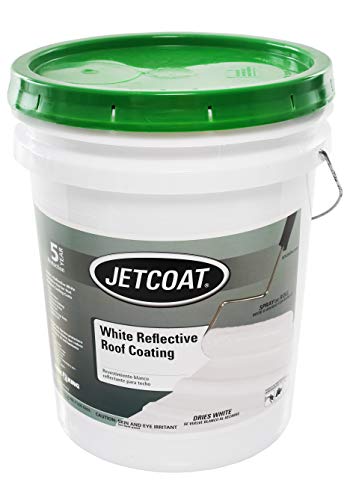
The reflective coating that bonds to genuinely awkward roof materials, from rubber to modified bitumen
Jetcoat Cool King is the answer when your roof is not plain metal. It is a fortified, waterproof elastomeric coating recommended for EPDM rubber, polyurethane foam, APP and SBS modified bitumen, asphalt, mobile home and RV roofs, concrete, and wood — a long compatibility list that covers most problem surfaces. It is not recommended for gravel, dead-level flat, or shingled roofs though, so check yours first.
Coverage is generous at roughly 50-70 square feet per gallon per coat, and the brand recommends two coats for best results. Once dry, the roof is sealed by a rubber-like cooling membrane that prevents leaks, and the finish dries to a clean white reflective surface. It dries to the touch in 2-3 hours, and you need to wait 6-8 hours before the second coat. That said, the durability is a genuine question mark for some owners, as reports of peeling do show up over time.
The case for it: a broad surface-compatibility list means a lot of unusual roofs can be coated without a separate primer, and the 4.75-gallon volume covers a substantial area at 50-70 square feet per coat.
This suits you if: your roof is rubber, foam, or modified bitumen and you want a wide-coverage coating that self-primes on most surfaces
Think twice if: your roof is shingled, gravel-covered, or dead-level flat — Jetcoat says so on the label
Understanding the Specs
Reflectivity and heat
A reflective white coating bounces solar energy instead of absorbing it, which keeps the roof surface cooler and eases the load on your cooling system. The percentage of reflection varies by product — the Gardner Sta-kool, for example, is an 87% reflective finish. The benefit only holds while the coating is clean and intact, so a dusty or peeling layer loses the reflective advantage over time.
Dry time and cure
Two numbers decide your schedule. Dry-to-the-touch time tells you when you can apply the next coat; full cure time tells you when the film has finished setting and is truly sealed. Dicor sets up in 6 hours, Kool Seal lists 24 hours, and Jetcoat dries to the touch in 2-3 hours. Ambient temperature and humidity move these numbers, so follow the label’s minimum application temperature.
Coverage per gallon
Coverage is stated per gallon at the recommended thickness, and it drops sharply on rough or textured surfaces that soak up material. Dicor lists 200 square feet per gallon, Marlin lists about 60 square feet, and Jetcoat lists 50-70 square feet per coat. Buy based on your actual roof area plus a little margin, because running short creates a visible seam line.
Surface compatibility and flexibility
A coating only works on surfaces it can bond to, and the flexibility figure tells you how well it will move with the roof. A film with higher elasticity, like the 350% stretch of Black Jack Elasto-Kool 1000, resists cracking over panels that expand and contract. Applying an acrylic to a rubber or foam surface that the maker did not list is a recipe for peeling.
FAQ
Can I apply acrylic roof coating over existing EPDM rubber roofing?
How many coats of acrylic roof coating do I actually need?
What is the difference between a five-gallon pail and a one-gallon can?
Will a white roof coating really keep my camper cooler inside?
How cold can it be when I apply acrylic roof coating?
Do I need a primer before applying acrylic roof coating?
Which surfaces are acrylic roof coatings not suitable for?
How long does acrylic roof coating take to dry between coats?
Can I use acrylic roof coating to stop an active leak?
Final Thoughts: The Verdict
For most projects, the Gardner Sta-kool Elastomeric Roof Coating is the winner. Its five-gallon volume, 87% reflective finish (it bounces back 87% of the sun’s heat), and silicone-enhanced acrylic formula that expands and contracts with roof movement handle a full mobile home or long metal run in one order. If you want maximum coverage efficiency for a metal RV roof, the Dicor RP-MRC-1 delivers 200 square feet per gallon and cures in 6 hours. For the widest surface compatibility, the Marlin Acrylic Top Coat works across EPDM (a rubber roof membrane), TPO (a plastic roof membrane), foam, concrete, and more. Whichever you choose, clean the surface and apply two coats — prep quality decides how long the coating holds.
How We Picked
We do not accept paid placement. Every pick is matched to a real buyer and a real use-case; we do not hands-on test units.
Sources & Methodology
Specifications: manufacturer listings and product documentation. Review insights: verified customer reviews, as of September 2026. Pricing: not shown on this page (it changes often); check the current price via the retailer link.
As an Amazon Associate, KitchPrep earns from qualifying purchases. This does not affect which products we feature.
Related Guides
