
Specs are compiled from manufacturer listings and verified buyer reviews and can change over time — please confirm the key details on the product page before buying.
If your propane flame flickers when the furnace kicks on, or your generator stumbles under load, the part at fault is usually the regulator — not the tank. A two-stage regulator drops tank pressure twice, in two separate steps, so the gas arriving at your appliances stays at a steady 11-inch water column instead of surging and sagging. This guide covers nine two-stage units that fit home use, from whole-house setups feeding generators and water heaters to compact vertical replacements for a camper van.
I’m Mohammad Maruf — the founder and writer behind KitchPrep. This guide is built by comparing the manufacturers’ published specifications and the patterns across verified customer reviews, so you get each pick’s real strengths and trade-offs instead of marketing spin.
You do not need a plumbing license to understand the difference between a 1/4-inch inlet and a 3/4-inch one, and you should not have to guess which capacity rating matches your appliances. Below, every spec is translated into what it actually does at your tank, so you can pick the right 2-stage propane regulator for home with confidence.
Our Picks at a Glance


How To Choose The Best 2-Stage Propane Regulator for Home
A bad regulator rarely announces itself. Instead, your furnace short-cycles, your generator hunts for fuel, or your range burner runs yellow at the tips. Getting the right one depends on four numbers and one installation detail — and all four are printed on the product label.
Match the BTU rating to everything running at once
BTU per hour is the total fuel demand your regulator can pass through. Add up the ratings on every appliance that could run at the same time — a 400,000 BTU pool heater plus an 8,900-watt generator, for example — and choose a regulator rated comfortably above that total. A regulator sized below your combined load is the most common cause of flame dropout when a second appliance fires up.
Get the thread sizes right before you order
Inlet and outlet sizing is written as a pair, like 1/2-inch x 1/2-inch NPT or 1/4-inch x 3/4-inch FNPT. NPT and FNPT both describe tapered pipe threads. The first number is where gas enters, the second is where it exits toward your appliances. Measure the pipe you are connecting to, not the regulator you are removing — old units are not always built to the same standard.
Understand the water column number
Outlet pressure is measured in inches of water column (WC), which is a very small unit of pressure. Almost all home propane appliances expect roughly 11 inches WC at the inlet. A two-stage regulator holds that number steady even as tank pressure falls from a full tank to a nearly empty one. If your regulator delivers a fluctuating number, your flame height fluctuates with it.
Plan the install before you buy
Check three things: which way the vent faces, whether a mounting bracket is included, and how much clearance you have around the body. Vent orientation is not cosmetic — a vent pointing the wrong direction may need to be returned. Some larger residential bodies cannot be mounted tight against a wall, because you still need room to turn the pipe fitting.
Quick Comparison
| Model | Best For | BTU Capacity | Outlet Pressure | Connections | Amazon |
|---|---|---|---|---|---|
| R622-DFF Propane 2nd Stage Regulator★ Best Overall | Whole-home and generator loads | 1,400,000 BTU | 9″–13″ WC | 3/4″ x 3/4″ FNPT | Amazon |
| GasSaf 5FT Two Stage Propane RegulatorBest Value | Grills, fire pits, and cabin heaters | — | 11″ W.C | QCC1 / Type 1, 3/8″ flare | Amazon |
| Cavagna Kosan 924NBest for RV | RV and trailer dual-tank setups | 160,000 BTU | 11″ WC | Dual cylinder auto changeover | Amazon |
| Camco Vertical Two Stage Regulator | RV and camper van replacements | 160,000 BTU/hr | 11″ WC | 1/4″ x 3/8″ Female NPT | Amazon |
| Marshall Excelsior MEGR-295 | Compact RV replacements | — | — | Integral two-stage | Amazon |
| R622-BCF Propane Second Stage Regulator | Mid-size residential systems | 875,000 BTU | 9″–13″ WC | 1/2″ x 1/2″ NPT | Amazon |
| R632A-CFF Propane 2-Stage Regulator | High-demand residential LP | 950,000 BTU | 9″–13″ WC | 1/4″ x 3/4″ FNPT | Amazon |
| R632A-BCF Integral Two Stage Regulator | Cabin and tiny-house systems | 850,000 BTU/hr | 9″–13″ WC | 1/4″ x 1/2″ NPT | Amazon |
| Marshall Regulator Home Propane Supply Kit | Full tank-to-house installations | 1,000,000 BTU (each stage) | 11″ WC second stage | 1/2″ x 3/4″ outlet | Amazon |
In‑Depth Reviews
1. R622-DFF Propane 2nd Stage Regulator – LP Gas Pressure Control for Tank, 9″-13″ WC, 3/4″ x 3/4″ FNPT, 1,400,000 BTU
Our pick — over 4.5★ from 900+ verified ratings; the strongest balance of quality and price.
The 1,400,000 BTU ceiling that feeds a generator, water heater, and shop heater at the same time.
Here is the number that settles the whole-house question: 1,400,000 BTU. That is the fuel ceiling this unit passes through, and it is the exact reason it can feed a standalone generator, a water heater, and a shop heater simultaneously without the pressure sagging when the second appliance fires. Set against the Cavagna Kosan 924N at 160,000 BTU, this regulator carries a far larger load — the widest capacity spread in this entire lineup.
Your burners get the same pressure whether the tank is fresh or nearly spent, because output holds steady at 9 to 13 inches WC (water column, a measure of gas pressure), the residential standard range. Both connections — inlet and outlet — are 3/4-inch FNPT (tapered pipe thread sized for standard residential gas plumbing). A built-in relief valve and a 3/4-inch screened vent manage overpressure and keep debris out of the vent path. What wins people over is straightforward function: buyers wiring these into 100 lb tank ceiling heaters and standby generators report the appliances start immediately with no regulator adjustment, and owners running a 750 ft line on 5 psi supply describe the generator starting every time after the initial air purge.
The catch is physical. The body is heavy and wide — owners describe it as “pretty large” and warn against mounting it tight to a wall, because you still need clearance to turn it onto the pipe. One owner also had to send a unit back over vent orientation, so check which way the vent faces relative to your outlet before ordering. Weight and mounting room are the trade-offs here, not performance.
What earns its keep
- A 1,400,000 BTU ceiling covers multiple high-draw appliances running at the same time.
- Steady 9″–13″ WC output keeps flame height constant as tank pressure falls.
- Standard 3/4″ x 3/4″ FNPT threading threads onto common residential gas plumbing without adapters.
- Built-in relief valve and a 3/4″ screened vent keep overpressure and debris out of the vent path.
Before you order
- The body is genuinely large — leave working clearance rather than mounting flush to a wall.
- Vent orientation has to match your outlet direction; verify it before you buy.
The fit: whole-home and generator owners who need heavy capacity and standard residential threading in one part.
Think it over if: your install space is tight — the oversized body needs room to be turned onto the pipe.
2. GasSaf 5FT Two Stage Propane Regulator with Hose
A hose-and-regulator kit that restores full burner height on grills and fire pits.
If your fire pit flames barely rise, a single-stage regulator is often the reason. This GasSaf unit regulates in two steps and holds a stated 11″ W.C outlet pressure, which is the number that restores full burner height. Buyers swapping it onto a 110,000 BTU grill report every burner running wide open with no leaks, and fire pit owners describe the flames more than doubling after the change. The solid brass body and all-included 5 ft hose mean it arrives as a single drop-in kit rather than a part plus a shopping list.
Connections are the easy part here. It fits all QCC1 / Type1 tank connections with a 3/8″ Female Flare Nut (5/8″-18UNF nut thread), which is the standard hand-tighten fitting found on most propane tanks. It covers RV appliances, gas generators, grills, stoves, fire pits, propane fireplaces, and water heaters. Excess flow protection is built in, so a sudden line break is restricted rather than left open.
The honest caveat is durability at the connection. Owners describe quality as the strongest point and fit as the next, and the same five feet of hose that makes it convenient for a grill is short for a fire pit that sits away from the tank — one owner needed an extension hose to move it clear of open flames. Materially, it is a brass-and-hose kit built for the price, and the review pages are split on long-term value and leak-free connections rather than unanimous. Buy it as the smart budget fix for a single appliance, not as a permanent whole-house anchor.
Where it shines: brass construction, a genuine two-stage body, and everything you need in one box — no separate hose purchase, no adapter hunt. For the price of a single replacement part you get the regulator and the line to the tank.
The limitation to know: five feet of hose anchors your appliance close to the tank, and the review pages mix steady long-term reports with connection complaints, so run a soapy-water check after installation.
Reach for this if: you are fixing one stubborn grill, fire pit, or cabin wall heater and want the regulator and hose in a single purchase.
Look elsewhere if: you need whole-house capacity or a long run from the tank to the appliance.
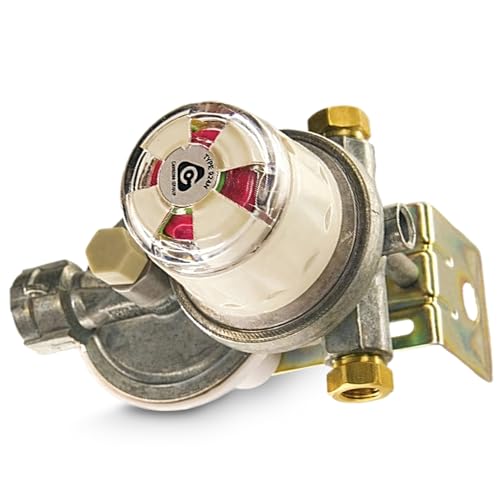
3. Cavagna Kosan 924N RV Propane Regulator for RV Trailer, Auto Changeover Dual Cylinder Setup, 160000 BTU Capacity
Auto changeover draws from the reserve cylinder so the furnace never shuts off during a tank swap.
This regulator solves a problem home units never face: running out of gas mid-trip. It draws automatically from a reserve cylinder through a switching valve for two tanks, so your appliances keep running while you change bottles, and a top-mounted indicator tells you at a glance when a swap is due. Output holds at a steady 11″ WC, and it manages an inlet range of 25-250 PSIG, which covers the tank pressure swings you see across a long trip.
The pre-mounted L bracket is the practical detail — it replaces or upgrades older setups without fabricating a mount, and this is the piece RV owners stock and recommend for the swap. The finish is polished brass, and the whole assembly is rated for outdoor use. Polished brass body rated for outdoor use, so it survives seasons of weather on the tongue of a trailer.
Capacity is the honest limit. At 160,000 BTU it is a fraction of what the R622-DFF above handles, so it belongs on RV appliances — heaters, cooktops, water heaters — not on a whole-home load with a generator tied in. It also expects the correct hoses, which owners flag as the one thing to order alongside it. Take the two minutes to confirm your pigtail ends match before checkout.
Why RV owners choose it
- Auto changeover pulls from the reserve cylinder so nothing shuts off during a tank swap.
- Top-mounted indicator lets you check fuel status without lifting a tank lid.
- Pre-mounted L bracket installs into existing setups without custom fabrication.
- Steady 11″ WC outlet across a 25–250 PSIG inlet range.
Where it stops
- 160,000 BTU suits RV appliances, not a whole-home load with a generator on the same line.
- You have to source and confirm the correct hoses separately.
Best for the road: trailer and motorhome owners who want fuel changeovers handled automatically instead of mid-meal.
Not for the house: if your load includes a generator or multiple large appliances, step up to a higher-capacity unit.
4. Camco Vertical Two Stage Propane Regulator – Compatible with 20 lb or 30 lb Propane Tanks with ACME Threads (59313)
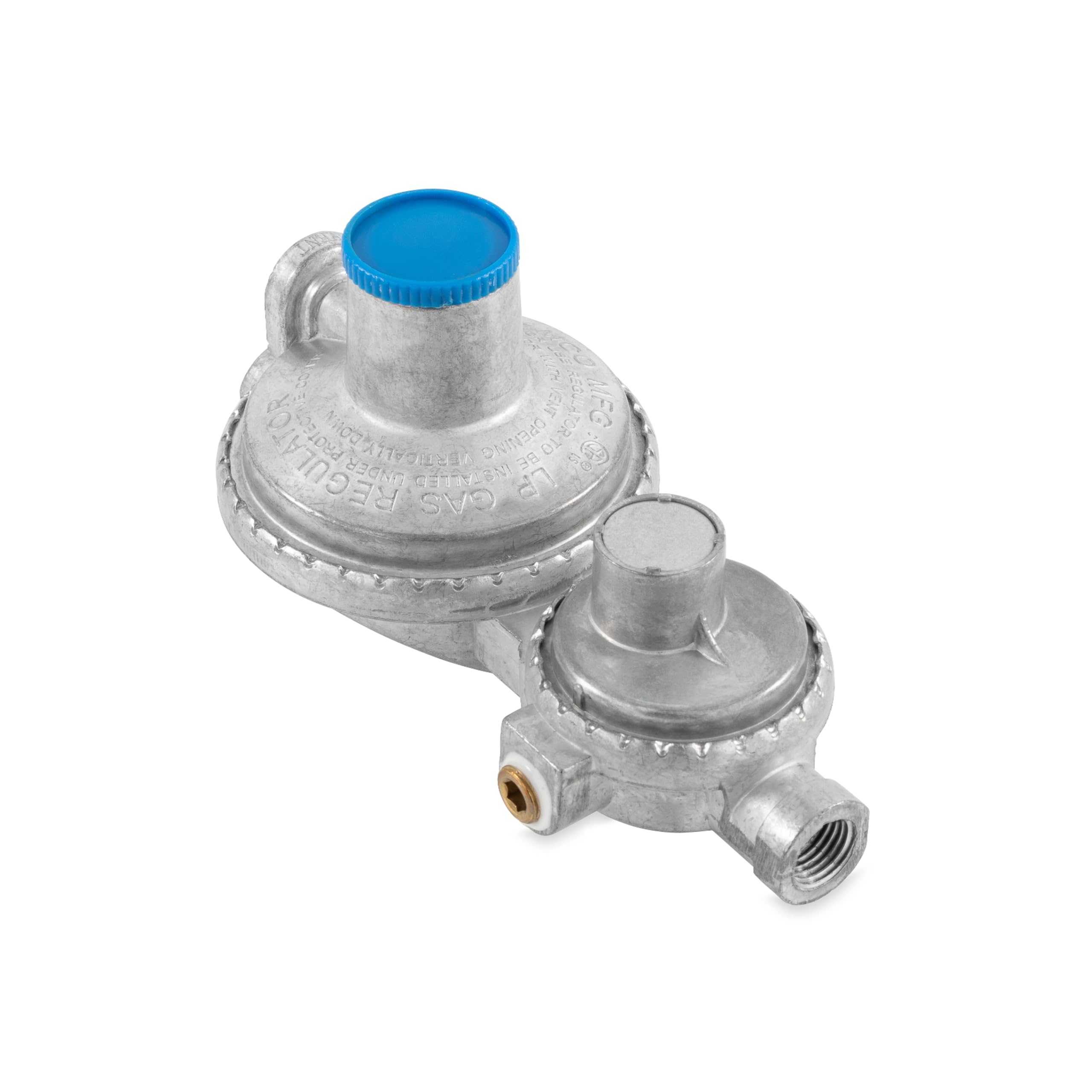
A vertical body sized to drop into tight camper and van bays.
When there is no room for a wide regulator, this is the shape that fits. The vertical orientation saves space against the vehicle wall, and the connections run 1/4-inch Female NPT (National Pipe Thread, a standard thread size) in with a 3/8-inch Female NPT out — sizes that match standard propane pigtails and the Camco 59843 20″ ACME x 1/4″ male NPT hose. It is built to attach to 20 lb or 30 lb tanks with ACME threads, and it holds a consistent 11-inch water column outlet.
Capacity is 160,000 BTU/hr, enough to run several RV appliances at once, and the dual-stage body smooths delivery even when inlet pressure shifts. For a camper van owner who wants a same-size replacement with the same mounting bolt pattern, that compactness is the whole pitch — installs as a straightforward swap.
One thing to weigh honestly: this is the lowest-rated pick in this group. Camco’s own review patterns flag that the valve can intermittently block flow or fail within a year for some units, and those cases typically get resolved through warranty replacement rather than repair. That said, plenty of buyers report trouble-free service for months and years, including van owners who needed a direct replacement and every problem disappearing after the swap. Order with a receipt and keep it — the warranty is real and covers a genuine failure.
The reason to pick it: the vertical footprint and preset, non-adjustable design that eliminates adjustment error — the outlet pressure is factory-set, so there is nothing to tune and no water-in-vent guesswork.
Buy with eyes open: failure within the first year happens for a minority of buyers, and the free-of-charge replacement is the standard remedy, so keep your purchase record on file.
Suits: camper van and teardrop trailers where a compact vertical body must drop into an existing mounting pattern.
Reconsider if: you want the long-service reliability record that the premium picks in this list carry.
5. Marshall Excelsior (MEGR-295) Compact Integral Two-Stage Regulator

The tiny direct replacement that ends flame flutter on an older rig.
If you are chasing the exact part that came on your rig, this is often it. The MEGR-295 is an integral two-stage regulator — both stages in one compact body — weighing just 1.48 pounds. It drops into older setups like the one owner’s ’86 Coachmen, and 2014 Four Winds, and it earns its place as a direct fit for aging motorhomes that need the OEM-style part, since the manufacturer confirmed fit on at least one application.
Owners describe the install as a five-minute job and the result as eliminating flame fluctuation and even the faint propane smell that signaled a tired valve. The threading matches the standard RV propane kit, and the body works with a Mr. Heater universal kit. What earns its keep is function: burners hold steady instead of pulsing, and the pressure stays where it should be across the appliance range.
The caveat worth flagging: a factory brass-to-aluminum joint on some units has leaked propane despite a white thread sealer, which is exactly the kind of joint you would never notice without a soapy-water check. Make that a mandatory step on the first few days after install. The upside is that owners who confirm quality describe it as a solid, value-priced replacement that outperforms the original — a fair trade for the one installation check every LP connection should get anyway.
The draw: a compact 1.48 lb integral two-stage body that fits standard RV mounting points, often making it a bolt-for-bolt replacement without new holes.
The check to run: the factory brass-to-aluminum joint has leaked for some buyers — always bubble-test that connection before trusting it.
The match for: older motorhome and camper owners who want an OEM-dimension replacement that bolts straight into the existing bracket.
Move on if: you want a residential-grade body with the wide internal clearances that handle whole-home fuel demand.
6. R622-BCF Propane Second Stage Regulator – LP Gas Pressure Control for Tank, 9″-13″ WC, 1/2″ x 1/2″ NPT, 875,000 BTU
The mid-size residential body for systems that do not need the giant.
This is the same family as the R622-DFF at the top of the list, sized down for systems that do not need the largest body. Capacity is 875,000 BTU (British Thermal Units, a measure of gas energy) and the connections are 1/2-inch x 1/2-inch NPT — a smaller pipe sizing than the 3/4-inch DF unit, which is the right call if your gas line is already 1/2-inch and you want a drop-in change rather than re-plumbing. Outlet stays in the 9″ to 13″ water column range, so burners see steady pressure through the whole tank drawdown.
Function and quality are the consistent stories owners tell. Buyers describe these as high-quality and solid parts that install easily, and at least one report notes the regulator operating at -38 degrees, which is the kind of temperature performance that matters if your tank sits outside through a hard winter. The internal relief valve and the large 3/4-inch screened vent handle overpressure in the same way as the larger model, protecting downstream appliances.
What this pick gives up is headroom. If you have a generator plus a water heater on the same line, the 875,000 BTU ceiling is real and you should step up to the 1,400,000 BTU DF instead. For a normal residential setup running a heater, grill, and range, 875,000 BTU is plenty and the smaller 1/2-inch threading is easier to fit into existing pipe. That trade is the whole decision.
Where the value sits
- 875,000 BTU handles a typical residential load without oversizing.
- 1/2″ x 1/2″ NPT fittings thread onto existing 1/2-inch gas pipe with no adapters.
- Steady 9″–13″ WC output keeps heater, grill, and burner output consistent.
- Internal relief valve plus 3/4″ screened vent manage overpressure conditions.
The trade-off
- Below the 1,400,000 BTU unit at the top of the list, so a generator plus multiple large appliances on one line may demand the bigger body.
Right for: residential systems already piped in 1/2-inch where 875,000 BTU covers every appliance on the line.
Not enough if: your combined load includes a whole-house generator plus high-draw appliances at once — go larger.
7. R632A-CFF Propane 2-Stage Regulator – Integral Dual Stage LP Gas Tank Regulators, 9″-13″ Water Column Spring, 950,000 BTU

Built for high-demand lines where a compact body falls short.
Home generator owners hit a ceiling fast — the small regulator that ran the grill cannot feed a generator and a furnace at once. This integral two-stage unit is rated to 950,000 BTU per hour with a maximum 250 psig inlet, and it delivers a 9″ to 13″ WC outlet range designed for nominal 11 inches W.C. performance. The connections are 1/4-inch FNPT inlet by 3/4-inch FNPT outlet, a pairing built for setups that need the larger outlet but step down on the tank side.
Owners who install these on whole-house and utility setups describe them as solidly made with static pressure arriving preset — the review pages sum it up: pressure control and build quality are the two things that come up most, with the outlet delivering exactly the right figure from the start. Put it on a home fireplace, a gas range, or a dryer line and the pressure holds steady rather than drifting.
The honest notes are two. First, this is genuinely oversized for a modulating boiler, where a matching size matters — going too large can drop a small appliance to a lower BTU figure than intended. Second, the review data is honest that a few units have shipped with leakage, so inspect threads and run a bubble test on install. Size it correctly to your load and check the factory joint, and this is a premium-grade regulator that behaves like one.
The standout: 950,000 BTU per hour with a 250 psig maximum inlet, on a large metal body designed to hold steady under high flow rather than undersize under a generator load.
Do this first: size it to the actual appliance draw — too large on a modulating appliance can under-deliver, and pressure should be verified on the outlet with a manometer after install.
Worth it for: homes with a generator, large fireplace, or utility appliance on the LP line that need the 3/4-inch outlet and the higher flow ceiling.
Overkill if: your only appliance is a small modulating boiler or a single range — go with a matched-capacity unit.
8. R632A-BCF Integral Two Stage Propane Regulator – LP Gas Pressure Control for Tank, 9″-13″ WC, 1/4″ x 1/2″ NPT, 850,000 BTU
The cabin workhorse that runs a stove, fridge, and water heater.
Off-grid cabins push a regulator hard in a different way than a suburban house — one tank feeding a whole set of appliances on a modest line. This integral two-stage unit is rated to 850,000 BTU/hr, takes up to 250 psig at the inlet, and produces a 9 to 13 inches W.C outlet range. The connection pair is 1/4-inch x 1/2-inch NPT, with a 1st stage 7/16-24 inverted flare vent and a 3/4 NPT screened second-stage vent over the outlet.
Owners describe it powering a serious cabin load — a vintage propane stove and oven, a refrigerator, a water heater, and even propane lights on the same system — plus a smaller version feeding a 24-inch range and a tankless water heater from a 20 lb tank with no adjustments needed. Other cabin owners run two tanks manifolded into the regulator and describe trouble-free operation. It is factory-adjusted, so there is nothing to tune on install.
One real-world detail to plan for: this regulator arrives without a mounting bracket, and owners mention fabricating their own. Physically it is also a heavier body, so think about how you will support it before you climb up to the tank. Buy it if you want a long-service integral body for a cabin or tiny house, and factor in a bracket plus a bubble test on install.
Why cabin owners trust it: 850,000 BTU/hr with a factory-set outlet that runs a stove, fridge, water heater, and lights off one propane supply, no adjustments needed.
Plan ahead for: no mounting bracket in the box, and a body heavy enough that support has to be sorted before you mount it on the tank.
The fit for: cabin and tiny-house builds with a single tank feeding a full set of appliances.
Check first if: your piping runs larger NPT sizing — the connection pair is 1/4-inch x 1/2-inch and adapters may be needed.
9. Marshall Regulator Home Propane Supply Kit LP 1122H-AAJ 1652-CFF 3/4″ Backmount

Two regulators and every fitting for a full tank-to-house build.
This is the only kit here that includes both the first-stage and second-stage regulators. Inside the box: a MEGR-1122H-AAJ high-pressure 10 PSI first stage regulator with a 1/4-inch inlet x 1/2-inch outlet and 1,000,000 BTU capacity, plus a MEGR-1652-CFF low-pressure 11″ water column backmount 90-degree second stage regulator with a 1/2-inch inlet x 3/4-inch outlet and 1,000,000 BTU capacity. You also get a POL x 1/4-inch pigtail to connect the tank to the first stage, a 1/2-inch brass shutoff, and a 1/2-inch iron pipe close nipple.
For anyone doing a full tank-to-appliance installation, having both regulators plus the fittings in one kit removes the guesswork of trying to match a first and second stage separately. Buyers describe it as almost everything needed to hook up a propane tank short of the plumbing lines and pipes, and one owner ran a direct connection from a 500-gallon tank to an off-grid generator using the kit plus hoses and pipe fittings, with the whole setup working smoothly.
The honest note for a DIY buyer is straightforward: this is a real gas-system installation and the kit assumes you know how to work with black iron pipe and thread sealant. If you have not run gas lines before, budget for professional help or take your time with a proper leak test. The upside is a matched, big-capacity regulator pair at a fraction of buying each stage separately, plus the shutoff valve and nipple already included. Both stages plus the pigtail, shutoff, and nipple arrive matched, so a new install needs only the plumbing lines.
What the kit delivers
- Both stages in one box: first stage at 10 PSI and second stage at 11″ WC, each rated 1,000,000 BTU.
- POL x 1/4″ pigtail, 1/2″ brass shutoff, and 1/2″ iron pipe close nipple included.
- Backmount 90-degree second stage simplifies mounting against a wall.
- Complete, matched solution for a new tank-to-house propane installation.
What it assumes
- The kit does not include the plumbing lines or pipes — those are on you.
- It expects the installer to know proper gas-line assembly and leak testing.
Built for: anyone installing a new home propane supply where first and second stage regulators both need to be bought and matched.
Not the pick if: you are simply replacing an existing second stage unit — a single regulator will do, no kit required.
Understanding the Specs
BTU Capacity
BTU per hour is the total fuel volume the regulator can pass through to your appliances. Add up the ratings of everything that could run at once — heater, generator, water heater, stove — and choose a regulator rated above that total, or the last appliance to fire up will starve for fuel. Residential units in this list range from 160,000 BTU for RV setups up to 1,400,000 BTU for whole-home loads.
Water Column Outlet Pressure
Propane appliances expect roughly 11 inches of water column at the inlet, which is a very small unit of pressure measured on a manometer. A two-stage regulator holds that number steady as tank pressure falls from full to nearly empty, so your flame stays consistent. A regulator delivering a shifting number is the reason a burner flickers when another appliance kicks on.
Inlet and Outlet Thread Sizes
Thread sizing is written as a pair, like 3/4″ x 3/4″ FNPT or 1/4″ x 1/2″ NPT. FNPT means female National Pipe Tapered, the standard thread cut into the regulator body, and the two numbers tell you the entry and exit sizes. Match them to your existing pipe, not to the regulator you are replacing, since old units are not always standard.
Relief Valve and Vent
Residential two-stage regulators include a built-in relief valve that releases excess pressure before it reaches your appliances. The vent must face the right direction for the installation and be kept clear of debris and water. Vent orientation is the one detail that sends more regulators back to the retailer than any other, so check it against your outlet direction before ordering.
FAQ
What is the difference between a two-stage and a single-stage propane regulator?
Can I use a two-stage propane regulator for whole-house propane supply?
How do I know which thread size to order?
Does vent orientation on a two-stage regulator matter?
Can I use a two-stage propane regulator for a standby generator?
Why does my propane flame flicker when the furnace kicks on?
Is an auto changeover propane regulator worth it for an RV?
Do two-stage regulators come with the fittings and hoses I need?
How should I leak-test a new two-stage propane regulator installation?
Final Thoughts: The Verdict
For most home setups, the 2-stage propane regulator for home winner is the R622-DFF Propane 2nd Stage Regulator because its 1,400,000 BTU capacity and steady 9″–13″ WC outlet carry the widest appliance load in this lineup on standard 3/4-inch threading. If your demand is smaller or your pipe is already 1/2-inch, the R622-BCF delivers the same steady output at 875,000 BTU. For a full tank-to-house build with both stages matched, the Marshall Home Propane Supply Kit is the one to reach for.
Whichever you choose, size it to your load and bubble-test every joint on install — that combination is what turns a stack of brass fittings into a system you forget about.
How We Picked
We do not accept paid placement. Every pick is matched to a real buyer and a real use-case; we do not hands-on test units.
Sources & Methodology
Specifications: manufacturer listings and product documentation. Review insights: verified customer reviews, as of September 2026. Pricing: not shown on this page (it changes often); check the current price via the retailer link.
As an Amazon Associate, KitchPrep earns from qualifying purchases. This does not affect which products we feature.
Related Guides
