
Specs are compiled from manufacturer listings and verified buyer reviews and can change over time — please confirm the key details on the product page before buying.
The short answer: pure sine wave is the one spec that decides whether your gear runs or whines. A 12V to 120V inverter takes the low-voltage DC power from a car, truck, RV, or solar battery and turns it into the household-style AC power your laptop, fridge, or microwave expects. Get either wrong and you will hear the buzz, see the flicker, or watch the shutdown light come on mid-trip.
I’m Mohammad Maruf — the founder and writer behind KitchPrep. This guide is built by comparing the manufacturers’ published specifications and the patterns across verified customer reviews, so you get each pick’s real strengths and trade-offs instead of marketing spin.
Most buyers overbuy wattage and underbuy waveform, which is backwards. Here is how the picks shake out, and which one deserves your dashboard or your off-grid wall — a practical read on the best 12v to 120v inverter.
Our Picks at a Glance
How To Choose The Best 12V to 120V Inverter
Start with the waveform, not the wattage number on the box. A pure sine wave inverter produces an AC output that matches the smooth curve of grid power. A modified sine wave inverter produces a stepped, choppy version of that curve. The stepped version is cheaper and works fine for simple things like lamps and phone chargers, but it can make motors hum, run hotter, or refuse to start.
Waveform First, Watts Second
If your load list includes a fridge compressor, a microwave, a CPAP machine, or a laptop brick, go pure sine wave. If you are only charging phones, running a fan, or powering a coffee maker in the truck cab, a modified sine wave unit does the job for less. The catch is that motors and sensitive electronics are exactly the loads people buy inverters for, which is why most shoppers end up on the pure sine side.
Continuous Watts vs Surge Watts
Continuous wattage is what the inverter can hold indefinitely. Surge wattage is a short burst it can handle when a motor first kicks on. A fridge or window AC can pull several times its running wattage for a split second at startup. That is why an inverter rated for far more continuous power than your device draws is not overkill — it is headroom for the surge.
Input Voltage and Battery Reality
A 12V to 120V inverter pulls serious current from your battery at full load. Thin cables add resistance, which turns into heat and voltage drop. That is why higher-powered units ship with heavy-gauge battery cables and why hardwiring to the battery beats a cigarette lighter socket once you pass light loads. The lighter socket itself is usually rated well below what the inverter can deliver.
Quick Comparison
| Model | Best For | Waveform | Continuous / Surge Power | Outlets | Amazon |
|---|---|---|---|---|---|
| GIANDEL 1500W Pure Sine Wave★ Best Overall | RV and off-grid whole-appliance duty | Pure Sine Wave | 1500W / 3100W | GFCI AC + USB-C 36W | Amazon |
| BELTTT 2000W Pure Sine WaveTop Performer | Full-time truck and RV installs | Pure Sine Wave | 2000W / 4000W | Dual AC + 20A + USB | Amazon |
| LANDERPOW 2000W Pure Sine WaveMost Versatile | Heavy startup loads like window ACs and tools | Pure Sine Wave | 2000W / 4000W | 3 AC + hardwire + USB-C 30W | Amazon |
| Ampeak 2000W | Quiet overnight camping and cabin use | Modified Sine Wave | 2000W / 4000W | 3 AC + dual USB | Amazon |
| VOLTWORKS 1500W Pure Sine Wave | Hardwiring into a motorhome circuit | Pure Sine Wave | 1500W / — | 3 AC + 2.4A USB | Amazon |
| JARXIOKE 1100W Pure Sine Wave | Wireless remote convenience in car or RV | Pure Sine Wave | 1100W / 2200W | 2 AC + USB-C + USB | Amazon |
| ALLWEI 1000W Pure Sine Wave | Compact in-car charging and small appliances | Pure Sine Wave | 1000W / 2000W | 2 sockets | Amazon |
| YSOLX 1000W | Budget camping and emergency backup | Modified Sine Wave | 800W / 1200W | 3 AC + 2 USB-A USB-C 30W | Amazon |
| OLTEANP 500W | Road trips and light mobile office duty | Modified Sine Wave | 500W / — | 2 AC + USB-C 36W + USB | Amazon |
In‑Depth Reviews
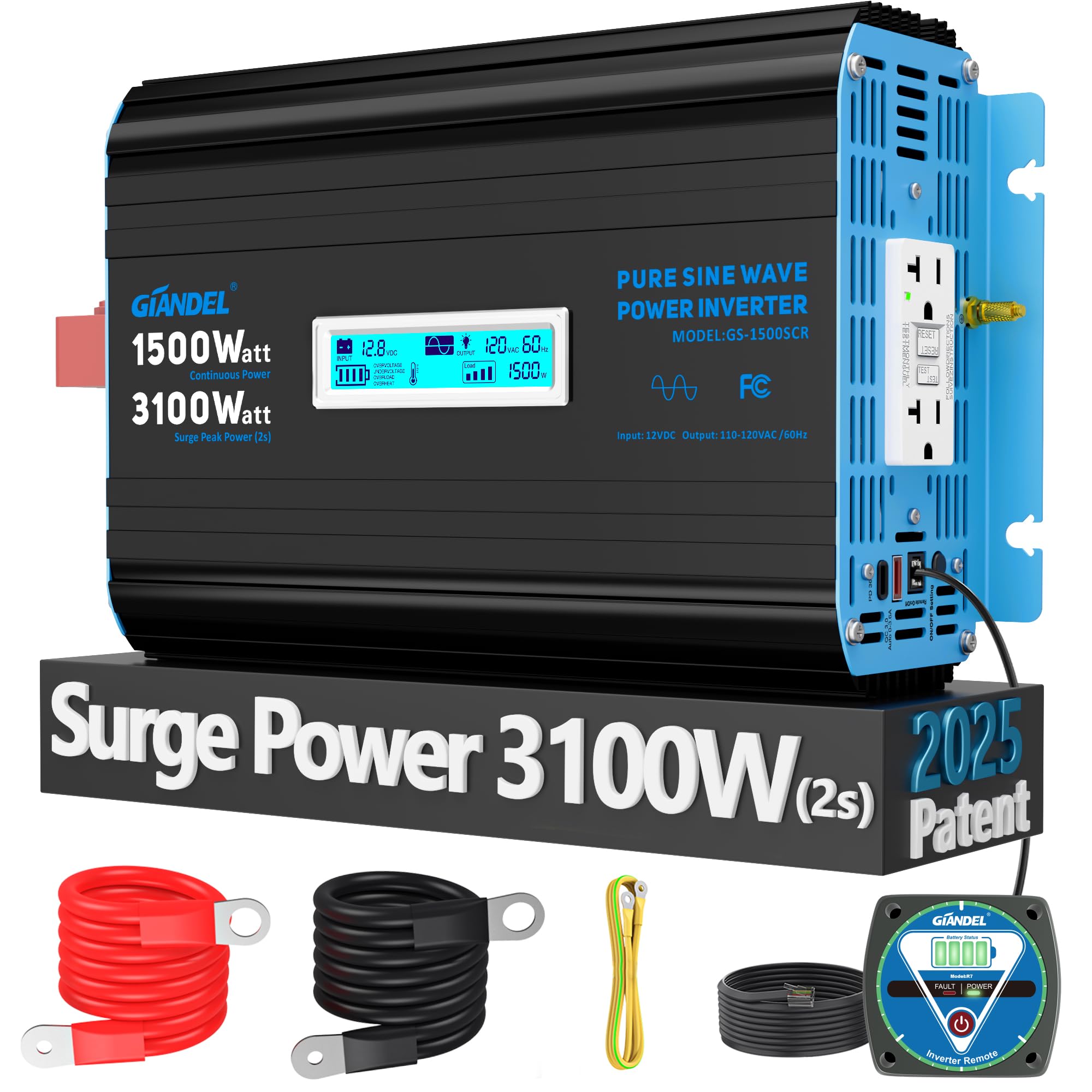
1. GIANDEL 1500 Watt Pure Sine Wave Power Inverter, 12V DC to 120V AC, 3100W Max, GFCI Outlets, USB-C 36W, Dual Remote for RVs, Campers, Off Grid Solar Setup
Our pick — 4.5★ from 750+ verified ratings; the strongest balance of quality and price.
The RV-friendly workhorse that keeps its cool on real appliances — no buzz, no guesswork.
The GIANDEL makes 1500 watts of continuous power and holds a 3100W surge for two seconds, which is the headroom a fridge or air-conditioning compressor needs at the moment it kicks on. Here is the real-world difference that number buys you: a 1000W microwave or a freezer can start up without the shutdown light flashing. That is the gap between an inverter you keep and one you return — and against the OLTEANP 500W below, this is 1500 watts versus 500 watts, so the GIANDEL carries three times the steady load ceiling.
What wins people over is the performance, with the built-in LCD reporting input voltage, output voltage, load wattage, and fault codes right on the face of the unit. The 15ft wired remote lets you switch the inverter on and off and read battery voltage from inside the RV, so you are not crawling into the bay every time. Build quality and the remote both draw steady praise, and power capacity shows up repeatedly in the context of running gas furnaces and RV air conditioners.
The recurring gripe is the power-output ceiling itself. Some owners say it delivers the rated wattage; others report it barely reaches 1200W under heavy draw, so treat the 1500W figure as the honest upper bound and size your loads below it. One owner charging an EV found it overheated and tripped a breaker above 90°F, so extreme heat plus a big continuous load is the combination to avoid. The 13″L x 8.1″W x 4″H body versus the OLTEANP’s 7.87″L x 4″W x 2.28″H is the trade you accept for the extra muscle. This is the best 12v to 120v inverter for anyone powering real appliances, and the pick to beat.
What carries this pick
- 3100W surge for two seconds handles compressor startup
- LCD shows input voltage, output voltage, load wattage, and fault codes
- 15ft wired remote controls on/off and reads battery voltage
- GFCI-protected 20A outlets add ground-fault protection
- Runs on lithium, LiFePO4, lead acid, AGM, and GEL battery types
Where it asks patience
- Some buyers report the steady output peaking below the rated figure
- Charging an EV pushed it into overheating above 90°F
- The 13″L x 8.1″W x 4″H chassis needs real mounting room
Step up if: you run an RV air conditioner, a fridge, or a gas furnace and want one inverter that starts them cleanly.
Hold back if: you only need USB charging and a laptop, where a smaller modified sine wave unit saves money and dash space.
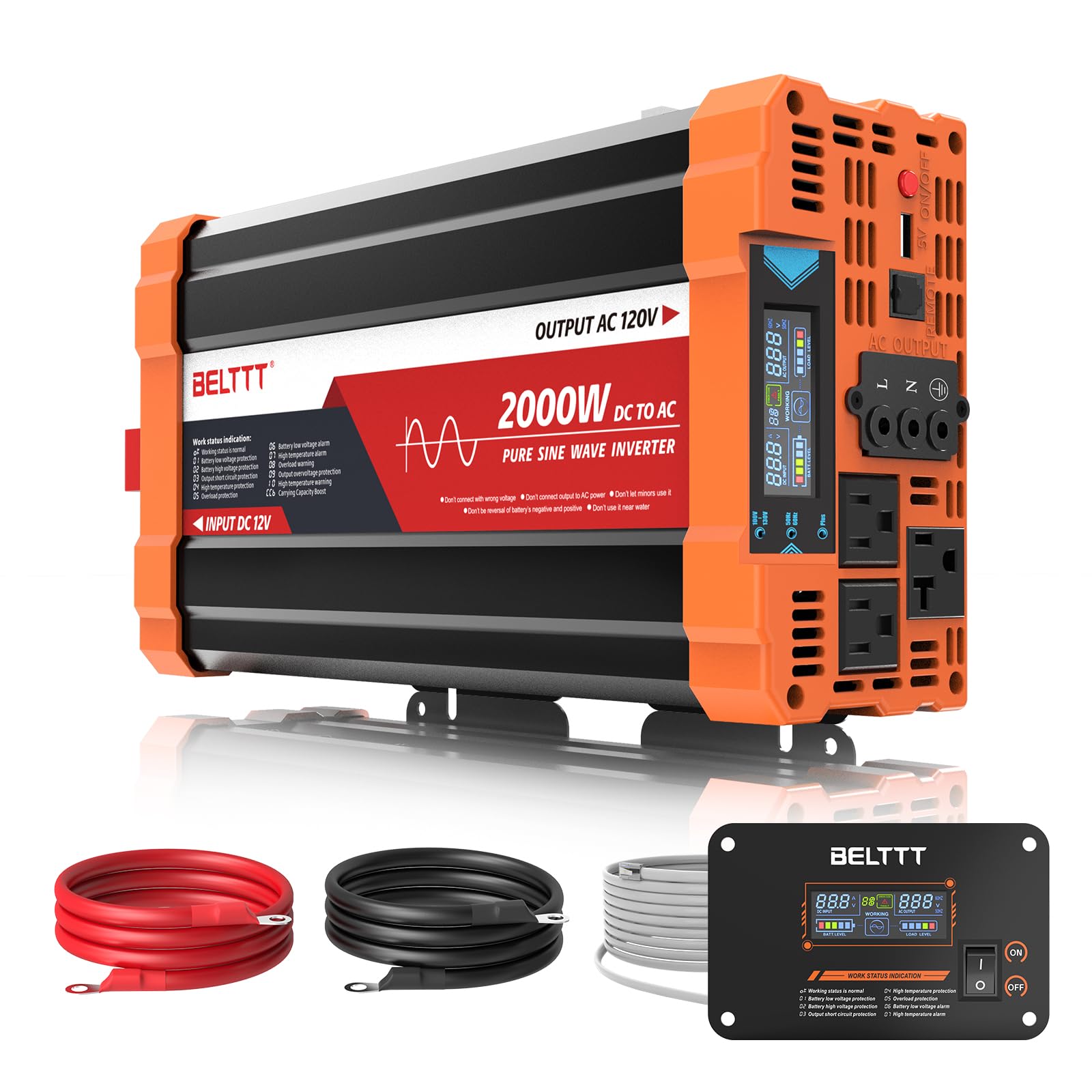
2. BELTTT 2000W Pure Sine Wave Inverter 12V DC to 120V AC, 4000W Surge
Built for the trucker who leaves it running all week and never thinks about it again.
Wooden trucks and full-time RVs are the case for the BELTTT. It delivers 2000 watts continuous with a 4000W surge, It has run five days a week powering a mini-fridge, a 700W microwave, and a TV, with the microwave handled for six-plus minutes at a stretch. A 23ft remote cable is the standout convenience here — long enough to reach from a concealed mounting spot up to the dash. The display shows input and output voltages plus battery and load status at the same time, which is more information than the smaller units above bother to give you.
What earns the most respect here is the build. A dual AC socket setup, a 20A outlet, a 5V2.1A USB port, and a hardwire port cover just about any connection you would need. Conversion efficiency stays above 93 percent at normal working load, which means less of your battery capacity is lost to heat.
The one honest snag is the supplied cables. Some units arrive with 6 AWG cables where 2 AWG was advertised, and thin cables are the fire risk on a 2000W draw — plan to check what you received and upgrade if needed. In a 775W test the crimped lugs ran warm, and soldering them dropped the voltage loss measurably. A few buyers also find the plastic end caps feel less substantial than the metal chassis. None of that changes the verdict: if you want a hardwired, always-on inverter in a vehicle, this is the one to build around.
Fit for full-time power: the 2000W continuous ceiling and 93 percent efficiency suit a truck or RV that runs gear daily rather than occasionally.
Check your cables on arrival: verify the gauge matches the 2 AWG rating before you push it near full load, and solder the lugs if you can.
Reach for it: when you want permanent, hardwired power in a truck sleeper or RV and a long remote cable to control it from the cab.
Look elsewhere: if you plan to only ever plug into a cigarette lighter socket, since this unit deserves a direct battery connection.
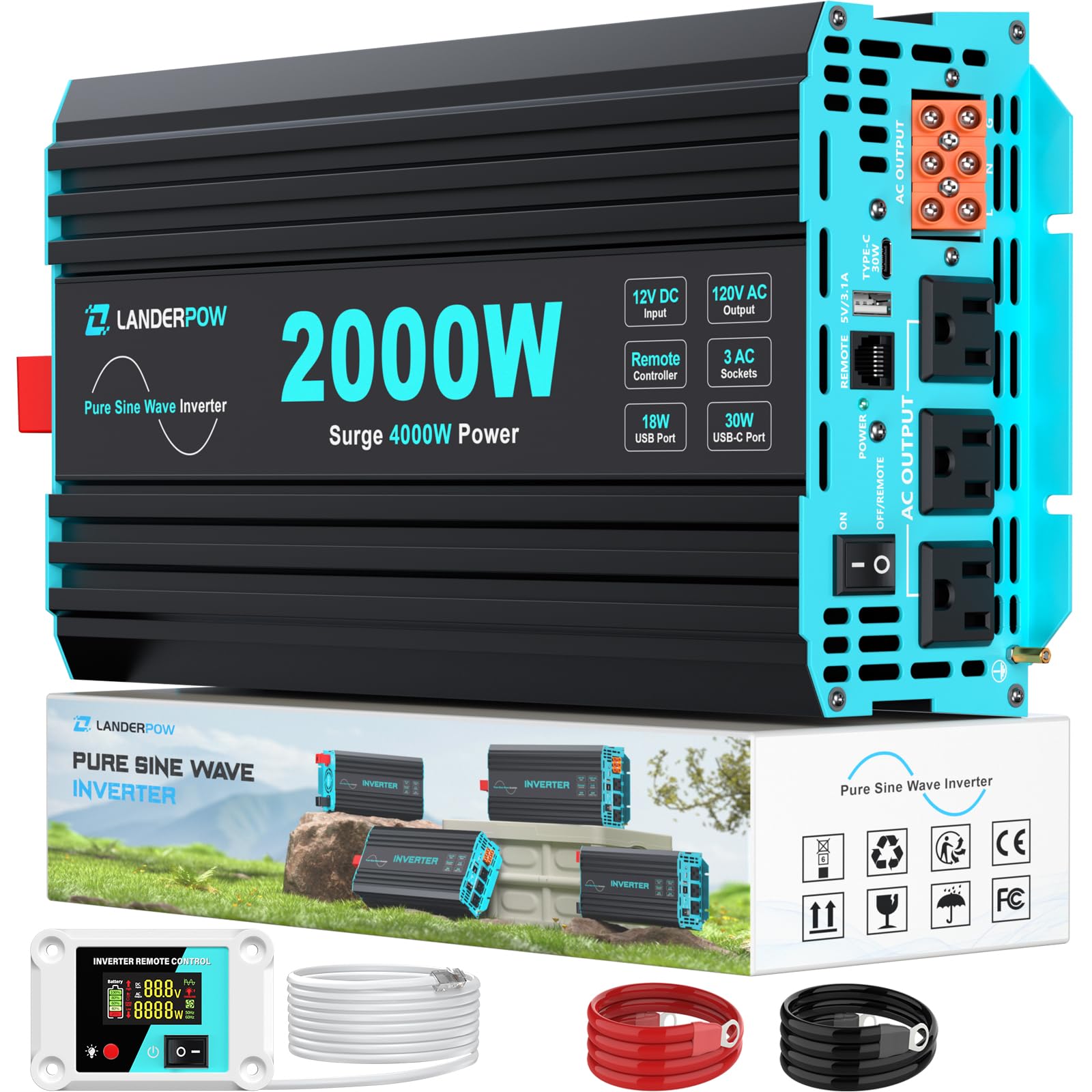
3. LANDERPOW 2000 Watt Inverter, 12V DC to 120V AC Pure Sine Wave 4000W Surge
Three outlets, a hardwire block, and a remote screen that reads like a dashboard.
The LANDERPOW leans hard into flexibility. It puts out 2000 watts continuous and 4000 watts surge at better than 91 percent efficiency, then spreads that power across three AC outlets, a hardwired AC terminal for high-current tools, a 5V/3.1A USB port, and a 30W PD port. That hardwire terminal is the detail that separates it from the GIANDEL and BELTTT — it lets you feed a fixed circuit directly instead of relying on plug-in cords. The 15ft wired remote carries an LED screen that tracks battery level, output, and error codes from wherever you mount it.
What earns the most credit is the quality and the raw power. Owners mention running a 10,000 BTU AC unit without trouble, and the 4000W surge starts window ACs and power tools. Installation is described as simple, and the near-zero idle draw matters for solar setups where every stray amp counts. The full metal shell and 3-year total coverage round out a package that reads as seriously built.
The catch is the cables and the occasional early failure. The supplied cables are too thin for the full 2000W draw — one owner saw heat at 1300W with the included 4AWG wires and had to move up to heavier gauge. A rare unit develops a crackling sound or a reboot loop, and the warranty process can take patience. Pair it with beefy cables and a healthy battery and it holds up: “customers note” it as a strong value, and that matches what the unit is built to do.
Strengths that matter
- 4000W surge starts window ACs and power tools
- Hardwire terminal plus three AC outlets cover fixed and plug-in loads
- Remote LED screen tracks battery level, output, and errors
- 30W PD and 5V/3.1A USB handle quick device charging
- Ships with 2AWG cables and a 3-year coverage window
Plan around these
- Included cables run warm near the full 2000W rating
- An occasional unit shows an early reboot-loop fault
- The 6.3-pound body needs a solid, ventilated mount
Suits you if: you want one inverter that can hardwire into a circuit and still offer spare outlets and a remote screen.
Think twice if: you expect the stock cables to carry the full load — budget for heavier gauge from the start.
4. Ampeak 2000W Power Inverter, Remote Controller, 89% Efficiency, 4000W Surge, 3 AC Outlets, Dual USB, LCD Display, 52dB

The campsite-friendly box that stays library-quiet when the fan finally wakes up.
Overnight camping has a soundtrack problem, and the Ampeak attacks it head-on. It runs at a rated 52dB — roughly the hum level of a quiet room — and its cooling fan only spins when the internal temperature climbs above 122°F. That combination means you are not listening to a whine all night in a tent-trailer or RV bunk. Output sits at 2000 watts continuous and 4000 watts peak, with 89.37 percent conversion efficiency to stretch your battery through the night.
What buyers single out first is reliability and performance. A mobile locksmith runs drills, grinders, a laptop, and lights off one unit daily, and another owner ran an 1800W heat gun, 1500W vacuums, and a 12,000 BTU portable AC on a single 12V 100Ah AGM battery. Three AC outlets and dual 5V/3.1A USB ports cover the charging spread, and the LCD shows input voltage, output power, and fault codes. The orange chassis is genuinely useful when you are searching a dim trunk at night.
The honest trade-off is the waveform. This is a modified sine wave inverter, not pure sine, so it is not the right match for sensitive electronics the way the pure sine picks above are. That is the deliberate cost saving — Ampeak states plainly that it suits the majority of household, workshop, and personal electronics rather than every sensitive load. One owner also notes that any inverter needs a healthy battery to keep working as voltage sags, so a drained starting battery will limit any unit. If noise is your top concern and your loads are laptop-and-appliance basic, this is the quietest path in the lineup.
The quiet play: 52dB operation and a fan that waits for 122°F make this the pick for tents, trailers, and late-night cabins.
Know your waveform: modified sine wave is fine for appliances and tools but not the sensitive-electronics choice, so confirm your loads before buying.
Choose it when: near-silent running matters more than pure sine wave, and you are powering tools, coffee makers, and general appliances.
skip it if: your device list leans on delicate audio gear or medical equipment that wants a grid-identical waveform.
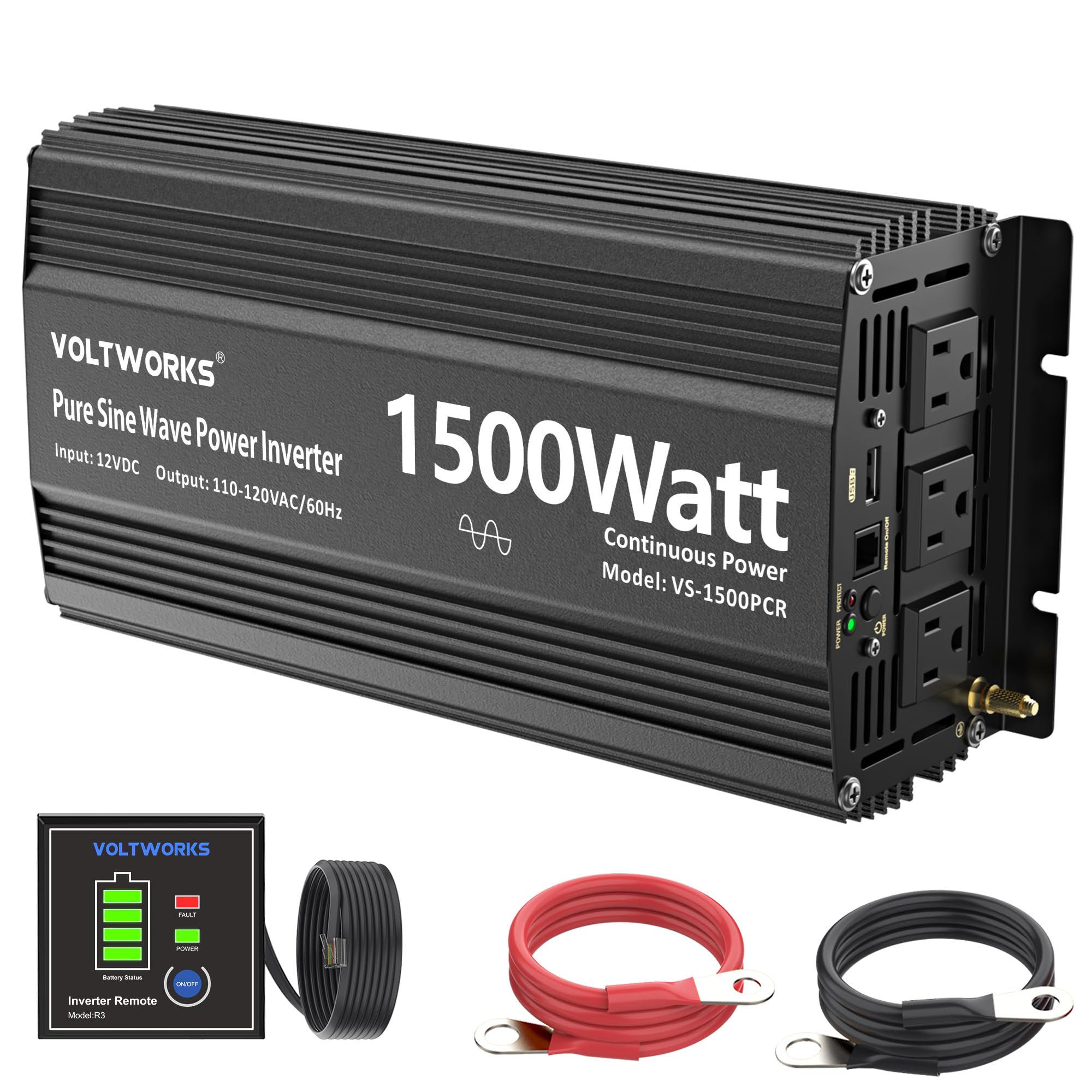
5. VOLTWORKS 1500Watt Pure Sine Wave Inverter 12V to 110V 120V AC
A motorhome favorite with a fuss-free remote and a fan that waits for real heat.
Motorhome builders and off-grid solar users tend to land on the VOLTWORKS. It produces 1500 watts of pure sine wave power to three AC outlets and 2.4A USB ports, and its cooling fan stays off until the temperature reaches 104°F or the load passes 800W. That delayed-fan behavior is why so many owners describe it as quiet — at light loads it simply is not running. The 15ft remote uses an RJ10, 4P4C connector, so cutting and extending the cable yourself is easy if you need a longer run.
What people lean on is performance and build quality. The aluminum housing takes drops and bumps, and the unit holds a 900W load at 120V without strain. It runs a fridge, an Xbox, and a TV simultaneously, and the idle draw is low enough that owners who remember to switch it off between uses see minimal battery drain. The full protection set — short circuit, input over-voltage and under-voltage, output short-circuit, over-load, over-current, and over-temperature — gives you plenty of reasons to trust it on a long trip.
Two things are worth knowing before you wire it in. The unit is floating neutral, meaning it needs a ground-neutral bond to meet code for certain hardwired installs, so plan that step rather than assuming it is plug-and-play. And the battery meter only reports state of charge, which is not useful on a LiFePO4 pack that holds a flat voltage curve — a watt meter tells you more. A rare early failure shows up in the review pages, but most reviewers point out a year of trouble-free service. If you are hardwiring into a Class C motorhome circuit, this is the natural fit.
Why it earns the slot
- Fan stays off until 104°F or an 800W load, so light duty stays silent
- 1500W continuous pure sine wave across three AC outlets
- 15ft RJ10 remote is easy to extend with a longer cable
- Aluminum housing handles drops and vibrations
- Full protection set covers voltage, current, load, and heat faults
Set up for these
- Floating neutral means a ground-neutral bond is needed for some installs
- Battery meter reads state of charge, which is unhelpful on LiFePO4
- A rare unit fails early, though most run for a year or more
Best matched to: motorhome and off-grid owners who want a quiet hardwired inverter with a remote they can extend themselves.
Rethink it if: you want a battery gauge that reads usefully on a lithium pack — a watt meter serves you better here.
6. JARXIOKE 1100 Watt Pure Sine Wave Power Inverter 12V DC to 110V 120V Converter with Type-C, 2 AC Outlets, Dual USB, LCD, Wireless Remote
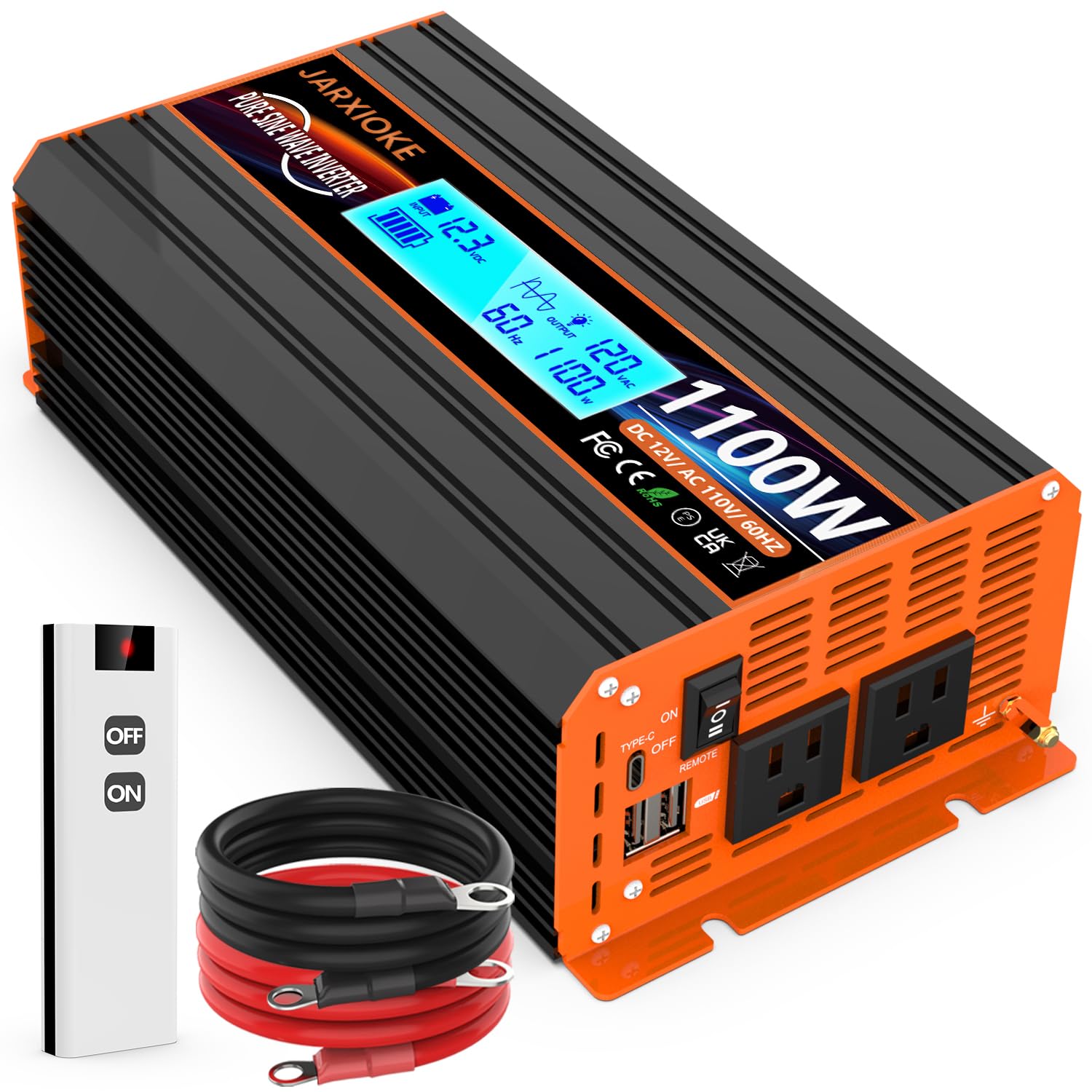
Control it from across the campsite — no cord, no crawling into the bay.
The wireless remote is the reason this JARXIOKE stands apart. It controls the inverter on and off from up to 100 meters away, which is far more range than the wired remotes on the GIANDEL and BELTTT. Output is 1100 watts continuous and 2200 watts peak at better than 90 percent efficiency, delivered through two AC outlets, a USB-C port, and dual USB ports. An isolated input and output design plus soft-start technology smooths the power delivery, and the large aluminum housing takes drops and impacts.
What buyers value here is performance, and it holds up over time — One unit has powered a garage freezer daily on a DIY solar setup, handling the defrost surge better than a prior 1000W inverter and still running cleanly in 105°F heat. Installation is described as simple, the display is easy to read, and the wireless remote gets steady praise for the convenience it adds. The protection set covers over and under voltage, overload, short circuit, overheat, reverse polarity, and a GND leakage safeguard, with product liability carried by AIG.
The main point to note is the fan. It runs in hotter weather above roughly 90°F, and owners call it loud when it kicks in — that is normal cooling behavior, not a defect, but worth knowing if you mount it near where you sleep. There is also a documented quirk in a few units where the output and reliability are inconsistent, so test yours thoroughly inside the return window. As a smaller, lighter pure sine unit than the 2000W picks above, the JARXIOKE fits where dash and cabinet space is tight.
The wireless win: one-tap on/off from up to 100 meters removes the need to leave the driver’s seat or tent to power up.
Plan around the fan: in hot weather the cooling fan runs audibly, so keep it away from sleeping quarters if quiet matters.
Ideal for: car and RV owners who want remote control from a distance and a compact pure sine unit that fits tight spaces.
Not the pick if: you need 2000W-class muscle for window ACs or big tools — that power lives in the larger picks.
7. ALLWEI 1000W Pure Sine Wave Inverter, 12V DC to 120V AC Converter
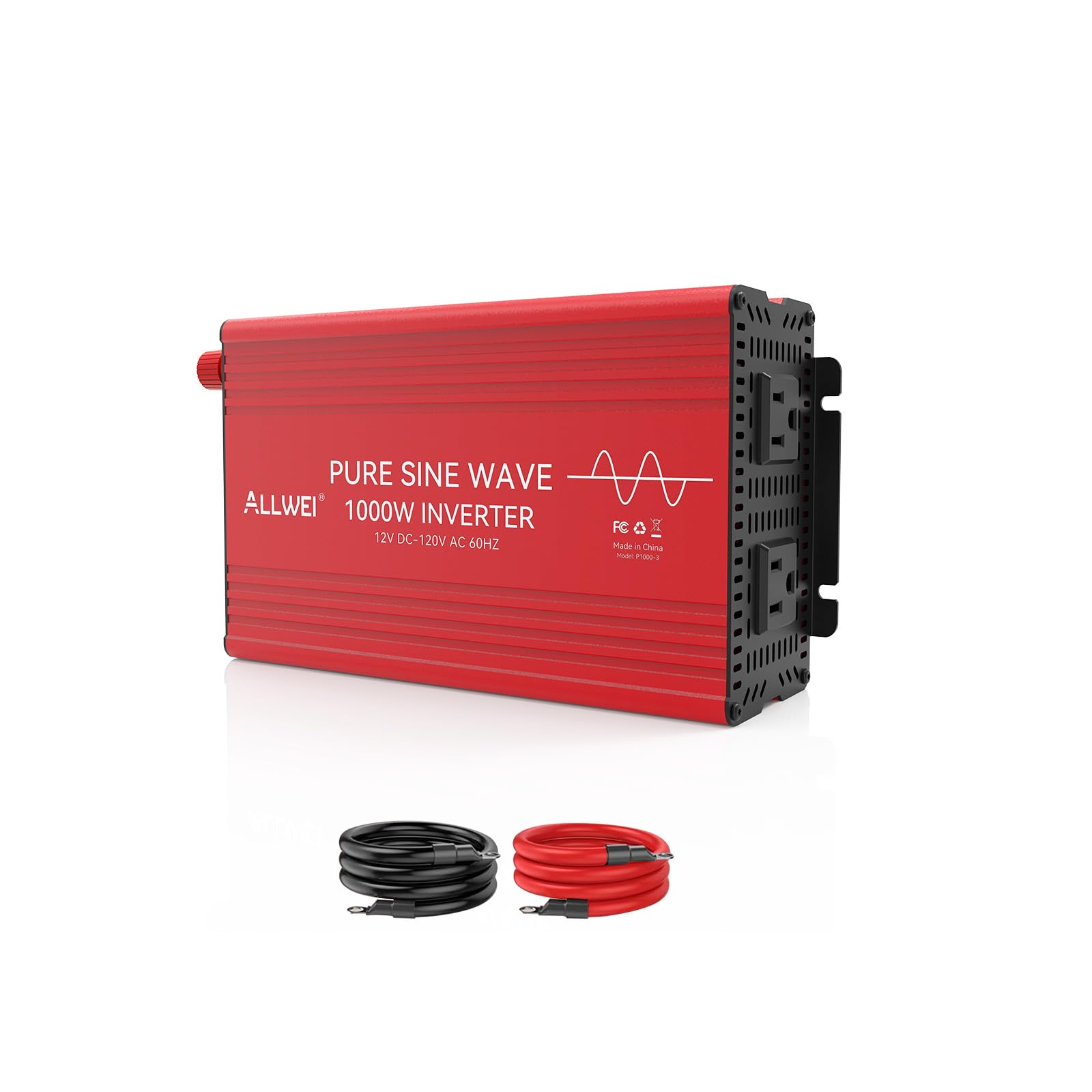
The light, tidy box for charging everyday gear without eating your whole console.
The ALLWEI is the small-space answer. It weighs 10.4 ounces, which is light enough to tuck away without dedicating a shelf, yet pushes 1000 watts continuous and a 2000W peak surge. The pure sine wave output runs better than 90 percent efficiency, so less of your battery is wasted as heat. It is built for 12V batteries — vehicle start, RV auxiliary, or deep-cycle — and it powers small appliances and light loads without the mechanical hum a cheap stepped waveform produces.
What earns the most credit is quality, with charging capability right behind it. Owners appreciate that it handles several devices at once, and the auto circuit protection is a genuine highlight: it runs multiple USB devices plus a high-amp 110V load without blowing the vehicle fuse, protecting the circuit before the fuse gives out and resetting automatically after an overload. The aluminum housing and the 14°F to 104°F operating range let it work through a wide spread of weather, and the 8-fold protection set covers low and high voltage, over and under temperature, overload, over-current, reverse polarity, and short circuit.
Be realistic about the ceiling. This is a 1000W unit, so it is not the answer for a window AC or a big inductive load — that is the GIANDEL and BELTTT territory. Some shoppers say the output not quite matching the advertised figure, so keep an eye on your heaviest device. For charging laptops, phones, small fans, and similar loads, though, the ALLWEI covers the job at a size that disappears into a glovebox or carry bag.
Right for: charging phones, laptops, and small appliances in a car or small camper where a light, low-profile unit is what you want.
Overkill would be wrong here: leave it on the shelf if you plan to run air conditioning or heavy tools — move up to the 1500W-and-above picks.
8. YSOLX 1000W Power Inverter 12V to 110V/120V for RV Camping

Three outlets and dual lighter ports for the price of a filling-station lunch run.
Campers and emergency-backup buyers who want outlets without the premium price walk into the YSOLX. It converts 12V DC to 110V/120V AC and, despite the 1000W name, delivers 800 watts of continuous power with a 1200W peak. It weighs just 1.5 pounds and spreads that power across three AC outlets, two USB-A ports, a 30W USB-C PD port, and dual 12V cigarette lighter sockets. The flame-retardant casing and LED voltage display round out a package aimed at basic road-trip and storm-season power.
The mix of ports is the selling point. Three AC outlets plus two cigarette lighter sockets let you charge a laptop, run a fan, and top up phones all at once — unusual flexibility at this tier. The silent cooling fan kicks on at 42°C and shuts down at 38°C, and the LED display shows real-time battery voltage. One owner ran it for a year on a 200-battery setup, powering three fans, three phones, and lamps for 24+ hours at a stretch. It is also impressively quiet in use, with a low wind-up noise at switch-on rather than constant fan drone.
The honest picture is mixed reliability. Some units run for years; others stop working after fewer than ten uses, and one desktop PC would not boot properly on it. Treat the YSOLX as an occasional-use unit rather than a constant primary power source, and remember the 1000W figure is a peak rating — the running ceiling is 800W. For a budget camping and backup inverter that gets you outlets and USB charging cheaply, it delivers the basics well.
Ports for the money: three AC outlets, two USB-A, a 30W USB-C PD, and dual cigarette lighter sockets give remarkable spread at this tier.
Mind the real ceiling: continuous output is 800W even though the name says 1000W, so keep heavy inductive loads off it.
Grab it for: budget road trips, camping, and storm-season backup where you want lots of outlet types without spending much.
Leave it for: constant, all-day power duty — this is an occasional-use inverter, not a permanent install.
9. OLTEANP 500W Power Inverter 12V DC to 110V/120V AC Car Converter for Vehicles

The truck-cab charger that turns a lighter socket into a wall outlet for a laptop.
Road trips and mobile offices are what the OLTEANP is built for. It puts out 500 watts of continuous power and turns a 12V vehicle battery into 110V/120V household-style AC, which is enough for laptops, tablets, small TVs, and game consoles on the move. The compact 7.87″L x 4″W x 2.28″H body tucks into a console, and the LCD reports input voltage, output voltage, and battery status in real time, with codes like OL, HI, LO, and OH for overload, high voltage, low voltage, and overheat. Two AC outlets plus a 36W USB-C fast-charge port and a 5V/3A USB port cover a typical family’s devices.
What buyers praise most is the performance and the display. The LCD showing both battery inputs and voltage output is repeatedly called out as handy, and the build is described as sturdy with an intelligent fan that adjusts to internal temperature. Ice-cool detail: owners have powered a laptop, a phone, and small tools on trips and found the multi-device charging genuinely convenient. That is the everyday strength — it does the small-electronics job well without a fuss.
Two limits are worth flagging. The vehicle cigarette lighter socket only supports up to 150W, so anything from 150W to 500W needs a direct battery connection with the included clips, and forgetting that trips the socket fuse. And this is a modified sine wave inverter — the maker advises against refrigerators, microwaves, air conditioners, laser printers, and sensitive medical devices, so it is not the pick for those loads. One off-grid owner also found the screen readings inaccurate on his unit, so treat it as a light-duty road-trip gadget rather than a whole-home backup.
Good to have
- LCD shows input voltage, output voltage, and battery status live
- Two AC outlets plus 36W USB-C and 5V/3A USB ports
- Compact 7.87″L x 4″W x 2.28″H body fits a console
- Intelligent fan adjusts to internal temperature
- Protection set covers under, over, overload, short circuit, and heat
Know before you wire it
- Cigarette socket carries only up to 150W; higher loads need battery clips
- Modified sine wave is unsuitable for fridges, microwaves, and sensitive gear
- An occasional unit shows inaccurate battery readings
Suits the family road trip: when you need laptop and device charging from the lighter socket with a live voltage readout.
Step past it for: anything over 150W through the socket, or any load that needs a clean sine wave.
Understanding the Specs
Waveform: Pure vs Modified Sine Wave
Pure sine wave output mirrors the smooth curve of household grid power, which is why it runs motors, audio gear, and sensitive electronics without hum or flicker. Modified sine wave output is a stepped approximation — cheaper to make and fine for simple loads like lamps and chargers, but it can make motors run warm and cause some devices to misbehave. If your load list includes a fridge, microwave, CPAP, or anything with a motor or fine electronics, pure sine wave is the spec that matters most. If you are only charging phones and running a fan, a modified sine wave unit can be the value choice.
Continuous Watts vs Surge Watts
Continuous wattage is the load an inverter can hold for as long as you need it. Surge or peak wattage is a brief burst it can supply when a motor or compressor first starts. That startup spike can be several times the running draw, which is why headroom matters. An inverter with a 4000W peak can start a window AC that a lower-surge unit cannot, even if the steady running draw is identical. When you choose, look at your heaviest device’s continuous draw and give the inverter surge room above it.
Input Voltage and Battery Cables
A 12V to 120V inverter pulls a lot of current from the battery at high load, and thin cables add resistance that turns into heat and voltage drop. That is why the more powerful units ship with heavy-gauge battery cables, and why a hardwired connection to the battery beats a cigarette lighter socket once you pass light loads. The lighter socket itself is usually rated well below the inverter’s capacity, so respect that limit or you will trip the vehicle fuse.
Display, Remote, and Cooling
A real-time display showing input voltage, output voltage, load wattage, and fault codes lets you troubleshoot fast — the OL codes, HI/LO voltage flags, and overheat warnings tell you what is wrong before you guess. A wired or wireless remote lets you control the inverter and read battery voltage without reaching the unit. Cooling fans keep the electronics safe under load, but they run louder in hotter weather, so mount the inverter away from where you sleep if quiet matters.
FAQ
Can I run a refrigerator from a 12V to 120V inverter?
What is the difference between pure sine wave and modified sine wave?
Can I plug my inverter into the cigarette lighter socket?
How do I size an inverter for my RV air conditioner?
Will an inverter drain my battery when it is turned off?
Do I need to ground my inverter?
Is a 2000W inverter the right size for power tools?
Why does my inverter fan run so loud?
Can I charge a laptop or phone from a modified sine wave inverter?
How much battery capacity does an inverter need for long runtime?
Can I hardwire an inverter into my camper’s AC circuit?
Final Thoughts: The Verdict
If you want one inverter that starts real appliances cleanly without buzz or guesswork, the GIANDEL 1500W Pure Sine Wave is the pick to beat — 1500W continuous, a 3100W surge for two seconds, and GFCI-protected outlets, all controlled from a 15ft wired remote. It holds 4.5 stars across 700+ ratings, with reviewers praising its performance running RV appliances. Want permanent, always-on power in a truck or RV? The BELTTT 2000W brings 2000W continuous and a 23ft remote. And for budget camping and backup trips where you just want outlets and quiet running, the YSOLX 1000W carries three AC outlets and dual lighter ports on a 1.5-pound body. Match your waveform and wattage to your heaviest load, and any of these will keep you powered.
How We Picked
We do not accept paid placement. Every pick is matched to a real buyer and a real use-case; we do not hands-on test units.
Sources & Methodology
Specifications: manufacturer listings and product documentation. Review insights: verified customer reviews, as of September 2026. Pricing: not shown on this page (it changes often); check the current price via the retailer link.
As an Amazon Associate, KitchPrep earns from qualifying purchases. This does not affect which products we feature.
Related Guides
