
Specs are compiled from manufacturer listings and verified buyer reviews and can change over time — please confirm the key details on the product page before buying.
You grab your first aid kit in a hurry, and the bandages are loose in a plastic tray that spills everywhere. The kits worth owning get three things right: supplies that won’t expire on you, a case you can find things in one-handed, and a size that fits where you’ll really keep it — a glove box, a kitchen drawer, a backpack. This guide covers nine kits that get those basics right.
I’m Mohammad Maruf — the founder and writer behind KitchPrep. This guide is built by comparing the manufacturers’ published specifications and the patterns across verified customer reviews, so you get each pick’s real strengths and trade-offs instead of marketing spin.
You’ll see what each kit actually holds, which cases survive a car trunk, and where the cheap trays fall apart. Below is the shortlist for the 1st aid kit that fits your home, car, or travel bag.
Our Picks at a Glance

How To Choose The Best 1st Aid Kit
You won’t upgrade a first aid kit every year, so the wrong pick sits in your closet for a decade. To get it right, match the case to where you’ll store it and check that the supplies inside are the ones you’ll actually reach for.
Piece Count vs. Useful Supplies
A “300-piece” kit sounds better than a “130-piece” kit, but piece counts include every adhesive strip, wipe, and packet — a thousand tiny bandages still leaves you short on gauze. Read the item list, not the headline number. Kits that spread their contents across bandages, gauze, antiseptic wipes, dressings, and tools tend to cover more real injuries than ones that pad the count with adhesive strips alone.
Case Material Decides Where It Lives
A soft-sided zippered pouch squashes into a glove box or backpack side pocket. A hard EVA shell (a molded foam-like outer case) or rigid plastic case holds its shape, keeps supplies from crushing, and sits flat in a cupboard or trunk. The trade is bulk — hard cases take up more room and weigh more. Pick the case for your storage spot first, then compare contents.
Refillable Beats Disposable
Bandages, wipes, and ointments all carry expiration dates, and the medications in a kit go off fastest. A kit with extra space and removable compartments lets you restock the pieces you burn through instead of replacing the whole thing. Kits that seal shut with glued trays usually can’t be refilled cleanly.
Quick Comparison
| Model | Best For | Case Type | Piece Count | Weight | Amazon |
|---|---|---|---|---|---|
| First Aid Only 298 Piece All-Purpose Emergency Kit★ Best Overall | Home, car, dorm, and camping | Soft nylon zippered pouch | 298 | 1 lb | Amazon |
| Be Smart Get Prepared 330 Pc First Aid KitBest Value | Glove box and college dorm | Soft bag with clip | 330 | 1 lb | Amazon |
| 300 Piece Professional First Aid Kit, Navy BlueBest Organizer | Cupboard or car trunk | Rigid plastic case with latches | 300 | 1.54 lb | Amazon |
| RHINO RESCUE EVA First Aid Kit | Cycling, hiking, and waterside | Water-resistant EVA shell | 130 | 1.36 lb | Amazon |
| Gevoke 410 Piece Hard Shell First Aid Kit | RV, boat, and Jeep storage | Waterproof EVA hard shell | 410 | 2 lb | Amazon |
| Besst Survivor Premium First Aid Kit | Hiking, moto riding, and disaster prep | Waterproof 600D polyester MOLLE bag | 221 | 1.5 lb | Amazon |
| KeepGoing Travel First Aid Kit | Flights, suitcases, and road trips | Stain- and water-resistant hard case | — | 10.55 oz | Amazon |
| Gevoke Professional 500 Piece Emergency Kit | Homes and small businesses | Waterproof 1680D polyester bag | 500 | 3.92 lb | Amazon |
| KeepGoing Large Home First Aid Kit for Kids | Families with young children | Water-resistant zippered binder case | 270 | 1.96 lb | Amazon |
In‑Depth Reviews
1. First Aid Only 298 Piece All-Purpose Emergency First Aid Kit
Our pick — over 4.5★ from 77,500+ verified ratings; the strongest balance of quality and price.
The one kit that lives happily in a glove box, a dorm drawer, and a tornado go-bag at the same time.
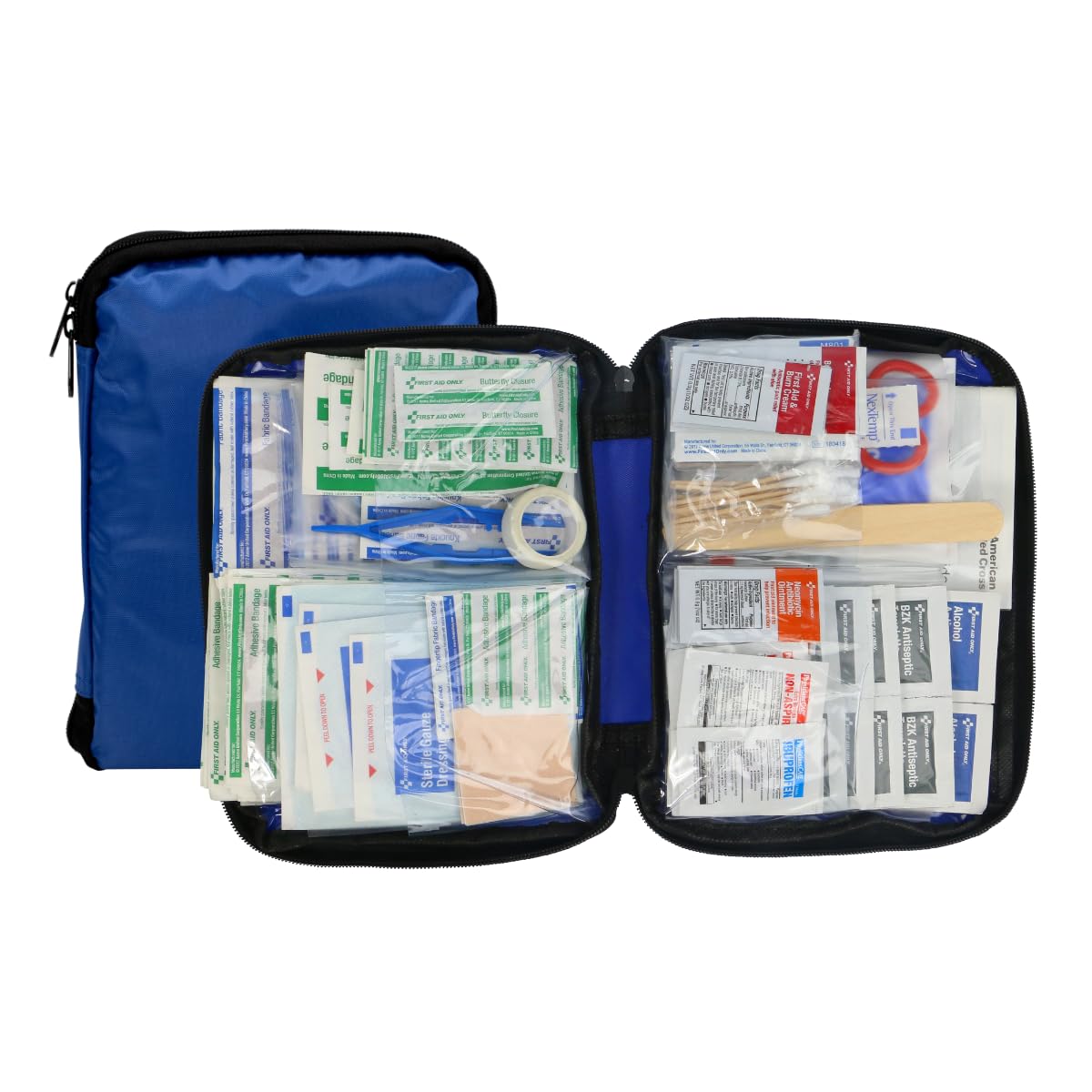
This is the crowd favorite for a reason: a soft-sided zippered case measuring 9.25 x 3 x 7 inches, packed with 298 pieces that cover the whole arc of small household injuries. You get adhesive fabric and plastic bandages, antibiotic ointments, BZK antiseptic towelettes, burn cream packets, a gauze roll and pads, wound closures, and a cold pack. The strap on the back of the case compresses it flat enough to slide into a backpack sleeve.
What wins people over is the quality of what’s inside — the supplies hold up instead of fraying on contact, and the case itself survives being stuffed under a seat for years. The two separate layers with individual compartments and clear plastic pockets are the real design win here. You can open it one-handed and spot the gauze without unpacking the whole thing, which matters more than any piece count when someone is bleeding.
The trade-off is the tweezers. They’re plastic, and a few buyers swap them for a metal pair. It’s the one part of this kit that feels entry-level against everything else. The medications inside also carry an expiration date, so plan to replace them yearly rather than assuming the kit is a one-time purchase. For cuts, scrapes, and burns, it just works. For a kit you’ll keep for a decade, that reliability is the whole pitch.
What makes it the default pick
- 298 pieces cover bandages, gauze, antiseptics, burn cream, and wound closures in one soft pouch
- Two-layer interior with clear pockets means you find supplies without unpacking
- Fits a glove box, drawer, backpack, or suitcase at 9.25 x 3 x 7 inches
- Water-resistant fabric bag holds up to trunk storage and being shoved in a go-bag
Where it falls short
- The included tweezers are plastic — a metal upgrade is worth the swap
- Medications expire and need annual replacing
- The case isn’t fully waterproof, so it doesn’t want to sit out in the rain
Buy this if: you want one kit that works equally well in a kitchen drawer, a car trunk, and a travel bag — 4.8 stars across 77,000+ ratings backs that pick.
Pass if: you need a fully sealed waterproof case, which this soft-sided pouch isn’t.
2. Be Smart Get Prepared 330 Pc First Aid Kit
A clip-on bag built for the glove box — but check the length before you assume it fits there.
If your first aid kit has to live in a car, this one targets that job directly. The soft bag measures 4 x 8 x 10 inches and carries 330 pieces, and the included strong clip lets you hang it off a headrest strap, a backpack loop, or a stroller bar. Buyers report the kit’s compartment layout makes it a solid fit for a college dorm or a car’s glove box. It’s the smallest-thought-out kit in this lineup for pure grab-and-go storage.
This kit earns its spot on value: you get 330 pieces, an interior sorted into clean, treat, and protect groupings, and long-dated supplies, all in a rugged bag that takes a beating. The bag is roomier in length than the First Aid Only 298-piece pouch — 10 inches to 7 inches — so it won’t nestle into a small drawer the same way. That extra length means more supplies and more room to dig around.
The honest catch is that the soft bag won’t stand up on its own like a rigid case. The bag itself doesn’t stand up like a rigid case, so if you’re packing for a hiking trip rather than a car console, the plastic tweezers and the floppy bag shape will frustrate you. For a car, a dorm room, or a boat, the clip and compartment layout work as intended. The clip holds, the 330 pieces match the listing, and it’s an easy buy to recommend.
What actually matters here: 330 pieces, a clip, and a compartment layout split into clean/treat/protect groupings is the value proposition. Nothing flashy — just a lot of kit for the category.
The catch, sized fairly: the bag is longer (10 inches) than a compact pouch kit, and it isn’t rigid, so it doesn’t hold its shape in a bag the way a hard case does.
Best for: the car console, dorm room, or boat where you want a well-sorted bag clipped within reach.
Think twice if: you need a rigid case that stands on its own, or a compact kit that fits a small drawer — this bag leans long.
3. 300 Piece Professional First Aid Kit, Navy Blue
A latched plastic case that stands on a shelf, opens flat, and keeps bandages off the floor.
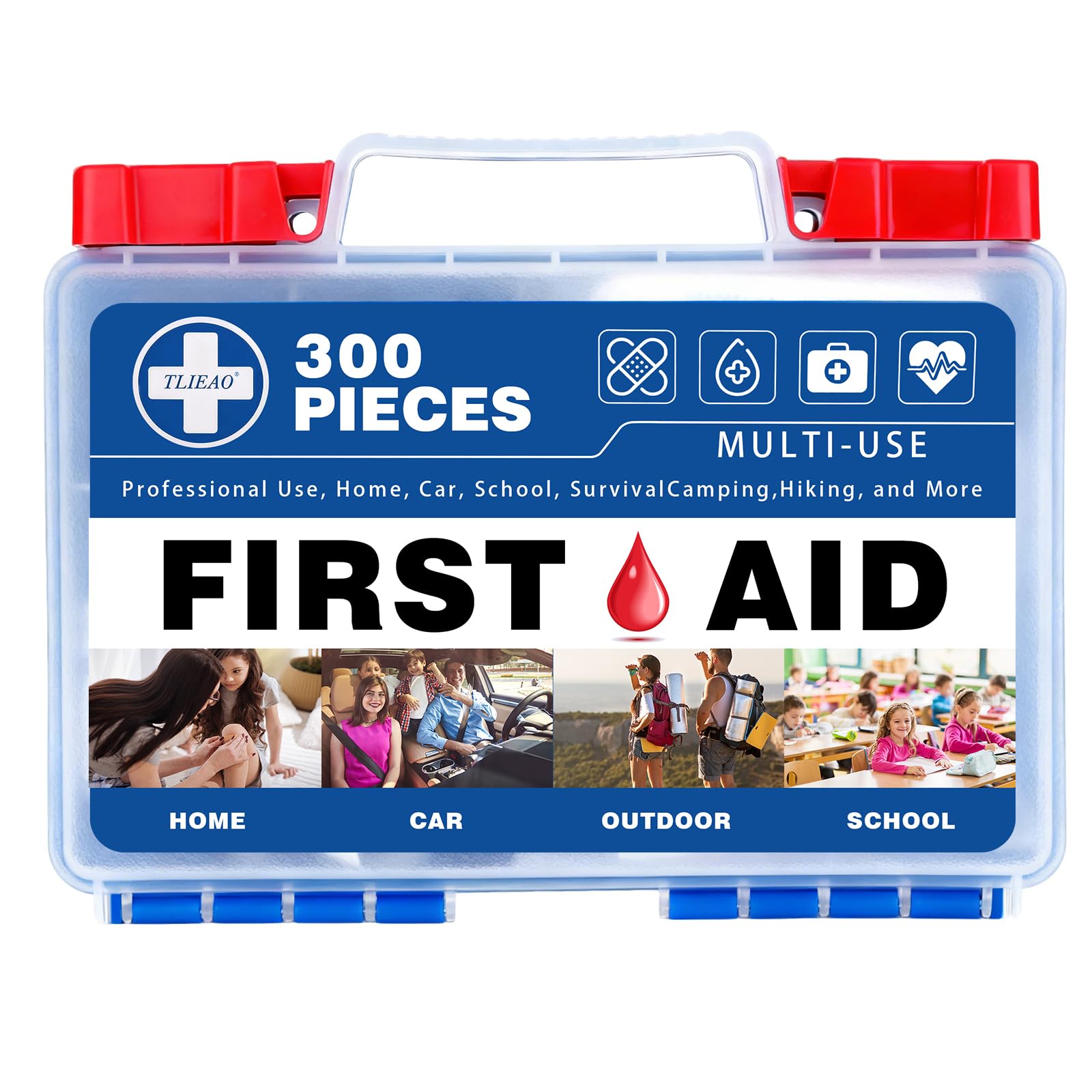
If you’ve ever opened a soft kit and watched plastic trays tumble out, this is the fix. The case is a rigid plastic shell with easy-slide latches and a clear cover, measuring 8.08 x 3.2 x 10.3 inches and weighing 1.54 pounds. Inside, individual compartments hold 300 essential supplies — bandages, gauze pads, antiseptic wipes, and dressings — with no filler. Everything inside is 100% latex-free.
Owners consistently call it compact for the storage it earns, and owners mention it slides into a cupboard or a car footwell without hogging space. That size-versus-content balance is the story: 300 pieces in a case you can carry one-handed is a genuinely tidy result. If you want a kit that sits flat in a cabinet, opens with one hand, and reads at a glance through the clear cover, this is the one.
Weighing 1.54 pounds against the First Aid Only 298-piece kit at 1 pound, this one runs roughly half a pound heavier — a fair trade for a plastic shell instead of fabric. The honest limit is that a rigid case won’t compress into a tight backpack sleeve the way a soft pouch does. Store it where it has shelf space, and it pays that back in organization.
The one feature that decides it: a clear-cover plastic case with slide latches means you see every supply without opening it, and nothing spills when you do.
Trade-off worth knowing: the rigid shell runs heavier than a soft pouch, and it needs shelf room rather than squeezing into a tight bag.
Pick it if: you want a tidy, latched case that stays put on a kitchen shelf or in a car footwell.
Look elsewhere if: your storage spot is a squashable backpack sleeve — a rigid plastic case won’t fold into that shape.
4. RHINO RESCUE EVA First Aid Kit Small Waterproof Travel Emergency Kit

A water-resistant shell that clips to a bike frame and handles 130 pieces worth of trail-side care.
This is the kit for anyone whose first aid needs happen miles from a road. The 130 high-quality emergency essentials cover minor wounds, cuts, scrapes, burns, sprains, cold care, and blister prevention, and it comes with both a CPR guide and a First Aid Guide tucked inside. The EVA outer shell — a water-resistant, foam-like molded material — plus a water-resistant outer zipper keeps the contents dry in a saddle bag or a wet tent.
What wins people over is the organization. An upgraded curved zipper on the main compartment lets the case open wider and lay flat, so every supply is visible the moment you unzip it. Customers note it packs neatly into a high-quality case and treats decently bad injuries without filler. The upgraded carabiner lets you mount it on a bicycle, truck, or RV instead of burying it at the bottom of a bag.
It runs just 8.46 x 5.51 x 3.54 inches and 1.36 pounds, making it the smallest kit in this lineup by footprint. The trade-off is piece count: 130 pieces covers small and moderate injuries well, but not the packed shelf of supplies a 300-piece kit brings. The kit is designed for outdoor emergency needs — hiking, camping, backpacking, and wilderness adventure — not for a full household stock. If your scenario is a bike ride or a trail, that math works in your favor.
Why it earns a spot: a water-resistant EVA shell, double-way zippers, and a flat-opening main compartment make this the kit you can genuinely use with one hand on a trail. The included carabiner mounts it to a bike or truck without a separate strap.
Trade: at 130 pieces, it covers minor to moderate injuries. A stocked household kit needs more supplies.
The right call for: cyclists, hikers, and campers who need a compact water-resistant kit they can clip and go.
Not the right shape for: a family home kit where you want a big, deep supply reserve.
5. Gevoke 410 Piece Waterproof Hard Shell First Aid Kit
A waterproof hard shell with a shoulder strap, built to live in an RV, a boat, or a farm truck.
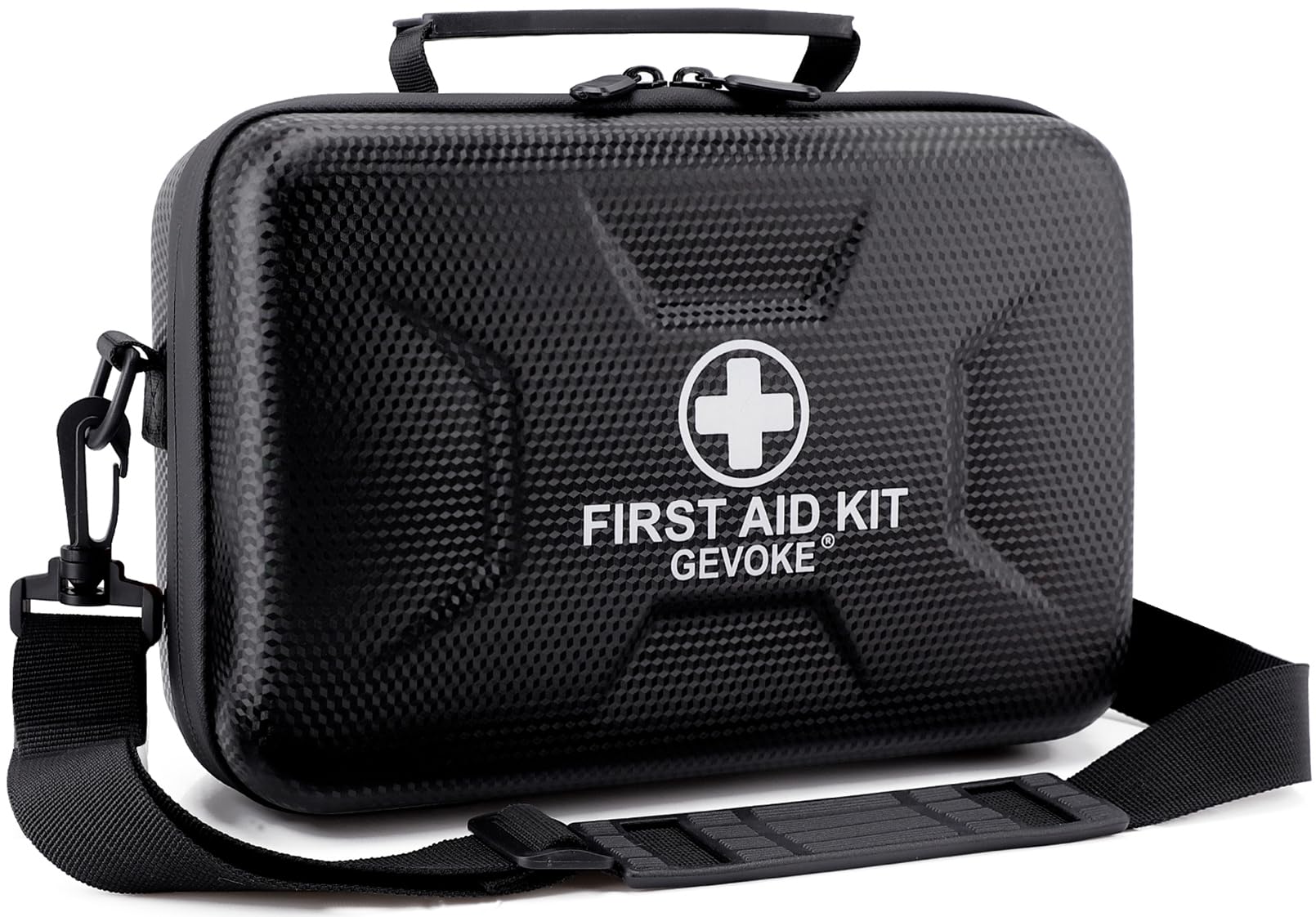
410 pieces in a waterproof EVA hard shell with a detachable shoulder strap and a durable TPU handle — that combination is the entire pitch. Measuring 9.8 x 6.6 x 4.1 inches at 2 lbs, it’s small enough to fit an RV, ATV, yacht, boat, Jeep, bike, or motorcycle storage bin. The five transparent compartments inside show every supply at a glance, so any adult can grab what they need without digging.
What earns its place here is capacity. Owners describe it as better than expected, with a rugged case and quality zipper that takes farm-truck and off-road abuse. The waterproof EVA surface and double zipper seal against moisture, which matters if this lives in a boat or a vehicle that sees temperature swings. Reviewers point out it covers minor emergencies for family, farm, and off-grid use without a fuss.
The one honest limit: a few shoppers say that gauze and emergency tape could be more plentiful. The kit covers a wide range of small injuries, but for serious trauma you’d pair it with a dedicated trauma kit. For its intended job — a rugged, waterproof, well-organized kit that stays in a vehicle — it’s a strong pick at 4.6 stars.
Why vehicle owners like it
- 410 pieces organized across five transparent compartments — visible at a glance
- Waterproof EVA shell and double zipper handle moisture and temperature swings
- Detachable shoulder strap plus TPU handle for carry flexibility
- Fits tight storage in an RV, ATV, boat, Jeep, bike, or motorcycle bin
What to know going in
- Gauze and emergency tape could be more plentiful for larger trauma
- At 2 lbs it’s heavier than compact pouch kits
- Hard shell takes storage space a soft bag wouldn’t
Reach for this if: the kit’s home is a boat, RV, farm truck, or off-road rig and you want waterproof protection.
Think again if: you need a compact kit that pockets into a backpack — the hard shell runs bulky.
6. Besst Survivor Premium First Aid Kit with Color-Coded Compartments

Color-coded compartments and a 59-page manual make this the kit that walks a beginner through an emergency.
This kit organizes around a specific idea: that in an emergency, you won’t know where anything is. Color-coded labels mark the purpose of each compartment, and a foldable interior layout with storage design puts bandages, hemostatic tools, or CPR supplies within reach. The included 59-page manual covers CPR, hemostasis, and fracture fixation for anyone who’s never done it before.
Inside are 221 all-inclusive pieces, including professional tools like an Israeli bandage, an emergency blanket, and a CPR mask. The MOLLE system — a webbing grid that lets you strap the bag to other gear — plus a D-ring and Velcro back panel mounts it on outdoor bags, car hooks, or tactical vests. The waterproof 600D polyester outer bag with a two-way zipper blocks moisture, dust, and dirt to keep the sterile gauze and pads clean.
Weighing just 1.5 pounds at 8.0 x 6.0 x 3.6 inches, it fits car trunks, backpacks, and cabinets without noticing it’s there. Buyers report it works as a hiking companion on long trails like the Camino de Santiago and that the labeling holds up under real use. The build quality on the bag itself gets mixed feedback — some find the zipper and fabric thinner than a hard case — but the contents and the labeling carry the pick. For anyone who’s new to prep buying, this one has the strongest “here’s how to use it” story in the lineup.
The standout feature: color-coded compartments plus a 59-page first aid manual make this the most beginner-friendly kit here. It assumes you’ve never stopped a bleed and walks you through it.
Fair warning: the bag itself is a soft MOLLE pouch — thinner than a hard shell, so don’t expect it to survive the same abuse as a rigid case.
Ideal for: hikers, moto riders, and first-time preppers who want labels and a guide rather than a pile of supplies.
Skip if: you need armor-grade hardware — a soft bag won’t take farm-truck abuse like a hard case will.
7. KeepGoing Travel First Aid Kit

A book-page layout that opens flat in a carry-on, in a tray table’s shadow, at 10.55 ounces.
At 10.55 ounces and small enough to vanish into a suitcase side pocket, this is the kit for the person who buys one because they’re packing, not because they’re preparing. The case is stain- and water-resistant, opens like a book with multiple interior pockets, and holds a surprising amount for its thin profile. The interior holds more than the slim exterior suggests.
What buyers rave about is the bandages. As owners put it, the kit held “the only bandaids that will stay on” — a dance instructor used them through full performances and kept coming back. The same pattern shows up across the review pages: heavy-duty zipper, sturdy nylon case, organized pockets, hand-sized with a carabiner for hanging. Blisters, cuts, and splinters on vacation all get handled without waiting for a pharmacy to open.
The catch is price. This is the priciest non-premium pick in the group, and owners who use bland OTC meds may find the tiny tablets inside feel lighter than they’d like. Buyers who restock and keep it forever tend to stop caring about the upfront cost. The compact shape actually prevents a problem bigger kits create — this is the kit you actually carry instead of leaving it behind. If your kit lives in a car trunk and rarely flies, a roomier option like the Be Smart bag is the better fit. If it lives in your suitcase, this one’s hard to argue with.
The design win: a book-page interior in a 10.55-ounce case means the supplies are visible and reachable even from a compact footprint. Heavy-duty zipper and stitched seams hold up to daily carry.
The honest note: the OTC medication doses are tiny, and the kit costs more than other compact options. Neither is a dealbreaker — just know what you’re buying.
The traveler’s kit: suitcase, backpack, or glove compartment, with bandages that actually stay stuck and a case that survives being carried daily.
Consider a bigger option if: you need a full supply reserve or a hard shell for rough storage — this one tune for portability.
8. Gevoke Professional 500 Piece Emergency First Aid Kit

Five hundred pieces in a tear-resistant 1680D polyester bag — the strongest supply base here.
Five hundred essential supplies make this the deepest pantry of the group, and the bag itself is built to keep them there. The outer shell is premium tear-resistant 1680D polyester fiber — a heavy-duty weave usually saved for tool bags — with waterproofing built in and a MOLLE system compatible with shoulder straps and snap buckles. Handles on the top and sides let you mount it on a car or truck, and reflective strips improve visibility in low light.
Inside, labeled compartments let you or your whole family find what’s needed at a glance, and the refillable design with double-zippered compartments and extra space means you restock instead of replacing. At 6.29 x 11.8 x 7.88 inches and 3.92 pounds, it’s the heaviest kit here — that’s the price of 500 pieces and a heavy-duty shell. Owners mention it covers scrapes through large lacerations, packs well in a car or hiking ruck, and stays functional for years.
The one honest note: this kit doesn’t include adhesive bandages. You’ll want to add a box of standard strips, which is odd for a 500-piece kit, but the rest of the contents more than cover the gap. For a home, a small business, or a family that wants one kit to handle everything, this is the closest thing to a full pantry in the lineup. At 3.92 pounds, it’s the heaviest kit here, and the 500 supplies justify it.
Where 500 pieces pay off
- 500 supplies across labeled, refillable compartments — an at-a-glance emergency setup
- Tear-resistant 1680D polyester with waterproofing handles outdoor and workshop use
- MOLLE system, top and side handles, and reflective strips for visibility and mounting
- Covers scrapes through large lacerations in one kit
What you’ll add yourself
- No adhesive bandages included — plan to add a box of standard strips
- At 3.92 pounds it’s the heaviest kit here
- The large footprint needs shelf or trunk space
Choose it if: you’re stocking a home, business, or vehicle with one deep kit that covers scopes through lacerations and refills cleanly.
Look past it if: you need a compact kit — this is the heaviest and largest here.
9. KeepGoing Large Home First Aid Kit for Kids
Two hundred and seventy pieces with character bandages and stickers — designed to stop a crying toddler mid-meltdown.
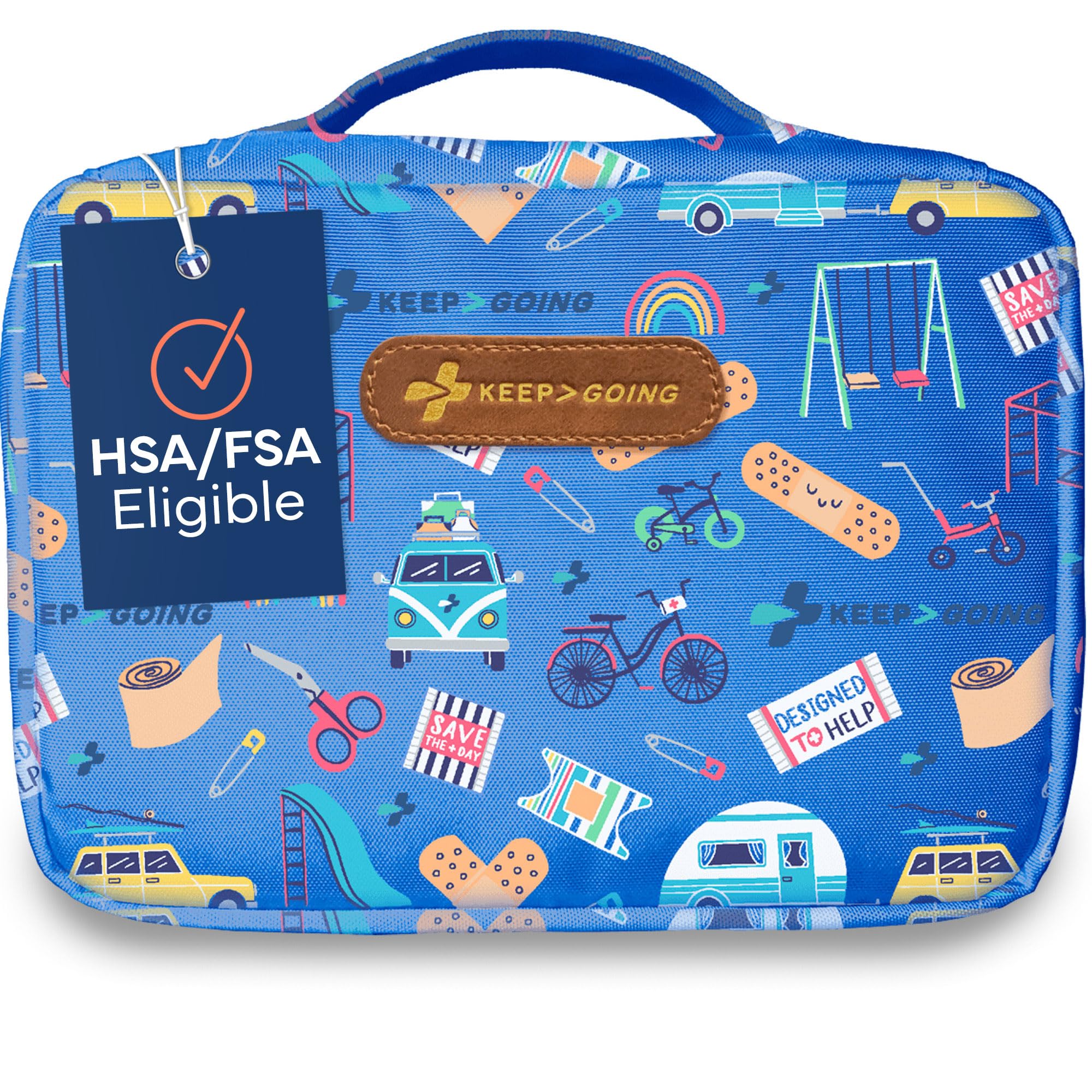
Every other kit here is designed for adults. This one is designed for the moment a four-year-old is screaming over a scraped knee. The 270 pieces include printed bandages and stickers that turn a cut into a small event, and the case itself comes in a cute color-scheme with a binder-style layout. Contents are latex-free, which matters for kids with sensitivities.
The case measures 12 x 10 x 3.5 inches and weighs 1.96 pounds — it lives flat on a shelf, opens like a binder, and holds labeled compartments with bandages, wipes, tweezers, gauze, ointments, scissors, cold packs, and character bandages. Customers note it fits in a diaper bag and covers virtually any scenario for a child or the wider family. Parents of toddlers note the printed bandages and stickers turn a crying fit into something close to fun, which helps when you’re cleaning a cut on a squirming kid.
The honest caveat: no medications are included, so you’ll want to add the children’s pain reliever of your choice. It’s the priciest kit in the list, and the value comes from the child-friendly design and organization, not raw piece count. If your household doesn’t have small kids, the character bandages are just decoration — a serious prep kit is a better spend. For families with littles, the design is the reason this one exists.
The point of this kit: character bandages, stickers, and a latex-free supply set built for kids mean the kit actually gets used instead of avoided. It’s the mom-designed choice for homes with toddlers.
What’s not in the box: no medications. The kid-friendly design is the value; the raw supply depth trails the larger home kits.
Made for: households with toddlers and small children where the kit needs to feel friendly enough to open during a meltdown.
skip it if: your home is all adults — the character-bandage design stops being a benefit and starts being just expensive packaging.
Understanding the Specs
Piece Count vs. Useful Supplies
The “pieces” number on the front of the box counts every adhesive strip, wipe, and packet — not every useful item. A 400-piece kit padded with tiny bandages covers less than a 130-piece kit built around gauze, dressings, and antiseptics. When you compare kits, read the itemized list: how much gauze, how many dressings, what ointments. That tells you whether the number reflects usable supplies or filler.
Case Material and Where You Can Store It
Soft-sided nylon and polyester bags squish into a glove box or backpack side pocket, and the fabric takes a hit without cracking. Hard EVA shells and rigid plastic cases hold their shape, keep supplies from crushing, and sit flat on a shelf — but they add bulk and won’t fold into a tight bag. Water-resistant outer shells (EVA, coated polyester) matter if your kit lives in a boat, a truck bed, or a humid environment. Pick the case for the storage spot first, then compare contents.
Refillability and Expiration
Bandages, wipes, ointments, and medications all carry expiration dates, and the medications go off fastest. A kit with removable compartments and extra space lets you restock only what you burn through. Glued-in plastic trays usually can’t be refilled cleanly — you end up replacing the whole kit instead of a few pieces. Over a decade of ownership, refilling a few expired packets costs far less than replacing the whole kit.
HSA/FSA Eligibility and Latex-Free
Some kits are HSA- and FSA-eligible, meaning you can pay with pre-tax health savings funds. Latex-free matters for anyone with a latex sensitivity — it applies to bandages, gloves, and any rubber-based supplies. Both labels appear on the packaging; check them before you commit if either applies to your household.
FAQ
How many pieces does a first aid kit actually need?
Will a first aid kit fit in my car’s glove box?
Do first aid kit supplies expire?
What does latex-free mean, and do I need it?
Is a hard shell first aid kit better than a soft bag?
What’s the difference between an HSA/FSA-eligible kit and a regular one?
Can a first aid kit handle a serious injury?
Should I buy one kit or several small ones?
How long will a first aid kit last?
What should I add to a first aid kit for my family?
Final Thoughts: The Verdict
For most households, the 1st aid kit to beat is the First Aid Only 298 Piece All-Purpose Emergency First Aid Kit. It’s held 4.8 stars across 77,000+ ratings for a reason: 298 pieces in a soft zippered pouch light enough for a glove box or backpack, at 1 lb, with a two-layer interior that makes supplies findable one-handed. If waterproofing matters and your kit lives in a boat or RV, the Gevoke 410 Piece Hard Shell seals up in a waterproof EVA case. For a home with toddlers, the KeepGoing Large Home First Aid Kit for Kids earns its higher tier through character bandages and a latex-free, binder-style layout. And if your days are split between a car, a dorm, and a desk, the KeepGoing Travel First Aid Kit at 10.55 ounces is the one that actually comes with you. Pick based on where the kit will live — that one decision narrows this list faster than any piece count.
How We Picked
We do not accept paid placement. Every pick is matched to a real buyer and a real use-case; we do not hands-on test units.
Sources & Methodology
Specifications: manufacturer listings and product documentation. Review insights: verified customer reviews, as of September 2026. Pricing: not shown on this page (it changes often); check the current price via the retailer link.
As an Amazon Associate, KitchPrep earns from qualifying purchases. This does not affect which products we feature.
Related Guides
