
Specs are compiled from manufacturer listings and verified buyer reviews and can change over time — please confirm the key details on the product page before buying.
If your sprinkler water can creep backward into the drinking lines, a half-inch backflow preventer is the cheap part that stops an expensive problem. This guide compares the nine units worth your time, from bronze pressure vacuum breakers for irrigation to dual-check valves built for boiler feed lines, so you can match one to your actual pipework instead of guessing at the hardware store.
I’m Mohammad Maruf — the founder and writer behind KitchPrep. This guide is built by comparing the manufacturers’ published specifications and the patterns across verified customer reviews, so you get each pick’s real strengths and trade-offs instead of marketing spin.
Half-inch plumbing moves fast, and the wrong preventer either weeps at the vent or blocks flow you needed. The pages ahead break down each fitting by thread size, pressure ceiling, and the jobs it handles best, so your search for the best 1/2 inch backflow preventer ends with a part that threads on clean and tests clean.
Our Picks at a Glance

How To Choose The Best 1/2 Inch Backflow Preventer
A backflow preventer is a one-way gate for your water. It lets supply water flow forward and physically blocks it from reversing, so anything sitting in a sprinkler head, a boiler, or a processing tank cannot get pulled back into the clean line. On a half-inch line, the choice depends on three things: what connection your pipe already has, how much pressure the body can take, and which style of preventer the job actually calls for.
Match the connection before anything else
Half-inch is the nominal size, but the fitting on the end is what decides whether the part drops in or fights you. NPT means National Pipe Tapered, a slightly cone-shaped thread that seals tighter as you turn it — it is the everyday standard on sprinkler risers and appliance lines. Union connections let you unscrew the whole assembly without cutting pipe, and press fittings crimp onto copper with a tool. Look at the threads on your old part with a flashlight before ordering.
Pressure vacuum breaker or dual check
A pressure vacuum breaker has an air vent on top that opens and breaks the siphon when supply pressure drops, which is why irrigation systems lean on them. A dual check valve uses two rubber seats in series to stop reverse flow but has no air vent, so it suits smaller supply lines on boilers, sterilizers, and lab equipment. Choosing the wrong style is the most common mistake here — a vented breaker on a boiler line will weep, and a plain check valve on a sprinkler riser may not satisfy your local inspector.
Read the pressure ceiling
Every unit lists a maximum pressure in psi, pounds per square inch — the most water pressure the body is rated to hold back. A 400 psi body gives you headroom on a high-flow irrigation line, while a 150 psi unit covers most household and light commercial runs. If your supply surges or you live where the main runs hot, that ceiling is the number to respect.
Quick Comparison
| Model | Best For | Connection | Max Pressure | Body Material | Amazon |
|---|---|---|---|---|---|
| Zurn Wilkins 12-720A★ Best Overall | Whole-yard sprinkler systems | 1/2 in threaded | — | Bronze | Amazon |
| Febco 765 T765CBVTop Performer | Industrial and hospital water services | NPT | 150 psi | Bronze | Amazon |
| Zurn Wilkins 12-375XLPremium Pick | High-hazard RPZ protection | Press | 175 psi | Bronze | Amazon |
| ONDAQUA 720 | Home irrigation and fire lines | 1/2 in | 400 psi | Brass | Amazon |
| Watts 9D-M3 | Boiler feed backflow protection | Union FNPT x FNPT | — | Brass | Amazon |
| Watts LF288A | RV and dishwasher replacement | NPT female | 8.6 bar | Lead-free brass | Amazon |
| MEASUREMAN MD135 | Budget sprinkler setups | Threaded | 160 psi | Brass | Amazon |
| AQOVOR 9D-M2 | Small hot and cold supply lines | NPT female | 175 psi | Brass and stainless steel | Amazon |
In‑Depth Reviews
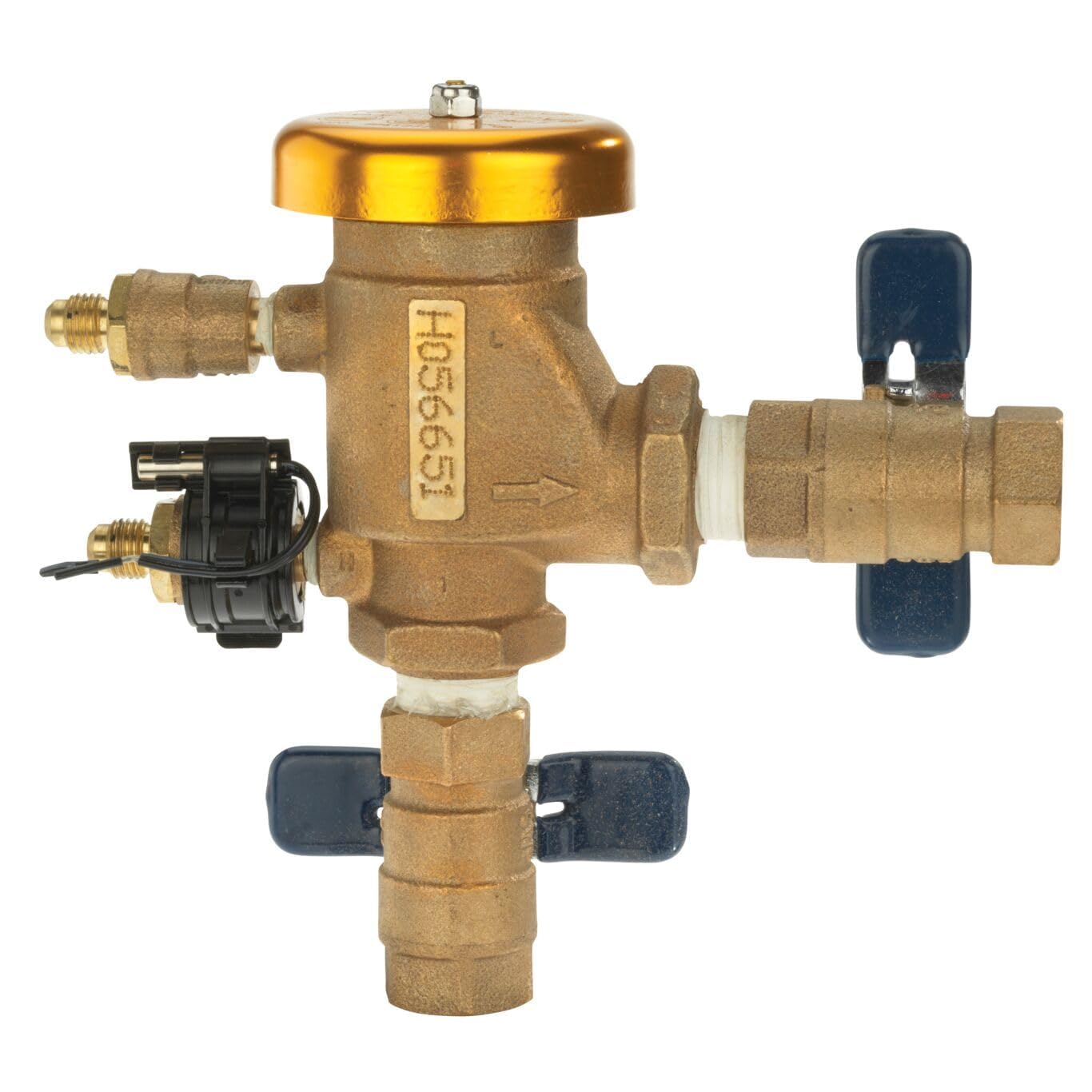
1. Zurn Wilkins 12-720A 1/2″ 720A Pressure Vacuum Breaker
Our pick — over 4.5★ from 3,000+ verified ratings; the strongest balance of quality and price.
The irrigation workhorse whose serial number stays readable no matter how you mount it
If you run a sprinkler zone off a half-inch riser, this is the part most people end up bolting on. It is a pressure vacuum breaker, which means a vented air chamber sits above the valve and physically breaks the pull of water when supply pressure drops — the exact scenario that lets lawn chemicals sneak backward into your house line. The body is bronze, a copper-and-tin alloy that shrugs off corrosion far better than the plastic bodies on cheaper risers.
Four test ports sit on the center line of the valve, which is the detail that separates a two-hour job from a four-hour one. You can pull a test without unbolting anything or rotating the assembly, so a certified tester can finish in one visit. The serial number also stays visible in any installed orientation, which saves a callback when the inspector needs to log the unit.
Owners lean on this thing for a living, and the pattern shows it: irrigation systems come back to life after the swap, and it drops straight in as an exact replacement for old units with the same inlet and outlet layout. One adjustment to expect — service ports moved off the body onto the inlet and outlet valves on newer versions, and the output now sits on the left unless you reorient it. The recurring gripe is the bronze body cracking after a few hard winters on a handful of units, which is why blowing the line out before the first freeze still earns its keep.
What earns the top spot
- Bronze body resists corrosion and stands up to winterizing
- Four test ports on the valve center line let a tester work without rotating the assembly
- Serial number stays readable in any mounting orientation
- Drops in as an exact replacement for older 720A units
Where it asks for care
- Service ports sit on the I/O valves on current models, so check your layout before ordering
- Output defaults to the left side unless you reorient the assembly
- Unprotected bodies can crack through repeated hard freezes
Reach for this if: you want the half-inch pressure vacuum breaker that fits a standard sprinkler riser and passes inspection without drama.
Think twice if: your line feeds a boiler or lab sink — a vented breaker belongs on irrigation, not on a closed supply loop.
2. Febco 765 Bronze Pressure Vacuum Breaker 1/2″ Inlet
The only half-inch breaker here that can phone home before the pipes freeze
Where the Zurn above tops out on a standard sprinkler riser, this Febco goes after the jobs that need a paper trail. It carries a freeze sensor compatible with SentryPlus Alert technology, a monitoring setup that signals facility staff when temperatures approach freezing, so a hospital, morgue, or chemical plant can react before a crack forms. That is a genuinely different job than a homeowner’s lawn loop.
The bronze assembly runs to a 150 psi maximum working pressure and a temperature range of 32°F to 140°F, which is the standard envelope for continuous-pressure health-hazard service. It comes with a plastic bonnet to shield the mechanism from freeze damage, a spring-loaded check valve, an air relief valve with an opening port, two resilient seated shutoffs, and test cocks. End connections are NPT, so it threads onto standard half-inch pipe.
Quality is what people write in about — it is the most-praised trait on the listing and it shows in the brass valves that turn smoothly instead of fighting back. Units go in fast and often replace an original Febco 765 that ran for roughly two decades. The honest catch is a pair of handle-nut leaks that show up on some installs; tightening the interior nut underneath usually ends it, and one buyer fixed it that way rather than sending the unit back. Finish work on your fittings before you thread it on and that stops being an issue.
The industrial case: if your preventer protects a health-hazard line, the freeze alert alone justifies stepping up here — a cracked assembly on that line is a far worse day than a slightly higher price tag.
Suits you when: the assembly serves a commercial or institutional line where someone needs a warning before the freeze, not after the leak.
Look elsewhere if: this is a weekend lawn project — a plain irrigation breaker does the same job for far less.
3. Zurn Wilkins 12-375XL 1/2″ 375XL Reduced Pressure Principle Assembly
A hospital-grade preventer you can strip down to the core with four bolts
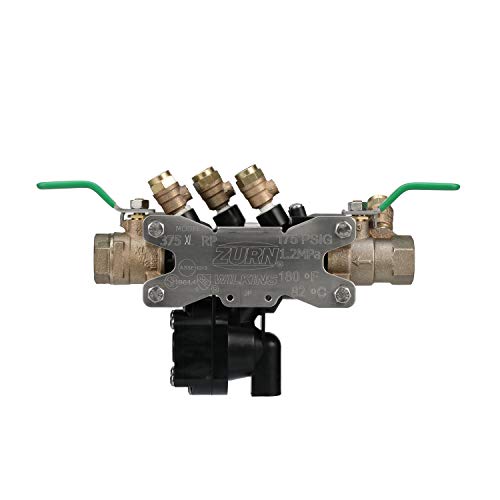
This is the heavy end of the lineup. A reduced pressure principle assembly, or RPZ, is the highest tier of backflow protection in plumbing — it holds two independent check valves plus a relief valve, so it guards against both backsiphonage and backpressure on the highest-hazard lines. At roughly 5.2 pounds in bronze, it arrives built like something meant to live outdoors for years.
The feature that earns its keep is the EZSwap pressure vessel, a UV-resistant reinforced nylon component designed to resist corrosion and mineral build-up, and it lifts out for easy access. That removable core is what makes winter sane: strip the internals, store them, and the body stays safe from freeze damage. A flush tool also comes in the box for line flushing.
Owners describe installation as the standout trait, and the four-bolt breakdown is the reason — you can remove the core and still screw the ball valves onto existing fittings without replacing pipe, which turns a plumbing project into a small one. The Zurn’s shorter body is the honest follow-up: some setups need a 1-inch nipple and coupler to bridge the gap left behind. It is also a press-connection unit, so unless your copper is already set up for press, factor that in before ordering.
Where the money goes: an RPZ earns its cost on high-hazard service — irrigation alone rarely needs one, but hospitals, chemical lines, and industrial water services are where this level of protection is the point.
Pick this if: your line requires RPZ-grade protection and you want a unit you can winterize by pulling the core rather than draining the whole run.
skip it if: your application is a simple sprinkler loop — you would be paying for protection the job does not need.
4. ONDAQUA 1/2″ Brass Pressure Vacuum Breaker, Max 400PSI
Four hundred psi of headroom in a body that will not flinch at a pressure surge
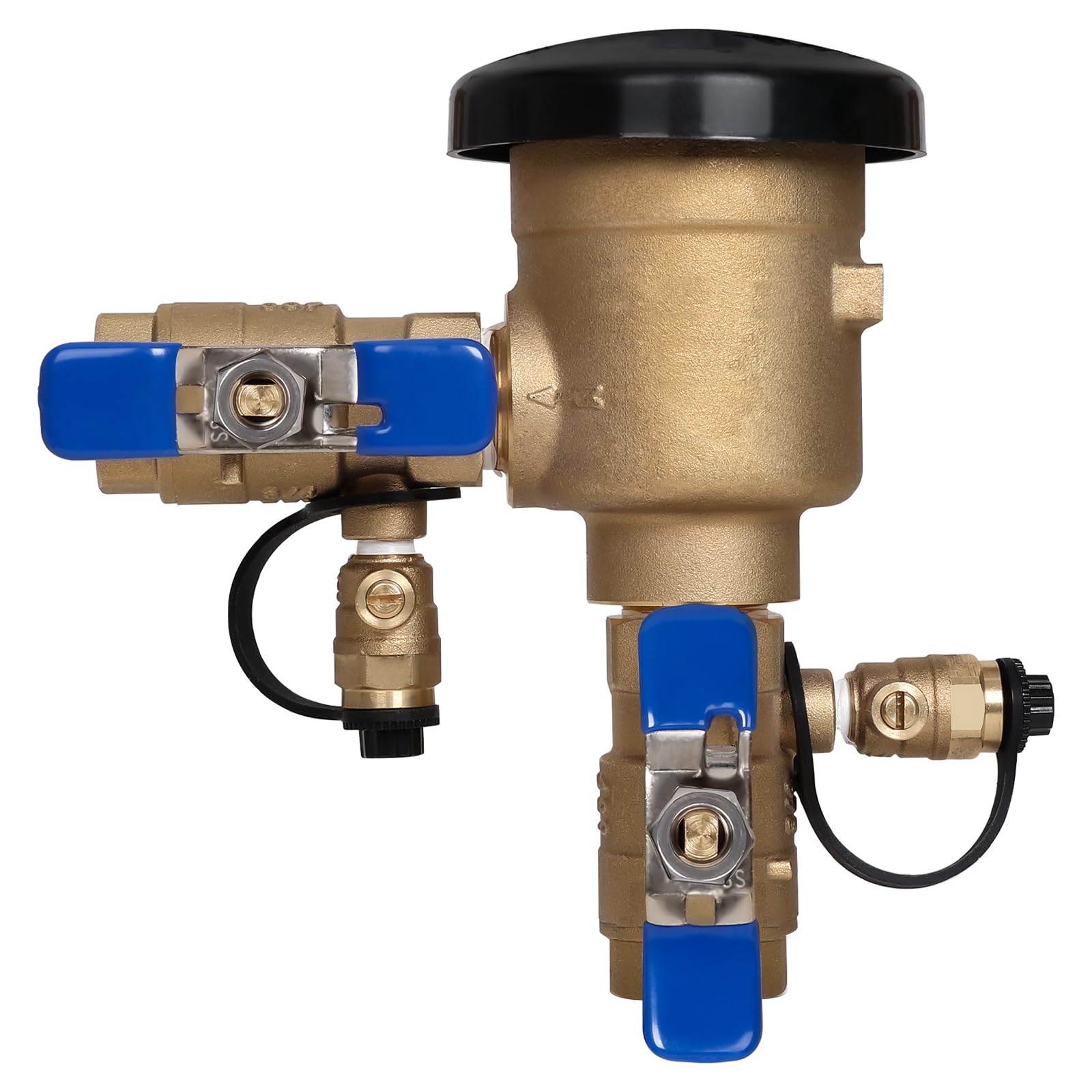
The 400 psi maximum pressure rating is the number that matters here. It is the highest ceiling on this list, well past the 160 psi and 150 psi units sharing the page, which means the body is built for high-flow pipe and the pressure swings that come with it. For a garden sprinkler main or a fire suppression line, that is real margin against a surge.
The body is thickened brass rather than a cheaper alloy, and the maker claims over 1,000 tests and a 15-year service life. Each unit ships with plumber-specific PTFE tape, and an arrow on the body marks flow direction so you can clock it correctly without guessing. It is built for non-potable systems: irrigation, industrial supply, fire suppression lines, and wastewater treatment pipelines.
What wins people over is the build — quality is the trait mentioned more than any other, and it shows in a brass body users describe as heavier and more solid than the plastic they replaced. Install stories line up too: a swap after freeze damage, no leaks, straightforward PVC work. The catch is the price-vs-repair question. This is close to a clone of the Zurn Wilkins, model number and all, and repair-part availability for that exact unit is not guaranteed. Sealing still needs thread tape, and no instructions come in the box.
The value read: if your line runs high pressure and you want a pressure vacuum breaker with a lot of headroom, the brass body and 400 psi ceiling give you a serious option without paying premium prices for the same job.
Worth grabbing if: your irrigation or industrial line runs high flow and you want a substantial brass preventer rated well past household pressure.
Consider your parts supply if: you need guaranteed OEM replacement components down the line, since the internals are not officially tied to the original brand.
5. Watts Brass & Tubular 9D-M3 1/2″ Backflow Preventer

The dual-check that keeps boiler feed lines from siphoning when supply pressure drops
For boiler feed lines, lab sinks, sterilizers, and processing tanks, this is the shape you want. It is a dual check valve with a union FNPT by FNPT (female national pipe tapered) connection, meaning the threads are female on both ends and a union nut lets you break the connection without cutting pipe. The body is brass, and it is built for smaller supply lines where a full-blown RPZ would be overkill.
Inside, a primary check valve uses a rubber disc seating against a mating rubber part to ensure tight closing, which is the mechanism that shuts down reverse flow. It works with both hot and cold water and can sit under continuous pressure, so it does not need to be downstream of a shutoff you keep cycling. Watts recommends it specifically for boiler feed lines where supply pressure can fall below system pressure — exactly the condition that pulls dirty water backward.
Installation stories run about half an hour, and it fixes leaks that have been chasing a problem across multiple parts. Two honest notes. One, cost: some owners call it expensive and one would have ordered a cheaper equivalent if time had allowed. Two, lead content — one buyer flags that it exceeds potable water line recommendations, which they suggest explains the lower cost than some alternatives. If your line is potable drinking water, check that against your local code before you install.
Best fit: mechanical rooms and small commercial loops where a dual-check valve is the right tool and the union connection makes future service simple.
Made for you if: your boiler or lab equipment needs reverse-flow protection and you want a union-thread brass valve that installs in about half an hour.
Check your code first if: the line carries drinking water, since lead content on this valve is a documented concern for potable service.
6. Watts LF288A 1/2″ Lead-Free Brass Anti-Siphon Vacuum Breaker
The 8-ounce brass answer to the flimsy plastic breaker hiding under your RV sink
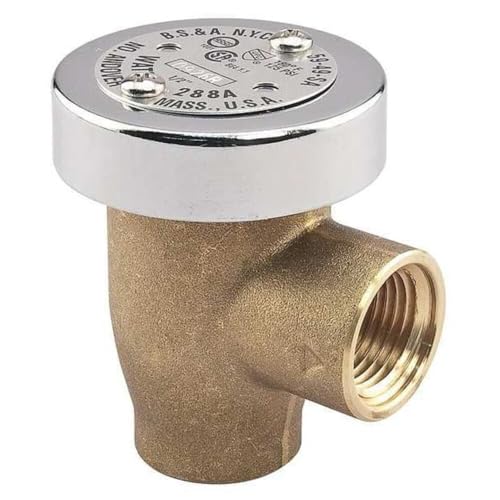
Most RV bathrooms ship with a plastic anti-siphon breaker tucked under the sink, and it is the first part to give out. This Watts replacement is the direct swap. It is a 1/2-inch anti-siphon vacuum breaker with female NPT inlet and outlet threads, a chemical-resistant silicone seat disc, a chrome hood, and an atmospheric vent that prevents spilling. At 8 ounces, the brass body has real heft compared to the plastic it replaces.
What makes it a compelling replacement is the specification list: it is lead-free brass, works with both hot and cold water, and carries a full-sized orifice that keeps pipe-size capacity and maximum flow intact. It is rated for low-flow, non-continuous hot or cold water health-hazard applications such as laboratory equipment — a narrower job than the full-pressure breakers, but exactly what an RV sink or a dishwasher supply line needs. This is the kind of part that also tops off swimming pools and swaps into a Hobart LXi dishwasher without drama.
Functionality is the trait that comes up most, and the pattern is consistent: it installs in a few minutes with no soldering, and it stops the leak the plastic one started. One buyer’s note on the trade-off: it is pricier than the OEM plastic part and worth it. The lead-free brass and heavier feel are what justify the step up.
Why it stands out: swapping out the OEM plastic part for this one gives you lead-free brass, a silicone seat, and a chrome hood on a part that installs in minutes without cutting or soldering.
Reach for this if: you are replacing a cracked plastic anti-siphon valve on an RV, camper, or dishwasher supply line and want metal once.
Look at a full-pressure breaker if: your line sees continuous high flow or high pressure — this one is rated for low-flow, non-continuous duty.
7. MEASUREMAN 1/2 Inch Pressure Vacuum Breaker, Brass Backflow Preventer
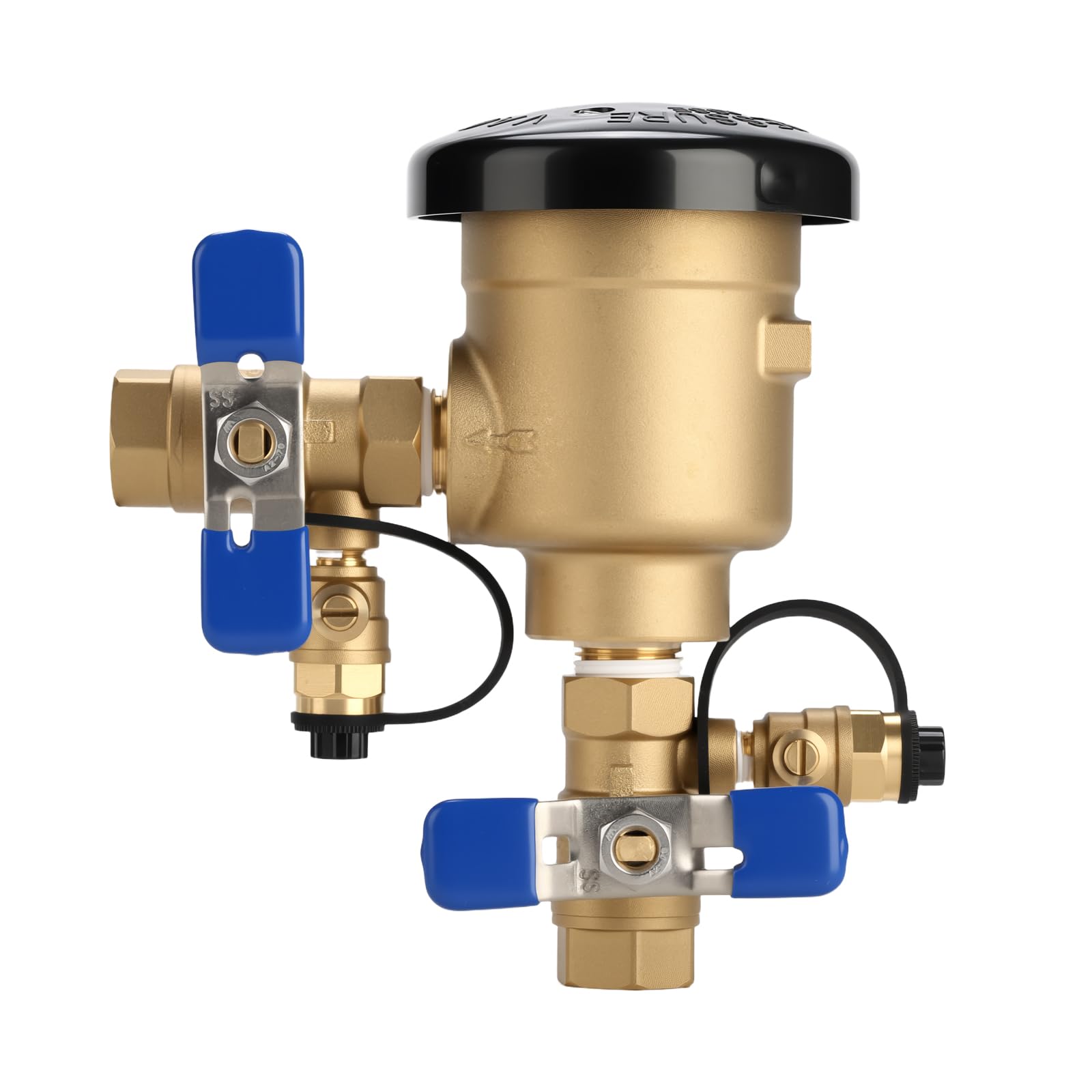
A full valve-and-shutoff package in solid brass for the budget-minded irrigation setup
What sets this MEASUREMAN apart is what comes attached. Most entry-level breakers are a body and a vent; this one arrives as a complete valve assembly with an air vent valve, shutoff valves, and test valves all included. The shutoffs have 304 stainless steel handles — the same grade used in kitchen equipment, chosen here for strength and reliable operation — and the body is solid brass rated to 160 psi.
It is built for sprinkler, irrigation, and outdoor water supply systems with half-inch connections, and it uses standard threaded ends that accept a wrench install. The assembly also helps prevent backsiphonage and contaminated water from flowing back into the supply line, which is the whole point of the device. The stainless handles are what lift this above a stripped-down budget unit.
There is a genuine trade-off to weigh here. The brass body is heavier than plastic and, if your system sits through hard freezes, brass is not immune to splitting. One owner had the valve leak before the system was fully set up even after professional installation, careful winterizing, and covering — a reminder that even a good unit needs a real blow-out before the cold. If your line goes through winter, plan for that.
The shortcut value: buying a complete valve-and-shutoff package in one order saves the trip that a body-only breaker would send you on for extra fittings.
Right fit for: a homeowner sprinkler or irrigation system that wants an all-in-one brass valve at a budget-tier price.
Keep an eye on: freeze protection — even a solid brass assembly needs a thorough line blow-out before the first hard freeze.
8. AQOVOR 9D-M2 3/4″ Brass Dual Check Valve Female NPT
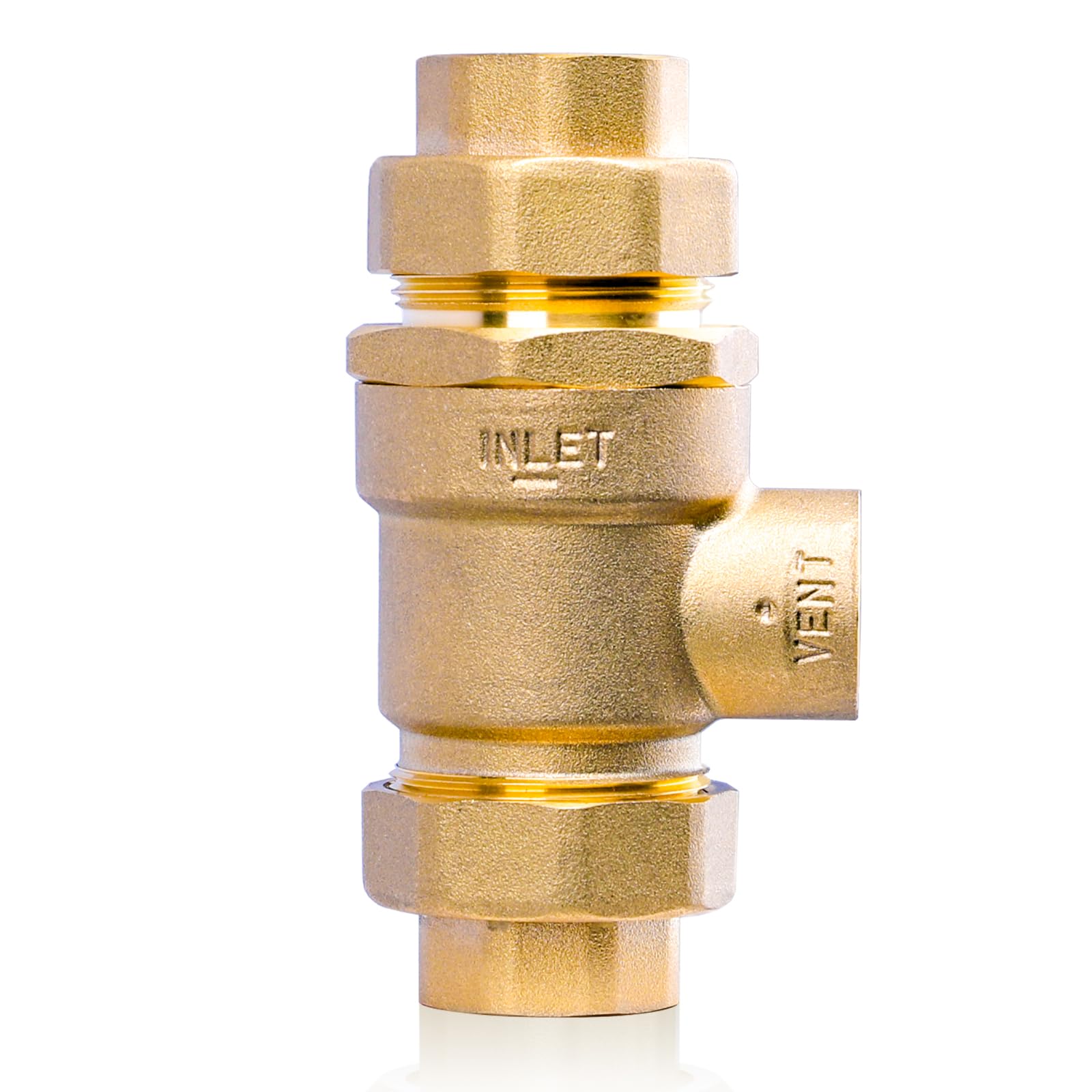
The compact dual-check built for lab tanks, sterilizers, and small hot-water loops
Small supply lines need a small preventer, and this one is the tightest package on the list. The forged brass body carries stainless steel internals and a pair of tight-seating rubber check valves, with an integrated strainer to catch debris before it reaches the seats. Temperature tolerance runs 33°F to 250°F and operating pressure spans 25 to 175 psi, so it handles hot and cold service. It threads on with NPT female ends.
The usability feature here is the lettering. Both ‘INLET’ and ‘VENT’ are cast into the brass rather than printed on stickers, so they stay legible through years of abuse and you cannot accidentally mount it backwards and cause a leak. It installs vertically or horizontally, which gives you room to work in tight cabinets and mechanical rooms. It is built for lab equipment, processing tanks, sterilizers, dairy equipment, and boiler feed lines.
Threading onto an original Watts part goes cleanly on most installs, and users report it operates correctly right from the start. The honest caveat is fit tolerance: on some existing Watts regulators, the tightening collars are just slightly different, so a true drop-in is not guaranteed on every legacy setup. A handful of units have leaked from the vent port even after disassembly and reassembly, which suggests the fit is a lot less forgiving on worn plumbing. Match the collar style before ordering and you skip that risk.
The precision pick: for a specific half-inch job — a lab tank, a boiler feed, a sanitizer line — the cast-in labels and flexible mounting orientation make this the easiest to install correctly the first time.
Good match when: you need a compact dual-check for a small hot-or-cold supply line, and you want inlet and vent markings you cannot rub off.
Check your old fittings first if: you are replacing a legacy Watts unit — union collars differ enough on some models to break the drop-in promise.
Understanding the Specs
Pressure rating in psi
Psi stands for pounds per square inch — the maximum water pressure a preventer is rated to hold back, and the number that tells you whether a unit is built for a standard household line or a higher-flow irrigation riser. A 150-160 psi unit covers most residential and light commercial lines; a 400 psi unit is geared for high-flow pipe and surge protection. Always check the ceiling against your supply pressure before installing.
Connection type
Half-inch is the nominal pipe size, but the end fitting decides whether the part threads on or fights you. NPT (National Pipe Tapered) is a slightly cone-shaped thread that seals tight as you turn it — the everyday standard on sprinkler and appliance lines. Union connections let you break the assembly without cutting pipe, and press connections crimp onto copper with a tool. Match the connection before you order.
Body material and freeze resistance
Bronze and brass are the two alloys most preventers use; both resist corrosion and hold up to outdoor weather far better than plastic. Freeze protection is a separate issue: even a solid brass body can crack if trapped water expands inside it, which is why winterizing or draining a unit matters regardless of material. Some assemblies use a removable pressure vessel that you can pull out and store before the cold.
Vented breaker vs sealed check valve
A pressure vacuum breaker has an air vent that opens when supply pressure drops, breaking the siphon — the design irrigation systems use. A dual check valve has two rubber seats in series but no vent, so it suits closed-loop jobs like boiler feed and lab equipment. Choosing the wrong style is the most common mistake: a vented breaker on a boiler line can weep, and a sealed check valve may not satisfy an inspector on an open irrigation system.
FAQ
Will a 1/2 inch backflow preventer fit my existing sprinkler line?
Do I need a vented pressure vacuum breaker or a sealed dual check valve?
What does the psi rating actually mean for a backflow preventer?
Can I install a backflow preventer myself or do I need a plumber?
How do I protect a backflow preventer from winter freeze damage?
Is a half-inch backflow preventer lead-free?
What is the difference between an RPZ and a pressure vacuum breaker?
How long should a brass backflow preventer last?
Do I need thread seal tape when installing a half-inch backflow preventer?
Why does my backflow preventer leak from the vent port?
Final Thoughts: The Verdict
For most households running a half-inch irrigation or sprinkler line, the best 1/2 inch backflow preventer is the Zurn Wilkins 12-720A, because the bronze body, four test ports, and always-visible serial number on the valve center line make it the unit that installs clean and passes inspection without a fight. If your job is industrial or institutional and you want freeze-warning capability, step up to the Febco 765 and its SentryPlus-compatible freeze sensor. And for a restaurant dishwasher line or a compact lab setup, the Watts 009-QT and the AQOVOR 9D-M2 are the right shapes for tight spaces. Whichever you pick, size the preventer to the actual line pressure and connection style before ordering, and winterize every unit before the first hard freeze.
How We Picked
We do not accept paid placement. Every pick is matched to a real buyer and a real use-case; we do not hands-on test units.
Sources & Methodology
Specifications: manufacturer listings and product documentation. Review insights: verified customer reviews, as of September 2026. Pricing: not shown on this page (it changes often); check the current price via the retailer link.
As an Amazon Associate, KitchPrep earns from qualifying purchases. This does not affect which products we feature.
Related Guides
