
Specs are compiled from manufacturer listings and verified buyer reviews and can change over time — please confirm the key details on the product page before buying.
Buying the wrong 14 inch diamond blade for concrete means one of two things: it glazes over on the first pass and spins useless, or the arbor hole refuses to sit on your saw’s shaft. Get the bond, the arbor, and the wet-or-dry rating right, and a single blade can carve through a whole patio, a footing, or a curb run without slowing down.
I’m Mohammad Maruf — the founder and writer behind KitchPrep. This guide is built by comparing the manufacturers’ published specifications and the patterns across verified customer reviews, so you get each pick’s real strengths and trade-offs instead of marketing spin.
Below you’ll find what actually separates a blade that lasts from one that dies mid-cut, plus honest trade-offs on each pick. Every option here is a real 14 inch blade built to fit a 14 inch saw — the safest way to shop for the 14 inch diamond blade for concrete.
Our Picks at a Glance


How To Choose The Best 14 Inch Diamond Blade for Concrete
The first thing to understand is that a 14 inch blade is not a universal fit. It only works on a saw built for that size, so confirm your saw before anything else. Then match three things: the arbor hole, the rim type, and whether the blade is rated for wet or dry cutting.
Match the arbor hole first
The arbor is the center hole in the blade that slides onto your saw’s spinning shaft. Most 14 inch concrete blades here list a 1 inch arbor with a 20mm bushing, which is a small adapter ring that lets one blade fit both a 1 inch and a 20mm shaft. A loose or wrong-sized arbor causes wobble, which ruins cut quality fast.
Segmented versus continuous rim
A segmented rim has gaps, called slots, cut into the diamond edge. Those slots push air and dust through, so the blade runs cooler and cuts faster. A continuous rim has no gaps and leaves a smoother edge, which suits finish work. Turbo blades sit in between — they have the cooling benefits of slots with a cleaner cut than a plain segmented edge.
Read the segment height and RPM
Segment height is how tall the diamond cutting edge stands off the steel core, measured in millimeters. Taller segments generally mean more usable cutting life before the blade wears down. The RPM figure is the maximum safe spin speed — your saw’s rated speed must not exceed it, or the blade can fail under load.
Quick Comparison
| Model | Best For | Rim Type | Arbor | Thickness | Amazon |
|---|---|---|---|---|---|
| Delta Diamond Boss Hog 14″ Turbo★ Best Overall | All-around premium cutting | Continuous rim turbo | 1″–20mm | 0.11 in | Amazon |
| ORIXTREME 14″ General Purpose SegmentedBest Value | Budget-friendly heavy jobs | Segmented | 1″–20mm bushing | 0.13 in | Amazon |
| Cougar HS 14″ SegmentedMid-Range Balance | Balanced price per cut | Segmented | 1″ with 20mm bushing | .125 in | Amazon |
| Trabo 14″ Segmented Rim | Versatile DIY and repair | Segmented | 1″ with brass reducer | 0.12 in | Amazon |
| Delta Diamond Mad Dog HS 14″ | Harder materials, longer life | Laser-welded segmented | 20mm | .125 in | Amazon |
| Makita E-01719 14″ | Gas-powered cutters | Segmented | — | — | Amazon |
| EDiamondTools 14″ All Purpose | Hard and reinforced concrete | Segmented | 1″ | 3 mm | Amazon |
| Pearl Abrasive P2 Pro-V 14″ | High-RPM pro cutting | Segmented | 1″ with 20mm | 0.13 in | Amazon |
| Diablo Diamond Segmented Turbo 14″ | Fast cuts, long life | Segmented turbo | 1″ and 20mm | 3.2mm kerf | Amazon |
In‑Depth Reviews
1. Delta Diamond Boss Hog 14 Inch Turbo Premium Diamond Blade for Masonry, Brick, Block, Pavers, Concrete, Stone, Wet/Dry Cutting, Continuous Rim (14″)
Our pick — over 4.5★ from 550+ verified ratings; the strongest balance of quality and price.
The turbo rim that leaves concrete looking cut by a machine, not a grinder.
This blade is the one to buy if you want a single disk that handles cured concrete, masonry, brick, block, pavers, and stone without swapping tools. Its trick is the continuous turbo rim: a smooth diamond edge with slots that keep it cooler than a plain solid rim, so you get a clean finish and long cutting life in the same blade. It measures 14″ diameter X.110 thick, which makes it a hair thinner than the ORIXTREME’s 0.13 inches — thinner often means a slightly faster, less binding cut.
The arbor is a 1″–20mm fit, so it seats on both common shaft sizes, and the 5,460 RPM maximum safe speed covers gas saws and handheld cutters. That speed ceiling is the same one the Cougar HS carries, so neither gives you extra headroom there. With 32 diamond teeth, it carries far more cutting points than the 14 tooth Trabo and the 24 tooth ORIXTREME, which is why it holds a cleaner edge in harder aggregate.
Where it earns its keep on a job site is durability under real load. Owners running it dry through walkway slabs and wet through 2 3/8″ pavers report no chipping, fast progress, and no slowdown after dozens of passes. It is covered by a lifetime warranty against warping, cracking, and material defects, so a manufacturing failure is on the maker, not you. The trade-off cutting concrete always brings is dust — a dry pass throws a heavy cloud, so a respirator is not optional (buyers report exactly that). The higher cost also means you are paying for longevity you only feel if you cut often.
Where it wins on the job
- Continuous turbo rim leaves a smooth, near factory edge in cured concrete and pavers
- Fits both 1″ and 20mm arbors with a 5,460 RPM max safe speed
- Lifetime warranty against warping, cracking, and material defects
- 32 diamond teeth for longer lasting cutting performance
What to weigh first
- Dry cutting throws heavy dust, so a respirator is a must
- Higher cost only pays off if you cut concrete more than once
Land the toughest job: choose this if you are cutting reinforced concrete, brick, or pavers and want one blade to finish the work without slowing.
That one cost: the.110 thickness is a touch gentler than a heavy segmented disk, so if you are forcing a fast feed through dense aggregate, lean on a segmented blade instead.
2. 14 Inch Diamond Saw Blade, General Purpose Segmented Blade
The workhorse that keeps cutting pavers long after the weekend you bought it.
If you are a bricklayer, a maintenance tech, or a homeowner with a driveway project, this is the budget-minded pick that does not act like one. It is a segmented blade, meaning its diamond edge has slots that push air and dust through to keep the cut cool and fast. The 15mm segment height is among the tallest here, so there is more diamond edge between you and a worn-out blade.
The blade is 0.13 inches thick with a 1″–20mm bushing arbor, so it fits circular saws, masonry saws, table saws, and handheld electric saws. It is rated for wet and dry cutting of concrete, brick, block, stone, and reinforced concrete, though the maker does not recommend it on asphalt or green concrete. At 24 teeth and 1.75 kg, it is lighter than the Boss Hog’s 1.97 kg and carries fewer teeth, a pairing that trades some hardness for an easier feed on softer masonry.
The thing buyers rave about most is plain blade quality — it holds an edge. Owners mention slicing through 400 pavers and even 5-inch rebar-reinforced concrete without issue, and note it fits machines perfectly and lasts with no signs of wear. It cuts dry with no surface chipping on concrete pavers, so finish passes look clean. The honest caveat: cutting speed draws mixed notes — most are happy, some find it a touch slower or jerky in dry cuts.
Where the value shows up
- Fit works on concrete saws, circular saws, table saws, and handheld cutters
- Handles reinforced concrete and 400+ pavers on a single blade
- 15mm segment height is generous for the running life
- Dry cutting shows no surface chipping on pavers
Where it falls short
- Not for a daily pro running hundreds of cuts a week
- Cutting speed feels slower to some versus premium turbo disks
- Maker does not recommend it on asphalt or green concrete
Reach for this if: you want one dependable 14 inch blade for a home build, paver patio, or light maintenance work without a premium price tag.
Look elsewhere if: you run a masonry crew full time and want a blade built to cut non-stop, where the Boss Hog’s continuous rim will hold up longer.
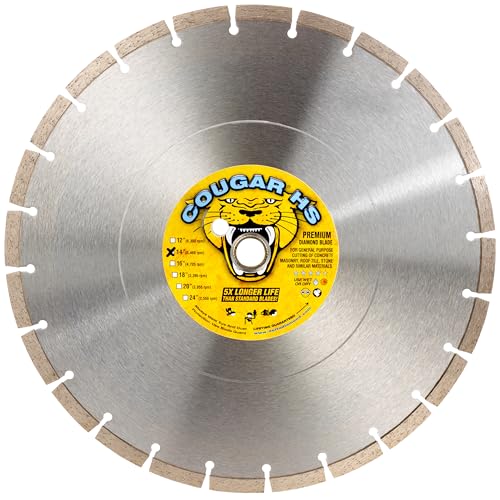
3. Cougar HS 14 Inch Diamond Concrete Saw Blade, Premium General Purpose Segmented Blade, Dry/Wet Cutting Concrete, Masonry, Brick, & Block 1″-20mm Arbor
Built with taller segments and an eye on how much each cut really costs.
This one is for the buyer who thinks in cost per cut, not in one big purchase. Its 12mm tall segments are built for longer life and smooth cutting, and the maker rates its premium diamond segments at up to 5X the life of standard-grade blades. It runs 14″ diameter X.125 thick with a 1″ arbor hole and 20mm bushing, and it tops out at a 5,460 rpm maximum. Segmented rim, 24 teeth, wet or dry on cured concrete, masonry, brick, and block.
It carves through concrete pavers and 20 pound patio blocks easily, and handles 1/2 rebar with no drama. One buyer who built a raised planter around an entire house reported making cuts they had thought were impossible.
What wins people over is blade quality and the value-for-money math — owners flag it as a good balance, with some buying two to three per year for regular cured concrete work. The recurring gripe is the center hole: the arbor runs smaller than the advertised 1″ on some units, so a buyer has had to punch out a brass ring to fit the saw. Match your arbor carefully before the first pass. It is also a touch heavier at the.125 inch thickness than the.125 inch segmented ORIXTREME, which runs 1.75 kg against this blade’s thicker build.
This suits you if: you cut cured concrete and pavers on repeat and want low running cost per cut.
Think twice if: your saw’s arbor is an unusual size, since the center hole has run tight for some buyers.
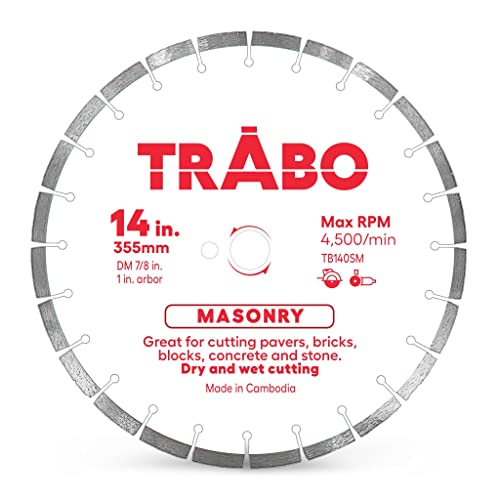
4. Trabo 14 Inch Masonry Segmented Rim Diamond Bond Blade for Cutting Cement, Pavers, Concrete with Rebar, Natural Stone and More, with 1 Inch Arbor
The do-it-all disk for repair jobs where the material keeps changing.
Got a fireplace surround, a retaining wall, and a slab patch all in the same month? This is the blade that shifts with the job. It is 0.12 inches thick, made from a carbon steel core with diamonds embedded in the segments, and it cuts cement, pavers, concrete with rebar, and natural stone. It fits angle grinders and circular saws, runs wet or dry, and arrives with a 1 inch arbor plus a ⅞ inch brass reducer ring glued inside the package.
Two things to know before your first cut. It is a 14 tooth blade, so it feeds readily but carries far fewer cutting points than the 32 tooth Boss Hog — better for lighter materials, less suited to forcing through dense aggregate fast. And the brass reducer ring hides in the packaging corner, which customers note missing. Check the bag before you blame the blade for not fitting.
Owners who have run it love how adaptable it is. It sliced through a 20-year-old asphalt drive in three passes without binding, and cut engineered quartz cleanly with no chips. It also handled a concrete foundation cut with rebar and a small retaining wall with ease. The ceiling is thick material: owners say do not plan on going through 4″ thick concrete with it — it shines in brick, mortar, and backer board. That is the honest line between a versatile home blade and a pro slab cutter.
Pick it for the variety: this suits homeowners and light contractors who cut several different materials and want one blade that keeps up.
Respect the limit: it is not made for heavy 4″ concrete, so match it to brick, block, and finish work.
Grab it when: your project list is a mix of stone, asphalt, and pavers and you want a single blade to cover all of it.
Barely fits if: your chop saw uses a ⅞ inch arbor — the reducer ring is easy to miss in the packaging and needs a firm fit before you spin it up.
5. Delta Diamond Mad Dog HS 14 Inch Segmented Diamond Saw Blade,.125 X 20mm Arbor, Made in USA, Premium, Wet/Dry, Laser-Welded, General Purpose Cutting Concrete, Masonry, Stone (14″)

A laser-welded American blade for the materials that eat cheap disks alive.
When you are up against harder stone or firebrick, this is the blade that finishes the run. It is a premium laser-welded segmented disk — the segments are joined to the steel core under heat, which strengthens the joint under load. Made in the USA, it runs 14″ diameter X.125 thick with a 20mm arbor and a 5,460 RPM maximum safe speed. It cuts wet or dry on cured concrete, masonry, brick, block, stone, pavers, slate, terrazzo, and roofing tile.
This is a heavy-duty general purpose pick: the maker rates it longer-lasting and faster-cutting than standard blades, which suits it to harder stone and firebrick. With 19 teeth, it sits between the Trabo’s 14 and the ORIXTREME’s 24, so it is not the fastest feeder in this list — it traded some bite for a tougher, longer-wearing edge. It also carries a lifetime warranty against warping, cracking, and material defects.
The durability story checks out on real jobs. Reviewers point out cutting over 1,000 feet of 6″ driveway concrete for removal and still running it perfectly afterward, and it walks through very hard firebrick. It also cuts asphalt cleanly and handles bluestone well. The recurring note is the same as every dry cut here: dust control is the real challenge, and one heavier-cut owner found it slowed after an hour of hard commercial use. That is a limit, not a defect — the maker never claims it is a commercial-grade production blade.
The laser-weld advantage: a heat-joined segment-to-core bond is what keeps it in one piece under hard, dry cutting.
One honest caveat: it is not meant for commercial daily use, so a full-time pro will want a heavier-duty disk.
It is the right blade if: you want a long-lasting, American-made disk for harder aggregate or for repeat weekend jobs.
Your mileage varies if: you cut for hours a day on a commercial site, where it slows and won’t outlast a heavier-duty blade.
6. Makita E-01719 14″ Diamond Blade, Segmented, General Purpose

Built specifically to survive the brute power of a gas cutter.
Most general purpose blades list a max speed and leave you to guess. This one is set up for gas power cutters specifically — the maker built it for the power of gas cutters in demanding jobs. It is a segmented blade with 12mm taller segments for longer life and faster cutting, laser welded for the strongest joint possible, and its segment slots help deliver a faster, cooler cut. It handles cured concrete, block, and brick.
Compared to the Cougar HS, this one lists 19 teeth against the Cougar’s 24, so it does not carry as many cutting points; its pitch is cool running under high gas power rather than maximum edge count. It is a name-brand blade from a tool line most contractors already run.
The owner experience is steady rather than spectacular. It holds up fine against other segmented blades, and owners who have used it on boulders report it looks set to last a long while — just do not push your full weight into it. The most-noted quirks are practical: a few owners find it cuts a little slower and feels slightly jerky on an electric saw in dry cuts, and more than one received a package that had been opened in transit. That packaging issue is a shipping concern, not a blade concern, and the disk itself arrives unused.
Where it fits the saw: a segmented, laser-welded blade tuned for the highest-power gas cutters on the job.
Fair warning: it feeds a little slower and jittery on lighter electric saws, and a few units ship with opened packaging.
Pick it for: a gas power cutter running cured concrete, block, or brick where cool, controlled cutting matters more than a feather-light feed.
skip it if: you run a low-power electric saw and want a blade tuned for light, constant-pressure dry cuts.
7. 14″ All Purpose Diamond Saw Blade for Concrete Asphalt 1″ Arbor

The pro-series disk for reinforced concrete, asphalt, and ductile iron in one pass.
For contractors cutting mixed hard material — reinforced concrete, asphalt, granite, terrazzo, or ductile iron piping — this one covers all of it. It is a segmented pro-series blade with a 0.125″ segment width and a 10mm segment height, and it lists a 4-5/8″ cutting depth, which tells you how deep it can reach through a slab in a single pass. It is 3 millimeters thick with a 1″ arbor and 24 teeth, and the maker recommends it on high speed handheld saws or lightweight walk behind saws.
The 4-5/8″ cutting depth is the standout number here — that is the whole reason a pro grabs this over a slimmer finish blade. Shoppers say a read-worthy scene: one owner’s cheap cut-off saw was cutting nothing until this blade went on, after which it worked through a 6-8 inch thick patio. Owners also note it cuts hard concrete, rebar, and 3/16″ steel edge metal and stays effective on concrete.
What carries it is that it performs against premium-brand disks in hard material, which is the whole point of a blade in this tier. The honest caveat: durability draws mixed notes. Some owners say it lasts a good while, while others report it breaking apart under heavy use.
Why pros reach for it: the 4-5/8″ cutting depth and reinforced-material rating put hard slabs and asphalt squarely in its lane.
What to respect: it is not for lighter multi-material jobs, and durability in extreme workloads is mixed.
Make it your pick if: you cut hard or reinforced concrete, asphalt, or ductile iron and need deep reach per pass.
Leave it on the shelf if: your cuts are brick, block, and pavers — a lighter segmented blade will outlast it on softer material.
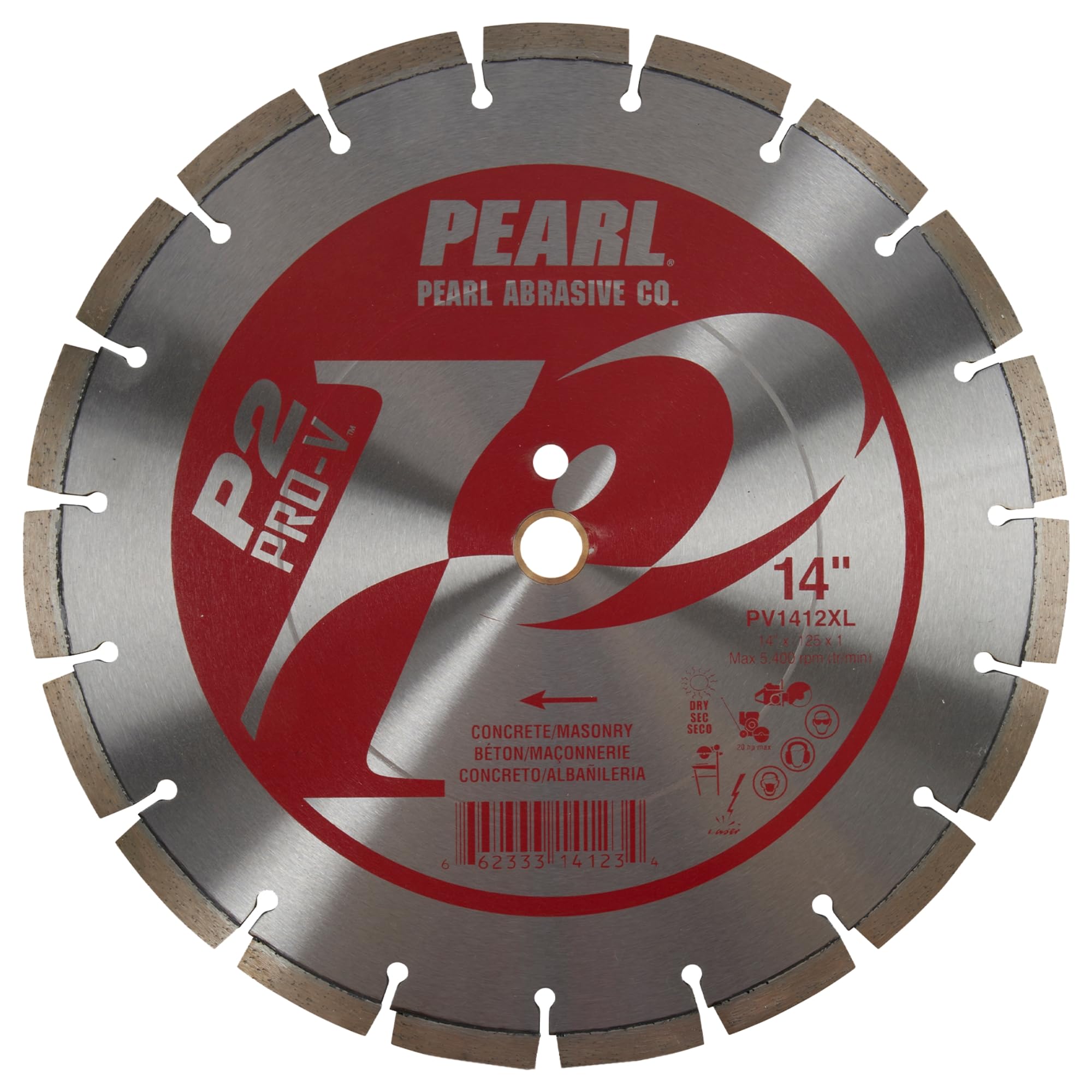
8. Pearl Abrasive P2 Pro-V PV1412XL Concrete and Masonry Segmented Blade 14 x.125 x 1, 20mm
The industrial-grade disk whose wide segments fight bogging under high RPM.
This is the blade for a pro mason running high-horsepower gas saws at speed. It is built with Direct Sintering Technology — a process that fuses the diamond rim to the core as one piece — and a 12mm diamond rim for dry cutting. It measures 14″ with a.125 thickness and a 1″ arbor with a 20mm reducer included. The wide diamond segments are what let it take higher RPM with less bogging than a thinner disk.
That high-RPM tolerance is the entire design story: it runs at speed without stalling, and it stays cool because the segmented rim lets air and slurry pass through. It spins true on portable saws and holds an edge on reinforced material. Owners running it on a Stihl TS-420 with water report it handled bluestone and granite besides the routine concrete, staying sharp through curbing cuts and slab expansion joints.
The professional feedback is the tell here. A full-time mason uses it every day and reports it fit perfectly, stayed heavy-duty and excellent quality, and remained sharp after a month of many hours of use. A pro crew that tested it found it cut concrete curbing into 36″ segments without slowing across 15 cuts and handled rebar from the first to the last. The honest limit: it is a mid-range blade that struggles on thick granite pavers, which the owner notes is typical for a non-specialty disk — so for soft and standard masonry, it is excellent; for exotic stone, it is not the specialist.
Built for the gas saw: Direct Sintering Technology with a 12mm diamond rim keeps it stable at high RPM with less bogging.
One honest limit: thick granite pavers will slow it — that kind of hardscape stone wants a specialty blade.
Choose it if: you run a high-horsepower gas saw daily and need a blade that takes RPM without stalling.
Not for you if: you cut specialty stone, where its mid-range edge struggles through the hardest pavers.
9. Diablo Diamond Segmented Turbo Masonry Cut-Off Blade – 14″ Dia, 3.2mm Kerf

The engineering-forward turbo disk with a lifespan and speed claim that stands out.
This blade carries the strongest claimed lifespan and speed in the group. The maker claims its 60% taller segments hold premium diamonds in a stronger bond for up to 4X longer life. Its SPEED-Edge slots cut vibration and are claimed to cut up to 30% faster than standard segmented discs. Those are manufacturer claims, but the design behind them is real: a 3.2mm kerf, hardened disc body that absorbs vibration, and a 5,500 max RPM.
The vibration-damping body is the practical win for a beginner. Less chatter means easier control in dry cuts, which matters more when you are new to a 14 inch saw. It runs wet or dry, and it lists compatibility with both 1″ and 20mm arbors, so it fits the same range of saws as the Boss Hog’s 1″–20mm fit. Compared to the ORIXTREME’s 24 teeth, the Diablo’s turbo composition is tuned for speed and less vibration rather than raw edge count.
Real jobs back the story up. One owner cut 1″ thick cement stucco from an entire 1,250 sq ft house into 1×1 foot cubes and says it still cuts like butter. On tough 1940s mud set tile with a thick mortar bed, it handled the job with little effort, and another owner calls it the blade to stop shopping around for. The scope limit comes from Diablo’s own framing: it is ideal for concrete, brick, and block, and the stucco owner never tested it on plain concrete — so for brick and block work, it is a standout; for continuous reinforced slab cutting, the ediamondtools blade is the more targeted tool.
The standout spec: a 60% taller segment with a claimed up to 4X longer life and up to 30% faster cuts — the strongest lifespan and speed story in this group.
Where it stops: it is framed for concrete, brick, and block rather than heavy continuous reinforced slab work.
Put this on your saw if: you want a fast, low-vibration blade with a stronger lifespan claim for block, brick, and general concrete work.
Step past it if: your main job is continuous reinforced slab cutting, where a hard-concrete specialist is the better match.
Understanding the Specs
Arbor size and bushings
The arbor is the center hole that mounts the blade to your saw’s spinning shaft. A bushing is a small adapter ring that shrinks a larger arbor hole so it can fit a smaller shaft — most blades here use a 1 inch arbor with a 20mm bushing, letting one blade fit both common sizes. When the arbor matches snugly, the blade spins true; when it is loose or the wrong size, it wobbles and cuts poorly. Always match the arbor before you cut anything, and keep any brass reducer ring in a known place so it does not get lost.
Segment height and rim type
Segment height is how tall the diamond cutting edge stands above the steel core, listed in millimeters — taller segments generally mean more usable life before the blade wears down. Rim type decides the style of cut: a segmented rim has open slots that run cooler and faster but leave a rougher edge, a continuous rim is smoother but cuts slower, and a turbo rim blends slots with a cleaner edge. The max RPM figure is the ceiling your saw must stay under, since exceeding it can break the blade apart.
FAQ
Will a 14 inch diamond blade fit my saw?
Can I cut concrete with a diamond blade without water?
What is the difference between a segmented and a continuous rim blade?
How long does a 14 inch diamond blade for concrete last?
Can these blades cut reinforced concrete with rebar?
What does segment height actually mean for cutting?
Do I need a different blade for wet versus dry cutting?
Is a turbo rim blade better than a standard segmented blade for concrete?
What does the maximum RPM rating on a diamond blade mean?
How do I keep a diamond blade cutting efficiently over time?
Final Thoughts: The Verdict
The best pick for most concrete jobs is the Delta Diamond Boss Hog 14″ Turbo — its continuous turbo rim cuts clean without chipping, its 1″–20mm arbor fits the common saws, and its lifetime warranty backs a blade built to outlast one project. If you want the budget-minded workhorse that still handles reinforced concrete and pavers, grab the ORIXTREME 14″ Segmented. And if you are cutting hard or reinforced slabs and need deep reach per pass, the EDiamondTools All Purpose is the one to reach for. Whichever you choose, match the arbor and let the diamond do the cutting — that is what separates a blade that lasts a season from one that lasts a year.
How We Picked
We do not accept paid placement. Every pick is matched to a real buyer and a real use-case; we do not hands-on test units.
Sources & Methodology
Specifications: manufacturer listings and product documentation. Review insights: verified customer reviews, as of September 2026. Pricing: not shown on this page (it changes often); check the current price via the retailer link.
As an Amazon Associate, KitchPrep earns from qualifying purchases. This does not affect which products we feature.
Related Guides
