
Specs are compiled from manufacturer listings and verified buyer reviews and can change over time — please confirm the key details on the product page before buying.
You already sanded. You already degreased. And the paint still lifted off that slick plastic bumper in a sheet, right? That is the exact problem a bonding primer solves. It is a thin liquid layer you roll, brush, or spray on before paint to give the topcoat a physical grip on slick surfaces like polyolefin plastic, glazed tile, and laminate. This guide walks through nine real options, sorted by what each one is actually built to stick to, so you can match the primer to your project instead of guessing.
I’m Mohammad Maruf — the founder and writer behind KitchPrep. This guide is built by comparing the manufacturers’ published specifications and the patterns across verified customer reviews, so you get each pick’s real strengths and trade-offs instead of marketing spin.
Some of these are spray cans built for a bumper job on a Saturday afternoon; others are quart cans of roll-on primer for cabinets and countertops. Every pick is judged on two things: what surface it bonds to, and how fast it lets you move on to paint. These are the picks worth buying in the Adhesion Primer category.
Our Picks at a Glance

How To Choose The Best Adhesion Primer
Picking the wrong primer is how a two-day project turns into a two-week redo. The good news is that the decision depends on four plain questions, and once you answer them the right can picks itself.
Start with what you are actually painting
The surface decides everything else. Bare polyolefin plastic, the kind used on many car bumpers and trim, is the hardest common surface to get paint to stick to, and it needs a promoter built for it. Glossy tile, laminate, and glazed brick are also slick, but they call for a roll-on bonding primer rather than an automotive spray. Metal, wood, and concrete are more forgiving but still benefit from a primer that grips and seals before the topcoat goes down.
Spray can or quart can
Spray cans win on trim, bumpers, and any small or awkward part you cannot easily roll. They reach into odd shapes and dry fast. Quart and gallon cans win on cabinets, doors, countertops, and floors, where you want to roll a wide, even coat and where a spray pattern would waste product and time. Match the container to the size and shape of the job, not to the brand.
Match the primer to your topcoat
Adhesion promoters are formulated to sit under specific finishes. Some bond well under acrylic lacquers, basecoats, epoxies, and solvent-based urethanes. Others are acrylic-urethane bonding primers meant to be topped with almost any paint. If you already have your topcoat picked out, read its label first, then choose a primer the maker says is compatible with it.
Know your dry time before you start
Some promoters let you spray topcoat in five minutes. Others want a day before you recoat, or ask you to topcoat within a set window while the surface is still tack free. Fast is convenient, but a longer open window gives you room to prime one day and paint the next. Neither is better, they just fit different work rhythms.
Quick Comparison
| Model | Best For | Form | Dry Time | Best Bonding Surface | Amazon |
|---|---|---|---|---|---|
| KLEAN-STRIP Bulldog Adhesion Promoter★ Best Overall | Auto trim, bumpers, plastic parts | 15 oz aerosol | 5 min tack free | Polyolefin plastic | Amazon |
| Custom Shop Adhesion PromoterTop Performer | Truck bed liners, fiberglass, vinyl wrap | 12 fl. oz spray | — | Plastic, aluminum, fiberglass | Amazon |
| INSL-X Stix Acrylic Waterborne Bonding PrimerMost Versatile | Cabinets, tile, glossy surfaces | 1 quart liquid | 24 hours dry | Glossy tile, PVC, glass, galvanized metal | Amazon |
| XIM UMA Acrylic Bonder and Primer/Sealer | Laminate, cabinets, tile, metal | 1 quart liquid | — | Hard, glossy surfaces | Amazon |
| LAUCO Adhesion Promoter Quart | Body shops, automotive trim, bumpers | 1 quart liquid | 5 min ready to paint | Plastic, metal, vinyl, fiberglass | Amazon |
| Stone Coat Countertops Bonding Primer & Sealer | Countertops before epoxy | 1 quart liquid | — | Laminate, tile, granite, quartz, cultured marble | Amazon |
| 3M Adhesion Promoter 111 | Double-sided tape, gaskets, VHB jobs | 250 mL bottle | 60 min cure | Paint and metal | Amazon |
| Rust-Oleum Stops Rust Universal Bonding Primer Spray | Galvanized steel, railings, outdoor furniture | 12 fl. oz aerosol | 30 min to touch | Galvanized steel, laminate, PVC, porcelain | Amazon |
| Liquid Rubber Multipurpose Primer | Concrete, wood, large outdoor surfaces | 1 gallon liquid | 1 hour dry | Wood and concrete | Amazon |
In‑Depth Reviews
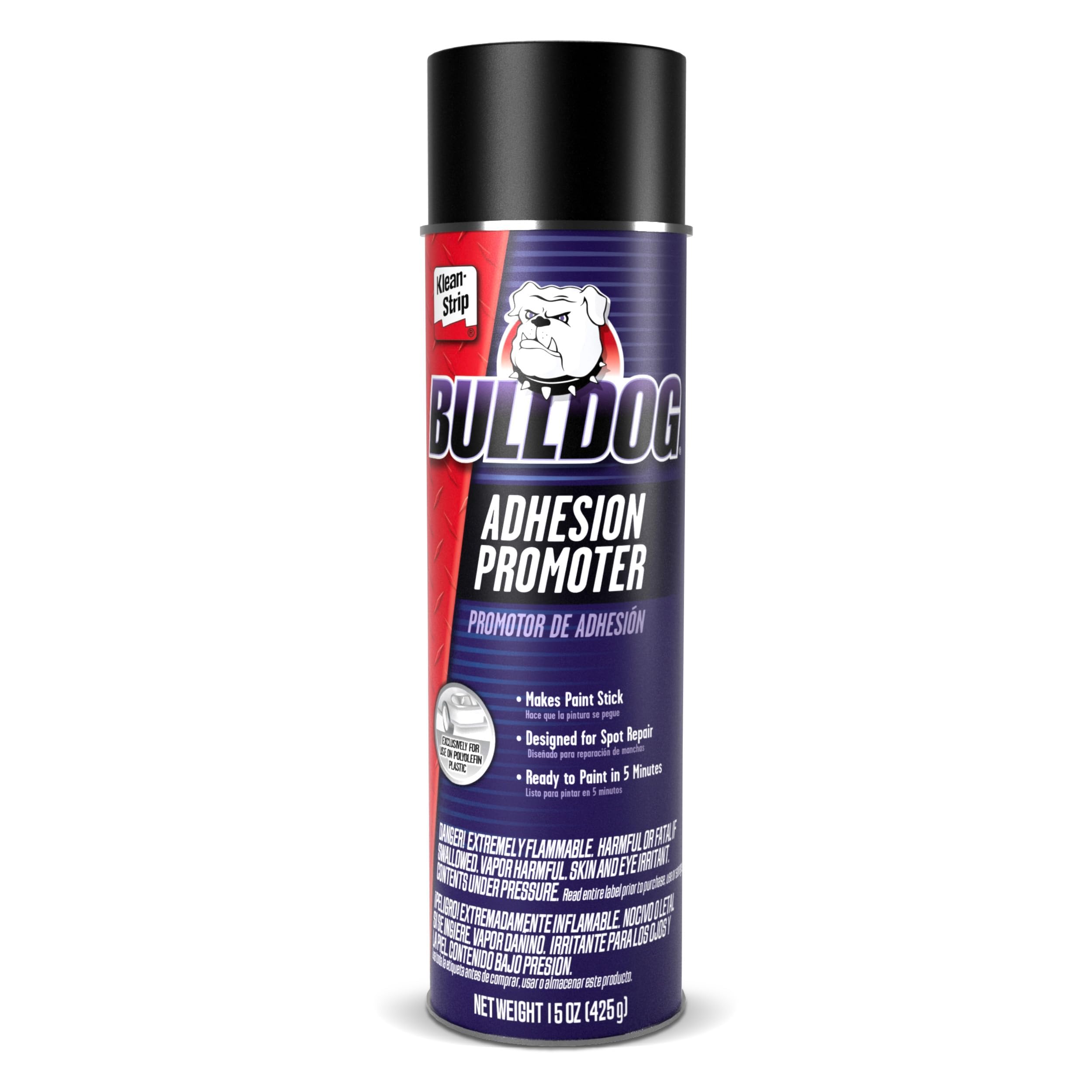
1. KLEAN-STRIP Bulldog Adhesion Promoter for Polyolefin Plastic Quick Dry Adhesion Promoter for Paint Prep – Fills 320 Grit Scratches – 15 Ounce Aerosol
Our pick — over 4.5★ from 650+ verified ratings; the strongest balance of quality and price.
The five-minute flash time that turns bare plastic trim into a paintable surface.
This is the one to reach for when your project is bare polyolefin plastic — the slick stuff car bumpers and fender flares are made from. It arrives as a 15-ounce aerosol can, sprays on clear, and dries tack free in 5 minutes, so you can have topcoat on the part inside the same afternoon. It also fills fine scratches left behind by 320-grit sanding, which means less time at the sander.
What wins people over is that it simply works on the parts that fight back. The spray lays down evenly, the film dries fast, and the panel comes out ready for the next layer without any wet-sticky wait. It is compatible with acrylic lacquers, basecoats, epoxies, primers, sealers, and solvent-based urethanes, so you are not locked into one brand of topcoat. What stands out further is the working window: the promoter stays active for up to 24 hours after you apply it, so you can prep the part one evening and shoot color the next day. The can itself carries a shelf life up to 2 years.
This aerosol beats the LAUCO quart on small jobs because you skip the pouring, mixing, and cleanup that a quart format forces on you. Spray it straight onto trim and handles and you are done. On bigger flat panels the LAUCO stretches further, so the two even out. The honest catch is what that convenience costs: the can sprays out fast, so a large hood or a whole vehicle burns through it quickly, and some buyers report the per-job cost runs high.
What buyers keep coming back for
- 5-minute tack-free dry time keeps a painting session moving
- Fills 320-grit sanding scratches so you sand less
- 24-hour active window lets you spread the job across two days
- Works with acrylic lacquers, basecoats, epoxies, primers, sealers, and solvent-based urethanes
Where it asks something back
- Fast-spraying aerosol burns through product on large flat panels
- Per-job cost runs high for anyone covering a whole vehicle
- Clear color means no visual guide to show where you already sprayed
Lock it in if: your job is bumpers, trim, fender flares, or any small plastic part you want prepped and painted in one sitting.
Hold off if: you need to cover a whole car body or large flat panel, where a quart of pour-on promoter goes further.
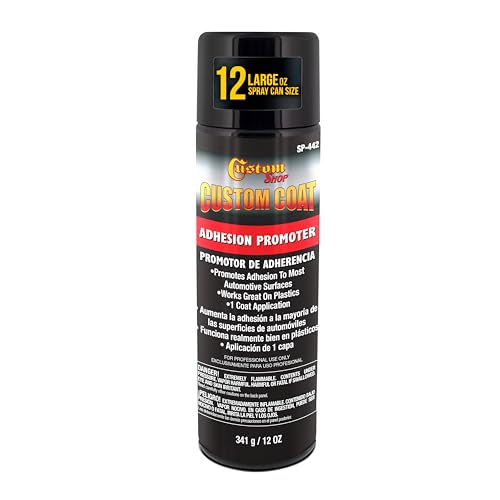
2. Custom Shop Adhesion Promoter 12 fl. oz Spray Can
The all-rounder spray that bridges plastic, aluminum, fiberglass, and painted surfaces in one can.
If your project mixes materials, this is the can that does not make you choose. It bonds to plastic, aluminum, fiberglass, and painted surfaces, and it is built to skip the sanding step on hard-to-reach spots. The high atomization nozzle throws a wide fan pattern, so coverage goes on quickly with less hand effort than a narrow spray. Before applying truck bed liner, owners mention this is the layer that makes the liner stick.
Its real strength shows up on larger jobs where you want one product to cover several surfaces. It is compatible with all automotive refinish products, so you are not hunting down a matching brand. Automotive detailers lean on it for plastic bumpers, grille trim, and prepping for vinyl wrap. For fiberglass work it holds up well too, which is where the KLEAN-STRIP’s polyolefin-specific formulation plays a narrower role.
The honest trade-off on this one is that it is not a miracle finish. Buyers call it a cost-effective alternative to commercial spray-ons, not an equal, and it rewards a proper prep routine with sanding beforehand. Mix-in the reports of it holding up on an Altima dash and the pattern is clear: done right, it lasts; skipped prep, it will not. Buyers put it plainly once the liner is down.
Where the value lands: the spray can format, the wide fan nozzle, and the fiberglass-to-plastic range mean one can covers several jobs without a product switch. That is what justifies reaching for it over a tighter, surface-specific promoter.
Go for it when: your job involves a mix of plastic, fiberglass, or metal and you want one spray can to handle the prep across all of them.
Reconsider if: you need a dedicated polyolefin-specific promoter for raw bumper-grade plastic, or if you want a quart to roll on a large panel.
3. INSL-X SXA11009A-04 Stix Acrylic Waterborne Bonding Primer, 1 Quart, White
The roll-on waterborne that grabs glossy tile, PVC, and galvanized metal the same afternoon.
When the surface is glossy tile, PVC, glass, or glazed block, a spray can will not do it — you want a quart of roll-on bonding primer. This one is an acrylic-urethane primer-sealer built for the hardest-to-coat surfaces, and it cures fully at temperatures as low as 35 degrees Fahrenheit, so cool-weather projects are not off the table. One quart covers 75 to 100 square feet for interior or exterior work.
What makes this the pick for kitchen and bathroom renovation is its adhesion range. It bonds to drywall, plaster, wood trim and doors, Formica, ceramic tile, glossy surfaces, PVC plastic, masonry, stucco, concrete, cement block, galvanized metal, aluminum, and more. It can be top-coated with almost any product, and the low-VOC formula cleans up with soap and water instead of solvent. Enamel holdout is excellent, which is a fancy way of saying your gloss topcoat lays down smoother and more evenly on top of it.
The catch is the price-per-area on small jobs. A quart only covers around 75 to 100 square feet, so cabinets and multiple coats eat through it quickly, and one owner noted the can is hard to open without the included can opener. Buyers who treat it as a small-quantity helper rather than a whole-room solution get the value: a little goes a long way, and it works so well it pulls double duty on cabinets and kitchen floors. The drying takes a full 24 hours, which means a slower schedule than the five-minute spray promoters.
The flexibility factor: almost any topcoat sticks to it, and it handles both interior and exterior surfaces, which makes it the one quart to keep on the shelf for the tile cabinet job you have been putting off.
Pick this for: cabinets, glossy tile, glass, and hard-to-coat kitchen or bath surfaces where you want to roll on and topcoat with your choice of paint.
Look elsewhere if: you need fast turnaround, since this primer wants a full 24 hours before you move to topcoat, and small quart coverage will not stretch across a whole house.
4. qt XIM Products 11052 White XIM, UMA Acrylic Bonder and Primer/Sealer

A roll-on bonder built to sit on ultra-smooth laminate and porcelain without lifting.
Ultra-smooth laminate is the surface that defeats most primers, and this is the one that holds. It is an acrylic bonder and primer-sealer with improved wet adhesion on hard, glossy surfaces, made to sit under almost any topcoat paint. It goes on smooth with almost no brush marks, levels out nicely, and is low odor for indoor use.
This one earns its spot on how it holds up once the paint has fully cured. Owners who roll it over porcelain tile report a scratch-resistant film that holds even without perfect cleaning first. It also primes laminate, Bondo (a two-part body filler), and painted laminate for epoxy countertops, and the maker’s recommended method is two to three light coats followed by a full two-day dry before the epoxy goes down. It dries fast enough to move between coats without waiting, but it needs a full cure before the heavier topcoats. what separates it from the Stone Coat Countertops primer is the metal-friendly bond — it works on properly prepared aluminum and galvanized metal (steel coated in zinc to stop rust), not just countertops.
The fair caveat here is economy. This is a quart, and heavy users may find the coverage-to-cost ratio tight once you factor in multiple coats, so it is a good fit for one cabinet run rather than a whole room. Pick your metal carefully when using it on metal surfaces, since the wrong prep will not bond. The finish itself is matte and white, which works as a base under most topcoats but is not a clear coat like the spray promoters.
Where it shines: laminate, porcelain, and properly prepped metal in one quart, with a smooth streak-free lay-down that leaves almost no brush marks.
Perfect for: cabinet runs, laminate countertops, porcelain tile, and prepared metal surfaces where smooth roll-on coverage matters most.
Skip if: you need to cover a wide area economically or want a fast five-minute prep, since this primer wants multiple coats and a longer cure window.
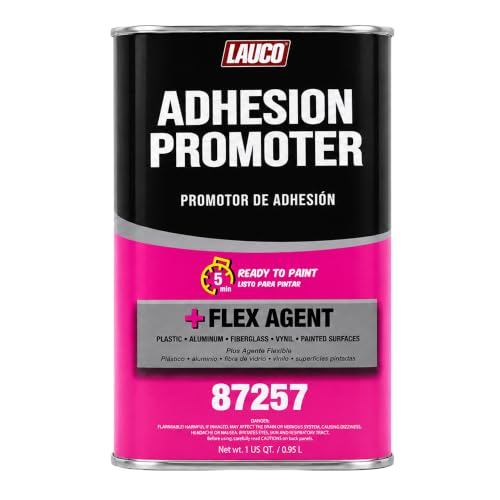
5. LAUCO Adhesion Promoter Quart, Automotive Surface Adhesion Enhancer with Flex Agent for Plastic, Metal, Fiberglass, and Vinyl, Fast Dry, Ready to Paint in 5 Minutes 87257
The quart of pour-on promoter that lets a body shop paint again inside five minutes.
Pour it, spray it, or brush it, and the surface is ready for topcoat in 5 minutes — the same flash time (how long the primer needs before you can coat over it) as the leading aerosols, but in a container that stretches across a much larger panel. It is formulated to improve bonding on plastic, metal, vinyl, and fiberglass, with a flex agent (an additive that keeps the dried film flexible) so the finish moves with the panel instead of cracking.
The range on this one is broad: rigid plastics, ABS, polypropylene, aluminum, steel, and more. It is built to reduce peeling, blistering, and delamination on plastic, metal, vinyl, and fiberglass before the topcoat goes on. If you are prepping a project that involves several materials in one job, this quart means one product to cover them all.
The honest note here is the format. A quart is more product than many single-bumper jobs need, and buyers who only spray one panel have noted they would have preferred a rattle can. It also asks for a full prep routine — clean, degrease, and sand — before it does its job. Prep improperly and the promoter will not save the finish; prep properly and the bonded layer holds like it should.
The volume advantage: one quart with a flex agent, a 5-minute ready-to-paint window, and coverage across plastic, metal, vinyl, and fiberglass means one can handles a multi-material body job without a second product.
Reach for this if: you have a quart-sized job, several substrates in one project, or you want the flex agent working for a bumper or trim piece that sees road flex.
Not for you if: you are prepping a single small part and would rather have the aerosol convenience of a spray can.
6. Stone Coat Countertops Bonding Primer & Sealer, 1 Quart (Translucent White)

The purpose-built primer that makes an epoxy pour stick to a dated laminate countertop.
If your project is covering yellow laminate or old cultured marble with a pourable epoxy finish, this is the primer designed from the ground up for exactly that. It is a urethane modified acrylic bonding primer and sealer in a low-odor, low-VOC formula, made to sit under epoxy on laminate, tile, granite, quartz, solid surface, and cultured marble. It is a direct upgrade replacement for the XIM UMA Primer, with a translucent white color that lets you see the layer as you work.
Applying it is deliberately simple: roll on two coats with a microfiber roller, sanding lightly between the layers for the best bond. Cleanup is warm soapy water — no solvents, so no harsh fumes in a small bathroom or kitchen. The primer covers yellow laminate countertops well enough that no bleed-through shows through the final epoxy, and extra coats handle tinted surfaces. what separates it from the general-purpose INSL-X Stix is that every formulation choice is aimed at one job: creating a foundation for poured epoxy.
The recurring gripe is opacity, not adhesion. Translucent white means a heavy-yellow or patterned countertop may still take multiple coats before the base is fully hidden, and one owner said they could have used a little more opacity to cover the pattern in fewer passes. The primer is thick, which helps hide the laminate itself, but on very dark or heavily patterned surfaces you should plan the extra coat.
Why it fits the epoxy job: the urethane modified acrylic base (a resin blend that grips both plastic and metal) and low-VOC formula (low in volatile organic compounds, the solvents that give off fumes) were built to be a clean foundation under a poured epoxy topcoat — a different job than prepping a bumper or a cabinet door.
Buy it when: you are resurfacing a laminate, tile, or cultured marble countertop with a pourable epoxy and want a primer purpose-built for that specific job.
Pass if: you need a clear coat over a decorative surface, or you are prepping automotive plastic, which calls for a polyolefin-specific promoter instead.
7. 3M Adhesion Promoter 111, Clear, 250 mL Bottle, Fast-Acting, Quick Drying

The bottle that makes double-sided tape grip like it was welded on.
This one is not for paint. It is for making self-stick tape and gaskets hold on surfaces that would normally reject them. It is an isopropyl alcohol based promoter that dries very quickly with a non-offensive odor, and it works on paint and metal — the surfaces tape traditionally struggles to grip. It can even act as a primer in some applications, cleaning and promoting adhesion in a single step.
Owners who use it with 3M VHB tape describe a near-permanent bond that took multiple tools to scrape off. The same performance shows up on neoprene gaskets — attaching fender flares to an offroad rig through mud, heavy rain, and rocks, or reattaching door and trunk gaskets that had lifted after the factory adhesive failed. It builds faster than a standard promoter at both normal and cooler temperatures, so cool mornings do not stall the job.
The one firm warning on the label is that this is for industrial or occupational use only and is not for consumer sale or use — worth knowing before you buy, even if it shows up on retail shelves. Either way, this bottle lasts a long time, and buyers who work with tape regularly treat it as a staple.
Where it earns its keep: one bottle replaces a stack of single-use wipes, works on metal and painted surfaces, and cures in 60 minutes for a bond that stays put through mud and rain.
Bring it home if: you install VHB tape, mount trim, reattach gaskets, or any time the surface and the tape argue about who is sticking to who.
Not the one if: you are prepping a plastic bumper or cabinet for paint, since this promoter is built for tape and gaskets, not paint adhesion.
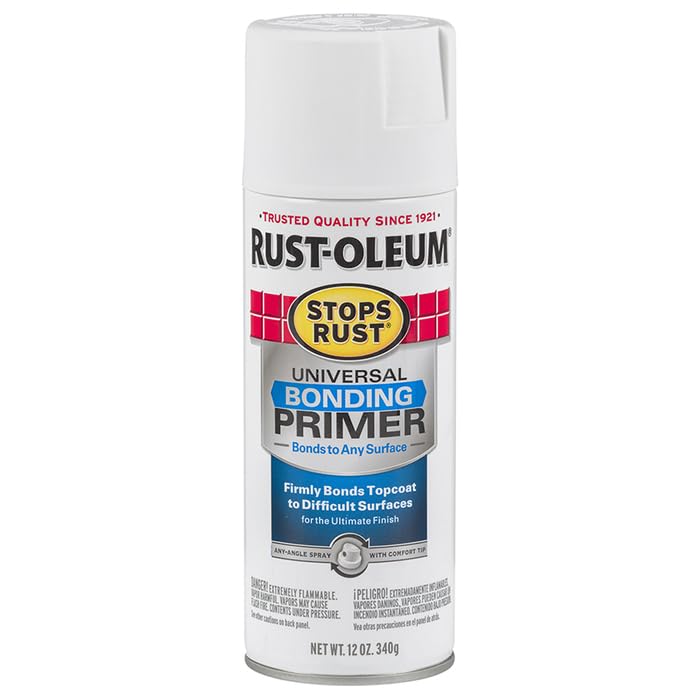
8. Rust-Oleum Stops Rust Universal Bonding Primer Spray, Flat White
The 30-minute-dry spray that bonds to rusty steel without a heavyweight prep routine.
When your project is outdoor and the surface has seen weather, this is the spray that keeps it simple. It is a water-based flat white bonding primer for interior and exterior use, built for galvanized steel, wrought iron, railings, furniture, laminate, PVC, porcelain, masonry, and glazed brick. It dries to the touch in 30 minutes and covers up to 10 to 12 square feet per can.
What sells this one for patio and metal furniture is the corrosion control. The formula is built to stop rust and corrosion on galvanized steel and wrought iron, not just to bond. On fiberglass and stainless steel it holds up well too, and owners who used it on wicker patio furniture and on a concrete porch ornament report it goes on smoothly and stands up to the weather. Recoat anytime, no strict window, which is the opposite of a promoter that demands you topcoat inside five minutes.
The honest tension on this one is the odor. Buyers describe it as extremely strong, which is unusual for a low-VOC water-based formula, so if you are spraying indoors, good ventilation is non-negotiable. The 12-ounce can also limits coverage to 10 to 12 square feet per can, so a large surface takes more cans than the quart options. Some buyers also find it pricier than the plain alternatives, which is the value complaint that shows up alongside the positive coverage notes.
Why it earns the tail slot in the outdoor lineup: it covers galvanized steel, wrought iron, laminate, PVC (a common rigid plastic), and porcelain, and it dries in 30 minutes — so it is the one spray to grab when the job is outside and the surface is a mix.
Grab this when: your project is a railing, patio chair, door, or galvanized piece that lives outside and you want a quick-drying spray that also works as rust protection.
Look past it if: you are working in a small enclosed space, since the strong odor means this wants open air or serious ventilation.
9. Liquid Rubber Multipurpose Primer for Concrete, Wood, Metal, 1 Gallon
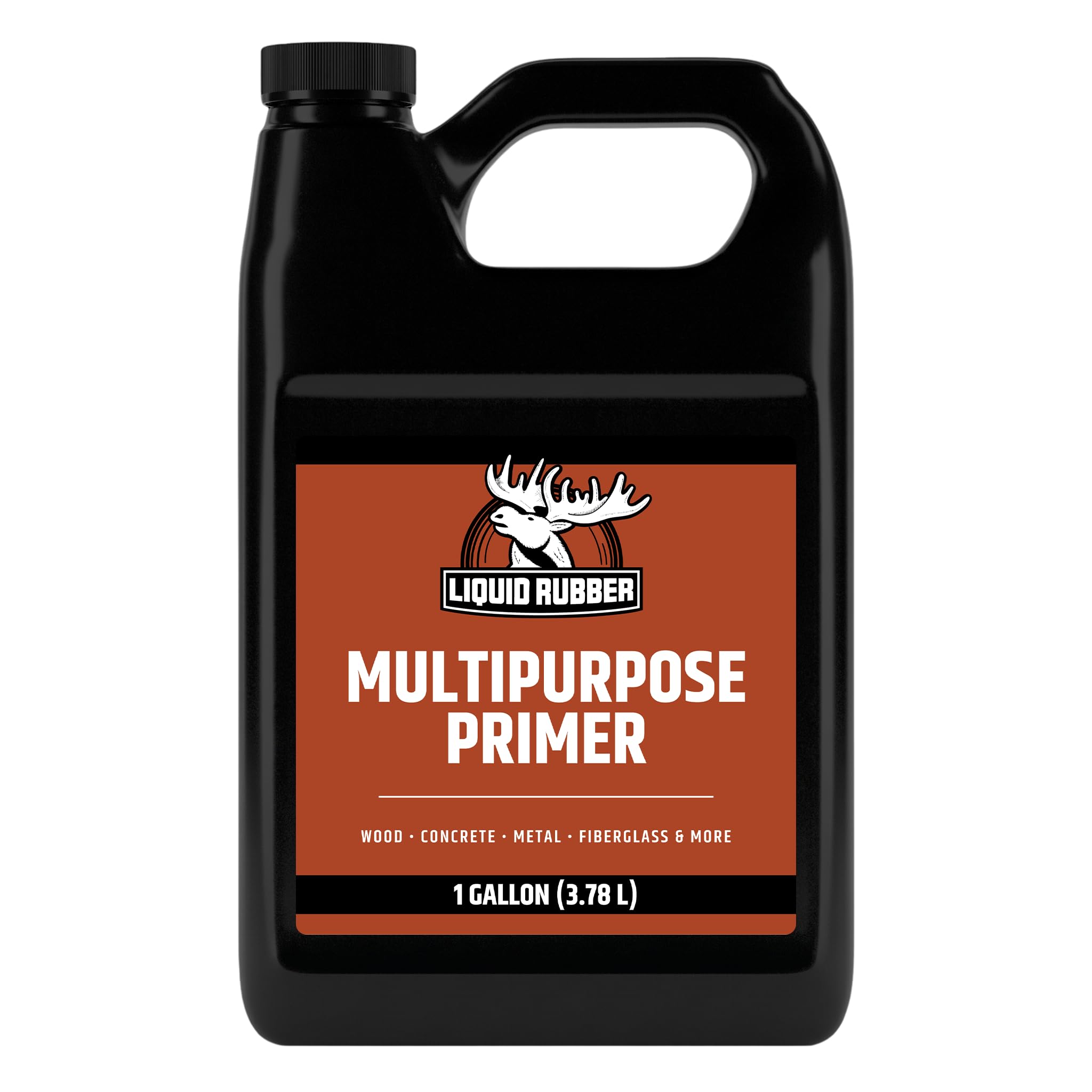
A full gallon of water-based primer that covers wide outdoor surfaces without a solvent load.
For a porch, deck, or large concrete slab, volume decides value, and this is the gallon option. It is a water-based, non-toxic primer for concrete, wood, and high-density polyethylene that improves adhesion, prevents blistering, and dries clear with a matte finish. It goes on with a brush or roller, or can be sprayed with the right equipment, and you apply one to two coats depending on the surface.
Coverage is the headline: one gallon reaches 175 to 200 square feet, which is far more area per container than the quart primers here. Dry time is 1 hour, and the full cure is 2 hours, so you can topcoat within 24 hours once the surface is tack free. The formula is water based with no solvents and low VOCs, so the odor and cleanup story is friendlier than a solvent promoter. On weathered, previously painted decking, customers note it works well and leaves a clean, clear result over wood.
The honest caveat is durability on high-wear surfaces. Some buyers who applied it under a polyurethane deck coating report it failing within a year, and durability carries the negative signal in the reviews overall. It also wants a fully dry, clean surface — no dirt, debris, oil, silicone, laitance, or efflorescence — and you should not apply it before rain or forecasted dew. Treat it as a primer for well-prepped, properly coated outdoor surfaces, not a shortcut around surface readiness.
The coverage case: a gallon covering 175 to 200 square feet with a 1-hour dry and clear matte finish is the formula for covering a deck or slab without buying three separate containers.
Worth it if: you are priming a large concrete or wood surface and want maximum coverage from a single water-based gallon with fast dry times.
Think twice if: your project is a high-wear finish that has to survive years of foot traffic, where the durability reports here make a specialized deck product the safer call.
Understanding the Specs
Flash Time and Dry Time
Flash time is how long you wait before the surface is ready for the next coat. A five-minute flash means you can spray topcoat almost immediately, which is what the aerosol promoters like the KLEAN-STRIP Bulldog and the LAUCO quart offer. A 24-hour dry, like the INSL-X Stix, means you prime one day and paint the next. Neither is universally better — fast suits small trim jobs, while a slower window is easier to schedule around.
Container Format and Coverage
Container format changes how you apply the primer more than anything else. A 15-ounce aerosol reaches into trim and awkward parts but runs out quickly on a large panel. A quart covers roughly 75 to 100 square feet, enough for cabinets but not a whole room. A gallon like the Liquid Rubber stretches to 175 to 200 square feet. Match the container to the size and shape of the job.
Topcoat Compatibility
The primer has to live with your paint. Some bonding primers, like the INSL-X Stix and the XIM UMA, work under almost any topcoat. Others, like the KLEAN-STRIP Bulldog, are specifically listed as compatible with acrylic lacquers, basecoats, epoxies, primers, sealers, and solvent-based urethanes. Read the primer label’s compatibility list before you buy the paint, not after.
Surface Match
Every primer here has a surface it was built for. Polyolefin plastic wants an automotive promoter like the KLEAN-STRIP Bulldog or the LAUCO quart. Glossy tile, PVC, and laminate want a roll-on bonding primer like the INSL-X Stix or XIM UMA. Galvanized steel and rusty metal want the Rust-Oleum spray. Concrete and wood want the Liquid Rubber gallon. Match the primer to the surface and the rest of the job gets easier.
FAQ
Do I really need an adhesion primer on plastic bumpers?
What is the difference between an adhesion promoter and a bonding primer?
Can I put paint straight over an adhesion promoter?
How much area does a quart of primer cover?
Can I use an adhesion promoter on bare metal?
Does the primer need to fully cure before I coat over it?
Is a low-VOC primer actually safer to use indoors?
How do I prepare a surface before applying adhesion primer?
Will adhesion primer work on a glossy tile or laminate floor?
Which primer should I use under a poured epoxy countertop?
Final Thoughts: The Verdict
For the majority of shoppers, the adhesion primer winner is the KLEAN-STRIP Bulldog Adhesion Promoter because it combines a 5-minute tack-free dry (touch-dry, no longer sticky), a 24-hour active window (the time you have to topcoat it), and clear compatibility with acrylic lacquers, basecoats, epoxies, primers, sealers, and solvent-based urethanes — a package that makes prepping trim, bumpers, and plastic parts a one-session job. If your project is cabinets, glossy tile, or laminate counters, grab the INSL-X Stix Acrylic Waterborne Bonding Primer and roll on two coats. And for taping gaskets, fender flares, or anything that calls for VHB (a strong double-sided foam tape), the 3M Adhesion Promoter 111 is the one to reach for.
How We Picked
We do not accept paid placement. Every pick is matched to a real buyer and a real use-case; we do not hands-on test units.
Sources & Methodology
Specifications: manufacturer listings and product documentation. Review insights: verified customer reviews, as of September 2026. Pricing: not shown on this page (it changes often); check the current price via the retailer link.
As an Amazon Associate, KitchPrep earns from qualifying purchases. This does not affect which products we feature.
Related Guides
