
Specs are compiled from manufacturer listings and verified buyer reviews and can change over time — please confirm the key details on the product page before buying.
Your floor is only as good as the glue underneath it, and the wrong adhesive means hollow spots, popping planks, and a repair job you will hate.
I’m Mohammad Maruf — the founder and writer behind KitchPrep. This guide is built by comparing the manufacturers’ published specifications and the patterns across verified customer reviews, so you get each pick’s real strengths and trade-offs instead of marketing spin.
Some adhesives are built for squeezing a bead into a tongue-and-groove joint, others are meant to be troweled across concrete as a full-spread mooring. A few you can pour, roll, and forget. Knowing which type your floor needs is the whole ballgame when you are choosing the adhesive for hardwood flooring.
Our Picks at a Glance


How To Choose The Best Adhesive for Hardwood Flooring
Before you look at any bottle, answer one question: is your floor floating or glue-down? Floating floors get a bead of adhesive in the tongue-and-groove joint. Glue-down floors get a full bed of adhesive troweled across the subfloor. Picking the wrong type is the most common mistake, and it is the one that costs the most to undo.
Match the adhesive type to your install method
Floating installs need a liquid PVA-style glue that spreads fast in a narrow groove and sets in minutes. Glue-down installs over concrete need a trowel-grade adhesive that doubles as a moisture barrier. If you are patching hollow or squeaking spots after the fact, you need an injectable repair adhesive with a fine tip or syringe, not the same jug you would buy for a fresh install.
Read the coverage number, not the container size
A 16-ounce bottle of Titebond tongue-and-groove glue covers roughly 200 linear feet at a 1/8-inch bead, while a 1-gallon pail of full-spread adhesive covers about 100 square feet with a notched trowel. Those are different units, so a bigger bucket is not automatically more product. Buy to your floor plan, not to the label.
Check open time against your own working speed
Open time is how long you have before the adhesive skins over and stops grabbing. Some tongue-and-groove glues let you reposition a plank for only 4-5 minutes before it needs a crowbar to come back up. Full-spread adhesives give you more room, but even then a thin formula can tack up fast enough that you should work in small sections rather than across the whole room.
Quick Comparison
| Model | Best For | Type | Coverage | Cure Time | Amazon |
|---|---|---|---|---|---|
| Titebond Tongue & Groove Flooring Glue #2104 (6 bottles)★ Best Overall | Floating engineered and laminate floors | Liquid PVA bead | ~200 linear ft per 16 oz bottle | 24 hours | Amazon |
| Sikabond-T21 All-in-One Polyurethane Adhesive – 4 GallonsBest for Concrete | Solid hardwood glue-down over concrete | Elastic full-spread polyurethane | 4 gallons | — | Amazon |
| RecPro RV Roll On Floor Adhesive – 1 GallonMulti-Surface Pick | RV and marine flooring over plywood | Water-based roll-on | ~100 sq ft per gallon | 24 hours | Amazon |
| ARDEX Henry 12235 1171N Floor Adhesive, 1 Gallon | Parquet and 3/4-inch hardwood glue-down | Liquid trowel adhesive | 1 gallon | — | Amazon |
| Bostik- Best Cartridge 10.1 Oz | Moisture barrier under hardwood over concrete | Urethane cartridge adhesive | 10.1 ounces | — | Amazon |
| 32 Fl Oz. Professional Wood Floor Repair Adhesive 2 Pack | Fixing hollow spots and popping boards | Injectable repair adhesive | 32 fl oz per bottle | — | Amazon |
| 3 Pack Titebond 2104 Tongue and Groove Glue Bottle, 16 oz | Smaller floating installs | Liquid PVA bead | 48 oz total | — | Amazon |
| Mannington MegaGlue Laminate & Floating Flooring Adhesive 16oz | Single-room tongue-and-groove touch-ups | PVAC liquid glue | 100 sq ft | — | Amazon |
In‑Depth Reviews
1. Titebond Tongue & Groove Flooring Glue #2104 (6 bottles)
Our pick — 4.5★ from 100+ verified ratings; the strongest balance of quality and price.
The six-bottle case that turns a weekend floating floor into a one-shot job
For anyone laying a floating engineered or laminate floor, this is the case that removes the mid-job panic of running dry. Each 16-ounce bottle lays roughly 200 linear feet at a 1/8-inch bead, and you get six of them, so a typical room can be glued without stopping to reorder. The glue is PVA-based, which means a water-resistant formula that passes Type II water resistance — a real benefit when you are worried about moisture creeping into the tongue-and-groove joint.
What wins people over is the value packed into the case. One buyer used 5 bottles on 1,100 square feet of oil-finish engineered hardwood, matching the 200-linear-foot-per-bottle rating. The second thing they call out is how quickly it sets — the job moves at a pace you have to respect, not fight. One condensed note sums it up well: dry lay the floor first, because once this glue grabs a plank you have only about 4-5 minutes before it needs a crowbar to come back up. That is not a defect; it is the trade-off for a bond that stays put for years. Reviewers who dry-lay first report their floating engineered floors are still tight at the joints five years on.
Where it bites is ease of use. The liquid is thin enough to spread fast, which is exactly why it works in a groove, but it also punishes sloppy handling. A few owners find the thinness fussy at first. The 24-hour full cure time is normal for this class of adhesive, so plan your furniture move-back for the next day.
What earns its place at the top
- Six 16-ounce bottles cover a large floating install — roughly 200 linear feet each at a 1/8-inch bead
- Passes Type II water resistance, so moisture in the joint is not a worry
- Sets in minutes, keeping the install on schedule
Where it asks for care
- Thin liquid rewards clean technique — new installers may want to practice on a spare plank
- Repositioning window is short, so dry-lay the floor before you open a bottle
- 24-hour cure time means no heavy traffic on day one
Go-to for floating jobs: Buy this if you are gluing together the joints of a floating engineered or laminate floor and want one case to finish the room.
Plan for it instead: The short reposition window and thin formula mean you should dry-lay first and keep a damp rag close.
2. Sikabond-T21 All-in-One Polyurethane Adhesive for Wood Floors – 4 Gallons
The four-gallon full-spread that puts real hardwood straight onto slab
If your plan is gluing solid hardwood down over a concrete slab, this is the bucket that carries the job. It is an elastic full-spread polyurethane adhesive, rated waterproof, and it handles boards up to 3/4-inch thick and up to 8 inches wide. The elastomeric chemistry is the reason it is here — it lets the floor move with the seasons instead of cracking, and it pulls double duty as a vapor membrane when you are laying directly onto concrete. One buyer who glued solid hardwood straight to slab rated the finished floor “5 out of 5” and perfectly level.
Nobody wants a creaky floor, and this is the adhesive that tends to deliver a quiet one. The cured bond stays slightly elastic, which reviewers credit for a solid feel and for killing noise and creaks in the finished floor. It cures in only a few hours, so you can move through the room faster than you would with a slower-setting spread. The container also includes a trowel blade that snaps onto any trowel, which saves a trip to the hardware store.
The catch here is shipping, not chemistry. The bucket arrives with only a label over the lid, and an occasional unit shows up dented, which can make it impossible to scrape every last bit out or reseal the lid for a second day. If your order arrives damaged, contact the seller before you start spreading — that is a packaging issue, not a product flaw. The other thing to know is that this is a premium-tier product, so budget accordingly. For a full glue-down over concrete, the time and labor you save by not hiring it out is the real value play.
Why it earns its price: A waterproof, elastic full-spread that bonds boards up to 3/4-inch thick and 8 inches wide, cures in hours, and acts as a vapor membrane over slab — the whole package for a concrete glue-down.
What to watch: Inspect the bucket on arrival and flag any denting before you use it, or you may lose usable product to a deformed lid.
Pick it when: Reach for this if you are gluing solid hardwood over concrete and want a waterproof, elastic bond with a fast cure.
Look elsewhere if: You only need a bead for a floating floor — this is a full-spread product, not a tongue-and-groove glue.
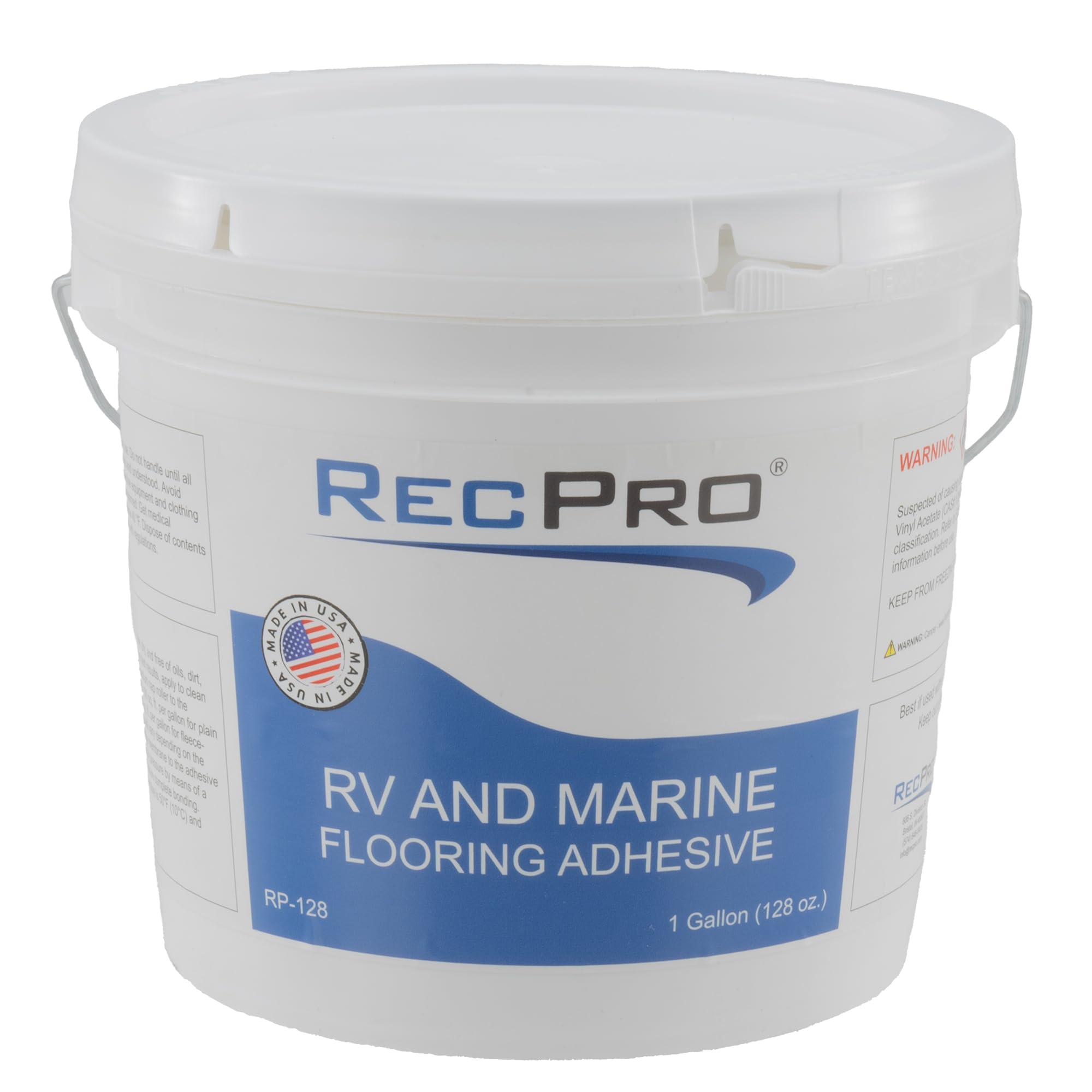
3. RecPro RV Roll On Floor Adhesive | Marine Grade | Water-Based | 1 Gallon
The roll-on that makes an RV or boat floor feel like it will never lift
This one is not for a living-room hardwood install — it is for a do-it-yourselfer sticking a flooring surface down over plywood in an RV, boat, trailer, or hauler. It is a water-based roll-on adhesive that comes in a 1-gallon pail and covers approximately 100 square feet with a notched trowel. Application is the easiest part; the product pours and spreads with a roller, and it wants to be laid down between 65-75 degrees Fahrenheit. After you set it, let it sit for 24 hours before walking on it.
Ease of application is what carries this pick — it is the single most-discussed positive across the review pages. Buyers roll it on with a half-inch nap roller in 5×8-foot sections, and report it works well as long as the plywood surface is clean. One user laid rubber coin flooring on an enclosed car hauler ramp and covered the whole ramp with a single gallon.
Honesty matters here: the notes that come up most often are a mixed bag on effectiveness. Some users report the bond holds strong, others report it let go. The pattern in the pages is that prep and temperature are doing a lot of the work. Surface must be clean, the room must be in the right temperature band, and you should roll the adhesive thick rather than spread it thin. Get those three right and the results read well; skip them and the outcome is patchy. There is also a spread of consistency between buckets in some orders, so do a small test area before you commit the whole pail.
The strong suit
- Rolls on fast and covers roughly 100 square feet per gallon
- Water-based formula is easy to spread and easy to clean while wet
- Works on felt-backed vinyl, rubber coin mat, and similar flooring surfaces over plywood
The reality check
- Effectiveness is genuinely mixed — prep, clean surface, and temperature make the difference
- Best applied only in the 65-75°F band, which limits cold-weather installs
- Consistency can vary between buckets in the same order
Right choice if: You are outfitting an RV, boat, trailer, or hauler and want an easy roll-on that spreads thin and goes far.
Skip if: You are gluing down solid hardwood in a home — that job wants a full-spread trowel adhesive, not a roll-on.
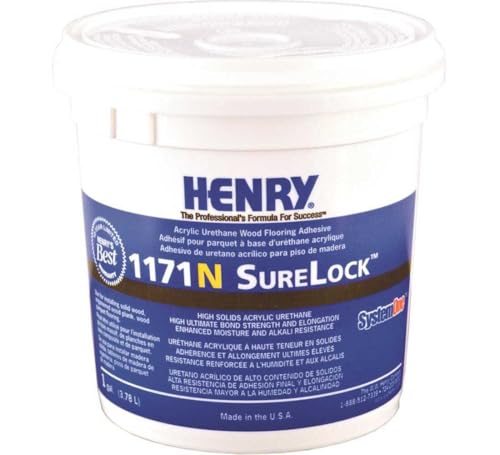
4. ARDEX Henry, WW Company 12235 1171N Floor Adhesive, 1 Gallon
A gallon that treats 3/4-inch hardwood with the patience a first-timer needs
Anyone gluing down 3/4-inch solid hardwood for the first time will appreciate what this Henry gallon does with time. It sets up slower than a fast-grab adhesive, which sounds like a downside until you are on your knees with a heavy board and no second pair of hands. The slower pace takes the stress out of placing each plank and lets you nudge it into alignment before the bond kicks. Water cleanup is another win — buyers describe wiping up slips with soap and water rather than chasing the residue with mineral spirits.
Where it stays honest: the product carries naphtha, so ventilation is non-negotiable. There is a strong smell, and a respirator is the right call if you are working in a closed room. Sturdy rubber gloves are also worth having, since latex tends to tear on adhesive work. Beyond that, water cleanup handles the bulk, though mineral spirits are what removes actual adhesive slips that have cured. Buyers also note the bond sets fast at the point of contact but dries slowly overall, so plan your schedule to leave the floor alone for the full cure.
Shipping is the one recurring complaint worth knowing about — some units arrive partially opened and resealed with tape. If that happens to you, it is worth a support call before you start. As far as what it is built for, this is a parquet and solid hardwood glue-down mug, not a tongue-and-groove bead. Reach for it when you are troweling a full bed under parquet tile or wide solid planks in a garage, workshop, or room where you can ventilate properly.
The slow-set advantage: A patient working window means you can align each heavy board without racing a fast grab — useful for a solo installer of 3/4-inch solid hardwood or parquet.
The ventilation rule: Contains naphtha; work in a ventilated space and use sturdy rubber gloves, as latex tears under adhesive work.
Reach for this if: You are putting down parquet or 3/4-inch solid hardwood and want more time to line each board up before the glue grabs.
Look elsewhere if: You cannot ventilate the workspace — the naphtha smell is real and unavoidable.
5. Bostik- Best Cartridge 10.1 Oz

A moisture barrier in a cartridge, sized for one strip or one patch
Bostik’s BEST is what you grab when you need more than glue — you need a moisture membrane too. The urethane paste is applied as a moisture vapor membrane, and the BLOCKADE protection in the formula is specifically there to stop subfloor moisture from damaging a wood floor laid over concrete. The permeability is low, which is the whole point: it slows vapor transmission from the slab so it does not reach the wood. That elastic chemistry also lets the floor expand and contract with the seasons rather than cracking.
What buyers report across the pages is that the practical side of this product is the reason they keep it on the shelf. The paste exhibits an exceptional green grab immediately after troweling, which means it holds a board in place the moment you set it. Users describe using it to secure transition strips on laminate floors, to patch about 8 square feet of engineered flooring, and for small repairs where a full bucket would be overkill. One note worth heeding is that it sticks to everything, so wipe any drips immediately rather than letting them cure overnight.
The slight catch with a cartridge is that it wants a specific applicator, and a few units arrive with adhesive leaking out of the back. That is a shipping issue, not a formula issue, but worth checking on arrival. If you are working a small transition, a single strip, or a repair patch, the 10.1-ounce cartridge is a sensible size. For a full-room install, you would need many cartridges, so line up a bigger format instead.
Made for: Small moisture-sensitive jobs — transition strips, laminate patches, or repairs where you want the glue and vapor barrier in one application.
Do not expect: Enough volume for a whole room. This is a cartridge for spot work, not a full-spread install.
6. 32 Fl Oz. Professional Wood Floor Repair Adhesive 2 Pack

The syringe-in-a-bottle that quiets a popping floor without pulling a single plank
This is a repair kit, not a fresh-install adhesive. It exists to fix the two most annoying wood floor problems: hollow spots and the cracking or popping sound that comes from an adhesive void between plank and subfloor. Instead of lifting boards up, you drill a small hole and inject the glue into the void, which fills the gap and takes the noise with it. It was developed for engineered wood floors where earlier adhesives left voids under the planks, and the 2-pack gives you two 32-ounce bottles.
Owners describe silencing a cracking sound in three separate hollow spots, though the glue needs a firmer push through the injection hole than they expected. That extra effort is the trade-off: a tight hole means the adhesive sits where you want it, but it also means a solid push on the applicator. One practical note from the pages is to buy more product than you think you need, since a single hollow spot can swallow more glue than it looks like it should.
The honest limit is that this fix does not land every time. Occasionally the void is in a spot the glue cannot reach, or the problem is structural rather than a gap, and the repair does not take. If your floor is beyond a spot repair, this is not the right tool. But for the specific case of a hollow or creaky board over a stable subfloor, the 2-pack is a straightforward solution that saves you from tearing the room apart.
Why it is on this list
- Targets hollow spots and popping boards without removing planks
- Two 32-ounce bottles give you enough to chase multiple problem spots
- Quiets the cracking sound that comes from adhesive voids
Honest limits
- Requires a firm push to inject through a small hole — patience and grip matter
- Not every void responds; a structural problem will not be fixed by injection alone
- Users consistently report needing more product than they estimated
Best for: Filling hollow spots and silencing a creaking engineered wood floor where you cannot or do not want to lift the boards.
Not the tool for: A full-room glue-down or a floating-floor joint — those need a fresh-install adhesive, not a repair injector.
7. 3 Pack Titebond 2104 Tongue and Groove Glue Bottle, 16 oz

Same proven PVA glue as the case, sized down for one room
This is the same Titebond 2104 tongue-and-groove glue in a three-bottle pack, which makes sense if your job is smaller than the full six-bottle case. You get 48 ounces total across three bottles, and the formula is recommended for laminate and floating floors, including installations over radiant heat systems. The fine-tip tube lays a precise bead, so you are not fighting a fat nozzle in a narrow groove. The adhesive dries clear, which keeps your joints looking clean on the finished floor.
What owners mention is that the fine tip is the quietly important part. Used on an engineered maple 5-inch floating floor, the bottle lays a clean, controlled bead with no smearing across the plank face. The glue also stays workable long enough to close up each joint before it sets, so you can move at a comfortable rhythm rather than a sprinter’s pace. Drying clear means any minor squeeze-out disappears into the seam instead of leaving a white haze.
The tip that saves the most product is storage. The glue has a habit of thickening at the bottom of the bottle between sessions, so tip the tube upside down and recap it after each plank. Users who follow that practice report no thickening issues at all. Long-term flexibility and crack resistance are not something the pages can promise with certainty, so if your floor faces big seasonal swings, treat this as a trust-the-brand gamble rather than a guarantee.
The tip wins it: A fine-tip nozzle lays a precise, clean bead in a tongue-and-groove joint without the mess, and the 48-ounce total is a good size for a single room.
What to plan for: Store the bottles upside down and recap after each plank, or the glue will thicken at the bottom between sessions.
Choose this over the case if: Your floating install is a single room and you do not want leftover bottles sitting on a shelf for a year.
Step up to the case if: Your job is a whole floor — six bottles will serve you better than three.
8. Mannington MegaGlue Laminate & Floating Flooring Adhesive 16oz

A single 16-ounce bottle built for small tongue-and-groove jobs and quick fixes
Mannington MegaGlue is a PVAC-based liquid glue designed for the Mannington Mega tongue-and-groove system, and it works for the same class of job as any bead-in-groove adhesive. One bottle covers about 100 square feet of flooring, which is why it fits a single small room or a short run of repairs rather than a whole-house install. It dries clear, so squeeze-out along a joint does not leave an obvious line, and the liquid flows enough to spread quickly in a groove.
On the repair side, customers note the bottle bailing them out of real problems. Used to re-glue peeling laminate in an RV with injection needles, the fix went in cleanly enough that the surface looked like new. It also works well gluing tongue-and-groove boards together and holding transition pieces on a laminate floor. At 100 square feet of coverage, it is a practical size when you do not want a case of glue going to waste.
Two honest notes worth flagging. First, this is a single bottle, not a case, so a full-floor job needs several. Second, a couple of users report the product arriving with the nozzle seal broken or glue already pooled in the box — a shipping issue to look for on arrival. And a couple of buyers thought the bottle was meant for a different job than it is, which is the classic tongue-and-groove-versus-full-spread confusion. Match the product to the install and this size does its job well.
Where it shines
- Covers 100 square feet from a single 16-ounce bottle
- Dries clear, so squeeze-out does not show on the finished joint
- Handy for re-gluing peeling laminate, transition strips, and small repairs
Watch for
- Single bottle only — a full-floor install needs several bottles
- Occasional units arrive with a broken nozzle seal and glue in the package
- Easy to mistake for a full-spread adhesive; confirm your install method first
Best for: One small tongue-and-groove job or a repair where a full case of glue would be overkill.
Skip if: You are covering a whole floor or laying a full-spread glue-down — this bottle sized for 100 square feet is not enough for either.
Understanding the Specs
Bead versus Full-Spread Coverage
Tongue-and-groove adhesives are measured in linear feet because you are running a bead along the joint. Titebond 2104 lays roughly 200 linear feet at a 1/8-inch bead per 16-ounce bottle, while the Titebond 2104 three-pack gives you 48 ounces and the six-bottle case gives you six bottles. Full-spread adhesives, like the RecPro roll-on, are measured in square feet because you are covering a whole floor area — around 100 square feet per gallon when applied with a notched trowel. When a listing shows 100 sq ft of coverage on a single bottle, that tells you it is sized for a small room or a patch, not a whole house.
Open Time, Cure Time, and Moisture Blocking
Open time is the window you have to reposition a board before the adhesive skins over and takes hold. A thin tongue-and-groove glue like Titebond may give you only about 4-5 minutes of repositioning, while slower adhesives give you more room to nudge heavy boards into place. Full cure can run longer — 24 hours is typical across the products here. If you are bonding wood directly to a concrete slab, look for an adhesive like Bostik’s BEST or Sikabond-T21 that doubles as a moisture vapor membrane; the goal is to slow vapor transmission from the slab so moisture never reaches the wood. For tongue-and-groove installs over radiant heat, the manufacturer recommends a formula rated for that use, such as the 3-pack of Titebond 2104.
FAQ
Do I need the same adhesive for a floating floor as for a glue-down floor?
How many bottles do I need for a floating floor install?
How long does flooring adhesive take to cure?
Can I use the same adhesive over concrete as over wood subfloor?
Will a tongue and groove adhesive work over radiant heat flooring?
How do I fix a hollow spot or squeak after the floor is already laid?
How much coverage should I expect from a 1-gallon bucket?
Is a full-spread polyurethane adhesive worth the higher cost over a bead glue?
Does the color of the adhesive matter for the finished floor?
What is the best way to store leftover flooring adhesive?
Final Thoughts: The Verdict
Across the board, the adhesive for hardwood flooring winner is the Titebond Tongue & Groove Flooring Glue #2104 because it nails the floating-floor job — six bottles, Type II water resistance, roughly 200 linear feet per bottle, and a set time that keeps the install moving. If you are gluing solid hardwood down over concrete and want a waterproof barrier in the bucket, grab the Sikabond-T21. And for the annoying hollow spot you cannot stop hearing at night, the Professional Wood Floor Repair Adhesive is the one to reach for.
One nudge: if your install is more than one small room and you are still deciding, the six-bottle Titebond case is the safest single call because the coverage math leaves you a working margin — and the whole point of buying a case upfront is not to stop mid-install for another order.
How We Picked
We do not accept paid placement. Every pick is matched to a real buyer and a real use-case; we do not hands-on test units.
Sources & Methodology
Specifications: manufacturer listings and product documentation. Review insights: verified customer reviews, as of September 2026. Pricing: not shown on this page (it changes often); check the current price via the retailer link.
As an Amazon Associate, KitchPrep earns from qualifying purchases. This does not affect which products we feature.
Related Guides
