
Specs are compiled from manufacturer listings and verified buyer reviews and can change over time — please confirm the key details on the product page before buying.
Carbon monoxide has no smell, no color, and no taste, so the only way you know it is building up in a vehicle cabin is a detector wired to tell you. That matters most in RVs, travel trailers, campers, and any rig where you sleep, cook, or run a heater a few feet from where you breathe. This guide covers four 12-volt units built specifically for that life and explains, in plain words, which one earns its spot on your wall.
I’m Mohammad Maruf — the founder and writer behind KitchPrep. This guide is built by comparing the manufacturers’ published specifications and the patterns across verified customer reviews, so you get each pick’s real strengths and trade-offs instead of marketing spin.
Three specs decide whether a 12-volt alarm protects you or just eats wall space: its wiring, what it detects, and how loudly it reacts. Every pick below is a real 12-volt vehicle alarm, so you can stop guessing and choose the auto co detector that fits your rig, your wiring, and your sleeping quarters.
Our Picks at a Glance

How To Choose The Best Auto CO Detector
In a vehicle, you do not get to smell a problem before it becomes one, so your detector has to be chosen on wiring, sensing, and mounting rather than looks. Here is what actually moves the needle.
Match the power source to your rig
A hardwired 12-volt unit draws from your coach battery and never needs a battery swap, which is why most RV owners pick one. A portable rechargeable detector runs on its own cell and can travel from the camper to the garage, but you are responsible for keeping it charged. Hardwired suits a rig you sleep in nightly; rechargeable suits a detector you carry between vehicles.
Decide if you need propane detection too
Many RV alarms are dual-duty, watching both carbon monoxide and liquid propane. If you cook or heat with propane in a space you also sleep in, a dual unit covers two hazards from a single spot on the wall. If carbon monoxide is your only concern, a dedicated CO detector does the narrower job.
Check the temperature range against your climate
Your alarm works in whatever cold or heat your rig sees, so a unit rated for harsh conditions keeps functioning through a frozen overnight or a parked-in-the-sun afternoon. A detector that quits in extreme cold quits exactly when a heater is running and you need it most.
Look at sensor age before you mount it
An alarm that sat on a shelf before shipping has already used up part of its sensing life, so it is worth checking the date before you commit. A sensor that is replaceable lets you keep the housing and refresh the part that does the actual work.
Quick Comparison
| Model | Best For | Type | Power Source | Detects | Amazon |
|---|---|---|---|---|---|
| Safe-T-Alert 35-742-BR★ Best Overall | Trailers and tight wall spaces | Flush mount, 12V | Battery powered (12V DC) | Propane and CO | Amazon |
| Safe-T-Alert 85-741-WT | Replacing an OEM RV alarm | Slim line, trim ring included | 12V DC hardwired | Propane and CO | Amazon |
| TOPTES CT-913 | Inspections and portable use | Portable, handheld | Rechargeable 4000mAh battery | CO only | Amazon |
| Safe T Alert 25-741-BL | Motorhomes with tight wall space | Surface mount mini, 12V | Corded electric (12V DC) | Propane and CO | Amazon |
In‑Depth Reviews
1. Safe-T-Alert by MTI Industries 35-742-BR 35 Series Dual LP/CO Alarm – Flush Mount, Brown
Our pick — over 4.5★ from 950+ verified ratings; the strongest balance of quality and price.
The alarm that disappears into your panel and watches two hazards at once.
If you own a trailer and want your detector to look like it was always part of the interior, this is the one to start with. It is a dual-duty unit, meaning a single device watches for both propane leaks and carbon monoxide — the two dangers that share space in a camper kitchen. The flush-mount body sits nearly flat against the wall, so nothing snags on it as you move around a narrow galley.
The numbers back up the small footprint. The case measures 6.375 inches wide by 2.875 inches tall by 1.25 inches deep, and the listed item dimensions run 1.25 by 6.3 by 2.8 inches. Compared to a typical RV alarm, that is a meaningfully tighter package, which is exactly the point when wall space is already spoken for. It runs on 12 volts DC at a current draw of 108 milliamps, and in plain terms that is a trickle your coach battery will barely register overnight.
What wins people over is how it handles the extremes. It is rated to operate from -40°F to +158°F, so a frozen overnight in the mountains or a sun-baked afternoon on the pavement does not take it offline. It also carries a low voltage power warning, which means it tells you when your supply is sagging rather than quietly failing. Universal fit means it is built to slot into common RV cutouts rather than one specific model.
The one thing to get used to is the startup sequence. A green flash at power-up looks a lot like an end-of-life signal, but a steady green means normal operation — the instructions cover it, though they are not the clearest. If you are replacing an old alarm and you already know your way around 12-volt wiring, this is the safest hands-off pick of the four.
What earns it the top spot
- Dual sensing for propane and carbon monoxide from one flush panel unit
- Operating range of -40°F to +158°F covers harsh RV conditions
- Low voltage power warning tells you when the supply drops
- Compact 1.25 x 6.3 x 2.8 inch footprint for tight walls
What to keep in mind
- The startup green flash reads like a fault before it settles to steady
- Only one LED lights during normal operation despite two sensors
- Documentation is thin and takes some reading to follow
Settle on this one: you want a low-profile dual alarm that guards propane and CO together in a camper or travel trailer.
Go elsewhere if: you need a detector you can carry between vehicles, since this one stays wired in place.
2. Safe-T-Alert 85 Series Carbon Monoxide Propane Gas Alarm – 12V – White [85-741-WT]
![Safe-T-Alert 85 Series Carbon Monoxide Propane Gas Alarm - 12V - White [85-741-WT]](https://m.media-amazon.com/images/I/61PNy6O1QML.jpg)
Built for the moment your old RV alarm finally gives out.
This is the pick for someone staring at a dead unit on the wall of a camper they already own. The 85 Series is a slim-line dual LP/CO alarm designed for the rugged RV environment, and it arrives with a trim ring in the box, so the swap does not mean hunting for extra parts. If your rig came factory-equipped with a Safe-T-Alert, this is the closest thing to plugging a new one into the old footprint.
Buyers report the swap is easy, with no modifications needed and a straight match for the original. It uses a 12-volt DC hardwired connection (a direct wire to your vehicle’s power), so it runs off your coach supply instead of a replaceable battery. At 11.36 ounces it weighs more than the surface-mount mini in this guide, which is 5.6 ounces, but that extra weight comes from a low-profile housing designed to sit unobtrusively against the panel.
A finished edge makes the finished install look intentional instead of improvised, which is why the easy-swap story lands so well with people refreshing an older coach. It detects propane and carbon monoxide together, so one replacement covers both alarms you may have been running separately.
What you trade for that simplicity is flexibility. This is a wall unit, not a pocket tool, so it cannot be moved from the camper to the garage when you want a second opinion on a suspicious appliance. If your need is a permanent in-wall monitor, that is not a drawback at all.
Where it fits best: the trim ring and slim housing make this the least fussy replacement for a factory RV alarm, and the 12V DC hardwired connection means no battery changes to remember.
Reach for this if: you are refreshing an older RV and want the fastest path back to a working LP/CO alarm.
Look past it if: you want a portable detector you can carry from one vehicle to another.
3. TOPTES CT-913 Portable Carbon Monoxide Detector, Rechargeable CO Detector with Upgraded Sensor, TFT Color Display with Triple Alarms, 0-1000PPM for Camping, Travel, Industrial & Professional Use
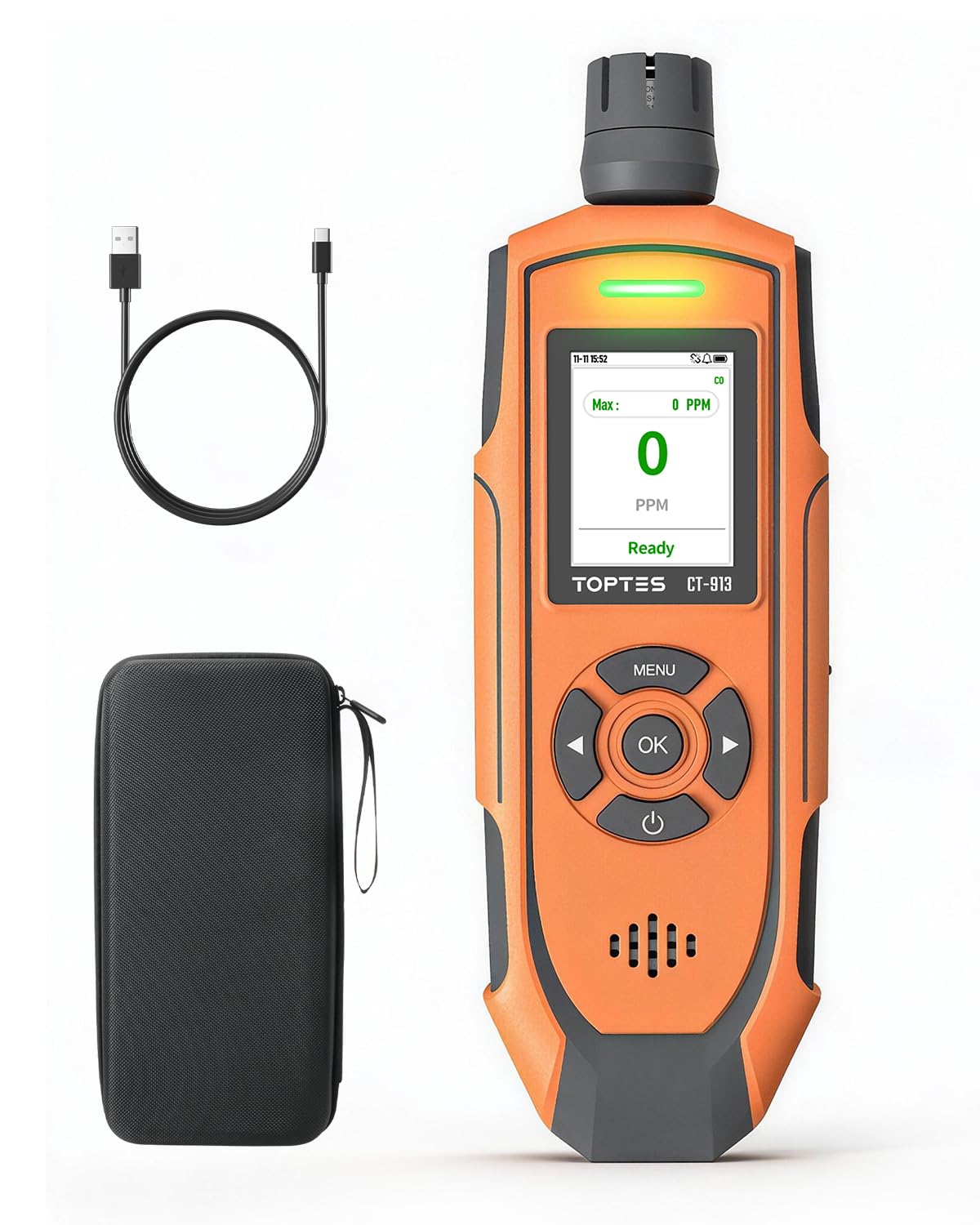
The one that tells you how much CO, not just that it is there.
Every other pick here sounds an alarm and leaves you guessing. This one puts a number on the screen. The TOPTES CT-913 is a portable, rechargeable analyzer that reads carbon monoxide from 0 to 1000 PPM in real time, with a trend graph that shows whether levels are climbing or settling. If you have ever stood in a camper wondering whether the smell was a problem, that readout is the answer.
The battery is the headline for anyone moving between job sites or campsites. Its 4000mAh rechargeable cell runs over 60 hours per charge, enough for a weekend of camping or a full day of inspections. Charging runs over USB-C, the same cable you already carry for a phone. In size, the CT-913 is the largest unit here at 8.58 inches deep by 1.72 inches wide by 2.76 inches tall, which is closer to a handheld instrument than a wall panel.
Where it earns its keep is verification work. The upgraded UK DDS electrochemical sensor tracks CO concentration changes in real time, and the triple alarm fires visual, audible, and vibration alerts together when you cross your set threshold. Owners use the digital readings to walk a room and trace a source appliance by appliance, and the orange housing stands out against a dark workbench or a dusty shelf. The CO sensor is user-replaceable after five years, so the CT-913 outlasts sealed alarms you throw away.
The honest catch is that this is a tool, not an always-on sentry. It watches while you carry it, but it will not guard your cabin at 3 a.m. unless you leave it powered and in place. Its alarm is also startlingly loud by design — the point is to snap you out of a task, not to be background noise.
What the screen buys you: real-time PPM readings and a trend graph turn a binary alarm into a measurement, so you can track down where the carbon monoxide is actually coming from.
Pick this if: you need readings, not just a beep — inspections, appliance checks, and RV troubleshooting.
skip it if: you want a permanently wired alarm that watches while you sleep.
4. Safe T Alert 25 Series Mini Dual LP/CO Alarm – Propane and Carbon Monoxide Alarm – Surface Mount, Black – 25-741-BL
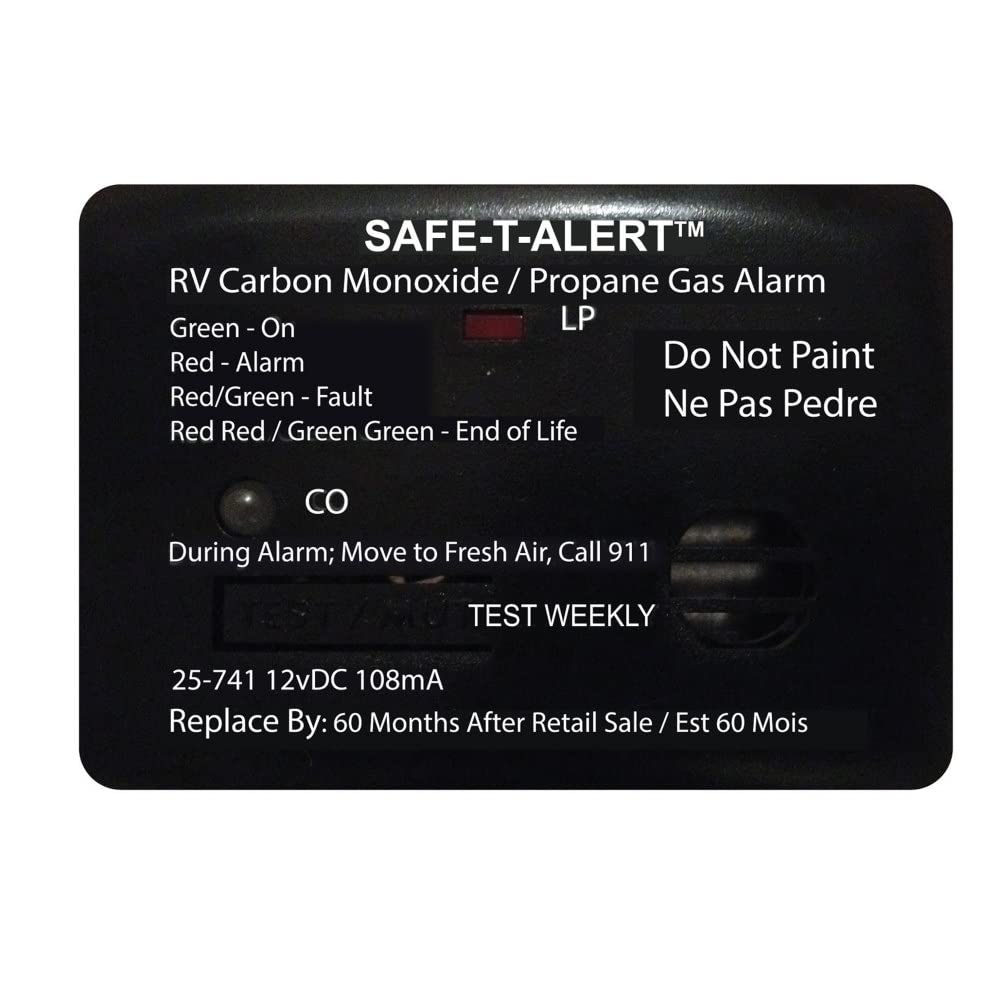
A palm-sized alarm for the tightest wall in the coach.
Class A, B, and C motorhomes, travel trailers, fifth wheels, and campers all share one problem: wall space is scarce. This Surface Mount Mini answers that with a compact surface-mount body designed specifically for limited interiors. At 1.25 inches deep by 3.5 inches wide by 2.5 inches tall, it fits where a larger flush unit will not. It is also the lightest of the wired alarms here at 5.6 ounces, compared with 11.36 ounces for the 85 Series — less weight hanging off a thin cabinet panel.
One unit covers two hazards by watching propane and carbon monoxide on the same patented dual-duty circuit, and it runs on 12-volt DC with no batteries to swap. The alarm mute button lets you air out the space while the rapid recovery sensor re-arms itself if conditions stay dangerous — handy when you are tracking down a propane smell and want to open a window without disarming your safety net.
Like the other wired units here, it is rated for -40°F to +158°F, so it keeps working through a brittle cold snap or a parked-in-the-sun afternoon.
Two things to check before you buy. Mounting this one is a slide-on job — you set the flathead screws into the bracket with the heads recessed so the unit drops down onto them, and the instruction sheet does not spell that out clearly. Also keep an eye on fitment and finish: the black version has been known to arrive in white, and one reviewer’s biggest complaint was receiving a white unit destined for a dark cabinet. Check the order color and the sensor date before you commit.
Why it earns its spot
- Smallest footprint of the wired alarms at 1.25 x 3.5 x 2.5 inches
- Lightest wired unit here at 5.6 ounces
- Dual propane and CO detection from a single 12V DC unit
- Alarm mute with rapid recovery sensor for safe ventilation
Where it asks for care
- Bracket uses recessed flathead screws that can be tricky to seat
- Some units ship in the wrong color, notably white instead of black
- The CO sensor lasts about 5 years, so check the build date on the box before mounting.
Best fit: a motorhome or trailer with almost no spare wall, where a compact surface-mount dual alarm is the only option that works.
Verify first: confirm the color and the sensor date on arrival, since both have been reported as off.
Understanding the Specs
Power Source and Current Draw
A 12-volt DC alarm runs off your coach or vehicle battery instead of its own cell, so it is always live when the system is powered. The 35 Series draws 108 milliamps at 12 volts, which a coach battery barely notices overnight. A portable unit like the TOPTES CT-913 flips that around with a 4000mAh rechargeable battery and over 60 hours per charge. Neither approach is wrong; it is about if you want a permanent sentry or a detector you can carry. Also note the 12 volts +/- 15% operational range on the 35 Series — a little voltage drift will not take it offline.
Detection Range and Operating Temperature
The TOPTES CT-913 reads 0 to 1000 PPM, which is a measurement instrument rather than a simple alarm. The Safe-T-Alert units watch propane and CO together and are rated from -40°F to +158°F, the extremes an RV actually sees. That temperature spec is worth weighing against your climate: a wired alarm that stays online through a hard freeze keeps working when a portable with a cold-limited battery might not.
FAQ
Do I need a dual propane and CO alarm, or is a CO-only detector enough?
Can I install a 12-volt RV alarm myself?
How long does the sensor inside these alarms last?
Will an RV alarm like this work in freezing weather?
What is the difference between flush mount and surface mount?
Why does my alarm flash green at startup?
Do these detectors run on batteries or vehicle power?
Is a portable CO detector worth it over a fixed one?
Do I need to cut a new hole to install a replacement RV alarm?
Can I mount a 12-volt alarm near propane appliances?
Final Thoughts: The Verdict
For most RV and camper owners, the auto co detector that makes the most sense is the Safe-T-Alert 35-742-BR, because it watches propane and carbon monoxide together, holds up from -40°F to +158°F, and fits a tight panel at just 1.25 inches deep. If you are swapping out a factory alarm and want the least fuss, the Safe-T-Alert 85 Series slides in with a trim ring included. For tracking down a source with real numbers instead of a plain beep, the TOPTES CT-913 gives you a 0 to 1000 PPM readout and a trend graph. And if wall space is your tightest constraint, the Safe T Alert 25 Series Mini is the smallest of the wired set at 3.5 inches wide.
How We Picked
We do not accept paid placement. Every pick is matched to a real buyer and a real use-case; we do not hands-on test units.
Sources & Methodology
Specifications: manufacturer listings and product documentation. Review insights: verified customer reviews, as of September 2026. Pricing: not shown on this page (it changes often); check the current price via the retailer link.
As an Amazon Associate, KitchPrep earns from qualifying purchases. This does not affect which products we feature.
Related Guides
