
Specs are compiled from manufacturer listings and verified buyer reviews and can change over time — please confirm the key details on the product page before buying.
Here is the short answer every buyer wants: the right battery backup for you depends on what you are protecting. If it is a desktop PC or a home theater setup, you want a box that delivers wall-style AC power the instant the grid drops out. If it is just your router, modem, or a security camera, a smaller DC-only unit can keep your internet alive for hours without the bulk. The nine picks below split cleanly along that line, and matching your gear to the right type is what stops you from overspending on wattage you will never use.
I’m Mohammad Maruf — the founder and writer behind KitchPrep. This guide is built by comparing the manufacturers’ published specifications and the patterns across verified customer reviews, so you get each pick’s real strengths and trade-offs instead of marketing spin.
Every unit here is either an AC-style box with standard wall outlets or a DC-style mini unit with barrel ports, and the switching speed on both tells you whether your gear stays alive through a blink. That single distinction is what separates a satisfying battery backup power supply pick from a frustrating one.
Our Picks at a Glance


How To Choose The Best Battery Backup Power Supply
Two units can show the same VA number on the box and still act completely differently in your living room. VA (volt-amperes, a rough measure of how much power a unit can deliver) is only the headline. What really separates them is the type of power they put out, how fast they switch to battery, and how long they last once they do. Get those three right and you almost never end up disappointed.
AC output versus DC output
An AC-output unit gives you the same standard wall sockets you already plug into, so anything with its own power brick or cord works normally. That covers towers, monitors, speakers, consoles, and TVs. A DC-output mini unit gives you small barrel ports at fixed voltages instead. Those only fit devices that already run on a power adapter, like a router, modem, ONT, or camera. A DC unit will not feed a desktop PC without an AC socket, so check your gear before buying.
Transfer time, VA, and wattage
Transfer time is how long the box takes to switch over to its internal battery when the wall goes dead. A unit rated at 0ms hands over instantly, which is what you want for a router that would otherwise drop every connection and restart. The VA figure is the headline capacity, while the watt figure is the real ceiling on how much hardware you can run at once. A unit sitting at 18 watts will not carry a gaming rig, no matter how big the battery inside it is.
Battery type and replacement
Most full-size units here use sealed lead-acid cells, which are cheap to replace and easy to swap with a screwdriver when they age out. The mini units use lithium-ion cells, which pack more capacity into less space but are usually not user-replaceable. Either way, runtime falls off as the battery ages, so a box with a user-replaceable battery keeps working for years longer than a sealed one you have to throw away.
Quick Comparison
| Model | Best For | Power Rating | Battery Capacity | Output Type | Amazon |
|---|---|---|---|---|---|
| APC BE650G1★ Best Overall | Full desk protection | 650VA / 390W | Lead Acid | AC outlets | Amazon |
| KP3 Mini UPSBudget Champion | Budget router backup | 18W | 10000mAh / 36Wh | DC barrel ports | Amazon |
| TalentCell Mini UPSLongest Runtime | Long network runtime | 98W | 27000mAh / 97.2Wh | DC barrel ports | Amazon |
| Eaton Tripp Lite BC350 | Tight spaces | 350VA / 210W | Sealed Lead Acid | AC outlets | Amazon |
| SKE DC20000 Plus Altair | Travel and cabinets | 5V/9V/12V DC | 20000mAh | DC plus USB-C | Amazon |
| APC BE600M1 | Home network core | 600VA / 330W | Lead Acid | AC outlets | Amazon |
| SKE VL425 | Vertical placement | 425VA / 240W | Sealed Lead Acid | AC outlets | Amazon |
| CyberPower ST900U | Home theater banks | 900VA / 500W | Other Than Listed | AC outlets | Amazon |
| CyberPower AVRG900LCD | Workstations with AVR | 900VA / 480W | Other Than Listed | AC outlets | Amazon |
In‑Depth Reviews
1. APC Battery Backup 650VA/390W Uninterruptible Power Supply for PC, BE650G1
Our pick — over 4.5★ from 4,000+ verified ratings; the strongest balance of quality and price.
The do-everything box that keeps a full desk alive, plugs and all.
If your worry is losing a tower mid-document rather than losing Wi-Fi, this is the one to start with. It runs on 120 volts of standard household AC input — the same power that comes out of your wall socket — and it holds eight outlets with 650VA / 390W of capacity behind them. Four of those outlets give you battery backup plus surge protection, and four are surge-only for the printer and desk lamp you never need on battery. APC rates it for up to 22 minutes of runtime when powering a 100W load, which is roughly one desktop and a monitor.
The biggest difference between these units is input voltage. This unit draws 120 volts from the wall, while the TalentCell Mini UPS further down the page runs on 12.6 volts of DC input (direct current, the lower-voltage power devices use) — a 9.5x gap, and the reason one plugs into a wall socket and the other plugs into a device. What wins people over is how it behaves when the lights flick. Owners put it through a pull-the-plug test and report a PC, monitor, mic, and speakers running 31 minutes at 54% battery, which they estimate lands around a full hour for lighter loads. Storm-season owners describe a fiber modem and a network switch riding out two consecutive outage days without a glitch, with day two still delivering power after nearly an hour.
The catch most people run into is the software, not the hardware. The beep-silencing and auto-shutdown utility has to be downloaded and installed, and a handful of buyers had trouble getting those files to appear at all and gave up on it. Plug it straight into the wall, not a surge strip, and charge it a full day before you trust it. One 4-star buyer summed up the trade-off plainly with a single line of praise and no complaints about the unit itself.
Where It Earns Its Keep
- 650VA / 390W carries a tower, monitor, router, and modem together
- Eight outlets split 4 battery-plus-surge and 4 surge-only
- Up to 22 minutes of runtime at a 100W load, per APC
- Battery swaps out with APC model APCRBC110, sold separately
What To Plan Around
- Beep-silencing software requires a download and install
- Lead-acid battery eventually ages out like any other
- Heavier and bulkier than a DC mini unit
Reach for this if: you have a desktop, a NAS, or a whole desk of gear and want one box to cover all of it.
Think twice if: your only device is a router and you would rather spend less on a DC mini unit.
2. KP3 Mini UPS Battery Backup for WiFi Router, 0ms Uninterruptible Power Supply for Router, Modem, CCTV Camera, 10000mAh 36Wh DC UPS
The smallest thing here, and the cheapest way to stop your internet dropping.
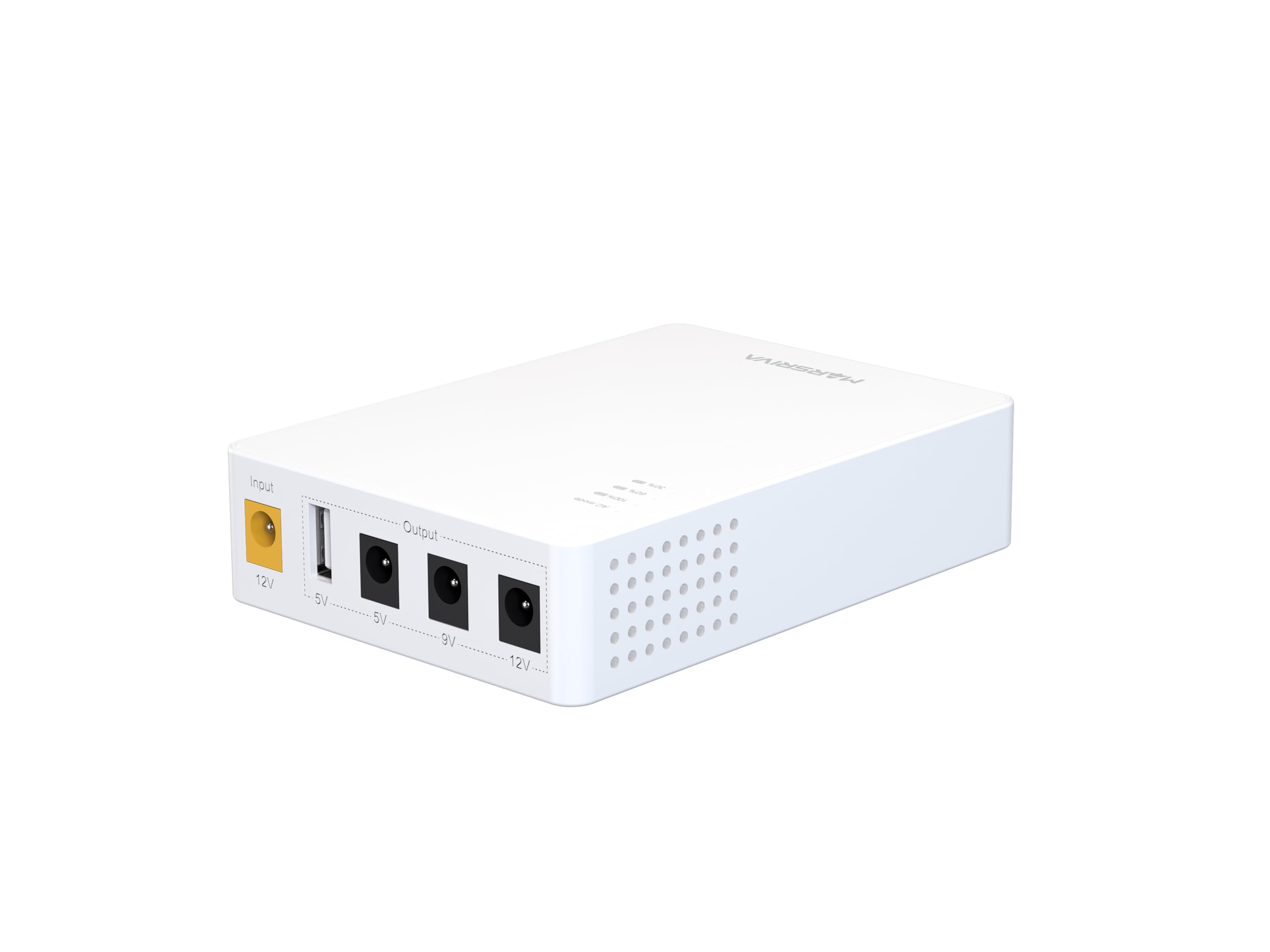
What you get is a 4.53 x 3.27 x 1.06 inch white box that weighs 10.56 ounces and sits behind a router without anyone noticing it. The important number is 0ms — the handover from wall power to battery happens with no measurable pause, so your router never reboots and your video call never drops. You get four DC outputs: one USB-A at 5V and three barrel ports at 5V, 9V, and 12V. The 10000mAh / 36Wh lithium-ion battery is sized for short outages, and the whole unit tops out at 18 watts of output.
That 18-watt ceiling is the honest dividing line against the TalentCell Mini UPS, which pushes 98 watts — a 5.4x gap. If you are thinking about adding a camera, a small switch, and a modem at once, the math gets tight fast. Buyers report it running an unmanaged network switch without complaint, and the one limitation they flagged is that it will not power an eero 6+ over the USB-A port. Each barrel port also feeds one device at a fixed voltage, so this is a router-and-modem box rather than a whole-rack solution. An occasional unit has failed badly on arrival, so treat the first plug-in as your test.
The physical protections built in are worth knowing about: overcurrent protection, voltage stability protection, short circuit prevention, overcharge prevention, and deep discharge protection, plus a thermal management system. In plain terms, that is a set of safeguards that stop a fault on one port from cooking the port or the device on it. Three-quarter of the consideration here is that this only suits low-power DC gear — routers, modems, ONTs, LED lights, cameras. It is not a full-size UPS and never pretended to be.
Compact fit: at a hair over 10 ounces and barely an inch thick, it mounts or tucks almost anywhere near your network gear.
Right-sized scope: pair one router and one modem with it and it does its job well; load it up with four devices and it will run out of headroom.
Pick it for: a single router or modem where you just want the internet to survive a blink.
Pass it by for: anything drawing more than a low-power DC load, or anything that needs an AC wall socket.
3. TalentCell Mini UPS Uninterrupted Power Supply 27000mAh 97.2Wh Lithium ion Backup Battery Pack
The capacity king of the mini units, built for gear that has to stay up for hours.
Where the KP3 runs a 10000mAh / 36Wh cell, this one carries 27000mAh / 97.2Wh — a 2.7x jump in both capacity and total energy. That is the difference between riding out a brownout and riding out an afternoon. Its 98-watt output ceiling is also 5.4x the KP3’s 18 watts, so it has real room for a mini-PC, an access point, an ONT, and a switch rather than just a router. Outputs break down as four DC 12V ports (voltage range 9–12.6V), one DC 9V, and two USB 5V ports, with an 18W USB-A/USB-C PD line for a phone or a single-board computer. Input is 12.6V/2A, and every DC port is the 5.5 mm x 2.1 mm barrel size, so check your device’s plug before ordering.
Runtime is where this earns its place. A buyer ran a 10.5W load (10.5 watts, about the draw of a small router) and got 5.5+ hours out of it, measuring roughly 47Wh (watt-hours, the total energy stored) over 4.5 hours. Owners running a modem, router, and VOIP box together describe it hanging on for around a day, and one buyer tucked it into a home’s wiring cabinet to feed a Spectrum modem and router over the 12V barrels (round DC power connectors) and expected 4+ hours of hold. It also replaces five separate wall adapters, which some owners say pays for itself in about 4.5 years of idle-draw savings.
Here is the honest part: load it wrong and it fails. The manufacturer states plainly that it cannot continuously power devices exceeding 37W (37 watts), because the battery drains too fast — and one buyer who connected an ONT (the box that brings fiber internet into your home), router, NAS (network-attached storage, a hard drive on your network), and Pi all at once ended up with a depleted battery overnight and a corrupted router that needed a factory reset. The lithium-ion cells are hardwired inside and not user-replaceable, so when the pack ages out, that is the end of the unit. The LED charge indicator is also nonlinear, showing roughly 100–85% on four lights and 85–40% on three, so do not read it like a fuel gauge.
top-tier endurance: 97.2Wh (watt-hours, the total energy stored) with an 18W USB-C PD line (USB-C Power Delivery, a fast-charging standard) means hours of network uptime plus a phone charge, all from one compact unit.
Network cabinet hero: one buyer summed up its home perfectly — it fits a builder-installed wiring cabinet that no full-size UPS could ever squeeze into.
Suits you if: you want the longest possible runtime for router, modem, and camera gear at a compact size.
Look elsewhere if: you need user-replaceable batteries, or you plan to daisy-chain more than a couple of devices onto it.
4. Eaton Tripp Lite BC350 350VA Small UPS 210W Battery Backup Surge Protector

A wall-hugging 350VA unit that slots into the tightest corner of a small setup.
At 5 x 7.99 x 2.99 inches with a 5-foot cord and bottom mounting tabs, this one is designed for wall-mount installation or a shallow shelf rather than a floor. It runs 120 volts input and supplies six outlets — three with battery backup and surge protection, three surge-only — inside a 350VA / 210W envelope. Surge suppression sits at 316 joules, and the unit filters out EMI and RFI disturbances, which are the electrical noise and interference that can stress hardware over time. It also stays silent in both line and battery modes, only beeping to flag a low battery or fault.
What wins people over is reliability, and by a wide margin it is the most-praised trait in the review pages for this unit, ahead of value and compact size. Its sealed lead-acid battery is rated for an average of 12 minutes of runtime and is user-replaceable. Owners in thunderstorm country describe their Wi-Fi dropping for around ten minutes on every brief outage and reconnecting on its own — and this unit put a stop to that pattern entirely. The wide outlet spacing gets called out specifically because it lets bulky power adapters sit side by side without stealing the neighbor’s socket.
The trade-offs are real but small. A couple of buyers found a dead receptacle on arrival, so test all six before you trust the unit. The battery and durability aspects read mixed across the review base, meaning performance expectations vary depending on how you load it. In battery mode it outputs a PWM sine wave, which suits routers, TVs, and low-power computers but is not the cleanest waveform for sensitive hardware. Given its 210-watt ceiling, treat it as a protector for internet and entertainment gear rather than a workstation.
The Case For It
- Wall-mount tabs and a 5-foot cord suit tight or out-of-the-way spots
- Six outlets, with three carrying battery plus surge protection
- 316 joules of suppression and EMI/RFI filtering
- Silent in both modes, with alarms only for fault conditions
Where It Falls Short
- 350VA / 210W only covers light loads like routers and TVs
- Stated battery life averages around 12 minutes
- Battery-mode waveform is PWM sine, not pure sine
The pick for: someone protecting a router, modem, or a single TV in a small space who wants it mounted out of the way.
Skip it for: a full desktop workstation that draws more than 210 watts.
5. SKE DC20000 Plus Altair Mini DC UPS 20000mAh Battery Backup & Surge Protector for Router & Modem

A 20000mAh mini UPS with the port spread of a much bigger box.
Five output types on a single slab that weighs 0.65 kg and measures 4.2 x 8.1 x 1.3 inches. You get 5V, 9V, and 12V DC barrel ports for routers, cameras, and modems, plus USB and Type-C for phones and tablets. It takes 12V input, uses a lithium battery, and is rated for an average of 7 hours of runtime. Automatic Voltage Regulation is built in — that is circuitry that smooths out small dips and spikes in the incoming power so your gear sees steady voltage rather than a wobble. An LED indicator shows remaining capacity at a glance.
Owners describe the quality as the standout, and it is the most-praised trait in its review base. The noise angle is a close second in the praise column, which is note because a unit like this can end up mounted on a wall above your router. One buyer powered a whole Echo Dot 3rd and 4th gen plus an Echo Pop off the 12V port at low volume, and also ran a Tempest weather station through outages. The port layout reads left to right as 5V barrel, 9V barrel, USB-A, USB-C, 12V barrel, and the unit wall-mounts in either orientation. Note that it needs a press-and-hold on the power button to switch on.
Two things a buyer should know before committing. Power duration reads mixed in the reviews — some owners mention the router staying up past nine hours, while others had one stop charging after just five months, treated as a rare failure rather than the norm. Size is also a mixed read: it is slim next to a full UPS, but a few buyers found it bigger in person than the photos suggested. It also will not power a full-size Echo or an Echo Show off the 12V rail, so stick to what its port voltages actually suit.
Flexible by design: five different DC and USB output types mean one box can feed a router, a camera, and a phone without any adapter shims.
Mount-it-anywhere: the slim slab profile and wall-mount option let it live beside a router or inside a media cabinet instead of on the floor.
Land on this if: you want a slim DC unit with a wide port mix for a networking cabinet or a travel kit.
Give it a miss if: you need AC sockets for a computer, or you want a battery you can replace yourself.
6. APC BE600M1 UPS Battery Backup & Surge Protector for Computer, Router, NAS

The name most people recognize, and the one with the deepest track record.
This is the crowd favorite for a reason: 4.5 stars across 29,000+ ratings, a number that no other pick here comes close to matching. Its headline numbers are 600VA / 330W and 23 minutes of runtime at a 100W load — that is the load of roughly one computer, or a router and modem with room to spare. It runs on 120 volts input and splits seven outlets as five with full battery plus surge protection and two surge-only. There is also a built-in 1.5A USB port that keeps working during an outage, so your phone can stay topped up while the wall is dead.
Quality and functionality are the two things this unit is praised for most, and both show up in owner stories. A user running a router and modem only described the switchover as smooth with no Wi-Fi drop, though the pair gave out after about three to four hours at roughly 50W (50 watts) of combined draw — a fair runtime for a router-class load, but not a desktop-class one. Another owner has run the same model eight years, and when the alarm finally would not reset, they replaced it with the same box. Owners also describe the small footprint fitting behind a couch or inside an entertainment center with no fuss, which is exactly why it ends up tucked behind so much home gear.
The recurring gripe is noise. The beeper goes off on battery and there is no built-in mute on this model, so if it sits in a bedroom or office, plan for the sound or keep it in another room. Battery life reads mixed across the review base, with some buyers finding a battery that arrives weak from the start. The internal battery is user-replaceable with APC model APCRBC154, sold separately, which is what makes this unit a long-term companion rather than a disposable box. The comparison worth making is against the two CyberPower units below: those carry bigger VA and watt figures but their review bases are a fraction of the size.
What Makes It Stand Out
- 600VA / 330W with 23 minutes of runtime at a 100W load
- Seven outlets, five of them battery plus surge protected
- Built-in 1.5A USB port for phone charging during outages
- User-replaceable battery APCRBC154, sold separately
Things To Weigh Up
- Beeper has no built-in mute on this model
- Battery charge time runs about 10 hours
- Battery life reads mixed in buyer feedback
Reach for this if: you want a well-known box with a huge owner base and enough outlets to protect a whole home network.
Keep shopping if: you need a silent unit, or you want to run a full desktop plus a monitor for an extended stretch.
7. SKE SMART KEY ENERGY SKE 425VA/240W UPS Battery Backup Surge Protector, VL425

One of the few units here you can stand on its side to fit a shallow shelf.
The design flexibility is the hook: 11.7 x 3 x 6.7 inches means it sits upright or lies flat, so it can slot into a gap where a wider unit would not. Seven standard US outlets split five black battery-plus-surge sockets and two white surge-only sockets. Alongside them you get an RJ45 port for surge protection, two USB outlets, and one Type-C outlet for charging a phone or a laptop. It runs 120 volts of AC input and tops out at 425VA / 240W, uses simulated sine wave output for stable power, and uses sealed lead-acid cells inside.
Power capacity is what this unit is praised for most, with surge protection (a feature that blocks voltage spikes) right behind it. Owners running a single TV describe it covering the brief dropouts that happen before a home generator kicks in — the kind of flicker that would otherwise reboot the TV, the cable box, and the streaming stick all at once. One owner running a Fiber ONT (the box that brings fiber internet into your home) off it timed roughly 45 minutes of runtime on the 5-amp-hour battery inside. The battery is replaceable with a Phillips screwdriver, and a press of the power button silences the unit, which makes it one of the quieter options in this lineup.
Reliability is the honest asterisk here: it carries the highest raw count of owner mentions in this unit’s data and Amazon flags that theme as mixed rather than positive, so this is a fair place to call it a fit note rather than a slam-dunk. A handful of customers note units failing well inside the first year, and one buyer found the replacement battery hard to find and expensive. Size the load right — modems, routers, ONTs (the boxes that bring fiber internet into your home), and light streaming gear — and it does its job without complaint. Push it toward high-power PCs and you are asking it to do something it was never rated for.
Vertical or flat: the tower footprint stands up or lies down, which is rare at this size and genuinely useful on a shallow shelf.
Cheap to keep: a Phillips screwdriver gets you a new battery, so you never have to bin the whole unit.
Fits best with: a modem, router, or ONT where you want USB and Type-C charging on the front of the same box.
Not the one for: a high-power PC, or anyone wanting a long track record behind the brand.
8. CyberPower ST900U Standby UPS Battery Backup and Surge Protector

Twelve outlets and a slim body, made to hold an entire entertainment wall.
If your problem is outlet count, this is the answer — 12 NEMA 5-15R outlets, split six with battery backup plus surge protection and six surge-only, and four of them widely spaced to swallow larger plugs. The power ceiling is 900VA / 500W, output is simulated sine wave, and input runs 120 volts through a right-angle plug with a five-foot cord. The slim profile keeps it low and out of the way behind a cabinet or entertainment center. It also carries a three-year warranty that covers the battery.
Quality and protection lead the praise for this unit, and that tracks with what owners put it through. A buyer connected a micro ATX gaming PC, a 7.1 home theater setup, and a 50-inch TV, and the PowerPanel software showed real-time draw bouncing between 80 and 180 watts. Owner runtime notes put it in the 10-to-20-minute range under that kind of load, which is enough to shut a machine down cleanly or bridge to a generator. Another described protecting a PS4 and a plasma TV through a full seven-hour outage — despite only partial charge on the unit, the console shut down safely with no data loss. It also runs well off the beat for an Elegoo 3D printer, where it just has to cover the drops.
The recurring annoyance is the alarm, which is loud and needs the software to tame — many owners simply disable it. A few units arrived with outlets that felt jammed and would not accept a plug at all; the fix was to turn the UPS off, unplug it, and use its own plug to force each socket open. It weighs around 10 pounds, so plan a spot that can take the weight. A three-year warranty that covers the battery is unusually generous at this price.
Why It Stands Out
- 12 outlets with four widely spaced for oversized plugs
- 900VA / 500W ceiling handles a full entertainment rack
- Free PowerPanel software shows real-time load and voltage
- Three-year warranty that also covers the battery
What To Expect
- Loud alarm needs the software to disable
- Runtime under a heavy load lands around 10 to 20 minutes
- Around 10 pounds of weight to place somewhere solid
The right fit for: a home theater or gaming wall that needs a dozen sockets and a high watt ceiling.
Might not suit you if: you want a silent unit, or you only need to protect a router and a modem.
9. CyberPower AVRG900LCD Intelligent LCD UPS Battery Backup

The workstation pick, with a readout screen and a correction circuit built in.
This is where AVR earns its place. Automatic Voltage Regulation corrects small drops and spikes in the incoming power without ever switching to battery — meaning your gear rides through brownouts and generator cycling without draining the battery at all. It carries 900VA / 480W and 12 NEMA 5-15R outlets, split six battery-plus-surge and six surge-only, with a right-angle 45-degree offset plug and a five-foot cord. Data line protection stops surges riding in over telephone lines from reaching your equipment, Output is simulated sine wave, and the unit is UL listed after testing in a UL certified lab. The warranty runs three years and covers the battery.
Power capacity is the trait most praised here, with power management close behind — the latter fits because you get an LCD readout showing real load and status, plus free PowerPanel software that is Linux compatible and allows configurable shutdown. A buyer running a desktop with three drives and a 32-inch monitor alongside a laptop with a 28-inch screen reported 175–200W (175 to 200 watts) of draw and 18–20 minutes of runtime, and noted that a single newer PC plus its monitor could run past 30 minutes. Others running solar or generator setups describe it buffering short interruptions without any device dropping out at all.
The catch, and it is the most-mentioned complaint in this unit’s reviews, is the alarm. It beeps frequently on battery and there is no straightforward way to silence it, so a bedroom or a quiet office is the wrong room for it. The LCD is also very bright, and one downside that catches people off guard is that the unit must be plugged into a wall outlet before it will power on, so a factory-fresh one will not start up from the start. Battery life reads mixed across the review base, with the standard hint that any sealed battery ages out in the years ahead.
Steady power on tap: AVR keeps your gear on clean voltage through brownouts without using the battery, which is exactly what a workstation needs.
Tells you what is happening: the LCD and downloadable PowerPanel software let you watch real load and set an automatic shutdown.
Choose this if: you run a desktop and monitors where brownouts and generator cycling are the real threat.
Go another way if: you are sensitive to beeping, or you plan only to protect a router.
Understanding the Specs
VA, Watts, and Real Load
The VA figure on the box is the unit’s total apparent power capacity, while the watt figure is what it can actually deliver to real equipment — the watt number is the one that matters for sizing. A unit rated 650VA / 390W has 390 watts of usable ceiling, which comfortably covers a desktop tower plus a monitor. A unit rated 18W total has a much smaller world of devices it can feed at once, and that ceiling is fixed by hardware, not by battery size. Add up the wattage of everything you want on battery (most devices list watts on the label or power brick), and stay well under the box’s ceiling.
Battery Cells and Replacement
Sealed lead-acid batteries are cheap, dense, and easy to swap with a screwdriver when they age. Lithium-ion cells pack more capacity into a lighter enclosure, which is why the mini DC units here feel so small, but they are almost never user-replaceable. Either way, runtime falls off as the battery ages, so a box with a user-replaceable battery can be refreshed for years after a sealed one would be scrap. Also check the transfer time: a unit rated 0ms hands over to battery with no pause at all, which is the number that keeps your router from rebooting.
FAQ
What is the difference between an AC UPS and a mini DC UPS?
Will an uninterruptible power supply keep my router online during a blackout?
What does transfer time 0ms actually mean?
How long will a battery backup run my computer?
Do I need an AC outlet UPS or a DC mini unit for a security camera?
Is a pure sine wave UPS better than a simulated sine wave one?
Can I replace the battery in my UPS, or do I need a new unit?
Does a battery backup protect against surges too, or only blackouts?
Why does my UPS beep during a power outage?
Can a mini UPS power a laptop as well as a router?
Final Thoughts: The Verdict
For most homes, the battery backup power supply winner is the APC BE650G1 because it splits the difference between raw AC power and easy battery replacement — four outlets on battery, four surge-only, and a user-swappable cell that keeps the box alive for years. If your target is your internet gear rather than your desk, grab the TalentCell Mini UPS, whose 27000mAh / 97.2Wh pack (milliamp-hours and watt-hours, two ways to measure stored energy) and 98W ceiling cover a router, modem, and camera far longer than the smaller KP3. And for a wall-mounted protector in a tight corner, the Eaton Tripp Lite BC350 is the one to reach for.
How We Picked
We do not accept paid placement. Every pick is matched to a real buyer and a real use-case; we do not hands-on test units.
Sources & Methodology
Specifications: manufacturer listings and product documentation. Review insights: verified customer reviews, as of September 2026. Pricing: not shown on this page (it changes often); check the current price via the retailer link.
As an Amazon Associate, KitchPrep earns from qualifying purchases. This does not affect which products we feature.
Related Guides
