
Specs are compiled from manufacturer listings and verified buyer reviews and can change over time — please confirm the key details on the product page before buying.
If your drawer is full of dead disposables and your game controller keeps dying mid-match, the fix is a rechargeable AA kit — batteries plus a charger that tops them up again and again instead of sending you back to the store. The short answer: the Panasonic Eneloop K-KJ17MCA4BA is the safest all-round pick, the Energizer Recharge Pro is the fastest to fill up, and the Powerowl Pro is the pick if you want maximum capacity and a big eight-slot charger in one box. Below you will find nine real kits, sorted so the mid-range and premium options sit up top and the budget-friendly ones come last.
I’m Mohammad Maruf — the founder and writer behind KitchPrep. This guide is built by comparing the manufacturers’ published specifications and the patterns across verified customer reviews, so you get each pick’s real strengths and trade-offs instead of marketing spin.
Rechargeable AAs look identical on the shelf, yet cycle counts, capacity in mAh, and charge times vary wildly between kits. That is why this guide breaks down the specs that actually change how often you recharge. Everything below is chosen and explained to help you find the best aa rechargeable batteries and charger for your household.
Our Picks at a Glance


How To Choose The Best AA Rechargeable Batteries and Charger
Most people shopping for a rechargeable AA kit start with the wrong question — they ask which brand is best. The better question is how many times you will actually cycle the batteries, and whether the charger treats each battery on its own.
Cycle count and capacity: two numbers that decide everything
Cycle count (how many times a battery can be drained and refilled before it fades) is the number that determines your real long-term value. Paired that with capacity in mAh, which sets how long each battery runs per charge. A higher mAh battery runs longer between top-ups but is not automatically better — some high-capacity cells trade away some cycle life for that extra runtime.
Individual-cell charging vs paired charging
A charger that tops up each battery on its own circuit fills a partly used cell without forcing the other one to overcharge. Chargers that work in pairs can leave a weaker battery under-charged while pushing a stronger one too hard. If you care about getting the full cycle count out of your kit, look for the word “individual” on the charger description.
Charging speed and what “fast” really costs
A three-hour top-up is convenient, but routine slow charging is gentler on a battery’s lifespan. Many kits do both, switching to a trickle charge (a low, steady top-off current) once the battery is nearly full. If you mostly charge overnight, charge time barely matters. If you swap batteries mid-game, it matters a lot.
Quick Comparison
Here is how the nine kits stack up on the three numbers that matter most — the capacity of each battery, how many bays the charger has, and what cycle life the batteries are rated for.
| Model | Best For | Battery Capacity | Charger Bays | Cycle Rating | Amazon |
|---|---|---|---|---|---|
| Eneloop Panasonic K-KJ17MCA4BA★ Best Overall | Everyday all-rounder | 2000mAh | 4 | 2100 cycles | Amazon |
| Energizer Recharge Pro K-KJ55MBS66AFastest Charge | Fast top-ups | — | 4 | — | Amazon |
| POWEROWL Gold-top 2800mAhHighest Capacity | Maximum capacity | 2800mAh | 8 | 1200 cycles | Amazon |
| Eneloop Panasonic K-KJ55MBS66A | Whole-house kit | 2000mAh AA / 800mAh AAA | 4 | 2100 cycles | Amazon |
| Bonai 16-Pack 2800mAh | Big households | 2800mAh | 16 | 1200 cycles | Amazon |
| BEVIGOR 8-Bay Smart Charger | Mixed AA and AAA | 2800mAh AA / 1100mAh AAA | 8 | 1500 cycles | Amazon |
| Duracell Ion Speed 1000 | Budget starter kit | — | 4 | Hundreds of recharges | Amazon |
| Amazon Basics 4+4 with Charger | Lowest cost entry | 2000mAh AA / 800mAh AAA | 4 | 1000 cycles | Amazon |
| Amazon Basics 8-Pack USB-C | USB-C charging only | 2000mAh | 8 | 1000 cycles | Amazon |
In‑Depth Reviews
1. Eneloop Panasonic K-KJ17MCA4BA Advanced Individual Cell Battery Charger Pack with 4 AA Batteries
Our pick — over 4.5★ from 14,000+ verified ratings; the strongest balance of quality and price.
The charger that tops off each battery on its own track — no pairing verdicts, no guessing at half-full cells.
At 2100 cycles, this kit is built to last several years of household use. Every battery in the Eneloop pair here is rated for up to 2100 recharge cycles — meaning you can drain and refill each one two thousand times before it starts to give up. At a typical household pace that is a set you might hand down rather than replace. The cells themselves hold up to 2100mAh typical and 2000mAh minimum, which is the number that decides how long your controller, flashlight, or wireless mouse actually runs on a single charge.
The real difference is in the charger. The Panasonic CC17 individually charges each AA and AAA battery on its own circuit — so a half-empty cell gets topped up without forcing a full one to overcharge. Four separate LED indicators show the progress of each slot, so you can tell at a glance which battery is done. Compared to paired-bay chargers, this is the feature that protects cycle life over the long haul, and it is why a lot of buyers never go back to cheaper kits after this one.
What wins people over beyond the specs is how the batteries hold their charge between uses. Reviews from owners who have run these in Xbox controllers put real-world game time somewhere in the 20 to 30 hour range with vibration off and the light dimmed — and the batteries are pre-charged at the factory using solar power, holding up to 70% of that charge after 10 years of sitting idle. It holds up to 70% of its charge after 10 years in storage, so it still fires up after months in a drawer.
Why owners keep buying more
- Each battery is rated for up to 2100 recharge cycles — the highest cycle count in this lineup
- Individual cell charging protects battery health, unlike paired-bay chargers
- Pre-charged at the factory and holds up to 70% of charge after 10 years in storage
- Works with both AA and AAA, so the same charger covers two battery sizes
Where it asks for patience
- Charges overnight rather than in three hours, so it is not the pick for mid-game swaps
- Four bays rather than eight, so larger households will charge in two batches
- NiMH chemistry, not lithium — some older devices may blink and reject the cell
Reach for this if: you want a long-cycle, workhorse kit and overnight charging fits your routine.
Look elsewhere if: you need speed above all — the Energizer Recharge Pro fills four batteries in about three hours.
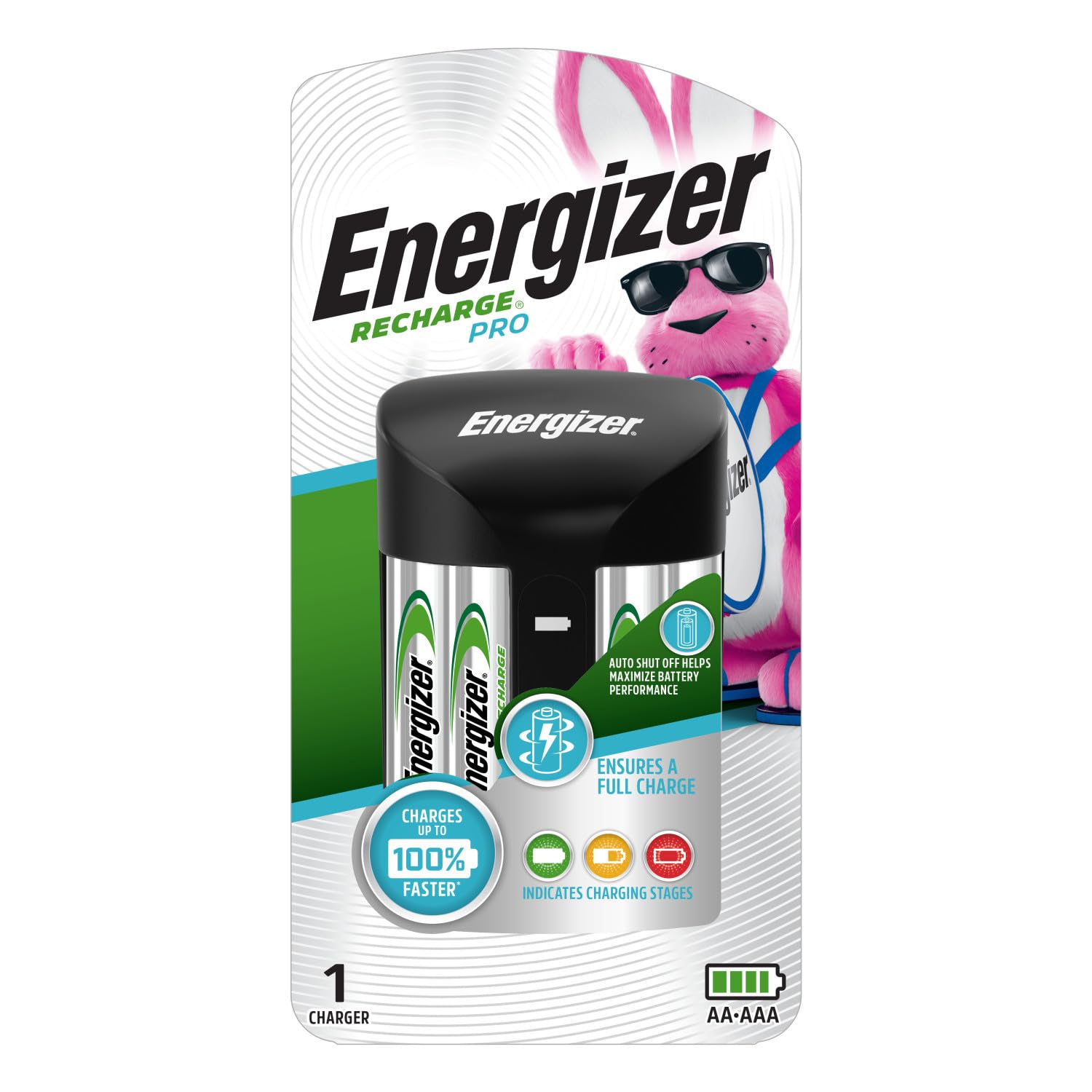
2. Energizer Recharge Pro Rechargeable AA Battery Charger With 4 NiMH Rechargeable AA Batteries
Four batteries from flat to full in about three hours — the fix for a controller dying mid-match.
The Energizer Recharge Pro makes its case on one number: a full charge in roughly three hours for two or four AA or AAA batteries. If you have ever swapped a dead pair of batteries into a charger and then sat around waiting for game night, that timing is the whole pitch. It is also rated as up to 100% faster than the Energizer Recharge Basic NiMH charger — the baseline kit the brand sells — so upgrading to this one meaningfully cuts the wait.
The charging feedback is louder and clearer than most. Red, yellow, and green indicator lights walk you through progress, and audible beeps announce when charging starts and finishes — so you do not have to hover over the unit to know it is done. There is also a bad-battery detector: a red X and repeated beeps when a cell is not worth charging. Auto shutoff and overcharge protection round out the safety side, so leaving it plugged in overnight is fine.
Owners use these in high-drain devices — game controllers, flashlights, and LED battery packs — and the general read is that the system delivers. One caution shows up in the review pages: this charger is built for occasional use rather than a full household conversion. If you have a dozen devices pulling batteries every day, expect frequent recharge cycles. If you need six or eight batteries topped up at once, consider the Powerowl eight-bay kit next on this list.
What you are buying: the fastest three-hour top-up in this lineup, plus a charger that tells you — loudly — when a battery is past saving.
Suits: gamers and gadget owners who want to be back in action within an afternoon.
Skip: anyone who needs eight or more batteries charged at once — the four-bay design caps how much it can process per cycle.
3. POWEROWL Gold-top Rechargeable AA Batteries PRO with 8-Bay Charger, 2800mAh, 8 Count
Maximum runtime per charge — 2800mAh cells that push high-drain gear further before the next top-up.
Where the Eneloop kit trades some capacity for cycle life, this Powerowl set goes the other way — 2800mAh per AA for longer runs per charge, backed by a 1200-cycle rebuild rating. If you are running a device that chews through batteries fast, that higher capacity buys you more hours between swaps. That 2800mAh figure is 40% more capacity than the 2000mAh Eneloop pack above, and it is the reason high-drain gear like remotes, cameras, and smart-home sensors stay powered longer per fill.
The eight-bay smart charger is a serious upgrade over four-slot kits. You can drop in up to eight AA or AAA cells and walk away — the smart circuit handles the rest, with a trickle charge mode that tops off the last few percent without cooking the cell. The batteries themselves are rated to keep 60% of their power after two years sitting idle, so a drawer full of these does not go dead on you. Since 2020, Powerowl has pre-charged its batteries at the factory using power generated from wind energy.
The honest note from the review pages is that some buyers report the cells dry out quickly between charge cycles, while many others say they hold up fine over two years of steady use. That split matches the chemistry — a 2800mAh cell is a careful balance of capacity and cycle life, and how well it holds depends on how hard the device pulls. If you need maximum runtime per charge and are willing to recharge regularly, this kit does exactly that.
Why it earns a spot up top
- 2800mAh per AA — 40% more capacity than the 2000mAh Eneloop pack
- Eight charging bays, so a full household load goes in at once
- Rated for over 1200 recharge cycles and holds 60% of charge after 2 years stored
The trade-off to weigh
- Some owners find the higher-capacity cells lose usable charge between cycles faster than expected
- 1200-cycle rating sits below the Eneloop kit’s 2100 cycles
- Owners note the batteries reach peak performance only after 3-5 full charge cycles
Best fit for: heavy battery users who want the biggest single-charge runtime and a charger that handles eight at once.
Not the one for: you if you want the longest possible cycle count — the Eneloop kit outlasts this one on rebuilds by a clear margin.
4. Eneloop Panasonic K-KJ55MBS66A Power Pack, 6AA, 6AAA, and 3-Hour Quick Charger

Twelve batteries, one charger, and a color-light system that tells you exactly how much charge is left.
This is the pick for the household that has batteries scattered across every drawer in the house. The kit bundles six AA (2000mAh typical, 1900mAh minimum) and six AAA (800mAh typical, 750mAh minimum) — twelve cells total, all pre-charged at the factory using solar power and rated to hold up to 70% of their charge after a decade of storage. Both the AA and AAA cells are made in Japan, and the whole set rebuilds up to 2100 times, matching the cycle count of the four-bay Eneloop kit above with a broader battery spread for the same charger.
The standout feature is the CC55 charger’s color-coded LED system. Each of the four bays shows a red light under 20% charge, orange between 20% and 80%, and green at 80% or more — so you can tell how full a partly drained battery is before you even decide to charge it. Drop in a battery that was pulled from a wireless mouse after a week of light use, and the light tells you it still has 80% left.
Charging is quick when you need it: a fully discharged set of four AA cells tops up in about three hours, and a pair of AA or AAA in up to 1.5 hours. One design choice worth flagging — this charger is slower when charging four at once than the two-cell mode, and a few users find the color indicators take a cycle or two to learn. But the trade-off is deliberate: slower charging extends battery life. Buyers who use these in weather stations and outdoor gear report they hold up in extreme conditions.
The one-line read: the most useful kit for a family that needs both AA and AAA on hand and wants to know which batteries are ready without testing them.
Honest limit: the color-coded LEDs are helpful once learned, but they are not obvious on first use — a few owners needed a cycle or two to decode which light means what.
Pick this if: your house runs on a mix of AA and AAA devices and you want one charger that covers both.
Think twice if: you only need AA — the K-KJ17MCA4BA above covers just AA for less outlay.
5. Bonai Rechargeable AA Batteries with Charger, 2800mAh, 16 Pack & 16-Bay Smart Charger
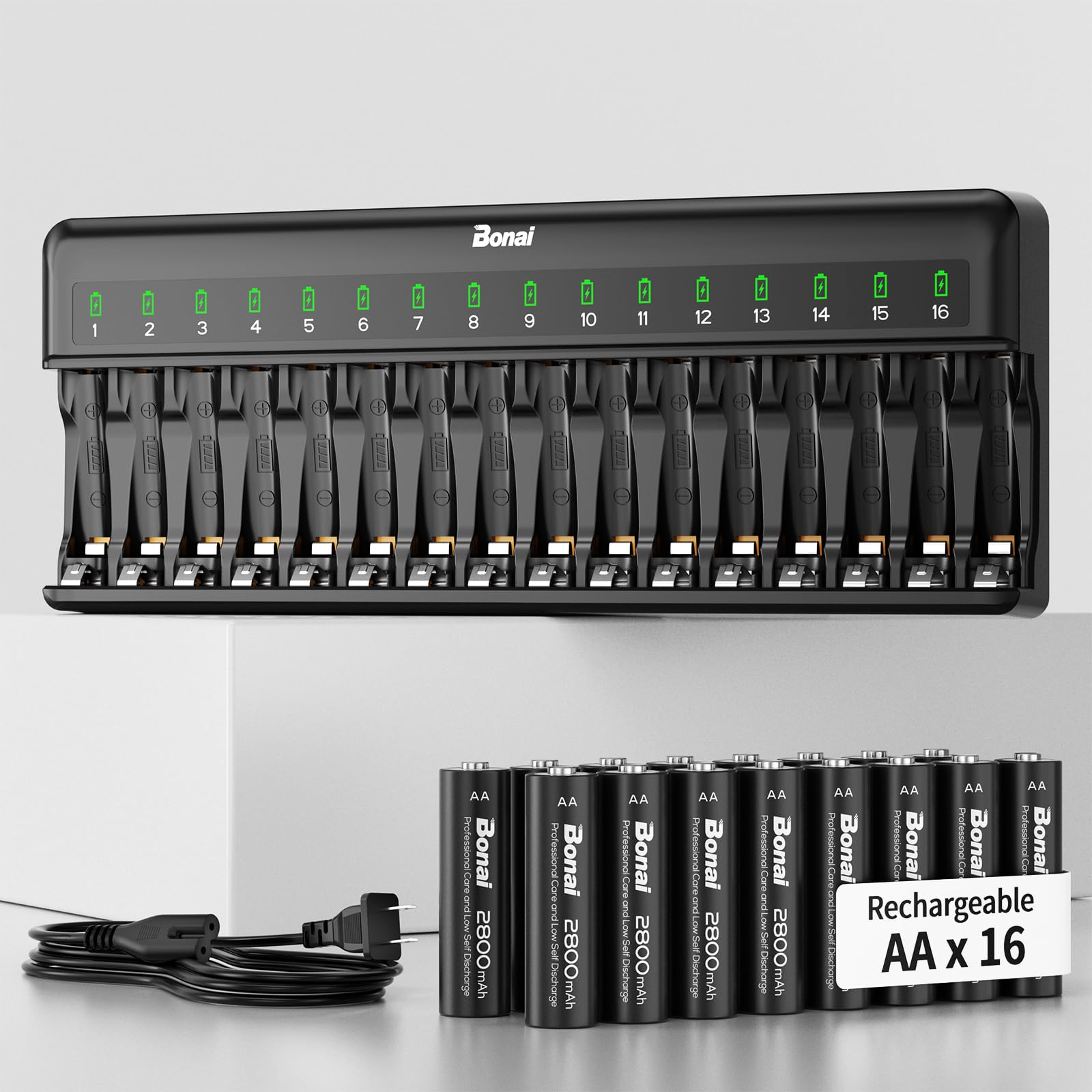
Sixteen 2800mAh cells and a charger built to fill every one of them in a single sitting.
If you are tired of running out of charged batteries mid-week, this kit solves that math outright — 16 AA rechargeable cells plus a 16-bay charger in one box. That is four times the battery count of the standard four-pack kits further down this list. Each cell is rated for up to 1,200 recharge cycles, so a full drawer of these is designed to last years of steady household use. The batteries are pre-charged, so they work straight from the start, and they hold up to a year of stored charge thanks to low self-discharge chemistry.
The charger itself is the quiet workhorse. It handles 1 to 16 batteries at a time, mixes AA and AAA cells in the same cycle, and runs off a standard AC wall plug rather than a USB adapter that eats a port. Built-in safeguards prevent overcharging, overheating, and short circuits, and it works on 110V to 240V outlets — so it travels well. Red, green, and flashing-red LED indicators walk you through charging, done, and fault states without requiring any guesswork.
The honest picture from the review pages is that the charger itself earns the most consistent praise — reliable, easy to use, especially for high-trust uses like a church sound setup running wireless mics. Battery performance gets a split read: some owners find they last far longer than the disposables they replaced, while a few say the cells do not hold a charge as long as expected for the rated capacity. If the charger reliability matters more to you than getting every last battery perfect, this kit delivers what it promises.
What stands out
- 16 AA batteries included — four times as many cells as standard four-pack kits
- 16-bay charger handles 1 to 16 batteries, mixing AA and AAA in one cycle
- Works on 110V-240V outlets and plugs straight into the wall, no USB port required
- Pre-charged and holds up to a year of stored charge
Where it splits opinions
- A few owners mention the cells do not hold charge as long as the capacity rating might suggest
- Charging speed is mixed — some batches can take overnight for a full 16-cell cycle
- At 1200 cycles, the rebuild rating sits below Eneloop kits at 2100
Step up to this if: you want a single kit that arms a whole household — kids’ toys, remotes, controllers, flashlights — without ever running out.
Stay with a smaller kit if: you only have a handful of devices and do not need 16 batteries sitting in a drawer.
6. BEVIGOR Rechargeable AA and AAA Batteries with 8-Bay Smart Charger, 4 AA 2800mAh & 4 AAA 1100mAh
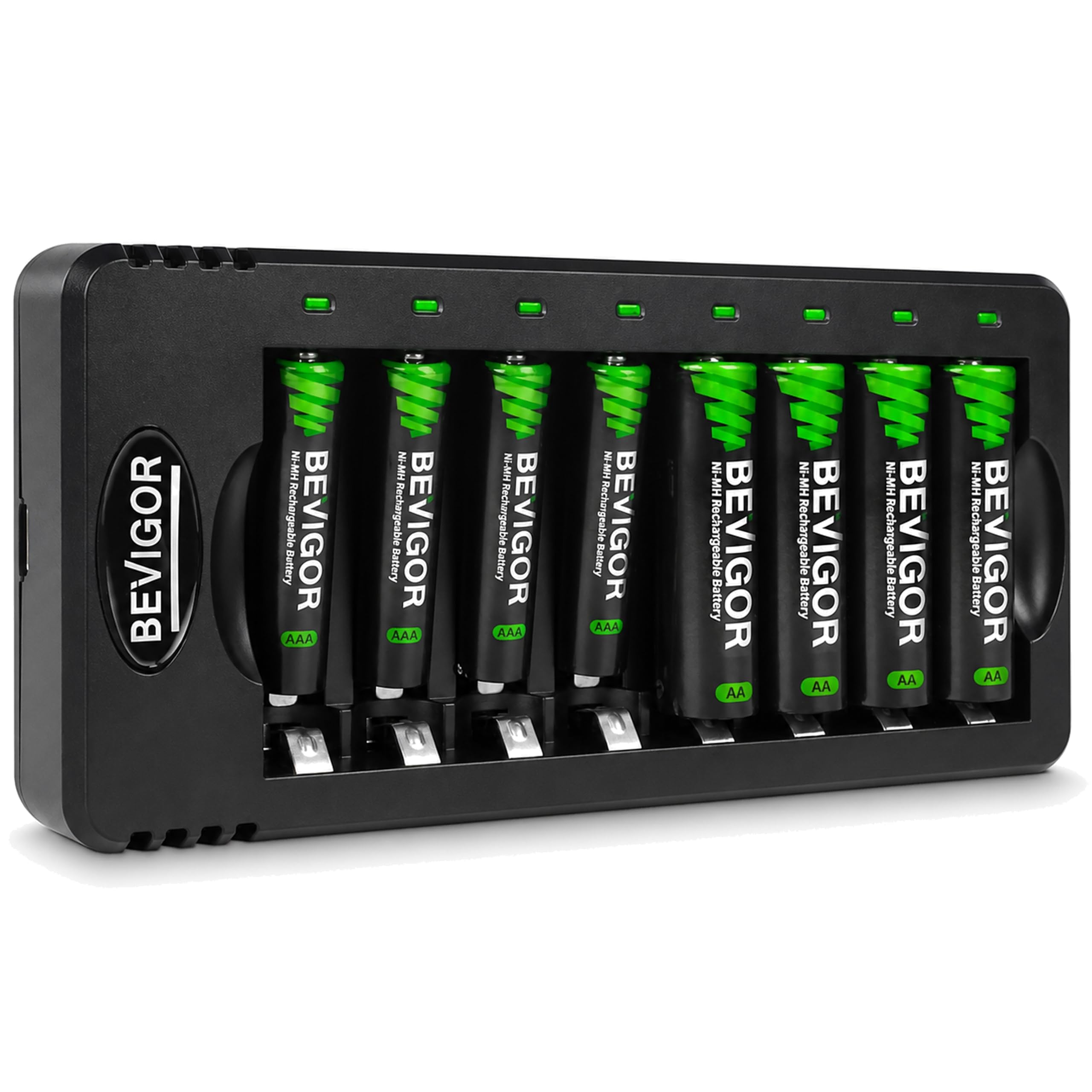
Eight-bay mixed charging with thermal protection and USB-C power — no wall plug required.
High-capacity AA cells paired with a smarter-than-usual charger is where this kit plays. The BEVIGOR pack bundles four AA at 2800mAh — matching the Powerowl set on capacity — plus four AAA at 1100mAh for the smaller devices that usually get short-changed by AA-only kits. Eight isolated circuits in the charger let you fill 1 to 8 batteries at a time, mixing AA and AAA together without restriction, and the whole set is rated for up to 1500 recharge cycles with a low-self-discharge design that keeps 80% of its capacity after 3 years of storage.
The safety system is what separates this charger from the budget end of the list. Automatic power-off and thermal protection (built-in heat monitoring that kills the current if things get too warm) prevent overheating, and red and green LED indicators tell you exactly what each bay is doing. The charger runs on a USB-C cable rather than a fixed wall plug — which means you can power it from a laptop, a wall adapter, or a power bank if you travel frequently. USB-C power lets you charge from a laptop, wall adapter, or power bank instead of a fixed AC plug.
The honest note is on battery longevity. Customers note the cells charge very fast and do not die suddenly, but a fair number note they do not last as long as premium name-brand batteries on a per-charge basis. The charger itself earns strong marks. If you want a fast, safe, individually-monitored top-up and are willing to trade some per-charge runtime for a lower entry point than the Eneloop kits, this covers that middle ground cleanly.
Where it shines: mixed AA/AAA charging with independent circuits and thermal safety — rare at this tier.
The fair warning: reviewers point out the cells do not match the per-charge longevity of premium brands like Energizer, even though they charge faster and hold up well enough for daily use.
Go with this if: you want a both-sizes kit with a smart charger and USB-C power at a reasonable price.
Move up if: maximum per-charge runtime matters more to you than mixed-size flexibility.
7. Duracell Ion Speed 1000 Battery Charger for AA and AAA with 4 Pre-Charged AA Batteries
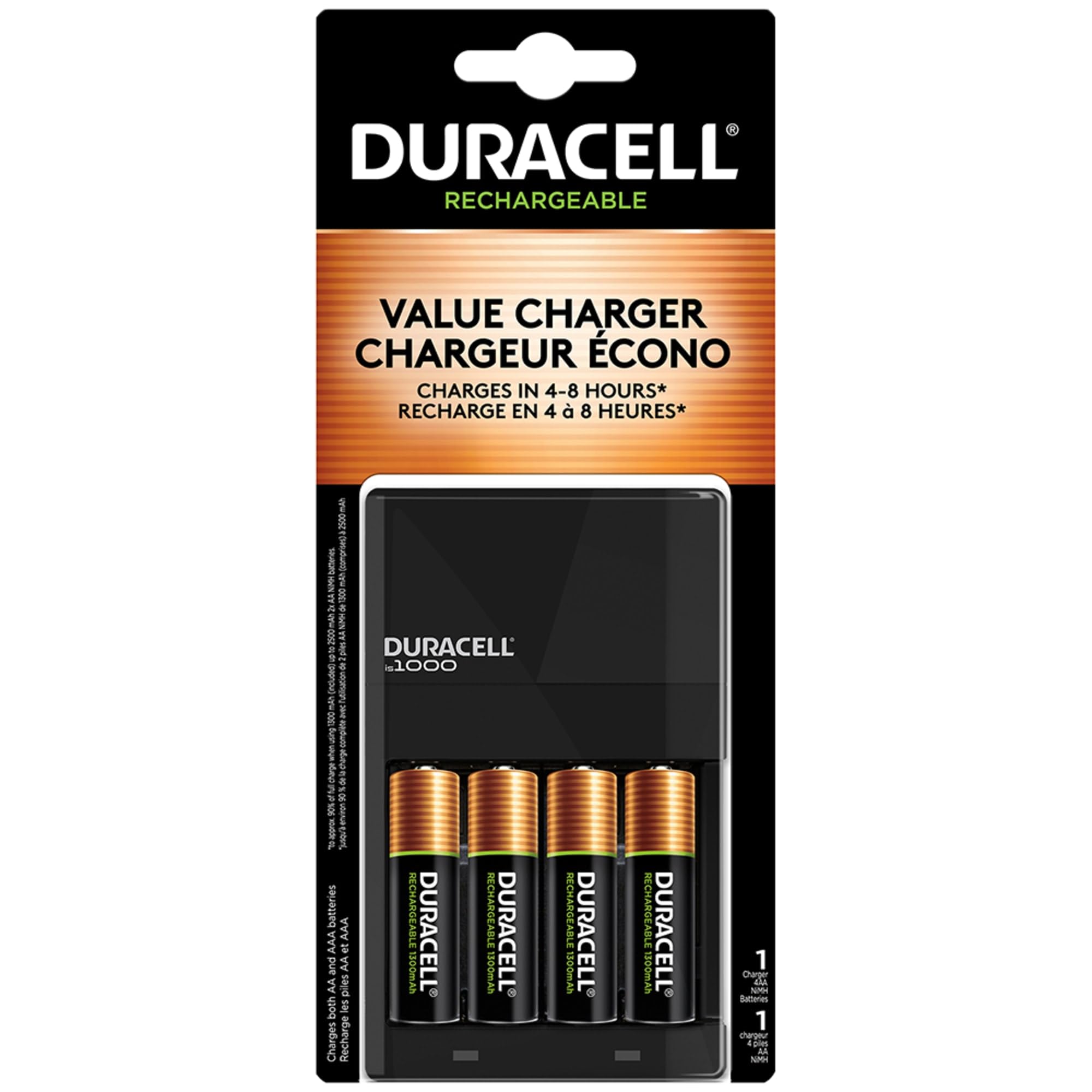
A four-bay starter kit with four pre-charged AA batteries for a first rechargeable purchase.
Four bays, one small charger, four pre-charged batteries — that is the whole pitch, and it is a clean one for a first rechargeable purchase. The Duracell Ion Speed 1000 charges four AA or four AAA NiMH batteries at a time in a compact form factor. It even accepts other brands’ rechargeable AA and AAA NiMH cells, so if you already own a few loose batteries from elsewhere, this charger will handle them. Cycle count is rated at hundreds of recharges, and the kit ships with StayCharged batteries that use Duralock Power Preserve Technology, guaranteed for three years in storage.
The standout practical detail is the foldable wall plug. With a six-hour charge time and no separate cord, this charger folds down and disappears into a drawer between uses — much smaller than a corded charger in real terms. The kit weighs 8.48 ounces and measures 4 x 1.22 x 9 inches, larger than the Eneloop K-KJ17MCA4BA. If you want a kit that travels and stows easily, the brawnier Duracell takes up more room.
What you get here is the honest read that this is a value pick rather than a premium one. Long-term owners of the 8-pack AAs used in Wii remotes report substantial money savings after a year of steady swapping, and the charger still performs after 40-plus cycles. A common early hurdle: the rechargeable cells are physically similar to standard alkalines, so they can get mixed up in the same drawer — match them to the charger or a labelled tray to avoid that. Also, some units ship with a clear spacer in the charger that must be removed before the first use.
What stands out
- Charges both AA and AAA on the same four bays — no separate units needed
- Foldable wall plug and a compact body that stows in a drawer
- Accepts NiMH batteries from other brands, not just Duracell’s own
- Included batteries are guaranteed for three years in storage
The honest trade-offs
- Six-hour charge time is slower than the Energizer Recharge Pro’s three hours
- A clear plastic spacer must be removed from the charger before first use
- Rechargeable cells look almost identical to standard alkalines — easy to mix up
The budget call: the cleanest way to try rechargeables without a big commitment — one charger, four batteries, one plug.
Move up if: you want faster charging or a longer cycle rating than this entry-level kit offers.
8. Amazon Basics 8 Count Rechargeable NiMH Batteries (4 AA & 4 AAA) with 4-Bay Battery Charger

Four AA and four AAA in one simple kit — the plainest way to get started with rechargeables.
If you want a starter kit that covers both battery sizes without committing to a higher-tier charger, this one ticks the boxes. The bundle includes four AA at 2000mAh and four AAA at 800mAh, plus a four-bay charger that accepts only NiMH batteries. Batteries are pre-charged and ready from the start, rated for up to 1000 recharge cycles, and hold 80% of their charge for up to 12 months in storage — the same low-self-discharge protection the premium kits tout. At 16 ounces with a slim body, it tucks away between uses.
The charger itself is smart about load distribution. It fully charges two AA cells within 3.5 hours or four AA within 7 hours, and two AAA within 2 hours or four AAA within 4 hours. That two-battery speed mode is the useful one — if you need a quick top-up of two batteries before heading out, it is a genuine time saver. The LED indicator does the talking: slow blink means charging, solid white means full, fast blink means the charger detected a defective or alkaline battery. Every time you plug it in, all LEDs cycle up and down in a quick sequence so you know the unit is powered.
The honest split in reviews falls on battery quality and charging speed — some owners use these for months without issue, mostly in TV remotes and gaming controllers, while a few find the runtime is shorter than they hoped. A common note is that the indicator lights can be confusing on arrival, though the manual clears that up. For a first rechargeable kit at an entry price, this delivers on what matters — the batteries fit, charge, and hold up well enough for light-to-moderate household use.
Why pick this: a both-size starter kit with low-self-discharge batteries and a charger that handles pairs fast and full sets at night.
Where it stops short: battery-level runtime draws mixed feedback — fine for remotes and controllers, less so if you expect premium-brand staying power per charge.
Best for: first-time rechargeable buyers who want a both-size kit and do not mind a slower full-set charge.
Look higher if: you want a longer cycle rating than 1000 or more charger bays than four.
9. Amazon Basics Rechargeable AA Low Self Discharge NiMH Batteries with 8-Bay Charger, USB-C Port, 8 Count

Eight AA batteries and an eight-bay charger that runs off USB-C — no wall adapter in the box.
The defining feature here is the charging port. This kit skips a built-in AC plug entirely and instead runs on USB-C, which means you can top it up from a laptop, power bank, car charger, or any USB wall block you already own. Eight AA 2000mAh cells come in the box, all pre-charged, all rated for up to 1000 recharge cycles and holding 80% of their charge for up to 12 months in storage. The charger fully charges eight AA batteries within 10 hours — a slow, steady fill that is fine for an overnight routine.
What the eight bays buy you is flexibility. You can drop in one, two, or all eight batteries and the charger distributes the load — no need to wait for a full set before starting. The LED indicator system works the same way as Amazon Basics’ other charger here: slow blink for charging, solid white for full, fast blink for a detected defective or alkaline battery. That consistency across the brand’s kits is nice if you already own one — the charging behavior is predictable across both units.
The honest note is that reliability gets a mixed read from owners, with a small number reporting the batteries or charger failing well before the listed cycle count. The eight-bay charging capacity draws clear praise from buyers who run battery-powered LED lights and similar high-draw devices, and the LED indicators occasionally go out of sequence enough that owners mention noticing it. Overall this is a value kit that works well for moderate household use — just do not expect the cycle durability of the premium Eneloop picks above.
The one-liner: a workable eight-bay kit whose USB-C charging and no-AC-adapter design make it the most travel-friendly option on this list.
Honest caveat: reliability draws mixed reports, and the charging indicator lights occasionally fall out of sync — worth knowing before you commit.
Reach for this if: you want USB-C charging and an eight-bay charger without paying for either premium batteries or a premium charger.
Move up if: long cycle life is a priority — the Eneloop kits at 2100 cycles sit well above this one’s 1000.
Understanding the Specs
Capacity in mAh
Capacity — written as mAh, short for milliamp-hours — is how much energy a battery can hold, so it sets how long a device runs on a single charge. A 2800mAh AA runs a gadget roughly longer per charge than a 2000mAh one, but the higher-capacity cell sometimes gives up a little cycle life to store that extra energy. Match capacity to how hard your device pulls: remotes and sensors barely notice the difference; game controllers and cameras benefit from the bigger cell.
Cycle count and low self-discharge
Cycle count is how many times a battery can be drained and refilled before it fades — 2100 cycles means every battery can be topped up thousands of times. Low self-discharge is a chemistry feature that slows how fast a battery leaks its charge while sitting idle, so a pre-charged cell can still have usable power months later. Together these two numbers decide how long the kit keeps paying you back. A high cycle count with poor self-discharge still has you hunting for a charger the moment you need the batteries.
FAQ
Will NiMH rechargeable AAs work in a game controller that takes standard AA batteries?
Is 2800mAh actually better than 2000mAh for everyday use?
What does individual cell charging mean and does it matter?
Can I leave rechargeable AA batteries in the charger overnight?
Why do some of my older batteries blink an error light instead of charging?
Do rechargeable AAs hold their charge when stored for long periods?
Will I save money by switching from disposable to rechargeable AAs?
Should I get a kit with more charger bays, or more batteries?
Do rechargeable AAs fit in every device?
Are rechargeable batteries safe to leave inside devices for months?
Final Thoughts: The Verdict
For most households, the aa rechargeable batteries and charger winner is the Eneloop Panasonic K-KJ17MCA4BA because it pairs the longest cycle rating in this lineup — up to 2100 recharges — with individual cell charging and a decade of stored-charge protection. If speed above all else matters to you, reach for the Energizer Recharge Pro and its roughly three-hour full charge. And for a large household that wants maximum capacity per charge plus an eight-bay charger, the POWEROWL Gold-top 2800mAh kit is the one to grab. One nudge worth acting on: the mid-range kits here cost a little more upfront than the budget picks, but the higher cycle ratings mean the reusable set keeps going long after a cheaper one would have been replaced.
How We Picked
We do not accept paid placement. Every pick is matched to a real buyer and a real use-case; we do not hands-on test units.
Sources & Methodology
Specifications: manufacturer listings and product documentation. Review insights: verified customer reviews, as of September 2026. Pricing: not shown on this page (it changes often); check the current price via the retailer link.
As an Amazon Associate, KitchPrep earns from qualifying purchases. This does not affect which products we feature.
Related Guides
