
Specs are compiled from manufacturer listings and verified buyer reviews and can change over time — please confirm the key details on the product page before buying.
You want power when the grid quits, and you want it without dragging a gas can into the garage. A battery solar generator stores electricity in a built-in battery and refills it from a wall outlet, your car, or a solar panel — no fuel, no fumes, no pull cord. The trick is matching battery capacity, AC output, and weight to what you actually run. Buy too small and your fridge trips the inverter. Buy too big and you cannot lift it.
I’m Mohammad Maruf — the founder and writer behind KitchPrep. This guide is built by comparing the manufacturers’ published specifications and the patterns across verified customer reviews, so you get each pick’s real strengths and trade-offs instead of marketing spin.
Below you will find the models that hold up in real blackouts and campsites, sorted by what they can genuinely run. Every pick here earns its place on capacity, output, and honest owner feedback. This is the shortlist for anyone shopping a battery solar generator.
Our Picks at a Glance

How To Choose The Best Battery Solar Generator
Most buyers get this wrong the same way: they buy on wattage alone and then discover the battery empties in forty minutes. Capacity is the real currency here. Watt-hours (Wh) tell you how long you can run something; watts (W) tell you what you can start. You need both numbers before you buy.
Match capacity to your longest outage, not your biggest appliance
Start with what you must keep alive and for how long. A fridge that draws around 100W and runs roughly a third of the time is a very different load from a space heater pulling 1,500W continuously. Add up the watts of everything you want running at once, then estimate the hours. A 1,000Wh-class station covers a fridge and phones overnight; a 3,000Wh-class unit covers a fridge, router, lights, and a CPAP through a multi-day storm.
Check the AC output rating against your hardest-starting appliance
Motors and compressors pull a spike of power the instant they kick on — that is the surge. A unit rated 1,500W continuous with a 3,000W surge starts far more than one rated 300W continuous with a 600W surge. If you plan to run a window air conditioner or a well pump, the continuous rating is the number that matters. Look at both figures on the label before committing.
LiFePO4 chemistry decides how many years you get
The battery inside is either a lithium-ion pack or a lithium iron phosphate (LiFePO4) pack. LiFePO4 lasts dramatically longer — several of the units here are rated to hold most of their capacity past 4,000 full charge cycles. That is the difference between a power station you replace in three years and one you hand down. Heavier, yes, but you pay for that chemistry once.
Quick Comparison
| Model | Best For | Capacity | AC Output | Weight | Amazon |
|---|---|---|---|---|---|
| Jackery Explorer 1000 v2★ Best Overall | All-round home backup and camping | 1,070Wh | 1,500W (3,000W surge) | 23.8 lb | Amazon |
| DaranEner NEO 350WBudget Champion | Light camping kits and CPAP on the move | 288Wh | 350W (600W surge) | 8.2 lb | Amazon |
| Jackery Explorer 300 + 40W PanelBest for Hikers | Hikers and van lifers who count ounces | 292Wh | 300W (600W surge) | 12.9 lb | Amazon |
| Anker SOLIX C300 | Backpackers who want fast USB-C charging | 288Wh | 300W (600W surge) | 15.5 lb | Amazon |
| BLUETTI Elite 100 V2 | Apartment outages and RV weekends | 1,024Wh | 1,800W (3,600W surge) | 25 lb | Amazon |
| DABBSSON 2000L | Whole-kitchen backup on a mid-tier budget | 2,048Wh | 2,200W (3,300W boost) | 41 lb | Amazon |
| DJI Power 2000 | Power tools and drone crews off-grid | 2,048Wh | 3,000W | 47.9 lb | Amazon |
| Anker SOLIX C2000 Gen 2 | RV boondocking and long fridge runs | 2,048Wh | 2,400W (4,000W peak) | 41.7 lb | Amazon |
| EcoFlow DELTA 3 Max | Running high-draw kitchen appliances | 2,048Wh | 3,400W X-Boost | 48 lb | Amazon |
| BLUETTI Elite 300 | RV shore power and true 3kWh storage | 3,014Wh | 2,400W (4,800W surge) | 58 lb | Amazon |
| EcoFlow DELTA Pro | Whole-home backup and mobile businesses | 3,600Wh | 3,600W (4,500W X-Boost) | 99 lb | Amazon |
In‑Depth Reviews
1. Jackery Explorer 1000 v2 Portable Power Station, 1070Wh, 1500W
Our pick — over 4.5★ from 3,500+ verified ratings; the strongest balance of quality and price.
Enough headroom to run a fridge all night, light enough to actually move it.
This is the one most people should buy. It pairs a 1,070Wh battery with a 1,500W AC output and a 3,000W surge peak — meaning it starts motor-driven appliances, not just laptops. Against the little 288Wh DaranEner further down the list, that is triple the stored energy and a 4.3× higher AC ceiling (1,500W vs 350W). Your fridge, a coffee maker, or a CPAP all fit comfortably.
The charging story is the standout. Switch on emergency charging in the Jackery App and it goes 0% to 100% in one hour; leave it on the default and it takes 1.7 hours to protect battery health. It has three pure sine wave AC ports, two USB-C ports (one pushing PD 100W), a USB-A port, and a 12V car port — six ways to plug in at once. Its LiFePO4 cells hold more than 70% capacity past 4,000 full charge cycles, which Jackery frames as over ten years of use.
At 23.8 pounds with a foldable handle it is genuinely carryable, and owners lean on it hard. What wins people over is the build quality and the fast top-up: the review pages describe shop vacs draining it from 95% to 60% in fifteen to twenty minutes, and CPAP users waking up with 30% still showing after two nights on maximum settings. A long-haul nomad running a car fridge for a week warns it is not enough for that load — go bigger. It is also worth knowing the Explorer 1000 v2 charges only from Jackery solar panels, so a third-party panel will not connect.
Where It Wins
- 1,070Wh capacity with a 1,500W / 3,000W surge inverter
- 0–100% in one hour via the app’s emergency charging mode
- LiFePO4 rated past 4,000 cycles, 70% capacity retained
- 23.8 lb with a foldable handle, six output ports including PD 100W USB-C
What To Weigh Up
- Solar charging works only with Jackery panels
- One long-haul owner running a car fridge around the clock found it ran dry within a week
- Wi-Fi drops overnight for some users
Buy it if: you want one unit that handles a fridge, phones, and a CPAP through a blackout and still fits in a car trunk.
Think twice if: you need to charge from a solar panel you already own — this pairs only with Jackery’s own.
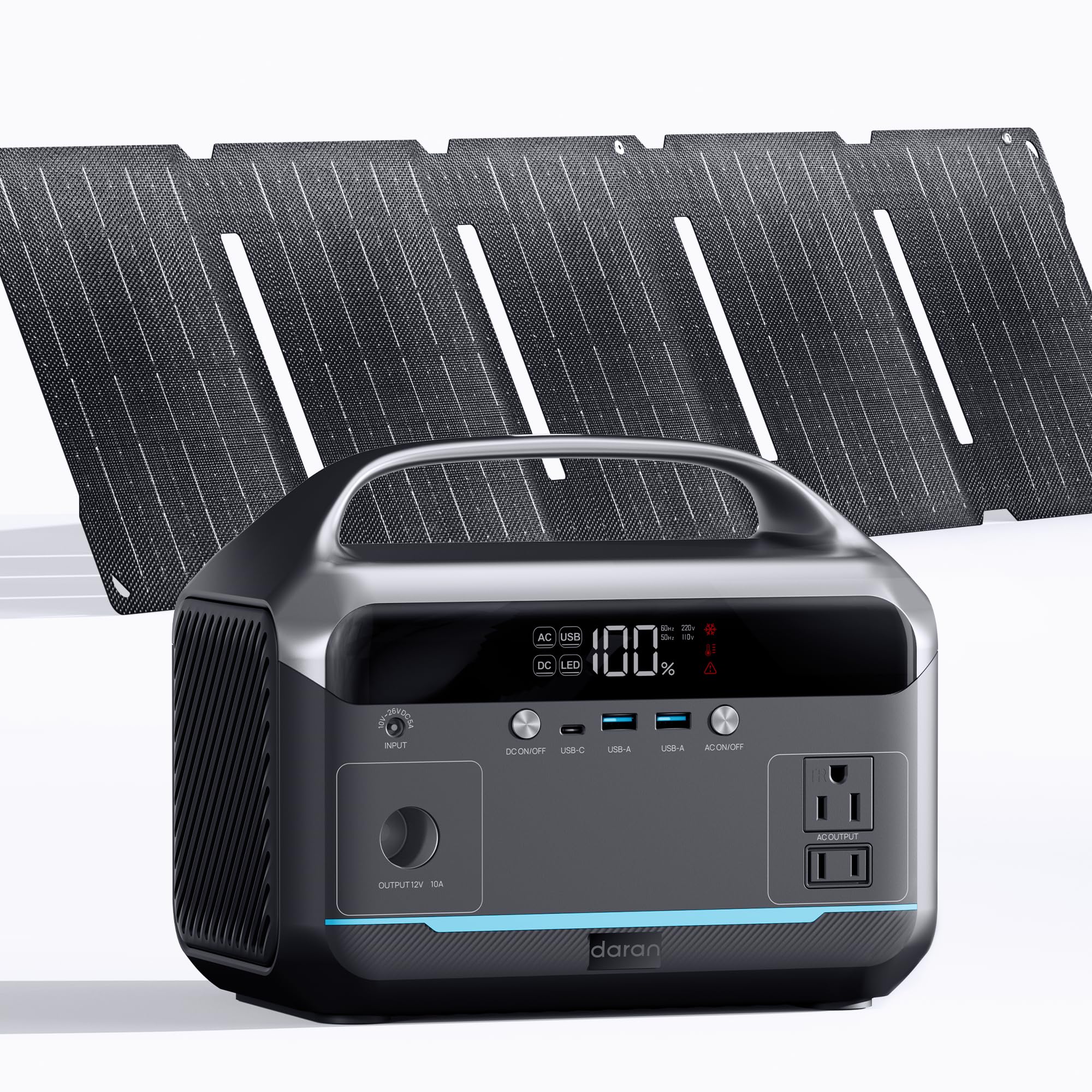
2. DaranEner NEO 350W with 40W Foldable Solar Panel, 288Wh LiFePO4
The starter kit that arrives with its own solar panel and weighs less than a gallon of water.
Here is the math on the cheap end. It carries 288Wh and a 350W AC output with a 600W surge — a fraction of the Jackery Explorer 1000 v2’s 1,070Wh and 1,500W, but at 8.2 pounds it is 15.6 pounds lighter and you can sling it in a backpack one-handed. For a camping kit of phones, lanterns, a drone, and a laptop, that is exactly the right size.
The LiFePO4 cells are rated at 3,000+ cycles, and you get a bundled 40W foldable panel with mono cells plus a built-in MPPT controller that squeezes more out of weak light. Recharge paths are wall (up to 90W), car (up to 100W), or solar. It also has two 110V pure sine wave AC outlets, a USB-C PD 60W port, two QC 18W USB-A ports, and a 12V/120W car port — six devices at once. Buyers report running two phones plus a small fan or portable AC for roughly seven hours and still seeing better than 70% left.
The catch worth flagging: there is no DC cigarette-lighter charging input, so you cannot top it up from a 12V socket — only the three-prong AC cord and the DC input for solar. There is also a track record of the screen not syncing with the true charge level, though DaranEner replaced a failed unit free, without asking for the old one back.
The verdict in one line: a light, solar-bundled entry point that covers phones, laptops, fans, and a CPAP in a pinch without a generator-sized footprint.
Keep in mind: it is not a home backup unit — match it to camping and short outages only.
Reach for this if: you are kitting out a tent, a van, or a hurricane go-bag and want the solar panel in the box.
Look elsewhere if: you want to charge from your car’s 12V socket — this model has no input for it.
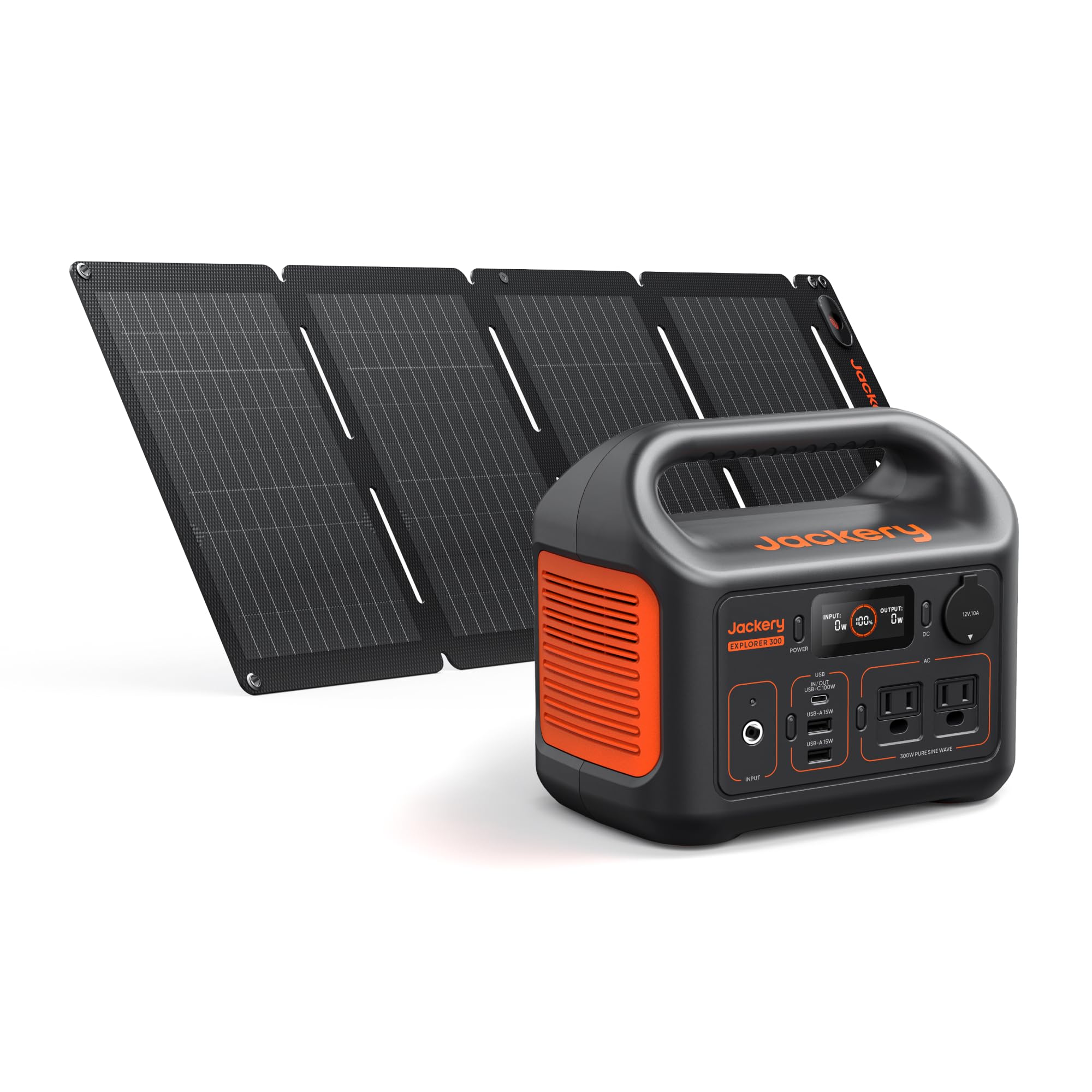
3. Jackery Solar Generator 300 and 40W Solar Panel, 292Wh, 300W AC
Built for the trail, not the garage — a 7.5-pound pack that carries its own sun.
Weight is the whole point here. From a 1,500W-class unit down to this 300W continuous / 600W peak output is a big drop in what you can start, so decide your loads first. The Explorer 300 runs 292Wh through two AC outlets, a 100W USB-C PD port, two USB-A ports, and a 120W car port — enough for laptops, drones, cameras, and LED lanterns. The integrated handle and the fact it is 17% lighter than the industry average for its class make long hikes less of a chore.
Its LiFePO4 battery holds 70% capacity past 4,000 charge cycles, which Jackery frames as more than eleven years of service. Solar is where it earns its keep: pair it with a 100W panel and you reach 80% in about 2.8 hours, or use the included 40W panel for 80% in around 7.5 hours. Owners who wired it into an eight-day overlanding trip ran a 12V car fridge overnight, used less than half the battery over ten to twelve hours, and held the fridge at 30°F. Off-grid, that is exactly the job.
The honest trade-off is the charging rate of the bundled panel. The 40W is fine for phones, tablets, and lights, but a full recharge on solar alone takes a full day of good sun — one buyer’s own verdict was to reach for a 100W panel instead. If your plan is to wander away from a wall outlet for a week, that is the upgrade to budget for.
What it delivers: a light, LiFePO4-powered pack with a bundled panel, made for weekend hikes, van life, and car-camping trips.
Where it stops: the recharge speed of the 40W panel, and an output ceiling that suits small electronics only.
Reach for this if: you care more about the weight on your back than the wattage on the label.
Look elsewhere if: your plan involves an air conditioner, a space heater, or a whole fridge.
4. Anker SOLIX C300 Portable Power Station with 60W Solar Panel, 288Wh, 300W

Eight ports on a unit the size of a lunchbox, and it tops itself up while you hike.
Two things define the C300: ports and silence. It gives you 300W continuous with a 600W surge out of 288Wh, spread across three AC outlets, a 120W car socket, two 140W two-way USB-C ports, a 15W USB-C port, and a USB-A port — eight in total. The 140W two-way USB-C means you can charge the station itself from a compatible USB-C charger, not just the wall brick. It runs at 25dB from 3.3 feet away, which is about as loud as a quiet room, so it disappears into a tent at night.
Recharging is quick for the class: 80% in 50 minutes from a wall outlet. The bundled 60W panel lives up to it in real sun — owners mention it pulling around 40W to 52W in full light and refilling the station fully by noon or in under 1.5 hours. There is an IP68-rated panel in the box as well, plus the LiFePO4 battery is rated at 3,000 cycles and backed by a 5-year warranty on the station.
What buyers do flag: it ships without a strap or a case, so add those if you plan to carry it far, and the app records live wattage and temperature but keeps no history. An inflatable queen mattress on an AC pump took it from full to 95% over ten to twelve minutes — enough to know a bigger draw will eat it fast. That is a small station doing a small station’s job.
Worth it for: backpackers who want fast USB-C charging, near-silent running, and a bundled panel that keeps pace in real sun.
Not for: running a fridge or any sustained heavy load — 288Wh empties quickly under real draw.
5. BLUETTI Elite 100 V2 Portable Power Station, 1024Wh, 1800W
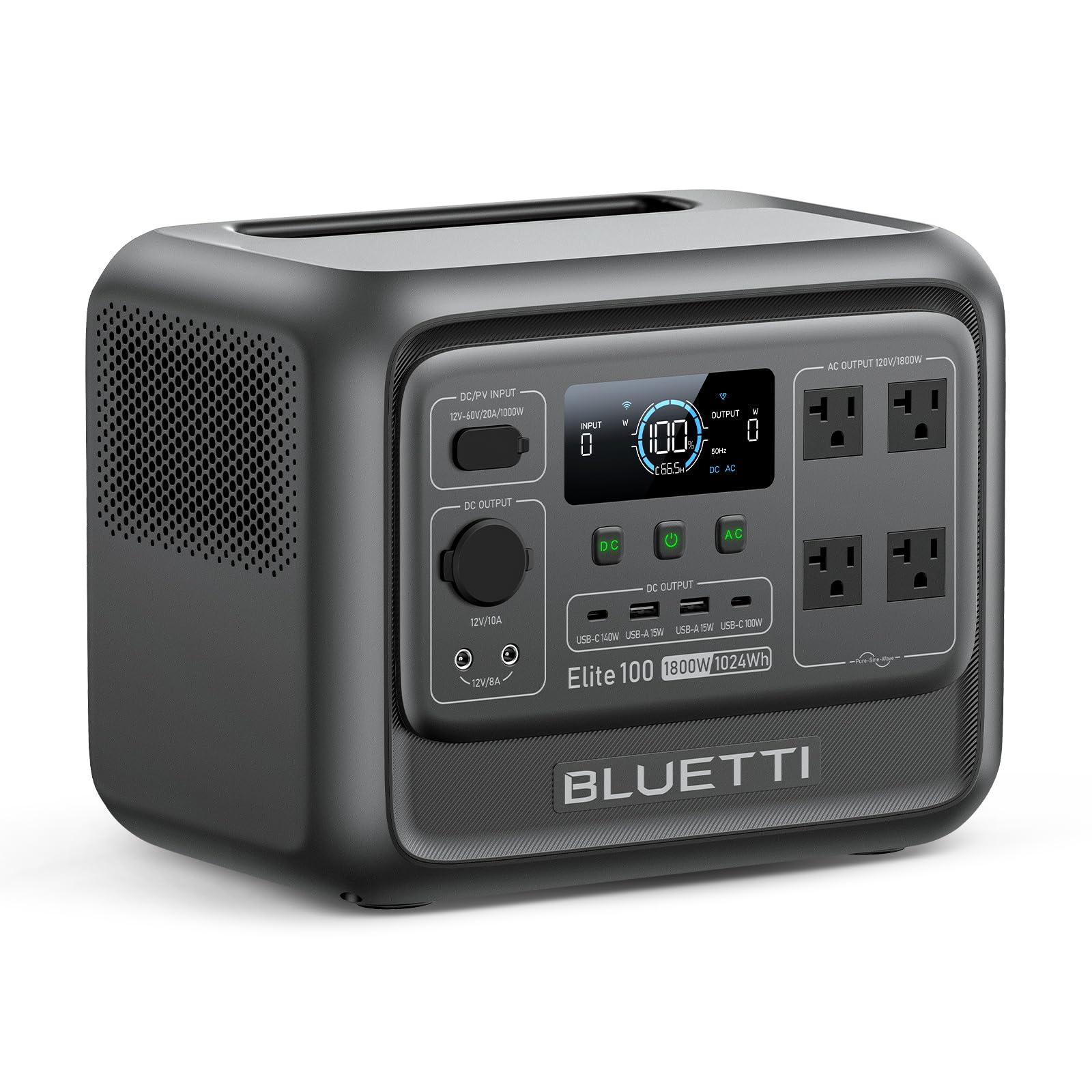
A 10ms safety net for your router and PC, plus enough juice for a fridge overnight.
The headline feature is the UPS (uninterruptible power supply) mode: with a 10ms switchover, the Elite 100 V2 keeps Wi-Fi routers and desktops alive the instant the grid blinks — fast enough that sensitive electronics do not notice. That is a different job from camping, and it is where this unit is most useful for anyone with a home office. Capacity is 1,024Wh with an 1,800W rated AC output and 2,700W power lifting, spread over 11 ports.
Charging is fast for the size: it reaches full in about 70 minutes with 1200W TurboBoost AC charging, or via up to 1000W solar input. In silent mode it runs at just 30dB, which BLUETTI frames as 50% quieter than other 1kWh-class stations — quiet enough for a bedroom. Its LiFePO4 battery holds 80% capacity past 4,000 cycles, a claimed 10-year lifespan. At 25 pounds with a hidden handle you can carry it one-handed from the closet to the kitchen.
Owners run it hard. The review pages describe it keeping a fridge alive for up to 48 hours during outages, and one remote-location astrophotographer runs a telescope mount, imaging cameras, a mini PC, a tablet, and a phone on it for 6.5 to 8-hour sessions at around 34W resting draw. The recurring gripe is that it is heavy enough that “portable” feels generous on a long haul, and physical buttons on the front can be hard to read in low light.
Best use case: a blackout-ready station for an apartment or home office where the UPS switchover and 30dB quiet mode matter as much as the wattage.
One catch: at 25 pounds it is heavier than the 1kWh class suggests — best stored where you need it, not lugged around.
Buy it if: the priority is keeping computers, routers, and a fridge up through short-to-medium outages.
skip it if: you need a backpackable unit — this is a home-and-RV tool.
6. DABBSSON 2000L Portable Power Station, 2048Wh, 2200W AC
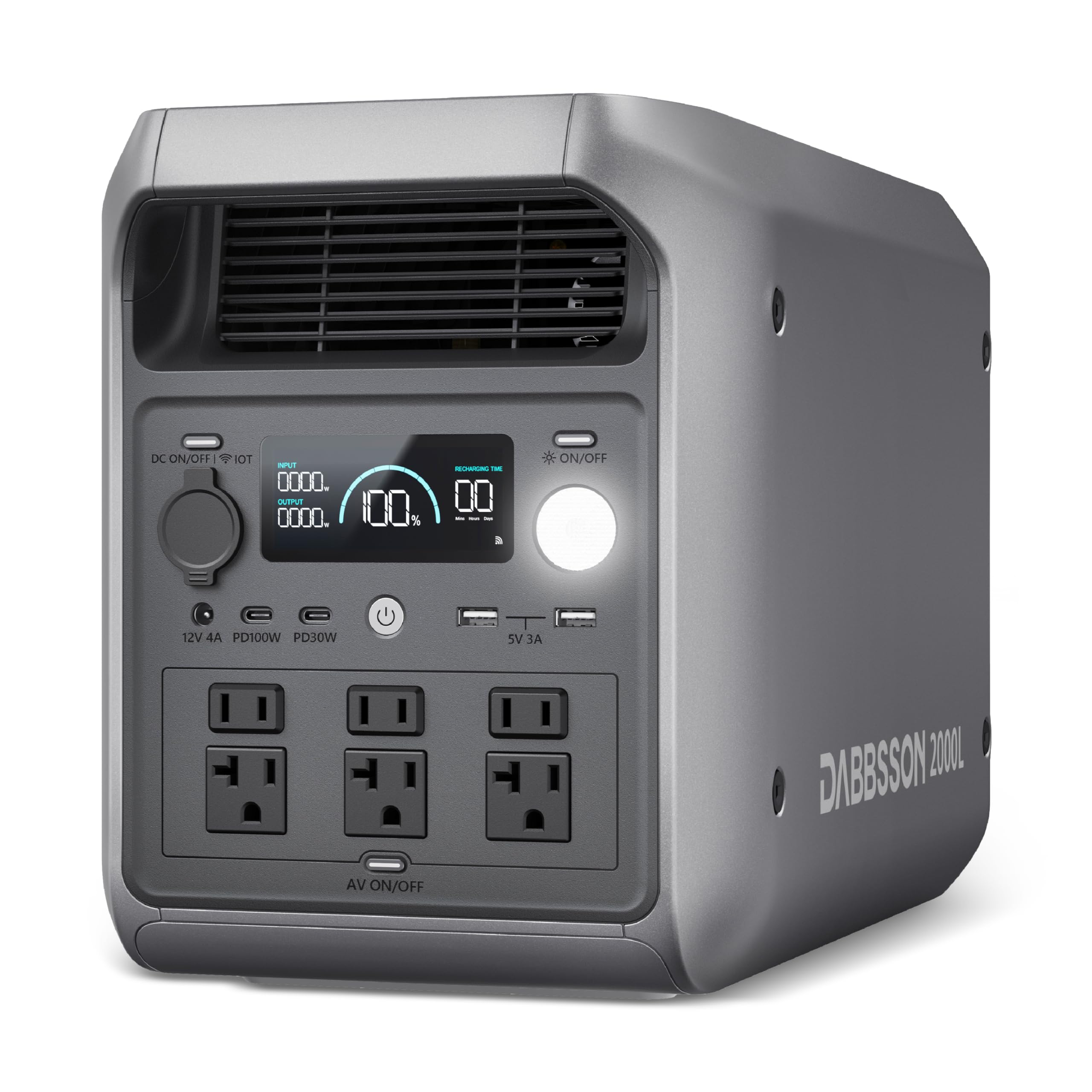
Kitchen-grade power for the money, if you can live with a fan that never quite stops.
For buyers who want serious capacity without jumping to the top of the market, the 2000L is the sharpest value here. It pairs 2,048Wh with a 2,200W continuous output and a 3,300W Power Boost, over six AC outlets. That means it starts large resistive loads, not just phones. It also runs a semi-solid LiFePO4 pack rated 4,000+ deep cycles to 80% in a UL94-V0 flame-retardant housing, with an under-15ms EPS switchover for computers and routers.
The real-world numbers are the selling point. Owners run a Keurig (1,400W), an air fryer and microwave (1,670W), and — in the same power station’s own reviews — ran a 1,600W air fryer three separate times. It ran two freezers plus two fridges simultaneously for 7.5 hours, and a double-door fridge for 20 hours and 40 minutes. Recharge to full is about 1 hour from AC, with up to 800W MPPT solar input available on the off-grid side.
The catch is noise. The cooling fan cycles every few minutes even at zero draw, and owners say it is audible from 20 feet in a quiet room — fine in a garage or on a job site, less so in a bedroom. It is also 41 pounds, which is light for the capacity but still a two-hand lift. The fan is the one thing to weigh up if you plan to keep it near where you sleep.
Strong Points
- 2,048Wh with 2,200W continuous and 3,300W Power Boost over six AC outlets
- Semi-solid LiFePO4 rated past 4,000 cycles to 80%, over 10 years of daily use
- Recharges to full in about 1 hour from AC, with up to 800W solar input
- Under-15ms EPS switchover for computers and networking gear
Fit Notes
- Cooling fan cycles even at zero draw and is audible from 20 feet in a quiet room
- At 41 pounds it needs two hands to move
- Energy management settings do not always hold — the charge can sit at 100% anyway
Perfect for: a job site or garage where you want whole-kitchen capability and are not sleeping next to it.
Skip if: bedroom or nursery placement matters — the fan rules it out.
7. DJI Power 2000 Portable Power Station, 2048Wh LFP Battery
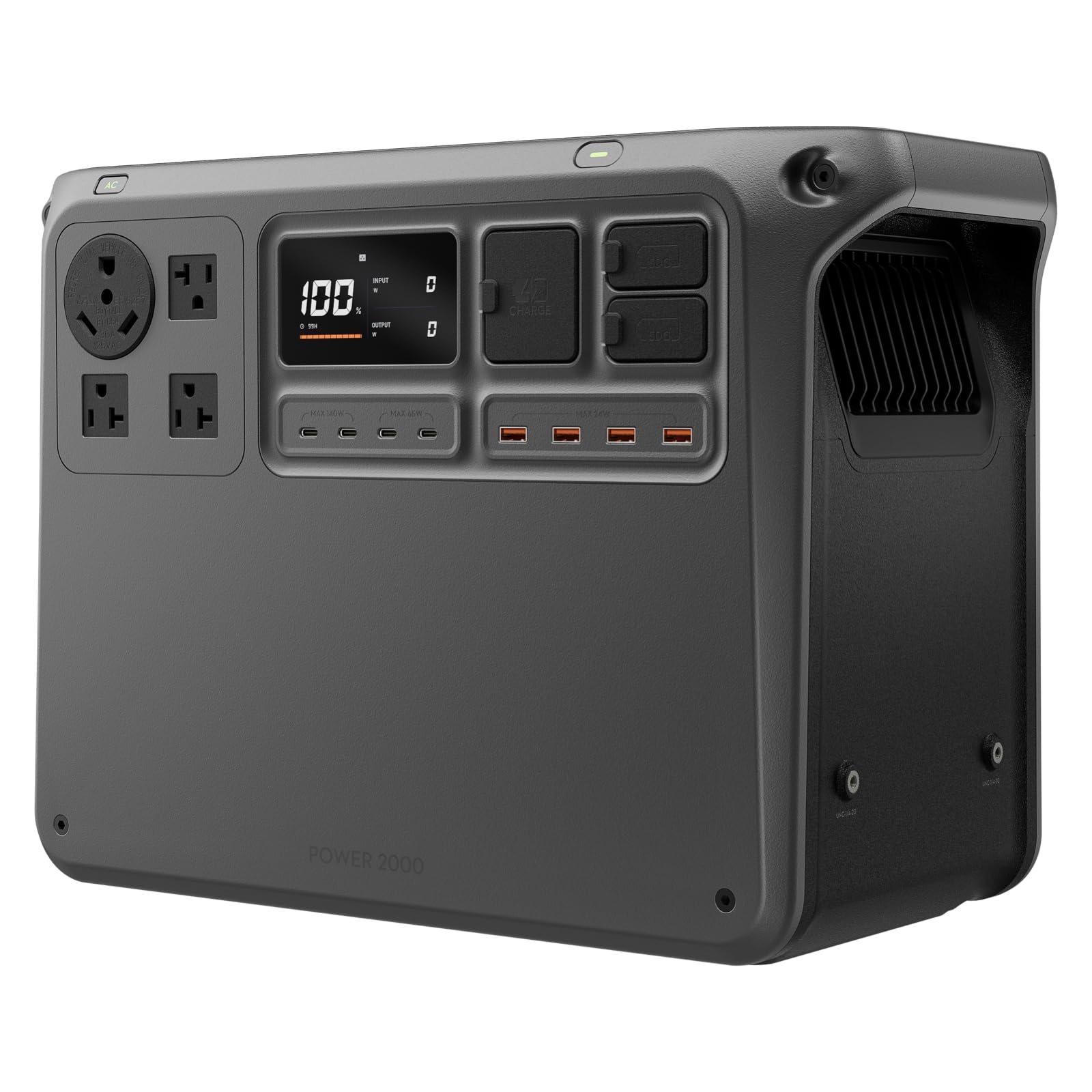
Desk-parts for a crew of five and enough output to run a trailer overnight without a gas engine.
Owners buy this one for two reasons: it can power serious equipment, and it stays quiet doing it. A 2,048Wh LFP battery feeds a 3,000W output, with 15 ports including dual full SDC ports — one of the widest port counts here. It recharges to 80% in 55 minutes via AC, and it runs as low as 30dB, which makes it usable inside an RV overnight. The UPS switchover is 10ms, twice as fast as DJI’s own Power 1000.
What owners actually run is the proof. Mobile DJs report a 6-hour pool-party set pulling only 25% out of it; camper customers note it running an entire trailer quietly in place of a noisy gas generator, with the readout showing roughly 40 hours of runtime with everything on; and one buyer runs it for business instead of a Honda EU3000, including Starlink, a 75″ TV, and a pellet grill. Expansion reaches up to 22.5kWh with additional batteries, which DJI says covers essential home devices for 4 to 6 days — though those batteries are sold separately.
The clear catch is the ecosystem. The DJI Home app is required to open up remote control, and the solar and car charging modules are not built in — you need a separate compatible adapter to connect a panel or a car battery. A look at the DJI peripheral supply issues suggests those add-ons have been hard to source at times. Standalone, though, it works from the start.
Buy it if: you need to run tools, drones, and campers quietly and want a wide 15-port spread for a whole crew.
Think twice if: you plan to plug in solar or a car charger right away — the adapters are sold separately and have been hard to find.
8. Anker SOLIX C2000 Gen 2 Portable Power Station, 2,048Wh, 2,400W
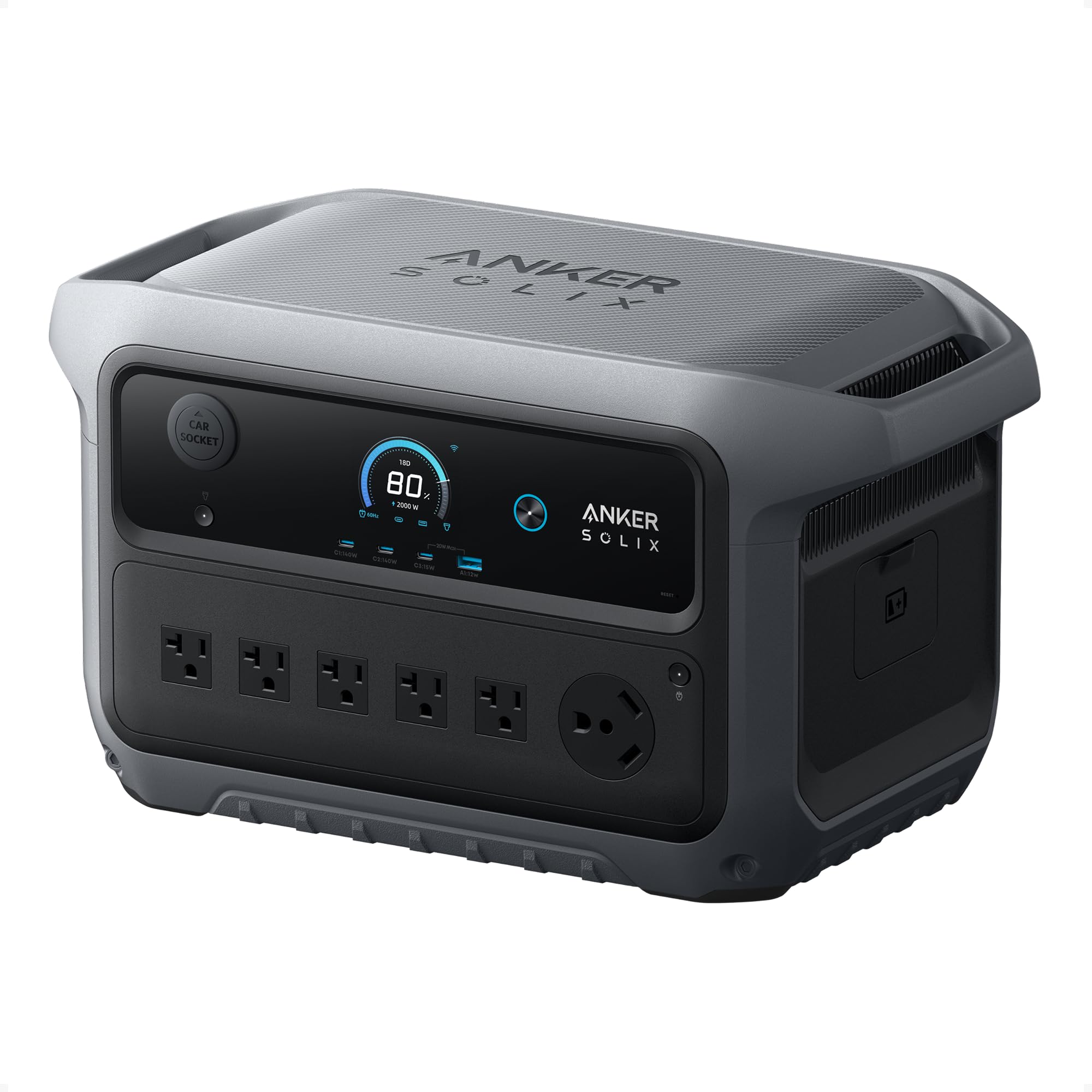
Sips power on standby so your fridge keeps humming for days, then tops up in under an hour.
The C2000 Gen 2 leans on efficiency. It draws only 9W on standby, which Anker rates for up to 32 hours of dual-door fridge runtime — and up to 64 hours if you add an expansion battery to reach 4kWh. With 2,400W continuous and 4,000W peak output, you can run window and RV air conditioners, not just lights and laptops. That is a different class from the Elite 100 V2 above, whose 1,024Wh handles a fridge overnight; this one is built for the 30-plus-hour version.
Charging is the headline: a full 100% in 58 minutes via wall or solar. Car charging is quick too — an optional 800W alternator setup brings it to 100% in 3 hours. And it is light for the capacity at 41.7 pounds, which Anker frames as 25% lighter and 29% smaller than comparable units. Owners have run a 10,000 BTU AC through the night, and a 13,500 BTU AC for around 90 minutes on one charge.
Two honest notes. With AC input connected, the output is capped at 1,800W instead of the full 2,400W, which is worth knowing before you plan a big restaurant-grade load. And the battery itself is on the heavy side — the one recurring theme in the feedback is that the unit earns its keep but asks for a rolling cart if you move it far.
Why It Earns Its Spot
- Only 9W standby draw, rated up to 32 hours on a dual-door fridge
- 2,400W continuous / 4,000W peak runs window and RV air conditioners
- 0–100% in 58 minutes, or 100% in 3 hours on an 800W alternator charger
- 41.7 pounds, 25% lighter than comparable units
- Expandable to 4kWh with an add-on battery
Bear In Mind
- Output drops to 1,800W while AC input is connected
- Heavy enough that a rolling cart is the practical way to move it
- Display and app usage estimates can drift from real draw
Suits: fridge-first backup and RV boondocking where runtime and quiet matter more than portability.
Does not suit: buyers who want to carry it far by hand — the weight wants wheels.
9. EF ECOFLOW DELTA 3 Max Portable Power Station, 2048Wh LFP, 2400W

X-Boost cheats the wattage ceiling so kettle-grade appliances still run off a battery.
EcoFlow’s X-Boost is what sets this unit apart from the C2000 Gen 2 and DJI Power 2000 further up: the 2048Wh battery feeds a rated 2,400W output, but X-Boost lets it drive up to 3,400W, enough to run fridges, microwaves, and power tools that would trip a plain inverter. From-wall charging is fast too — 0–80% in 1.13 hours on X-Stream, and the unit carries a 10ms transfer time for home backup duty plus extended 5-year service.
Owners work it hard. A family dessert business runs a waffle iron and one to two freezers off it, using the surge for several seconds of startup draw. A travel review reports a 1700W wall charge with a quiet fan and battery temps around 100°F indoors. There is an XT-60i connector that open up a higher current and faster solar charging; a plain XT-60 is limited to 12V/8A, so cabling matters if you plan to solar-charge at full speed. The display shows per-port rates and time estimates, and the app pairs via Bluetooth then Wi-Fi.
The honest caveats: at 48 pounds it is heavy — one buyer notes it arrives with a hand truck to make that manageable — and the front buttons are dim in bright light. The bigger heads-up is that the app’s mode layout can feel confusing on first setup, with two home screens to learn.
Buy it if: you need to run genuinely heavy appliances like microwaves and freezers and want the 3,400W X-Boost headroom.
Think twice if: 48 pounds is more than you want to move — the included hand truck is worth keeping.
10. BLUETTI Elite 300 Portable Power Station, 3014.4Wh

Three full kilowatt-hours, an RV shore-power outlet, and a footprint smaller than most 2kWh units.
For camper vans and RVs, this is the one built for the job. It packs 3,014Wh into a compact shell — an energy rating that dwarfs the 1,024Wh Elite 100 V2 up the page — and it is the only station here with a proper TT-30 RV outlet and a 12V/30A DC output for 12V fridges, water pumps, and diesel heaters. A 2,400W AC output with a 4,800W surge starts resistive loads like kettles, and the 10ms UPS keeps routers and computers alive through outages.
Charging is fast for 3kWh: 0–80% in as fast as 78 minutes, and its LiFePO4 battery is rated past 6,000 cycles — the highest cycle count here. Owners run a 12,000 BTU air conditioner all night on it, and one buyer’s own testing clocked a dehumidifier at 77.2% efficiency (1.05kWh out from 1.36kWh in). The app controls outputs and monitors usage, and firmware updates go over Wi-Fi.
The honest limits are on the solar side. Input caps at 60V/20A, and exceeding the open-circuit voltage can damage the MPPT and void the warranty — the wrong panel spec is a real risk. There is also no battery expansion, so 3,014Wh is the ceiling. At 58 pounds it is a two-hand move, though the built-in handles help.
The specialist’s angle: a genuine RV shore-power replacement in a compact footprint, with the longest-rated LiFePO4 battery here at 6,000+ cycles.
The real catch: solar input is voltage-sensitive and there is no room to grow the capacity later.
Reach for this if: your load lives in an RV and you want shore-power capability with real 3kWh storage.
Look elsewhere if: you want to add batteries later — this tops out at its shipped capacity.
11. EF ECOFLOW Portable Power Station 3600Wh DELTA Pro, 120V 3600W AC

The one that stops pretending to be portable and starts being a home battery instead.
At 3,600Wh and 99 pounds, the DELTA Pro is the biggest unit here for a reason: it is designed to run a house, not a campsite. A single unit delivers 3,600W AC output, 4,500W with X-Boost, and can be paired with a second unit to reach 7,200W. Fifteen output methods — five AC outlets, two USB-C at 100W, USB-A fast charge, DC outlets, a car port, and an Anderson port — let it run multiple appliances at once. Capacity expands from 3.6kWh up to 25kWh with add-on batteries and Smart Generators, which is the real game for long blackouts.
Fast charging is the second half of the pitch: 1.8 hours to full with a 240V/3000W input, 2.7 hours on a standard 1800W wall outlet, or 2.8 hours on four 400W solar panels at up to 23% conversion efficiency. Owners who run mobile businesses report it running a heat press at vendor markets with no voltage drop across five 120V outlets, and others run AC units for hours during outages. Buyers describe getting up to 15 days on a single full charge under light load.
The one clear limiter is that the solar input path is capped at 15A, which is worth knowing before you build a big array around it. And 99 pounds means it is not something you move casually — this belongs on a cart or a shelf, next to the panel, not on a hike.
Why It Leads the Big Class
- 3,600Wh expandable to 25kWh for multi-day home backup
- 3,600W AC output (4,500W X-Boost, 7,200W paired) across 15 output methods
- 1.8-hour recharge on 240V, 2.7 hours on 1800W wall outlets
- Solar-charged in 2.8 hours with up to 23% conversion efficiency
Where It’s Committed
- 99 pounds — this is a set-in-place unit, not a carry-along
- Solar input capped at 15A
- Best results need 240V or paired batteries, which adds complexity
Built for: whole-home backup and mobile businesses where a full 3.6kWh and 15 output methods are the point.
Not built for: anyone who needs to lift it more than a few feet — you are buying a home battery, not a camping toy.
Understanding the Specs
Watt-Hours and AC Output
Capacity in watt-hours (Wh) tells you how much energy is stored — it decides runtime. The formula is capacity divided by load, so 1,020Wh running a 100W fridge survives about ten hours of run time; the same battery running a 1,000W tool empties in an hour. AC output in watts (W) tells you the biggest load the inverter can carry at once. The surge figure (usually double the rated output on smaller units) covers the split-second spike a motor draws when itstarts. Match both numbers to your appliances before you buy.
LiFePO4 Chemistry and Cycle Count
A cycle means one full drain and recharge. Lithium iron phosphate (LiFePO4) cells here are typically rated for thousands of cycles before dropping to roughly 70–80% of original capacity. The higher the cycle rating, the longer the station lasts before you replace it. LiFePO4 also handles heat and heavy draw more gracefully than standard lithium-ion.
FAQ
How many watt-hours do I need to run my refrigerator during an outage?
What is the difference between rated AC output and surge power?
Can a battery solar generator really run a window air conditioner?
How long does a LiFePO4 battery last before it needs replacing?
What is a UPS switchover time and why does it matter?
Can I charge my solar generator from the car while driving?
Is a solar panel included with these stations?
Can I expand the capacity later, or am I stuck with what I buy?
How quiet are battery solar generators compared with a gas generator?
Does the brand’s app require internet, and can I control the unit remotely?
Final Thoughts: The Verdict
For most people, the battery solar generator to buy is the Jackery Explorer 1000 v2 — it pairs 1,070Wh with 1,500W / 3,000W surge, tops up in one hour, and stays light enough at 23.8 pounds to actually carry. It also carries the highest owner rating in this lineup — 4.7 stars across 3,000+ reviews — making it the safest first pick.
If you want the fast-charging charger and a bundled solar panel in one box, the Anker SOLIX C300 is the compact choice for backpackers and short trips. And if your goal is a full home backup that can run through days of outages, the EcoFlow DELTA Pro is the one to reach for — the 3,600W output and 25kWh expansion ceiling cover almost any scenario a home owner or mobile business will face.
How We Picked
We do not accept paid placement. Every pick is matched to a real buyer and a real use-case; we do not hands-on test units.
Sources & Methodology
Specifications: manufacturer listings and product documentation. Review insights: verified customer reviews, as of September 2026. Pricing: not shown on this page (it changes often); check the current price via the retailer link.
As an Amazon Associate, KitchPrep earns from qualifying purchases. This does not affect which products we feature.
Related Guides
