
Specs are compiled from manufacturer listings and verified buyer reviews and can change over time — please confirm the key details on the product page before buying.
Cutting beams, posts, or thick timber with the saw you already own depends on one number: how deep the attachment actually cuts once the clamps and hardware eat into your bar length. Pick the wrong design and you waste money on a cut that comes up short. This guide breaks down the real cutting depth each design delivers.
I’m Mohammad Maruf — the founder and writer behind KitchPrep. This guide is built by comparing the manufacturers’ published specifications and the patterns across verified customer reviews, so you get each pick’s real strengths and trade-offs instead of marketing spin.
Some picks mount to a circular saw for straight rip cuts, others clamp to a chainsaw bar for slabbing logs on site. Every pick here is a real, verified attachment that turns your existing saw into a beam-cutting tool. The numbers below decide whether a cut actually fits your beam. If you are weighing a beam saw attachment against buying a dedicated beam saw, the depth math here usually settles the decision quickly.
Our Picks at a Glance
How To Choose The Best Beam Saw Attachment
Two families of attachment dominate this category: beam cutters that bolt onto a circular saw, and rail or frame mills that clamp onto a chainsaw bar. Each solves a different job, and picking the wrong family for your work is the most common mistake. Here is what actually matters before you buy.
Cut depth versus rated capacity
The headline number on a beam cutter — “12 inch cut” — describes the maximum depth the attachment reaches when it is fully dialed in. That figure is real, but it only applies when the attachment is mounted on the right class of saw and the chain is kept sharp. On a 45 degree bevel the capacity usually drops, so if your work involves rafters or miter cuts, check the rated angle capacity separately from the straight-cut depth.
How much bar length you lose to the clamps
Chainsaw mills clamp onto your bar, and those clamps consume usable cutting width. That means a mill rated for a 36-inch bar does not cut a 36-inch-wide slab — the clamping hardware and the spike on your saw eat the difference. Before you size a mill to a log, subtract that loss from your bar length so you are not disappointed on the first cut. The same logic applies to a circular-saw cutter: the blade guard and mounting plate shift where the cut actually lands.
Worm drive versus standard circular saw mounts
Beam cutter attachments are built for a specific saw class. Worm drive saws — the heavy, gear-driven saws favored for framing — use a different footplate geometry than a standard sidewinder circular saw. Buying the wrong mount means a finicky install, missing bolts, or a guard that has to come off. Match the attachment to your saw’s drive type before anything else.
Quick Comparison
| Model | Best For | Max Cut Depth | Saw Type | Item Weight | Amazon |
|---|---|---|---|---|---|
| Granberg G778-48 Alaskan MKIV Chainsaw Mill★ Best Overall | Slabbing large logs on site | 13 inches | Chainsaw | 21 pounds | Amazon |
| Prazi 12″ Beam Cutter (Worm Drive)Top Performer | One-pass cuts on 8×8 beams | 12 inches | Worm drive circular saw | 3.5 pounds | Amazon |
| Prazi 12″ Beam Cutter (Non-Worm Drive)Best Value | Standard circular saw owners | 12 inches | Standard circular saw | 3.5 pounds | Amazon |
| S77000 12 Inch Beam Cutter | Budget one-pass beam cuts | 12 inches | Worm drive circular saw | — | Amazon |
| VEVOR Rail Mill Guide System | Guided cuts on long logs | — | Chainsaw | 22.9 pounds | Amazon |
| Timber Tuff Portable Chainsaw Sawmill | 16 to 24 inch bar owners | 11.81 inches | Chainsaw | 14.3 pounds | Amazon |
| Portable Chainsaw Mill 36 Inchs Rail Mill Guide System | 14 to 36 inch bar flexibility | 12 inches | Chainsaw | 17.3 pounds | Amazon |
| 36 Inch Chainsaw Mill (3 Sizes) | Modular, packable milling | — | Chainsaw | 18.1 pounds | Amazon |
In‑Depth Reviews
1. Granberg G778-48 Alaskan MKIV Chainsaw Mill, 48-Inch Portable Sawmill Guide
Our pick — over 4.5★ from 950+ verified ratings; the strongest balance of quality and price.
Clamps to a 48-inch chainsaw bar and mills logs up to 42 inches wide into slabs and beams on site.
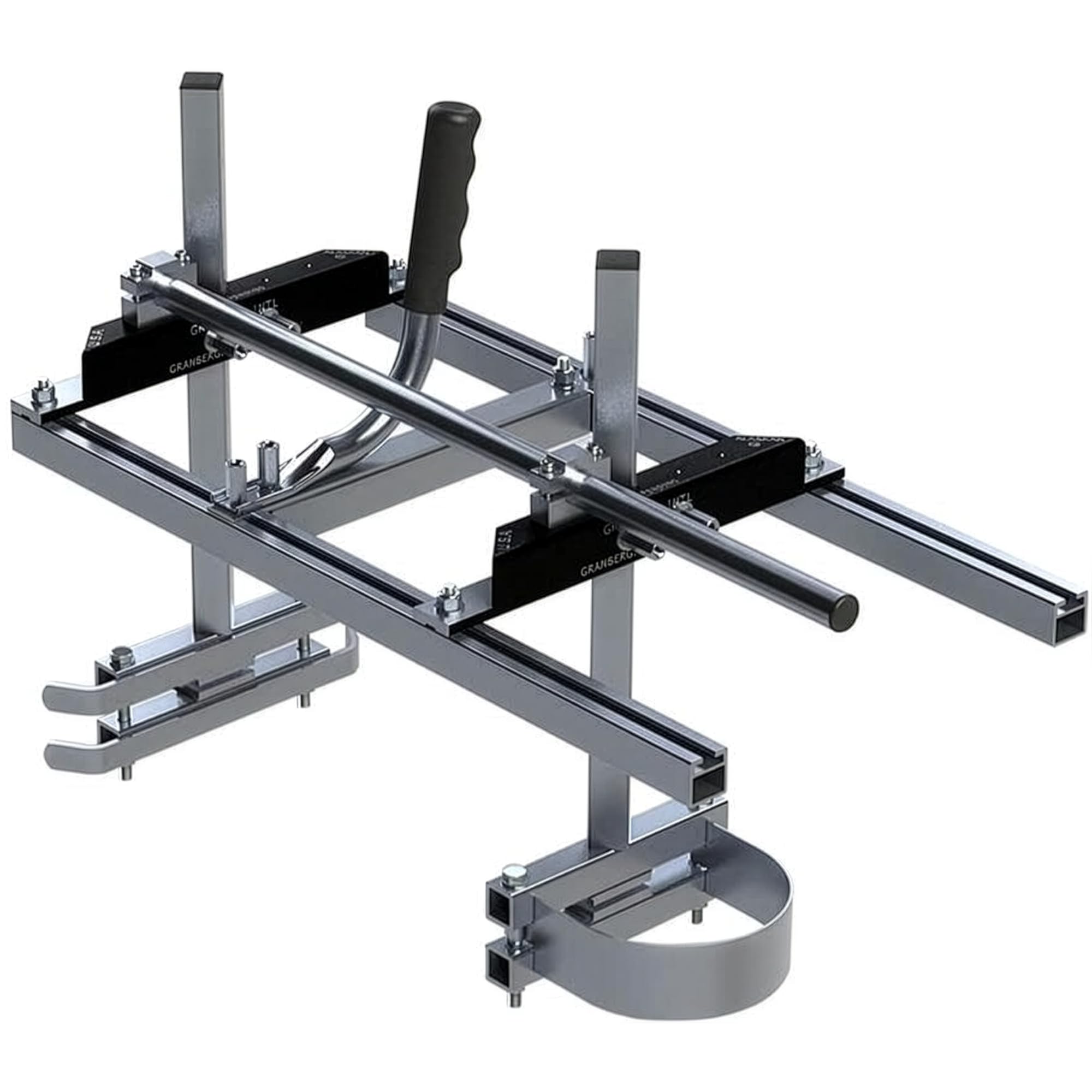
Breaking down big logs into boards, slabs, or squared beams is what this attachment does best, and it is the one the rest of the category gets measured against. It fits chainsaw bars up to 48 inches long and cuts planks and beams up to 42 inches wide, at thicknesses from 1/2 inch to 13 inches — so you can mill a wide slab in one pass or dial the guide down for thinner siding. It clamps directly onto your chainsaw bar with no drilling, so you can assemble it in under an hour with hand tools and get cutting the same day.
Stability is what makes this mill hold up on a deep cut. The frame is aircraft-grade aluminum with zinc-plated steel hardware, and the mass is real — at 21 pounds it is 3.7 pounds heavier than the 17.3-pound Portable Chainsaw Mill 36 Inchs, and that extra weight is what keeps the guide rail from wandering. A 1.8 KW power source rating anchors the milling setup, and the adjustable rail and integrated wood cutting guide handle the alignment so long cuts stay true.
What wins people over is the quality of the machined parts — owners consistently describe a fit and finish they did not expect from a bolt-together mill. The honest catch is bar math. Buyers report that a 24-inch bar yields only 19-20 inches of maximum cut width once the clamps take their share, so size your saw to the log, not the other way around. Thickness adjustment also takes some getting used to, and several owners built their own gauge blocks to speed it up.
What Earns Its Keep
- Fits bars up to 48 inches and cuts beams up to 42 inches wide, 1/2 to 13 inches deep
- Aircraft-grade aluminum frame with zinc-plated steel hardware for stable alignment
- Clamps directly to the bar with no drilling, assembling in under an hour
- Crafted in America and backed by responsive support that owners call out repeatedly
Before You Commit
- Every inch of bar lost to the clamps is real cut width you do not get back
- At 21 pounds it is physically taxing to run through many hours of milling
- Thickness setting is fiddly enough that some owners make their own wood gauge blocks
Land on this one: You are milling logs larger than a 24-inch bar can handle and you want a mill that will outlast several cheaper units.
Keep looking: You only cut framing lumber and mostly work with a circular saw — a beam cutter attachment for your worm drive is far quicker to set up.
2. Prazi 12″ Beam Cutter Attachment for Circular Saws — For 7-1/4″-8-1/2″ WormDrive Saws
Bolts onto a 7-1/4 to 8-1/2 inch worm drive saw and cuts 12 inches deep in one pass.
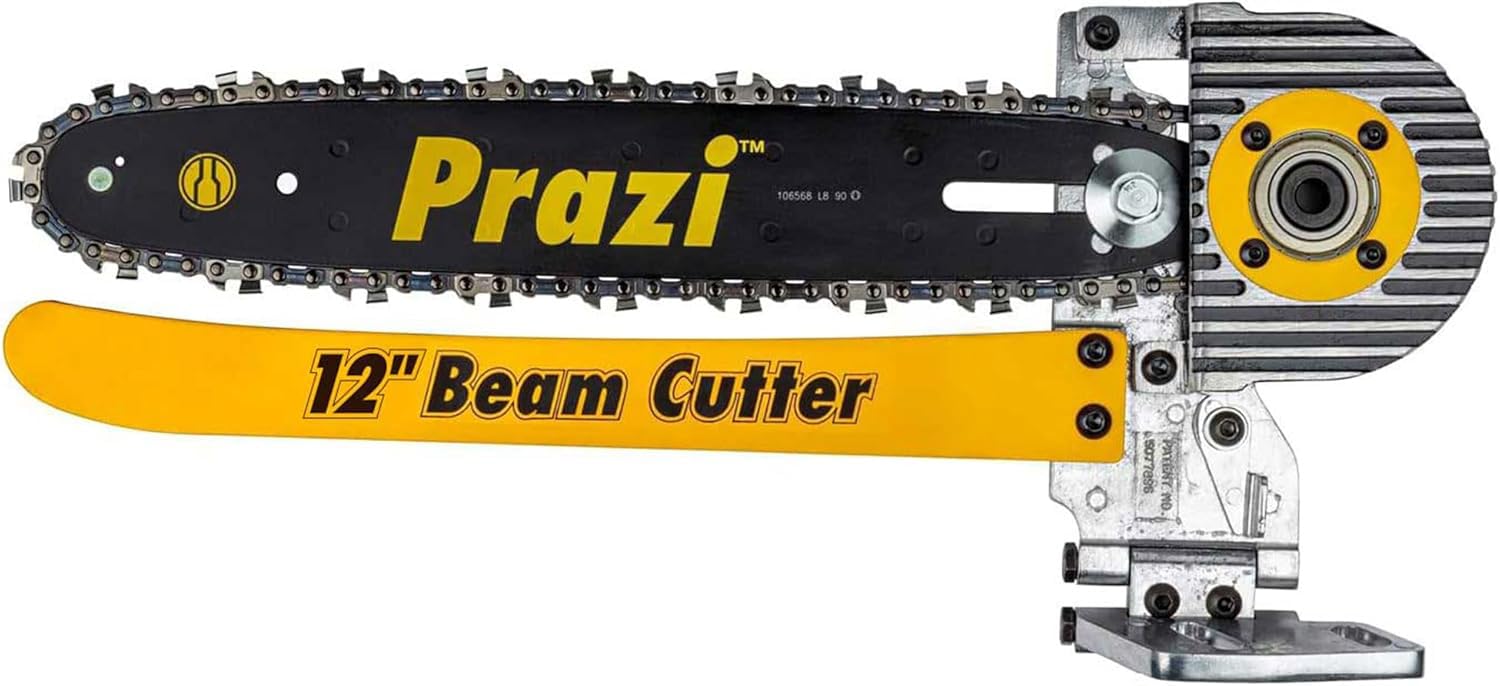
Here is the number that sells it: a standard circular saw reaches about 2-1/2 inches deep, and this attachment pushes that reach to 12 inches, or 8 inches when you bevel to 45 degrees. That means a single pass through an 8×8 post instead of flipping the beam or switching to a chainsaw. It bolts onto Skil, Bosch, Makita, DeWalt, and Craftsman worm drive saws in about 60 seconds, and no saw parts need to come off to mount it.
The comparison against a chainsaw mill is the real story. Where a chainsaw-driven mill like the Granberg trades speed for cut width, this attachment keeps the cut square and straight because the blade stays vertical and the footplate glides along a fence. It also runs far quieter than a chainsaw and produces a cleaner edge, so owners mention needing less sanding before the beam is ready to frame. The anti-kickback low-profile chain and double-guarded guide bar handle the safety side, and a dust deflector guard keeps the cut line visible.
Fitment is the catch. Not every saw is a drop-in — customers note that on a Milwaukee M18 Fuel Rear Handle saw the blade guard has to come off, and the install needs a 5/16-18 left-hand bolt plus a 1/4-20 carriage bolt to sit right. An occasional buyer finds the bar vibrates on the very first cut until the fence is set, which can leave a sloppy start. The front-running advice from owners is to expect a short setup period rather than true plug-and-play, then enjoy the clean, single-pass cuts that follow.
Where it wins: One-pass cuts through 8×8 and larger beams, square and straight, from a saw already on your truck. The 12-inch straight depth and 8-inch 45-degree capacity cover framing, rafters, and stairs.
Where it costs you: A worm drive saw is required — this will not mount to a standard sidewinder circular saw, so if your saw is a standard drive type, look at the non-worm-drive version instead.
Reach for this if: You run a worm drive saw daily and want 12-inch beam cuts without hauling a second machine to the job.
Look elsewhere if: Your saw is a standard sidewinder — the non-worm-drive beam cutter in this list is the correct mount.
3. Prazi 12″ Beam Cutter Attachment for Circular Saws — For 7-1/4″ Non-Worm Drive Saws
Cuts 12 inches deep on a standard 7-1/4 inch sidewinder circular saw.
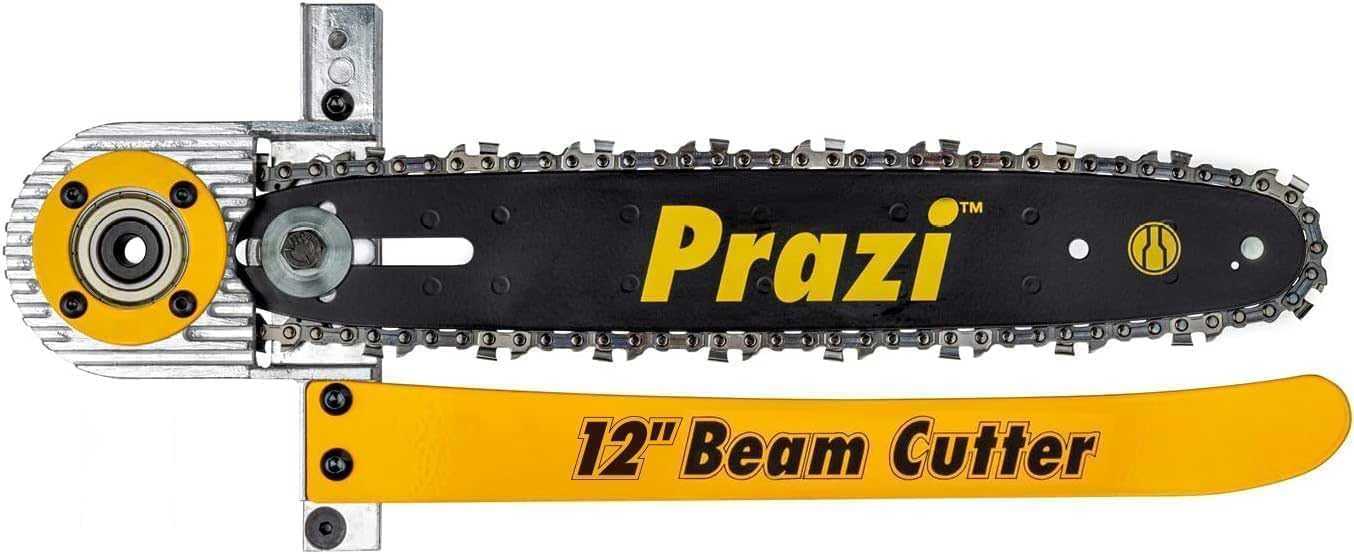
If your saw is a sidewinder — a standard 7-1/4-inch circular saw without the worm drive gearbox — this is the mount that fits. It takes your cut depth from 2-1/2 inches to 12 inches, and the 45-degree cutting angle handle rafters and miters in a single operation. Prazi builds it with the same high speed steel blade and 3.5-pound body as its worm drive sibling, so the cutting performance is the same; only the mounting plate changes.
The claim that sells this attachment is that it does what a chainsaw or a plain circular saw cannot — one-pass cutting through thick beams. Owners confirm the cutting performance: it slices 6×6 posts cleanly, and the accuracy and fast installation earn their share of credit. It installs quickly enough that switching tasks on a job site does not kill your rhythm, and it shares the lifetime limited warranty coverage that Prazi backs its cutters with.
The honest trade-off is compatibility. Fitment with Dewalt saws has been reported as an issue, and the chain tightness can loosen over a cut unless you check it. Those are the two most-cited gripes in owner feedback, and both have workarounds — checking chain tension before each beam and confirming your exact saw model against the mount. It is worth a quick fitment double-check before you mount it, especially on a Dewalt sidewinder.
The selling point: The same 12-inch cutting depth as the worm drive version at a standard-saw mount, with a 45-degree cutting angle for rafters and miters.
What to watch: Saw compatibility varies by brand — confirm your standard circular saw model is on the mount’s list before ordering, and keep an eye on chain tension through a cut.
Fit this to: A standard 7-1/4-inch circular saw owner who wants one-pass beam cuts without buying a worm drive.
Do not buy it for: A worm drive saw — the worm drive version is the right mount for that machine.
4. S77000 12 Inch Beam Cutter for Worm Drive Saws

A budget worm drive cutter that rips 12 inches deep through 6x and 8x framing lumber.
This is the entry-level pick for framing lumber. It converts a 7-1/4-inch or 8-1/4-inch worm drive saw into a beam cutter that rips 12 inches deep, with a vertical blade that produces square cuts. The 3-3/8-inch blade runs a 46-tooth chain and cuts wood at a maximum of 5800 RPM, which is enough to slice through 6x and 8x material in one pass. For rough framing where the cut gets covered anyway, that is the whole job.
Owners who use it for what it is built for are satisfied: the 6x and 8x cuts come out straight and square, and it is easier to cut square with this setup than with a conventional chainsaw. A dust deflector guard and a low-profile anti-kickback chain keep the operation controlled on the framing line. The 45-degree angle capacity means rafters and miter cuts are covered with the same attachment, and the worked metal handle gives a firm grip through a long cut.
The honest catch is setup. Fitting it to a saw takes significant disassembly, so it is not a good choice if you switch the attachment on and off frequently. A few reviewers point out the chain arrived installed backward from the factory, which is a two-minute fix once you spot it — reverse it and the saw cuts as advertised. The cut quality is rougher than a dedicated chainsaw mill and leaves a slightly wavy edge on a worm drive Skilsaw, which is fine for framing but needs sanding for finish work.
Buy this when: You want one-pass 12-inch cuts on framing beams and accept a rough finish and a slower install in exchange for a budget-tier price.
Step up instead if: You switch attachments often or need finish-grade edges — the Prazi worm drive cutter installs faster and cuts cleaner.
5. VEVOR Rail Mill Guide System, 15 ft 6 Crossbar Chainsaw Mill Kit
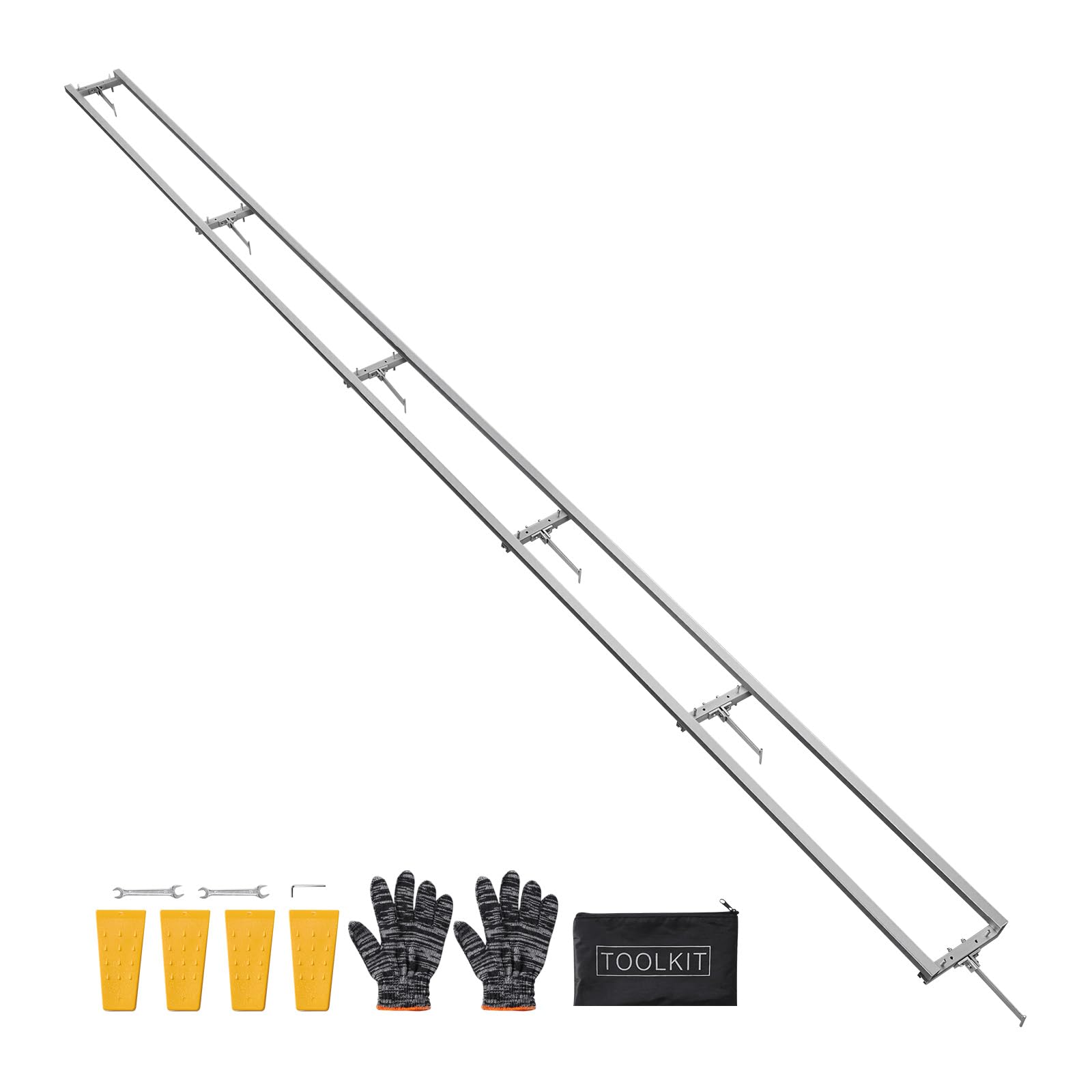
A 15-foot guide rail with six adjustable crossbars that keeps a chainsaw mill cutting straight through long logs.
This is the support system, not the mill — and that distinction matters when you buy it. The 15-foot guide rail has six movable crossbars that slide to fit whatever log you are working with, clamping down for steady horizontal cuts. It fits most electric chainsaws and milling attachments, so if you already own a mill attachment, this rail gives it the straight runway it needs to produce even slabs. Four included anti-binding wedges slide into the kerf to keep the blade from pinching as the log relaxes.
The build explains the price step up. The rail is made from high-grade aluminum with a chrome-plated finish for wear and corrosion resistance, and locknuts at the key joints plus six reinforced crossbars keep the saw gliding without chatter. At 22.9 pounds the rail setup anchors a larger log than a shorter mill can manage, and the 180-inch span handles longer trunks in one setup. Owners describe the material quality as a strong point, and the packing has survived shipping well in most cases.
The recurring gripe is small hardware — the crossbar screws loosen over time and need a split-lock washer to stay put, and there is no storage bag or case included. A few buyers received the product without the hardware or instructions, so unpack and inventory everything the day it arrives. And if you do not already own a chainsaw mill attachment, this rail alone will not cut anything; pair it with a mill.
Why it earns a spot: The 15-foot span and six adjustable crossbars handle longer logs and give any chainsaw mill a straight path for slab and beam cuts.
Where it needs care: It is the rail system only — no mill attachment included — and the crossbar hardware needs split-lock washers to stay tight through heavy use.
Best paired with: An existing chainsaw mill attachment and a long log you want to break down in one straight setup.
Not for you if: You need a complete milling package from the start — this is the rail only, and the mill itself is a separate purchase.
6. Timber Tuff Portable Chainsaw Sawmill Lumber Cutting Mill, 24 Inch

A 14.3-pound aluminum mill that clamps to 16 to 24 inch chainsaw bars and adjusts board thickness from 0.20 to 11.81 inches.
Running a 16 to 24 inch bar and breaking down occasional logs without a heavy frame is exactly what this mill is built for. It clamps to your saw and arrives with the mounting hardware you need, so setup takes minutes with hand tools. The mill body is aircraft-grade aluminum with stainless steel hardware, and at 14.3 pounds it is the lightest full mill in this list — meaningfully easier to carry out to a felled tree than the 21-pound Granberg.
The adjustability is the standout. Two thumbscrew rails set board thickness anywhere from 0.20 to 11.81 inches, so the same guide produces thin siding, 1-inch stock, bench slabs, and squared beams. Log length is limited only by the log itself, which is the whole appeal — you mill where the tree fell rather than winching the trunk out whole. Owners who use it for planking and post-making call it perfect for that job, and the guide handle is a frequently praised extra that makes long cuts easier to control.
Log size is the honest limit. On a 24-inch bar, a 19-inch log is not workable because the spike, the bark, and the clamping nose behind the sprocket all eat into the cut — you are down to roughly a 15-inch maximum log, with no adjustment to fix that. You also lose about 2 inches of cut from the bar length when the mill is attached. The stainless hardware resists rust, a real plus over steel jigs, but tighten the bolts evenly — uneven overtightening has stripped threads, and replacement parts are not stocked on the manufacturer’s site.
The appeal: A 14.3-pound aircraft-grade aluminum frame that fits 16 to 24 inch bars, with 0.20 to 11.81 inch thickness adjustment for siding, stock, and slabs.
The size trap: On a 24-inch bar, real log capacity lands around 15 inches once the spikes, bark, and clamping nose are subtracted — size down your expectations, not the mill.
Made for: A weekend woodworker with a mid-size chainsaw who wants to mill logs into planks, beams, and siding without a heavy mill frame.
Pass if: Your logs are wide or you own a 36-inch bar — the larger mills in this list cover that size range properly.
7. Portable Chainsaw Mill 36 Inchs Rail Mill Guide System

Fits chainsaw bars from 14 to 36 inches and cuts 36-inch wide logs, with thickness from 1/2 inch to 12 inches.
This is the sizing-flexibility pick. It fits chainsaw bars from 14 to 36 inches long and 36 inches wide, with thickness adjustment from 1/2 inch to 12 inches, so the same attachment handles rough framing lumber and fine slabs. It clamps directly onto your bar with no drilling, and the high-quality steel and aluminum construction keeps the frame rigid through a long cut. At 17.3 pounds it sits between the lightest and the heaviest mills in this list, which makes it portable enough for field use while staying stable.
Owners who use it on their own property call it a strong entry into milling — the aluminum and steel construction feels sturdier than the price would suggest, setup with the clamping system is straightforward, and no bar drilling is required. The guide rail handles log lengths limited by the log itself, and the mill converts rough logs into cedar, walnut, and oak slabs with a clean finish. The adjustable thickness range covers everything from thin siding to thick beams, so it is genuinely one attachment for a variety of jobs.
The honest catch is the saw you pair with it. A 350 Stihl or larger is the practical minimum — a smaller saw will bog on thick cuts. And there is a size loss to plan for: shoppers say the clamps effectively consume several inches of cutting width, so a 20-inch bar ends up cutting around 15.5 inches. The height lock needs a wrench rather than a wingnut, and one owner found a back bar bolt cross-threaded, so check the hardware on arrival.
What Makes It Stand Out
- Adjusts from 14 to 36 inch bars and handles 36-inch wide logs
- Thickness range from 1/2 inch to 12 inches in one attachment
- Steel and aluminum frame stays rigid through long cuts
- Clamps on with no drilling; setup takes just minutes
What to Plan Around
- Clamps consume several inches of cut width — a 20-inch bar cuts about 15.5 inches
- Needs a strong saw — a 350 Stihl class or larger to run thick cuts
- Height lock needs a wrench, and hardware should be checked on arrival
Ideal for: A woodworker who wants one mill that adapts to changing bar lengths and log sizes without buying multiple attachments.
Think twice if: Your saw is smaller than a 350 Stihl class — this mill needs real horsepower to cut thick slabs.
8. 36 Inch Chainsaw Mill, Portable Sawmill Converts to 3 Sizes (16″-36″)
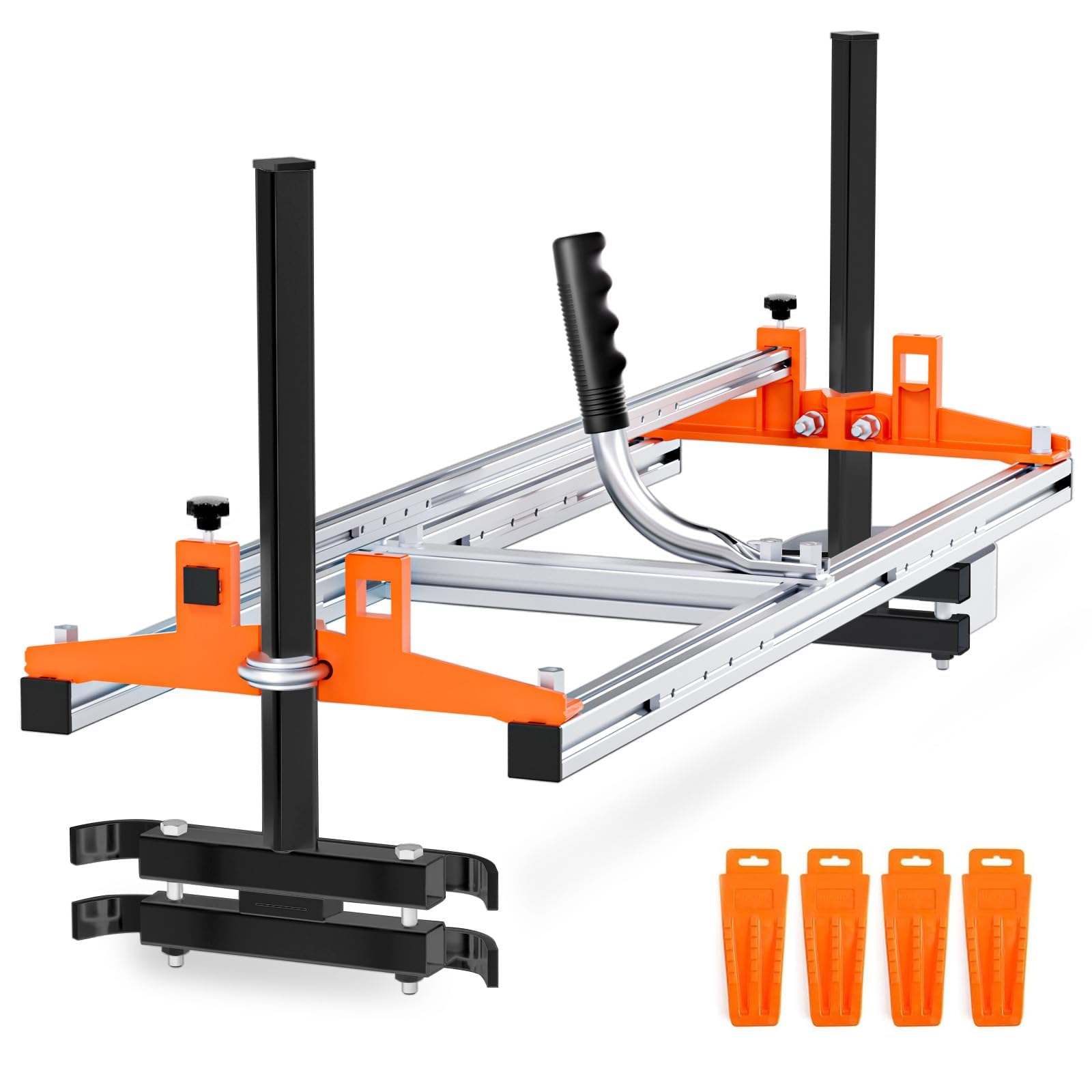
A spliced-frame mill that converts to three sizes from 16 to 36 inches and packs down for transport.
The defining feature here is the modular build. Instead of one fixed frame, the mill uses a spliced construction that lets you run it in three sizes for independent use, cutting from 14 inches up to 36 inches when fully assembled. The pieces pack down small, which is the whole reason to choose this over a fixed-frame mill — it fits in a truck bed or a pack, then assembles in minutes when you reach the tree. At 18.1 pounds it stays manageable to carry into a field site.
Owners who value portability are impressed: the mill assembles quickly, packs tight, and stays solid and rigid despite the splice joints. You can also connect multiple units for extra length to mill larger slabs, which makes it a scalable setup rather than a fixed one. The aluminum profile construction is described as very rigid — buyers report it resists flexing even under heavy load. The advanced aluminum profile and straight-line connector method is a recognized design that keeps the splice joints true.
The honest downside is vibration. Some owners mention the mill vibrates apart during a cut, with cross-brace screws loosening or falling out within minutes, and the U-bolts can be imprecise to adjust. Replacing those screws with better hardware fixes most of it. There is also a cut-width trade-off to expect: customers note the setup effectively takes about 4 inches off total cutting length, so a 20-inch bar ends up cutting around 15.5 inches. Check that all parts arrive — a few units have shown up short on hardware.
what separates it: A spliced frame that converts to three sizes from 16 to 36 inches and packs small, with the option to connect multiple units for longer cuts.
The one fix to budget for: Cross-brace screws loosen under vibration — swapping them for better hardware keeps the frame tight through a full cut.
Choose this if: You want a packable mill that travels to remote logs and can scale up by connecting units for longer slabs.
skip it if: You want a rigid fixed-frame mill that never needs hardware attention — the aluminum mills with solid frames in this list hold up with less fussing.
Understanding the Specs
Cut Depth and Angle Capacity
Cut depth is the maximum thickness the attachment can slice in one pass. A beam cutter rated at 12 inches removes a 12-inch-deep bite, which covers most structural beams and posts. When you tilt the cut to 45 degrees, capacity often drops — one worm drive cutter lists 8 inches at that angle — because the blade enters the wood at a slant instead of straight down. If your work involves rafters or mitered ends, check both the straight depth and the angled capacity before you buy.
Bar Length, Clamp Loss, and Log Size
Chainsaw mills clamp onto the bar, and that hardware eats into your usable cut width. A 20-inch bar typically cuts around 15.5 inches once the clamps take their share, and a 24-inch bar yields roughly 19 to 20 inches of cut. Log capacity is smaller still, because you also subtract the spike and the bark. The practical rule: size your saw and mill to the widest log you plan to cut, not the average one, because there is no adjustment to reclaim that lost width after the fact.
FAQ
Will a beam saw attachment fit my circular saw?
How deep can a beam saw attachment actually cut?
Why does my 24-inch bar only cut about 15 inches?
Do I need a ripping chain for milling beams and slabs?
What size chainsaw do I need to run a chainsaw mill?
Is a beam cutter attachment better than buying a beam saw?
Can I use a beam cutter attachment on pressure-treated lumber?
How long does a beam cutter chain last?
What is the difference between a chainsaw mill and a rail mill guide?
Do these beam cutters work on electric chainsaws too?
Final Thoughts: The Verdict
For most buyers, the beam saw attachment winner is the Granberg G778-48 Alaskan MKIV Chainsaw Mill because it handles the widest logs and outlasts the budget-tier mills — and it is the crowd favorite with 4.7 stars across 900+ ratings, so it is the safest bet if you want one mill that stays with you for years. If you cut framing beams and already own a worm drive circular saw, reach for the Prazi 12-inch worm drive beam cutter, which adds 12-inch single-pass cutting without hauling a bigger machine to the job. And if your saw is a standard sidewinder, the Prazi 12-inch non-worm-drive beam cutter is the correct mount for your saw. Whichever you pick, verify your saw’s drive type and bar length against the attachment’s rating before you order — that single check prevents the most common disappointment in this category.
How We Picked
We do not accept paid placement. Every pick is matched to a real buyer and a real use-case; we do not hands-on test units.
Sources & Methodology
Specifications: manufacturer listings and product documentation. Review insights: verified customer reviews, as of September 2026. Pricing: not shown on this page (it changes often); check the current price via the retailer link.
As an Amazon Associate, KitchPrep earns from qualifying purchases. This does not affect which products we feature.
Related Guides
