
Specs are compiled from manufacturer listings and verified buyer reviews and can change over time — please confirm the key details on the product page before buying.
You want your lamps, Christmas tree, or grow lights to switch themselves on and off without you thinking about it. That is exactly what an automatic light timer does — it sits between your wall outlet and your device and runs the schedule you set. The tricky part is picking between a mechanical dial you twist with your fingers and a digital version with buttons and a screen. Each one has a real trade-off, and this guide walks you through nine solid options so you can match the timer to your actual room, device, and patience level.
I’m Mohammad Maruf — the founder and writer behind KitchPrep. This guide is built by comparing the manufacturers’ published specifications and the patterns across verified customer reviews, so you get each pick’s real strengths and trade-offs instead of marketing spin.
Mechanical timers never need Wi-Fi or an app, while digital models give you minute-level control and battery backup. Below you will find the nine timers worth your outlet space, sorted by what they actually do well. This breakdown of the best automatic light timer covers dials, digital screens, countdown buttons, and one outdoor-ready option.
Our Picks at a Glance


How To Choose The Best Automatic Light Timer
The timer you pick should match the way you actually think about your lights. If you want to glance at a dial and see the whole day at once, a mechanical model wins. If you want your aquarium lights to come on at 6:12 in the morning and off again at 7:48 at night, you need digital programming. Everything else — outlet count, plug spacing, wattage rating — falls into place after you answer that first question.
Mechanical Or Digital: Pick Your Programming Style
A mechanical timer uses pushpins or trippers that you slide into slots around a rotating dial. Each slot represents a chunk of time, and the timer clicks your device on and off as the dial turns. The upside is you can see your entire schedule at a glance with zero menus and zero screens. The trade-off is the resolution — most mechanical dials work in 30-minute steps, so you cannot set a light to come on at 6:15 sharp. Digital timers let you program exact minutes and usually store several on/off events, plus a battery that keeps your settings alive through a power cut.
Outlet Layout And Plug Spacing
Every timer here plugs into a standard indoor receptacle. The problem is that a bulky timer body can cover the outlet next to it, which is annoying if you already have a lamp and a charger fighting for the same wall plate. Look for a design that either sits flush, places its sockets on the side, or stacks vertically so both outlets stay usable. If you plan to control two lamps at once, a dual-outlet timer handles both from a single plug-in.
Noise, Drift, And Backup Power
Mechanical timers make a faint ticking or winding sound as the gears turn. In a living room you will never notice it. On a nightstand two feet from your pillow, you will. Digital timers run silently but rely on a small internal battery to hold your schedule, and that battery is what saves you from reprogramming everything after a storm knocks the power out. Some mechanical dials also drift over months and need a small adjustment, which is normal for the design, not a defect.
Match The Rating To The Device
Every timer in this guide lists an amperage and wattage rating, and that number tells you what you can safely plug in. A 15-amp, 1875-watt rating covers lamps, string lights, fans, coffee makers, and most small appliances. Heaters are the one to treat carefully — never run a space heater through an extension cord or power strip on a timer, and check the plug itself for wear over time.
Quick Comparison
| Model | Best For | Program Type | On/Off Settings | Outlets | Amazon |
|---|---|---|---|---|---|
| GE 24-Hour Plug-in Mechanical Timer★ Best Overall | Christmas trees and holiday decor | Mechanical pushpin | 30-minute intervals | 2 grounded | Amazon |
| NSi TORK RTN312 Mechanical TimerHeavy Duty Pick | Higher-draw appliances and lamps | Mechanical tripper | 2 per day | 2 receptacles | Amazon |
| BN-LINK U47 Mini 24-Hour TimerBest Value Two-Pack | Spare timers and multiple rooms | Mechanical pushpin | Up to 24 per day | 2-pack | Amazon |
| BN-LINK 7-Day Digital Timer Outlet | Vacation security and aquarium lights | Digital, 7-day | 8 programs | 2 grounded | Amazon |
| HBN Outlet Timer Indoor Digital | Kitchen appliances and coffee makers | Digital, 7-day | 8 on/off programs | 2 grounded | Amazon |
| DEWENWILS 24-Hour Digital Timer | Bedrooms and offices needing silence | Digital, daily | 3 on/off events | 2 grounded | Amazon |
| TESSAN Countdown Timer 2 Pack | Chargers and short-run devices | Push-button countdown | 6 preset times | 2-pack | Amazon |
In‑Depth Reviews
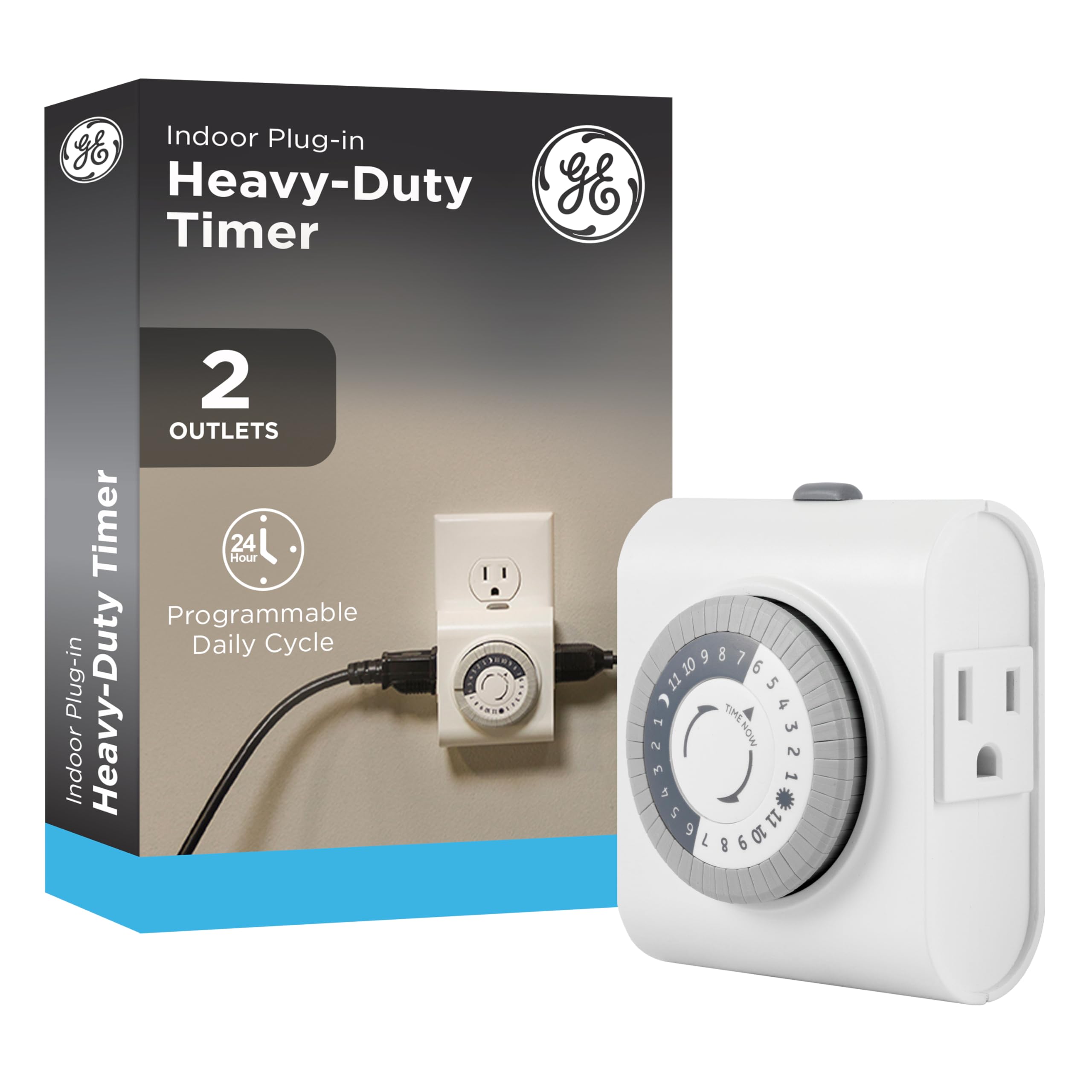
1. GE 24‑Hour Plug-in Mechanical Timer Outlet, 2 Grounded Outlets, 1 Pack
Our pick — over 4.5★ from 14,000+ verified ratings; the strongest balance of quality and price.
The 4.6-star, 14,000-rating mechanical timer most households use to run the Christmas tree.
This GE model is the crowd favorite for one simple reason: it works the way your brain already thinks about time. Two grounded outlets let you run a lamp and a string of lights from a single plug-in, and the 30-minute interval pushpins (fingers that flip up or down to mark on and off moments) let you set a daily cycle in under a minute. That 4.6-star standing across 14,000+ ratings is the strongest showing in this group, and it holds the top spot here for that reason alone.
The thing everyone raves about is the accuracy to the half hour combined with set-and-forget simplicity — no app, no Wi-Fi, no pairing headache. Owners describe it as durable enough to run a Christmas tree season after season without unplugging and replugging the cord. The top override switch lets you bypass the timer for one evening of manual control while the dial keeps right on ticking in the background.
Here is the honest catch: it makes a soft winding noise while plugged in. Owners describe it as a constant hum that some find bothers sleep in a bedroom, even though it disappears completely in a living room or hallway. It is also indoor-only, so keep it out of the rain.
What Owners Keep Raving About
- The 30-minute pushpin setup is fast enough to finish before your coffee cools
- Two grounded outlets automate a lamp and a string of lights from one wall plate
- The override switch pauses the cycle without erasing your schedule
The Honest Trade-Off
- Soft winding hum while plugged in — fine for hallways, annoying near a pillow
- Indoor use only, so it cannot run an entry light or porch fixture
- 5-minute drift is normal for the design if you want on-the-minute scheduling
Go with this one if: you want the simplest, most proven mechanical timer for the holiday lights, hallway lamp, or living room string lights, and you do not need outdoor use or minute-level timing.
Look elsewhere if: your timer lives on a nightstand, or you need on-the-minute accuracy for a plant cycle.
2. NSi Industries TORK RTN312 Indoor 15-Amp Plug-in Heavy Duty Mechanical Appliance Timer
A 15-amp, 1800-watt metal-bodied timer for the shop lamp or garage fan that needs to run itself.
Where the GE timer packs a fine-grained pushpin row, this TORK uses a simpler two-tripper system: slide a green tripper into the slot for the “on” time, a red tripper for the “off” time, and rotate the dial clockwise to your current time. That two-setting-per-day approach is exactly what makes it easy — 2 on/off settings, versus 24 on the BN-LINK U47, is a bigger gap between the two than most shoppers realize. The trade-off is fewer scheduling options.
Buyers report it handles heavier current loads well, thanks to the 15-amp, 1800-watt tungsten rating and a grounded 3-prong outlet that takes incandescent, compact fluorescent, and LED bulbs. What customers praise most is functionality, with ease of use right behind — the pin-and-dial method clicks into place, and the override switch lets you toggle the light manually without erasing your settings.
The honest catch: timekeeping is the weak point here. Owners note the small, hard-to-read dial drifts and needs resetting every few weeks — the design has low resolution, and the printed hour marks are tiny. That is a real quirk of this style of tripper dial, and it is worth knowing before you commit. The 5-year warranty is the longest in this group and is the strongest reassurance in the whole lineup.
Why It Belongs Here: The 15-amp, 1800-watt rating and 5-year warranty beat every other mechanical option in this guide for higher-draw shop and garage equipment.
Where It Falls Short: The small dial is genuinely hard to read, and the drift means you will be resetting the current-time arrow every few weeks — mechanical timers honestly do this.
Reach for this if: you need a heavy-duty timer with a long warranty for a garage fan, work-light, or a heavier lamp load, and you do not mind a quick reset every few weeks.
Better fit elsewhere if: you want to program lights on a tabletop where you read the dial every day — the tiny hour marks get old fast.
3. BN-LINK U47 Indoor Mini 24-Hour Mechanical Outlet Timer, 3-Prong, 2-Pack
Two mini 24-hour dial timers in one box — one for the bedroom lamp, one for the living room tree.
The mini form factor is the star here. Each timer is small enough to sit flush against the wall without stealing the outlet beside it, and you get 2 in the box, so you can run the bedroom lamp and the living room Christmas tree on separate schedules. Owners call out the compact size again and again — 686 reviews mention it alone. Setup is genuinely easy: pins UP turns the timer OFF, pins DOWN turns it ON, and your schedule repeats daily once it is plugged in.
With up to 24 on/off settings per day at 30-minute intervals, this little dial gives you fine-grained daily control on a mechanical timer. Owners rave about the value — with a 4.4-star history across 56,000+ ratings, it is the most-reviewed timer in this guide. Owners tend to buy a batch and hand them out to different rooms. It is rated 125-volt, 15-amp, 1875-watt resistive, and it plays nicely with LED and CFL bulbs.
The honest catch: these mini mechanical dials do not last forever. The internal gears stiffen over time — one customer thread recommends checking the dial rotation every few months and replacing the unit once you feel resistance increasing. That is roughly 8-12 months of steady use in most homes. The flip side is that at this price you keep a spare in the drawer and swap it in seconds.
What The Setup Really Looks Like: Grab the dial, pull the pins up for the off-times, push them down for the on-times, rotate the dial pointer to your current hour, and you are done — genuinely a one-minute job with no manual needed.
The Long-Term View: These small mechanical units wear out after roughly a year of daily cycling, so the two-pack is really a one-now-one-spare purchase.
This is your pick if: you want an inexpensive timer for several different rooms and are happy to keep a spare.
Think twice if: you want a set-and-forget timer that runs five years without replacement.
4. BN-LINK Indoor 7-Day Programmable Digital Timer Outlet, 2 Outlets, 1 Pack

The 7-day digital timer whose Random mode varies your lights so an empty house looks lived-in.
This is the model for anyone who wants true minute-level control plus a security feature that most timers simply do not offer. The “Random” vacation mode varies your programmed lights so your home appears occupied even when you are 500 miles away — this alone is what owners say drove the purchase. It stores up to 8 on/off programs across both grounded outlets, supports schedules as short as one minute, and the two outlets fire simultaneously.
Daylight Savings mode is a one-button shift, and a rechargeable backup battery holds your settings for up to 3 months across power outages so you never reprogram after a storm. Owners call it easy to program — 2,700 people say so, and the design places the dual outlets so two cords fit without crowding. It is rated 120V, 15A/1725W and is ETL listed.
The honest catch: some units go bad on you. A few report failure after 6 months, and a small fraction say the on-time sometimes drifts randomly by up to half an hour. Programming is also not obvious on first use — most owners keep the manual nearby for the first week or two, and one reviewer got a lemon and had it replaced by a responsive customer service team. That is a genuine quality-control variance, not a design flaw, but worth knowing.
Where It Earns Its Place
- Random vacation mode makes an empty home look occupied — a real security benefit
- Backup battery keeps your programs alive for up to 3 months without power
- 8 programs at one-minute resolution cover everything from space heaters to aquariums
What to Expect
- Programming has a learning curve — keep the manual handy the first week
- Occasional units fail early; the company replaces them, but expect an RMA call
- Space heater use needs caution — avoid extension cords and check the plug for wear
Bring this home if: you travel often and want your lamps on a believable random schedule, or need minute-accurate timing for an aquarium or reptile habitat.
Skip the digital route if: you want something you can set once and never look at a manual again — a mechanical dial timer will serve you better.
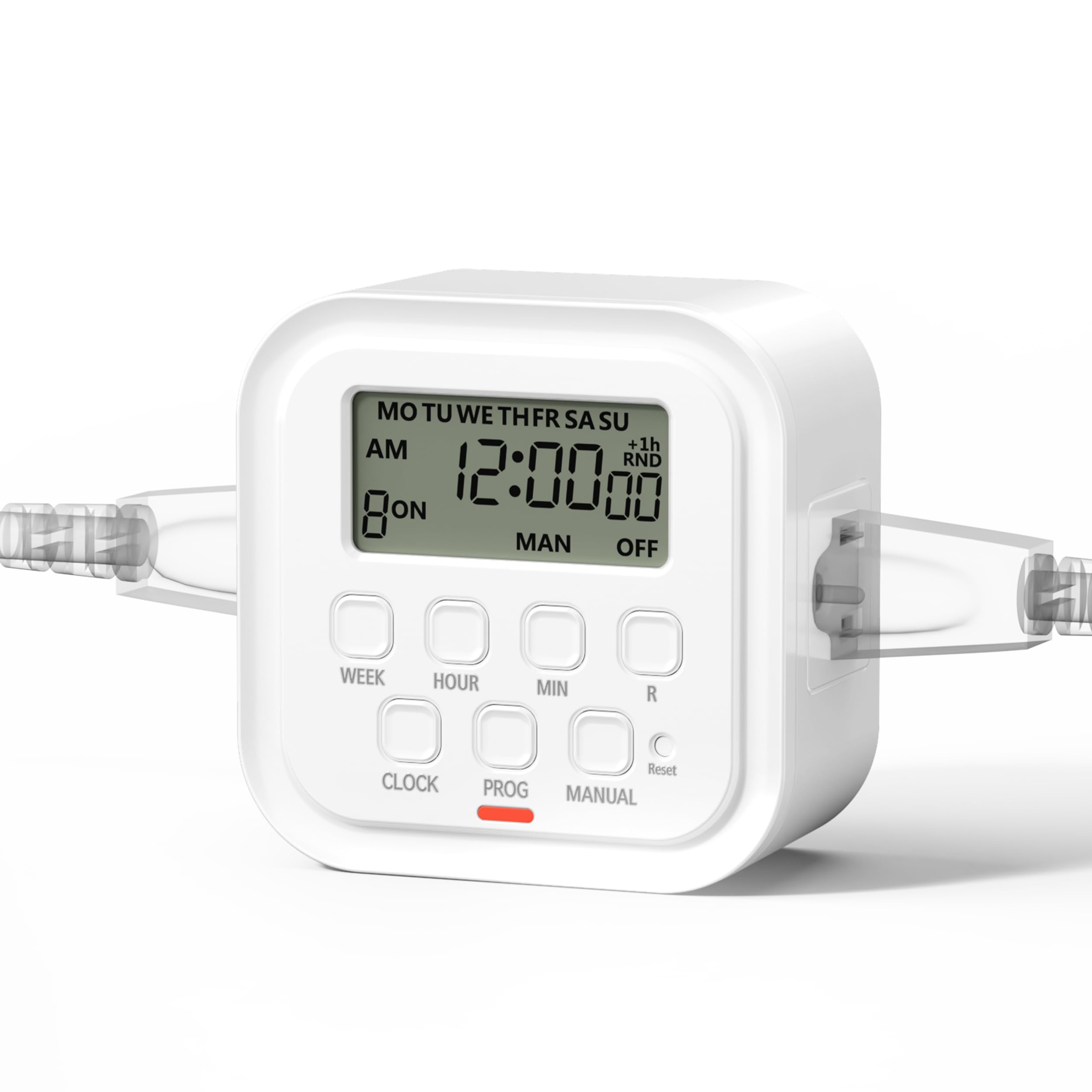
5. HBN Outlet Timer Indoor Plug in Timers for Light Lamps Fan, Digital Timer
Eight on/off programs at one-minute resolution make this the pick for grow lights and aquarium hoods.
The flexibility is the whole pitch here: 8 on/off programs across the dual grounded outlets, with settings as short as one minute. Grow-light owners who need to nail a precise light cycle can actually hit the exact hour and minute. The dual outlets fire together, so both your grow light and your fan switch on and off in sync — no more trying to run two separate timers on the same schedule.
Owners praise the easy programming most — 145 customers single it out, with quality right behind it. Vacation Random mode is built in, so your lights vary when you are away. The battery backup here has held programs through power outages longer than four hours according to one happy user, and it stores your settings when you unplug it and move it to another room. Daylight saving mode is a one-press change, and it is rated 125V, 60Hz, 15A/1875W resistive with a 1/2HP motor rating for fans.
The honest catch: the on/off state is genuinely confusing at first, particularly the “auto on” state that must be set correctly regardless of when you plug it in. The instructions get mixed reviews — worth reading cover to cover before you start. One owner noted that over a year of service, a small voltage bleed-through showed up that could affect sensitive electronics, so skip it for a delicate LED clock and use it for lights, fans, or a crockpot instead.
The Real-World Payoff: Grow lights, aquarium hoods, and reptile heat lamps all need a fixed daily cycle — this one sets to the minute and remembers it through blackouts.
One Thing To Note: The mixed reputation of the instructions is real; read the manual thoroughly before you start programming.
Built for you if: you run a grow tent, reptile habitat, or a hydro setup that needs an exact light cycle, and you want Random mode for holidays.
Less suited to: anyone who wants low-maintenance with zero manual reading — the on/off programming takes patience.
6. BN-LINK Timer Outlet with 2 Grounded Outlets, Mechanical Light Timers, 15A/1875W, 2 Pack

A silent digital timer with a 6-month memory backup, built for nightstands and offices.
The story behind this one is simple: mechanical timers hum or tick and people who sleep next to them get annoyed. This DEWENWILS is genuinely silent — the only sound is a soft click at the exact on/off moment. It has 3 easy-select modes on a side switch (OFF / AUTO / ON), 5 user-friendly buttons, and it setup as daily repeat with up to 3 on/off events. That keeps programming dead simple, no button combinations to memorize.
What wins people over here is ease of use and silence, with value for money right behind. A household that owns a dozen of them runs lights all over the house on a set evening schedule — no flipping switches. Side-mounted outlets on this model mean the second outlet stays usable, which is the main gripe mechanical timers get working around. It is rated 125V, 60Hz, 15A resistive, 1000W tungsten, 3-prong.
The large display is a plus, but programming the initial day-of-week step is the one part that trips up first-time digital users.
Why It Wins the Bedroom
- Truly silent operation — a real difference from the mechanical hum timers
- 6-month memory backup preserves your schedule through long outages
- Side-aligned outlets leave the adjacent socket free
The Limits to Know
- Only 3 on/off events per day — fewer than the other digital options here
- The initial day-of-week programming step is a common trip-up
- Single-schedule design means no per-day variation without resetting
Perfectly matched to: a nightstand lamp, an aquarium in a bedroom, or an office setup where a humming dial timer would drive you crazy.
Look elsewhere if: you need five or more on/off events across a single day.
7. TESSAN Outlet Timer Indoor 2 Pack, Countdown Timers for Electrical Outlets

Six preset countdowns from 15 minutes to 6 hours, set with one button and no programming screens.
This is a different kind of timer from everything else on the list. You do not program a schedule; you press a countdown button and the timer counts down to off. Six preset times — 15 minutes, 30 minutes, 1 hour, 2 hours, 4 hours, and 6 hours — cover the vast majority of real at-home use cases. That means e-bike chargers, curling irons, holiday fairy lights, and phone charging stations all become safer without you thinking about it, because the timer switches them off automatically.
Owners use these for a surprisingly wide range of jobs — an e-bike charger, a terrarium fogger, a golf cart charger, and even overnight phone charging. The functionality and quality aspects dominate the positive feedback, with around 86 customers praising how it works across many different devices. Up to 1875W max handles a lot of what you would plug into a wall outlet. The repeat function gives you a same-time-every-day option if you do want automatic cycles.
The honest catch: 6 hours is the longest countdown, so anything that needs to run for 8 or 12 hours is out. Programming depth is also limited — there is no way to build a multi-step sunrise-to-sunset light schedule here. One reviewer noted a rare dud in their pairs, but the overall picture is a device owners describe as genuinely useful.
The Use-Case Fit: A push-button countdown is unbeatable for anything you want to switch off after a set window — chargers, curling irons, holiday lights.
The Design Ceiling: 6 hours maximum and one countdown per press means this is not a lamp-scheduling timer for a full evening.
Pick this one for: e-bike chargers, phone charging, or small appliances that just need auto-shutoff after a set time — no schedule to think about.
Not the right tool for: running a lamp on a nightly sunset-to-bedtime cycle — that needs a programmable timer instead.
Understanding the Specs
Mechanical Dials: Pushpins And Trippers
A mechanical timer uses a rotating dial driven by a small motor. Pushpins (the small tabs that flip up or down) or trippers (color-coded plastic clips) mark the on and off moments, and the dial turns past them once every 24 hours. Most mechanical dials work in 30-minute intervals, so you cannot set a light for 6:15 sharp. The upside is simplicity: no screen, no menus, no battery to replace, and a glance at the dial shows your whole day. The trade-offs are noise (a soft tick or hum as the gears turn), drift over months that needs a small reset, and the 30-minute resolution limit.
Digital Timers: Programs, Backup, And Random Mode
A digital timer runs on a small chip with a screen. You program exact times with buttons — sometimes down to the minute — and store several on/off events. A rechargeable backup battery holds your schedule through a power outage; the DEWENWILS keeps it for up to 6 months, the BN-LINK 7-day for up to 3 months. Digital timers run silently. Many also include a Random mode that varies your on/off times slightly so your home looks occupied while you travel. The 15A/1875W rating appears across most digital models here, covering lamps, fans, coffee makers, and holiday lights.
FAQ
Will an automatic light timer work with LED bulbs?
Can a light timer handle a space heater?
Do mechanical timers make noise?
How long do automatic light timers last?
What is Random Mode and how is it different from a normal program?
Can I use an automatic light timer with two lamps on one outlet?
Do digital timers lose their schedule if the power goes out?
Is a mechanical or digital timer better for Christmas lights?
Can an automatic light timer be used outdoors?
What is the difference between a light timer and a countdown timer?
Final Thoughts: The Verdict
The automatic light timer that carries the day is the GE 24-Hour Plug-in Mechanical Timer, because it is the most proven mechanical option with the strongest track record and the simplest setup on the list. If silence is non-negotiable, grab the DEWENWILS 24-Hour Digital Timer — 6-month memory backup and genuinely quiet operation, tough to top in a bedroom. And for the garden, pool pump, or landscape lights, the BN-LINK Outdoor 7-Day Timer is the one to reach for since it is the only weatherproof pick here. Whichever direction you go, these nine timers are all worth a look — the GE in particular has earned its spot as the household workhorse with more verified ratings than any other timer in this guide.
How We Picked
We do not accept paid placement. Every pick is matched to a real buyer and a real use-case; we do not hands-on test units.
Sources & Methodology
Specifications: manufacturer listings and product documentation. Review insights: verified customer reviews, as of September 2026. Pricing: not shown on this page (it changes often); check the current price via the retailer link.
As an Amazon Associate, KitchPrep earns from qualifying purchases. This does not affect which products we feature.
Related Guides
