
Specs are compiled from manufacturer listings and verified buyer reviews and can change over time — please confirm the key details on the product page before buying.
Buying a bunk bed is really a bet on one thing: whether the frame stays quiet and steady after a few months of kids climbing it. Most of the models below get that right, and the differences between them come down to how high the top bunk sits, how much floor space the bottom leaves open, and how the ladder and guardrails are built. This guide walks you through each frame in plain terms so you can pick the one that fits your room and your kids.
I’m Mohammad Maruf — the founder and writer behind KitchPrep. This guide is built by comparing the manufacturers’ published specifications and the patterns across verified customer reviews, so you get each pick’s real strengths and trade-offs instead of marketing spin.
What follows breaks down the frame material, the guardrail height, the mattress sizes each bed takes, and how assembly actually goes. Every pick here has been checked against its own published specs and owner feedback, so you can read this as a straightforward bunk bed comparison and buy with confidence.
Our Picks at a Glance


How To Choose The Best Bunk Bed
Start with the ceiling, not the bed. A bunk bed’s total height is fixed, and the top bunk needs enough clearance for a kid to sit up without banging their head on a fan or a sloped ceiling. Measure your ceiling height first, then compare it against the assembled height of any frame you’re considering.
Match the guardrail to the mattress
The guardrail is the wall that keeps a sleeper on the top bunk. A taller rail gives you more room to work with, but a thick mattress eats that space quickly. Most makers recommend a mattress between 4 and 8 inches thick so the top of the mattress stays below the top edge of the rail. If your child rolls in their sleep, a taller rail paired with a thinner mattress is the safer combination.
Decide on twin-over-twin or twin-over-full
A twin-over-full layout puts a wider bed on the bottom, which is handy if an adult or a teenager sleeps below. The trade-off is width: the bottom layer takes up more floor space in the room. A twin-over-twin stacks two matching beds, which saves more floor area and keeps the footprint narrow.
Check how the frame is built and how it goes together
Metal frames tend to be lighter and easier to move, while solid wood frames feel heavier and quieter under load. Look at whether the slats lock into place, since loose slats are the usual source of squeaks. Assembly time also varies a lot from model to model, so if you’re planning to build it alone, check whether an extra pair of hands is needed for lifting the top bunk into position.
Quick Comparison
| Model | Best For | Assembled Size (L x W x H) | Mattress Size | Weight Capacity | Amazon |
|---|---|---|---|---|---|
| LIKIMIO Bunk Bed Twin Over Twin★ Best Overall | Compact kids’ rooms | 76.8″L x 40.7″W x 71.7″H | Twin | — | Amazon |
| Jocoevol Metal Bunk Bed Twin Over TwinMost Versatile | Convertible two-in-one use | 78.6″L x 41.3″W x 68″H | Twin | 440 lbs (lower) / 330 lbs (upper) | Amazon |
| SHA CERLIN Bunk Bed Twin Over TwinBest Low Profile | Low-ceiling small rooms | 77.8″L x 40.7″W x 60.7″H | Twin | 400 lbs | Amazon |
| VECELO Bunk Bed Twin Over Twin | Under-bed storage | 78″L x 41.5″W x 65″H | Twin | — | Amazon |
| KAIFAM Metal Bunk Bed Twin Over Full | Mixed ages and adults | 76.77″L x 53.98″W x 54.25″H | Twin, Full | Around 500 lbs | Amazon |
| JOYMOR Solid Wood Low Bunk Bed | Young children and toddlers | 79.13″L x 41″W x 47.64″H | Twin | 264.5 lbs | Amazon |
| KOMFOTT Wood Twin Over Full House Bunk Bed | Play value and guest sleepovers | 80″L x 58″W x 75″H | Twin, Full | 350 lbs (upper) | Amazon |
| Merax Wood Bunk Bed with Drawers | Built-in clothing storage | 80″L x 42.9″W x 64.6″H | Twin | 400 lbs per bed | Amazon |
| Grain & Grove Bear Twin Over Twin | Durable everyday frame | 80.75″L x 42″W x 62.25″H | Twin | 400 lbs per bed | Amazon |
| Max & Lily Fundamental Twin Low Bunk Bed | Low-profile twin bunk | 80″L x 54.25″W x 49.25″H | Twin | 400 lbs | Amazon |
| Plank+Beam Classic Twin Over Twin | Premium solid-wood build | 81.5″L x 42.5″W x 65″H | Twin | 400 lbs per sleeping surface | Amazon |
In‑Depth Reviews
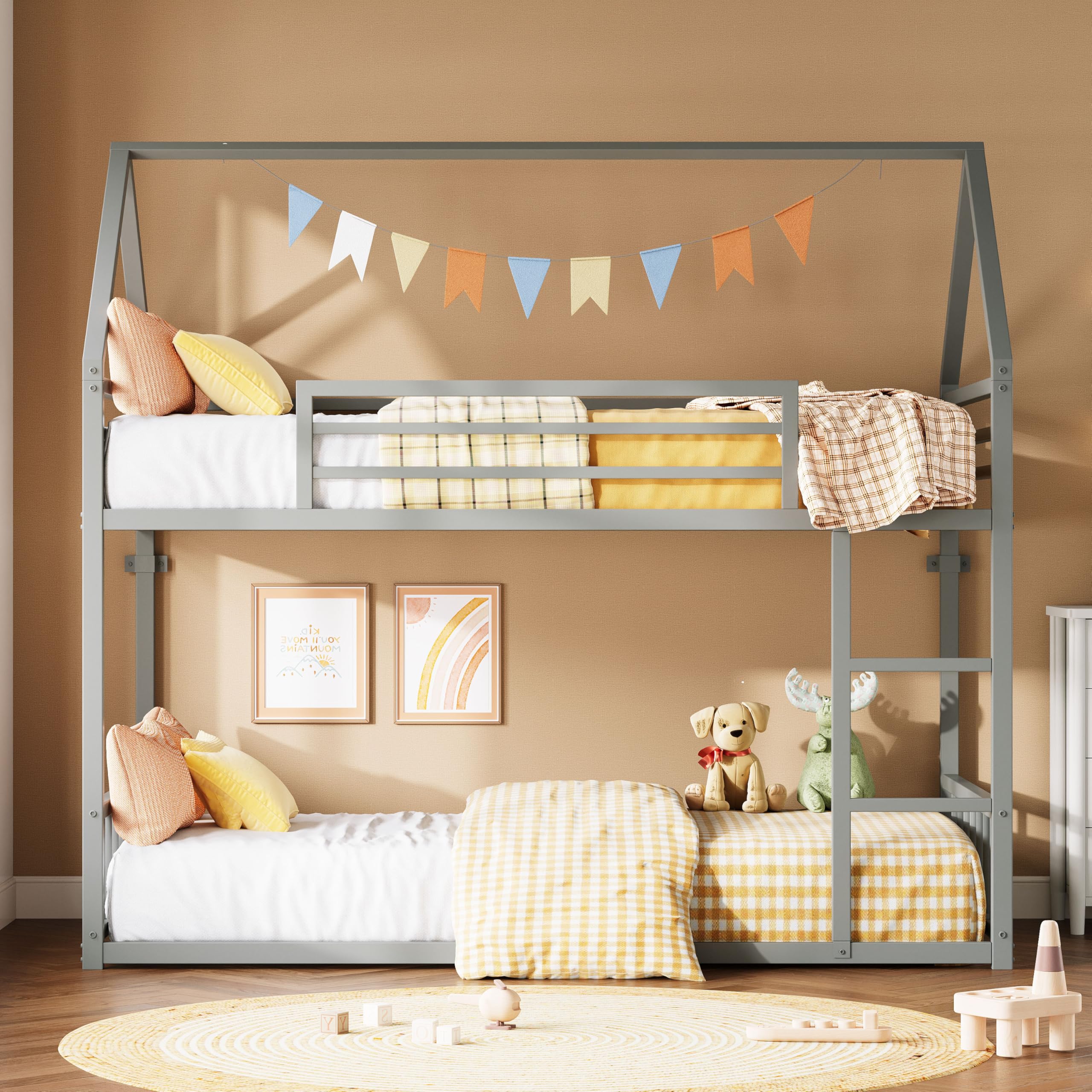
1. LIKIMIO Bunk Bed Twin Over Twin, House Bunk Bed Frame with Ladder, Grey
Our pick — over 4.5★ from 650+ verified ratings; the strongest balance of quality and price.
The house-shaped frame that quietly wins on the two things that actually matter: steady and easy to build.
If you’re sorting a small room for two kids, start here. The LIKIMIO is the crowd favorite in this category for a reason — 4.6 stars across 600-plus owners — and it earns the top spot on the two things buyers care about most: how quickly it goes up and how solid it feels afterward. In a category where a wobbly frame is the fastest way to regret a purchase, this one holds its ground.
Assembly is the headline. The parts, tools, and instructions arrive in a single box, and buyers routinely report getting the whole thing up in about an hour solo — one condensed review clocked it at a two-hour build with wall brackets included. The frame uses metal slats under a house-shaped silhouette, grey finish, and what stands out in reviews is the steadiness: “it’s very stable, doesn’t move,” and it stays put under a three-year-old climbing without the bed budging. It’s heavy enough to stay planted, light enough to shift for cleaning.
The height is where the honest caveat sits. At 71.7 inches tall, the top bunk sits at chest height for a 5’8″ adult — easy to reach, but noticeably taller than some low-profile alternatives like the Max & Lily below, so ceiling clearance matters. Some buyers also note missing parts on a rare occasion, so unpack and inventory before you start. Otherwise, it’s the balance of price, looks, and sturdiness.
What earns it the top spot
- Approximately one-hour solo assembly reported by multiple buyers
- Very stable — several owners note it doesn’t shift under active kids
- House-shaped design that dresses up a kid’s room with minimal effort
- Fits a standard twin mattress without a box spring
Where it asks a little more of you
- 71.7-inch height needs real ceiling headroom above the top bunk
- A handful of buyers report missing hardware on arrival — check the box before building
- Some assembly needs a second set of hands for the top bunk placement
Buy it if: you want a compact twin-over-twin that builds in about an hour and holds firm under boisterous kids.
Think twice if: your ceiling is low or your kids are old enough to need a taller top bunk with more headroom.
2. Jocoevol Metal Bunk Bed Twin Over Twin, Industrial Bunkbeds Heavy Duty Bed with Safety Guard Rails and Space-Saving Design, Steel Bed for School, Bedroom (Vintage Brown)
Two beds in one frame — a bunk when you need it, a pair of singles when you don’t.
The pitch here is flexibility. This is one of the few picks in the group that converts from a stacked bunk bed into two separate single beds, which matters if you’re planning for a room that might change as kids grow or if you’re outfitting a dorm or guest space. The frame is industrial in look — vintage brown, iron headboard, polished finish — and you can set the ladder on either the left or right side, so it works with the shape of your room rather than against it. The measurements sit at 78.6″ L x 41.3″ W x 68″ H, a touch longer and narrower than the LIKIMIO above.
The weight capacity is the standout spec: 440 pounds on the bottom bunk and 330 pounds on the top. That’s serious load-bearing for a metal frame, and it means an adult can sleep below without worry. The 16.5-inch guardrails are taller than most in this list, and the bed includes a bedside storage bag plus four hooks — small additions that actually get used. Owners mention the assembly as a solo job done in around two hours, though you’ll need help bringing the top bunk into position. Noise gets mixed feedback: some owners note it stays quiet when kids jump, others mention screws loosening over time and needing periodic tightening, so a wrench check every few months is smart.
What’s genuinely useful here is that length change. At 78.6 inches, it’s slightly longer than the LIKIMIO — a small gap difference that matters if your room has a tight corner. The convertible design plus the higher guardrails make this the pick if you value adaptability and long-term use over a fixed bunk.
The convertible angle: separating into two twin beds is a real option most bunks don’t offer, and it changes the math on this purchase if your room layout could shift in a year or two.
The honest catch: as with most metal frames, stability is good but not dead-silent. A scheduled tightening of the hardware keeps it that way.
Worth it for: households that want one purchase to cover both bunk-bed and twin-bed scenarios, plus extra storage accessories thrown in.
Look elsewhere if: you want a wooden frame with zero screws to re-tighten, or you need a shorter bed for a very small footprint.
3. SHA CERLIN Bunk Bed Twin Over Twin with Ladder and Guardrail, Rustic Design
At 60.7 inches tall, this is the pick that fits rooms where other bunks won’t.
Start with the number that changes everything: 60.7 inches total height. That’s noticeably shorter than the LIKIMIO at 71.7 inches, and it’s the deciding factor if your room has a low ceiling, a ceiling fan, or a sloped roofline. The 8.5 inches of clearance under the bottom bed gives you room for seasonal clothes or storage bins, and the bed’s compact 77.8″ L x 40.7″ W footprint means it tucks into tighter spots too. The black powder-coated finish and wood headboard keep the look clean rather than industrial.
The square-tube steel frame is rated to 400 pounds, and plastic buckles lock each slat in place to stop rattling as kids climb. Assembly runs about an hour solo or 30 to 40 minutes with two people, and the package even warns you to use back support when lifting, because it’s heavy on arrival. Once built, it’s light enough to reposition without help.
Here’s the honest part: a few long-term customers note that the bottom slats can shift out of place and the guardrails need occasional attention. It’s not a durability disaster — most buyers use it happily for years — but if your kids are rough on furniture, plan on checking the slat buckles every month or two. That small maintenance habit keeps everything tight.
The height is the feature: 60.7 inches is genuinely low for this category, making it the smart first choice for anyone whose room simply won’t clear a taller bunk.
The real trade-off: a lower top bunk means less headroom up there, so it suits younger kids rather than tall teenagers.
Best match for: low-ceiling bedrooms and buyers who need the quickest possible assembly window without sacrificing storage underneath.
Not the pick if: your sleeper is a teen who needs room to sit up on the top bunk, or you want a set-and-forget frame with no slat maintenance.
4. VECELO Bunk Bed Twin Over Twin, Metal Bunkbeds with Ladder and Full-Length Guardrail, No Box Spring Needed, Space Saving, Noise Free, White
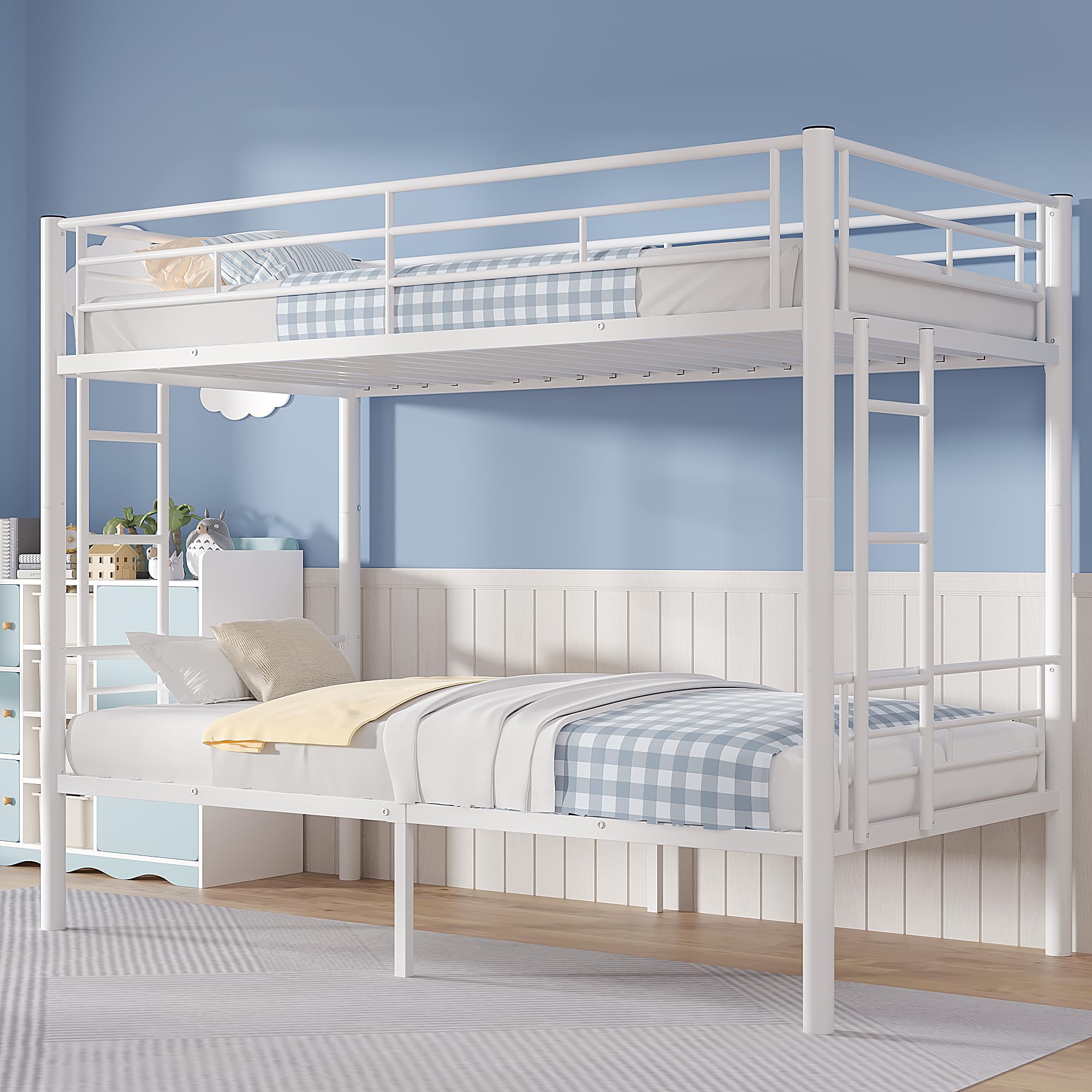
Two ladders, 20 slats, and 13 inches of storage underneath — the value play done well.
For the money, the VECELO covers the basics and then a few extras. The frame runs 78″ L x 41.5″ W x 65″ H in a white powder-coat finish, and it uses 20 metal slats for mattress support — that’s more slats than most metal bunks in this list, which spreads weight more evenly and cuts the wobble owners complain about on cheaper frames. You get 11-inch full-length guardrails on the top bunk plus two side ladders, so kids can climb from either side.
Setup is fast. The instructions and tools are in the box, and the maker estimates 30 minutes to build; owners confirm it’s quick, with one review describing a two-hour build that felt straightforward. The 13 inches of under-bed clearance is generous for a twin-over-twin and takes bedding, bins, or shoes without a fight. The custom plastic buckles hold the slats tight to cut rattling, and reviewers point out the frame feels more substantial than they expected at this price point.
The honest note: a minority of shoppers say the mattress doesn’t stay put as firmly as they’d like on the slats, and a small number mention minor creaking over time. That’s a slat-design quirk, not a build failure — a non-slip pad under the mattress on the top bunk solves it for most. Otherwise, this is a solid budget-friendly frame that runs with the higher-priced picks.
What makes it a smart buy
- 20 metal slats for even support — more than most metal bunks here
- Dual side ladders so kids can climb from whichever side fits the room
- 13 inches of under-bed storage space
- Fast assembly, with the maker estimating 30 minutes
What to know before you buy
- A few buyers report the mattress shifting on the top slats
- Occasional minor creaking noted in some long-term use
- At 65 inches tall, it’s mid-height — check your ceiling clearance before ordering
The value winner for: buyers who want more slats, two ladders, and deep under-bed storage without moving up to a premium price tier.
skip it if: you need the lowest possible top bunk, since the SHA CERLIN above sits 4.3 inches shorter.
5. KAIFAM Metal Bunk Bed, Twin Over Full with Safety Guardrail and Ladder, Heavy Duty (Black)
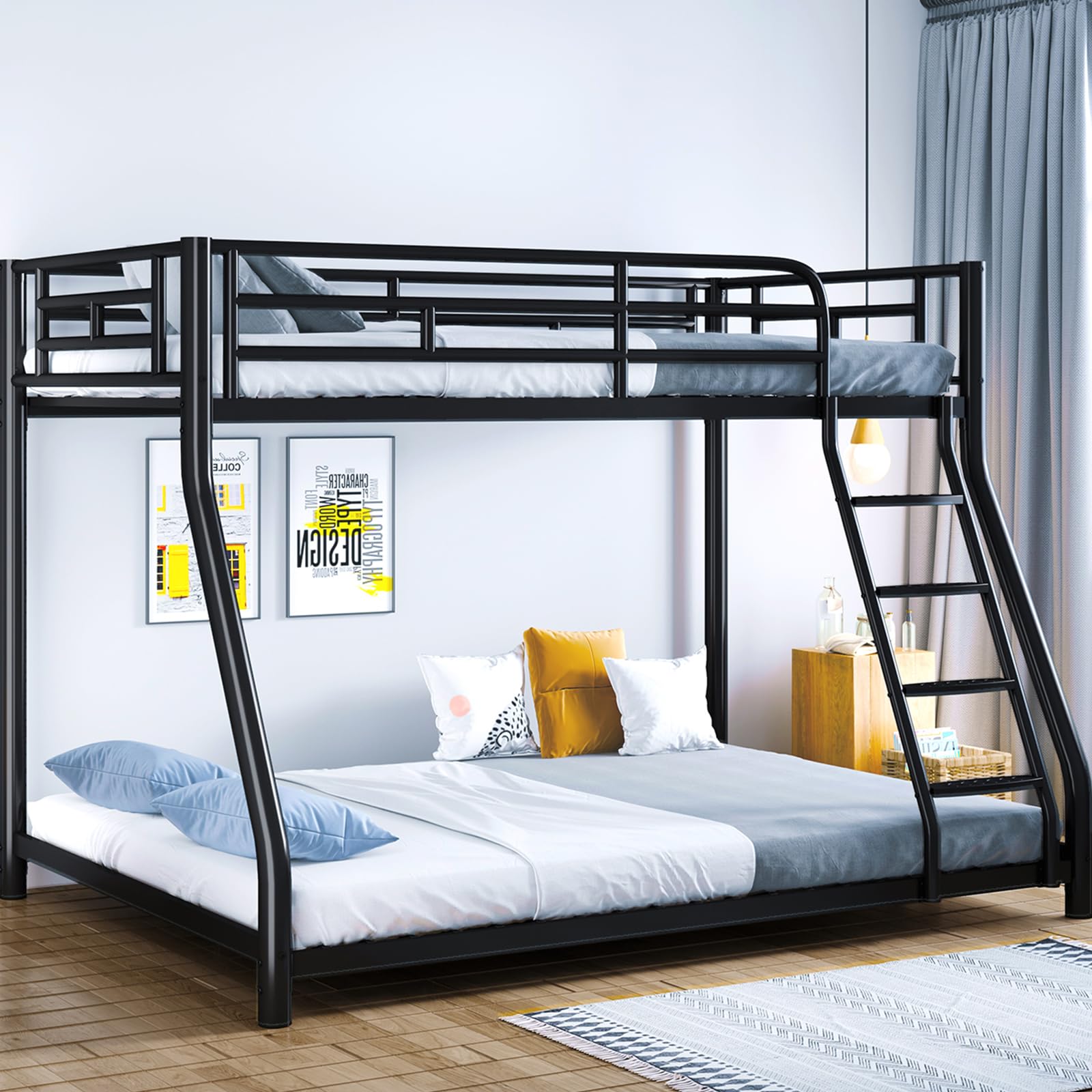
A full-size bottom bunk that adults can sleep on — rare in this price neighborhood.
Most twin-over-twin bunks leave the bottom bunk too narrow for a grown-up. This one doesn’t. The lower tier runs 76.77″ L x 53.98″ W — a genuine full size — while the upper tier stays twin (76.77″ L x 40.16″ W). That means two kids can share the bottom when guests come over, or a parent can actually lie down with a sick child. The whole frame is twin-over-full, 54.25 inches tall, painted black, with a total weight capacity around 500 pounds.
The metal frame uses thicker stock with a denser bar arrangement, which owners say translates into real steadiness — one reviewer noted a 5’8″ woman sat comfortably under the bottom bunk, and it holds 190 pounds without flexing. The semi-enclosed guardrails sit higher than typical, and the stair treads are wider with a non-slip design, which matters when a small kid is climbing up in socks. Assembly is straightforward, and a rubber mallet helps when seating the top bunk’s mattress supports.
A handful of owners found the mattress-support bars didn’t seat as firmly as they wanted, and one buyer couldn’t get all the cross-pieces into their slots. It’s the kind of thing that can happen with a damaged shipment, but if your frame arrives and the slats won’t lock in, send it back. For most buyers, the twin-over-full layout is the real win — a wide bottom, a compact top, and space for the family to grow into it.
The layout is the advantage: a twin on top over a true full on the bottom is a genuinely different sleeping arrangement than the twin-over-twin picks above.
Worth a careful check on arrival: a small number of owners had trouble with the support bars seating properly, so inspect and test-fit before you finish assembly.
Go for it if: your household wants a bottom bunk wide enough for two kids or one adult, plus a higher-rated frame for growing children.
Choose a twin-over-twin instead if: floor space is tight, since the full-size bottom layer is the widest footprint in this lineup.
6. JOYMOR Solid Wood Low Twin Over Twin Bunk Bed for Kids, with Guardrails & Ladder (Black)
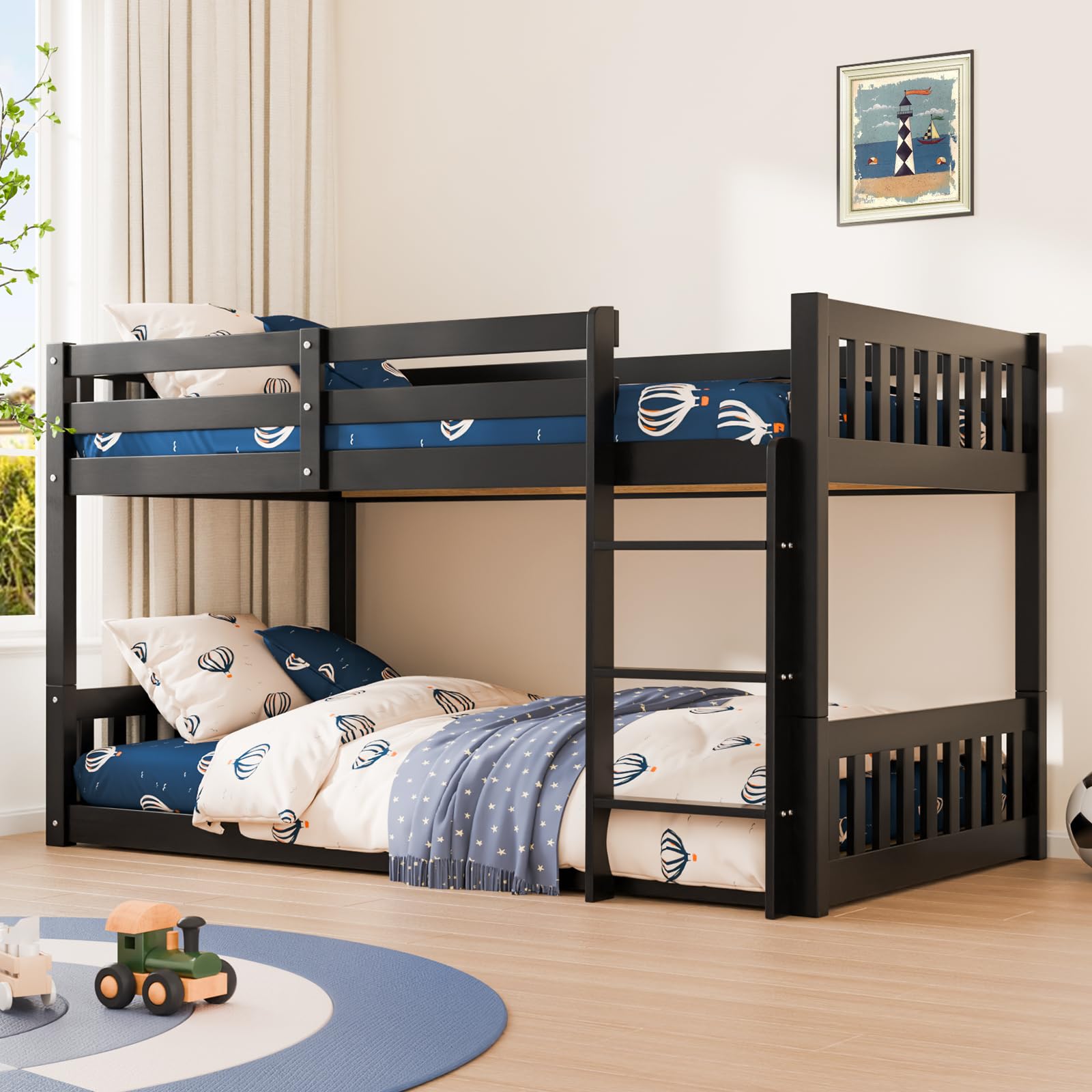
A solid pine frame low enough that a two-year-old can safely climb it.
This is the bunk for parents whose biggest fear is a fall. The whole bed tops out at 47.64 inches — the lowest in this entire lineup — so the bottom bunk sits close to the floor and the top bunk is a short climb. The frame is solid pine with hardwood slats and carries a max load of 264.5 pounds. If you’ve got toddlers sharing a room, or you’re worried about a younger child rolling off, this height changes what’s possible.
The full-length guardrail is 11 inches tall, and the flat ladder keeps climbing simple for small legs. The maker recommends a 4-to-6-inch mattress with the top at least 5 inches below the 11-inch guardrail edge. The bed measures 77.17″ L x 41.33″ W x 47.24″ H and doesn’t need a box spring.
Assembly is where opinions split. Owners describe the build as clear within the instructions but not always quick, and a few note that the finished frame feels lighter than expected — a wooden bunk built for the toddler years rather than for a 12-year-old. There’s also a one-year free replacement on installation problems, damage, and missing parts, which softens that risk. If your kids are under six and you want the lowest, softest-landing bunk, this is the one.
The safety angle: the combination of a 47-inch overall height, an 11-inch guardrail, and a maker-recommended 4-to-6-inch mattress thickness is designed around younger climbers.
The honest limit: the 264.5-pound capacity is the lowest in this group, so it’s built for small kids rather than teens or adults.
Perfect for: parents of children under six who want a low, gentle bunk with a matching safety setup.
Pass if: your kids are already older or heavier — the higher-capacity metal and engineered-wood picks above are a better long-term fit.
7. KOMFOTT Wood Twin Over Full House Bunk Bed with Built-in Ladder, Solid Pine, White
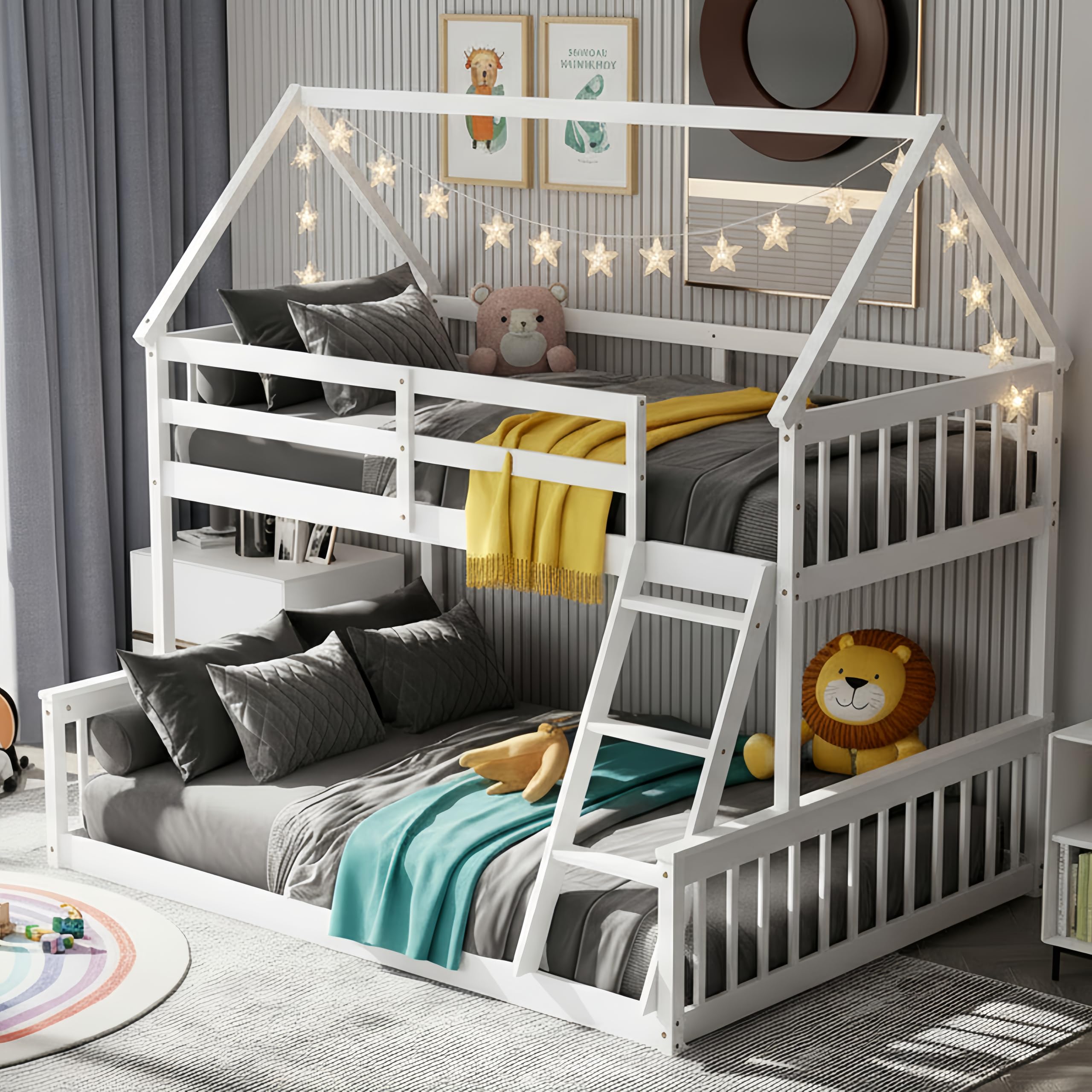
The bunk that doubles as a playhouse — and can split into two freestanding beds.
This one sells on charm, and the charm is earned. The frame has a house-shaped roofline that kids turn into a fort or a tent setup, and the whole structure is crafted from solid pine wood with plywood slats. The upper bed is rated for 350 pounds, and the layout is twin over full — a narrower sleeping surface up top, a wider full bed below. At 80″ L x 58″ W x 75″ H, it’s the tallest and widest in this lineup, so measure your room carefully before committing.
Two things stand out beyond the look. First, the bed can be divided into two separate beds — one twin for a kid, one full for a teen or adult — which is genuinely useful when a child outgrows sharing a room. Second, the 12-inch full-length guardrails on the top bunk sit solidly, and the 3-step integrated ladder gives kids a stable footing. The maker recommends a 6-inch mattress per bed, with no box spring needed. Assembly uses numbered parts and detailed instructions, though it ships in two boxes that may arrive on separate days.
Owners are split on the build. Some describe it as easy; others found it slow and frustrating, and one buyer mentioned cracked or misdrilled boards on arrival. That’s on the assembly-experience side rather than the finished bed, which most owners call solid. If you want a bunk that adds real play value to a child’s room and can be reconfigured later, this covers both.
What feels special here
- House-shaped roofline turns the bunk into a play fort
- Splits into a twin bed and a full bed as needs change
- 12-inch full-length guardrails plus a stable 3-step ladder
- Solid pine wood frame with plywood slats
What to expect on the downside
- Assembly gets mixed feedback — budget several hours and a helper
- At 75 inches tall, it needs real ceiling clearance
- Ships in two boxes that may arrive days apart
Built for: families who want a showpiece bunk with actual play value that can evolve into two beds.
Not ideal if: your room is tight or your patience for assembly is short — this one rewards planning and two sets of hands.
8. Merax Wood Bunk Bed with Drawers, Convertible Bunk Bed with Ladders and Two Storage Drawers, Twin Over Twin, White

Two built-in drawers turn the bunk into real bedroom storage.
If your kids’ room has nowhere to put clothes, this frame is a two-for-one. The Merax pairs a twin-over-twin bunk with two storage drawers tucked underneath — real drawers, not the open under-bed cavity most bunks give you. The frame itself is solid pine wood with solid pine legs, a full-length guardrail on the upper bunk, and a headboard and footboard on the lower bunk with a handrail on the ladder. It measures 80″ L x 42.9″ W x 64.6″ H and holds 400 pounds per bed.
Buyers who’ve lived with it for six months report it holds up well — steady, sturdy, and good-looking, with a teen on the bottom and a preteen up top. The two drawers work and solve a real problem, though they’re the frame’s quirkiest part: owners note the kids pull them out past their stops and the runner design could be more polished. Plan to remind kids to push them back in gently. The build itself takes about three hours with help, and one person can handle most of it until the top bunk needs lifting into place.
One honest watch-out: the assembly directions are picture-only in places, and a few owners mention undrilled holes and a steep ladder angle. Neither is a dealbreaker, but if you’re not comfortable drilling, plan to have a helper on hand. The drawer hardware and slat sockets are the most common spots that need attention.
The storage win: two enclosed drawers beat an open under-bed nook when kids actually need somewhere to put clothes away.
What to brace for: assembly runs about three hours, and a few buyers found a couple of holes needed drilling — keep a drill handy.
Best for: bedrooms where storage is the sticking point and a convertible twin-over-twin would solve two problems at once.
Look at a simpler frame if: you want the quickest, easiest build — the extra drawer hardware adds assembly steps.
9. Grain & Grove Bear Twin Over Twin Bunk Bed, Brushed White
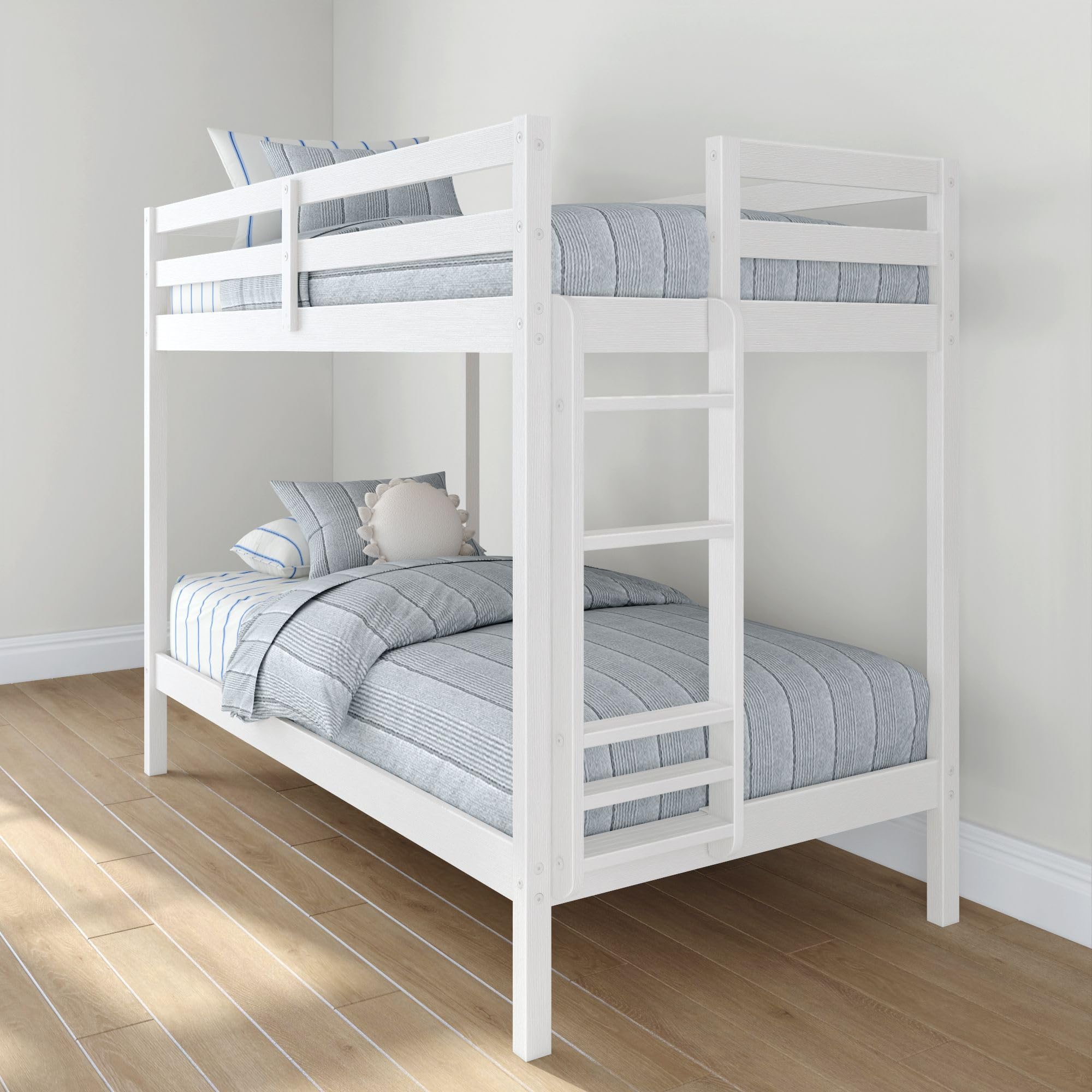
A twin-over-twin that dresses up like a real piece of furniture, not a kids’ frame.
Some bunks look like bunks. This one doesn’t. The Grain & Grove Bear is built from engineered wood with color-matched hardware and wooden slats supported by a metal bar underneath, giving each bunk a 400-pound capacity. At 80.75″ L x 42″ W x 62.25″ H, it’s a taller-than-low bunk with a taller-than-average 14-inch guardrail on the top bed — good protection for a younger sleeper who rolls in their sleep.
The flexibility is in the ladder: it installs on either end of the frame, so you can route traffic on the side that fits your room layout. Assembly has the right ingredients — tools, hardware, and instructions in the box — and buyers consistently describe it as quick, with one household reporting it went up in under two hours with two people. It takes standard twin mattresses 5 to 8 inches thick, with no box spring needed.
Real-world wear is where the smaller caveats live. Some owners wish the finish was more even on the ladder and a few report the painted hardware chipping quickly, so handle the small painted parts gently during assembly. A couple of buyers also note they expected the frame to feel more solid at this price. On balance, though, the bed holds up well and looks like furniture you’d pay more for, which is the whole point of this pick.
What makes it look high-end: color-matched hardware, engineered wood, and a clean white finish that reads more like a design-store bed than a budget bunk.
The fair caveat: painted hardware can chip if you’re rough during assembly, so set the finished hardware aside until you’re ready to install it.
Best fit for: buyers who want a bunk with polished aesthetics and a 14-inch guardrail for younger sleepers, without paying the premium solid-wood price.
Look at solid wood instead if: you want the longest possible service life and don’t mind the higher cost.
10. Max & Lily Fundamental Twin Low Bunk Bed, Kids Solid Wood Modern Bed Frame, Pecan
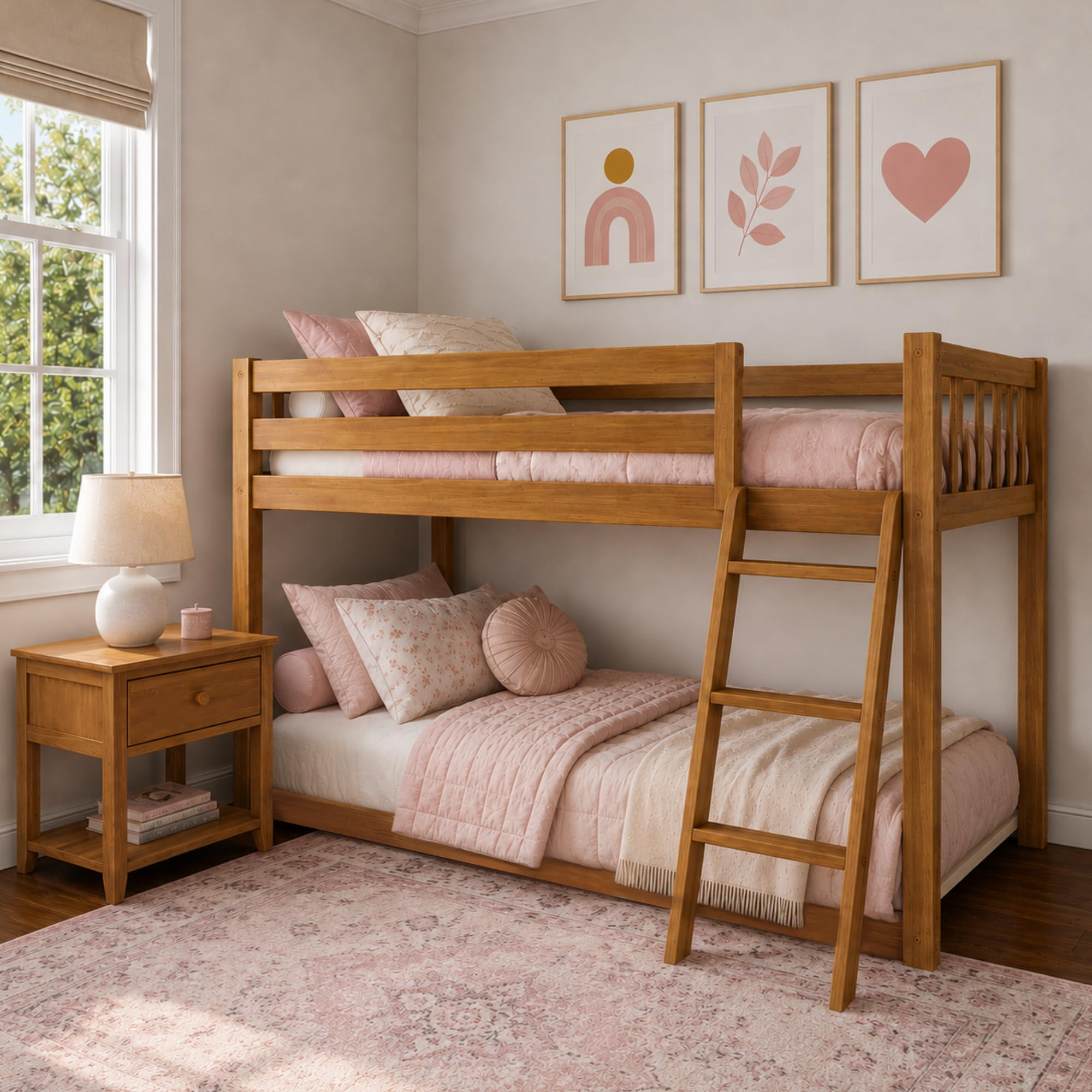
The low-profile bunk built with solid wood and clean, non-toxic finishes.
There’s a reason this bed sits at the top of buyer ratings across thousands of owners. Max & Lily builds the Fundamental from solid wood with low-VOC, non-toxic finishes, and it shows in the details: strong wood slats backed by a metal support bar, secure metal-on-metal bolt connections, and 14-inch guardrails on the top bunk. The whole frame measures 80″ L x 54.25″ W x 49.25″ H and supports up to 400 pounds.
That 49.25-inch height is the defining feature. This is a low bunk by design — the bottom bed sits close to the floor and the top bunk is easy to make up, easy to climb, and safe for younger kids to use without a big drop. Buyers describe the wooden finish as exceeding the price point and the frame as genuinely sturdy once assembled. The maker recommends a 5-to-8-inch mattress, with no box spring or bunkie board needed.
The honest note concerns long-term wear. Most customers note the bed staying solid for years, but a small number describe structural boards cracking or the ladder breaking after a few weeks of rough use. That’s a minority outcome, not the norm — but if your children are hard on furniture, check the assembly instructions carefully and re-tighten the bolts after the first month. Used properly, this is among the most durable low bunks you can buy.
What earns the loyal following
- Solid wood frame with low-VOC, non-toxic finishes
- Low-profile 49.25-inch height — safe for younger children
- Metal-on-metal bolt connections for stability
- 400-pound capacity per the maker’s spec
What a careful buyer should know
- A handful of reviewers point out boards cracking under very rough use
- Assembly directions are picture-only and can be confusing
- At 54.25 inches wide, it takes a real footprint in a small room
Right call if: you want a low, solid-wood bunk with a non-toxic finish and a loyal owner base behind it.
Better to skip if: your kids are famously hard on furniture, or you’d rather not spend a few hours interpreting picture-only instructions.
11. Plank+Beam Classic Twin Over Twin Standard Bunk, Walnut
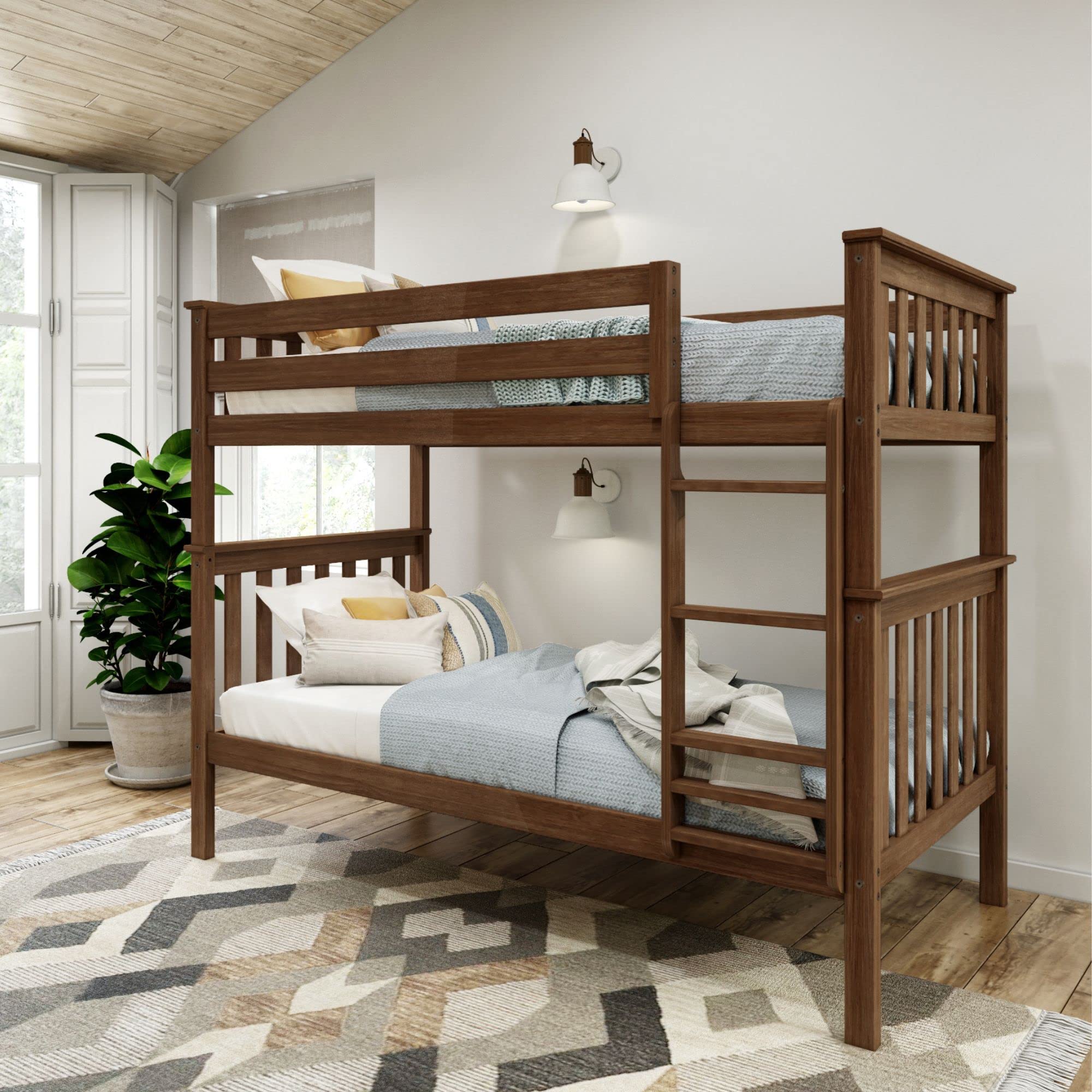
Knot-free New Zealand pine with metal-on-metal joints — the premium bunk in the group.
If you’re going to spend once and be done, this is the one to consider. Plank+Beam builds the Classic from solid, knot-free New Zealand pine with hand-applied low-VOC finishes — no veneer, no particle board. The frame uses metal-on-metal connections for strength and carries a 400-pound resting capacity per sleeping surface. It measures 81.5″ L x 42.5″ W x 65″ H and takes memory foam, spring, hybrid, or latex mattresses, with 8 inches the recommended thickness.
The stack design is the same as most twin-over-twins, but the bed can be pulled apart into two freestanding beds when you need the space. The maker states the bed meets or exceeds US and EU safety standards. Assembly runs about three hours and gets strong reviews from owners — one person can do most of it, though lifting the top bunk into place is a two-person job.
The honest gap: at over 80 inches long and just under 65 inches tall, this is a bigger-frame bunk than the LIKIMIO above, so it needs a slightly larger room. A few buyers have noted the screws loosen over time as kids climb, so a periodic tightening is worth budgeting into your routine. And a small number of units arrive with a damaged board from shipping, so inspect the box on delivery before you start building.
The material story: knot-free pine, hand-applied low-VOC finish, and metal-on-metal joints are the parts you actually pay for in a premium bunk.
The practical note: at over 80 inches long, this needs more room than most picks here, and the hardware wants a tightening every few months.
Premium pick for: buyers who want documented safety verification, knot-free solid wood, and a frame that can separate into two freestanding beds.
Spare yourself the money if: your room is snug or your budget points to a metal or engineered-wood frame that gets the job done at a lower tier.
Understanding the Specs
Guardrail height and mattress thickness
The guardrail is the wall along the top bunk that keeps a sleeper from rolling out. Its height is measured from the mattress surface to the top edge of the rail, so a thick mattress shortens the protective margin. Makers often recommend a mattress between 4 and 8 inches thick so the mattress top stays safely below the rail’s edge. Pair a 14-inch rail with a 6-inch mattress and you have more buffer; pair the same rail with a 10-inch mattress and you eat most of it.
Frame material and slat design
Metal frames are lighter and easier to move; solid wood frames feel heavier and oftenquieter under load. Slat design matters more than most buyers realize — the slats are the boards that support the mattress, and when they lock in place with a buckle or clip system, they don’t rattle as kids climb. Weight capacity tells you how much the frame is rated to hold, and a higher figure usually means thicker material and better joints, though it always refers to a stationary resting load, not jumping.
FAQ
How thick should a mattress be for the top bunk of a bunk bed?
Can two adults sleep on a twin over full bunk bed?
Do I need to attach a bunk bed to the wall?
How long does a bunk bed take to assemble?
Can a bunk bed be separated into two single beds?
Is a metal bunk bed noisier than a wooden one?
Does a low bunk bed require a different mattress thickness?
Do I need a box spring or bunkie board for a bunk bed?
How much weight can a bunk bed really hold?
Can I change the side the ladder is on after assembly?
Final Thoughts: The Verdict
For most rooms, the bunk bed to buy is the LIKIMIO twin-over-twin — it holds 4.6 stars across 600-plus owners, builds in about an hour, and stays rock steady under its house-shaped frame, which is exactly what a small kids’ room needs. If you want the frame to split into two separate beds down the line, the Jocoevol Metal Bunk Bed gives you that flexibility with taller 16.5-inch guardrails. And if your room has a low ceiling, the SHA CERLIN at 60.7 inches tall is the one to measure against before anything else. Every pick here earns its place on published specs and real owner feedback — the only question is which dimensions match your room.
How We Picked
We do not accept paid placement. Every pick is matched to a real buyer and a real use-case; we do not hands-on test units.
Sources & Methodology
Specifications: manufacturer listings and product documentation. Review insights: verified customer reviews, as of September 2026. Pricing: not shown on this page (it changes often); check the current price via the retailer link.
As an Amazon Associate, KitchPrep earns from qualifying purchases. This does not affect which products we feature.
Related Guides
