
Specs are compiled from manufacturer listings and verified buyer reviews and can change over time — please confirm the key details on the product page before buying.
If your rip cuts keep coming out burned, wavy, or fuzzy at the edges, the blade is usually the problem — not your technique. A 10 inch table saw blade has to match the job, and the biggest fork in the road is tooth count. Put a 24-tooth ripping blade on a piece of 8/4 walnut and it slices through fast and clean. Put that same blade on plywood and you get chip-out on the bottom face. Switch to a 40-tooth general-purpose blade and you cover most furniture work in one pass. The nine blades below were picked to cover that whole range, from budget two-packs you can toss instead of sharpening to premium blades that come back from the sharpener better than new.
I’m Mohammad Maruf — the founder and writer behind KitchPrep. This guide is built by comparing the manufacturers’ published specifications and the patterns across verified customer reviews, so you get each pick’s real strengths and trade-offs instead of marketing spin.
Pick the wrong blade and you’ll fight burn marks, slow feed, and extra sanding on every cut. The fix is matching tooth count and kerf (the width of the cut the blade makes) to the wood you’re cutting. This breakdown of the 10 inch table saw blade options covers arbor sizing (the hole that mounts on the saw), kerf thickness, and tooth geometry in plain terms.
Our Picks at a Glance

How To Choose The Best 10 Inch Table Saw Blade
Most people buy one blade and expect it to do everything, then blame the saw when the cuts go wrong. The honest answer is that no single blade rips 8/4 hardwood and crosscuts birch plywood perfectly — that is why serious shops keep two or three on the wall.
Start with tooth count, because it decides the job
A ripping blade carries 24 teeth (sometimes 30) and its job is speed through long grain. A general-purpose blade sits around 40 teeth and handles both rips and crosscuts without swapping. A fine-finish blade runs 60 to 80 teeth and is built for plywood, melamine, and trim where chip-out ruins the piece. More teeth means a slower feed, a smoother edge, and more heat in the cut.
Thin kerf versus full kerf
Kerf is the width of the slot the blade cuts. A thin kerf blade takes less wood out per pass, so underpowered saws feed it without bogging down. It also wastes less stock. The trade-off is a thinner plate that flexes more under heat and tends to leave slightly more saw marks. Full-kerf blades run stiffer and truer but demand more motor.
Check the arbor before you buy anything
The arbor is the hole in the middle of the blade, and on most 10 inch table saws it measures 5/8 inch. Every blade on this list uses that 5/8 inch arbor, so it drops onto the spindle of a standard table saw or miter saw without an adapter.
Quick Comparison
| Model | Best For | Tooth Count | Kerf | Arbor | Amazon |
|---|---|---|---|---|---|
| Forrest WW10407125 Woodworker II★ Best Overall | Buy-once general purpose | 40 | 0.125″ | 5/8″ | Amazon |
| DEWALT DW3112Budget Champion | Budget ripping and rabbets | 24 | Thin kerf | 5/8″ | Amazon |
| Luckyway 40T 2-PackTwo For One Value | Two blades for one price | 40 | 2.4 mm | 5/8″ | Amazon |
| CMT 250.024.10 ITK XTreme | Fast hardwood ripping | 24 | 0.102″ | 5/8″ | Amazon |
| 3-Pack Combo 32T/60T/80T | A blade for every material | 32 / 60 / 80 | 0.095″ | 5/8″ | Amazon |
| Freud LM72R010 Heavy-Duty Rip | Flat-bottom joinery | 24 | 0.126″ | 5/8″ | Amazon |
| Freud LM74R010 Glue Line Rip | Full-kerf glue-line rips | 30 | Full kerf | 5/8″ | Amazon |
In‑Depth Reviews
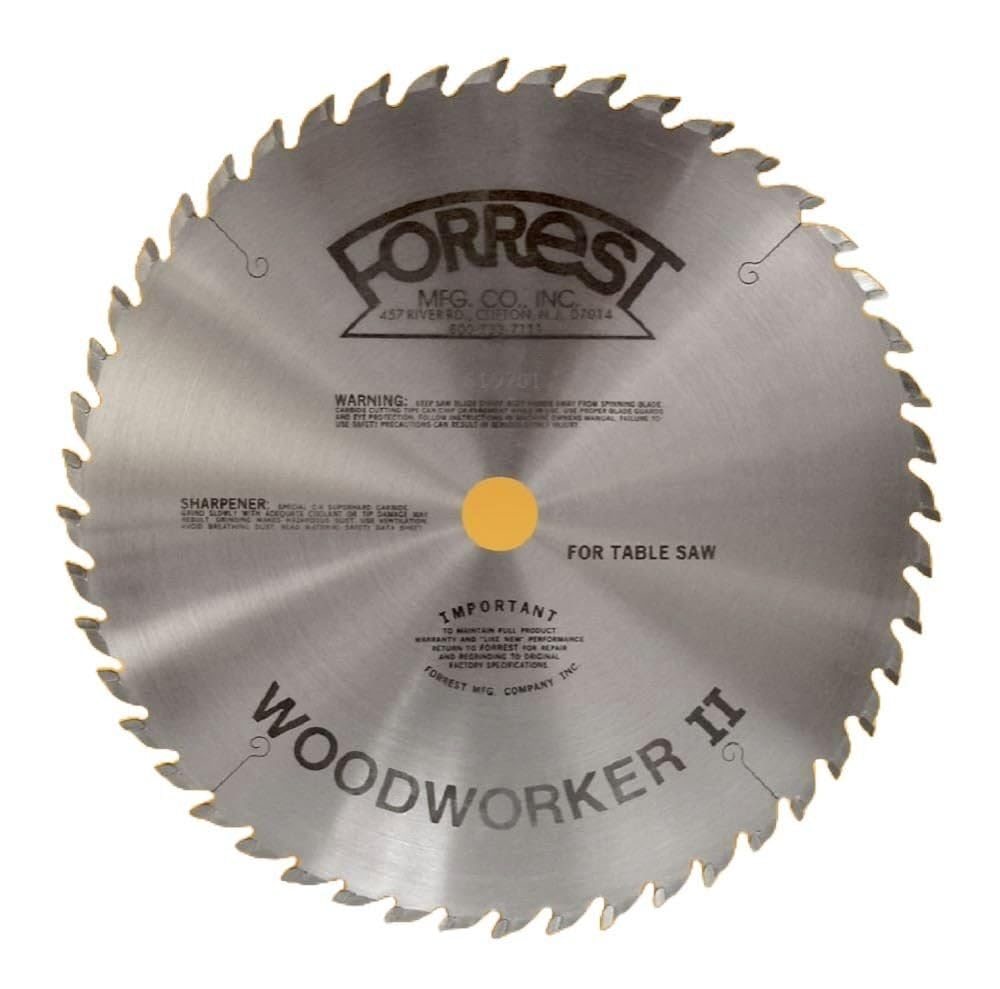
1. Forrest WW10407125 Woodworker II 10-Inch 40 Tooth ATB.125 Kerf Saw Blade with 5/8-Inch Arbor
Our pick — over 4.5★ from 800+ verified ratings; the strongest balance of quality and price.
A 40-tooth ATB blade built to be resharpened for years, not replaced.
For the woodworker who only wants to mount one blade and leave it there, the Forrest Woodworker II is the benchmark. It runs 40 teeth in an ATB grind (alternating top bevel — teeth angled left and right in turn, which shears the fibers instead of chipping them) on a.125 inch kerf.
Blade quality is the thing that wins people over here, followed closely by sharpness. Owners rip 8/4 walnut and cut hard maple with glue-ready edges that need almost no sanding. The 30-degree ATB tooth style (a steeper bevel angle than the common 15 degrees) cuts down on bottom splintering on radial crosscuts. And because the kerf saves 1/3 on wood loss per cut compared with a thicker blade, your lumber goes further over a project.
The catch is the sharpening math. As owners put it: “This is the top of the line. They cut like butter, and when they don’t, send them back to get resharpened (after years of use) to Forest for resharpening.” That resharpening cycle is the whole point — you are not buying a disposable blade. It also needs a well-tuned saw to perform, and the value score lands mixed because the up-front cost sits well above the mid-range picks.
What earns it the top spot
- 40 ATB teeth cut hard maple and 8/4 walnut with glue-ready edges
- Heavier 2.2 lb plate resists flex compared with the DEWALT’s 1.7 lb body
- Resharpenable carbide instead of throw-away — manufacturers’ spares are not included
- Saves 1/3 on wood loss per cut thanks to the kerf
Where it stings
- Premium-tier spend you have to justify over years of use
- Wants a true, well-aligned saw to show what it can do
- The resharpen cycle takes the blade out of rotation for a stretch
Buy this if: you want one 40-tooth blade that rips and crosscuts cleanly and comes back sharp.
Think twice if: you swap blades mid-project for rough framing work and want something you can abuse.
2. DEWALT 10-Inch Miter / Table Saw Blade, ATB, Thin Kerf, 5/8-Inch Arbor, 24-Tooth (DW3112)
A 24-tooth thin-kerf ripper that drops straight onto a 5/8-inch arbor.
If your saw is a jobsite model or an older Craftsman and you just need it to rip straight, this is where the money goes furthest. It carries 24 teeth on a thin kerf (a narrow cut — the blade removes less wood and the motor works less hard), which means it feeds faster than the Forrest’s 40-tooth layout on long rips. At 1.7 pounds it is 29% lighter than the Woodworker II’s 2.2 lb plate, so the saw spins it up quickly.
Buyers write most about cutting performance, and value comes right behind it. It slices through 4×4 stock cleanly, cuts hard maple for cabinet doors without the burning and spiral marks an old ripping blade left behind, and glues up without extra work. A contractor who builds exotic hardwood items and is hard on blades reports these beat pricier blades on value, holding up 6+ months of near-daily use on a portable saw.
One honest note: sharpness gets mixed feedback. Several buyers make rabbet joints with it and find it exceeds expectations, but if you want a polished, splinter-free crosscut on veneered plywood, the higher-tooth blades further down this list are the better fit. This is a ripping and general carpentry tool, not a finish blade.
The real spec: 24 teeth on a thin kerf means fast feed and low motor load — ideal for 2x lumber and rough rips.
Where it lands: a genuine value blade that matches the sharpness of pricier options on softwoods and mid-hardwoods without the spend.
Best for: budget-minded rips, framing cuts, and rabbet work on a saw that cannot muscle a heavy plate.
Skip if: you need finish-grade crosscuts on plywood or veneer, where a 60 or 80 tooth blade wins.
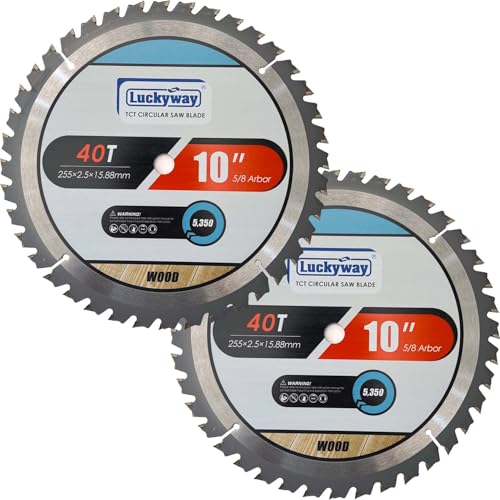
3. Luckyway 10 Inch Table Saw Blade 40T, 5/8″ Arbor for Cutting Wood 2-Pack
Two general-purpose blades for less than the cost of sharpening one premium blade.
Two 40-tooth blades in one box is the headline, and it makes sense for anyone who hates downtime. Each blade spins up to 5350 RPM with 40 Tungsten Carbide Tipped teeth (carbide is the hard cutting tip brazed onto each tooth) on an ultra-thin 1/10 inch kerf — 2.4 mm wide, narrower than the Forrest’s.125 inch. A 40-tooth count with 67% more teeth than the DEWALT’s 24 gives you a cleaner crosscut without giving up rip speed entirely.
Blade quality is the most-praised trait here, and cut quality and value follow right behind. A 40-year furniture maker tested them through 2 inch hard ash and found them razor sharp, with the thin kerf letting him feed stock faster than a full-kerf blade allows. There is no splintering on accurate cuts, and buyers find them compatible with most 10 inch table saws, jobsite saws, and miter saws on a 5/8 inch arbor.
Durability and sharpness get mixed reviews, so set your expectations. The thin plate cannot shed heat the way a heavy full-kerf body does. One long-time woodworker notes the teeth are small and expects roughly one resharpening at best. Some users report tearout and quick dulling on tougher stock. Treat these as workhorse shop blades rather than lifetime tools and they hold up well.
Why it earns a spot: at 40 teeth with a 2.4 mm kerf, two blades give you clean cuts and the option to keep one on the saw while the other rests.
Reasons to grab the pair
- Two 40T blades, so you are not caught mid-project without a spare
- Thin 2.4 mm kerf feeds fast on tablesaws and miter saws alike
- Rated up to 5350 RPM for compatibility across 10 inch machines
- Handles wood and plastic, plus aluminum trim reportedly
What to keep in mind
- Thin plate runs hot under sustained hard cutting
- Small teeth limit resharpening to about once
- Occasional tearout on plywood and dense grain
Worth it when: you want clean general-purpose cuts and a spare on hand without a premium spend.
Look elsewhere when: your work is all thick hardwood ripping where a full-kerf plate holds up longer.
4. CMT 250.024.10 ITK XTreme Ripping Saw Blade, 10-Inch x 24 Teeth ATB Grind with 5/8-Inch Bore
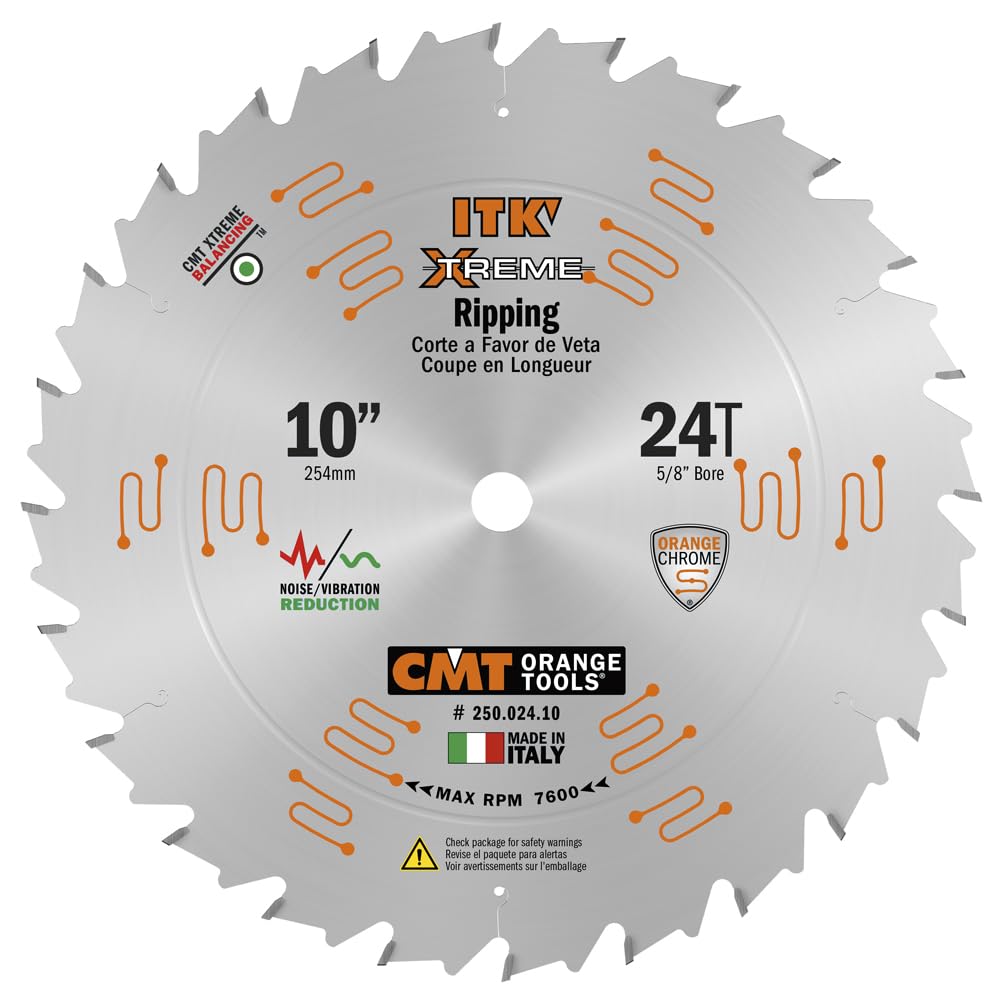
A 24-tooth ATB ripper that cabinet shop owners run instead of Diablo.
Built for stationary and portable table saws cutting softwood and hardwood, plywood, OSB, and pressure-treated lumber, this CMT runs 24 ATB teeth on a 0.102 inch kerf and a 0.071 inch plate. That thin kerf cuts faster and leaves a cleaner edge than the Freud LM72R010’s 0.126 inch kerf — nearly a third narrower, which also takes less material out per pass on expensive stock.
What earns the devotion here is the cut quality. A shop owner who has run more brands than he can list calls this the best rip blade he has used, describing 2 inch walnut coming off it like butter. Buyers report similar results ripping oak, cherry, coffee wood, and cedar, plus softwoods like pine, with a sharp edge, thin kerf, and no vibration. Several have moved their whole shop over from Diablo to CMT.
The honest limit: this is a ripping blade, and one reviewer noted it is not the cleanest finish for fine detail work — end grain and precision joinery want more teeth. There is also some vibration reported, so a properly aligned fence and arbor matters here. For fast, high-volume ripping on hardwoods, that trade-off is easy to accept.
Why it stands out: 24 ATB teeth with a 0.102 inch kerf combine speed and cutting quality that woodworkers put above the Diablo 30T glue-line at similar money.
Good to know: it is a ripping specialist, so keep a higher-count blade on the shelf for crosscuts and trim.
For the shop: anyone ripping hardwoods daily who wants a fast, sharp, resharpenable blade that keeps pace with the work.
Not the pick for: miter cuts, plywood crosscuts, or any job where you need a polished finish straight off the saw.
5. 3-Pack Combo 10-Inch 32T & 60T & 80T Woodworking Saw Blades with 5/8″ Arbor,.095″ Thin Kerf

Three tooth counts on one box, so you never cut the wrong material with the wrong blade.
This set solves the problem most buyers hit on day one: you cannot rip rough lumber and crosscut veneered plywood with the same blade and expect both to look good. The kit gives you a 32-tooth for general-purpose work, a 60-tooth for fine finish, and an 80-tooth for ultra-fine finish. All three run on a 0.095 inch thin kerf (a narrow cut that saves wood) with an ATB tooth design (alternating top bevel, where teeth angle side to side for cleaner cuts) and a 5/8 inch arbor that fits most 10 inch table saws, jobsite saws, and miter saws.
The value math is what buyers keep coming back to. Several note these blades match or approach expensive name-brand quality, and they are cheap enough that replacing rather than resharpening makes sense — especially for anyone who cannot find a saw filer locally. The hardened steel bodies and tungsten carbide teeth are spec’d for softwood, hardwood, plywood, chipboard, and laminate, and one buyer cut 1/4 inch plywood glued to drywall and reported the blades still sharp afterward.
The trade-off is that none of the three hits the ceiling of a dedicated premium blade. The 80-tooth delivers clean trim and plywood crosscuts but will not match the gloss of a purpose-built finish blade, and the 32-tooth rips fine for home projects without matching a dedicated rip blade on thick hardwood. As a starter kit or a second set to hang on the wall, it does real work.
Why the three-blade kit works
- Covers general-purpose, fine finish, and ultra-fine finish in one purchase
- 0.095 inch thin kerf feeds easily on underpowered saws
- Comes in a protector for safe storage between cuts
- Fits most 10 inch tablesaws, jobsite saws, and miter saws
What you trade away
- No single blade reaches dedicated premium performance
- Rough stock and thick hardwood ripping go to the 32T, which is less efficient than a true 24T rip blade
- Replacement mentality rather than serviceable blades
The right call for: DIYers and first-time table saw owners who want a full range without buying blades one at a time.
Look past it if: you already run dedicated rip, crosscut, and finish blades and need another general-purpose blade, not a full set.
6. Freud Heavy-Duty Rip Saw Blade – 10″ Diameter, 24 Teeth, 5/8″ Arbor (LM72R010)
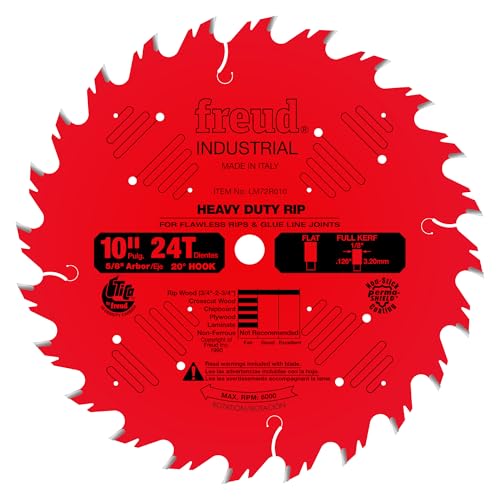
The raker teeth that let you cut dadoes and half laps without reaching for a router.
Most 24-tooth ripping blades are pure speed. This one does something extra because of its Flat Top Grind teeth — the tips are ground flat rather than angled, which leaves a square-bottomed cut you can glue up. That means dados, rabbets, and half laps come off the table saw flat and ridge-free, instead of needing a router bit or a shoulder plane to clean up.
The.126 inch kerf gives you a stiffer body than the CMT’s 0.102 inch kerf or the DEWALT’s thin-kerf plate, so it resists wander on hard stock. Quality is the aspect buyers praise most on this blade, with sharpness right behind. Across years of use on a DeWalt jobsite saw cutting end grain boards — hard maple, purple heart, cherry, walnut — owners mention durable teeth and clean cuts through 2-9/16 inch thick 45-degree laminates.
Two things to know before you buy. It runs loud, with a high-pitched whine that owners point out, and durability feedback is mixed — some report teeth breaking during extended use. The finish also is not always glue-ready without a light hand-plane pass, though it makes an excellent edge for a 24-tooth blade. Neither issue touches its value, which buyers rate highly.
The edge it owns: flat-top teeth give square, ridge-free bottoms for joinery work most rip blades cannot match.
What it delivers
- Flat Top Grind leaves glue-ready flat bottoms on dadoes and rabbets
- Full.126 inch kerf body stays stable on hard maple and exotic stock
- Works for crosscuts too, with no splintering per owner feedback
What else to weigh
- Sharp high-pitched whine in use
- Occasional tooth breakage report on the toughest materials
- Not always glue-ready straight off the saw
Get it for: joinery work where a flat-bottomed cut saves you a routing step, plus tough hardwood rips.
Only if: you want one blade doing ripping and joinery cuts, and you do not mind the noise.
7. Freud LM75R010: 10″ Industrial Thin Kerf Glue Line Ripping Blade, Carbide
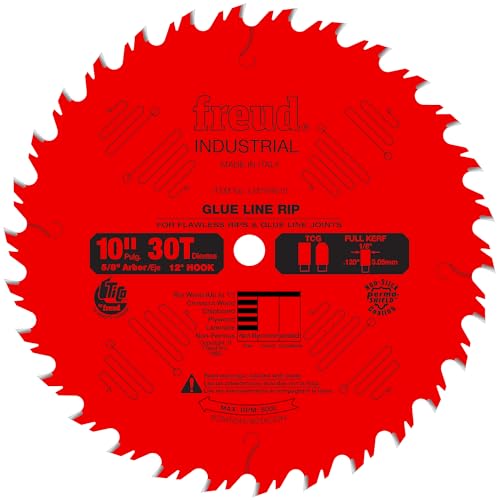
The same 30-tooth TCG grind on a full-kerf plate for saws with the motor to run it.
This is the LM75R010’s heavier sibling — same 30 teeth, same TCG grind, same glue-line ambition, but on a full kerf with a reinforced plate instead of a thin.091 inch body. That thickness makes it stable and flat, which pays off on longer rips in dense wood where a thin plate tends to wander. It runs the same laser-cut anti-vibration slots and Perma-Shield non-stick coating as its sibling, so drag and pitch buildup stay low.
Blade quality leads the praise, with sharpness a close second, and the rip quality and glue-up readiness follow. Customers note 1-5/8 inch cherry cutting cleanly with no burning and glue-ready edges that need no planing or jointing. What buyers on a Rigid R4513 and Sawstop saw is clean, burn-free cutting across walnut, maple, cherry, and purple heart. Several note the quality is close enough to premium alternatives that they do not need to look further.
One caution: the “no planing needed” claim gets pushed back on. Without a power feeder, some reviewers point out that light planing is still needed on 4/4 red oak and that vibration shows up on thicker maple and jatoba. That is a real limit worth knowing. Set against that, the burn resistance and edge quality keep it squarely in the premium tier.
Why premium-tier buyers stick with it: full kerf plus a reinforced plate and 30 TCG teeth keep long hardwood rips flat and burn-free.
What to expect honestly: a light plane pass may still be needed on some stock unless you feed with power.
Reach for this if: your table saw has the motor for a full-kerf blade and you want maximum stability on thick hardwood.
Look past it if: your saw is underpowered or you are already happy with a thin-kerf ripping blade.
Understanding the Specs
Tooth Count and Grind
Tooth count sets the job. A 24-tooth blade rips long grain fast with a rougher edge, a 40-tooth handles general work, and a 60 to 80-tooth blade finishes plywood and trim with minimal chip-out. The grind matters just as much. ATB teeth (alternating top bevel) angle left and right for clean crosscuts. TCG (triple chip grind) pairs flat and beveled teeth for smooth rips. FTG (flat top grind) leaves flat-bottomed cuts for dadoes and rabbets.
Kerf, Arbor, and Plate
Kerf is the width of the cut and the thin-versus-full decision shapes how the blade feels. Thin kerf lowers the load on the saw motor and wastes less stock, while full kerf runs stiffer and truer. Arbor is the center hole, and 5/8 inch fits most 10 inch table saws. Plate thickness — the steel body itself — is tied to how steady the blade stays under heat.
FAQ
Will a 10 inch blade with a 5/8 inch arbor fit my table saw?
Is a 40 tooth blade good for both ripping and crosscutting?
What is the difference between thin kerf and full kerf?
Can a ripping blade be used for crosscutting?
How long does a 10 inch table saw blade stay sharp?
Does blade thickness affect how much wood I waste?
Which blade is best for cutting plywood without tearout?
Do I need a different blade for dados and rabbets?
What RPM rating should I look for in a 10 inch blade?
Is a more expensive blade actually worth it over a budget one?
Final Thoughts: The Verdict
If you want to buy once and keep a single blade on the arbor for years of rips and crosscuts, the Forrest Woodworker II 40T is the pick — a 40-tooth ATB blade that handles hard maple and 8/4 walnut and comes back from service ready to work again. For a fast, sharp ripping blade that cabinet shops swear by, the CMT 250.024.10 with its 24 ATB teeth and 0.102 inch kerf is money well spent. And if you want one blade that does both rips and crosscuts without a swap, the Freud LU84R011 Combination with 50 teeth covers almost everything on a full-kerf-capable saw. If your priority is squeezing the most out of every board you buy, the thin-kerf Freud LM75R010 wastes the least on every rip.
How We Picked
We do not accept paid placement. Every pick is matched to a real buyer and a real use-case; we do not hands-on test units.
Sources & Methodology
Specifications: manufacturer listings and product documentation. Review insights: verified customer reviews, as of September 2026. Pricing: not shown on this page (it changes often); check the current price via the retailer link.
As an Amazon Associate, KitchPrep earns from qualifying purchases. This does not affect which products we feature.
Related Guides
