
Specs are compiled from manufacturer listings and verified buyer reviews and can change over time — please confirm the key details on the product page before buying.
If you want one great cup of espresso every morning without giving up half your counter to a full-size machine, the Bialetti Moka Express is the pick that matters most. It brews a rich, concentrated shot on any stovetop with no electricity, no pods, and no learning curve worth losing sleep over. Below you get five very different ways to make that single cup — a stovetop classic, two countertop pod machines, a battery-powered travel brewer, and a designer moka — so you can match one to how you actually live.
I’m Mohammad Maruf — the founder and writer behind KitchPrep. This guide is built by comparing the manufacturers’ published specifications and the patterns across verified customer reviews, so you get each pick’s real strengths and trade-offs instead of marketing spin.
Every machine here is built around a single serving, so the real differences come down to how you heat the water, what you load in, and how much room you can spare. The five picks below cover every way to brew that single cup.
Our Picks at a Glance

How To Choose The Best 1 Cup Espresso Maker
Buying a single-cup espresso maker is really a choice between three heating methods, and the one you pick decides how much work you do before that first sip. A stovetop moka pot puts you in charge of heat, water, and timing. A countertop pump machine presses a button and pulls the shot for you. A battery brewer heats its own water wherever you are. Pick your heating method first; the rest of the specs follow from it.
Stovetop Moka Pot or Electric Pump Machine
A moka pot uses your stove as its heat source and the pressure of rising steam to push water up through the ground coffee. That means zero electricity, a cleaning routine of nothing but a water rinse, and a finished cup that is concentrated and coffee-like rather than a fine, high-pressure shot. An electric pump machine trades that ritual for speed — you drop in a pod or grounds, press one button, and hot coffee lands in the cup in about a minute. Choose the pump machine for rushed mornings, the moka pot if you want the hands-on ritual.
Pod Compatibility and What You Can Load
Pod machines are only as flexible as the capsules they accept. The Nespresso Original format is the one to know, because it is the lineup most single-serve machines are built to take, and it also covers the widest spread of brands and roasts. If you prefer loose ground coffee you will want a moka pot or a brewer that accepts grounds directly, since that route costs less per cup and lets you dial in your own grind. Check compatibility before you buy — a machine that only accepts a narrow pod line can leave you hunting.
Bar Pressure, Crema, and Cup Size
Pressure is measured in bars, and on pump machines you will see figures like 20 bar. Higher pressure generally gives you a thicker layer of crema, the golden foam on top of a fresh espresso shot. Capacity matters just as much: a single-serve reservoir means you refill between cups, so a 24 fl oz tank lets you pull several shots before heading back to the tap. Pod machines also let you choose between a short espresso and a longer lungo, which is handy when one person’s idea of a good cup is not yours.
Footprint and Portable Use
Counter space is the quiet deal-breaker in most kitchens. A hammered-metal machine that takes up a sliver of counter, or a battery brewer you can drop into a bag, makes single serving genuinely convenient — while a wider unit that needs a dedicated corner can end up in a cabinet. If you commute, camp, or work shifts somewhere coffee pots are not allowed, a rechargeable self-heating brewer lets you make a hot cup where there is no outlet at all.
Quick Comparison
| Model | Best For | Brew Method | Coffee Input | Capacity | Amazon |
|---|---|---|---|---|---|
| Bialetti Moka Express (1 Cup)★ Best Overall | Classic stovetop espresso, no power needed | Moka Pot (stovetop) | Ground | 2 fl oz | Amazon |
| CHULUX Bafè-ProBest Value | Fast pod espresso on a small counter | Electric pump (20 bar) | Nespresso Original pods | 24 fl oz | Amazon |
| Alessi AAM33/1 | Design-forward solo coffee ritual | Moka Pot (stovetop) | Ground | 2.4 fl oz | Amazon |
| CERA+ PCM03S | Hot espresso with no outlet nearby | Battery self-heating (20 bar) | Capsule or Ground | 80 ml | Amazon |
| Nespresso Pixie by De’Longhi | Quick, tidy single shots at home | Electric pump (pod) | Nespresso Original pods | — | Amazon |
In‑Depth Reviews
1. Bialetti Moka Express 1 Cup (2 Oz)
Our pick — over 4.5★ from 119,500+ verified ratings; the strongest balance of quality and price.
The stovetop original that brews a concentrated single shot with nothing but heat and ground coffee.
The defining number here is the 2 fl oz capacity — exactly one espresso cup, filled to the line. There is no power cord, no pod, and no button: you fill the boiler, add ground coffee without pressing it down, screw the two halves together, and set it on gas, electric, or induction with Bialetti’s induction adapter plate. The design dates to 1933, and a single-part aluminum body with a reusable filter is why this format has outlasted every trend since. Cleaning is a water rinse — no detergent, and definitely not the dishwasher, both of which the maker warns will damage the finish and change how your coffee tastes.
What wins people over is the taste-to-effort ratio, and the room to experiment: this is the everyday method in plenty of households, and owners take it camping and to hotels because it runs on any cooking surface. On gas, the guidance that keeps coming through is a medium flame plus a metal plate under the pot, pulling it off right as it starts to sputter so the brew does not scorch. Dark roasts and a grind that is a touch coarser than a pump machine’s expect both land well.
Here is the honest catch. This is not true espresso — it does not build the pressure a 20-bar pump machine does, so what you get is a strong, concentrated coffee shot you can dilute with hot water if you want to stretch it. Buyers also report the metal gets very hot, and the plastic handle can get uncomfortably warm on a long brew. Treat it as a stove-top tool that needs an adult nearby, not a countertop appliance.
What Earns It The Top Spot
- One-cup 2 fl oz capacity with a reusable filter — nothing disposable to restock.
- Brews with no electricity on gas, electric, or induction, so it travels to campsites and hotel kitchens.
- Full teardown for cleaning and a simple water-only rinse afterwards.
What To Keep In Mind
- Not pressurized espresso — it is concentrated stovetop coffee, not a crema-topped shot.
- Gets hot in use; the handle warms up too, so it needs a careful hand.
- The cup is small by design — fine for one person, tight for two full mugs.
Who it fits: the solo drinker who wants a fixed two-ounce shot with no pods, no cord, and no cabinet full of equipment.
Think twice if: you want a push-button crema shot, because that is a pump machine’s job, not a moka pot’s.
2. CHULUX Bafè-Pro Single Serve Espresso Machine
A 20-bar pump and a 1400-watt heater turn one pod into a crema-topped shot in about a minute.
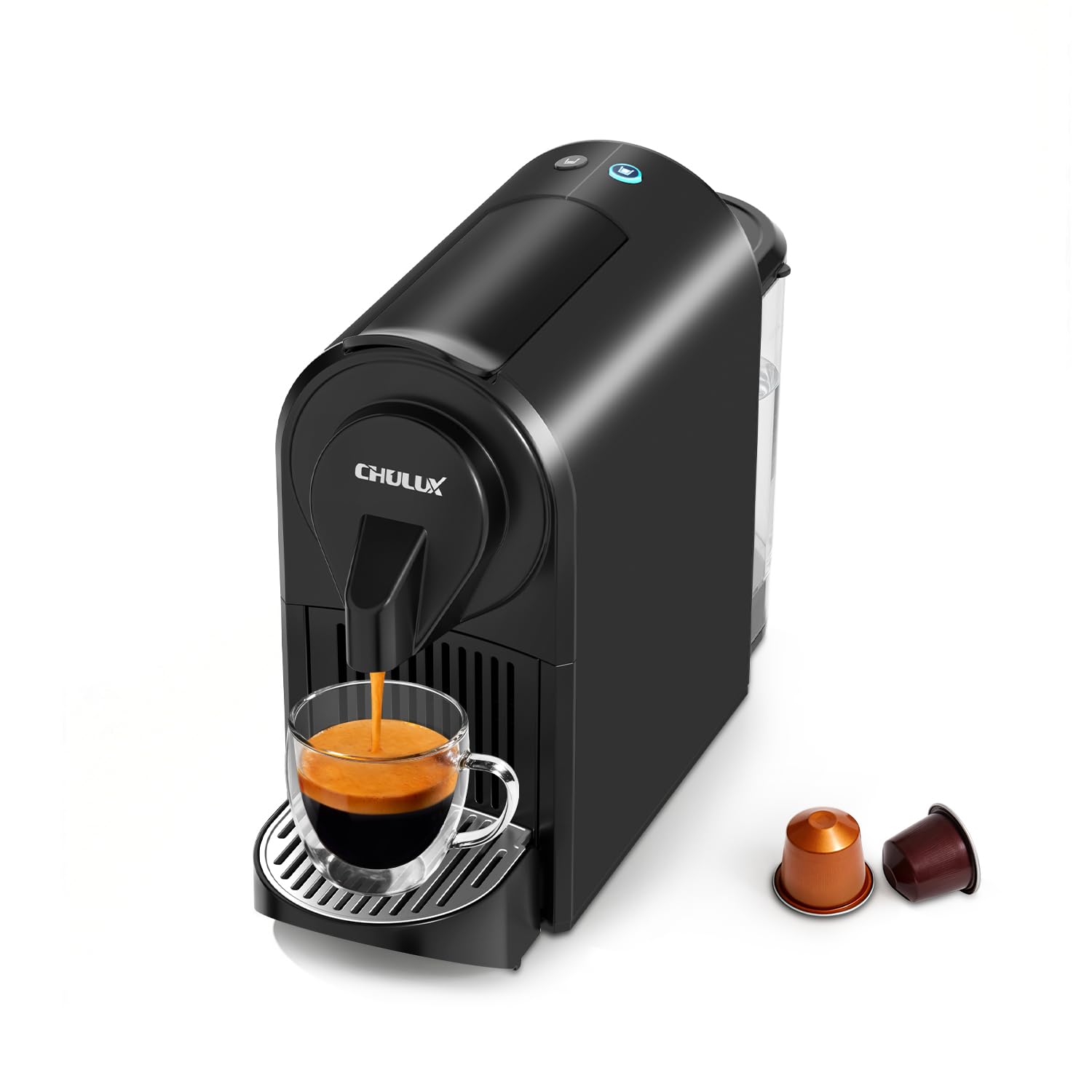
If your idea of a good espresso is the thick golden foam rather than the stovetop gurgle, this is the machine that delivers it fastest. A 1400W heater warms up in 15 to 20 seconds, and once you drop in a Nespresso Original pod and press the button, your cup is ready in one to two minutes. The 20-bar Italian pump is what pulls that full-bodied extraction with the rich, velvety crema on top — the thing a moka pot fundamentally cannot do, since the Bialetti has no pump at all. And its 24 fl oz reservoir lets you pull several shots back-to-back without a refill, versus the 2 fl oz of a single moka fill.
Owners keep coming back to how little it asks of them: pod in, button pressed, spent capsule auto-ejects into its own drawer. Both the drip tray and the capsule container pull out and go straight into the dishwasher, and the foldable tray takes a taller travel mug when you want a double. It is also genuinely compact for a pump machine, which is why small-kitchen buyers rate it so highly against bigger, pricier pod brands. Two selections — a classic espresso or a longer, smoother lungo — cover both moods from the same box of pods.
The catch is worth knowing before you commit. Puncture reliability is the recurring gripe: buyers report that certain third-party capsules never get pierced cleanly, some barely work after months of use, and a machine that pierces everything on day one can start missing pods later. Stick to well-known capsule brands and this mostly stays out of your way.
Fast And Hands-Off: 15-20s preheat and pod-to-cup in 1-2 minutes makes this the pick for rushed mornings, and the auto-eject drawer means you are not knocking capsules out by hand.
Safety And Shutdown Covered: overheat protection plus an auto-shut-off after 5 minutes of inactivity, and all water and coffee-contact parts are made from food-safe materials.
Reach for this if: you want café-style crema with almost no effort and a small footprint on the counter.
Look elsewhere if: you plan to experiment with every off-brand pod you can find — the puncture mechanism is fussier about capsules than the pump is about anything else.
3. Alessi AAM33/1 Design Espresso Coffee Maker, 1 Cup

A designer moka that turns a single-cup stovetop brew into something you leave on the counter.
This is the stovetop route done as a piece of design. At 10.88 ounces it is lighter than the plastic-handled Bialetti’s 1.5 pounds, and it comes in 1, 3, or 6 cup sizes if you ever want to brew for more than yourself. It runs on the same principle as any moka pot: water in the boiler, ground coffee in the reusable filter basket, assemble, heat, done.
Solo coffee drinkers are the ones who get the most out of it. The single-cup version is recommended for exactly that — one large espresso or cappuccino without leftovers going cold. what separates it in use is the shape: the smooth curves make the two halves easy to screw and unscrew, the handle sits further from the pot so it stays cooler to grip, and the rounded carafe lets you see the espresso level as it rises, which is a small thing that matters every morning.
Two honest notes before you buy. The design and coffee quality land well, but a share of buyers find the size smaller than expected — check the cup count against your own habit, because this really is a one-person maker. And the value-for-money feedback runs less favorably than the quality feedback, so you are paying in part for the Alessi name and the Mendini shape. Look after the silicone gasket and it should hold up, since the gasket has been reported to show no wear after months of twice-daily use.
Where It Shines
- 2.4 fl oz capacity — slightly more than a standard single-cup moka pod.
- Rounded body makes it easier to screw and unscrew than a boxy pot, and shows the brew level.
- Handle set further from the pot so it stays cooler to hold.
The Honest Trade-Offs
- Sized purely for a solo pour — those expecting more will find it too small.
- You pay a premium for the designer look, not just the coffee it makes.
- Stovetop brew means no button, no timer, and a learnable routine.
Best for: the solo drinker who wants a beautiful, low-profile stovetop maker that doubles as countertop decor.
Not the one if: you are brewing for two or three at once — buy the 3-cup size instead.
4. CERA+ PCM03S Portable Espresso Machine
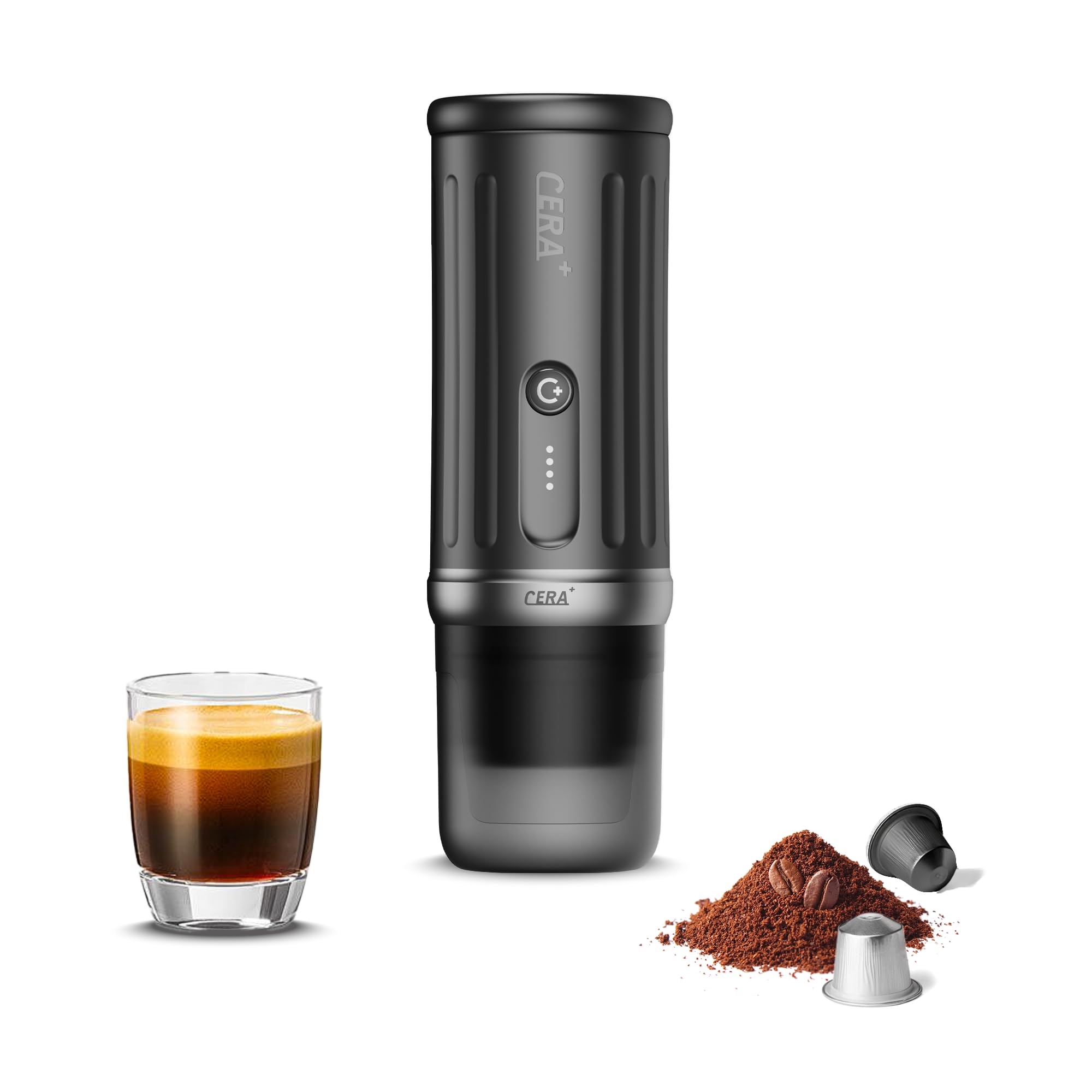
A rechargeable espresso maker that heats its own water and pulls a 20-bar shot with no outlet in sight.
The headline is the battery: a 3×4500mAh pack that CERA+ rates at up to 8 hot espresso cups per charge with 1.7 oz (50 ml) of cold water, or 500+ shots if you feed it preheated water. That self-heating is the real trick — it warms 1.7 oz (50 ml) of water from 77°F to 198°F (25°C to 92°C) in 140 seconds, so you are not hunting for a kettle or a wall socket. It weighs 1.6 pounds and stands 9 inches tall with a slim 2.75-inch footprint, which is what makes it a bag-and-go machine rather than a countertop fixture.
Loading is where it beats the Bialetti and the Alessi for flexibility — this single machine takes either NS-compatible pods or straight ground coffee, so you can travel light with capsules or bring your own beans and a grinder. It carries the same 20-bar pressure system as the CHULUX, so you are getting that rich espresso body and smooth crema rather than a stovetop concentrate. Every cup is one button, and there is no app, no Bluetooth, and no Wi-Fi pairing to set up first.
The limitation, and it is a real one, is that you have to plan around the battery rather than a cord. Owners mostly rave about the shots and the portability, but feedback on battery life splits — some get plenty of cups out of a charge, others run it down faster than expected. Expect a short learning curve on grind and tamp too if you use grounds, with the shots improving once you find your setting. Charging runs 30W over USB-C and reaches full in about 1.5 hours, so top it up before a trip rather than mid-commute.
Built for no-outlet days: 140-second self-heating and a 13500mAh pack mean a hot shot on a camping table, in a hotel room, or on a shift where coffee pots are not allowed — no kettle, no plug.
Two Ways to Load: pods or ground coffee in the same 20-bar machine gives you travel convenience plus the freedom to use your own beans.
Ideal for: travelers, campers, and anyone who works somewhere a coffee pot is not an option and wants hot espresso without an outlet.
Skip the upgrade if: you brew at the same counter every morning and never leave it — a corded machine costs less for the same shot.
5. Nespresso Pixie Aluminum Espresso Machine by De’Longhi

A low-profile pod machine with hammered metal sides that claims the smallest slice of counter you can spare.
When counter space is the deciding factor, this is the one to measure against. It stands 9.25 inches tall with a slim 4.6-inch depth, runs on Nespresso Original pods, and gives you two selections — a short espresso or a longer lungo — from a single button. The body is aluminum with hammered metal sides, so it reads more like a small appliance than a pod dispenser, and the whole thing weighs 5.4 pounds. It also shuts itself off automatically after 2 minutes of inactivity, which is a small running-cost win you stop thinking about.
What owners keep praising is how unfussy it is: pop in a capsule, press once, and a proper espresso lands in the cup. It brews the full Nespresso Original range, so you are not boxed into one roast, and it comes with a Nespresso welcome kit and user manual from the start. Against the CHULUX it holds the higher rating but far fewer ratings — the CHULUX has the larger review base while this one carries the stronger score — which is the classic trade-off between a well-proven crowd-pleaser and an equally sharp favorite with a smaller following.
Worth saying plainly: this is a pod machine, so you are tied to capsules rather than loose grounds, and a rare unit can arrive defective — one buyer’s machine never moved water from tank to cup and had to go back. If that happens, the return process handles it; it is not a pattern across the line. Nespresso rounds this out by recycling the aluminum pods it collects, and the capsules are made from at least 80% recycled aluminum, which is a nice touch if you care about what happens to the empties.
Smallest Footprint Wins: at 9.25 inches tall and 4.6 inches deep, this is the one that sneaks onto a crowded counter without forcing you to reorganize the kitchen.
Two Sizes, One Button: espresso or lungo from a single press, so a strong shot and a longer cup both come from the same box of pods.
Pick this if: you are short on counter space and want the tidy, consistent pod shot that a metal-bodied machine delivers.
Consider the CHULUX instead if: you want the bigger reservoir and dishwasher-safe drip tray, and you are willing to trade a little rating strength for a much larger group of owners behind it.
Understanding the Specs
Brew Method and Heat Source
The brew method decides everything about your morning. A moka pot uses stovetop heat to push water up through ground coffee — no electricity, a full teardown for cleaning, and a concentrated drink. An electric pump machine presses the shot for you using a 20-bar pump, which is the layer of pressure that builds the crema on top. A battery brewer heats its own water, so it can pull a real shot anywhere. Match the method to where and how you brew, then judge the remaining specs.
Pressure, Capacity, and Brew Time
Pressure is listed in bars, and a 20-bar pump produces the thick, velvety crema that a stovetop moka pot simply cannot reach. Capacity tells you how many cups you can pull before refilling — a single-serve moka holds 2 fl oz, a rounded designer moka about 2.4 fl oz, and a pump machine’s reservoir can range from a single-shot setup up to 24 fl oz for several cups in a row. Brew time is the other number that matters: some pump machines go from cold to a finished shot in one to two minutes, while stovetop machines give you control over the heat and the moment you pull it off.
FAQ
Does a 1 cup espresso maker make real espresso or just strong coffee?
What does 20 bar pressure actually do for my espresso?
Which pods work with the Nespresso Original machines?
How long does it take to brew one cup?
Can I use ground coffee in these single-cup machines?
Is a stovetop moka pot harder to clean than a pod machine?
What is the difference between a 1 cup and a multi-cup espresso maker?
Can I take a single-cup espresso maker traveling or camping?
Do I need an adapter plate to use a moka pot on an induction cooktop?
How many espresso cups can the CERA+ brew on a single charge?
Final Thoughts: The Verdict
For most people, the 1 cup espresso maker that gets the job done best is the Bialetti Moka Express — it brews a rich, concentrated single shot on any stovetop with no power, no pods, and nothing to replace. It holds a 4.6-star rating across 119,000+ owners — the strongest review signal in this lineup. If you want the crema of a real pump shot with push-button simplicity, the CHULUX Bafè-Pro is the one to grab, with its 20-bar pump and dishwasher-safe parts. And if you brew away from an outlet — camping, hotels, or a shift where coffee pots are off-limits — reach for the CERA+ PCM03S, whose self-heating battery makes hot espresso anywhere.
How We Picked
We do not accept paid placement. Every pick is matched to a real buyer and a real use-case; we do not hands-on test units.
Sources & Methodology
Specifications: manufacturer listings and product documentation. Review insights: verified customer reviews, as of September 2026. Pricing: not shown on this page (it changes often); check the current price via the retailer link.
As an Amazon Associate, KitchPrep earns from qualifying purchases. This does not affect which products we feature.
Related Guides
