
Specs are compiled from manufacturer listings and verified buyer reviews and can change over time — please confirm the key details on the product page before buying.
If you want one box that keeps your fridge, router, and phone alive when the grid drops, the Jackery Explorer 1000 v2 is the safest first pick for most people. It pairs a 1,070Wh battery with a 1,500W AC output, and it can be refilled from empty to full in about an hour when you switch on emergency charging in the app.
I’m Mohammad Maruf — the founder and writer behind KitchPrep. This guide is built by comparing the manufacturers’ published specifications and the patterns across verified customer reviews, so you get each pick’s real strengths and trade-offs instead of marketing spin.
Quick honesty note before you scroll: this list uses flexible, human-like matching for “about 1000 watts,” so it accepts same-class portable power stations from roughly 900W to 1200W and leaves out 300–500W mini units and 2000W+ big rigs. Not every pick is the exact number you typed, but each one serves the same job. Below you’ll find the 1000-watt power station picks worth your money, sorted by what they actually do best.
Our Picks at a Glance

How To Choose The Best 1000-Watt Power Station
A 1000-watt power station is really two numbers wearing one coat. The wattage (W) tells you what you can plug in and start, and the watt-hours (Wh) tells you how long it will run before you need a refill from the wall, your car, or a solar panel.
Start with watts, then match the battery size
Rated watts decide the appliances this box can handle. A 1,000W unit will run a mini-fridge, a TV, a fan, and a laptop, but a heater or a large air fryer will trip its protection. Surge watts matter too — that is the brief spike a motor or compressor pulls when it kicks on. A 2,000W surge covers most small appliances that start with a jolt.
Then look at capacity. A 999Wh pack and a 1,070Wh pack look almost identical on paper, but that gap is the difference between finishing a movie night and hunting for a charger.
Battery chemistry changes everything
LiFePO4 (lithium iron phosphate) is the cell type to look for in this class. It holds up to thousands of charge cycles and runs cooler than older lithium-ion packs, which is why most picks here advertise a 10-year service window. Standard lithium-ion still shows up, and it works fine — it simply ages faster.
Think about how you will refill it
Wall charging runs from about one hour to eight hours depending on the model and whether you enable a fast mode. Solar input is slower but earns its keep on multi-day trips. A car port (12V) is the slowest option and usually adds only a few percent per hour of driving, so plan around it rather than relying on it.
Quick Comparison
| Model | Best For | Capacity | AC Output | Weight | Amazon |
|---|---|---|---|---|---|
| Jackery Explorer 1000 v2★ Best Overall | Overall pick for home backup and camping | 1,070Wh | 1,500W | 23.8 lb | Amazon |
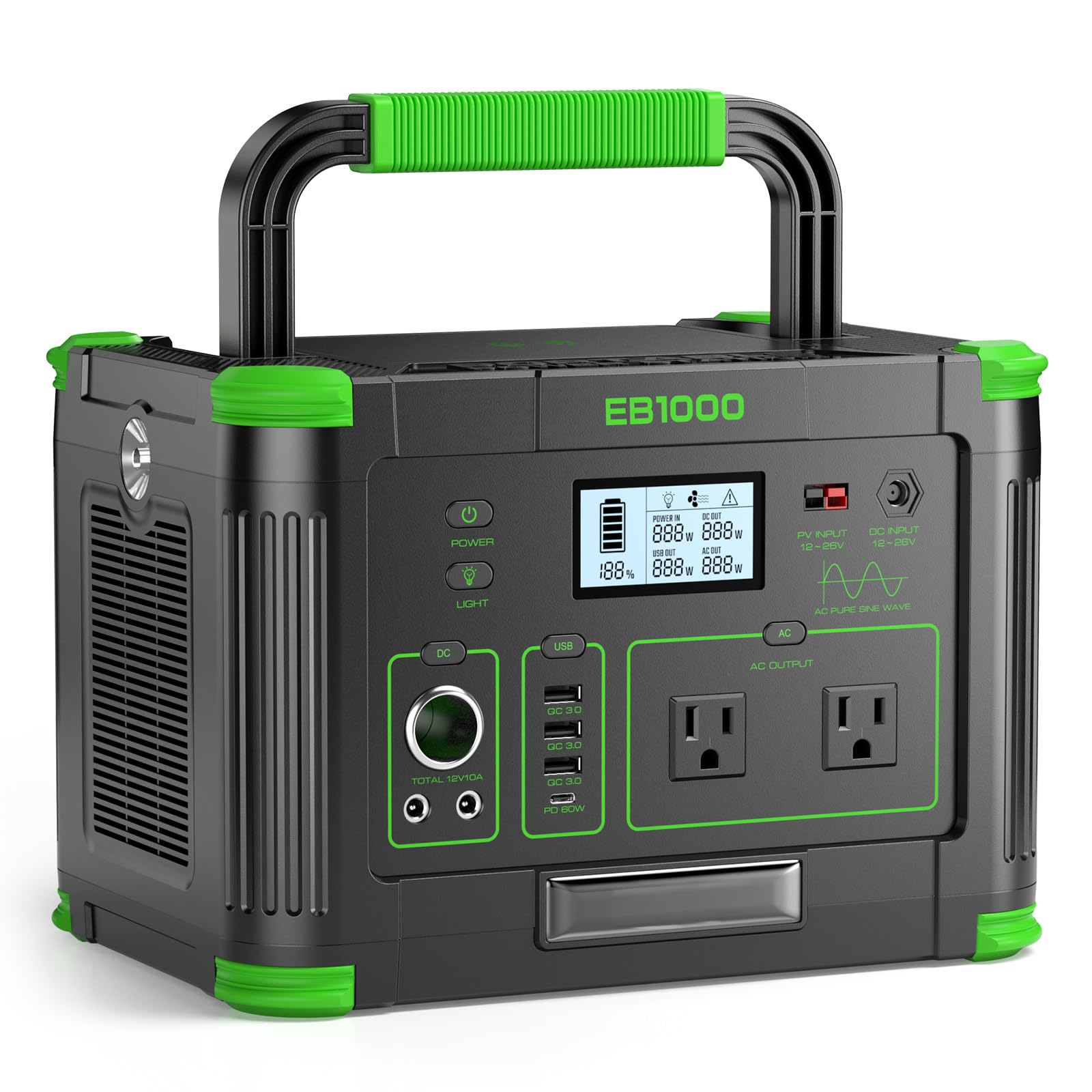
| GRECELL Portable Power Station 1000W 999WhBest Value | Budget-friendly value with 10 ports | 999Wh | 1,000W | 20 lb | Amazon |
| GRECELL 999Wh Solar Generator 1000WTravel Light | Lightweight off-grid travel | 999Wh | 1,000W | 18.4 lb | Amazon |
| GRECELL 1000W Portable Power Station 999Wh | Small-device backup on a tighter budget | 999Wh | 1,000W | 18.4 lb | Amazon |
| PECRON E1000LFP | Expandable capacity for long off-grid runs | 1,024Wh | 1,800W | 29 lb | Amazon |
| PECRON F1000 LFP | Fast AC charging plus UPS for desk gear | 960Wh | 1,500W | 23.9 lb | Amazon |
| DJI Power 1000 V2 | Quiet overnight use and DJI gear owners | 1,024Wh | 2,600W stable output | — | Amazon |
| BLUETTI Elite 100 V2 | Compact home backup with fast solar | 1,024Wh | 1,800W | 25 lb | Amazon |
| BLUETTI AC180 | High-capacity all-rounder for RV and home | 1152Wh | 1,800W | 37.4 lb | Amazon |
| Anker SOLIX C1000 | Fastest recharge and UPS reliability | 1,056Wh | 1,800W | 27.6 lb | Amazon |
In‑Depth Reviews
1. Jackery Explorer 1000 v2 Portable Power Station, 1070Wh, 1500W
Our pick — over 4.5★ from 3,500+ verified ratings; the strongest balance of quality and price.
The camping box that refills itself while you eat lunch.
The 1,070Wh battery matters most because it decides how many nights you get before you need a plug. Owners running a CPAP on trips report two nights with the machine maxed out, and roughly 15–20% drained per night at gentler settings. That is the kind of number that turns a weekend into a full week.
Inside sits an LFP battery (lithium iron phosphate — the cooler-running, longer-lived cell type) that the maker says holds over 70% of its original capacity after 4,000 charge cycles. The 1,500W AC output and 3,000W surge peak cover fridges, electric pots, and even an AC unit, and the whole thing weighs 23.8 pounds with a foldable handle. The app adds three charging modes: one-hour emergency charging from 0 to 100%, a 30 dB quiet overnight mode, and an energy-saving mode. A service electrician runs fridges, freezers, a large hammer drill, and 8ft ground rods off it, and refills to full from both a 100W solar panel and a 12/24V car charger.
Against the GRECELL 1000W value pick, the Jackery is the bigger machine: 1,500W versus 1,000W of AC output, and a 3,000W versus 2,000W surge peak for starting motors. What wins buyers over is the build quality by a wide margin, with charging speed close behind — the recharge genuinely behaves like the manual claims. The honest catch is that this is a portable power box, not a whole-home generator. Running a car fridge around the clock for a week or more will empty it, and it is heavier than its price-class rivals by a noticeable margin when you carry it up a hill.
What earns the top spot
- 1,070Wh paired with a 1,500W AC output and a 3,000W surge peak — enough to start a compressor or a fridge
- One-hour emergency recharge via the Jackery App, with a healthier 1.7-hour default mode
- LFP battery rated for 4,000 cycles with over 70% capacity retained, per the maker
- 30 dB quiet overnight charging mode and an energy efficiency mode
Where it asks patience
- 23.8 pounds is still a two-hands carry for anything longer than a short walk
- Only works with Jackery solar panels for solar charging — no universal MC4 freedom
- An occasional owner reports the WiFi link dropping overnight
Buy this if: you want a do-everything 1000-watt tier power station that powers a fridge, a CPAP, and home electronics, and you value fast refills and a long-life battery.
Hold off if: you need to charge third-party solar panels or move the unit frequently — the Jackery-only solar port and its weight will get in your way.
2. GRECELL Portable Power Station 1000W 999Wh Solar Generator
Ten ports in a 20-pound shell, at a budget-tier entry point.
A 999Wh battery and a 1,000W pure sine wave output (2,000W surge) is the core of this box, and it is enough for laptops, a small TV, a fan, a router, and CPAP gear. Pure sine wave means the AC power resembles what the wall gives you, so sensitive electronics like laptops and monitors run without odd buzzing.
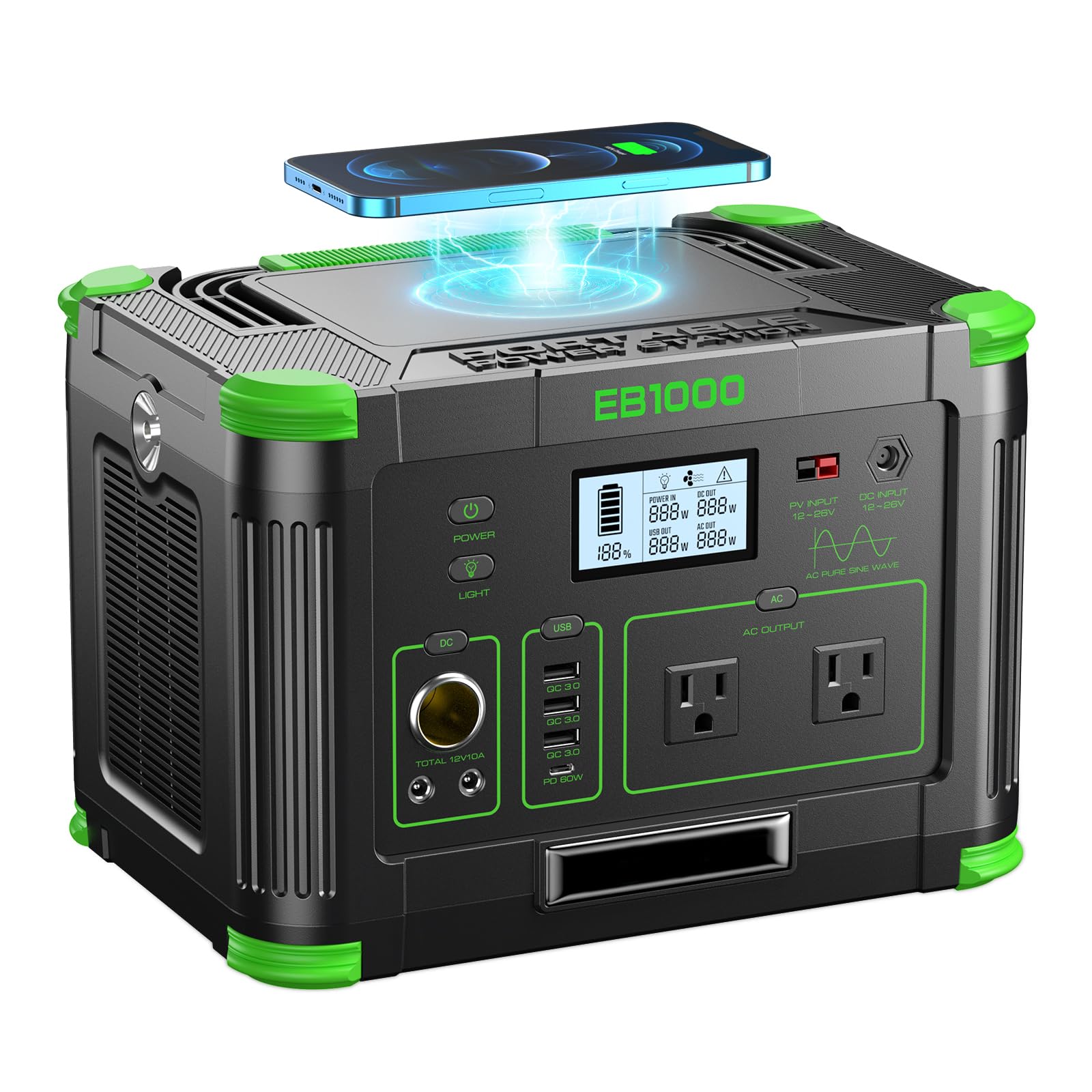
The port count is where this one flexes: two AC sockets, a 60W USB-C PD port, three USB-A Quick Charge 3.0 ports, a wireless charging pad, a 12V car port, and two DC outputs — up to ten devices at once inside the 1,000W combined limit. It recharges three ways: wall outlet, solar panels through the built-in MPPT (a tracker that squeezes the most watts out of variable sun), and a car port. The included 7909 solar cable fits most portable solar setups. Owners praise the power quality above anything else, with functionality close behind, and the recharge speed and battery runtime land in mixed territory — some find them fine, others want more.
The 217,000+ reviews worth of GRECELL history is not there yet, but the pattern is honest: the fan kicks in after a few minutes under heavy load and hums at a moderate level, and the AC output has to stay off while charging. It is also the smaller sibling in this group — 999Wh against the Jackery’s 1,070Wh — but the price difference buys a lot of extra gear. A handful of users short on patience with slow car charging have reported the port adding only a few percent per hour, so plan your top-ups around a wall outlet.
The port whisperer: For anyone traveling with a camera, drone, three phones, and a tablet, the simultaneous ten-device capacity beats any single big outlet on this list. The 60W USB-C PD port will charge a MacBook Pro at speed while the wireless pad handles a phone on top.
The reality check: A 999Wh pack is not a home backup. Owners who tried to run coffee pots and heaters have come up short, and the milk-crate-sized frame is fine in a trunk but not something you want clipped to a backpack.
Pick it for: budget-conscious campers and remote workers who want lots of ports and clean sine wave power for laptops, routers, and phones.
Look elsewhere for: high-draw heating appliances or a whole-home backup plan — those need more capacity than this box can give.
3. GRECELL 999Wh Solar Generator 1000W (Peak 2000W)
The van-lifer’s option that fits in a storage compartment.
At 18.4 pounds with a 999Wh battery and a 1,000W pure sine wave output, this is the lightest pick in the group. The body reads as compact enough for one-handed carry with the ergonomic handle, and that is the whole pitch here: serious AC power without a serious carry penalty.
Three recharge paths layer in. Wall outlet takes about seven to eight hours, a 12V car port tops it up while you drive, and MPPT solar panels do the off-grid work — the MC4 cable in the box connects to most portable solar arrays. Pass-through charging means you can run your gear while the station itself refills, which is the difference between a pit stop and a wasted afternoon. The 10-port hub (two 120V AC outlets, one 60W USB-C PD, three USB-A QC 3.0, a 10W wireless pad, a 12V car port, and two DC outputs) covers phones, tablets, and a laptop all at once, with individual module switches and a smart LCD showing real-time wattage and battery percentage.
What buyers report most is reliability, with value for money close behind — the crowd consensus reads as a steady, well-made box that shows up for ice storms and weekend trips. The catch is that charging speed splits opinions: some owners mention it lasting all day on a full charge, while others find the recharge window longer than they expected. One peculiarity worth knowing is that the unit has no AC inverter in the sense you might assume from other GRECELL home units — it works as a straightforward battery-to-outlet station, not an inverter-heavy powerhouse.
What it owns: 18.4 pounds and a one-hand handle is a real comfort upgrade over the Jackery’s 23.8 pounds, and the MC4 solar cable opens up third-party panels the Jackery cannot touch.
What buyers should plan around: The 7–8 hour wall charge is the slowest in this list, so charge overnight before a trip rather than during it.
Reach for this if: portability and third-party solar compatibility matter more than a fast wall charge.
Think twice if: you want a one-hour plug-in refill before a sudden outage.
4. GRECELL 1000W Portable Power Station, 999Wh Solar Generator Backup Battery
A tidy, folding-handle box for fans, tablets, and small fridges.
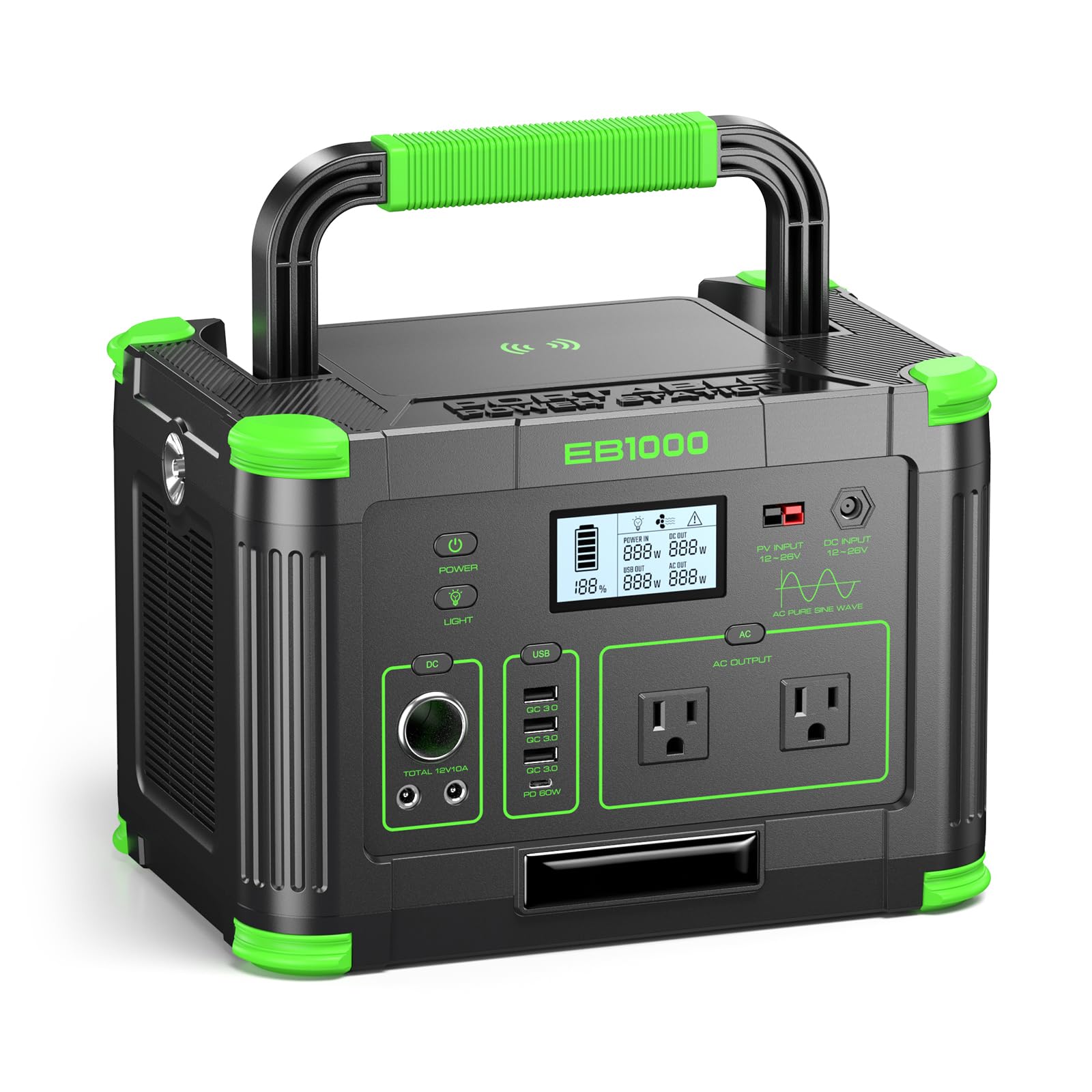
The 999Wh battery teams up with 1,000W continuous output and a 1,100W overload protection threshold, which is a slightly tighter ceiling than the rated wattage suggests. Laptops, a 32″ TV, mini-fridges, and CPAP machines sit comfortably in the design intent; anything that starts with a compressor kick will want a gentler ramp-up.
Charging flexibility is where this one shines for a budget design. Solar panels from 60W to 200W (not included) refill it in six to nine hours, a 12V car charger takes nine to eleven hours, and an AC wall adapter finishes the job in seven to eight hours. That triple-path design means you can tailor your top-up to what you have: sun at a campsite, the car cigarette port on a drive, or the wall at home. The 18.4-pound frame with a folding handle and a 20-second auto-sleep LCD round out a package built for tailgating, backyard parties, and weekend camping.
What buyers keep mentioning is raw power performance — the ability to run fans, tablets, phones, and small appliances cleanly — with value for money right behind it. The battery life column splits more than any other: some find it long-lasting, others watch the charge drop faster than expected with heavier loads. As with any 1,000W class box, the fast-drain complaints usually come from people pushing beyond the design envelope with higher-wattage appliances.
The everyday hero: For anyone who just needs a fan, a phone, a laptop, and a small fridge to survive an evening, this covers all four without drama. The folding handle and light 18.4-pound shell make it easy to move between rooms or the car trunk.
Best for: low-wattage users who need a compact, easy-carry station with three charging routes.
Not for: anyone expecting to start a high-draw appliance like an air fryer — the 1,100W protection ceiling is a hard stop.
5. PECRON Portable Power Station E1000LFP, 1024Wh/1800W LiFePO4

A starter box that grows with your need instead of getting replaced.
A 1,024Wh LiFePO4 battery drives 1,800W of output and a full 12 output ports, including five AC outlets, two USB-C, two USB-A, an XT60 output, a cigar port, and a DC 5525 output. That is the widest port spread in this list, and it means you can leave everything plugged in at once without playing outlet Tetris.
The standout is the expansion path: you can grow this unit up to 4,096Wh by adding batteries, which stretches its useful life further than buying a bigger box up front. Fast charging in 1.3 hours (roughly 78 minutes) cuts downtime to a lunch break, and the plastic body keeps the whole thing at 29 pounds — weighty but carried with two hands rather than one. Owners running a fridge, a phone, internet gear, and a monitor off 65% charge report hours of steady service, and they call out the expandability as the thing that made them choose it over a larger one-piece unit.
Quality gets consistent praise as the top positive note, and reliability sits in mixed territory — most units work as designed, and a small number of owners have reported failures at the five-month or four-month mark. The trade-off is a smaller owner base and a lower word-of-mouth track record than the major brands, so treat the warranty path as part of the purchase decision rather than an afterthought.
The growth story: If you would rather add a battery in year two than buy a whole new station, the expandable-to-4,096Wh architecture makes this the smartest long-play pick in this class.
The size reality: At 29 pounds it is not a throw-it-in-a-daypack unit — plan it for a van, an RV, or a fixed home-backup shelf.
Buy it for: users who want to start with a 1024Wh box and grow the system as their needs scale.
skip it if: you want a proven, widely-reviewed flagship experience — this is a smaller, younger brand with a thinner history.
6. PECRON F1000 LFP Portable Power Station 960Wh, 1500W
A 20-millisecond UPS that quietly bridges the gap in a blackout.
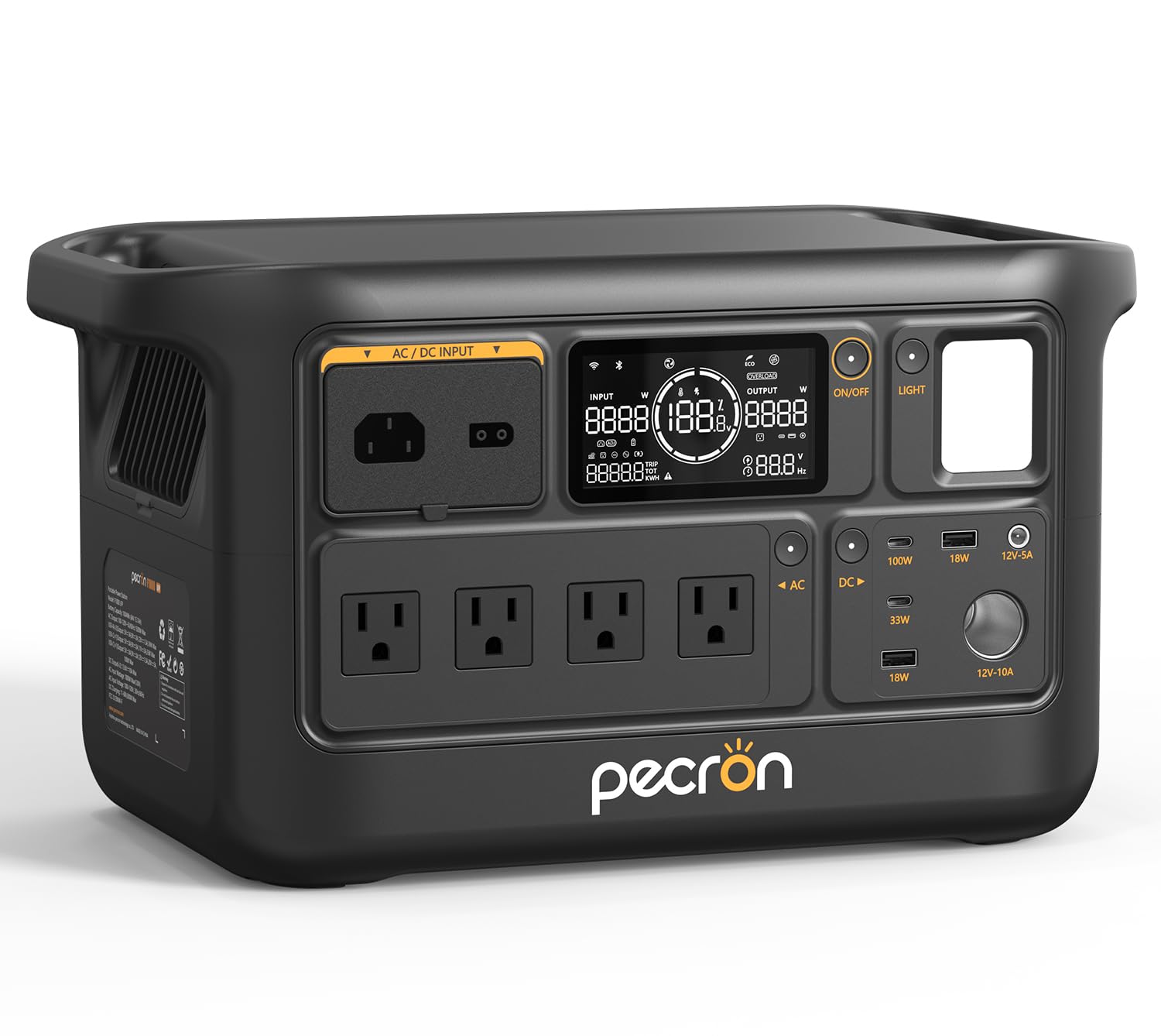
The UPS function here switches to battery power in 20 milliseconds during an outage, which is quick enough to keep a desktop PC, WiFi router, or fish tank running without a hiccup. Anyone who has lost work to a flicker knows what that is worth, and it makes this one of the more practical picks for a home office or a workspace that cannot afford downtime.
Beyond the UPS, the toolkit is serious: a 960Wh battery, 1,500W pure sine wave AC output, and ten output ports including a 100W USB-C port that will fast-charge a laptop, a 33W USB-C, two USB-A at 18W, a DC 5525, a cigar port, and four 1500W AC outlets. The battery is LiFePO4, and the AC input accepts 1,000W, meaning a full charge takes only about 70 minutes through the included charger. Solar input caps at 600W, so a decent panel array will also get you to 80% in about 1.4 hours. At 25 dB, the maker claims it is quiet enough for a bedroom, and the app lets you set input and output behavior.
Owners use this in ways that show its range: One owner runs a full storage-locker shop — 12V RV LEDs, soldering irons, heat guns, a Dremel, a hair dryer, an angle grinder, a Sawzall, and a small compressor — and reports 5 stars on everything but the toughest cut on a 7″ circular saw. Another describes running one per bedroom, powering lights, a fan, a laptop, and a phone “easily.” Performance is praised most heavily, with charging speed right behind it, and the overall read is of a genuinely fast, quiet 1500W-class station that punches above its weight.
What stands out
- 20ms UPS switchover — fast enough to protect a PC and router during a blackout
- 1,000W AC input gets you to full in about 70 minutes; 600W solar hits 80% in about 1.4 hours
- Ten ports, including a 100W USB-C PD for laptops
- 25 dB operation and app-controlled input/output settings
The honest caveats
- 960Wh is the smallest capacity in this group — plan your runtime accordingly
- A 7″ circular saw is at the edge of what it can start
- 23.9 pounds is manageable but still a two-hand carry for long distances
Choose it if: you want the fastest AC recharge plus genuine UPS protection for a work-from-home setup or light shop use.
Pass if: you need maximum capacity — the 960Wh pack is the tightest in this lineup.
7. DJI Power 1000 V2 Portable Power Station, 1024Wh LFP Battery
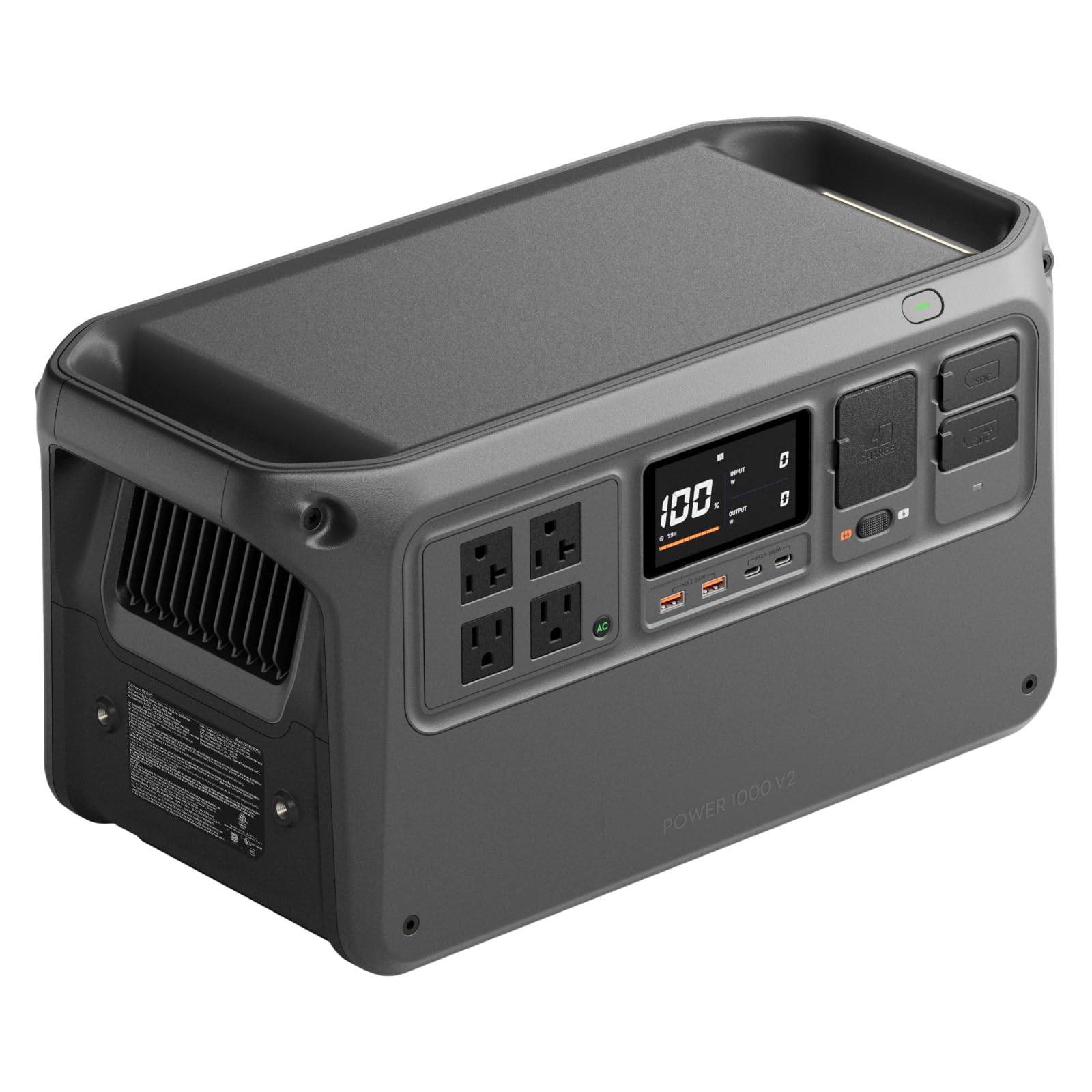
Built for vans and camper nights where silence is part of the plan.
At 26 dB in normal operation, this is a power station you can sleep next to in an RV or camper van without hearing the fans cycle all night. That single number is why it is in this list — nothing else here prioritizes quiet operation in a confined space the way this one does, and it pairs with a 10ms UPS switchover that is twice as fast as the original Power 1000.
The 1,024Wh LFP battery has a 10-year lifespan claim from the maker, backed by an intelligent BMS, sub-nano coating, and a flame-retardant housing. Dual 140W USB-C ports (280W combined) are a real differentiator if you film or fly drones — DJI says that is 40% more power than typical dual 100W USB-C setups, and owners who power multiple drone batteries in the field call this out. Charging gets to 80% in just 37 minutes, and the stable output tops out at 2,600W. A mobile DJ ran a full rig — Opus Quad, a Yamaha HS5 monitor, an audio interface, USB fans, and an iPhone — through a six-hour pool party set on about 25% of the battery.
The thing to know is that MPPT and car charging modules are not built into the unit — connecting solar or a car battery requires a separate compatible adapter. Owners who need those paths have reported waiting on back-ordered DJI peripherals and improvising with third-party MPPT adapters, so plan around the standalone use case unless you already own the DJI ecosystem. On quality, owners are almost unanimous, and Odor shows up as a small but real recurring note from a handful of negative reviews.
The quiet achiever: 26 dB is quieter than most refrigerators. If you sleep in the van or the tent next to your power station, this is the one where you will not notice it is running.
Reach for it if: you have a camper van, an RV, or a content setup where silence and DJI Power ecosystem compatibility matter.
Think twice if: you plan to build out solar or car charging — you will need DJI adapters that have had availability issues.
8. BLUETTI Elite 100 V2 Portable Power Station, 1024Wh 1800W
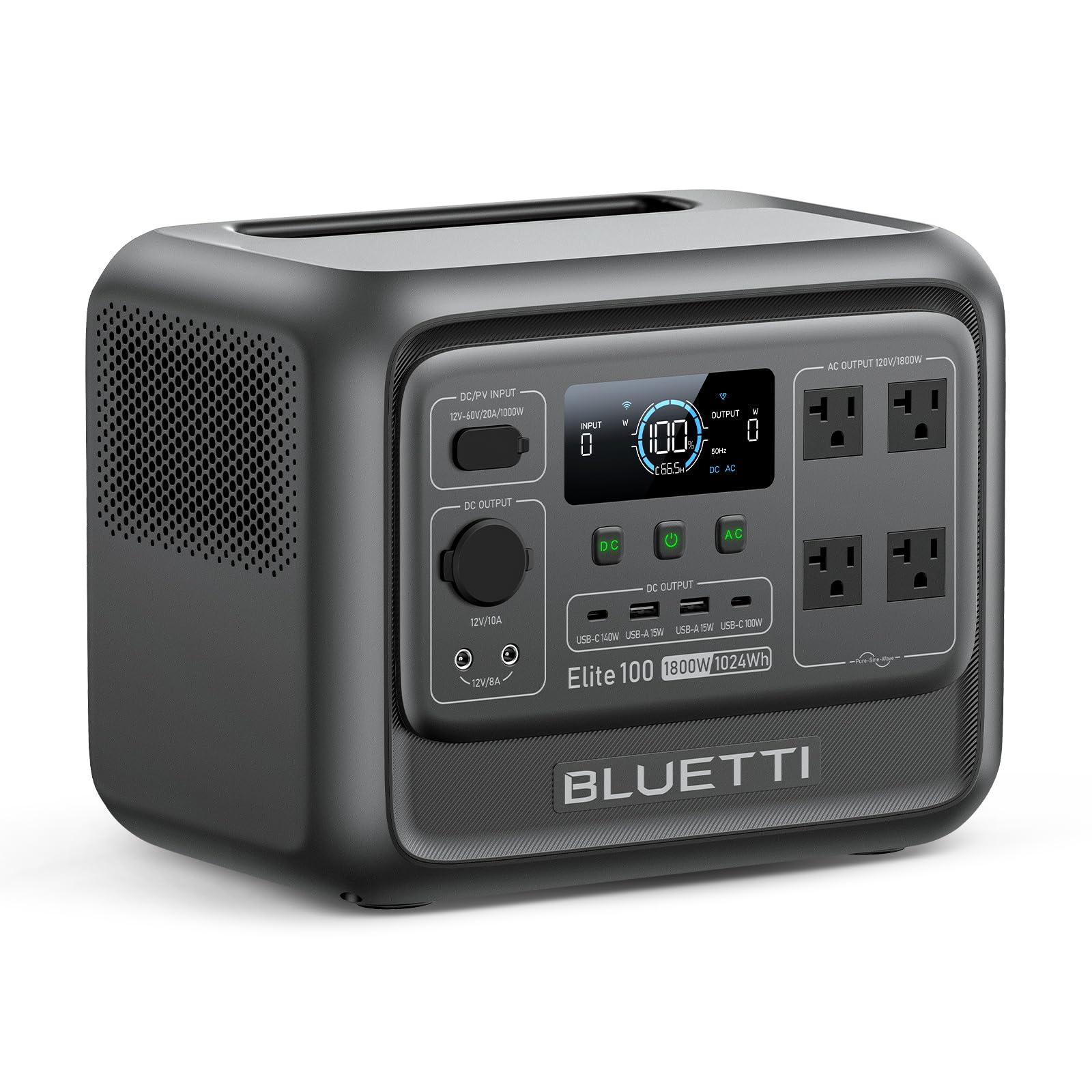
Shrunk by a third and lightened by thirty percent, without losing punch.
A 1,024Wh LiFePO4 battery drives 1,800W rated AC output and 2,700W of Power Lifting (a boost mode for higher-start appliances), with a 3,600W surge behind it. That covers roughly 90% of everyday appliances by design, and the 10ms UPS switchover keeps Wi-Fi routers and PCs alive through brownouts and short outages without a blink.
Where this one outpaces most of the list is charging: 1,200W TurboBoost AC refills it in about 70 minutes, and up to 1,000W of solar input delivers what the maker calls the fastest solar charge for a 1kWh power station. Car charging is also unusually quick — up to 6× faster with the BLUETTI Charger 1 accessory. Owners running fridges report up to about 48 hours during outages, and one astronomy owner powers a telescope mount, imaging and guide cameras, a mini PC, a tablet, and a phone at ~34W resting draw for 6.5 to 7 hours. The app pairs over Wi-Fi and Bluetooth for monitoring and OTA updates.
For home backup and remote trips, this is the balance between capacity and portability. The 35% smaller body and 30% lighter 25-pound frame mean it stores easily in an RV compartment or a closet, and the hidden handle makes one-handed carry realistic. Owners who bought two units pair them for longer outages, and the LiFePO4 cell handles over 4,000 life cycles to 80% — the maker rates that as a 10-year service window under typical use.
The one to beat on solar: 1,000W of solar input is the highest in this group, so off-grid stays are limited by your panel collection rather than the station itself.
What to know going in: It is still marketed as portable but lands at 25 pounds — fine for a car trunk, not for a hike, and heavy enough that one-handed carry is really for short moves only.
Buy it for: home backup plus off-grid trips where fast solar and quiet overnight operation both matter.
Consider a lighter pick if: you need to carry it farther than a parking lot to a campsite.
9. BLUETTI AC180 Portable Power Station 1152Wh 1800W

The 1152Wh tank that runs a full-size fridge for a day and a half.
A 1152Wh LiFePO4 battery pairs with 1,800W output and eight outlets, and the app-tap boost pushes it to 2,700W when a bigger draw calls for it. Customers note running a full-size fridge for a day and a half on one charge, and one RV owner covers everything except the rooftop AC — headroom that makes this the heavyweight in the group.
Charging is the other headline: 1,440W of AC input fills it in just one hour, and a 500W solar array takes 2.8 to 3.3 hours on its own. Blend solar and AC and the timer comes back under an hour. The 20ms UPS mode lets it sit on standby as a home battery backup, and owners who lost power with kids at home describe instant switchover with no interruption on a setup running a TV, lamps, a router, and laptops off one outlet. Heavy as it is at 37.4 pounds, that weight is the reason the capacity is this high.
What owners rave about is the sheer power and simplicity, and the value holds up even next to the newer Elite 100 V2 — you give up some portability for a bigger tank. Firmware updates matter on this one: a few owners have reported inverter-draw surprises at first, then seen the unit perform above expectations after a firmware refresh and a full discharge-recharge cycle. That is a real setup step, not a defect, and the crowd consensus is overwhelmingly positive.
Where it wins
- 1152Wh is the largest battery in this list — enough for a full-size fridge for a day and a half
- 1-hour recharge at 1,440W AC input, and 2.8–3.3 hours on 500W solar
- 8 outlets, 2,700W boost mode, and 20ms UPS for home backup
What to know
- 37.4 pounds makes it a two-person lift for anything but a short car trip
- Firmware updates are worth doing before you rely on runtime numbers
- The 15W idle inverter draw can surprise buyers who leave the AC output on when not in use
Pick this one if: you want the biggest capacity, the fastest recharge, and UPS backup in one box, and you do not plan to carry it far.
Look at the Elite 100 V2 if: you want similar backup power in a much smaller, lighter footprint.
10. Anker SOLIX C1000 Portable Power Station, 1,056Wh
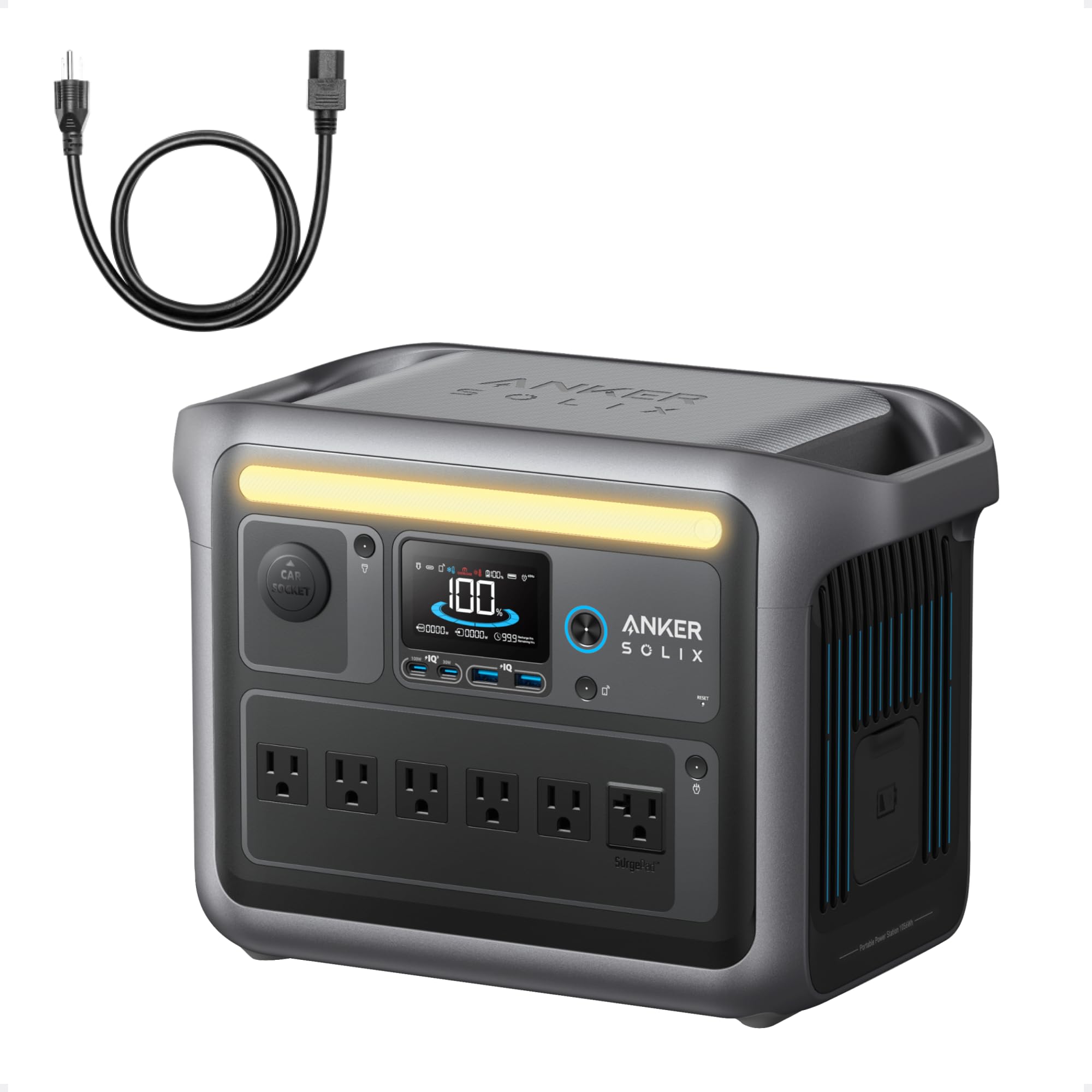
43 minutes to 80 percent, with UPS behavior that owners trust.
The 1,056Wh LiFePO4 battery recharges to 80% in 43 minutes via UltraFast recharging in the Anker app, and hits a full charge in under an hour. That is the fastest recharge-to-80% in this group, and for anyone whose power needs arrive suddenly — an unexpected outage, a last-minute trip — it is the number that decides whether you are ready. The maker rates the LiFePO4 cells at 3,000 cycles over a 10-year lifespan.
SurgePad technology lifts the output to 2,400W and gives access to 99% of appliances across 11 ports, and the design is 15% smaller than comparable 1kWh units — a real benefit for tight RV storage. On a 30-day RV trip, reviewers point out powering a microwave, Keurig, furnace, and water heater on everything except the rooftop AC, with ~24 hours of boondocking between charges. The app lets you customize charging speed and track real-time power statistics, and firmware updates have ironed out the early Wi-Fi and Bluetooth connection quirks.
Reliability earns the most owner praise by a wide margin, with charging speed close behind — Owners also report keeping four pieces of medical equipment running for six hours on roughly 600W total draw during an AC failure. The trade-off is portability: at 27.6 pounds it is not a grab-and-go unit, and some owners wish the app tracked solar performance over time. Neither is a dealbreaker, and both matter more to a camper who moves the unit daily than to someone who leaves it on a shelf ready to go.
The confidence pick: Reliability and charging speed are the two things owners return to most in their reviews, and that combination is why it is the pick for anyone who wants their backup power to simply work.
Reach for it if: you want the fastest recharge to 80%, genuine UPS reliability, and a compact footprint for an RV or home office shelf.
Consider a lighter option if: you need to carry the station frequently between rooms or vehicles.
Understanding the Specs
Watt-Hours (Wh) — the runtime number
Watt-hours measures the total energy stored in the battery, and it decides how long your gear runs before a refill. A 1,000Wh pack will keep a 100W appliance going for about ten hours on paper, though real-world numbers run lower because some energy is lost in the conversion from battery DC to household AC. That is why capacity matters more than any other single spec for anyone planning an overnight outage.
LiFePO4 vs standard lithium-ion
LiFePO4 (lithium iron phosphate) is the cell chemistry behind most of the top picks here. It runs cooler than older lithium-ion, handles thousands of charge cycles, and typically holds up past ten years of regular use. Standard lithium-ion packs are lighter and cheaper but age faster. If the box will live in a hot garage or a camper, LiFePO4 is the safer long-term bet.
UPS switchover time
UPS (uninterruptible power supply) mode is what happens when the wall goes dark: the station switches to its own battery in a set number of milliseconds. Anything under about 20ms is fast enough for computers, routers, and CPAP machines to keep running through a flicker. Slower switch times may cause sensitive electronics to reboot.
Pure sine wave AC output
Pure sine wave describes the shape of the AC power the station produces, and it is the same clean shape your wall outlet gives you. Electronics built around motors or delicate chips — laptops, monitors, medical devices — run better on pure sine wave than on modified sine wave, which can cause buzzing, overheating, or erratic behavior.
FAQ
Will a 1000-watt power station run my fridge during an outage?
What is the difference between watt-hours and watts on these units?
Can I charge a 1000-watt power station with solar panels?
Do I need a pure sine wave output for a CPAP machineYes. Pure sine wave output matches the shape of household AC power, which is what CPAP machines are designed around. Every pick in this list uses pure sine wave AC outlets. Owners of the Jackery Explorer 1000 v2 report two nights of CPAP use maxed out, and roughly 15–20% per night at gentler settings, so a 1024Wh-or-larger pack covers most sleep setups comfortably.?
How long does a LiFePO4 battery last in a power station?
Can I use a 1000-watt power station as a UPS for my computer?
Will these power stations run a space heater or air conditioner?
How quickly can these units recharge from a wall outlet?
What size power station do I need for RV or van life?
Can these power stations be charged while powering devices at the same time?
Final Thoughts: The Verdict
For most people buying a 1000-watt power station, the Jackery Explorer 1000 v2 is the safest pick because it balances a 1,070Wh LFP battery, 1,500W AC output, and one-hour emergency charging in a package owners describe as built to last. If you need the fastest recharge and genuine UPS protection for a home office or RV, grab the Anker SOLIX C1000. And for maximum capacity with a 1-hour full recharge, the BLUETTI AC180 is the one to reach for. One honest nudge: if any of these three fits your use case, they hold the highest owner satisfaction and the largest review bases in this category — the kind of track record that keeps a power station ready for a decade.
How We Picked
We do not accept paid placement. Every pick is matched to a real buyer and a real use-case; we do not hands-on test units.
Sources & Methodology
Specifications: manufacturer listings and product documentation. Review insights: verified customer reviews, as of September 2026. Pricing: not shown on this page (it changes often); check the current price via the retailer link.
As an Amazon Associate, KitchPrep earns from qualifying purchases. This does not affect which products we feature.
Related Guides
