
Specs are compiled from manufacturer listings and verified buyer reviews and can change over time — please confirm the key details on the product page before buying.
A basement stays cold for one simple reason: cold air sinks, and most houses never send enough heat down there. A heat pump fixes that by pulling heat from outside air and pushing it into the room, even when it is freezing out. The tricky part is sizing it right, because a unit that is too small runs nonstop and one that is too large cools and heats unevenly. This article walks through 13 real basement heat pump options, from a single-zone wall unit to a full tri-zone system, and shows you exactly which one fits your space, your wiring, and your budget.
I’m Mohammad Maruf — the founder and writer behind KitchPrep. This guide is built by comparing the manufacturers’ published specifications and the patterns across verified customer reviews, so you get each pick’s real strengths and trade-offs instead of marketing spin.
Below you will find plain-English breakdowns of BTU output, SEER2 efficiency, cold-weather heating limits, and the installation reality of each system. Whether your basement is a finished living space or a bare workshop, the right basement heat pump keeps it comfortable all year without wasting power.
Our Picks at a Glance
How To Choose The Best Basement Heat Pump
A heat pump moves heat instead of generating it, so it heats and cools with the same equipment. For a basement, the two things that decide whether you are happy are the BTU rating and the cold-weather heating floor.
Match BTU output to your basement square footage
BTU, short for British Thermal Unit, measures how much heat the unit can move in an hour. A 12,000 BTU unit handles roughly 550 square feet, while a 24,000 BTU unit covers up to about 1,500 square feet. Go too small and the compressor never rests, which shortens its life and drives up your power bill.
Check the cold-climate heating floor
Every heat pump has a lowest outdoor temperature where it still produces useful heat. Some units are rated down to 5°F, while others go as low as -22°F. If you live where winters drop well below freezing, that number matters more than the cooling spec.
Understand voltage and breaker requirements
Most larger mini splits run on 208-230V and need a dedicated breaker, while smaller single-zone units often run on 115V. Check your panel before you buy, because adding a circuit is a separate cost.
Plan for professional installation
Almost every system here requires a licensed technician, a vacuum pump, and proper line-set brazing. A handful are marketed as DIY-friendly for experienced homeowners, but the manufacturer warranty on most units depends on professional startup.
Quick Comparison
| Model | Best For | Cooling Power | Coverage | Efficiency | Amazon |
|---|---|---|---|---|---|
| Senville Tri Zone 28000 BTU★ Best Overall | Whole-home multi-room zoning | 28,000 BTU | 1,500 sq. ft. | Energy Star | Amazon |
| DELLA Motto 12000 BTUBest Value | Tight budgets, small rooms | 12,000 BTU | 550 sq. ft. | 20 SEER2 | Amazon |
| YITAHOME 24000 BTU (B0GYQSLM13)Best Coverage | Large basements on 208-230V | 24,000 BTU | 1,500 sq. ft. | 18.5 SEER2 | Amazon |
| Cooper & Hunter MIA 12,000 BTU | Small finished rooms | 12,000 BTU | 550 sq. ft. | 21.2 SEER2 | Amazon |
| YITAHOME 24000 BTU (B0GZP2CCW1) | Multi-room coverage with Alexa | 24,000 BTU | 1,500 sq. ft. | 18.5 SEER2 | Amazon |
| ActiveTrail 24000 BTU | Wide temperature swings | 24,000 BTU | 1,500 sq. ft. | 19 SEER2 | Amazon |
| DELLA Econo 23000 BTU | Dependable mid-size basements | 22,000 BTU | 1,500 sq. ft. | 17 SEER2 | Amazon |
| Daikin Entra 18,000 BTU | Efficiency-focused buyers | 18,000 BTU | 1,000 sq. ft. | 18 SEER2 | Amazon |
| Cooper & Hunter 36,000 BTU | Open-plan basements and shops | 36,000 BTU | 600 sq. ft. | 19.5 SEER2 | Amazon |
| Goodman GPH1442H41 | Whole-house packaged system | 42,000 BTU | — | 14 SEER | Amazon |
| Coleman 46515811 | RV and bus basement replacement | 27,000 BTU | 917.5 sq. in. | — | Amazon |
In‑Depth Reviews
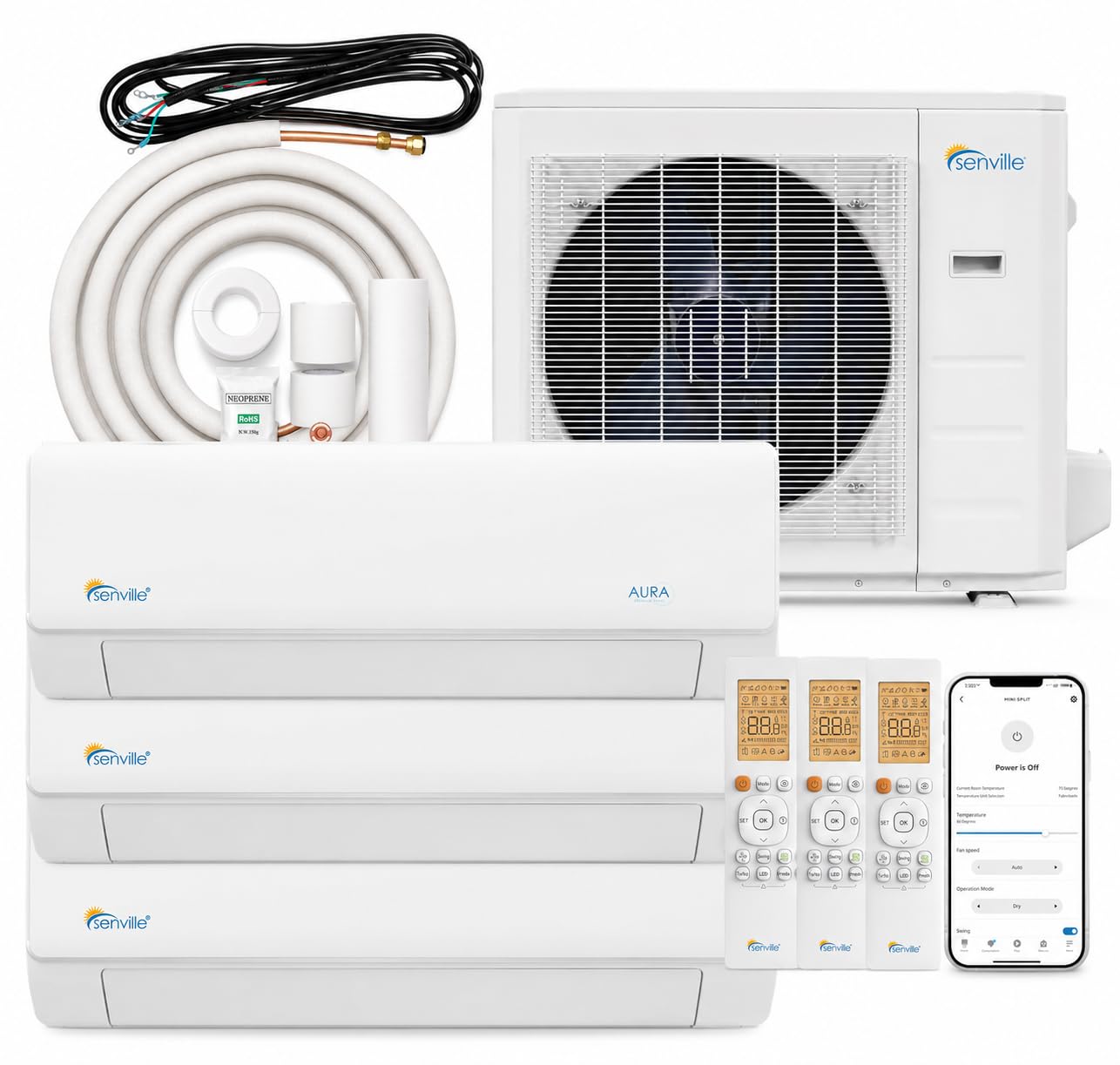
1. Senville Mini Split Air Conditioner Heat Pump, White, Tri Zone, 28000 BTU
Our pick — 4.5★ from 150+ verified ratings; the strongest balance of quality and price.
Three indoor heads, one condenser, and enough BTU muscle to keep every level of the house breathing.
If your basement is finished and shares a wall with the rest of the house, this is the pick that gives each space its own temperature instead of one blanket setting. The system covers 1,500 square feet of floor area from a 28,000 BTU, 2.3-ton condenser with an Energy Star rating. Each of the three indoor air handlers has its own independent temperature control, so the basement office can sit colder than the upstairs bedroom without compromise.
The package arrives complete: three air handlers, the outdoor condenser, a 16-foot line set, a communication wire, and an installation kit. Copper coil and a rotary scroll compressor form the core, and the filter is an ionizing type. The manufacturer backs it with a limited warranty bundling 5-year parts coverage and 10-year compressor coverage — but the first startup generally needs a licensed tech to register it. On the smart side, Alexa-enabled control works through the mobile app once the system is joined to a supported network.
What wins people over is the build quality and the running cost. The recurring gripe is that the line-set wiring often arrives too short, and the manual skips a few purging steps — a minor nuisance that only bites self-installers.
Where this system wins
- Three independent indoor heads cover three separate rooms or zones
- 28,000 BTU condenser with 2.3-ton capacity covers 1,500 square feet
- Energy Star rated for lower running costs across the year
- 10-year compressor and 5-year parts limited warranty
What you should know before buying
- Professional installation required to keep the warranty intact
- Line-set wiring runs short on some basement layouts
- The condenser is heavy and wants two people to move it
Lock this in when: you want one system to condition three separate basement rooms without losing individual control.
Reconsider if: you plan a solo DIY install and can’t hire a licensed tech for the first startup.
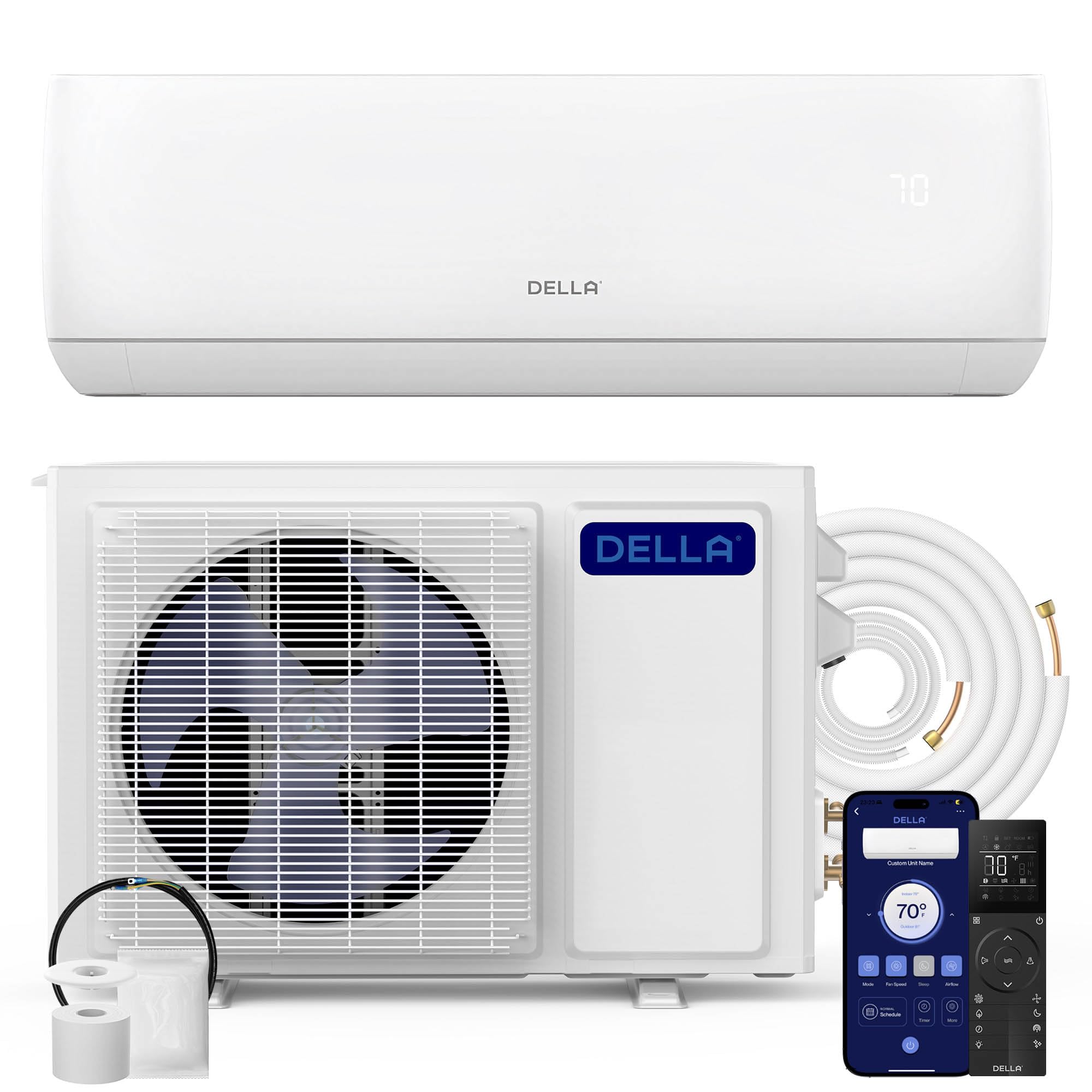
2. DELLA Motto Series 12000 BTU 20 SEER2 115V Mini Split AC
Whisper-quiet at 27 dBa, this is the small-basement pick that punches well above its size.
Read the numbers next to the Senville and the trade-off is obvious: this unit covers up to 550 square feet, while the tri-zone covers 1,500. That is a 2.7x gap in floor area and a 2.3x gap in cooling power — 12,000 BTU here versus 28,000 BTU there. What you give up in scale you gain back in convenience: the DELLA runs on standard 115V, so most finished basements already have a compatible circuit.
Efficiency is genuinely strong for the price tier. The 20 SEER2 rating, DC inverter compressor, and R-32 refrigerant give it cleaner operation and better power savings than older refrigerant systems. The outdoor condenser includes a bottom heating element rated for temperatures as low as 5°F, and it manages heating output at 12,300 BTU/h too, so shoulder-season basement heating works. Smart features are surprisingly complete: 4D airflow up-down and left-right, I Feel mode, a 24-hour timer, sleep mode, eco energy saving mode, multiple fan speeds, and a turbo function. Alexa and WiFi control work through the app.
The honest wedge with this unit is long-term durability. A minority of owners have hit compressor failures after extended use, and one review put it plainly: “Bought two units under two years ago; one failed after less than 12 months of runtime with a bad compressor — the board sends voltage but the unit won’t start.” The installation is genuinely DIY-friendly if you have manifold gauges, a vacuum pump, and a torque wrench — otherwise budget for a pro. Wiring manual clarity is a common note, and the line set tops out around 8-10 foot ceilings, so tall basements may need the kit extended.
The small-space champion: for a single basement bedroom or den under 550 square feet, this is the easiest system to justify on price, efficiency, and electrical compatibility.
Set expectations on longevity: 20 SEER2 efficiency and R-32 refrigerant are modern, but a compressor failure is the one failure mode worth planning around if you run the unit hard year-round.
Buy it if: you have a small basement room and want 20 SEER2 efficiency without rewiring for 230V.
Step up if: your space runs larger than 550 square feet or you need multi-zone control.
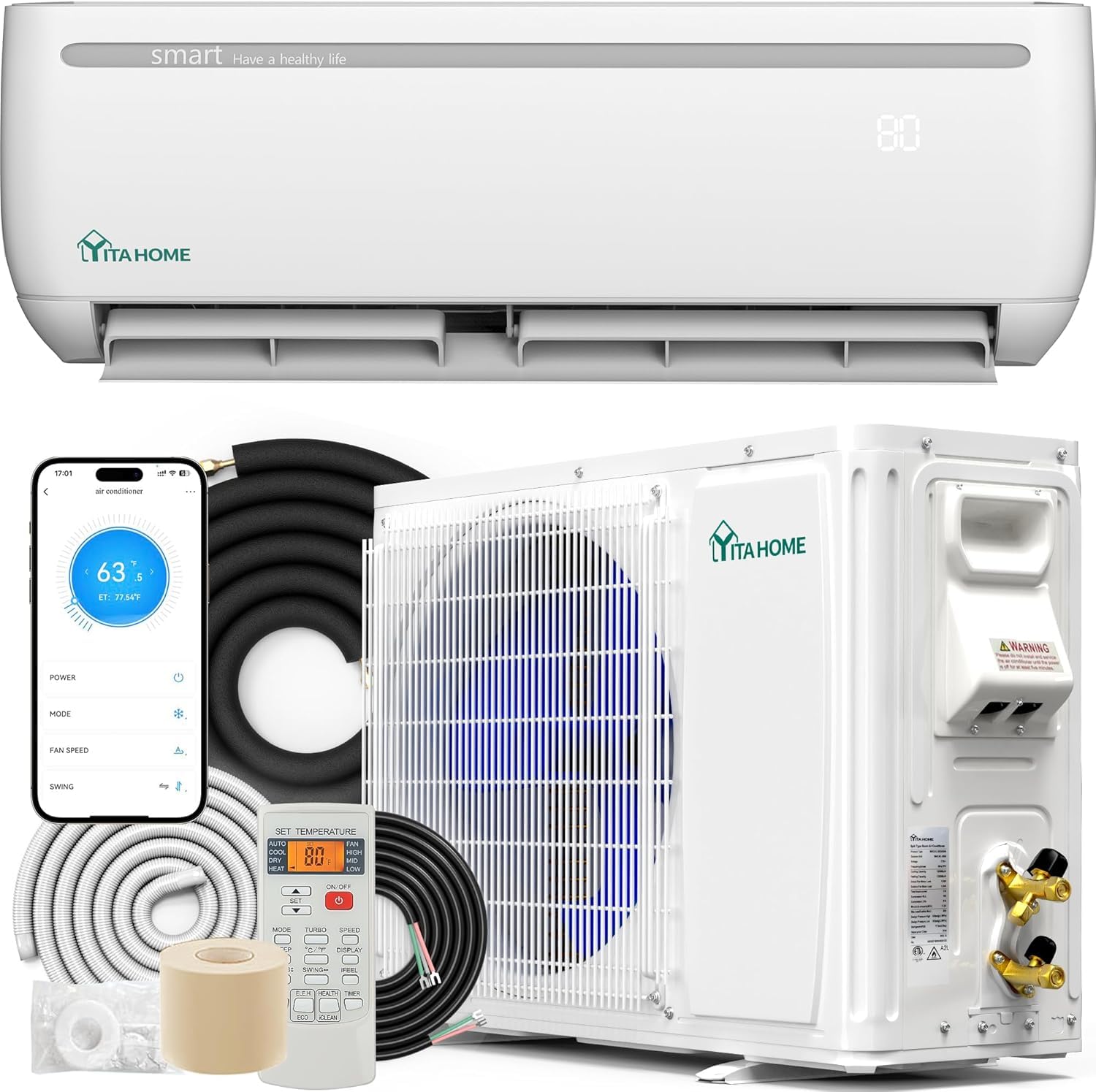
3. YITAHOME 24000 BTU Mini Split Air Conditioner Heat Pump System, WiFi Enabled 18.5 SEER2
A 24,000 BTU single-zone system that treats a full finished basement as one smooth comfort zone.
The headline here is reach: 1,500 square feet of coverage from 24,000 BTU, with an inverter compressor that yields about 25% energy savings versus non-inverter designs. Two tons of capacity, ETL and AHRI certified, and an annual energy consumption of 1,200 kilowatt hours per year. That puts it squarely in the same coverage class as the Senville above — but as a single head, not a tri-zone setup, so you trade room-by-room control for a simpler install and one cleaner wall mount.
Modes run five ways: auto, cool, dry, heat, and fan. WiFi and Alexa control come standard, and extras include auto defrosting, self-diagnosis and self-cleaning, iFEEL mode, a 24-hour timer, sleep mode, and a “HEALTH” mode using negative ions, electrostatic dust removal, and PM2.5 removal. Operation stays under 50 decibels, and the remote sets anywhere from 60°F to 90°F. It handles environments from 5°F up to 118°F, throws air up to 50 feet, and uses a 4D circulation pattern to keep the whole room even.
Where owners go cool on this one is heat performance and WiFi. The unit only joins 2.4GHz networks, so routers that broadcast only a 5GHz SSID will not connect — worth checking before you buy. On the heating side, several owners note it falls a bit short in the coldest weather, though the cooling side is strong and quiet. Installation gets the biggest positive feedback, with a full kit that includes everything but the shut-off valves and side grille.
Why a large basement buyer wants this
- 24,000 BTU covers 1,500 square feet of floor area
- 18.5 SEER2 inverter rated for roughly 25% energy savings
- WiFi and Alexa control with five operating modes
- Washable air filter keeps maintenance simple
The trade-offs to weigh
- WiFi only works on 2.4GHz networks, not 5GHz
- Heating performance is more modest than cooling
- Licensed HVAC install strongly recommended
This is the one for: anyone with a large open basement on a 208-230V circuit who wants a single wall-mounted unit instead of multiple heads.
skip it if: your router is 5GHz-only or your winters drop well below freezing.
4. Cooper & Hunter MIA 12,000 BTU 115V Wall Mount Mini Split AC, 21.2 SEER2

The 21.2 SEER2 efficiency leader in the small-room class, with a smart kit and app control already in the box.
Among the 115V single-zone picks in this guide, this one edges ahead on efficiency — 21.2 SEER2 beats the DELLA Motto’s 20 SEER2 and the DELLA Econo’s 17 SEER2. Coverage tops out at 550 square feet, matching the DELLA Motto, but for a small finished basement office or workshop that is exactly the right scale. The system is UL listed, AHRI certified, and includes the smart kit for schedule and remote-control use through the smartphone app.
Year-round heating works with ambient temperatures up to 5°F. The included install kit is generous: a 16-foot pre-flared insulated copper line set, 16-foot communication wire, small accessories, and a 16-foot drainage extension. Advanced inverter technology keeps the compressor operating precisely, which reduces electricity consumption versus fixed-speed designs. U.S.-based technical support is available if the app or the system throws an error code. Freight delivery is standard, and the carrier calls to coordinate drop-off.
Owners keep coming back to how quiet it runs and how effectively it conditions a room. The recurring gripe is the pre-installed drain hose clamp — one buyer referred to the moment it leaked as an “a leak he described as an “inside waterfall”,” and it is a small part worth checking or replacing pre-install. On the plus side, one owner noted the unit qualified for an energy rebate, and others report it cools objects, not just air. A minority of compressor failures get reported, but this is a small slice of the whole picture.
The efficiency leader of the small zone: for a 550-square-foot basement bedroom or home office, the 21.2 SEER2 rating and included smart kit offer a strong efficiency-per-dollar combination.
One prep step before install: upgrade or secure the drain hose clamp before you mount the indoor head, and you skip the most common complaint entirely.
Reach for this if: you have a single small basement room and want the highest SEER2 rating in the 115V tier with app control included.
Look elsewhere if: you need multi-zone coverage or heating at subzero temperatures.
5. YITAHOME 24000 BTU Mini Split AC/Heating System, 230V 18.5 SEER2
Seven modes, two voice assistants, and 25 decibels of quiet — the most feature-stuffed single-zone pick here.
Same coverage as its YITAHOME sibling above — 24,000 BTU, 1,500 square feet, 18.5 SEER2 — but this variant opens the door to both Alexa and Google Home voice control, plus a wider mode set. That 25-decibel sleep-mode rating is the lowest in this entire guide. Regular operating mode stays between 25 and 50 decibels, which is quiet enough to run overnight next to a bedroom without you noticing.
Seven modes cover auto, cool, heat, dry, sleep, ECO, and fan, plus extras like iFeel, “HEALTH” mode with negative ions and PM2.5 removal, a 24-hour timer, 4D auto swing, and iClean. The system works from 5°F to 118°F ambient and throws air up to 50 feet. ETL and AHRI certified, with an annual energy consumption of 1,200 kilowatt hours per year. The inverter technology is rated for roughly 50% energy savings — that is a higher efficiency claim than the 25% figure on the earlier YITAHOME pick, and it depends on the wider mode set that keeps the compressor out of full-throttle more often.
Where this one stumbles is refinement. WiFi control has noticeable lag — one experienced installer docked a star purely for that. Owners mention overcooling in some modes: setting 65°F can drift to around 51°F before the blower cuts back. And a handful of buyers have had delivery problems, with one writing “two orders never arrived” before finally getting a working unit. None of those are deal-breakers for the right buyer, but they are the honest notes to weigh against the feature list.
What stands out
- 25-decibel sleep mode is the quietest in this roundup
- Works with Alexa and Google Home voice control
- 7-in-1 mode set with a 24-hour timer and 4D swing
- 18.5 SEER2 inverter rated for about 50% energy savings
Real friction points
- WiFi control lags noticeably in the app
- Temperature can overshoot past the set point in lower modes
- Some orders arrive late or in separate shipments
Ideal for: smart-home owners who want voice control through either Alexa or Google Home and hate hearing the unit run at night.
Not your match if: you rely on precise temperature set points or the fastest app response times.
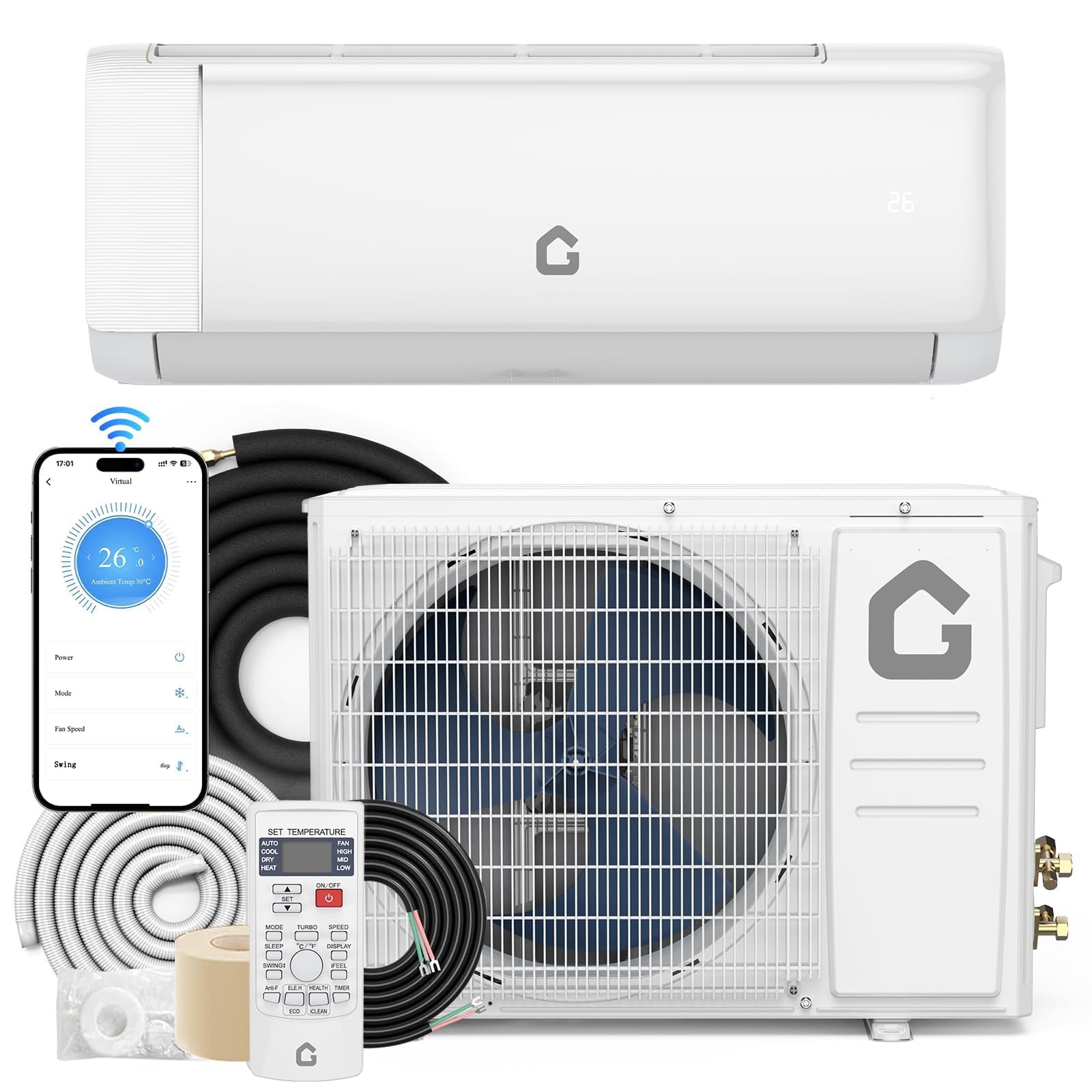
6. ActiveTrail 24000 BTU Ductless Mini Split AC/Heating System, 19 SEER2
Built for the nastiest basements — this one keeps working when outdoor temps swing from deep winter to desert summer.
Most heat pumps stop being useful below freezing or above 110°F. This one lives through -4°F to 140°F, which matters if your basement gets the worst of both seasons. Coverage tops out at 1,500 square feet from 24,000 BTU cooling and 24,000 BTU/h heating capacity, with a high-power inverter and heat pump delivering about 25% energy savings. ETL and AHRI certified, five modes including Cool, Heat, Fan, Dry, and Auto, and a backlit LCD remote that handles a 0.5 to 24-hour timer.
The 13-foot copper pipe install kit, drain hose, wiring, remote, and user guide all come in the box. Anti-dead wind design and 50-foot 4D airflow circulation keep the basement comfortable evenly. The HEALTH mode purifies air with negative ions and removes PM2.5 dust. Quiet operation sits at just 41 dB — a bit louder than the YITAHOME 25 dB sleep mode, but still well below conversation level for most of the day.
The catch is that this is a smaller-review-volume unit with a mixed picture on installer experience. One long-term HVAC contractor installed nine of the 18,000 BTU version and reported them “efficient, handles 110°F down to 10°F” with zero problems. But another buyer with a cabin installation had a unit quit after a few days and found support slow to respond. Value for money scored mixed, which suggests the pricing lands in a spot where some buyers feel it’s a solid deal and others think a slightly different spec would have served better.
Reach for this in harsh climates: the -4°F to 140°F operating window is the widest in this guide, so it suits basements in extreme regions where other picks would sit idle.
Keep support in mind: feedback on after-sale service is uneven, so budget for the possibility of self-troubleshooting if something goes wrong.
Yes for you if: your basement swings between brutal winters and scorching summers.
Think twice if: fast warranty support is a top priority, since response has been mixed.
7. DELLA Econo Series 23000 BTU Mini Split Air Conditioner, 17 SEER2

A mid-tier workhorse that hits the balance between coverage, efficiency, and reliable everyday performance.
Coverage lands at 1,500 square feet from a 22,000 BTU cooling unit — slightly below the YITAHOME single-zone picks at 24,000 BTU, but close enough that most mid-size basements won’t notice the difference. The 17 SEER2 rating is the lowest in this tier, which shows up as slightly higher running costs, but it still carries a 5-star BEE rating and handles 208-230V with a maximum fuse size of 25A. The heat pump works down to 5°F/-15°C, and DC inverter technology is rated for up to 30% power savings.
What keeps buyers happy is reliability across the long haul. Multiple owners have replaced older, less efficient systems and reported the Econo running without complaint. One reviewer with a 925-square-foot bungalow in full sun reported the home stays cool at 71-72°F on the low setting, with electric bills cut more than 10%. Another replaced unsafe wood stoves and space heaters for elderly parents in a rural area and reports the house stays evenly heated. The 16.4-foot install kit is generous and includes standard 1/4-inch and 1/2-inch copper piping.
The honest note here is that installation is not for beginners. You need a micron gauge, a valve core removal tool, a vacuum pump, a torque wrench, and a flaring tool. Customers note a unit needing occasional resets after long idle periods, which is a small but real quirk to plan for. Quieter than most at 37 dBa, but slightly noisier than the YITAHOME 25 dB sleep unit if ambient quiet at night is your top priority.
The value pick for a full basement: solid build and mid-tier efficiency at a price that undercuts the premium brands, with strong feedback on cooling performance and long-term reliability.
Not a starter DIY job: the tool requirements and vacuum-procedure requirements push this toward a pro install unless you already own the kit.
For you if: you want dependable mid-size coverage with broad owner satisfaction and don’t need the highest SEER2 number available.
Go elsewhere if: you need subzero heating performance or the quietest possible operation at night.
8. YITAHOME 22 SEER2 18K BTU 2 Zone Mini Split AC/Heating System

The most fully documented spec sheet here — 18,000 BTU, 9 HSPF2, 10.5 EER2, and 3.30 COP all on one condenser.
Where the YITAHOME units describe the system in broad strokes, this one publishes every efficiency figure you could want. The 18 SEER2 rating, 9 HSPF2 heating efficiency, 10.5 EER2, and 3.30 COP (Coefficient of Performance) are all specific to this unit. Coverage is 1,000 square feet. Cooling power is 18,100 BTU with a modulation range of 6,900 BTU minimum up to 20,000 BTU maximum. Heating is 18,000 BTU with a minimum of 5,800 BTU and a maximum of 22,500 BTU. That modulation range is the key spec — it lets the system throttle down to a low BTU output instead of cycling on and off, which keeps the basement at a steady temperature and cuts power waste.
Heating works from 5°F up to 65°F ambient, and cooling from 50°F to 115°F. The included Titanium Apatite Photocatalytic Air Purifying Filter is a specific component note if air quality matters. Features include Powerful Operation, ECO+, Blue Fin Protection, dry mode, fan mode, auto mode, self-diagnostics with digital display, sleep mode, and cold draft prevention. The included install kit has a 15-foot 1/4 x 1/2 Maxwell line set, interconnecting cables, and a Maxwell wall mounting bracket. The system uses R-32 refrigerant.
Owners consistently report strong quality and temperature control. The system pours out heat quickly and cools a large room without strain, and it holds a steady temperature once set. The one practical note comes from the buyer experience: this unit works best with a vacuum pump pulling the line set thoroughly before startup, and the same pump-and-line discipline applies as with any mini split. There is no redundancy in the smart features — the remote is the primary control, and Alexa control is not part of the spec.
what separates it: full transparency on efficiency metrics — 18 SEER2, 9 HSPF2, 10.5 EER2, 3.30 COP, and a 6,900 BTU minimum modulation point give you a real picture of how it will perform.
What to note: this is a remote-controlled system with no smart app integration built in, so it appeals more to buyers who prefer straightforward operation over app control.
Pick this if: you want a mid-size system with fully disclosed efficiency specs and the ability to hold a precise temperature in a 1,000-square-foot basement.
Look elsewhere if: smart app or voice control is a required feature.
9. Cooper & Hunter 36,000 BTU 230V Wall Mount Mini Split Heat Pump, 19.5 SEER2

36,000 BTU of ductless heat pump muscle — the biggest single-zone pick here before you step up to full packaged systems.
This is the pick for a large open basement, home addition, or shop space where a 24,000 BTU unit would run nonstop trying to keep up. At 19.5 SEER2, efficiency stays competitive despite the bigger compressor. The system operates as both air conditioner and heat pump, and it handles heating in ambient temperatures up to -13°F, so it stays useful across seasonal swings.
Whisper Technology keeps the wall unit quiet, and pre-charged outdoor condenser plus a 16-foot insulated copper line, a 16-foot communication cable, a 16-foot drainage extension, and small accessories are included. Freight delivery and professional installation are the norm. Free U.S.-based technical support is included. Smart Kit lets you control the system from your phone using the app.
Owner feedback centers on real-world reach: this unit cools an insulated 1,500-square-foot shop down to 79°F even at upper-90s to 100°F with humidity, and it dries the air thoroughly in the process. In a 2,000-square-foot metal building with 14-foot walls and a 40-foot door, it is slightly undersized but still keeps the space at 82°F when it hits 100°F+ outside, and holds around 50°F when it drops to 40°F outdoors — an impressive showing in a poorly sealed building, where power bills ran about half of expectations. The one recurring wish: a more detailed install manual. The 240V wiring is L1/L2/ground with no neutral, and the pre-installed line set needs cutting, flaring, and full evacuation.
The real value here: for a large open basement or shop, the 3-ton capacity and 19.5 SEER2 efficiency give you serious conditioning power without stepping up to a packaged whole-house system.
Installation expectation: the panel prop rod is awkward and the sleeve is flimsy — plan to swap the sleeve for PVC and take your time on the line-set work.
This is your system if: you have an open-plan basement, workshop, or bonus space that needs serious single-zone output.
Choose something smaller if: your space is under 800 square feet, where this unit would be oversized.
10. Goodman 3.5 Ton 14 SEER Package Heat Pump – GPH1442H41

A different animal entirely — this is a packaged heat pump for whole-home scale, not a ductless wall unit.
If your search started because your existing basement HVAC died, this Goodman package heat pump is the equivalent replacement in the 3.5-ton class. It delivers 42,000 BTU of cooling power from a scroll compressor with no inverter, at 14 SEER efficiency. At 400 pounds, it is by far the heaviest system here, and a factory-installed Bi-Flow liquid line filter dryer, an aluminum fin coil, and a permanently lubricated condenser fan motor round out the package. The unit ships with louvered protection around the coil. It is designed for a curb-mounted configuration, which is different from the wall-mounted mini splits above.
The 14 SEER rating places it in a lower efficiency tier than every mini split in this guide — the DELLA Econo’s 17 SEER2 and the Cooper & Hunter’s 19.5 SEER2 both beat it on raw efficiency. But the Goodman is competing on a different scoreboard: whole-home coverage and package-unit reliability. This is designed to condition a full house, not just a basement, and buyers use it exactly that way.
Owner sentiment is strong. One buyer replaced a 15-year-old 2.0-ton Goodman with this new 3.5-ton unit and reported installation in about four hours with the box arriving undamaged. A long-time Goodman household wrote: “this is my 3rd Goodman in 41 years.” A minority report a defective unit slipping through — one buyer hit a wobbly fan at startup and found the labor exclusion on the warranty frustrating. The unit requires a new or modified curb before install, which is a separate task from wiring and ductwork.
Worth it for the right project: if you are replacing a whole-home packaged heat pump, the 3.5-ton scale and 42,000 BTU output deliver the coverage a ductless unit cannot match.
Weight and mounting reality: at 400 pounds this needs professional rigging, and it requires a curb setup rather than a wall mount.
Built for: whole-home or large commercial replacement where a packaged heat pump is the existing system type.
Wrong pick if: you just want to heat a finished basement room — the mini splits above are far simpler for that job.
11. Coleman 46515811 2 Ton A/C Basement
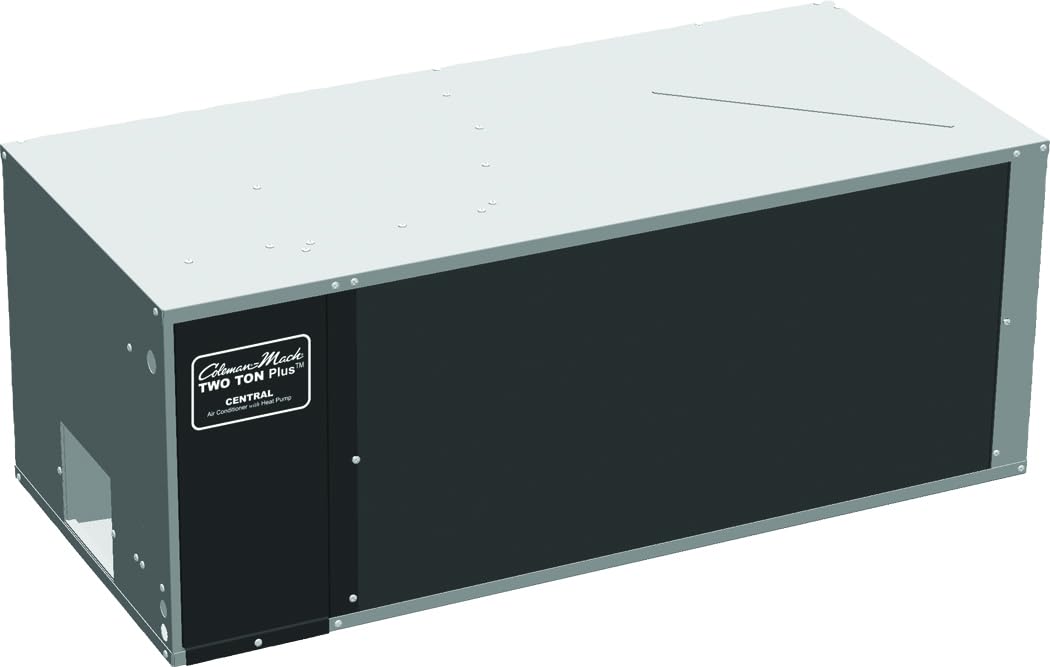
A basement-mount heat pump built for buses and RVs — a completely different wiring and mounting world from the wall units.
The word “basement” here refers to a different basement than most people picture: this Coleman unit is a basement-mount system common to buses and RVs, not a residential foundation. Two compressors each rated at 13,500 BTU add up to 27,000 BTU of cooling power, running on 120 volts with a heat pump included. It measures 45-7/8 inches long by 20-7/8 inches wide by 18-5/8 inches high and uses the new part number 36515-011. There is no condensate pump included and no inverter, so the system runs at fixed speeds.
Where it earns its spot on this list is as a direct replacement for an existing basement HVAC system. Reviewers point out it is nearly a bolt-in substitute for the original, requiring only minor electrical skills to connect the 120VAC cables — one buyer made it simple by noting that “if you can change a light fixture in your house, you can handle the 120VAC wiring.” Another watched it work flawlessly through some of the hottest days of summer.
The honest note is on the heat side. One reviewer noted a knocking noise after about eight months of use on the heat mode, suspecting the reversing valve, and flagged that warranty resolution meant paying for a new unit — one outlier rather than a widespread pattern, but worth knowing if you plan to lean heavily on heating. Customer service gets strong marks from the buyers who reached out, including one who got expedited shipping for an early arrival. Installation takes around 4.5 hours for a professional RV tech.
Best features for the RV and bus crowd
- Basement-mount form factor fits existing RV and bus ducting
- Two 13,500 BTU compressors total 27,000 BTU
- Runs on 120 volts with a heat pump included
- Nearly bolt-in replacement for many existing basement units
What to plan around
- No inverter, so it runs at fixed speeds
- No condensate pump included
- A minority report a rattle on the heat side after months of use
Perfect for: RV and bus owners who need a basement-mount direct replacement and have basic electrical comfort.
Not for you if: you want to heat a finished residential basement — a ductless mini split is the right tool.
Understanding the Specs
BTU Output and Square-Foot Coverage
BTU, short for British Thermal Unit, measures how much heat the unit moves per hour. In a basement, size matters more than anywhere else because cold air settles and a slightly undersized unit fights the space forever. The 12,000 BTU picks here cover up to 550 square feet, the 18,000 to 24,000 BTU picks cover between 800 and 1,500 square feet depending on model, and the 36,000 BTU and above picks handle open-plan and whole-home scale. Match the rated coverage to your actual basement, then add a little headroom if your space is poorly insulated.
SEER2 Efficiency and What It Costs to Run
SEER2 is the current efficiency standard for cooling. The higher the rating, the more cooling you get per unit of electricity. In this guide, the range runs from 14 SEER on the whole-home Goodman package up to 22.3 SEER2 on the Cooper & Hunter Hyper Heat and 22 SEER2 on the YITAHOME dual-zone. A higher rating usually costs more up front but pays back in lower running costs — the YITAHOME 2-zone lists 700 kilowatt hours per year while the single-zone YITAHOME units list 1,200 kilowatt hours per year. On the heating side, look for HSPF2, EER2, and COP figures if the manufacturer publishes them, since the Daikin pick here is the only one in this group that lists all four.
FAQ
How many BTU do I need for a 1,000 square foot basement?
Can I install a basement heat pump myself?
Will a mini split heat my basement in winter?
What voltage does a 24,000 BTU heat pump need?
How long does a line set need to be for a basement install?
Is a dual-zone mini split better than two single-zone units?
Why is my mini split making knocking noises in heat mode?
Do these heat pumps work with Alexa or Google Home?
Can I put a wall-mount mini split in a basement?
What is the difference between a mini split and a package heat pump like the Goodman GPH1442H41?
Final Thoughts: The Verdict
For most full-basement installs, the basement heat pump winner is the Senville Tri Zone 28000 BTU because the 2.3-ton condenser covers 1,500 square feet and gives three separate rooms their own temperature with a 10-year compressor warranty behind it. If your basement is a single mid-size room and you want the highest SEER2 efficiency in the small class, the Cooper & Hunter MIA 12,000 BTU at 21.2 SEER2 is the one to reach for. And if your winters drop well below freezing, the Cooper & Hunter 24,000 BTU Hyper Heat is the only pick here rated to keep heating down to -22°F. Whatever you choose, confirm your breaker, voltage, and line-set distance before the truck arrives — those three details decide whether the install runs smoothly.
How We Picked
We do not accept paid placement. Every pick is matched to a real buyer and a real use-case; we do not hands-on test units.
Sources & Methodology
Specifications: manufacturer listings and product documentation. Review insights: verified customer reviews, as of September 2026. Pricing: not shown on this page (it changes often); check the current price via the retailer link.
As an Amazon Associate, KitchPrep earns from qualifying purchases. This does not affect which products we feature.
Related Guides
