
Specs are compiled from manufacturer listings and verified buyer reviews and can change over time — please confirm the key details on the product page before buying.
When the power goes out, you want to keep your fridge, wifi, and a couple of lights running without hauling a 100-pound machine out of the garage. A 3600-watt-class generator hits that balance. This guide covers eleven real picks, from budget-friendly workhorses to premium inverter units, and explains plainly which one fits your house, your RV, or your campsite.
I’m Mohammad Maruf — the founder and writer behind KitchPrep. This guide is built by comparing the manufacturers’ published specifications and the patterns across verified customer reviews, so you get each pick’s real strengths and trade-offs instead of marketing spin.
One quick note before we start: these picks are matched by class rather than by an exact wattage stamp. A few units here run slightly above or below the headline number but serve the same job — powering your essentials when the grid drops. If you want the shortest path to the right machine, the comparison table below is where to look for the best 3600 watt generator for your situation.
Our Picks at a Glance

How To Choose The Best 3600 Watt Generator
Most people shopping this size have the same three worries: will it run my fridge and furnace fan, will my neighbor hate me, and can I lift it alone. Sort those three and the decision basically makes itself.
Peak watts vs running watts
The peak number is a short burst the machine can survive for a moment — that is what kicks a fridge compressor or a circular saw into motion. The running watts figure is what it holds hour after hour, and that is the number you actually plan around. A generator advertised near 4000 peak watts often runs in the 2900 to 3600 range continuously, so total up your appliances’ steady draw first, then check the starting surge separately.
Inverter or open frame
Open-frame units like the Westinghouse here are the classic construction-site shape: simple, tough, and loud. Inverter models convert the engine’s raw output into a smooth wave, which is why phones, laptops, and CPAP-style devices prefer them. If your backup list includes a smart TV and a router, inverter is the safer bet — if it is a well pump and a space heater, either type will do the job.
Tank size, runtime, and weight
A bigger tank means fewer refuel trips at 2 a.m. — but it also means more pounds to wrestle onto a truck bed. The Westinghouse carries a 4-gallon tank for up to 14 hours of run time, while the PowerSmart 4300 keeps going 12 hours on a 1.98-gallon tank. Weight splits the same way: the lightest picks here hover near 46 to 49 pounds, and the heaviest cross 100 pounds. Pick the divide that matches your back and your driveway.
CO shutdown is not optional
Carbon monoxide is odorless and can build up fast in a garage or camper. Every pick on this list treats it seriously — several use an automatic sensor that kills the engine when exhaust levels climb. Never run any of these indoors, even the quiet ones.
Quick Comparison
| Model | Best For | Running Watts | Runtime | Weight | Amazon |
|---|---|---|---|---|---|
| Westinghouse 4650 Peak Watt★ Best Overall | Whole-camper and home essentials | 3600 W | Up to 14 hrs | 100.6 lb | Amazon |
| PowerSmart 4300 Watt InverterBest Value | Budget home backup and RV | 3500 W | 12 hrs at 25% load | 68 lb | Amazon |
| Oxseryn 4400-Watts InverterCompact Pick | Light RV camping and jobsite | 3400 W | 14 hrs at 25% load | 57 lb | Amazon |
| PowerSmart 4400W Inverter MB5040C | Older users and solo campers | 3600 W | — | 68 lb | Amazon |
| Aceup Energy 4000 Watt | Quiet RV and home use | 3200 W | Up to 5 hrs at half load | 48 lb | Amazon |
| Pulsar PGD40ISCO | Small trailers and light backup | 3200 W | 4 hrs at half load | 47.3 lb | Amazon |
| ERAYAK 4500W Inverter | Camping and apartment backup | 3500 W | — | 54 lb | Amazon |
| WEN 56360i | Tent camping and travel | 2900 W | — | 46 lb | Amazon |
| WEN DF360iX Dual Fuel | Boondockers wanting propane option | 2900 W gas / 2600 W propane | — | 49 lb | Amazon |
| Champion 4000-Watt RV Ready | RV and home essentials | 3000 W | Up to 10 hrs | 48.1 lb | Amazon |
| Champion 4500-Watt Electric Start | Whole-camper and food-truck duty | 3500 W gas / 3150 W propane | Up to 14 hrs gas / 21 hrs propane | 99.2 lb | Amazon |
In‑Depth Reviews
1. Westinghouse 4650 Peak Watt Portable Generator
Our pick — over 4.5★ from 700+ verified ratings; the strongest balance of quality and price.
A 3600-running-watt open-frame generator with a 4-gallon tank rated for up to 14 hours between fills.
If your outage list includes a fridge, a mini fridge, a heater, and a couple of lights in a trailer, this is the one most people end up buying — and the crowd agrees, with a 4.6-star average across well over 700 reviews. It runs 3600 watts continuously with a 4650-watt burst for starting motors, and it draws that power from a 212cc Westinghouse four-stroke OHV engine (overhead valve design for better fuel flow) with a long-wearing cast iron sleeve (a hard metal liner inside the cylinder that resists wear).
What wins people over is that it just keeps starting. A four-gallon tank with a built-in fuel gauge runs up to 14 hours between fills, so you can power through a long outage without constant refueling. One verified owner who’s burned through fifteen tanks reports that it still fires on the first pull, second at worst when the thermometer drops below 15°F — a stretch where he says the machine powered a 60-inch TV, a tower fan, and a 20-amp charger while his Keurig and a 12-amp grinder barely stumbled. That is a trip through cold weather and a couple of house parties without a single failure. Others describe the pull cord as roughly five times easier than the Generac 3500xl they came from, and the noise as close enough to a Firman 3650 inverter that they stop noticing it fifty feet from the woodstove.
The catch is the weight. At 100.6 pounds this is a two-person lift onto a tailgate, and the runtime advantage is real but so is that number. The Westinghouse is also an open-frame unit, so it is not going to blend into a campground in the way a fully enclosed inverter does. If you keep it parked on a concrete pad and wheel it out to the garage door, that is a non-issue. If the plan is to sling it into a truck bed alone every weekend, reach for a lighter pick.
What people rave about
- 3600 running and 4650 peak watts cover fridge, heat, and a few extras
- Four-gallon tank means up to 14 hours before you refuel
- Cold starts hold up — first pull in sub-15°F conditions
- Built-in CO sensor shuts the engine down if exhaust builds up
What you learn to live with
- 100.6 pounds is a genuine two-person lift onto a truck
- Open-frame design runs louder than a fully enclosed inverter
Your pick if: Blackouts hit your neighborhood or you want a permanent garage backup that can run a camper the same weekend.
Look elsewhere if: You need to carry it solo — 100.6 pounds will not move itself.
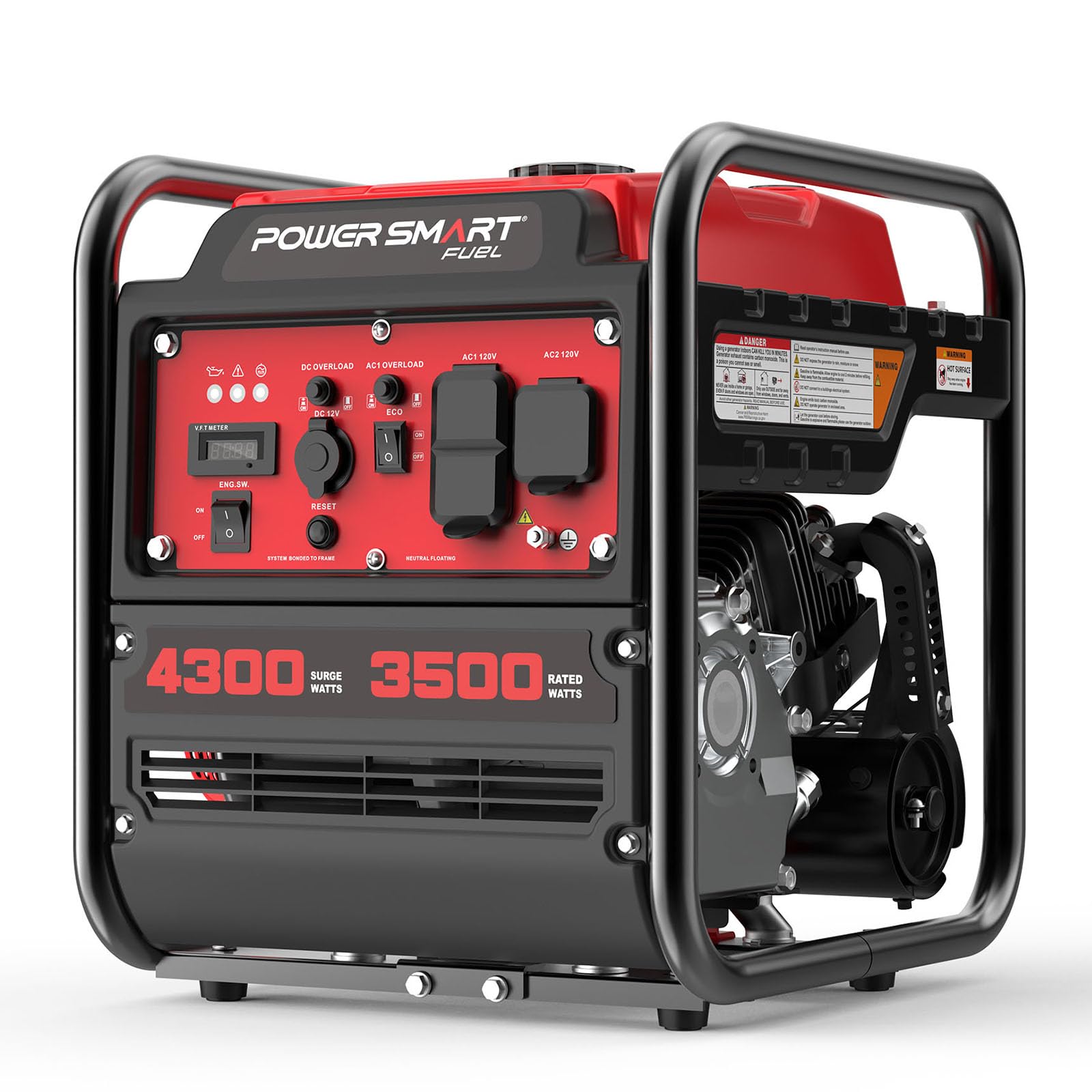
2. PowerSmart 4300 Watt Portable Generator with Inverter Technology
A 3500-running-watt inverter with sub-3% THD that ran a fridge, microwave, and TV for four days straight in one owner’s ice storm.
PowerSmart built this around a 223cc four-stroke engine delivering 4300 starting watts and 3500 running watts, wrapped in a body measuring 18.5 by 15.9 by 19.7 inches. It carries a 1.98-gallon tank, which is small compared to the Westinghouse’s four gallons — but the machine itself is lighter and it goes 12 hours at a quarter load between fills, so you are trading refuel trips for muscle strain.
The inverter output is the star here. It keeps total harmonic distortion under 3% — meaning the electricity coming out is smooth enough for phones, tablets, and cameras without the risk of a power brick getting cooked. One verified buyer’s account captures it best: “Ran 4+ days nonstop in ice storm, powering fridge, microwave, TV, space heater, wood stove blower, lights.” That is the whole use case in one sentence.
The setup is where the small annoyances live. The shipping brackets come off only with an open-end wrench and tight bolts, the unit needs about 20 ounces of 10W-30 oil before it will run, and the oil drain points into the frame so most owners buy a short extension hose. Budget a Saturday afternoon for the first fill and the break-in, and expect a loud idle that wants a 25-foot buffer from the house.
What owners notice most: reliability earned this pick its reputation — it starts on the first pull after refueling even in the low teens.
One thing to plan for: the manual gas gauge and awkward oil drain mean you will get your hands dirty at refuel time.
Reach for this if: You want inverter-grade clean power and long runtime without premium-brand pricing — the value here is hard to argue with.
skip it if: You want an enclosed, quiet-style inverter — this one is loud enough that a 25-foot buffer is the plan.
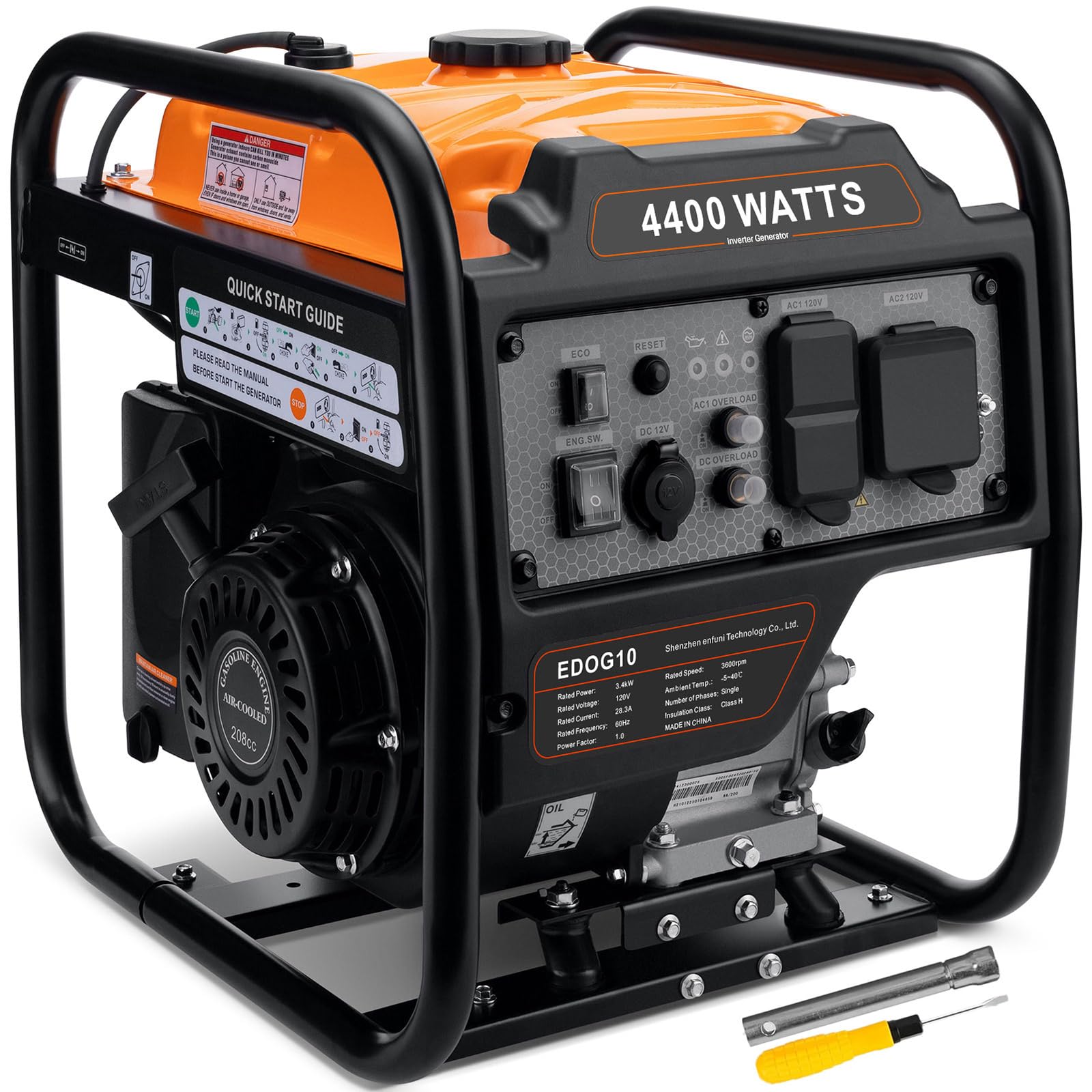
3. Oxseryn 4400-Watts Inverter Generator
A 57-pound inverter rated 3400 running watts with a 2-gallon tank good for 14 hours at quarter load in eco mode.
On paper the Oxseryn reads like a compromise — 4400 peak watts but only 3400 running watts — and in practice that is exactly what it is. It is a light-weight inverter meant for the light RV user or the general camper, not the homeowner trying to run the whole house through a blizzard. Look at the fuel math though: a 2-gallon tank rated for 14 hours at a quarter load beats the PowerSmart 4300 by two hours on a nearly identical tank size.
The starting story is the strongest part. Buyers report it firing on the first or second pull almost always, and one verified buyer with four months and dozens of uses says the only maintenance has been two oil changes. The output is inverter-clean through an eco mode that lets the engine idle down between loads, and the inclusion of a 30-amp RV outlet means a travel trailer can plug in without an adapter.
Two things to know before you buy. The battery-life feedback is genuinely mixed — one buyer got 16 hours on eco while others count closer to seven under real load. And the noise picture is split too: several owners say it is not nearly as loud as their previous machine, while others rate it “not very quiet.” The choke orientation has drawn complaints about reaching it in the dark. None of those are dealbreakers, but they explain why the average sits below the company it keeps.
The weight advantage: 57 pounds is roughly 43 pounds under the Westinghouse 4650 — a one-person lift that fits a small truck bed or garage shelf.
Real-world runtime: half a tank or less per session at eco idle is the typical report, so plan on a refuel every weekend of camping.
Best fit: Light RV use, tailgate weekends, and anyone who needs to move this thing alone.
Not for: Whole-house backup — 3400 running watts will not carry central HVAC or an electric water heater.
4. PowerSmart 4400W Peak / 3600W Running Portable Inverter Generator

A 61-pound inverter with a built-in 30-amp RV outlet, light enough for one person to load solo.
At 61 pounds this inverter is the classic one-person generator. PowerSmart designed it around an included 30-amp RV outlet, so a camper’s air conditioner, microwave, and fridge can all plug in without hunting for adapters. Peak output is 4400 watts with 3600 running, and the whole thing measures 19.3 by 16.9 by 16.5 inches — small enough to slide under a bench in a camper storage bay.
What owners consistently point to is the move. Older users and solo campers describe it as the machine they can shift without assistance — from a garage shelf into a truck bed, or from a truck bed to a campsite pad. And on the noise front it runs at 76 dB from 23 feet under load, which is loud but not neighbor-enraging, and eco mode quiets it further while stretching the tank.
One quirk has become folklore on the review pages: the easiest start is with the choke set midway between “choke” and “run,” then eased to “run” once it fires. Experienced owners also recommend cutting the fuel valve before shutdown to keep the carburetor from flooding, a two-second habit that saves a lot of pulling the next morning. There is an ignition switch missing on some reviewers’ wish list, and one owner’s unit (a different model number) arrived damaged and later failed, which is rare but worth knowing.
Where it shines
- 61 pounds is a genuine one-person job to move
- Built-in 30A RV outlet handles camper AC without adapters
- Under 3% THD keeps laptops and TVs safe
- CO shutdown plus low-oil protection built in
Where it asks patience
- Startup has a learning curve — the choke trick is nearly required
- 76 dB under load is loud enough to need distance from a campsite neighbor
The pick for: Solo campers and RVers who value the ability to move the generator themselves.
Think twice if: You want a truly quiet machine — this one announces itself at 76 dB under full load.
5. Aceup Energy 4000 Watt Gas Inverter Generator
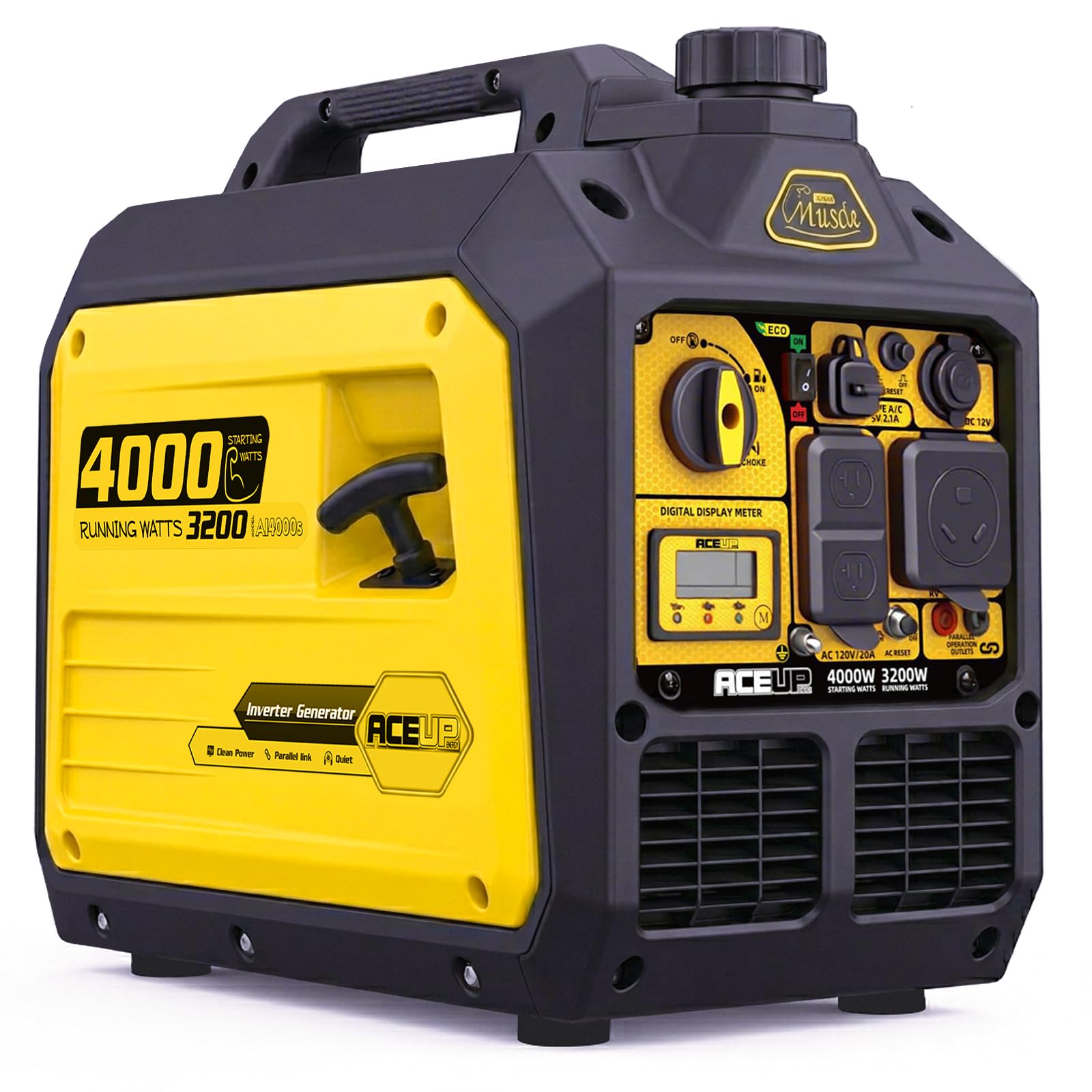
A 48-pound inverter rated about 60 dB in eco mode, with THD under 1.5% for sensitive electronics.
Aceup’s 149cc engine puts out 4000 peak watts and 3200 running watts, with a 1.32-gallon tank rated for up to 5 hours at half load. That is a small tank, and combined with the modest output it makes this a light-duty backup — not a whole-house solution. What makes it worth considering at this size is the quiet: it runs at about 60 decibels in eco mode at 23 feet under a quarter load, and inverter output holds total harmonic distortion below 1.5%.
The knob is the other clever bit. A single five-in-one dial handles fuel on and off, engine start and stop, and choke — and turning off the engine also cuts the fuel, so you never leave gas sitting in the carburetor. Owners give it high marks on quality and reliability, with a smart gauge that reads voltage, runtime, fuel, hertz, and power output all in one panel.
The honest downside is starting consistency. Starting-time feedback is mixed, which tends to be the pattern with brand-new small engines before the break-in oil changes. There is also one review of a unit that arrived with a defective stepper motor and was refunded by Amazon — rare enough to mention, not to weight against the whole line. If you buy this one, plan on fresh 10W-30 oil, a break-in load for a few hours, and checking the spark plug if the first start is fussy.
Quiet enough for campgrounds: roughly 60 dB in eco mode is about the level of a normal conversation at arm’s length — good enough for neighbors on an RV pad.
Know your limit: 3200 running watts handles a fridge, lights, and a fan; it will not carry central HVAC or a full-size water heater.
Right for you if: Quiet operation and portability top your list, and your appliance set is modest.
Step up if: You need to run a bigger load — 1.32 gallons and 3200 running watts cap what this can carry.
6. Pulsar PGD40ISCO Ultra Light Quiet 4000W Portable Gas Inverter Generator

At 47.3 pounds, the lightest pick here that still runs 3200 watts and starts a 13,500-BTU camper AC.
Pulsar’s 4000-watt inverter runs on a 145cc engine putting out 4000 peak and 3200 rated watts, and it fits inside a body under 19 inches long on the short side. Rated at 59 dB, it is designed to sit on a trailer tongue or under a camper awning without making the campers next door into enemies. It is rated for air conditioning units up to 13,500 BTU, which is standard travel-trailer territory.
Where owners say it earns its keep is sustained use. One verified buyer counted 410 hours across three summers without a single problem, running 36 hours straight on a 13,500 BTU AC with a soft start and a microwave. Another describes moving it one-handed between a yard and a shed, and says the filtered inverter output plays nicely with computer-grade electronics.
The one caveat to know is the fuel tank. It holds a single gallon and is rated for 4 hours at half load — real-world reports on AC duty land around 4 to 6 hours, which means an overnight outage needs a refuel. Owners who use it hard also recommend ethanol-free gas and frequent oil changes, which adds a small maintenance ritual to the routine. The compactness is a gift for storage but it does mean you will handle the fuel logistics more often than owners of a bigger-tank machine.
Built for boondocking: 47.3 pounds makes it the lightest machine in this lineup, and 59 dB is quiet enough to converse next to.
Plan your fuel: one gallon means a refuel roughly every 4 to 6 hours with an AC running.
Ideal owner: A camper who values low weight and low noise above all else and does not mind topping off the tank.
Look past if: You want overnight and overnight-plus runtime without getting up to refuel.
7. ERAYAK 4500W Portable Inverter Generator

A 4500-peak-watt inverter rated 0.2–1.2% THD, the lowest distortion figure on this list.
ERAYAK pushes 4500 peak watts and 3500 running watts out of a 208cc four-stroke engine, delivering it through a 30-amp RV outlet, two 120-volt household receptacles, a 12-volt cigarette lighter port, and USB-A and USB-C ports. That USB-C inclusion is unusual at this size and means phones get charged without an adapter. Rated noise is 60.5 dB, and total harmonic distortion sits between 0.2 and 1.2% — a range low enough that laptops, CPAP-style devices, and mobile chargers all run without worry.
The runtime math is one of its strong points: fuel consumption is rated at about two liters per hour at rated load, and about eight-tenths of a liter per hour at a quarter load. A buyer who kept one going through a Chicago storm reported a full day and night running the fridge, chargers, and lights without a hitch. Another ran it for six days straight powering two houses at and above rated capacity.
Two realities before purchase. The stated runtime is at low load — at full load you are looking at a tank that empties faster than the marketing implies — and the advertised quiet is not the field feeling for everyone. One owner says “ECO mode fairly quiet but not super quiet as advertised,” and the machine’s 54-pound frame is light for the output but still not a featherweight. Parallel-ready 50-amp output means two units together can double your power, but the kit is sold separately.
Why it earns a spot
- 0.2–1.2% THD is among the cleanest power figures in this lineup
- USB-A and USB-C ports on the panel — no adapter needed for phones
- Parallel-ready for doubling power later
- Three-year limited warranty with US support line
Where it falls short of the pitch
- Quiet claim is optimistic compared to real field reports
- Full-load runtime drains the tank faster than the rated figure suggests
Great match for: Anyone whose backup list leans on electronics — laptops, medical devices, and phones that want truly clean power.
Think twice if: Low noise is your top priority — real owners describe it as quiet-but-not-super-quiet.
8. WEN 3600-Watt Portable Inverter Generator (56360i)

At 46 pounds, the lightest machine here, with 2900 running watts enough to start a 13,000-BTU camper AC.
WEN’s 56360i runs a 149cc engine putting out 3600 surge watts and 2900 rated watts, in a fully enclosed inverter body that weighs in at 46 pounds. That is the lightest pick in this lineup, and at the same time it is the smallest on running watts — the honest trade being portability for capacity. The panel includes two three-prong 120-volt receptacles, a TT-30R RV outlet, a 12-volt DC receptacle, and two 5-volt USB ports, plus a three-year warranty.
The standout feature is the fuel shutoff. When you cut the fuel before shutdown, the engine burns off the gas sitting in the carburetor — which means the next start is a simple pull rather than a wrestling match. A verified buyer who used it as a camp trailer battery supplement for 40 hours reports it firing on the second pull in standard mode, and on the fourth pull only at 14°F. Another says that on a boat swim platform they had to check that it was still running because it was that quiet.
The trade-off is the ceiling. Rated at 2900 running watts, this will run a 13,000-BTU air conditioner, a furnace fan, four LED lights, and recharging for a 12-volt battery — all together, but that is close to the top. A buyer who tried bigger tools and appliances found it did not have the muscle and had to step up. The 4-hour tank at AC load also means refuel before bed unless you are willing to run it stripped down.
What people rave about: the fuel shutoff habit has become the signature of this machine — it prevents carburetor flooding and keeps starting easy run after run.
Where it caps out: 2900 running watts is the lowest on this list, so a mini-fridge and a space heater together is about as much load as you should plan for.
Pick this when: Lightweight portability matters most and your appliance list stays modest — the WEN is the lightest serious machine here.
Look past if: Your backup plan involves a well pump, central HVAC, or a job-site tool with a big induction motor.
9. WEN Quiet and Lightweight 3600-Watt Dual Fuel RV-Ready Portable Inverter Generator (DF360iX)

The same WEN bones as the 56360i, but able to run on gasoline or a propane tank when gas is scarce.
This is a 149cc inverter with dual-fuel capability: 3600 surge and 2900 rated watts on gasoline, and 3500 surge with 2600 rated watts on propane. It weighs 49 pounds and it includes a tool-free LPG quick-connector, so a standard propane tank plugs straight in without tools or an adapter. The Watchdog CO sensor shuts the engine down automatically if carbon monoxide climbs, which is a meaningful safety add for anyone running it near a camper or garage door.
What wins owners over is the flexibility. When the propane runs out, you switch to gasoline — and when gasoline is hard to find during a storm, you can lean on a spare propane tank instead. One owner who replaced a failed on-board LP generator in an Arctic Fox camper says the WEN runs a 10,800-BTU air conditioner, starts below 40°F, and drinks about one 20-pound propane tank every six hours of AC use.
The honest caveats are starting roughness and the propane wattage dip. A first start can be smoky or rough, and the machine occasionally needs two pulls — one owner traced it to a fuel cap vent and had no trouble after the second day. Propane costs you the lower power numbers, so if you are running the AC it stays on gas. And the 30-amp plug placement can interfere with certain RV cable ends, an issue that some owners solve by trimming the cable housing.
What sets it ahead
- Runs on gasoline or propane — propane at 2600 running watts
- CO Watchdog shuts down automatically if exhaust builds up
- Tool-free LPG quick-connector means no adapter hunting
- 49 pounds, three-year warranty
Where it asks understanding
- Propane drops you to 2600 running watts — AC stays on gasoline
- 30-amp plug placement interferes with some RV cable ends
Ideal for: Boondockers, storm preppers, and anyone who wants the option of a propane tank as their fallback fuel.
Not for: Someone who wants full AC duty on propane alone — that combination needs gasoline.
10. Champion 4000-Watt RV Ready Portable Inverter Generator

Champion’s sub-50-pound 4000-watt inverter is built for the RV pad and reasonably quiet at 64 dB.
This Champion runs a 149cc engine for 4000 starting watts and 3000 running watts, with up to 10 hours of run time per tank and a body weighing 48.1 pounds. It is one of the lightest 4000-watt inverters in the industry, and the spec sheet backs that up: 64 dB from 23 feet (about as loud as a normal indoor conversation at arm’s reach), low enough to hold at a campsite without apologizing to neighbors.
Clean power is another strong suit. Output holds under 3% total harmonic distortion, so TVs, routers, and phone chargers stay safe. Owners running construction and mobile-work duties report it handling a 30-gallon air compressor without trouble — an unusual test for a 3000-watt continuous machine. The CO Shield system auto-shuts the engine if carbon monoxide levels rise, which is the kind of feature you hope never fires but want in the box.
The connections include a 120-volt 25-amp TT-30R RV outlet, a 120-volt 20-amp household duplex, a 12-volt automotive outlet, and parallel ports so a second Champion unit can double the output with a kit. A 3-year limited warranty rounds it off.
What earns it the spot: clean sine-wave output and a CO Shield auto-shutoff are the two features that separate it from cheaper 4000-watt boxes.
Practical note: parallel-ready for growing into two units later, but the kit ships separately.
Built for: RVers and light home-backup users who want a champion-brand inverter under 50 pounds.
Step away if: You need a bigger tank — 10 hours at light load means a refuel for overnight AC duty.
11. Champion 4500-Watt Electric Start Dual Fuel Portable Inverter Generator

The food-truck-grade machine — 4500 watts, push-button start, and a dual-fuel valve that switches with a flip.
Champion’s biggest inverter here runs a 212cc engine for 4500 starting watts and 3500 running watts on gasoline, and 3150 running watts on propane. It carries up to 14 hours of run time on gasoline and up to 21 hours on propane, and it starts with a push-button electric ignition rather than a pull cord. Rated noise is 61 dB, quiet enough for RV parks and tailgates, and the CO Shield auto-shuts the engine if carbon monoxide builds up.
What wins people over is durability under real work. One buyer runs a food truck with four seven-cubic-foot freezers, a commercial fridge, three high-speed blenders, a point-of-sale terminal, lights, a warmer, and two fans from 10 a.m. to 10 p.m. — and reports that this Champion outlasted previous 6000-watt and 8000-watt off-brands that shut off six or more times a day. Another describes it as a first generator purchase with no prior experience and says it fired on one pull after a storm knocked power out in Northwest Indiana, running a fridge, two freezers, phones, a smart TV, and two fans at half capacity overnight on a single tank.
The price of that capability is 99.2 pounds. It is heavy — noticeably heavier than the four-footprint-shorter 48-pound Champion 4000-watt on this list — and owners say loading it takes two people. The electric start makes that easier, and wheels are built in, but this is not a unit you will want to move every day. It is a permanent backup or a food-truck fixture, not a weekend portable.
Where it towers
- 4500 starting watts / 3500 running on gas; 3150 running on propane
- Up to 14 hours on gas, up to 21 hours on propane
- Electric push-button start instead of a pull cord
- Intelligauge reads voltage, frequency, and hours
Where it demands
- 99.2 pounds is a two-person lift for most users
- Parallel-ready only with a separately sold kit
The pick if: You want electric-start convenience, dual-fuel flexibility, and enough muscle to run a commercial or whole-RV load.
Think otherwise if: You need to move it often — nearly 100 pounds and a two-person lift is a real cost.
Understanding the Specs
Running watts vs peak watts
Peak watts is a short-lived burst — usually a few seconds — that lets a machine kick over a fridge compressor or a saw motor. Running watts is the number you hold minute after minute, and it is what your total appliance draw has to stay under. If your fridge, freezer, and furnace fan together add up to about 2000 watts, a generator with 2900 to 3600 running watts leaves room for lights and chargers. The peak figure only matters for the startup moment.
THD — why sensitive electronics care
THD stands for total harmonic distortion, a measure of how “clean” the electricity coming out of the outlets is. A low THD — under about 3% — means the wave is smooth enough that laptops, TVs, phones, and CPAP-style devices see power close to what the wall socket delivers. Above 5% the wave starts to look rough, and hardware gets unhappy over long runs. Inverter models on this list sit between 0.2% and 3%; open-frame units tend to be rouggh, so if a smart TV or CPAP-style device is on your backup list, pick the inverter.
FAQ
Can a 3600 watt generator run a refrigerator and a furnace fan at the same time?
Will a 3600 watt generator run a camper air conditioner?
Is an inverter generator worth the extra cost over an open frame unit?
How long will a single tank of gas last on a 3600 watt generator?
What does THD mean and why does it matter for my devices?
Can I run two generators together to get more power?
Is a 3600 watt generator loud enough to bother my neighbors?
Do these generators shut off automatically if carbon monoxide builds up?
How much oil and what weight should I use in a 3600 watt generator?
Can I use propane instead of gasoline on these generators?
Final Thoughts: The Verdict
For most people shopping this size, the best 3600 watt generator is the Westinghouse 4650 Peak Watt because it balances 3600 running watts, a four-gallon tank with 14-hour runtime, a CO sensor (carbon monoxide detector that shuts the unit off if levels get unsafe), and cold-start reliability that owners keep reporting after fifteen tanks — no other pick here does all of that at once. If portability leads your list, grab the Champion 4000-Watt RV Ready at 48.1 pounds with 64 dB quiet output, or the WEN 56360i at 46 pounds if you want the lightest machine in the group. And for a dual-fuel setup that runs on propane when gasoline runs short, the WEN DF360iX is the one to reach for — clean power, CO Watchdog, and 49 pounds without compromise.
How We Picked
We do not accept paid placement. Every pick is matched to a real buyer and a real use-case; we do not hands-on test units.
Sources & Methodology
Specifications: manufacturer listings and product documentation. Review insights: verified customer reviews, as of September 2026. Pricing: not shown on this page (it changes often); check the current price via the retailer link.
As an Amazon Associate, KitchPrep earns from qualifying purchases. This does not affect which products we feature.
Related Guides
