
Specs are compiled from manufacturer listings and verified buyer reviews and can change over time — please confirm the key details on the product page before buying.
If the power dies and your fridge, router, and AC all go dark, a regular generator can still fry the electronics you were trying to save. An inverter generator fixes that by smoothing the electricity into a clean wave that laptops, TVs, and fridges can actually digest. This guide covers twelve portable inverter generators that start at 8,000 watts and climb well past it, sorting the whole-home workhorses from the camping-friendly quiet units. One honest note up front: this list uses flexible, human-style matching, so not every pick is the exact wattage you typed into the search bar. Some are larger. The nearest same-type size does the same job, and every pick below is a true inverter unit.
I’m Mohammad Maruf — the founder and writer behind KitchPrep. This guide is built by comparing the manufacturers’ published specifications and the patterns across verified customer reviews, so you get each pick’s real strengths and trade-offs instead of marketing spin.
You will see how pure sine wave output, THD ratings, and dual-fuel flexibility separate a generator that quietly saves your freezer from one that just makes noise. Think of this as your plain-English cheat sheet for finding the best 8000-watt inverter generator.
Our Picks at a Glance

How To Choose The Best 8000-Watt Inverter Generator
The number in the product name can mislead you. Peak watts are a brief surge for starting a motor, and running watts are what the machine can hold all day. A unit advertised at 8,000 peak watts usually runs closer to 6,500 watts steady, which is the figure your fridge and well pump actually live on.
Why THD matters more than wattage for electronics
THD stands for total harmonic distortion, a measure of how rough the electricity is. A rating of ≤2% or ≤3% means the power is smooth enough for a laptop or TV. If the number is not published, treat that silence as a warning, because your router and desktop do not enjoy guessing games.
Fuel type and how long you can actually run
Dual-fuel units run on gasoline or propane, and tri-fuel adds natural gas, so you can lean on a home gas line instead of hauling cans. Runtime is listed at a load percentage, so an 8-hour rating at 50% load tells you real numbers. Heavy loads drain the tank faster.
Quick Comparison
| Model | Best For | Peak Watts | Fuel Type | Weight | Amazon |
|---|---|---|---|---|---|
| Genkins 8000-Watt Portable Inverter Generator★ Best Overall | First generator or off-grid cabin | 8000 | Gasoline | 112 lb | Amazon |
| Genkins 8000W Portable Quiet Inverter GeneratorCompact Pick | Home backup on a budget | 8000 | Gasoline | 112 lb | Amazon |
| Pulsar GD10KBN 10500W Dual FuelBest Dual Fuel | Storm prep and RV trips | 10500 | Gasoline, Propane | 125 lb | Amazon |
| Champion 9000-Watt Open Frame Inverter | Whole-house backup with CO safety | 9000 | Gasoline | 152.2 lb | Amazon |
| Champion 8500-Watt Remote Start Tri Fuel | Tri-fuel convenience and quiet operation | 8500 | Gasoline, Propane, Natural Gas | 151 lb | Amazon |
| maXpeedingrods 10500 Watt Tri-fuel Inverter | Job sites and outdoor events | 10500 | Gasoline, LPG, Natural Gas | 143 lb | Amazon |
| Westinghouse 12000 Peak Watt Dual Fuel | Whole-home backup with long runtime | 12000 | Gasoline, Propane | 187.4 lb | Amazon |
| Pulsar PGD105TiSCO Tri Fuel | Natural gas home backup | 10500 | Gasoline, Propane, Natural Gas | 247 lb | Amazon |
| Gidrox 11000W Tri-Fuel Inverter Generator | Whole-home backup with transfer switch | 11000 | Gasoline, Propane, Natural Gas | — | Amazon |
| WEN 13,000-Watt Tri-Fuel Inverter | EV charging and heavy home loads | 13000 | Gasoline, Propane, Natural Gas | 246.9 lb | Amazon |
| GENMAX 13500W Tri-Fuel Inverter | Unattended home backup with auto-start | 13500 | Tri-Fuel | 273.7 lb | Amazon |
| DuroMax XP16000iH 16,000-Watt | Commercial use and mobile setups | 16000 | Gasoline, Propane | 368 lb | Amazon |
In‑Depth Reviews
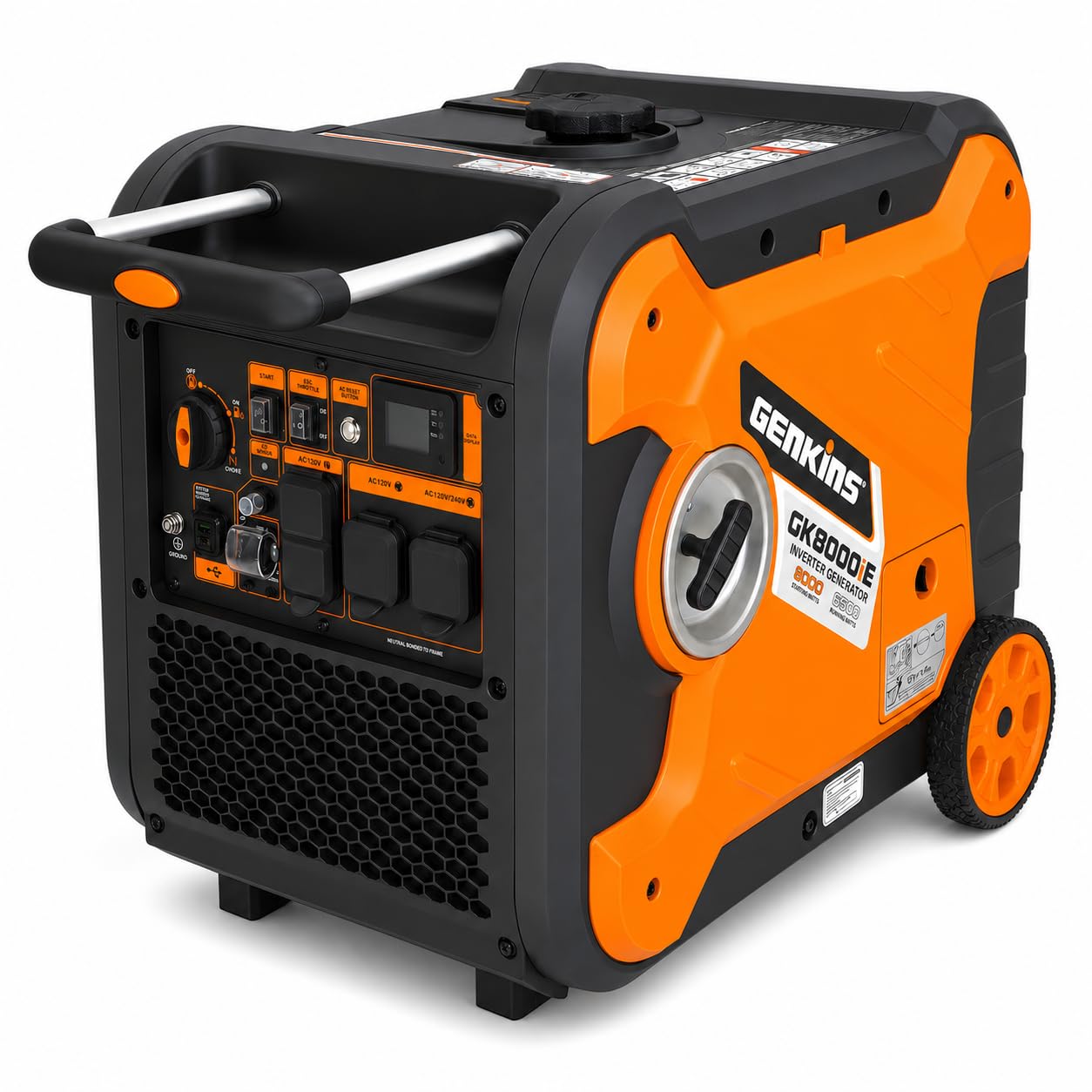
1. Genkins 8000‑Watt Portable Inverter Generator, Gas Powered Electric‑Start 120V/240V
Our pick — 4.5★ from 950+ verified ratings; the strongest balance of quality and price.
The off-grid workhorse that starts on the first pull after two years of use.
This is the crowd favorite at 4.5 stars across 900+ ratings, and the highest-rated unit in this entire roundup. It delivers 8000 peak watts and 6500 running watts from a 327cc OHV engine (overhead valve, a design that runs cooler and cleaner), which is enough to run a fridge, a router, and some lights at the same time. The 30 A current rating and 120V/240V output mean it can feed a transfer switch (a device that connects the generator to your home wiring) as easily as it feeds an extension cord.
The quiet operation is what wins people over. At 62 dBA from 23 feet away, it hums rather than roars, so your neighbors stay on speaking terms during a long outage. Fuel economy comes from ESC Mode, which automatically drops the engine speed when the load is light — the 4-gallon tank stretches to 8+ hours at 50% load and up to 16+ hours at 25% load. And what about startup? Electric start is standard, and the digital display shows real-time status so you are not guessing at voltage.
Safety gets real attention here too. Built-in carbon monoxide protection monitors the air and shuts the unit down automatically when dangerous levels are detected, though you should still only run it outdoors, away from doors and windows. The 112-pound frame with a telescoping handle and never-flat wheels makes it movable without a second person. The honest catch: some buyers report the battery ships disconnected, and a few units arrive needing a wheel re-tightened. Treat the setup manual as required reading, not a suggestion.
What owners rave about
- Owners single out performance more than any other trait.
- 62 dBA quiet operation at 23 feet
- 16+ hours of runtime at 25% load on the 4-gallon tank
- Electric start with a digital display for real-time status
Where it asks for patience
- Battery ships disconnected and needs a quick connection
- An occasional unit arrives with a loose wheel or wobble
- No oil or funnel included in the box
Buy it if: you want the best-reviewed starting point for cabins, camping, and light home backup, and you do not mind a five-minute setup.
Look elsewhere if: you need natural gas hookups or a remote fob — this one keeps it simple with gasoline only.
2. Genkins 8000W Portable Quiet Inverter Generator for Home, Electric Start
Same engine as its sibling, foot shorter footprint, and a spot on the patio instead of the driveway.
The number that matters here is the 19″L x 18″W x 24″H footprint — this unit is the exact same 112-pound class as the Genkins above but squeezes into a smaller corner. Against the Pulsar GD10KBN, it also wins on the scales, since the Pulsar tips 125 pounds versus this unit’s 112. Its 327cc 4-stroke OHV engine delivers 8000 peak watts and 6500 running watts, and the 27 A current rating feeds one 240V NEMA L14-30R outlet, one 120V NEMA L5-30R outlet, and two household 120V outlets.
Low THD (≤2%) pure sine wave output keeps sensitive electronics safe, so laptops and TVs do not flicker. Quiet operation lands at 62 dBA from 23 feet, which is about the level of a normal conversation. Runtime is respectable: the 4-gallon tank gives you 8 hours at 50% load and 16 hours at 25% load, with ESC Mode trimming engine speed as the load drops. The telescopic handle and two tires make transport a one-person job, one you can genuinely wheel through a gate.
Two setup quirks trip up new owners. The electric start arrives dead because the battery ships disconnected — you have to connect the capped wires near the oil fill before the push button works, and the recoil start needs a couple of pulls until then. A handful of units also arrive with a faulty inverter that overloads under heavy single-load draws like a single RV air conditioner. Both are fixable, but both cost you an afternoon.
Worth the shelf space: a compact 8000-watt package with a genuine 120V/240V outlet mix and clean sine wave power for electronics.
Plan for setup: budget ten minutes for the battery hookup, and confirm your heavy loads are within the 6500 running watt ceiling before a storm.
Reach for this if: you want the Genkins platform in a tidier footprint for patio or garage storage.
Think twice if: you want a fully assembled, plug-and-play unit straight out of the crate.
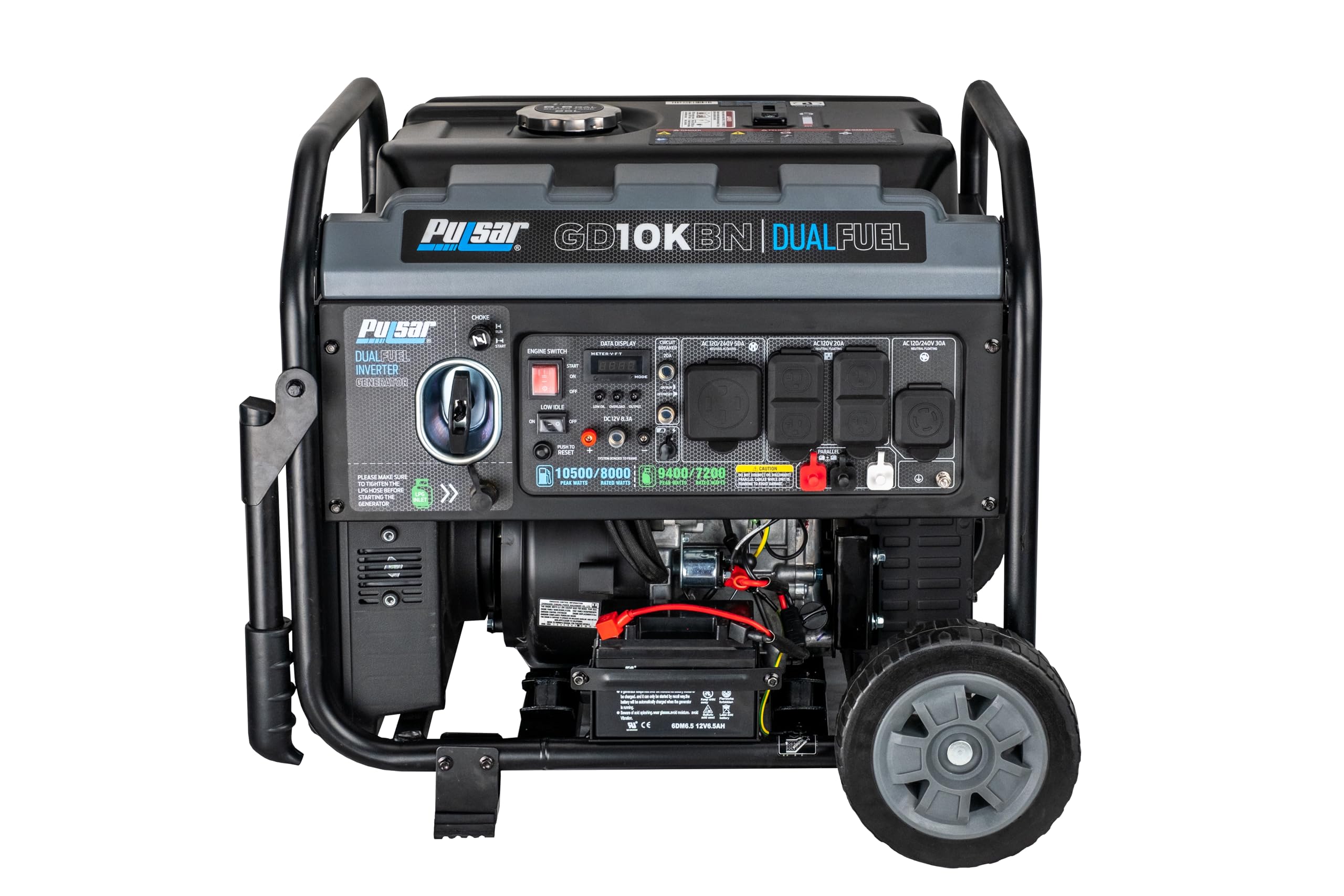
3. Pulsar GD10KBN 10500W Dual Fuel Home Backup Portable Inverter Generator
A 10.5KW dual-fuel bruiser that will run all night, on either gas or propane.
When a storm knocks the grid out and you need something that just works, the ability to switch between gasoline and propane is the whole point. This Pulsar runs on either fuel, feeds a 15-50R outlet for RVs and campers, and handles central A/C during an outage. It is bigger and heavier than the Genkins units above — 125 pounds versus their 112 — and its 29.9″L x 21.5″W x 22.8″H body needs its own floor space. The payoff is genuine flexibility, since propane stores indefinitely and does not gum up a carburetor.
The digital multimeter shows voltage, frequency, total hours, and hours until your next recommended service. That hour meter is the feature you will grow to love, because it takes the guesswork out of maintenance intervals. Overload protection and short circuit protection are built in, and the 312cc engine turns out up to 10.5 KW of peak power. On propane it needs two to three pulls to start because there is no line bleed, so plan for a little patience on the first fire-up of the season.
The one recurring gripe is noise. This is a loud generator — owners describe it as a yelling match, not a conversation, and the volume does not match the expectation set by the inverter label. The neighbors will hear it. Budget for a spot away from the house and away from bedroom windows, and it earns its keep.
Go with this if: you want dual-fuel flexibility, a real hour meter, and the muscle to carry a home through a multi-day outage.
Consider another pick if: a quiet machine is your priority — this one is loud enough to draw attention.
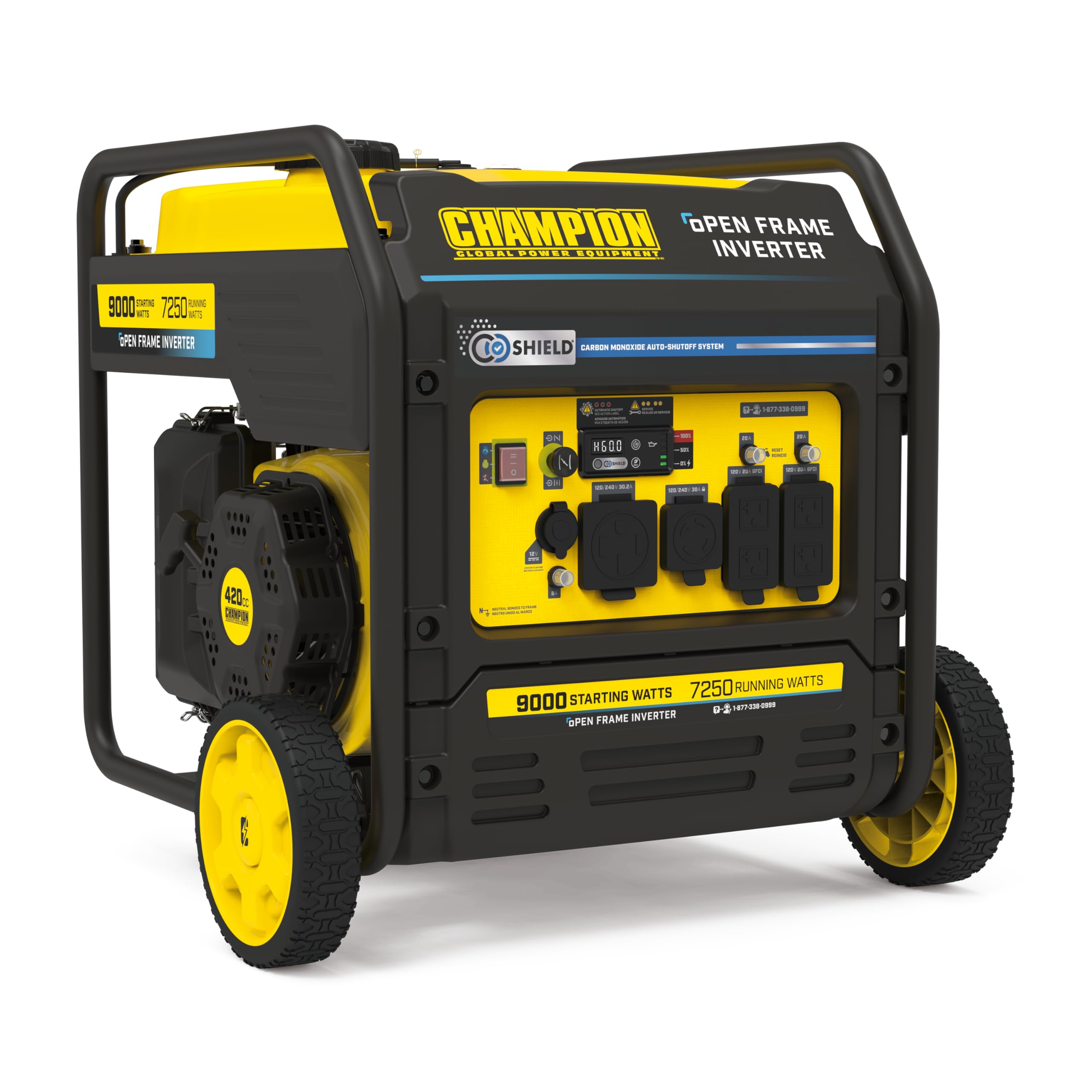
4. Champion Power Equipment 9000-Watt Electric Start Home Backup Portable Open Frame Inverter Generator
A 420cc workhorse that starts in the cold and shuts itself off when the air turns risky.
The feature that earns this pick its slot is CO Shield, a carbon monoxide auto-shutoff system that cuts power when dangerous fumes build. That matters if you are running it near a garage or under an overhang, because carbon monoxide is odorless and takes people by surprise. The 420cc Champion engine works with a battery-included electric start, plus Cold Start Technology that helps in freezing weather. There is a 120/240V 30.2A outlet, a 120/240V 30A locking outlet, two 120V 20A household duplex outlets, a 12V automotive-style outlet, and a dual port USB adapter — enough ports to skip the power strips.
If you were weighing a traditional open-frame generator, note that this one is 50% quieter and 20% lighter than a comparable 7250-watt traditional unit. It gives you 9000 starting watts and 7250 running watts with up to 10.5 hours of run time on gasoline, and clean power under 3% THD for your electronics. The Intelligauge with Power Meter monitors voltage, frequency, and operating hours, so you always know where the machine stands. Economy Mode sips fuel and stretches engine life.
One caveat from the review pages: the electric start has arrived dead on a rare unit, and dealing with that online can be a headache if you would rather not pay return shipping. Since Champion includes a 3-year limited warranty and free lifetime technical support, that path is covered, but it is a good argument for testing the starter the day it lands.
Pick it for the safety stack: CO Shield plus a 3-year warranty is the combination you want if the machine lives near the house.
Small trade-off: at 152.2 pounds, this is a wheel-it-around machine, not a lift-it-into-the-truck motor.
Best for: households that want a large-brand safety net and a starting wattage headroom over a standard 7250-watt unit.
Skip if: you need propane or natural gas — this one is gasoline only.
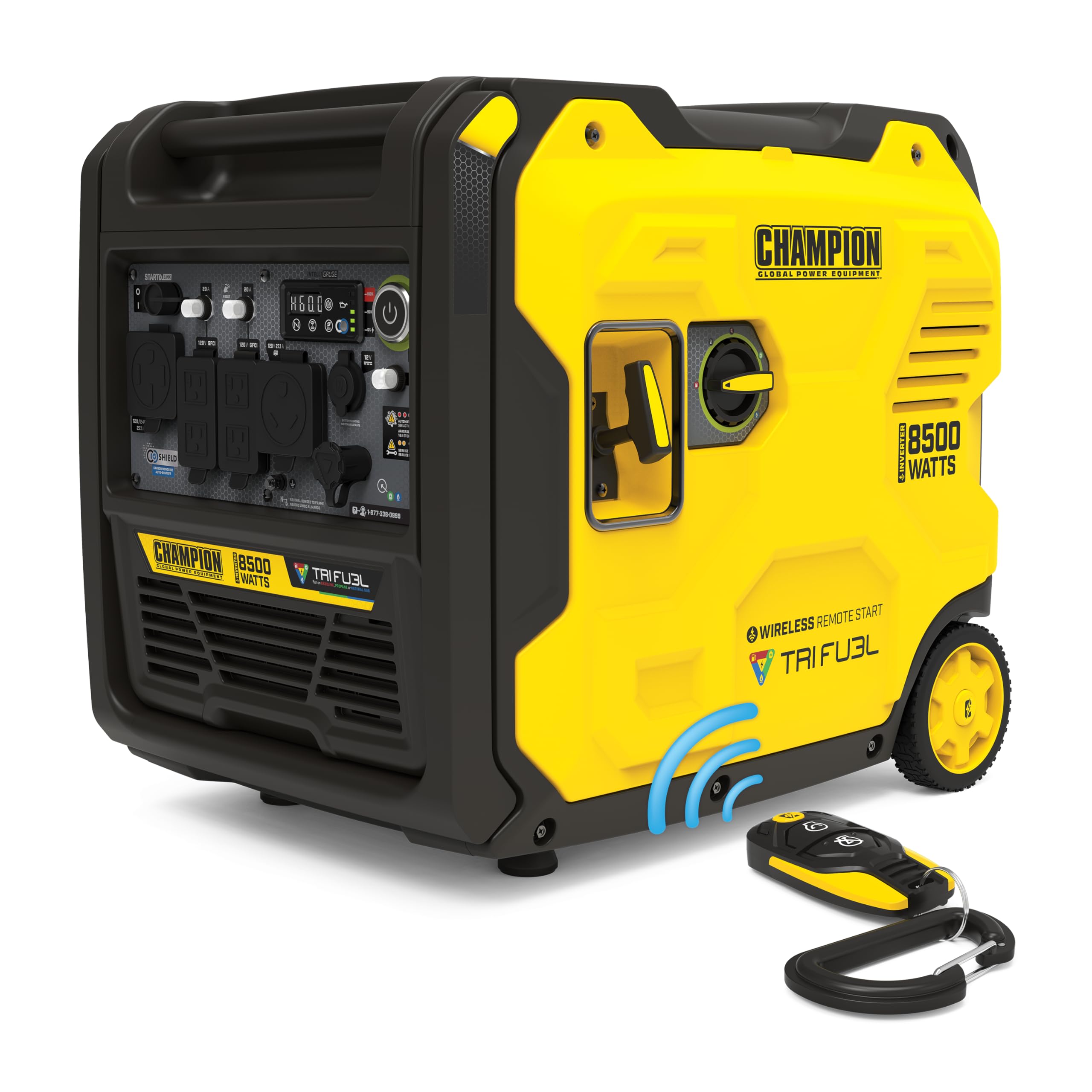
5. Champion 8500-Watt Remote Start Tri Fuel Portable Inverter Generator
Start it from the porch. Run it on natural gas, propane, or plain gasoline.
Tri-fuel capability is the headline, and the box includes both hoses — a 25 ft. natural gas line and a 6.6 ft. propane line — so nothing is missing when you unbox it. The remote key fob reaches up to 80 feet, which means you can fire it up from inside the house without walking into the cold, and a push-button electric start handles the close-up case. Runtime hits 13 hours, and the noise level sits at 64 dB(A), which is genuinely neighborhood-friendly for a machine this size.
Transfer switch integration is the sleeper feature here. The generator connects to Energy Storage Systems or Automatic Transfer Switches, automating start and stop and enabling 120V AC battery charging. If your home already has an ATS, this unit slots right into that workflow instead of making you the switch. The StartLINK system is the same family of tech that owners describe as quick to set up and straightforward to run, with with performance and reliability the traits buyers praise most. Champion backs it with a 3-year limited warranty and free lifetime technical support.
The one hiccup is delivery. One owner’s shipment landed three days late, which cost them money. It is an outlier, but worth checking the tracking if the unit is for a time-sensitive storm prep.
Matches you well if: you want tri-fuel flexibility, a remote fob, and ATS-ready wiring in one box.
Look at the 9000-watt instead if: you need the higher 9000 starting watts and do not care about propane or natural gas.
6. maXpeedingrods 10500 Watt Tri-fuel Inverter Generator, 120/240V, E-start
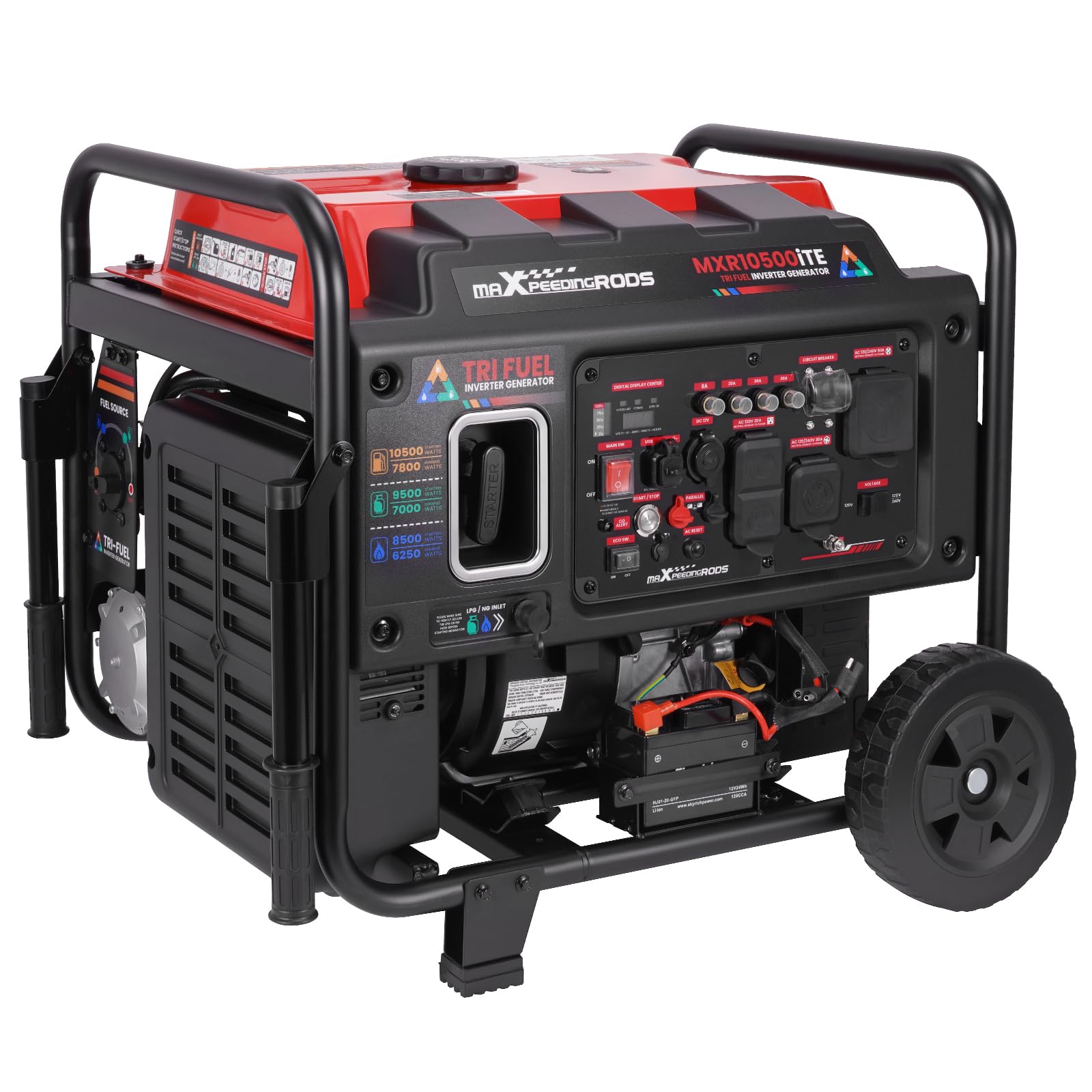
A 50-amp tri-fuel monster that shrugs off an RV air conditioner and keeps going.
This maXpeedingrods runs on gasoline, LPG, or natural gas, and puts up to 10,500 peak watts on gasoline, 9,500 peak watts on LPG, and 8,500 peak watts on natural gas. That is real flexibility for a moderate budget, and the 312cc OHV engine is smaller than both the WEN’s 550cc and the GENMAX’s 550cc units further down this list. Even so, the 50 A current rating is the highest in this group, which buys you headroom for heavy tools and RV loads. The 120/240V switching lets you jump between device types without a second machine.
Starting options are generous: electric, remote, or recoil, all with a fast-startup mode. Inverter pure sine wave output keeps laptops, phones, and cameras safe, and ECO-Mode automatically trims fuel use and noise as the load drops. The CO sensor shuts the generator down if hazardous carbon monoxide levels are detected, which is the kind of feature that matters most for folks who run their unit near the garage. The unit is 25.2″L x 19.69″W x 20.87″H and rolls on wheels with a telescopic handle, so patio storage is realistic.
The one frustration in the review pages centers on the battery and app. A dead starting battery can prevent starting even with the pull cord due to the electronic choke, and the phone app has been described as buggy. The customer service reputation is strong, and the warranty path is real, but you should test the battery the day it arrives.
Strong on paper: the 50 A rating and tri-fuel flexibility together are unusual at this wattage class.
Watch the starter battery: keep a spare charged battery on hand and you sidestep the biggest reported hassle.
Fits you if: you want a job-site-strong tri-fuel unit with remote start and clean sine wave power.
Reconsider if: you plan to run propane-heavy and prefer a brand with broader local service centers.
7. Westinghouse 12000 Peak Watt Dual Fuel Portable Inverter Generator
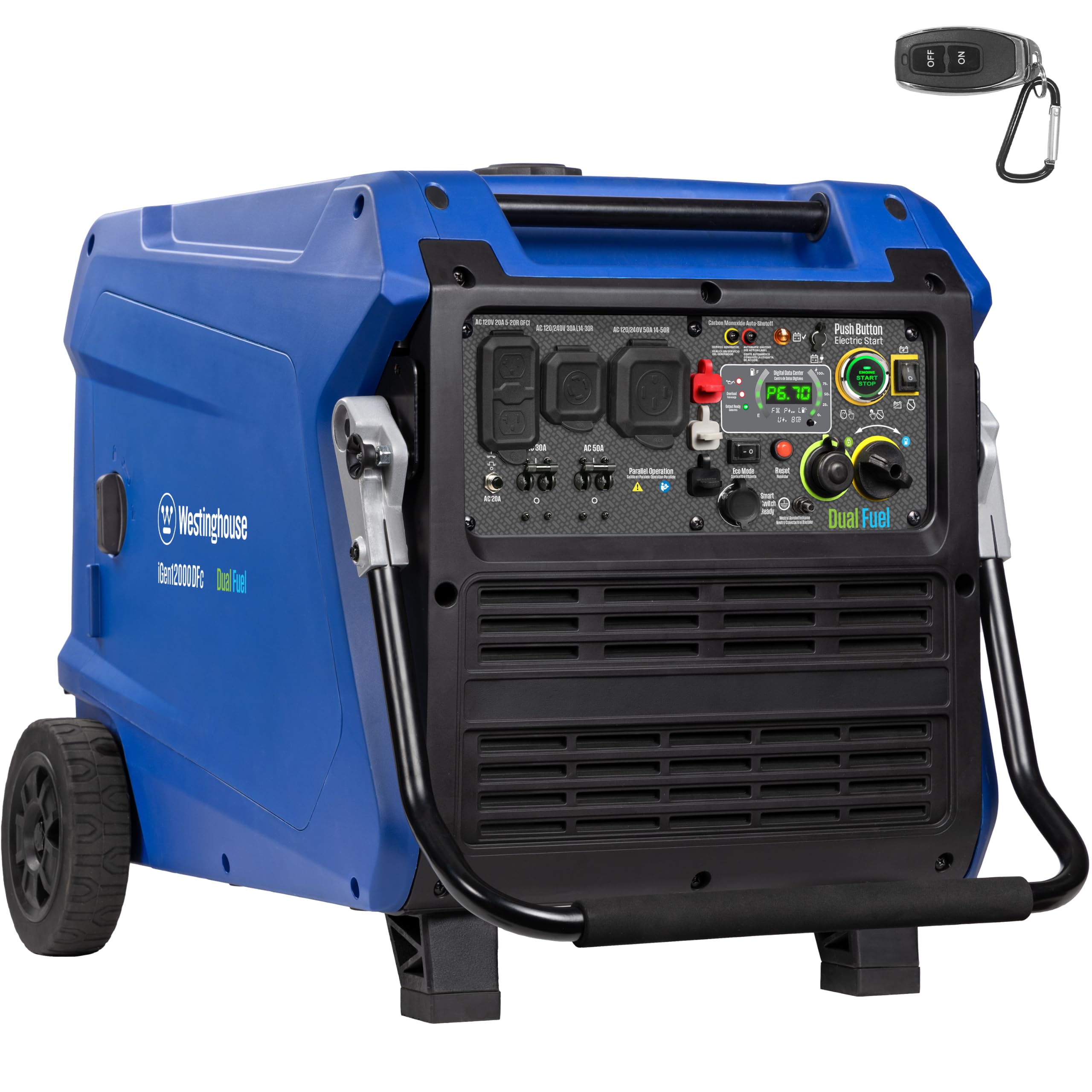
The 19-hour overnight runner that plugs straight into a transfer switch.
Runtime is the number that matters here. The 7.9 gallon fuel tank on this Westinghouse runs up to 19 hours at 25% load, which means you can power through a full overnight outage without refueling at 3 a.m. Gasoline output is 12,000 peak watts and 9,000 running watts, and propane steps it down to 11,000 peak watts and 8,100 running watts. That headroom is why owners have used it for charity food trailers and 38-foot fifth wheels at 50% load.
The 457cc Westinghouse 4-stroke OHV engine (overhead valve, a design that runs cooler and cleaner) is the largest displacement in this roundup, and it pairs with a fully enclosed design, insulation, and mufflers to keep the sound as low as 64 dBA (about as loud as a normal conversation). The 50A outlet (14-50R) and the L14-30R twist-lock are both transfer switch or interlock kit ready, and there is a GFCI 120V duplex household outlet (a shock-protection outlet) plus a parallel-ready setup for doubling output. The LED data center shows fuel level, power output, remaining run time, voltage, and lifetime hours, and the giveaway kit includes a key fob, battery charger, propane regulator, oil, funnel, and tool kit — you do not chase extras.
The honest friction point is warranty structure. Westinghouse does not cover labor after year one, and not every service center works on generator electrical systems. It is worth knowing before you buy, especially if you are not the fix-it type.
Draws you in with
- Up to 19 hours at 25% load on the 7.9 gallon tank
- Parallel ready to double output
- LED data center with fuel, load, voltage, and hours
- Transfer switch or interlock kit ready right from the start
Details to weigh up
- 187.4 pounds — plan the parking spot before delivery
- Labor is not covered after year one of the warranty
- Only 120/240V 50A and 30A outputs — no natural gas option
Best for: households with a transfer switch or interlock who want a single all-night tank of fuel.
Who should pass: apartment or patio dwellers who cannot park a 187-pound machine.
8. Pulsar PGD105TiSCO Tri Fuel Inverter Generator, 10500-Watt

Home-gas-ready power that never asks you to refill a fuel can.
If your home has a natural gas line, this is the pick that lets you run during an outage without ever topping off a tank. Gasoline delivers 10,500 peak watts and 8,500 running watts, propane steps down to 9,500 peak and 8,000 running, and natural gas runs 8,400 peak and 6,800 running. The 458cc OHV engine is EPA and CARB compliant, and the 6.9 gallon fuel tank supports up to 9 hours of continuous operation at half load when you are running on gasoline. Quiet operation lands at 62 dB, and the unit stays safe with sensitive electronics.
The outlet panel is unusually complete: one USB A, one USB C, four GFCI 120V 5-20R outlets, one 120V/240V L14-30R, and one 120V/240V L14-50R. That L14-50R is the one your electrician will want for home backup wiring. The digital control center shows hours, voltage, load, and frequency so you always know what is happening. The included kit covers a remote fob, electric start battery, propane and natural gas hose with regulator, 10W-30 motor oil, spark plug wrench, and screwdriver — everything except a break-in checklist.
This is a heavier machine at 247 pounds, and the middle of the review distribution warns about fuel selector valve issues on some units. The complaints are split — some units run outstandingly, others arrive defective — so buy from a seller with a clean return path. When it works, it works hard.
Ideal for natural gas homes: whole-house backup on the existing utility line with a modern inverter and a full outlet panel.
Be picky on the seller: the middle-of-the-road ratings here make a clean return policy worth more than a small discount.
Suits you if: you have natural gas service and want whole-home capability without hauling fuel.
Another glance if: you need to move the unit often — 247 pounds is a permanent placement.
9. Gidrox 11000W Tri-Fuel Inverter Generator with Remote Start and Transfer Switch

The quiet 8.7-gallon all-nighter with a 21-hour ceiling and a dial for fuel switching.
The oversized 8.7 gallon tank stands out in this group — Gidrox rates it for up to 21 hours of backup during extended outages, which is the longest runtime number in this article. Peak output is 11,000 watts with pure sine wave output under 3% THD, which is the clean power med-grade electronics and central AC need. Tri-fuel support covers gasoline, propane, and natural gas, and the innovative dial-start system lets you switch fuels in seconds instead of hunting for fittings. NG and LPG hoses are included.
Quiet operation lands between 62 and 65 dB, which is roughly the volume of a normal conversation. There is a dedicated ATS port for automatic transfer switch integration, a heavy-duty 50A (14-50R) outlet for luxury RVs, and a 30A (L14-30R) 240V outlet for whole-house backup. All outlets are protected by waterproof rubber covers and GFCI safety. Push-button electric start works alongside a remote and a manual backup, and Gidrox stands behind the unit with a 3-year limited warranty.
One owner flagged a ceiling on the sustained side: once past 5500 watts, the unit struggles, and fuel consumption climbs fast at 5000 watts. Plan your loads keeping that curve in mind, and the ownership experience is a good one.
Great fit for: homes wiring up an ATS who want the longest fuel tank in the lineup and a genuinely quiet machine.
Second look if: you plan to run everything at once — the sustained balance sits well under the peak rating.
10. WEN 13,000-Watt 120V/240V Tri-Fuel Inverter Generator with Quiet 550cc Engine
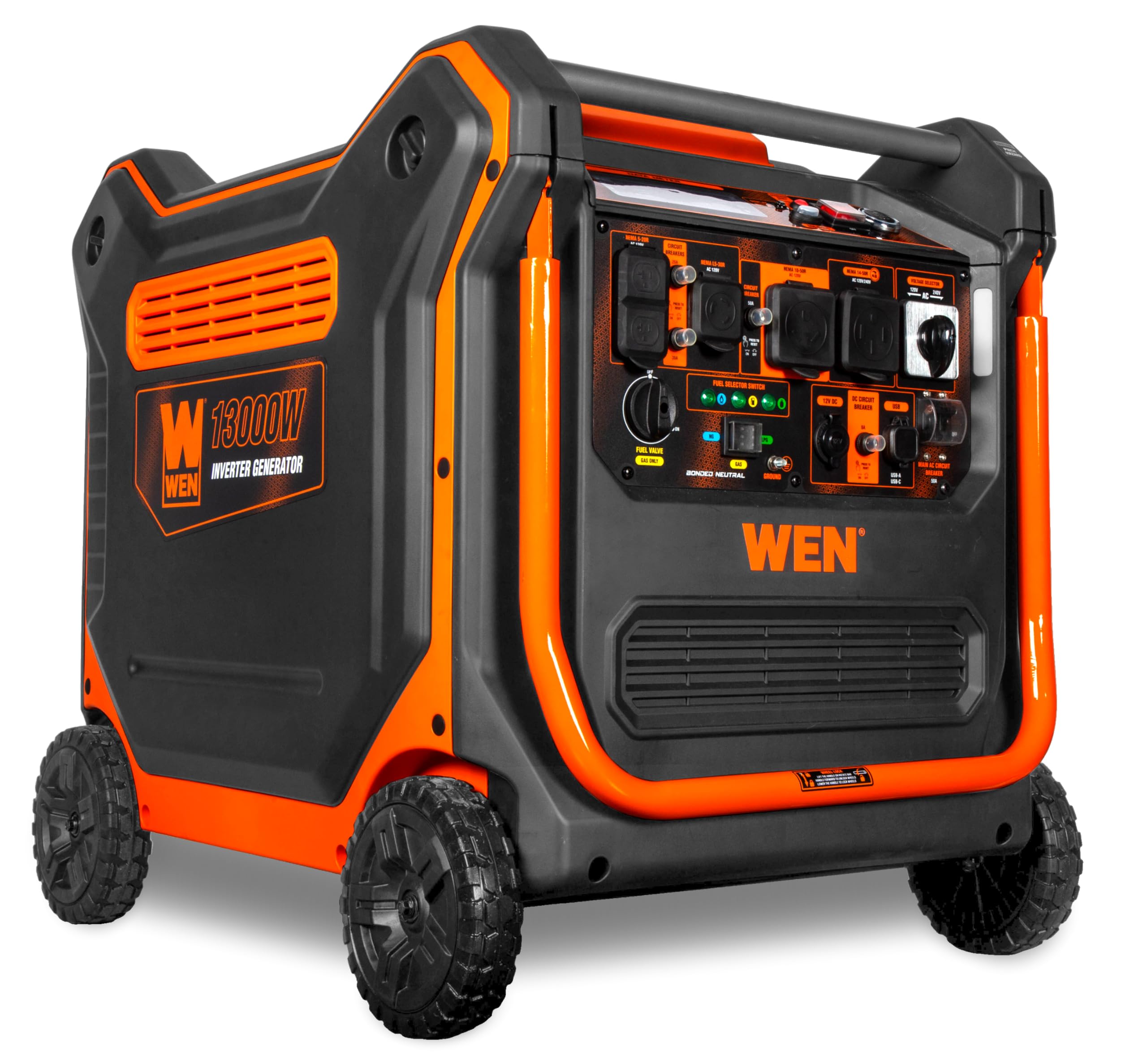
A 550cc tri-fuel giant that will charge your EV or carry a whole house.
The standout here is the EV-ready 14-50R outlet and the bonded-neutral 120V/240V configuration, which together make this the only pick in this roundup advertised for Level 2 charging of battery and hybrid electric vehicles. Gasoline output is 13,000 surge watts and 10,500 running watts, propane steps it to 11,250 surge and 9,000 running, and natural gas lands at 10,000 surge and 8,000 running. The 550cc 4-stroke OHV engine is the most powerful on the WEN side of the lineup, and the 7.1 gallon tank gives up to 7.7 hours of half-load runtime.
The WEN Watchdog CO Shutdown Sensor automatically turns the generator off if carbon monoxide levels get dangerous. Owner reports back the power output and quiet operation — the unit is described as barely audible in nearby rooms under full load. Two 120V 5-20R outlets, a 120V/240V 14-50R, a 120V L5-30R, a 10-50R, a 12V DC outlet, two USB outlets, and the included 5-foot LPG hose and quick-connect adapter make this the most outlet-rich unit on the list. A three-year limited warranty is standard.
One honest quirk in the manual: the voltage selector means you cannot use 240V and 120V receptacles simultaneously — switching to one shuts the other off. That is a real limitation if you were expecting double-duty outlets, and it is worth planning your load layout around.
Big draw: EV-charging-ready output, tri-fuel support, and the highest outlet count in this roundup.
Note on layout: the 240V and 120V outlets are mutually exclusive via the voltage selector — plan dry runs before the real outage.
Matches if: you want whole-house backup with EV charging capability from a major small-engine brand.
Keep looking if: you need simultaneous 240V and 120V feeds without a selector interlock.
11. GENMAX 13500W Tri-Fuel Inverter Generator with ATS 2-Wire Auto-Start
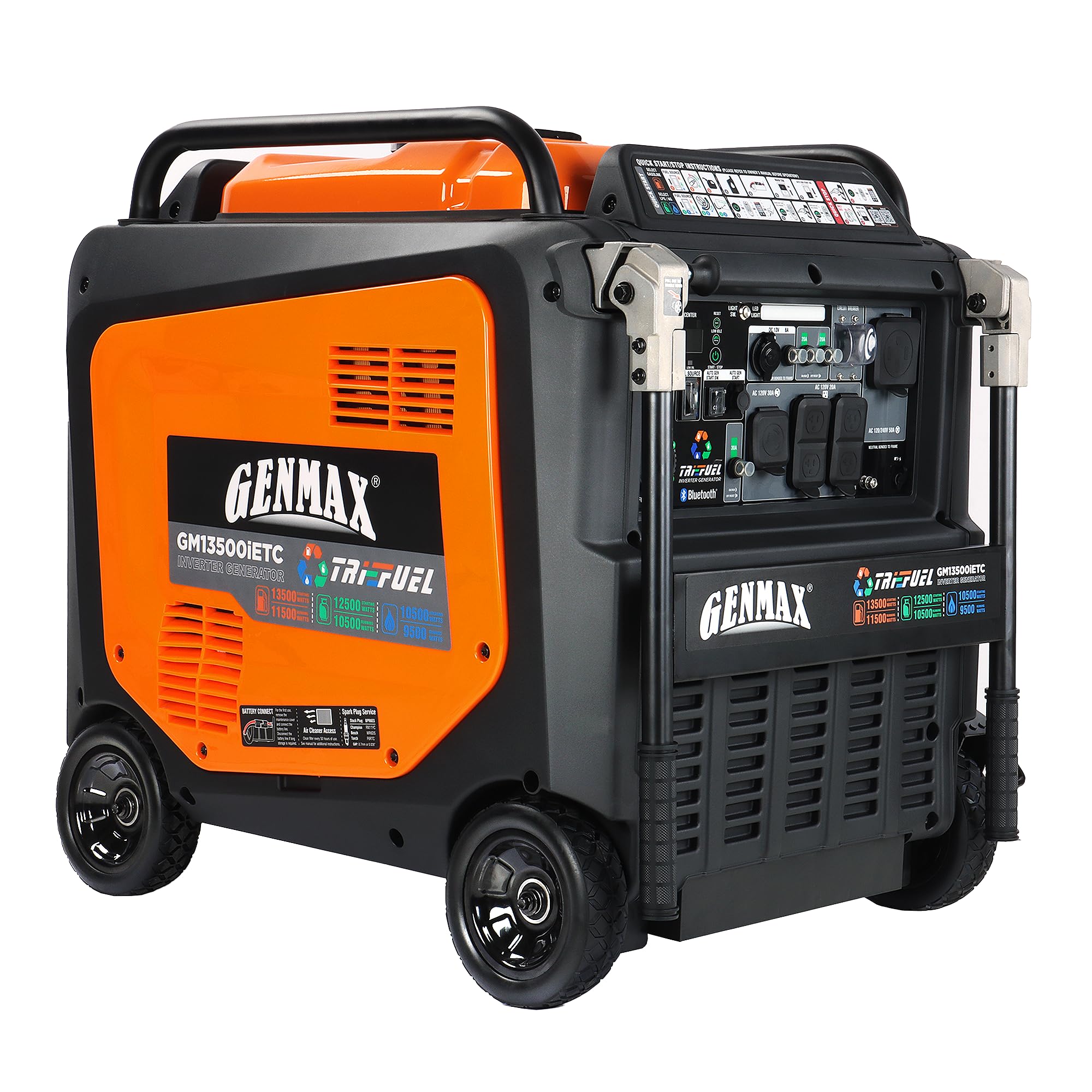
It starts itself when the power dies and tells your phone it did.
Five start options is the story here: push-button electric start, remote key fob, Bluetooth app control, recoil backup, and — the one that matters most — ATS 2-wire auto-start (a feature that lets the generator start itself when the power goes out). That last option is the reason many owners pick this unit over the Westinghouse, and it is genuinely hard to find in the portable generator class. Gasoline delivers 13,500 peak watts and 11,500 running watts, propane steps to 12,500 peak and 10,500 running, and natural gas lands at 10,500 peak and 9,500 running — all switchable via a dedicated fuel selector dial. Peak output uses a 550cc 4-stroke OHV engine (overhead valve, a design that runs cooler and cleaner), and the built-in LED light illuminates the control panel for that midnight fire-up.
Clean inverter power under 3% THD keeps laptops, phones, and sensitive electronics protected. There are four 120V GFCI 5-20R outlets, a 120V/240V 14-50R for EVs and heavy tools, an L5-30R, and 12V DC ports, so the outlet panel is broad. Quiet operation settles at 62 dB(A) at 25% load, comparable to a normal conversation, and Eco-Mode trims the engine speed to match load, stretching runtime up to 11.2 hours on a 6.9 gallon tank. The CO Shield system auto-shuts down on carbon monoxide, and the unit is CARB certified for all 50 states.
The recurring gripe in the review pages is long-haul reliability — a few units have needed service within the first few months. GenMAX backs it with a 3-year limited warranty and ongoing technical support, so it is a manageable risk, but registering the unit promptly is smart.
Standouts for the price point
- ATS 2-wire auto-start for unattended outage kick-in
- Five start methods including Bluetooth app control
- 62 dB(A) at 25% load with up to 11.2 hours runtime
- Built-in LED panel light for nighttime starts
Buyer reviews flag these
- Owners single out performance more than any other trait.
- 273.7 pounds — plan a permanent, wheel-accessible spot
- A few units have needed service within the first few months
- Long-term reliability is mixed in the review pages
Best for: homeowners who want the generator to start itself the moment the grid drops and who need tri-fuel flexibility.
Worth skipping if: you plan on frequent relocation — this is the second-heaviest unit here.
12. DuroMax XP16000iH 16,000-Watt Dual Fuel Portable Digital Inverter Generator
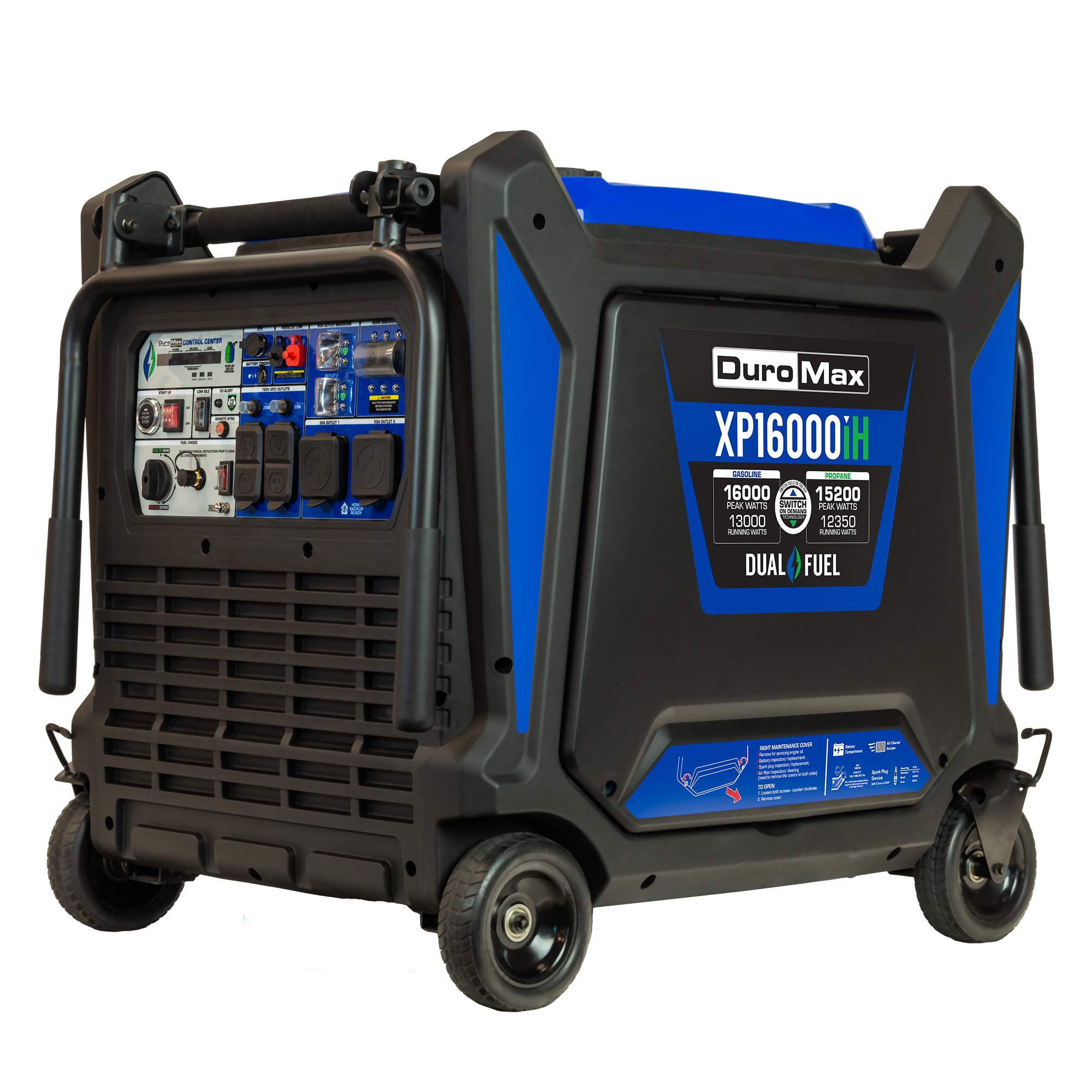
The commercial-grade 16,000-watt option for setups that need serious muscle.
This DuroMax sits at the top of the whole pack on raw output — 16,000 peak watts and 13,000 running watts on gasoline, or the same dual-fuel flexibility on propane. At 368 pounds, it is also the heaviest unit in this roundup — well over twice the 112 pounds of the Genkins at the top of the list, and more than 90 pounds heavier than the 273.7-pound GENMAX. That weight is the price of the wattage. Owners running food trucks, mobile sports bars, and jobsite setups are the crowd that fits this machine.
The Digital Control Center LCD shows hours run, voltage output, and load level, and the remote control makes starting easy. Low oil shutoff protects the engine, and a battery tender keeps the starting battery fresh so it fires on demand. Emissions compliance is EPA and CARB approved, which matters in California and other regulated states. When everything lines up, owners mention the unit running 8 to 12 hours nonstop without a skip, which is the reliability food trucks need when there is no room for downtime.
The middle of the review distribution shows real outliers — a starter failure in under 50 hours, an out-of-box overload error, and one unit that failed during break-in and was not covered by the seller. This is the highest-priced machine in the lineup, and the warranty support comes up as a weak point in the review pages. Buy from a seller with a strong return policy and inspect the unit in the first hour of break-in.
Where it earns its place: the biggest wattage ceiling here, EPA and CARB compliance, and a battery tender for cold-morning starts.
Where to be careful: the warranty track record is uneven, and 368 pounds means this is a permanent-placement unit, not a portable one.
Right pick for: mobile businesses, commercial food setups, and jobsites that truly need 16,000 watts.
Wrong pick if: you need to lift or move it regularly, or you want warranty support that never comes up as a weakness.
Understanding the Specs
Peak Watts vs Running Watts
Peak watts is the short burst a generator can deliver when a motor first kicks on, and running watts is what it can hold steadily. A fridge or well pump spikes hard for a second and then settles, so a machine rated at 8,000 peak watts might run 6,500 watts all day. Match your biggest motor’s startup draw against the peak number and everything else against the running number, and the lights stay on.
THD and Pure Sine Wave Output
THD is the roughness of the electricity coming out of the outlet. Inverter generators convert the engine’s raw output into a smooth sine wave, and a rating of ≤2% or ≤3% is clean enough for laptops, TVs, and routers. If a unit does not publish a THD number, your sensitive electronics are rolling the dice on every connection.
Fuel Type and Runtime Math
Dual-fuel runs on gasoline or propane, and tri-fuel adds natural gas so you can hook into a home line during a long outage. Runtime is always listed at a load percentage — 8 hours at 50% load means half that if you push it harder. Sizing your tank to your longest realistic outage avoids the 3 a.m. refuel run.
Decibel Ratings and Placement
dBA is a measurement of sound (a small increase in the number is a noticeable jump to the ear). Numbers between 62 and 65 dBA from 23 feet are quiet for this class — roughly a normal conversation. Anything above 68 dBA starts drawing neighbor attention and belongs on the far side of the yard, away from windows and doors.
FAQ
Will an 8000-watt inverter generator run a central air conditioner?
What is the difference between a regular generator and an inverter generator?
Can I run an 8000-watt inverter generator on propane instead of gasoline?
How long can an 8000-watt inverter generator run on a full tank?
Do I need a transfer switch to use these generators at home?
Can I run a 240V and a 120V outlet at the same time on these generators?
Will an 8000-watt inverter generator fit in the back of a pickup truck?
How often do I need to change the oil on a large inverter generator?
What size inverter generator do I need for whole-home backup?
Final Thoughts: The Verdict
For most homes, the best 8000-watt inverter generator winner is the Genkins 8000-Watt Portable Inverter Generator because it pairs a genuine 8000 peak and 6500 running watt output with CO protection (a sensor that shuts the unit down if carbon monoxide builds up), 62 dBA quiet operation (about as loud as a normal conversation), and a track record of starting on the first pull after two years. If you want tri-fuel flexibility and natural gas compatibility for whole-home backup, reach for the Gidrox 11000W Tri-Fuel Inverter Generator, which carries the longest fuel tank in this roundup and an ATS port (a connection that lets it auto-start during an outage). And for commercial loads, mobile food setups, and jobs that never stop, the DuroMax XP16000iH 16,000-Watt is the machine to reach for when uptime beats portability — and one honest nudge: that Genkins 8000-watt pick holds its rating across a much larger review base than every other unit here, which is exactly the sign you want before buying the machine that runs your fridge at 2 a.m.
How We Picked
We do not accept paid placement. Every pick is matched to a real buyer and a real use-case; we do not hands-on test units.
Sources & Methodology
Specifications: manufacturer listings and product documentation. Review insights: verified customer reviews, as of September 2026. Pricing: not shown on this page (it changes often); check the current price via the retailer link.
As an Amazon Associate, KitchPrep earns from qualifying purchases. This does not affect which products we feature.
Related Guides
