
Specs are compiled from manufacturer listings and verified buyer reviews and can change over time — please confirm the key details on the product page before buying.
If your porch light, driveway post, or yard lantern still needs a human to flick a switch every evening, you are one small device away from never thinking about it again. An automatic light sensor — often called a photocell or photo eye — reads daylight and flips your fixture on at dusk and off at dawn by itself. The trick is picking one whose voltage and mounting thread actually match the fixture you already own, because the sensor is the cheap part and the rewiring is the headache.
I’m Mohammad Maruf — the founder and writer behind KitchPrep. This guide is built by comparing the manufacturers’ published specifications and the patterns across verified customer reviews, so you get each pick’s real strengths and trade-offs instead of marketing spin.
Most of these screw straight into a standard knockout hole, so the whole job can take minutes with the power off. Below you will find the wiring, voltage, and load ratings that decide which automatic light sensor fits your fixture.
Our Picks at a Glance


How To Choose The Best Automatic Light Sensor
A photocell is a light-activated switch. It watches how bright the sky is, and when it gets dark enough it closes the circuit and sends power to your bulb. When morning light hits it, it opens the circuit again and the light goes off. That is the entire job, and every product on this list does it. The differences that actually matter are voltage, thread size, and load rating.
Match the voltage before anything else
Voltage is the pressure of the electricity running through your fixture, measured in volts. Some sensors are built for a single 120V circuit. Others, like the 100-277V models here, accept a wider range and will work on more systems. If you are unsure what your fixture runs on, check the old sensor or the transformer label first. Sending the wrong voltage through a sensor is the fastest way to burn it out.
Check the mounting thread and hole size
Most hardwired sensors screw into a knockout hole (the punched opening on a junction box or post light) and lock down with a nut. Threaded diameters here run around 5/8 inch and 1.06 inch. Some units ship with a 5/8-18 threaded mounting nipple, which is a standard threaded stem. A sensor that is too large for a tight post lantern will not seat, and one that is too small will not seal against rain.
Know your load rating and bulb type
Load rating is how much bulb power the switch can carry. You will see numbers like 500W for tungsten loads (traditional filament bulbs) and 850VA for ballast loads (fluorescent and HID fixtures). A mercury vapor or high pressure sodium setup pulls differently than a modern LED. Stay under the rated number and the switch contacts last far longer.
Quick Comparison
| Model | Best For | Voltage | Load Rating | Thread Diameter | Amazon |
|---|---|---|---|---|---|
| GOODSMANN Photo Eye 9920-9805-01★ Best Overall | Transformer replacement | 120V-900W transformers | 900 lm flux | Wall bracket | Amazon |
| Southwire Woods Twist LockJob Site Ready | Street and lot lighting | 110V | NEMA locking plug | Twist-lock conduit | Amazon |
| Flutesan 3 PiecesWide Voltage Range | Multi-fixture jobs | 100-277VAC | 110-220V rated | Under 0.6 inch hole | Amazon |
| Creative Hobbies 2 Pack JL-103A | Post lantern upgrades | 120VAC | 500W tungsten / 850VA | 5/8-18 nipple | Amazon |
| Amptonica UL Listed 2 Pack | Wall packs and poles | 120V 60Hz | 600W tungsten / 600VA | 5/8 inch hole | Amazon |
| nsi TORK RKP203 | Adjustable commercial use | 120V 50/60 Hz | 2000W tungsten / ballast | 1/2 inch threading | Amazon |
| KUKUPPO 2 Pack | Shaded sensor spots | 100-277VAC | 500W / 5A | 1.06 inch | Amazon |
| YELLORE 2 Pack | Backup sensor value | 120-277V | 500W tungsten / 850VA | 1.06 inch | Amazon |
| Riakrum 4 Pack | Multi-post coverage | 120V | 4A current rating | Screw thread | Amazon |
In‑Depth Reviews
1. GOODSMANN Photo Eye, Light Sensor, Photo Cell for Power Pack Transformer
Our pick — over 4.5★ from 850+ verified ratings; the strongest balance of quality and price.
The replacement part that keeps your old transformer off the scrap heap.
If your landscape transformer still hums but the lights quit responding to daylight, this is the part you want. It bolts onto GOODSMANN power packs in the 120 watt, 200 watt, 300 watt and 900 watt range, and the maker says it fits most transformers on the market. That range is the whole pitch — you are not buying a new power pack, you are buying a sensor.
The wall mounting bracket is included, and the body is built weatherproof for year-round outdoor duty. At 0.32 ounces it is light enough to hang off a thin bracket without sagging. Compare that to the Flutesan three-pack, which weighs 4.48 ounces for the set, and you can feel how little material this part carries. It ships with a 900 lm luminous flux rating and a polished finish.
You skip buying a whole new transformer kit, because this sensor drops straight into Malibu and Hampton Bay units. Buyers report the swap is quick — as one review page puts it: “Install took about a minute including removing the old photocell.” The one honest catch is compatibility: it is built for non-digital transformer systems, so a modern smart transformer may not be the right host for it.
What earns the top spot
- Fits 120W, 200W, 300W and 900W non-digital transformers from GOODSMANN and most other brands
- Comes with the wall mounting bracket, so you are not hunting hardware
- Weatherproof construction and a 0.32-ounce body that mounts easily
Where it narrows
- Built for non-digital transformer power packs, not digital or smart systems
- Pairs best with a GOODSMANN timer if you want a custom on/off cycle
Buy it if: you own a GOODSMANN or Malibu-style transformer that still works but lost its daylight sensing.
Pass if: your system is a digital plug-and-play pack — this sensor wants the older analog wiring.
2. Southwire Woods Outdoor Twist Lock Light Control with Photocell
Twist it into the socket and your parking lot stops running all night.
The twist-lock format here is a different animal from the screw-in sensors. Instead of threading into a knockout with a lock nut, this one twists into a NEMA locking plug base — the same connector style found on street lights, parking lot heads and driveway lamp posts. It is built for the fixture you already own, not for a retrofit job. The body measures 2.5 inches long by 2.5 inches wide by 2 inches high in brushed silver.
What wins people over is the durability of the connection. Twist-lock bases lock against vibration and weather far better than a plug that just pushes in, which matters on a post that takes wind all year. The E26 bulb base compatibility means it works with the standard bulb sockets most outdoor heads already carry.
The catch that shows up in the reviews is longevity. Several owners mention their unit did not last as long as they hoped, though many of those same buyers still call it good value and describe a snap-in install that works the moment power comes back. One buyer swapped out a 25-year-old 220V driveway control for this 110V unit using the existing north-facing holes, and had it running on schedule — on at roughly 8pm, off at roughly 5am in San Diego summer. If your fixture has a twist-lock base and you want the job done in one move, this is the one.
The real question: does your fixture have a twist-lock or NEMA base? If yes, this is a clean swap. If no, you want a screw-thread sensor like the Amptonica or YELLORE instead.
What to watch: check the sensor head after you plug it in. Owners note it can be rotated to face north afterward without pulling the whole light back down.
Right for: street, lot and driveway fixtures that use a NEMA twist-lock socket.
Think twice if: you need a sensor that threads into a small post lantern knockout — this base will not fit.
3. Flutesan 3 Pieces Dusk to Dawn Sensor for Outdoor Lighting
Three sensors, one wide voltage window, and a fit note you must read first.
This pack covers three fixtures at once and accepts an unusually wide operating range: the rated voltage is 110-220V, but the actual working range spans 100-277VAC. That breadth is why it can sit on incandescent, fluorescent and LED loads alike. The one hard rule from the maker: LEDs run on DC power internally, so other voltages are not suitable. Copper is the contact material, and the set weighs 4.48 ounces.
Installation is straightforward for anyone who has done a junction box before. The mounting hole needs to be less than 0.6 inches in diameter. You kill the power, pull the junction box cover, drop the photocell into the knockout hole and tighten the lock nut. Customers note the swap itself is simple, and a few mention they found the wiring guide online since instructions were thin in the box — module red to lamp black, whites together, module black to power black.
Where this pack divides opinion is consistency. Quality is the most-discussed topic across its reviews, and it comes out mixed rather than glowing — the recurring gripe is a unit dying within months, and at least one buyer had all three fail. The rating sits lower than the rest of this list for exactly that reason. Still, three wide-range sensors are handy spares for a multi-post yard, and the coil-click test (cover the eye and listen for the click) confirms each one before you wire it in.
Reasons to buy the three-pack
- Extremely wide 100-277VAC working range covers many fixture types
- Compatible with incandescent, fluorescent and LED loads
- Fits most hardwire post lights with a knockout under 0.6 inches
Before you commit
- Durability is the recurring complaint — a unit can die within months
- Install location matters: the eye should not face the light it controls, and not sit in deep shade or bright glare
Good fit for: yards with several posts and a mix of fixture types where the wide voltage window earns its keep.
skip it if: you want one sensor to last a decade — the reliability track record here is shakier than the top picks.
4. Creative Hobbies 2 Pack Outdoor Hard-Wired Post Eye Light Control

Two photo eyes sized for the post lanterns most driveways already have.
These two sensors come set up for the most common job there is: putting a dusk-to-dawn switch on a post lantern, yard light or entry fixture. The load rating is the useful number here — 500W for tungsten loads and 850VA for ballast loads on a 120VAC, 50/60Hz circuit. In plain terms, that covers normal filament bulbs and the ballast-driven fluorescent or HID fixtures you might still be running.
Connections are made with 7-inch wire leads and a 5/8-18 threaded mounting nipple, so you need hardwired installation and about an inch of free space for the body. Each switch measures 1.12 by 0.84 by 2.05 inches. If your post lantern has tight quarters, measure first — that is the single most common misfit in the reviews.
The verdict from owners is that this is a solid, rain-tolerant sensor for the price of two. One reviewer noted the packaging held up even through a detergent spill in the same box. The recurring gripe is on the lens cover, which can pop off, and the unit size, which runs larger than some mini photocells. But the two-pack structure is the quiet win: if one ever fails, the spare is already on the shelf and no trip to the store is needed.
Standout spec: the 850VA ballast rating means this can drive fluorescent or HID post fixtures most 500W-only sensors cannot handle cleanly.
The catch: the body is a full-size unit, not a mini. Measure the mounting opening and the interior space before ordering.
Reach for this if: your lantern has standard space and one of your two sensors might die in a storm someday.
Look elsewhere if: your fixture is a compact modern post light that only fits a mini rounded photocell.
5. Amptonica Outdoor Hard-Wired Post Eye Light Control, UL Listed (2 Pack)
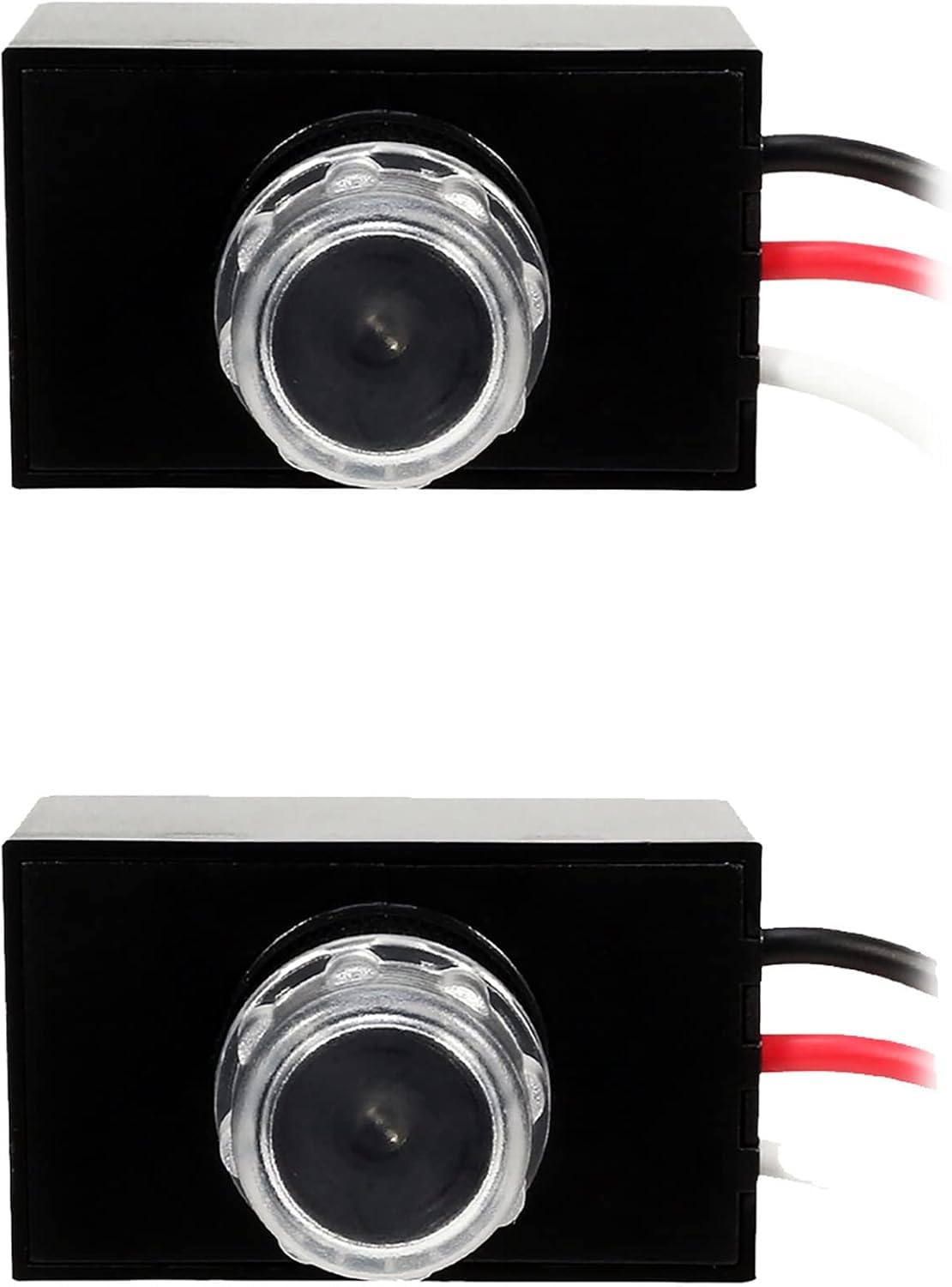
The one with a delay so passing headlights will not flick your lamp off.
IP65 protection is the headline here, and it is worth explaining: that rating means the housing resists dust and low-pressure water spray from any direction, which is exactly what an outdoor post sensor faces in a storm. The powder-coated black body measures 3.34 by 2.36 by 1.96 inches and weighs 3.2 ounces. It mounts on a wall or pole with a 5/8-inch hole, and ships with mounting hardware.
The delay function is the second feature worth knowing. When car headlights, lightning or a passing animal throws brief light at the sensor, the delay stops the switch from bouncing the light off and back on. On a 120V 60Hz circuit it handles 600W of tungsten load or 600VA of ballast load, and works with incandescent, fluorescent, LED, halogen, mercury vapor, high pressure sodium and CFL bulbs.
Several reviewers point out the sensor still running strong into its third year on a driveway light. One recurring gripe in the reviews is a missing rubber gasket, which is annoying but did not stop buyers from finishing the wiring; one even said the diagram was clear enough for someone with zero electrical experience. The UL listing (a safety mark showing the switch was tested to a recognized standard) is the extra reassurance here.
What buyers come back for
- IP65 rating keeps rain and dust out of the housing
- Delay function ignores headlights, lightning and animals
- UL listed and 600W / 600VA rated for a broad bulb mix
Small things to know
- Only one rubber gasket is included even though instructions show two
- Hardwired installation is required, so you need a knockout hole and junction access
Solid pick for: anyone running a wall pack, pole light or driveway head that takes direct weather and wants a trusted safety listing.
Not for: fixtures with no knockout opening — this needs a hardwired mount.
6. nsi Industries TORK RKP203 Outdoor Swivel Mount Photocontrol
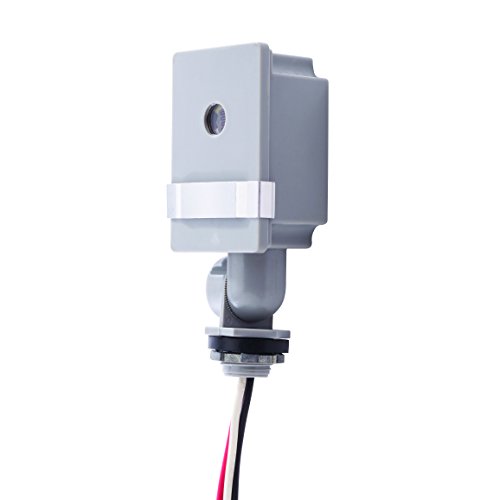
Commercial-grade sensing with a swivel head and a light adjustment bar.
The TORK RKP203 is rated at 120V, 50/60 Hz and handles 2000 watts of tungsten and ballast load — a far heavier duty rating than anything else on this list. That means you can run several lamps off one switch without worrying about the contacts inside.
You can aim the head at the sky without pulling the fixture off the wall, thanks to the swivel base that separates it from fixed-angle sensors. The light adjustment bar lets you dial in the threshold instead of accepting whatever the factory set, and a built-in time delay keeps stray light from cycling the sensor off. The whole unit weighs 4.2 ounces. It uses standard 1/2-inch threading, so it drops into common electrical boxes — one owner even fit it alongside a GFCI (a ground-fault outlet that cuts power on a fault) in a single-gang box.
You get a sensor that holds up, though water can find its way into a fixture housing — the recurring issue is more about the box than the switch, and sealing the housing with caulk solves it. Owners describe two units running on separate light posts with immediate detection and a light-up within 30 seconds of covering the sensor eye. It works with incandescent, compact fluorescent, halogen and LED loads.
Why it stands above: the 2000W rating is more headroom than the average homeowner needs, which is exactly why it lasts in commercial or multi-lamp setups.
What to fix nearby: if your fixture housing fills with water, the sensor is not the failure — caulk and seal the housing so moisture cannot reach it.
Best for: perimeter security lighting, landscape arrays and commercial exterior systems that pull serious wattage.
Look elsewhere if: you want a small screw-in sensor for a decorative post — this is a bigger, heavier-duty part.
7. KUKUPPO 2 Pack Photo Cell Outdoor Light Sensor, Dusk to Dawn
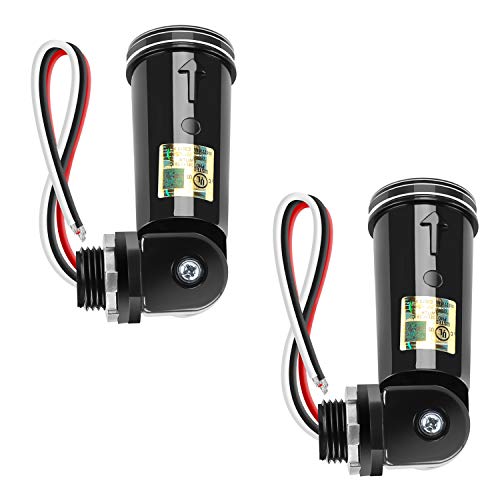
Flicker fix for shaded posts with a swivel head you can aim away.
Shade is the number one enemy of a photocell. If the sensor sits under a tree or in deep shadow, it can mistake a cloudy afternoon for night and flick the lights on. This KUKUPPO pair addresses that with a swivel base and a 30 to 120 second time delay — long enough that a stray animal, headlight or lightning flash cannot bounce the switch.
Electrical specs are solid for a value pick. Input is 100-277VAC at 50/60Hz, loaded for a maximum 500W and 5A. Cross that and the maker says the photocell will burn out, so keep an eye on your circuit. The threaded diameter is 1.06 inches and it mounts with a rubber gasket and zinc alloy lock nut. Operating levels sit at 10-20Lx on and 30-60Lx off — in plain words, a low-light threshold for switching on and a brighter threshold for switching back off.
Owners describe these as reliable for years, though a handful received a defective unit the seller replaced after basic troubleshooting. The recurring note is the flicker problem in shaded spots, and the fix is the same every time: aim the sensor head toward open sky. For HOA-managed lighting or any lighting circuit that gets confused on overcast days, this set is worth the look.
Where it wins
- Swivel base lets you aim the eye away from shade and glare
- 30-120 second delay stops flicker from stray light
- Wide 100-277VAC range covers many fixture voltages
Honest trade-offs
- Shaded install location can still cause cycling on cloudy days
- 5A maximum current — do not oversize the circuit it feeds
Fits the buyer who: has lighting in a shaded spot and needs to be able to aim the sensor head after installation.
Not for: high-wattage circuits or multi-lamp arrays — for those, the TORK RKP203 has the load rating you need.
8. YELLORE 2 Pack Dusk to Dawn Sensor with Swivel Mount

A spare in the box beats a scramble out to the post at dusk.
The biggest quiet benefit of the YELLORE pair is the second unit. Two sensors means a backup on the shelf for whenever the first one finally quits — a smart money move for a part that lives outdoors in rain and snow. The three-year warranty is the longest on this list.
You can wire it into most outdoor power setups, because under the shell it is a 120-277V photoelectric switch (a switch that reads light levels) with UL listing and IP65 water resistance (sealed against dust and water jets). Load rating is 500W tungsten or 850VA ballast, with a threaded diameter of 1.06 inches and operating levels at 10-20Lx on and 30-80Lx off — a slightly wider off threshold than the KUKUPPO above, which can help in changing outdoor brightness. The swivel base lets you position the head after the wiring is done, and the body is a heavy-duty build sealed against rain and snow.
Owners describe the install as a two-wire splice and a base nut tightened down, done in minutes. The most-mentioned topic is the mix of adjustability and value — the swivel head gets praise, so do the two units for the price of a single branded replacement. The clock-drift note is worth knowing: several buyers mention the sensor cycling briefly during the twilight hours, a small trade-off against the setup convenience. The manufacturer includes an installation guide, and if a unit fails, the seller has replaced pairs promptly.
Standout value: a three-year warranty and a two-pack give you double the coverage of a single sensor at the same shelf price.
The honest note: a handful of shoppers say twilight cycling, so check the sensor position after dark on day one.
Best for: buyers who hate coming home to a dark yard and want a backup sensor already in the drawer.
pass on it if: your fixture can only take one sensor and you would rather pay less for a single unit.
9. Riakrum 4 Pack Dusk to Dawn Photocell Sensor for Outdoor Lighting
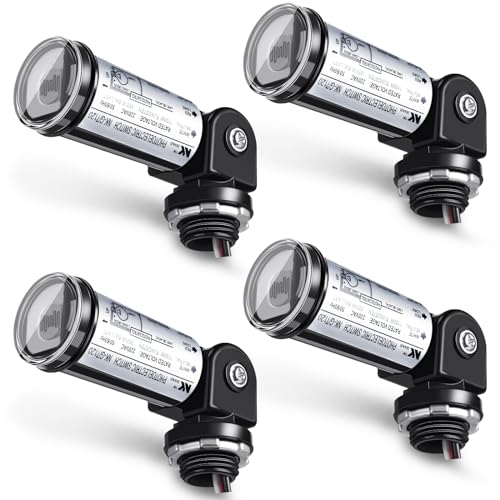
Four sensors for the person who owns four light posts and knows it.
You cover four fixtures in one order with the Riakrum set, which suits the homeowner with a long stretch of matching posts or the landlord outfitting a small property. They run on 120V with a 4A current rating, and the model number is NK-GT120VAC 50/60Hz with the size printed on the listing — so verify dimensions before you buy, since a mismatched form factor is the biggest return reason in this category.
The mounting style is the rotary method — screw the threaded body into the knockout hole and lock it down with a rubber washer and zinc alloy nut. Contact material is brass, which resists corrosion better than soft metals. The angle can be adjusted after installation by rotating the head to aim the sensor eye at clear sky, and the delay function ignores headlights from passing vehicles.
The honest caveat is construction. Durability lands on the negative side of the review spread with several buyers reporting breakage, usually from over-tightening the lock screw on the plastic housing. One owner broke a single unit that way but still praised the set — the extra sensors mean one cracked housing does not end the job. Functionality is the strongest reported point, and the sensors respond faster than many box-style units, which typically hold a three-minute delay. With four units, you pay for a single sensor per fixture what many single-pack units cost alone — but budget for careful tightening.
Why four in one box: for multi-post yards, buying four separates at once lowers the per-post cost and eliminates a second trip to the store.
The build note: tighten the lock screw gently — the plastic housing is the weak point on this model.
Best for: multi-post yards, small rental properties or anyone replacing sensors across several fixtures at once.
Not for: a single post lantern where one good sensor does the job — you would be paying for three spares you may never need.
Understanding the Specs
Voltage Range and Rated Voltage
Voltage is how much electrical pressure the sensor can safely handle. A single-voltage unit like the Southwire Woods at 110V or the Riakrum at 120V is locked to one service. A wide-range unit like the Flutesan, rated 110-220V but working across 100-277VAC, covers far more fixture types. If you are not sure what your fixture runs on, wide-range sensors give you a safety margin. Never assume — always check the old sensor or the transformer first.
Load Rating and Bulb Compatibility
Load rating is the maximum power draw the switch can pass through. Tungsten numbers (500W, 600W, 2000W) describe traditional filament bulbs; ballast numbers (600VA, 850VA) describe the transformer-driven loads inside fluorescent and HID fixtures. Modern LED bulbs draw far less than these ratings allow, so if the sensor matches your voltage, LEDs almost always fit within the load limit. Staying under the rating keeps the switch contacts alive for years.
FAQ
What is the difference between a photocell and a motion sensor?
Will a 120V sensor work on a 240V fixture?
What size hole does a photocell need to mount?
Why does my light flicker on and off at night?
Can I run LED bulbs on a photocell rated for tungsten loads?
How long should an outdoor photocell last?
Does a photocell work with a dimmer switch?
What does a time delay on a photocell actually do?
Can a photocell be mounted facing sideways instead of up?
Do I need a junction box to install one?
Final Thoughts: The Verdict
If you are replacing the photo eye on a landscape transformer, the automatic light sensor worth picking first is the GOODSMANN Photo Eye 9920-9805-01 — it fits the standard non-digital transformer wattages, includes the mounting bracket, and owners describe the swap as a one-minute job. If your fixture has a twist-lock base and sits out in the weather, the Southwire Woods Twist Lock is the clean drop-in for street, lot and driveway heads. When the load is heavy — security lighting, landscape arrays, commercial exterior systems — reach for the nsi Industries TORK RKP203 and its 2000W rating.
How We Picked
We do not accept paid placement. Every pick is matched to a real buyer and a real use-case; we do not hands-on test units.
Sources & Methodology
Specifications: manufacturer listings and product documentation. Review insights: verified customer reviews, as of September 2026. Pricing: not shown on this page (it changes often); check the current price via the retailer link.
As an Amazon Associate, KitchPrep earns from qualifying purchases. This does not affect which products we feature.
Related Guides
