
Specs are compiled from manufacturer listings and verified buyer reviews and can change over time — please confirm the key details on the product page before buying.
If you are buying a 12 Inch Miter Saw, the thing that decides whether you love it or curse it is simple: does the blade hit the same line every single time? A miter saw that cuts square from the start saves you hours of trim work. One that drifts makes every corner joint show a gap. This shortlist sticks to real 12-inch models only, from budget-friendly compound saws up to premium sliding machines, so you can match one to the work you actually do.
I’m Mohammad Maruf — the founder and writer behind KitchPrep. This guide is built by comparing the manufacturers’ published specifications and the patterns across verified customer reviews, so you get each pick’s real strengths and trade-offs instead of marketing spin.
The saws below split into two clear groups: fixed-head compound saws that stay put and lightweight sliding saws that handle wider boards. The real decision point is how you plan to cut your boards, and that is what this guide to the best 12 inch miter saw helps you settle before you spend.
Our Picks at a Glance

How To Choose The Best 12 Inch Miter Saw
A 12-inch blade lets you cut wider stock than a 10-inch saw without the bulk of a 15-inch timber saw, so it suits home shops and job sites. But two 12-inch saws can behave very differently based on three things: whether the head slides, how many stops the miter plate has, and whether the bevel tilts both ways.
Fixed head or sliding head
A fixed-head compound saw cuts straight through stock and never moves, so it is lighter and cheaper to own. A sliding saw runs the motor head forward on rails, which lets it crosscut much wider boards without you repositioning the wood. If you frame decks and trim houses, the slide earns its place. If you mostly cut 2x4s at 90 degrees, you can skip it.
Single bevel versus dual bevel
A single-bevel saw tilts the blade to one side only, so cutting a compound angle means flipping your board to reach the other side. A dual-bevel saw tilts both directions, so long heavy boards stay put while you change the angle. For crown molding and picture-frame miters, dual bevel is the feature that keeps your work day moving.
Quick Comparison
| Model | Best For | Blade Size | Motor (Amps) | Bevel Type | Amazon |
|---|---|---|---|---|---|
| DEWALT DWS715★ Best Overall | Reliable fixed-head trim work | 12 inches | 15 A | Single bevel | Amazon |
| MarvTool Dual-Bevel SliderBudget Champion | Budget DIY framing and trim | 12 inches | 15 Amp | Dual bevel 0-45° | Amazon |
| DOVAMAN DMS03GWidest Crosscuts | Wide cuts with laser guidance | 12 inches | 15 A | Dual bevel | Amazon |
| VEVOR Sliding Compound | Shop space against a wall | 12 inches (30.5 cm) | 15 Amp | Dual bevel 0-45° | Amazon |
| Metabo HPT C12FDHB | Fast repetitive crosscuts | 12 inches | 15 A | Dual bevel | Amazon |
| WEN MM1215 | Small shops and wall placement | 12 inches | 15 Amp | Dual bevel | Amazon |
| DEWALT DWS716 | Precise bevel cuts on trim | 12 inches | 15 A | Dual bevel | Amazon |
| Metabo HPT C12RSH3 | Professional sliding capacity | 12 inches | 15 Amp | Dual bevel 45° | Amazon |
| Makita LS1219L | Weight-carrying capacity jobs | 12 inches | 15 A | Dual bevel | Amazon |
In‑Depth Reviews
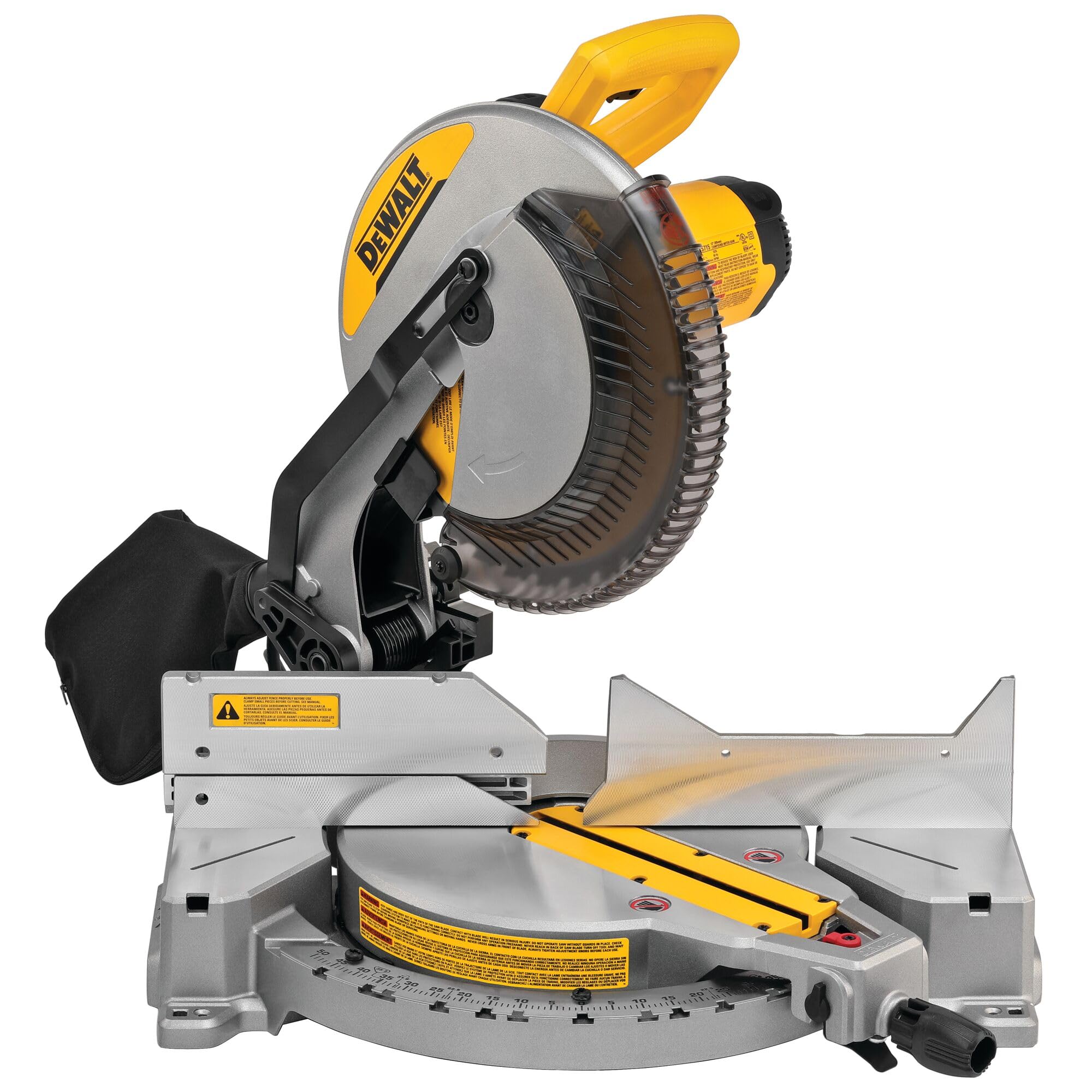
1. DEWALT 12-Inch Miter Saw, 15-Amp, Single Bevel, Compound (DWS715)
Our pick — over 4.5★ from 6,500+ verified ratings; the strongest balance of quality and price.
A 15-amp fixed-head saw with 14 positive stops that cuts baseboard and framing square without a slide to maintain
If your work is baseboard, door casing, and framing lumber, this is the saw that shows up and never complains. The stainless-steel miter detent plate (the ridged metal ring that clicks into set angles) carries 14 positive stops, so you drop the handle into 22.5° or 45° and it locks without hunting around.
A 15-amp motor gives you the standard full-size draw for chewing through thick stock. Buyers report it “cuts hard/softwoods and large stock cleanly,” and the crosscut capacity backs that up: 2-inch x 8-inch dimensional lumber at 90 degrees and 2-inch x 6-inch at 45 degrees. Cutting angle tops out at 90 degrees, which matters because a fixed-head design like this holds its angle with fewer moving parts than a slider. The tall sliding fence supports 5-1/2-inch base vertically, so standing baseboard up against the fence is a normal move, not a workaround. Bevel travel runs 0 to 48 degrees left and 0 to 3 degrees right, so this is a single-bevel saw — the biggest head-to-head against the dual-bevel picks further down is that right-side bevel work means flipping your board over.
Weighing 42.8 pounds, it is 11.1 pounds lighter than the DOVAMAN sliding saw at 53.9 pounds, which means one person can lift it onto a bench without asking for help. The recurring gripe across owner feedback is the included vertical clamp — it works, but it is the one piece people upgrade first. The rest of the feedback reads like a love letter: smooth operation, accurate angles from the angle dial, and a stock blade sharp enough to go to work straight away.
What buyers keep talking about
- 14 positive miter stops lock repeatable angles without fiddling
- 15-amp motor walks through hardwoods and large stock
- 42.8 pounds — lighter than most sliding saws in this list
- Tall fence handles 5-1/2-inch base vertically for trim work
Where it asks for patience
- Single bevel only reaches 0 to 3 degrees to the right
- The bundled clamp is the weakest piece in the box
The call: owns the trim and framing lane — a great first serious saw that holds its angle.
Look elsewhere if: you cut long crown molding in both directions, where a dual-bevel slider makes far more sense.
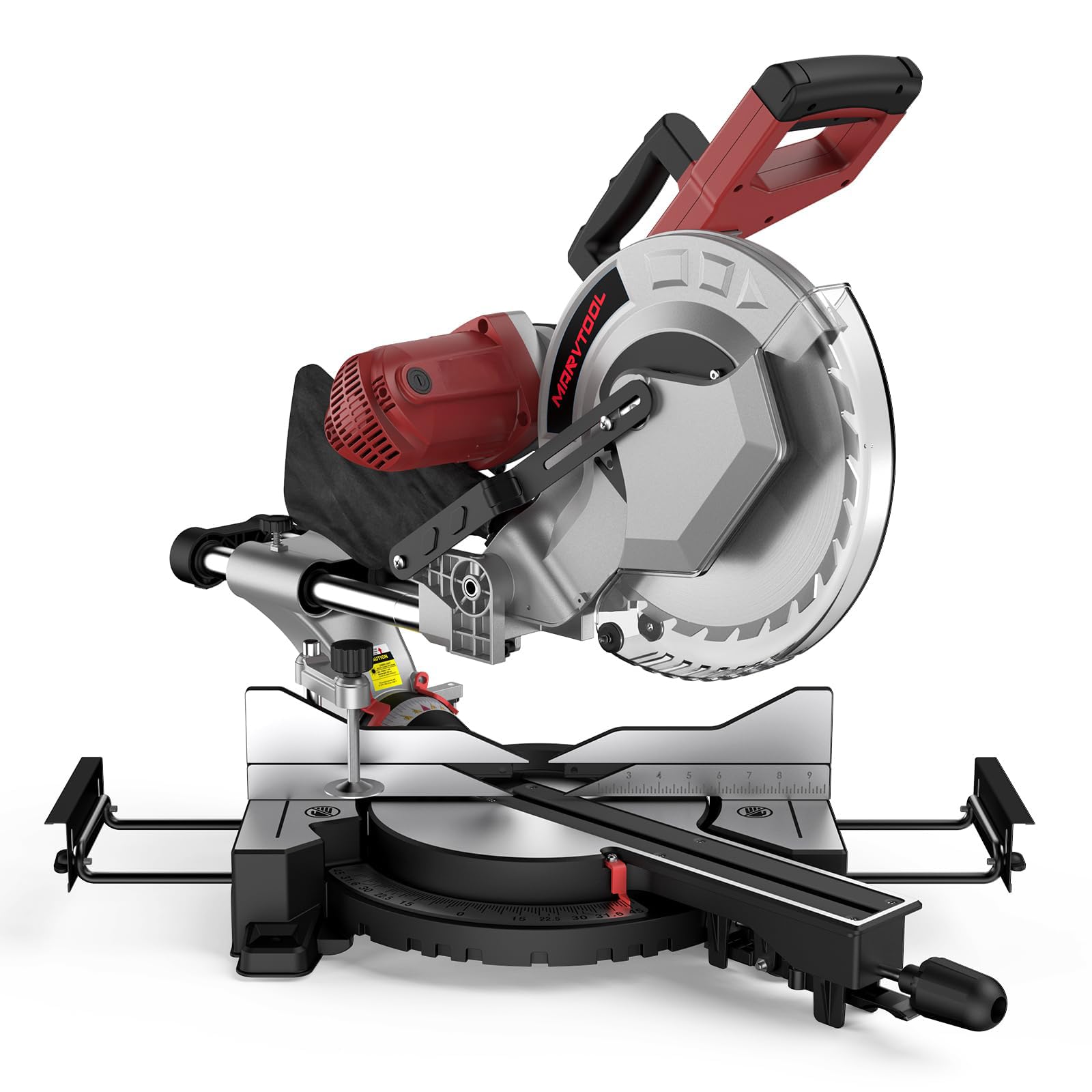
2. 12-Inch Dual-Bevel Sliding Compound Miter Saw, 3800RPM, 15 Amp, Dual Bevel 0-45° with Extension Table, 36T Blade
A 39.6-pound dual-bevel slider with a 36-tooth blade, extension tables, and a 2-year warranty at a fixed-head price
For basement framing and quick trim, this MarvTool saw delivers the two features people usually pay extra for: a sliding head and a dual bevel. The bevel tilts from 0° to 45° on both the left and right, so you never flip a board to reach the far side. The base also adjusts on both sides for compound angle cuts, which is exactly what crown molding and angled joints demand.
At 39.6 pounds, it is the lightest saw on this entire list — and 26% lighter than the 53.9-pound DOVAMAN slider, a gap you feel every time you lift it onto a stand. The head locks into the base with a release knob, so it folds down compactly for storage or tossing in a truck bed. Elsewhere on the bench, it measures 25.3″L x 18.5″W x 20.4″H, noticeably more compact than the 35″L x 22″W x 21″H DOVAMAN.
What wins people over is the value. A buyer using it for basement framing and trim said it was lighter than expected, easy to adjust and lock, and had “no issues.” Another called it “surprisingly fantastic” for trim work, with a pre-installed blade that was ready to cut from the start. The honest trade-off here is a missing laser guide — you line up the cut edge yourself, which is a normal skill for anyone doing trim, just slower at first. A couple of owners had a small plastic piece arrive broken in shipping. The dual-bevel capacity remains the headline: right-bevel cuts without flipping the stock.
Why it earns its spot
- Dual bevel 0° to 45° left and right saves board-flipping
- 39.6 pounds — the lightest saw in this lineup
- 36-tooth blade pre-installed and ready to cut
- Includes two extension tables and a 2-year warranty
What you give up
- No laser guide — you align the cut edge by eye
- A small plastic shipping part has arrived broken for some
Reach for this if: you need a dual-bevel, sliding saw for DIY framing and trim at the entry point of the market.
The limit: the missing laser guide slows your first few weeks until you trust your marking.
3. DOVAMAN 12-Inch Dual-Bevel Sliding Compound Miter Saw, 15-Amp
A 15-amp slider with a 4.2″ x 13″ crosscut capacity, 9 positive stops, and a laser guide for wide posts and compound angles
The sliding rail system lets this saw crosscut up to 4.2″ x 13″ in a single pass — wider stock than any fixed-head saw in this list can manage without repositioning the board. A 15-amp pure copper motor spins the blade up to 3800rpm for hardwoods and softer woods alike, and the dual-bevel head handles 45-degree climbs on both the horizontal and vertical planes.
Where this saw separates itself from the budget sliders above is the angle hardware. There are 9 positive stops built into the base, including the common 0°, 15°, 22.5°, 30°, and 45° positions on both sides. A laser guide rides along to mark the cut path. And the switch design includes a safety lock with the trigger reachable from both left and right hands, so you do not have to swap hands mid-project.
Power and honesty: a buyer who put it through a 20×20 deck build said it was “great for the money” and had held up. Another said the cut it makes is “quieter than my last one” and handles 1×12 easily. The recurring gripe is the blade lock mechanism, which owners mention cannot be fully locked in place — long-term durability is where the verdict splits. One owner’s plastic handle broke off mid-project. The main knock for trim work is the stock 40-tooth blade, and the fix is a finer replacement. Weighing 53.9 pounds at 35″L x 22″W x 21″H, this is the heaviest and widest saw on the bench-top picks, so plan the space before it arrives.
The sliding advantage: the 4.2″ x 13″ cutting capacity, 9 angle presets, and a laser guide give you more material flexibility than the fixed-head DEWALT above — and the dual-bevel head eliminates the board-flipping step entirely.
The honest catch: the blade lock has been a hard stop for some owners, and the 53.9-pound frame plus 35-inch width makes it a bench-friendly tool, not a grab-and-go one.
Good match for: anyone cutting wide posts and compound angles who wants both a laser guide and dual-bevel in one saw.
Bypass it if: you need a light, mobile saw for a job site — the weight and blade-lock complaints work against you.
4. VEVOR Sliding Compound Miter Saw, 12-Inch Blade, 15 Amp Motor, 60-Tooth
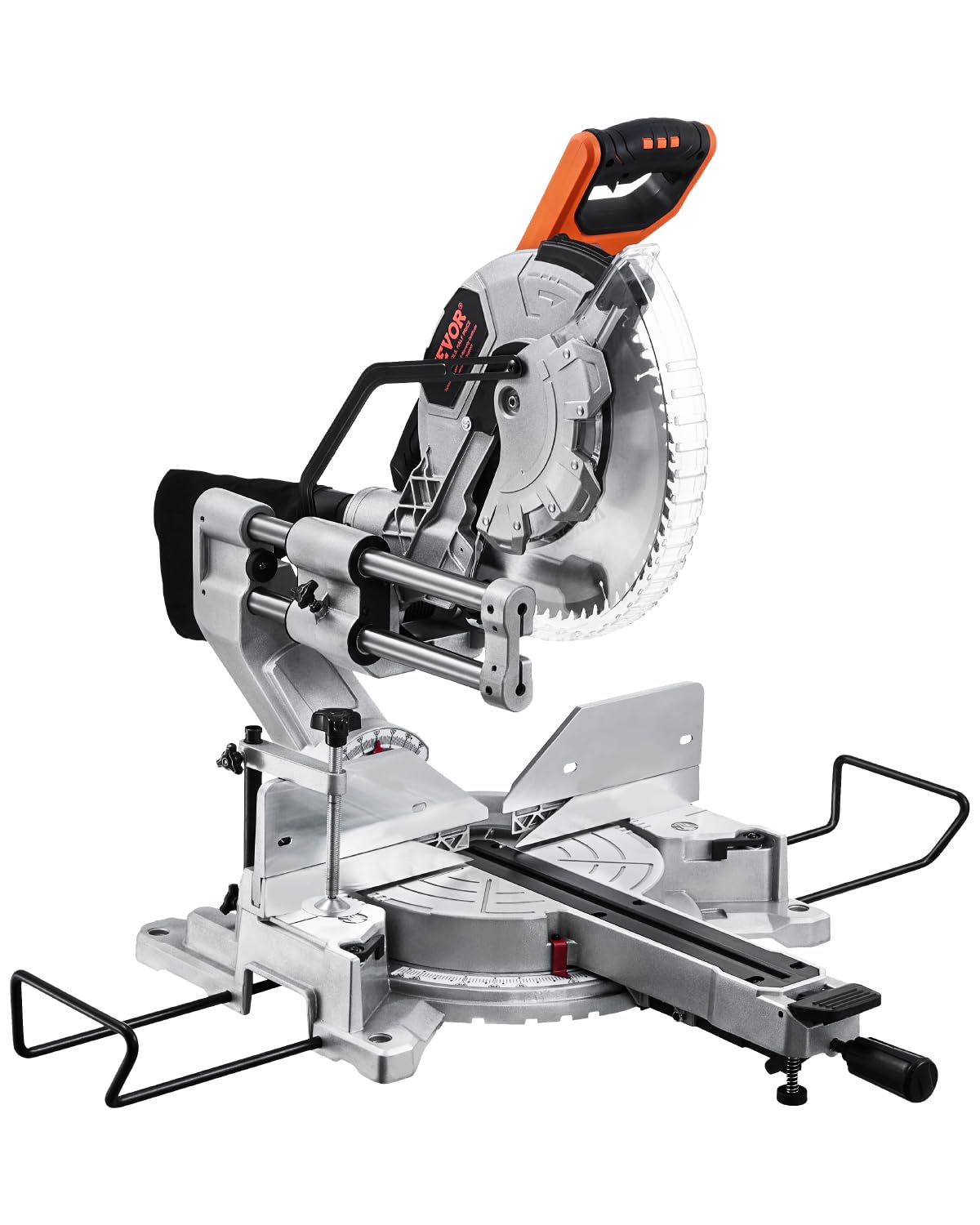
An axial-slide saw that travels in place, so it sits flush against a shop wall without rear clearance
Most sliding saws need clearance behind them because the head travels backward. This VEVOR uses an axial sliding system that moves the head forward and back in place, so the whole machine can be pushed flush against a wall. If your workshop is a bench in a garage, that single design choice is worth more than any spec sheet. The aluminum base adds to the story: it is lighter than a traditional cast-iron base, so moving the saw around the shop is easier, and it dissipates heat so the saw can run steadily through long cutting sessions.
Cutting capacity is generous. With a 60-tooth blade turning up to 5000RPM, the LED guide system projects a cutting line directly onto the wood so you can line up each cut without guesswork. The 15-amp motor runs 2500W for straight cuts and 3000W for bevel cuts, and the motor handles all types of hardwood with a bevel range of 0° to 45° in both directions. Owners describe the light quality as high and the value as strong for the money it costs. The 60-tooth blade gets specific praise for coming from the start able to cut cleanly.
The recurring gripe is the dust system: the included bag fills fast and can clog on softwoods, so most owners eventually hook up a shop vac. Mobility is a mixed bag — the saw is manageable but heavy, and the plastic knobs are the pieces most likely to wear over time. The heavy-duty cutting headline is real, though: with the higher bevel power and the 5000RPM blade speed, this is one of the few saws in this list built to run continuously on demanding work.
Standout strengths
- Axial slide travels in place — saw can sit flush against a wall
- 60-tooth blade spins up to 5000RPM for smooth cuts
- 2500W straight / 3000W bevel power for continuous use
- LED guide system projects the cut line onto the wood
The trade-offs
- The included dust bag is small and clogs on softwood
- Plastic knobs are the parts most likely to wear over time
Perfect for: a small shop where the saw has to live against a wall and run through long hardwood cuts without overheating.
Skipping it makes sense if: you need top-tier dust collection straight from the box — plan on a shop vac from day one.
5. Metabo HPT 12-Inch Compound Miter Saw | Xact Cut LED Shadow Line System | Dual Bevel | C12FDHB

A 4,300 RPM head with the Xact Cut LED Shadow Line System, which shows the blade kerf in any light
Most 12-inch saws on this list spin at 3800RPM or so, but this Metabo HPT 15-amp motor runs a no-load speed of up to 4,300 RPM. On repetitive crosscuts, that extra blade speed means less drag through the wood and a faster feed rate. The Xact Cut LED Shadow Line System projects the actual blade position as a shadow on the material, which owners find easier to trust than a laser line because it shows the blade kerf rather than guessing at it. It works in any lighting condition, including a bright job site.
Raw cutting capacity is bigger than the fixed-head DEWALT above. This saw cuts up to 7-inch material vertically and 7-1/2-inch material nested against the sliding fence — that vertical number is what lets you stand tall baseboard up and cut it in one pass. The miter range runs 0-52° to the right and left with detent stops at 0°, 15°, 22.5°, 31.6°, and 45°. The dual-bevel head reaches 0-48° both left and right, with positive stops at 0°, 33.9°, and 45°. A large table supports long stock, and a vice clamping system holds it steady.
At 44 pounds, it splits the weight difference neatly between the 42.8-pound DEWALT and the heavier sliders. Owner feedback is overwhelmingly positive on power — cutting through 4×4 posts gets compared to cutting through butter. The recurring gripe is the side rails: they are not included, so you supply your own material supports. One owner reported a base plate cracking on a small cut, a rare enough event that it reads as a unit-specific issue rather than a design pattern.
The speed case: 4,300 RPM no-load speed leads the list, paired with a shadow-line cut guide that works in bright light where laser dots disappear.
What to know: side rails are not in the box, and one owner saw a base plate crack on a small cut — a single-unit event, but worth a careful unboxing inspection.
Best for: a builder cutting tall base vertically and needing the fast-repeating crosscut speed of a 4,300 RPM head with a shadow line guide.
And not for: anyone who expects side rails in the box, since you will source your own stock supports.
6. WEN MM1215 15-Amp 12-Inch Dual Bevel Sliding Compound Miter Saw with LED Cutline

A dual-rail front-slide frame that lets a bench-top saw sit flush against a wall with no rear clearance
Anyone who has owned a rear-slide saw knows the pain of needing a foot of clearance behind the bench. The WEN MM1215 solves that with a dual-rail slide system that runs forward instead of back, keeping a compact footprint so the saw can sit flush against a wall. It crosscuts boards up to 13.25 inches wide and 4.5 inches thick, and the dual-bevel head bevels or miters up to 45 degrees in either direction with 9 miter stops.
The 15-amp motor and 80-tooth carbide-tipped blade (1-inch arbor, model BL1280) are the standout combination. A higher tooth count means smoother, cleaner edges on trim, which is exactly where a sliding saw usually gets pressed into duty. The onboard LED cutline guide lights your cut so you can align the line before lowering the head. from the start you get two quick-lock table extension support arms, two adjustable support fences, a quick-clamp assembly, a dust port, a dust bag, a carrying handle, and a two-year warranty.
Feedback is honest and split. Owners who cut decks and framing love the front-slide compactness and say the shadow line is accurate to 1/16 inch. One detailed feedback note praised the motor for running half as loud as a Harbor Freight equivalent but flagged that long cuts over 8 inches deflect, the right fence was off at 90°, and the bevel is not repeatably accurate over 6-8 inches. The blade installation job is not quite turnkey, and the dust collection is weak enough that a shop vac is a better partner than the included bag. Treat it as a solid general-trades saw rather than a precision cabinetmaker’s tool.
Where it shines
- Dual-rail front slide runs flush against a wall
- 80-tooth carbide blade cuts trim smoothly
- 13.25-inch crosscut width and 4.5-inch thickness
- 9 miter stops with LED cutline for quick alignment
What to plan for
- The included dust bag needs a shop vac upgrade
- Long cuts over 8 inches can deflect on this frame
- The bevel is not repeatably accurate over 6-8 inches
Ideal for: home shops with no room behind the bench that still want sliding crosscuts up to 13.25 inches on general building work.
Choose another saw instead if: your projects demand repeatable bevel precision beyond 6-8 inches — this one earns its keep best at framing and trim scale.
7. DEWALT Miter Saw, Double-Bevel, Compound, 12-Inch, 15-Amp (DWS716)

A fixed-head DEWALT with dual bevel 0-48° and a tall fence that nests 6-5/8-inch crown molding
If you want DEWALT build quality in a fixed-head saw but need to bevel both ways, this is the step-up from the DWS715. The double-bevel design tilts 0-48° to the left and right with positive stops at 0°, 22.5°, 33.9°, and 45°, so crown molding and baseboard work in both directions without flipping the board. The stainless-steel miter detent plate keeps the same 14 positive stops, and a cam lock miter handle with detent override lets you move quickly between common angles.
The tall sliding fences are the hidden giant here. They support crown molding up to 6-5/8-inch nested and base molding up to 6-1/2-inch vertically against the fence — genuinely taller capacity than the DWS715 above, which supports base up to 5-1/2-inch vertically. Miter capacity runs 0-50° left and right, so you can cut past the standard 45° corner when the geometry demands it. Owner feedback describes a whole room of baseboards cut without difficulty and performance matching more expensive models. The adjustability receives mixed notes — this is not a saw that arrives and needs zero setup.
At 48.3 pounds, it is heavier than the single-bevel DWS715 at 42.8 pounds but lighter than the sliding DOVAMAN at 53.9 pounds. The one real asking price is time: owners suggest planning roughly an hour of tune and alignment to hit precision, because the factory calibration is close but not always perfect. The payoff is a saw that holds its angle for years without a slide to maintain.
Why it earns the upgrade: the 6-5/8-inch crown and 6-1/2-inch base capacity is the tallest vertical cut in the fixed-head class, and dual-bevel 0-48° means no board-flipping for compound angles.
The reality check: plan about an hour of tune and alignment after unboxing, and expect a 48.3-pound chassis that stays put on the bench rather than moving around a job site.
Nails it for: trim carpenters who need dual-bevel flexibility and tall crown capacity but do not want a slide to maintain.
Not the pick for: anyone wanting to pull the saw out of a truck daily — the fixed-head frame and weight resist easy transport.
8. Metabo HPT 12-Inch Dual Bevel Sliding Miter Saw, C12RSH3
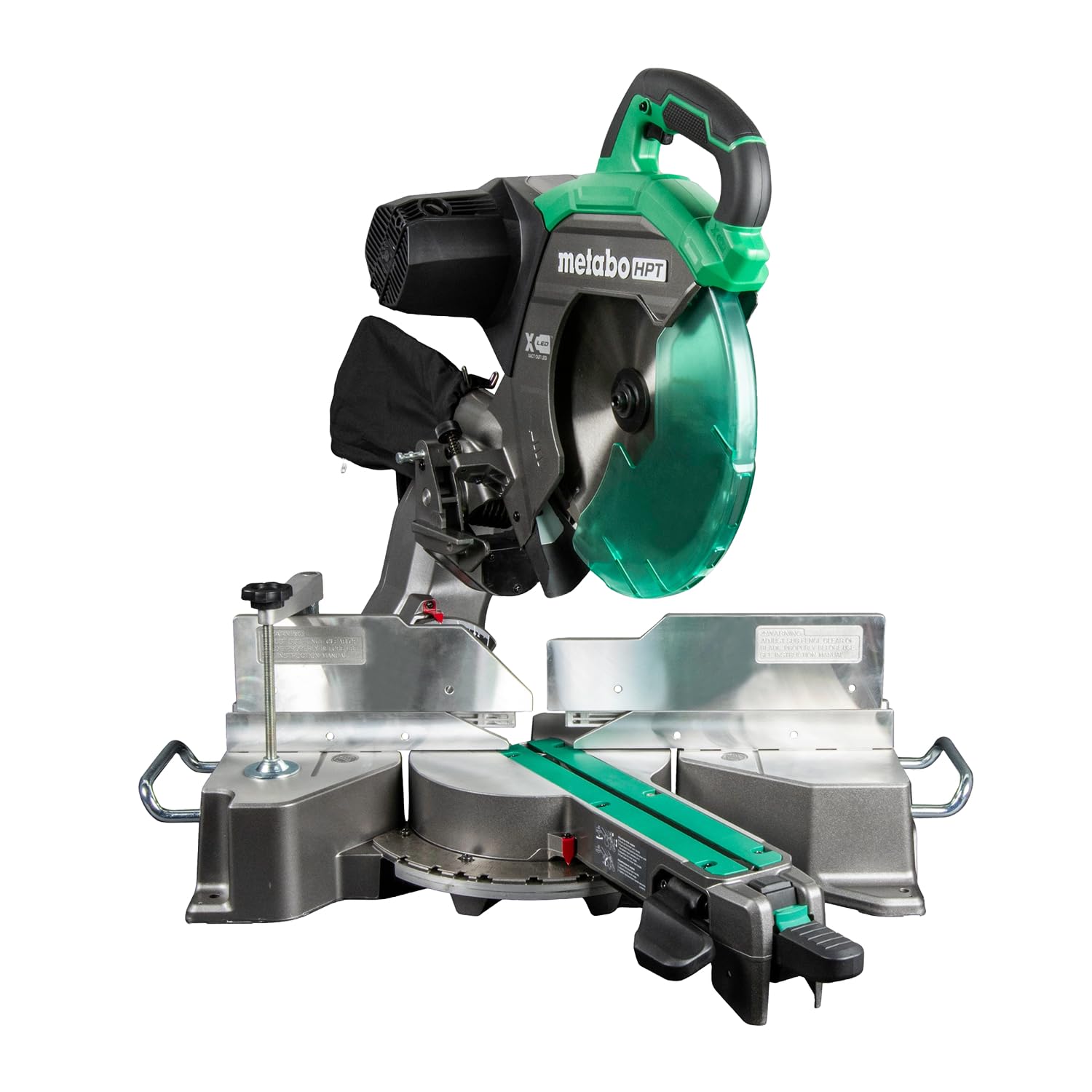
A forward-rail professional slider that cuts square from the start and shrugs off tight benches
This is the saw for a narrow bench. The forward rail system runs compact, and owners described it as easily fitting a narrow bench while cutting square straight from the start — an especially strong claim given how heavy these sliders can feel. The 12-inch dual-bevel head runs a no-load speed of up to 4,000 RPM and delivers a bevel range of 45° to the left and right. There are 9 miter detent stops for quick angle changes.
The Xact Cut Shadow Line puts a clear mark on the cut line, working in any lighting condition and giving more visibility than a laser in bright light. The miter angle range is 0-45° to the left and 0-57° to the right, so you can reach past standard 45s on right-hand cuts — a genuinely useful detail for odd framing angles. A one-touch bevel and miter lock lets you move quickly between angle positions, and the adjustable miter scale keeps things honest over time. At 53.6 pounds, it is in the same weight class as the DOVAMAN slider above at 53.9 pounds.
The recurring honesty point is the slide. Customers note that the sliding mechanism is not always perfectly smooth and can catch a bit if debris gets on the rails — a maintenance item rather than a flaw. The soft start keeps torque from jerking the saw when you trigger it. Two details cut both ways: the LED cut line stays on with no on/off switch, which some like for visibility; and the dust hookup needs a rubber coupler or hose clamps for a shop vac connection. The 5-year warranty is the headliner.
What earns the price
- Forward rail system fits narrow benches
- 0-45° left and 0-57° right miter range
- Soft start stops the torque jerk on trigger pull
- 5-year warranty backs the professional build
Where it asks for care
- The slide can catch and needs debris kept off the rails
- The LED cut line has no on/off switch
- Dust hookup needs a rubber coupler or hose clamps
Matches well with: a pro who wants forward rails, wide right-hand miter capacity, and a Japanese-engineered build with a long warranty.
Move past it if: you need a shop-vac hookup straight from the start — the dust port needs an adapter on your end.
9. Makita LS1219L 12″ Dual-Bevel Sliding Compound Miter Saw with Laser

The two-rail precision slider built for big horizontal cuts and tall crown work
This Makita is the saw for anyone cutting large stock on a regular basis. The unique 2-steel rail sliding system runs a single slide-glide action that reduces the saw’s footprint enough to operate flush against a wall — the compact footprint means you can set up against the shop wall and still crosscut 15 inches at 90 degrees. Capacity above that is where the price tag gets real: the LS1219L supports up to 8-inch crown molding vertically nested and 6-3/4-inch baseboard vertically.
The dual dust collection ports mean extraction keeps up in a way most saws in this list only get partway toward. The direct drive motor and guard system is engineered for 6-3/4-inch vertical cutting capacity, so tall base runs through in one pass. The in-front bevel lock is where you want it — no reaching around the machine to change angles. A 12-inch 60-tooth micro-polished blade, hex wrench, vertical vise, and dust bag are all included.
The honest caveat is weight. At 81.6 pounds, this is by far the heaviest saw here — well over the 53.9-pound DOVAMAN and the 44-pound Metabo HPT C12FDHB, and not the machine anyone moves alone. Accuracy feedback is strongly positive: reviewers point out the saw arrives square and holds accuracy on real projects. Some owners describe needing a small tune-up on the bevel zero position from the start. The aluminum detent plate is a wear point owners flag — ease the pin in gently rather than snapping it home. For a permanent bench with a shop vac and room for a heavy saw, this is the pick that stops the upgrade itch.
Top-tier performance
- 15-inch crosscuts at 90 degrees in a flush-against-wall design
- 8-inch crown and 6-3/4-inch base capacity in one pass
- In-front bevel lock keeps adjustment reaches short
- Dual dust collection ports keep extraction strong
The real caveats
- 81.6 pounds — this is a bench saw, not a tote-along
- Aluminum detent plate is a long-term wear point
- Small out-of-box tune-up may be needed for zero bevel
An easy fit for: a pro cabinetmaker or trim carpenter cutting 8-inch crown and 15-inch crosscuts on a permanent bench.
A hard pass if: portability matters — at 81.6 pounds this is a bench-mounted machine that earns its space with truckload-scale output.
Understanding the Specs
Motor amperage and RPM
A 15-amp motor is the full-size standard for a 12-inch saw, which is why so many of the saws here run 15 A. The number tells you the saw can hold speed when the blade hits thick stock without bogging down and leaving burn marks. No-load RPM is the blade’s top free speed, and it shapes how fast you can feed a board and how smooth the cut finishes. A 4,300 RPM head like the Metabo HPT C12FDHB pushes through repetitive crosscuts faster than a 3,800 RPM unit, though the higher speed is not a substitute for a sharp, well-matched blade.
Bevel: single versus dual
Bevel is the blade tilting sideways off a 90-degree cut. A single-bevel saw tilts one direction only, so switching sides on a compound cut means rolling the board — fine for a home shop cutting shorter pieces. A dual-bevel saw tilts left and right, which matters when you are working with a long, heavy board that you would rather not move. Pay attention to the actual bevel range, because it is not always symmetrical. Some saws reach 0-48° both ways with positive stops, while others only manage 0 to 3 degrees to one side.
FAQ
What does a sliding miter saw do that a fixed-head one cannot?
Can a 12-inch miter saw cut a 6×6 post?
Is dual bevel really worth the extra cost over a single bevel saw?
What is the difference between a laser guide and an LED shadow line on a miter saw?
How many teeth should the blade on a 12-inch miter saw have?
Do I need positive stops on a miter saw for accurate angles?
How much does a 12-inch sliding miter saw weigh?
Can I put a different blade on a 12-inch miter saw?
Do these miter saws cut metal and plastic, or only wood?
Is a 12-inch miter saw too big for occasional home projects?
Which miter saw has the highest crosscut capacity for wide boards?
Why does my new miter saw cut slightly off square from the start?
Final Thoughts: The Verdict
For most home shops and light job sites, the 12 inch miter saw winner is the DEWALT DWS715 because it pairs a 15-amp motor and 14 positive stops with a 42.8-pound frame — the lightest of the fixed-head saws and light enough that trimming baseboard becomes a one-person job. If you want the dual-bevel capacity for crown molding and matched miters, grab the DEWALT DWS716 for its 6-5/8-inch crown and 6-1/2-inch base clearance. And for large cuts and shop-vac-level dust control with 8-inch crown capacity, the Makita LS1219L is the one to reach for. That top pick holds a 4.8-star rating across nearly 7,000 owners, and its feedback is why it sits first here.
How We Picked
We do not accept paid placement. Every pick is matched to a real buyer and a real use-case; we do not hands-on test units.
Sources & Methodology
Specifications: manufacturer listings and product documentation. Review insights: verified customer reviews, as of September 2026. Pricing: not shown on this page (it changes often); check the current price via the retailer link.
As an Amazon Associate, KitchPrep earns from qualifying purchases. This does not affect which products we feature.
Related Guides
