
Specs are compiled from manufacturer listings and verified buyer reviews and can change over time — please confirm the key details on the product page before buying.
An automatic lamp timer lets your lamps switch themselves on at dusk and off when you’re already asleep — no more walking room to room flipping switches. The one that suits most homes is the GE 24-Hour Plug-in Mechanical Timer: it holds 4.6 stars across 14,000+ ratings, runs on simple 30-minute pushpins, and needs no app, no Wi-Fi, and no learning curve. If quiet matters more than anything, the DEWENWILS digital model is the near-silent alternative, and if you want lights that follow the actual sunset, the myTouchSmart does that automatically. This guide covers all nine picks and the differences that decide which one lands on your wall.
I’m Mohammad Maruf — the founder and writer behind KitchPrep. This guide is built by comparing the manufacturers’ published specifications and the patterns across verified customer reviews, so you get each pick’s real strengths and trade-offs instead of marketing spin.
Most timers look alike on a shelf, yet they split into three clear families: mechanical dial timers with pushpins, digital push-button models with battery backup, and sun-tracking units that follow your local daylight. Matching the family to your lamp and room decides which best automatic lamp timer you should buy.
Our Picks at a Glance
How To Choose The Best Automatic Lamp Timer
Three things decide whether you’ll love your timer or resent it: how you set it, whether it forgets your schedule when the power blinks, and whether it stays silent in the room where you sleep.
Mechanical Pushpin Or Digital Push-Button
A mechanical timer runs on a physical dial with tiny pins you push down for “on” and leave up for “off”. It never needs programming, but the pin spacing sets how precise you can be — a 30-minute interval dial rounds your chosen time to the nearest half hour. A digital timer swaps pins for buttons, so you can pick an exact minute. Digital models like the HBN support schedules as short as one minute, which matters if you’re running a grow light or a kitchen appliance on a tight window rather than a living-room lamp.
What Happens When The Power Goes Out
This is the quiet dealbreaker most buyers only notice after the first storm. A plain mechanical dial keeps ticking on its own internal spring or motor, so it simply resumes — but a digital timer without backup wipes its stored schedule and waits for you to reprogram it. Several electronic models here carry a battery that holds settings through an outage so your lamps pick up where they left off instead of sitting dark.
Noise, Outlet Space, And Where It Hangs
A mechanical timer’s motor can produce a faint constant hum or a soft winding sound, which is fine in a hallway but grating three feet from a pillow. Digital units switch without that drone. Also check the body size before you commit: a bulky plug-in can cover the wall outlet next to it, so a slim profile keeps your second socket usable. Every timer on this list is rated for indoor use only, and you’ll want the lamp’s own switch left in the On position so the timer controls the current at the socket.
Quick Comparison
| Model | Best For | Interval | Outlets | Power Rating | Amazon |
|---|---|---|---|---|---|
| GE 24-Hour Plug-in Mechanical Timer★ Best Overall | Best Overall | 30-minute | 2 grounded | 15A | Amazon |
| BN-LINK Timer Outlet, 2 PackMulti-Pack Value | Multi-Pack Value | 30-minute | 2 grounded | 15A / 1875W | Amazon |
| DEWENWILS Indoor 24 Hour Digital TimerQuiet Bedrooms | Quiet Bedrooms | Daily programs | 2 grounded | 15A / 1000W tungsten | Amazon |
| Intermatic TN311K | Longest Service Life | 3 ON / 3 OFF trippers | 1 grounded | 15A inductive | Amazon |
| HBN Outlet Timer | Most Programming Options | 1-minute | 2 grounded | 15A / 1875W | Amazon |
| myTouchSmart Plug-in Digital Timer | Sun-Tracking | Custom on/off | 1 grounded | 15A / 1875W | Amazon |
| OSKOS 2-Pack Indoor Digital Timer | Two-Room Coverage | Daily repeat | 1 always-on + 1 timed | 15A / 1875W | Amazon |
| NSi Industries TORK RTN312 | Heavy-Duty Loading | 2 ON / 2 OFF trippers | 2 grounded | 15A / 1800W | Amazon |
| ENERLITES 8-Hour Countdown Timer | Push-Button Countdown | 15, 30 min, 1/2/4/8 hr | 1 outlet | 15A / 1200W tungsten | Amazon |
In‑Depth Reviews
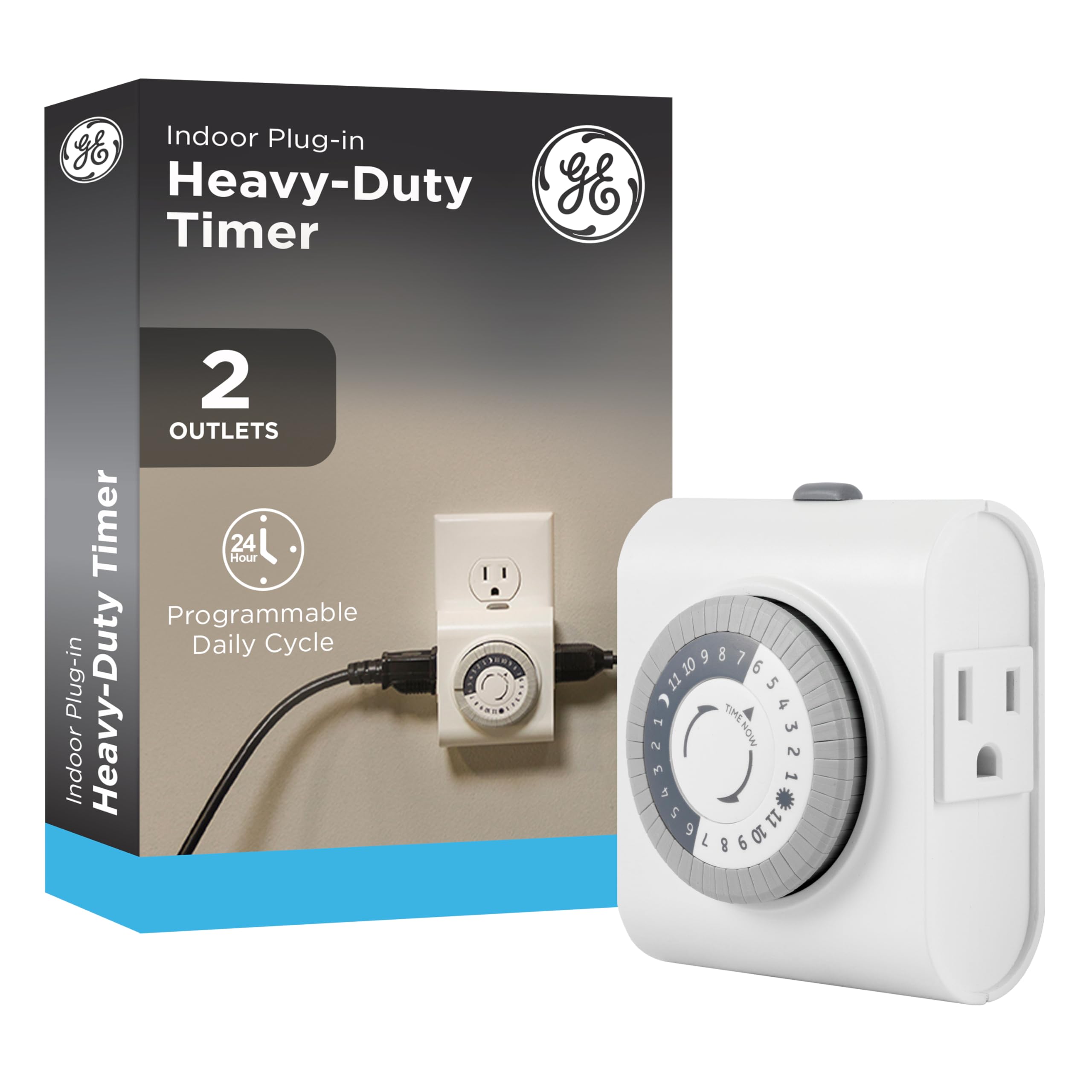
1. GE 24-Hour Plug-in Mechanical Timer Outlet, 2 Grounded Outlets
Our pick — over 4.5★ from 14,000+ verified ratings; the strongest balance of quality and price.
The no-fuss dial timer that automates two lamps at once without an app in sight.
If you want your living-room lamps on a dependable daily rhythm and you’d rather not fiddle with menus, this is the pick to beat. You set the on and off times by pressing down little pushpins spaced every 30 minutes, turn the dial until the arrow points at the correct time of day, and that schedule repeats on its own every single day. Two grounded outlets sit on the face, so one timer runs two three-prong lamps at once — handy when a matched pair of side-table lamps should switch together. It’s rated for a 15-amp load (15 amps is the amount of electrical current it can handle), which comfortably covers basic lamps, fans, and seasonal décor, and it plugs straight into any indoor outlet with no wiring involved.
What earns its reputation is steady, uncomplicated performance: the timing holds accurately to the hour and half-hour, and a top override switch lets you pause the automatic cycle whenever you want a lamp on right now without disturbing your saved schedule. That switch is the small feature people end up using most, because it means a late movie night doesn’t force you to reprogram anything. Where this dial timer separates from a digital model is durability and price-to-simpleness — there’s nothing to lose, nothing to reset, and no settings to remember. It’s also tiny next to the heavy-duty NSi TORK RTN312, whose listed body measures 30″D x 8″W x 6″H against this one’s 2.7″D x 3.4″W x 3.4″H.
Where It Wins
- Two grounded outlets run a pair of lamps from a single plug-in.
- Override switch pauses the schedule without erasing it.
- Pushpin programming needs no app, Wi-Fi, or instructions.
- Compact 2.7″D x 3.4″W x 3.4″H body tucks against the wall.
Where It Trails
- The internal motor can emit a faint winding hum, so it isn’t the pick for a bedside table.
- Half-hour pin spacing rounds your chosen time to the nearest 30 minutes.
- Indoor use only.
Snap it up if: you want two lamps automated on a rock-solid daily loop with zero setup fuss.
Think twice if: the lamp sits within arm’s reach of your pillow, where a mechanical motor’s soft drone will get noticed.
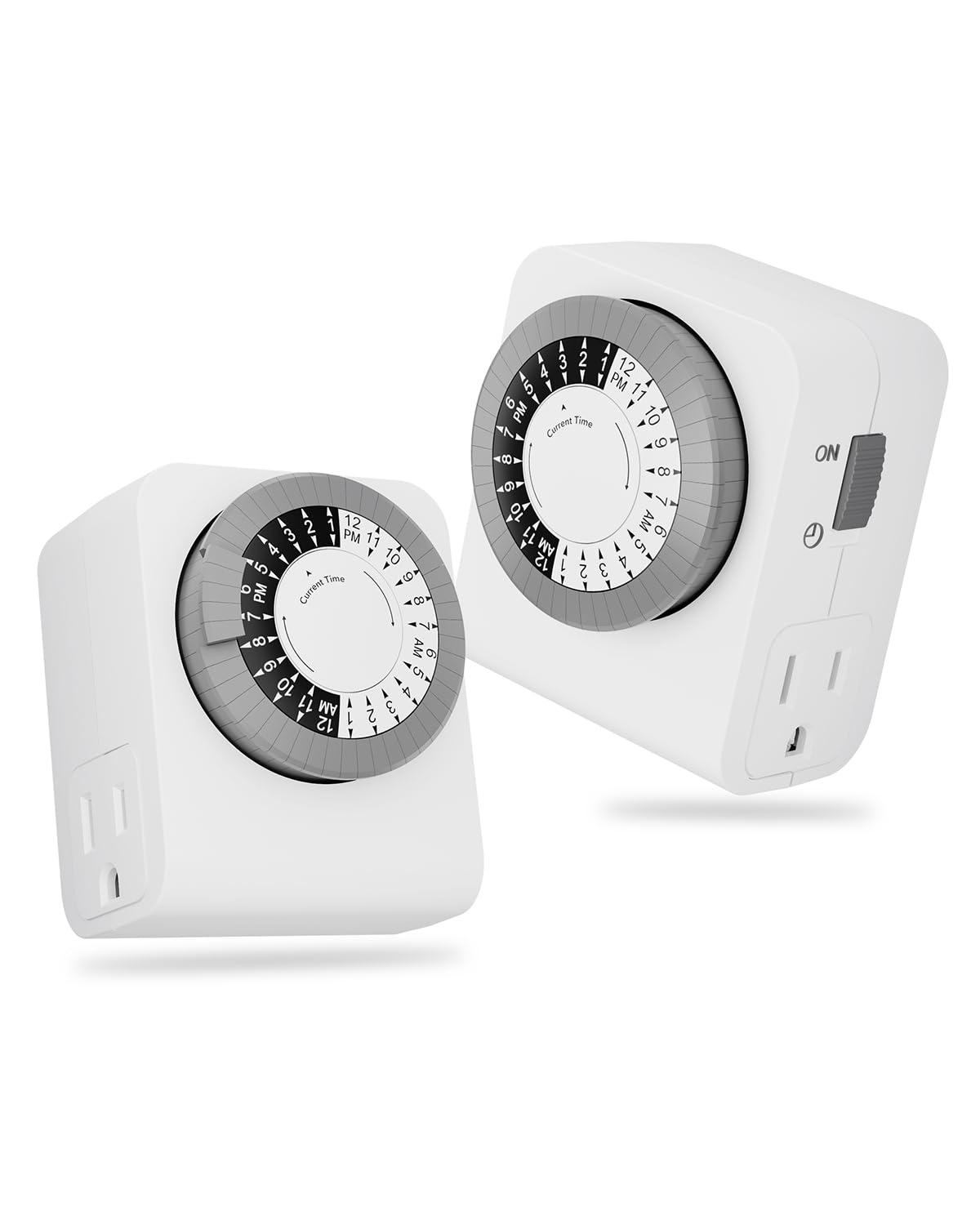
2. BN-LINK Timer Outlet with 2 Grounded Outlets, 2 Pack
Two identical dial timers in one box, so both ends of the house get automated at once.
Buying a timer one at a time gets old fast when you’ve got a lamp in the den and another in the hallway. This two-pack solves that in a single order, and each unit runs a straightforward pushpin dial. You get up to 48 on/off settings in 30-minute intervals on each timer, and once you’ve pressed the pins down they repeat daily with no resetting. The unit ships with all pins down by default, so you simply pull up the ones you want for “off” and leave the rest for “on” — a slightly different fingerprint from the GE, which starts the opposite way. The polycarbonate housing is rated to a 125VAC, 60Hz, 1875W, 15A load (125 volts AC, 60 hertz, 1875 watts, 15 amps — the electrical capacity it can handle), enough for lamps, fans, coffee machines, and string lights.
The design leans practical: the body measures 2.6″D x 1.61″W x 3.15″H, so it stays out of the way of an adjacent socket, and the dual grounded outlets let you run two devices on one schedule. Owners consistently report these run quietly — a pleasant surprise if you’ve been living with a louder mechanical hum — and the versatile side really shows up around the holidays, when two lamps or a Christmas tree and a window light can share one program. A 12-month warranty backs each unit. The recurring gripe worth knowing: the time slots are narrow enough that pushing a pin down may call for a thin tool or a fingernail rather than a fingertip, and the manual override switch is your quick way around that when you just want light now.
The two-pack math: if a single timer automates one foot-and-a-half stretch of a room, this order puts two more rooms on a schedule at once — and beats the GE on the sharpest detail for multi-room buyers: two complete units in hand instead of one.
The honest catch: those slim pins demand a bit of patience during first setup, and this is still a spring-wound mechanical mechanism, so budget-space it away from the quietest rooms.
Reach for this if: you’re automating more than one room and want two timers for the price of one trip.
Look elsewhere if: you need pinpoint minute-level scheduling — a digital push-button timer gives you that instead.
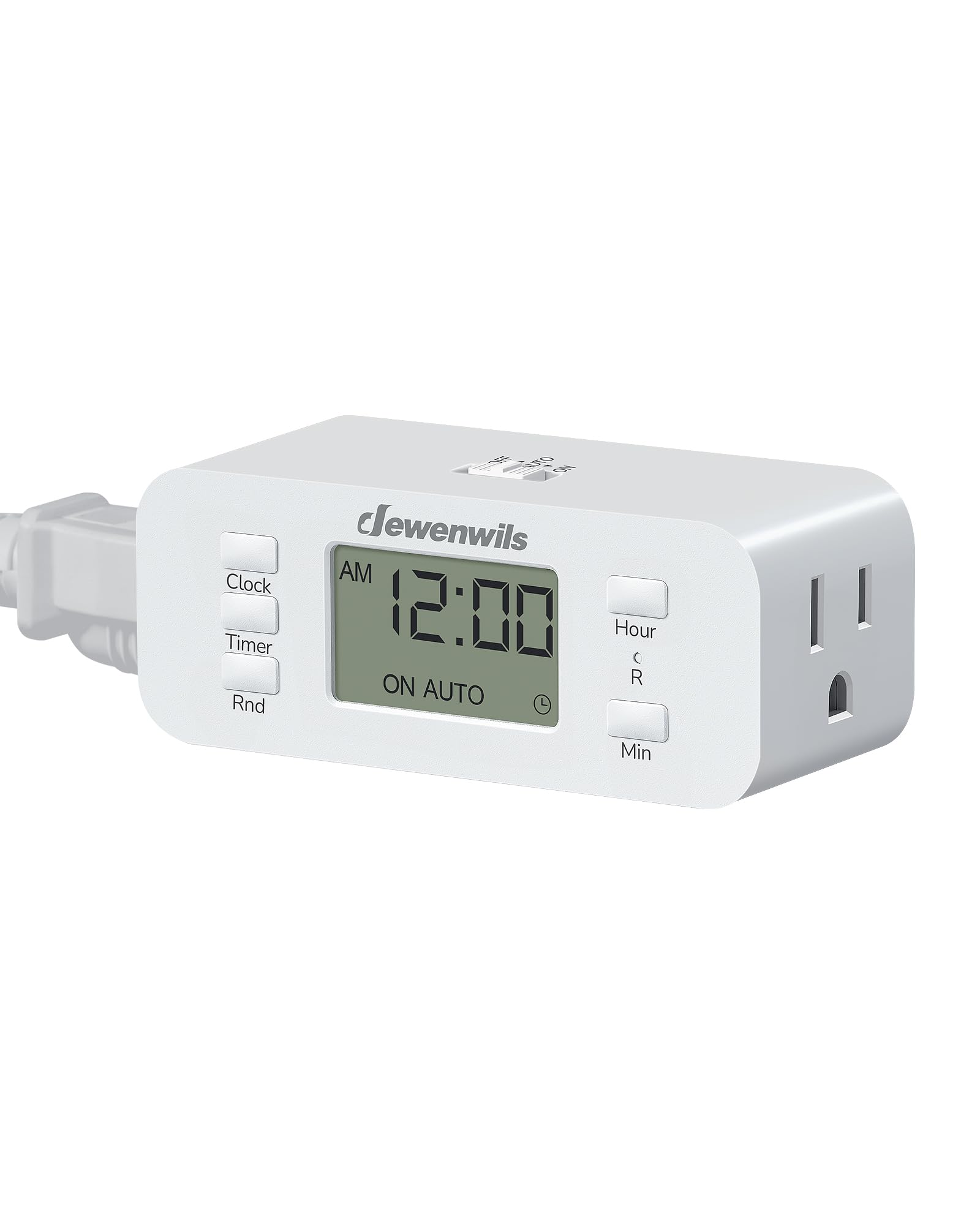
3. DEWENWILS Indoor 24 Hour Programmable Digital Timer Outlet
The bedside-friendly timer that switches silently and keeps your schedule through a blackout.
Here’s the profile this fits: you want the lamp on your nightstand to come on at a set hour and off after you’ve drifted, and any hum or tick is a dealbreaker. DEWENWILS built this for exactly that. It switches without the drone of a mechanical dial — owners who moved over from older spring timers routinely note the difference a silent switch makes. You program up to three on/off events per day, and each one repeats daily, so once it’s set you truly don’t touch it again. The side-mounted outlets angle away from each other, keeping your second socket clear instead of blocked.
The feature that quietly matters most is the memory function. A built-in Ni-MH battery holds your settings for up to 6 months during a power outage or when the unit is unplugged, so a storm doesn’t wipe your routine. Its electrical rating is 125V 60Hz, 15A resistive and 1000W tungsten, which covers lamps, holiday lights, grow lights, and small heaters. A three-mode side switch handles Off, Auto, and On — leave it on Auto for timed operation, or flick it to On for a quick manual boost. The compact body measures just 1.57″D x 3.66″W x 1.42″H, so it hugs the wall. It also carries a random security mode that varies your lighting while you’re away, which is a nice extra for travel.
Why It Lands
- Silent switching suits bedrooms, offices, and livable spaces.
- 6-month battery memory survives outages and unplugging.
- Side outlets won’t block the neighboring socket.
- Random mode gives a lived-in look when you’re away.
Worth Knowing
- Only three on/off events per day, so tight multi-cycle schedules aren’t its strength.
- Wiring in the on/off logic takes a couple of reads to feel natural.
Buy it for: a bedroom, nursery, or office lamp where quiet operation and outage-proof memory matter most.
Pass if: you need eight or more daily programs or one-minute granularity — the HBN handles that workload better.
4. Intermatic TN311K 15-Amp Heavy-Duty Lamp and Appliance Timer

An old-school dial timer that owners describe plugging in and forgetting for a decade.
Some buyers don’t want clever — they want a device that works for years without a second thought, and this Intermatic is built for precisely that crowd. It’s a purely mechanical timer: no digital screen, no Wi-Fi, no Bluetooth, nothing to update. You get three on and three off trippers, which lets you shape a tailored schedule around a morning and evening lamp routine rather than being locked to one daily block. The grounded plug and receptacle design keeps the connection secure, and a manual override lets you switch things around on the spot. Its load rating is 15A inductive with 12FLA 72 (LRA) motor compatibility, so it’s comfortable driving heavier-duty appliances as well as simple lamps.
The thing that wins people over is longevity. Buyers report units still running after a decade of daily service, and some describe timers bought twenty-plus years ago still ticking. That track record is why it earns a spot here despite a simpler feature set. It controls LED, CFL, and incandescent bulbs, and the tripper-pin method is about as quick and intuitive as scheduling gets. The trade-off to weigh first: reliability is the one attribute owners rate as mixed, so treat this as a sturdy mechanical tool rather than a precision instrument. It also comes with four green and red pins when you only need two, and those small pins are easy to misplace — keep the spares somewhere findable.
Where it shines: Measured in years of service, this mechanical timer outlasts every digital model here.
Where to be careful: as with any dial timer, there’s no battery backup layer beyond the mechanism itself, and the loose pins need a home.
Choose this if: you want one dependable timer that will likely outlast your lamp and never asks for an app.
Skip if: you need weatherproofing or multi-program precision — this is a simple indoor mechanical unit.
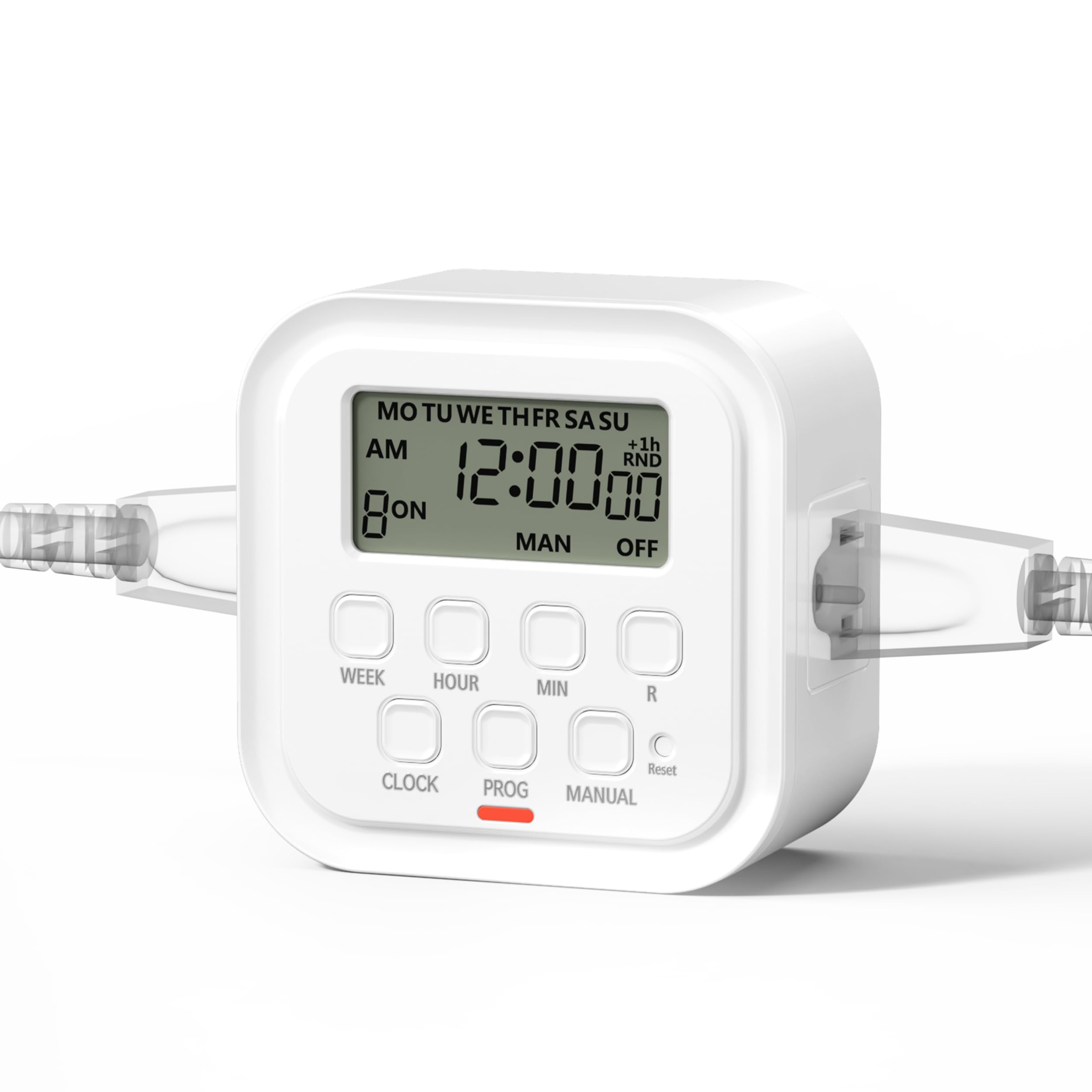
5. HBN Outlet Timer Indoor Plug in Timer for Light Lamps Fan, Digital Timer
A flexible digital timer that syncs mismatched lights and can run schedules as tight as a minute.
This is the planner’s timer. It gives you up to 8 on/off programs across a 7-day week, and the settings can be as short as one minute — so instead of rounding your lamp to the nearest half hour, you choose the exact minute you want. You can pick individual days or use the pre-set combination days for a weekday-versus-weekend routine, and a daylight saving time mode keeps the schedule aligned when the clocks shift. Two grounded outlets sit on the body, rated 125V, 60Hz, 15A/1875W resistive and 10A/1250W tungsten with 1/2HP motor compatibility (125 volts, 60 hertz, 15 amps/1875 watts for standard resistive loads like lamps, and 10 amps/1250 watts for tungsten bulbs, plus it can handle a 1/2 horsepower motor). A random vacation mode varies your programmed lights so the house doesn’t look empty while you’re gone.
Where it pulls ahead of simpler dial timers is synchronization. Growers and aquarium keepers appreciate how it lines up multiple lights on one shared schedule rather than letting two plugs drift apart. It also handles varied loads well — a slow cooker on an eight-hour window, a heater on a timed block, aquarium and nebulizer duty. The mixed reviews cluster around one thing: the manual and the automatic-override status can read as confusing on first setup, and the device works best once you set it to “auto on” and leave it there. Read the instructions once and this becomes a five-minute task rather than a puzzle.
Reasons It Rises
- 8 programmable events with minute-level precision.
- Day-of-week scheduling plus daylight saving mode.
- Random vacation mode varies your lights automatically.
- Dual grounded outlets at a 15A/1875W rating.
Reasons To Pause
- The auto-override logic takes a careful read to master.
- Timekeeping is rated mixed, so verify accuracy against your phone in the first week.
Best match for: anyone automating several lights, a grow setup, or kitchen appliances that need exact, repeating windows.
Not for you if: you want zero-setup simplicity — a plain pushpin dial gets you there faster.
6. myTouchSmart Plug-in Digital Timer, 1 Grounded Outlet

The timer that watches the sunset for you, so your lights drift with the seasons on their own.
If you’ve ever had to nudge a lamp’s on-time earlier every few weeks as autumn shortens the days, this is the fix. MyTouchSmart’s built-in SunSmart feature sets on/off times that automatically track sunrise and sunset in your region, so a porch or landscape light comes on at dusk without you touching a button — and it adjusts itself through daylight saving too. You can also skip the sun-tracking and either pick a preset or set up to 8 custom on/off times to suit your own schedule. A backup battery preserves your settings through a power outage or if the unit gets unplugged, which means no reprogramming when you move it.
It handles one grounded outlet on the right side and a digital display with blue LED indicators beside each button showing which programs are active. Light compatibility is broad: LED, CFL, incandescent, and halogen all work, and it even handles dimmable LED and CFL bulbs. Electrical rating sits at 125V 50/60Hz, 15A 1875W general purpose and 10A 1250W tungsten with 1/2HP (125 volts, 50/60 hertz, 15 amps/1875 watts for everyday loads, and 10 amps/1250 watts for tungsten bulbs, plus a 1/2 horsepower motor). The setup is where opinions split — plenty of people find it intuitive and describe it as set-and-forget, while others find the date-plus-time entry and multiple button presses fiddly, and the display is harder to read once the timer is pushed into the wall. There’s also no instant on/off override on the face, so a manual boost means reaching past the schedule.
The feature that converts people: sun-tracking is a genuine hands-off upgrade — you set it once and the schedule follows the calendar without your help.
The friction to expect: the initial programming is the busiest of any timer here, so give yourself a quiet ten minutes with the manual on first setup.
Pick this when: you want dusk-to-evening lighting that follows the real sun and never needs seasonal adjusting.
Consider another if: you prefer a one-button manual override up front — that convenience isn’t on this face.
7. OSKOS 2-Pack Indoor 24-Hour Programmable Digital Timer with Polarized Plug
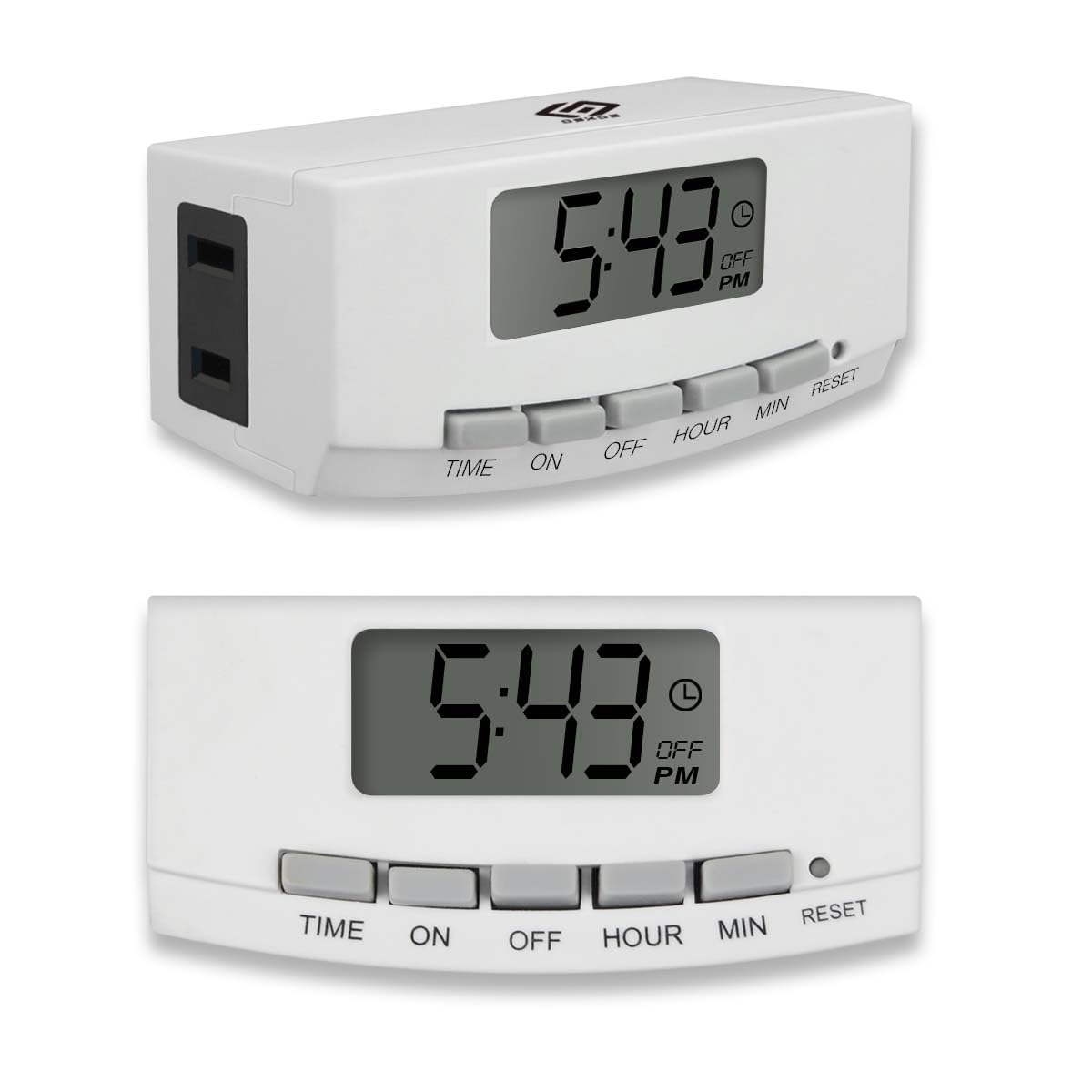
Two slim digital timers, each splitting one always-on outlet from one timed outlet.
This OSKOS pair is for the buyer who wants a lamp timed but also needs a permanent socket close by — think a hallway outlet powering both a scheduled accent lamp and a device that should never switch off. Each unit carries a polarized outlet on the left that stays always-on and a timer-controlled outlet on the right. Programming is simple: one daily repeat setting and five buttons handle the current time and your on/off times, so you don’t wrestle with layered menus. You get two of these in the box, which covers two rooms right away, and the slim profile with a large screen is built to avoid blocking the adjacent wall outlet.
It’s UL listed, and the load rating suits the usual suspects — indoor lights, lamps, small appliances, seasonal decorations — while a battery backup carries your settings through power outages. The design lets you set on/off times that make an empty house look “lived in” while you’re away, a small but genuine security benefit. The instruction that trips some owners up is basic but important: the lamp’s own switch has to be left in the ON position, because the timer controls current at the socket, not the lamp’s switch. Keep an eye on the power rating too and don’t overload it.
what separates it: that always-on plus timed split on a single face is a rare combination given most timers here give you two timed outlets or one, so you’re getting both jobs at once.
Where to be mindful: the display sits low once plugged in, and setup expects the lamp switch left on — small habits that catch first-timers.
The right call for: someone who wants a scheduled lamp and a live outlet on the same wall plate, twice over.
Look past it if: you need precise multi-event scheduling or higher wattage headroom for heavy appliances.
8. NSi Industries TORK RTN312 Indoor 15-Amp Plug-in Heavy Duty Mechanical Appliance Timer

A mechanical timer built to switch heavy loads — 1800W of them — and prove it with a 5-year warranty.
You come to this TORK when the thing you’re scheduling draws real current: a space heater, a fan, an appliance that a featherweight timer would balk at. Its ratings are the selling point — 120-volt, 60 Hz, 15-amp, with 1800-watt resistive and 1800-watt tungsten capacity, plus 2A electronic ballast and a 1/2 hp motor rating (120 volts, 60 hertz, 15 amps, 1800 watts for standard loads and 1800 watts for tungsten bulbs, 2 amps for electronic ballast, and a 1/2 horsepower motor). Few timers on this list carry that combination, and the 5-year warranty underlines how seriously NSi stands behind it. The set method is mechanical and simple to use: push a green tripper into the slot for the time you want on, a red one for off, then turn the dial clockwise until the arrow meets the correct time. It uses two on/off settings per day and repeats them daily.
Once it’s programmed, daily repetition takes over, and an override switch lets you bypass the schedule without erasing it. Two grounded 3-prong receptacles mean a pair of devices can share the load, and it’s compatible with incandescent, compact fluorescent, and LED bulbs. Owners prize the function and ease-of-setting — it handles good current and doesn’t complain. Fair warning about longevity: durability and timekeeping both pull negative feedback, with some owners finding it keeps poor time with a small, hard-to-read dial and losing a few minutes over several weeks. If exact-to-the-minute accuracy is your priority, a digital unit fits better — but for brute load-switching, few here compete.
The load-switching case: this drives up to 1800W without breaking a sweat, a genuine step above the 1000W-tungsten DEWENWILS and the 1200W-tungsten ENERLITES for heavy appliances.
The accuracy caveat: the mechanical dial trades precision for toughness, so plan to reset it now and then rather than rely on continuous accuracy.
Go with it if: you’re switching a heavy appliance or heater and want a built-to-last unit with real current headroom.
Steer away if: your schedule needs minute-level accuracy — that’s where a digital timer wins.
9. ENERLITES 8-Hour Countdown Timer for Electrical Outlets, UL Listed

Not a clock timer at all — a push-a-button countdown that turns your lamp off for you.
This one works on a different principle from every dial timer above. Instead of setting a clock time, you press a button for a fixed duration and let it count down: six options cover 15 and 30 minutes, and 1, 2, 4, and 8 hours. It’s ideal for something you want to run for a set stretch and then stop without your involvement — a crockpot, a battery charger, a hair clipper you don’t want to overcharge, or a lamp you want to stay lit for a couple of hours after you sit down. There’s no programming, no clock to set, and no dial to read: just plug in and press. Eight buttons with LED indicators make the choice obvious, and a Repeat function can rerun the same duration at the same time each day if you want that pattern. It’s rated 15A at 120VAC, 60Hz, 1200W tungsten and 1/4 HP motor (15 amps at 120 volts AC, 60 hertz, 1200 watts for tungsten bulbs, and a 1/4 horsepower motor), and it’s UL listed.
Two habits deserve flagging before you buy. First, the LED indicator powers down about thirty seconds after the timer starts, so the button going dark doesn’t mean the countdown has stopped — it hasn’t. Second, the unit needs to be reset after a power outage, since there’s no clock memory to ride through it. Several owners also note the body is sizeable enough that two won’t fit side by side in a single outlet, so if you want two countdowns running at once, plan on separate receptacles. There’s no six-hour option in the set, which a few buyers wished for, though the preferred feel of a push button over a fiddly dial comes up often as a reason they keep buying more.
The simple appeal: it changes the question from “what time should this go off?” to “how long do I want this on?” — which is exactly what some tasks need.
The setup quirk: the early LED shutoff and the post-outage reset are the two things to know going in, neither a fault, just its nature.
It’s made for: anyone who wants a device to run for a fixed stretch and then switch itself off, charger safety and slow-cooker timing included.
Look to another if: you need clock-based scheduling, an outage-proof memory, or a six-hour option in the mix.
Understanding the Specs
Pushpin Interval Versus Digital Precision
A mechanical dial spaces its pushpins a set distance apart, and that spacing is your scheduling resolution. A 30-minute interval means your lamp can only switch on or off at half-hour marks, which is fine for a living-room lamp but too coarse for a grow cycle. A digital timer swaps the pins for buttons and can build programs as short as one minute, so you control the exact time rather than the nearest block. The trade is setup effort: pins are instinctive, menus take a first-time read.
Load Rating And Power Draw
Every timer carries a current rating in amps and a wattage ceiling, and that ceiling is what stops you from overloading it. A 15-amp, 1875-watt rating handles lamps, fans, coffee machines, and string lights with room to spare. Ratings for tungsten loads — which is what incandescent bulbs and heaters present — are often lower than the resistive number, because tungsten draws a heavy inrush. Match your device to the tungsten rating, not just the headline amperage, especially for heaters.
FAQ
Will an automatic lamp timer work with my LED or dimmable bulb?
Do I need to leave my lamp’s own switch turned on?
What happens to my schedule during a power outage?
Can I run two lamps or devices off one timer?
Is a mechanical timer noisier than a digital one?
Can I set a timer for just a few minutes rather than a whole day?
How much load can these timers safely handle?
Will a plug-in timer block my second wall outlet?
Can a timer make an empty house look occupied?
Are these timers for indoor use only?
Final Thoughts: The Verdict
For a straightforward lamp setup, the automatic lamp timer winner is the GE 24-Hour Plug-in Mechanical Timer — the crowd favorite at 4.6 stars across 14,000+ ratings, with two grounded outlets and pushpin scheduling that takes seconds. If your lamp lives near your bed, reach for the DEWENWILS Digital Timer, whose silent switching and 6-month memory backup make it the quiet pick. And for dusk-to-evening lighting that follows the real sunset without you adjusting it each season, the myTouchSmart is the one to hang.
How We Picked
We do not accept paid placement. Every pick is matched to a real buyer and a real use-case; we do not hands-on test units.
Sources & Methodology
Specifications: manufacturer listings and product documentation. Review insights: verified customer reviews, as of September 2026. Pricing: not shown on this page (it changes often); check the current price via the retailer link.
As an Amazon Associate, KitchPrep earns from qualifying purchases. This does not affect which products we feature.
Related Guides
