
Specs are compiled from manufacturer listings and verified buyer reviews and can change over time — please confirm the key details on the product page before buying.
A fogged mirror and a damp, musty smell every morning usually mean one thing: your bathroom air is not going anywhere. A wall-mounted fan fixes that without cutting into your ceiling. Three things decide whether you end up happy with it — how much air it moves, how loud it is while doing that, and whether the housing actually fits the wall cavity you already have.
I’m Mohammad Maruf — the founder and writer behind KitchPrep. This guide is built by comparing the manufacturers’ published specifications and the patterns across verified customer reviews, so you get each pick’s real strengths and trade-offs instead of marketing spin.
You will see airflow measured in CFM (cubic feet per minute — the volume of air the fan pushes out every 60 seconds) and loudness in sones (a measure of how loud the fan sounds to your ear), both explained in plain words so you can match a fan to your room. By the end you will know which of these is the right bathroom wall fan for your space.
Our Picks at a Glance
How To Choose The Best Bathroom Wall Fan
You want the steam off your mirror and the damp smell out of the room, and you want it to happen from the wall rather than the ceiling. That last part matters in older homes, modular homes and tight attics where the ceiling is not yours to cut into. Here is what to check before you buy.
Match CFM to your bathroom size
CFM (cubic feet per minute) is how much air the fan pushes out every 60 seconds. More CFM means faster steam and odor removal, so your mirror clears sooner and the room stops feeling sticky. Pick too little and the fog lingers; pick more than you need and you mostly just add a little noise. The six picks here run from 70 CFM up to 110 CFM, so most rooms have a match.
Understand what a sone rating tells you
A sone is a measure of how loud the fan sounds from where you are standing — lower means quieter. A fan rated around 1.0 sone is genuinely quiet, so you can run it while someone sleeps in the next room. Units near 2.0 sones stay comfortable for most people, but you will notice them running. Higher than that starts to feel like a small appliance humming in the corner. A hollow wall cavity makes any fan sound louder, because the wall acts like a drum.
Check the duct size and wall depth first
Fit is the biggest surprise with wall fans. A fan that needs a 5.9-inch duct will not bolt onto a wall built around a standard 4-inch run. Measure the duct opening already in your wall and the depth of the cavity behind it before you order. Several picks below include adapters that let a larger unit step down to a smaller duct, which saves guesswork. Replacing an existing fan? Matching the old opening size gives you the fastest swap.
Decide if you want a sensor
A humidity sensor (a moisture detector) turns the fan on for you once the air turns damp, then off again when the room dries out. A motion sensor does the same job but reacts to movement instead of moisture. Both help in a busy household where nobody remembers the switch. The trade-off is one more piece of electronics that can misbehave over time, so read the notes on each pick.
Quick Comparison
| Model | Best For | Airflow | Quietness | Duct / Install | Amazon |
|---|---|---|---|---|---|
| Panasonic FV-0510VSL1 WhisperValue★ Best Overall | Whole-bath ventilation with a built-in light | 50, 80 or 100 CFM | Whisper quiet | 4″ oval duct, wall or ceiling | Amazon |
| Broan-NuTone LP80 LoProfilePremium Pick | Thin 2×4 wall cavities and tight retrofits | 80 CFM | 1.0 sones | 3″ round or 4″ oval duct, in-wall | Amazon |
| Panasonic FV-0810VSS1 WhisperValue | Always-on low-speed background ventilation | 30-100 CFM adjustable | Ramps up slowly and quietly | 4″ oval duct, wall or ceiling | Amazon |
| Delta BreezSlim SLM70H | Retrofits into a small existing opening | 70 CFM | 2.0 sones | 7.5″ x 7.25″ housing, wall or ceiling | Amazon |
| Zeyzer Black Ceiling or Wall Fan | High airflow in a dark, modern bathroom | 110 CFM | Under 34 dB | 5.9″ duct, 6.3-6.7″ opening | Amazon |
| Hehou Motion Sensor Wall Fan | Hands-free operation in a tiny bath or toilet room | 80 CFM | Under 34 dB | 4″ duct, wall mount | Amazon |
In‑Depth Reviews
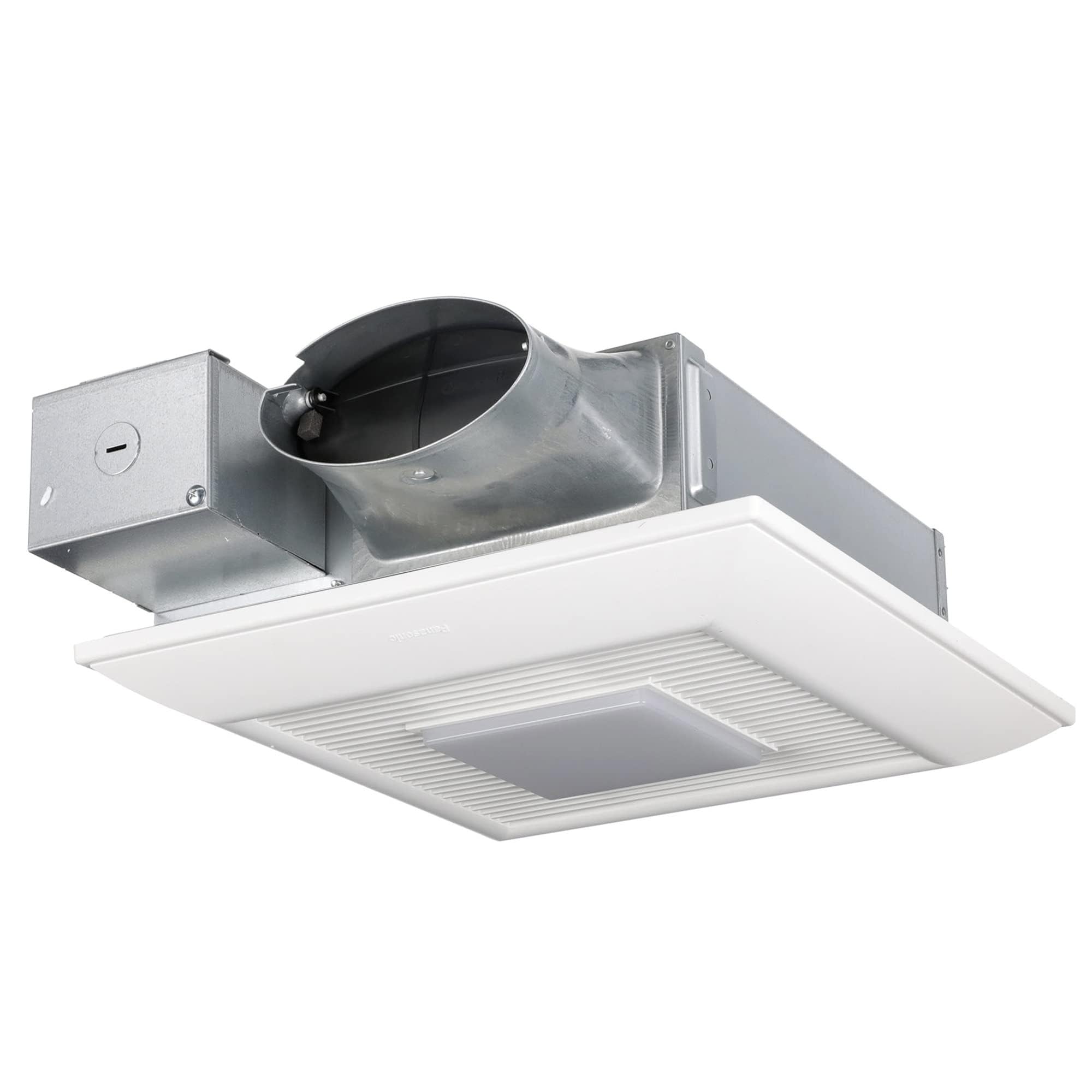
1. Panasonic FV-0510VSL1 WhisperValue Bath Fan + Light, 50-100 CFM
Our pick — over 4.5★ from 550+ verified ratings; the strongest balance of quality and price.
One fan you can tune to your exact room, then run so quietly you forget it is there.
This is the pick to beat if you are replacing an old builder-grade fan and want the job done once. A single Pick-A-Flow switch on the housing sets the airflow to 50, 80 or 100 CFM, so you can install it for a small room today and dial it up if you add a shower later — no second purchase. It also carries a 4.6-star rating across 560+ ratings.
Inside, it runs a DC/ECM motor (a brushless motor design that uses less power and spins more smoothly than a basic AC motor). The light is a real reason to choose it over a plain vent: a dimmable 3000K LED (3000K is a warm white light, closer to a soft bulb than a stark office light) plus a low-power nightlight for after-dark trips. Buyers report this fan is roughly half as loud as the older fan it replaced, with a slow, quiet startup that ramps in gently instead of banging on. Even at the lowest 50 CFM setting, they say it clears steam and odor.
Now the catch to plan for. Its housing measures 13″D x 13″W x 4.88″H, so it is larger than many older fans — the Zeyzer below measures 3.9″D x 7.6″W x 5.3″H, a genuinely smaller footprint. A like-for-like swap is therefore unlikely; owners typically cut and patch drywall, and the 4″ oval duct outlet often needs an adapter to meet round duct. It is UL listed for wall, ceiling and tub/shower enclosure mounts when GFCI protected. Budget an afternoon, not twenty minutes.
Where it earns its keep
- Pick-A-Flow lets you set 50, 80 or 100 CFM at install — one fan covers small and full baths
- Warm 3000K dimmable LED plus a nightlight means you can drop the separate vanity light
- Energy Star certified with a DC/ECM motor that draws less power than a standard fan
- UL listed for wall, ceiling and tub/shower enclosure mounts when GFCI protected
What to plan around
- The 13″ x 13″ housing is bigger than most old fans, so expect drywall work
- The 4″ oval duct outlet usually needs an adapter to meet round duct
- The nightlight wants its own separate power hookup to work as intended
Best for: anyone replacing an old fan who wants quiet operation, adjustable airflow and lighting all from one box.
Think twice if: your wall opening is small and you have no appetite for cutting and patching drywall.
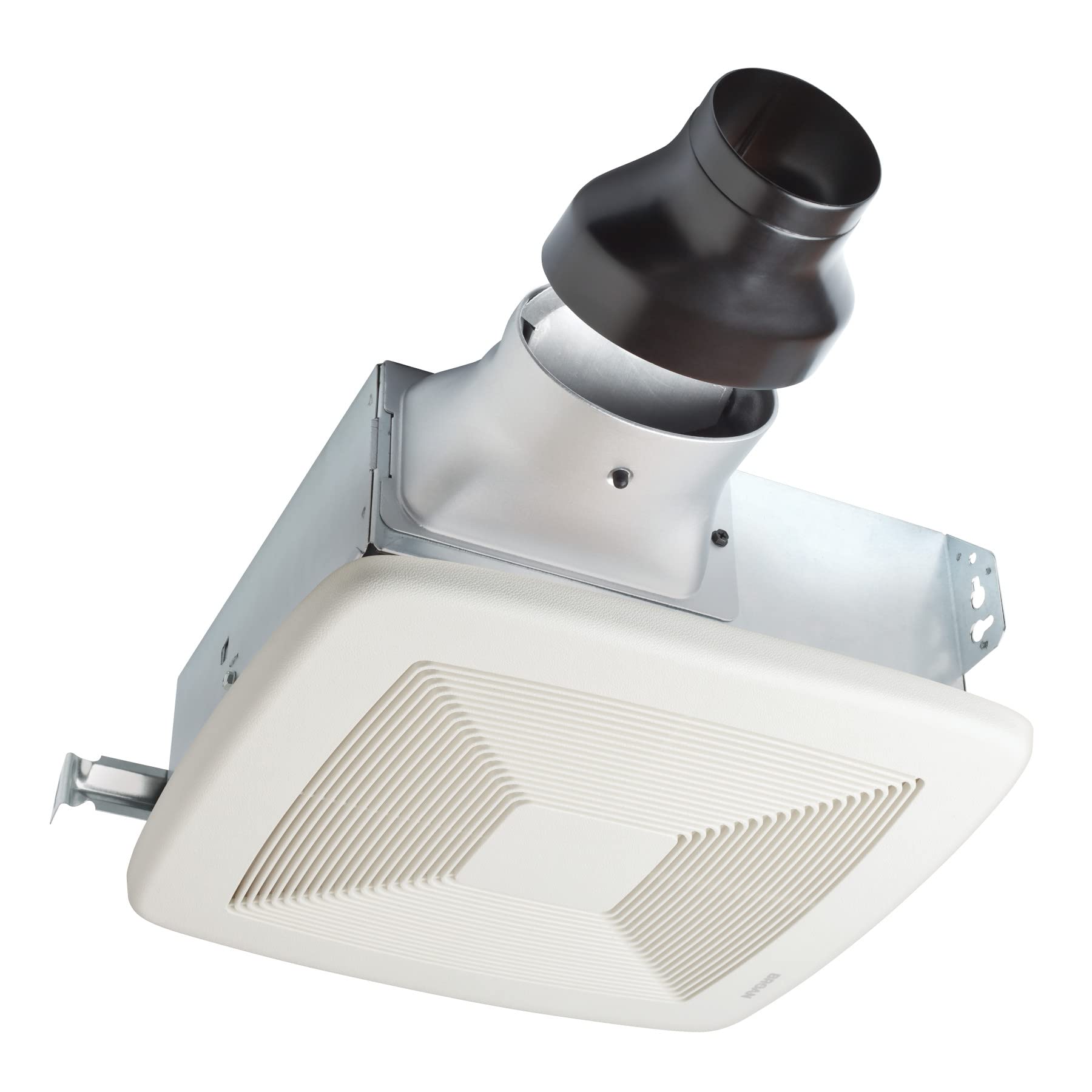
2. Broan-NuTone LP80 ENERGY STAR Certified LoProfile 4″ Bath Ventilation Fan, 1.0 Sones, 80 CFM
Built for the shallow wall nobody else can fit into, and quiet enough to run during a phone call.
Depth is what earns this fan its spot: it slides into a wall between 2″ x 4″ studs, the tightest cavity a wall fan will realistically meet, and the galvanized steel housing measures 10.5″ x 11.38″ x 4″. Staring at a shallow modular-home or older-house wall and wondering what could possibly fit? Owners describe it fitting a 3.5″ wall depth with room to spare, and one buyer swapping an 8″ fan needed a bigger ceiling hole but slotted this cleanly into a 4″ thin space.
On noise, the 1.0 sone rating holds up in practice — the review pages describe it as barely audible from the next room. One of the more useful points customers raise is that the motor sits in a replaceable housing, so if it ever wears out you swap the motor instead of tearing out the whole unit. It also comes with both 3″ round and 4″ oval duct connections, an adapter some competitors sell separately, and a paintable 13″ x 14″ white grille so you can blend it into your wall color.
The honest part: retrofit gets fiddly. It mounts only to the right stud, and the brackets above and below the housing mean you may be cutting drywall across the cavity plus a few inches above and below it. The duct and adapter together can push past 6.5″ of height clearance. That makes it straightforward for new construction and a measure-twice job for a retrofit. For a room up to 75 sq. ft. — or a one-car garage — the 80 CFM of airflow is well matched.
The real deciding factor: 4″ of housing depth is the whole pitch. In a shallow cavity, almost nothing else here will go in without renovating the wall itself.
Offsets worth knowing: the included 3″ and 4″ duct connections, the replaceable motor, and a paintable grille mean less extra spending on adapters and finishing than you might expect.
Grab this one if: you are framing a new bathroom wall or working inside a shallow 2×4 cavity and want a quiet 1.0-sone unit that fits.
Look elsewhere if: you are doing a fast like-for-like swap and cannot open up drywall above and below the fan.
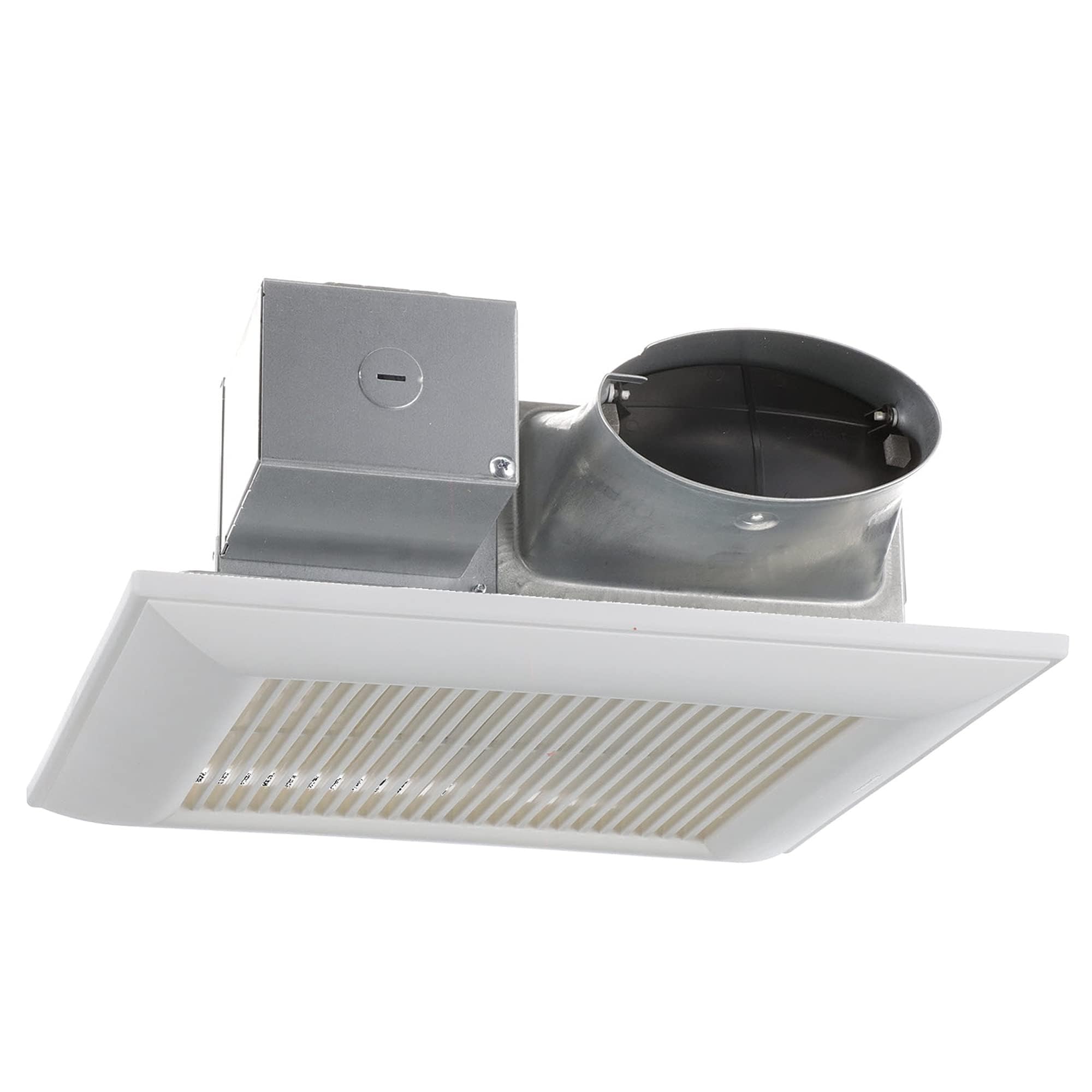
3. Panasonic FV-0810VSS1 WhisperValue Bath Fan + Dual Speed, 30-100 CFM
Runs at a whisper all day long, then opens up to full power the moment you hit the switch.
Set to a low continuous speed, this fan keeps the air in your bathroom turning over all day, so a closed-up room never develops that stale, damp feel. Flip the wall switch and it jumps to its maximum of 80 or 100 CFM for a shower. You can set that resting speed anywhere from 0 to 70 CFM in 10 CFM steps. At only 3-3/8″ deep, the housing also slips into tight ceiling and wall cavities where a full-size fan simply will not go.
Owner feedback backs up the build. In a 2×6 framed bathroom, owners mention installing two of these, with the multiple wiring options and speed modes making short work of it. One buyer who hit a rafter sitting dead center in the ceiling hole said this slim-line fan saved them from cutting the opening out and moving it. The 4″ oval duct connection matches a standard run, and like its sibling above it is UL listed for ceiling, wall and tub/shower enclosure mounts when GFCI protected.
Two things to know. First, it ramps up slowly — it starts near-silent and builds to full speed over several seconds, which reads as broken if you are watching for it. Give it a moment. Second, buyers raise loudness most often, and it lands as mixed: some owners find it ultra quiet, others find it noisier than expected, and a few actually like a little white noise to cover bathroom sounds. Want total silence? This is not it.
The wiring win: because it runs a low preset speed continuously and jumps to full on switch, you get real air turnover without running a loud fan for hours — Energy Star certified, with a 4″ oval duct that matches standard runs.
The expectation to set: loudness is the most-discussed point in reviews, and it lands mixed. Buyers who wanted an audible fan to mask sounds are happy; buyers chasing true silence may not be.
Reach for this if: you want an always-on low-speed vent that quietly clears moisture in a finished bathroom and can step up to 100 CFM on demand.
Consider another pick if: you need the very quietest result possible and cannot accept any fan hum at full speed.
4. Delta BreezSlim SLM70H 13.1W Exhaust Bath Fan with Humidity Sensor

It watches the moisture in the air and switches itself on for you — ideal for a rental or a bathroom you do not think about.
Never touch a switch again: in humidity mode this fan turns on once the room climbs above 60% humidity and stops once it drops back below 60%. That means it runs exactly as long as the shower steam lasts. Its brushless DC motor is Energy Star qualified and moves 70 CFM at 2.0 sones — comfortable, not silent. Blue and amber LEDs show which mode is active, and the blue light is dim enough to see at night without being intrusive.
What owners latch onto is the fit. The housing is a compact 7.2″D x 7.5″W x 3.9″H, which the brand calls the only bath fan this size on the market. Customers note it sliding into the same opening a dead fan left behind, with only a housing swap needed in one case, and the automatic moisture response clearing a basement bath reliably. Thin enough for tight attic rafters comes up repeatedly too.
Keep an eye on the humidity sensor. It is a small optional part, and while the company’s support line is described as responsive and willing to send a replacement, owners also report the sensor eventually failing — sometimes after a year or two, sometimes much longer. When that happens the fan still works fine on manual control but stops switching itself on. One buyer notes the sensor is a low-cost part itself if you are comfortable soldering. Love the concept and can live with a part change down the road? It is a strong fit for a small opening. Want zero maintenance? Plan on manual mode.
What keeps buyers coming back
- Humidity sensing works on its own above 60% and shuts off below 60%, so steam gets cleared automatically
- The 7.5″ x 7.25″ housing retrofits into small existing openings without a full tear-out
- Brushless DC motor is Energy Star rated at roughly 5.8 CFM/watt
- Blue and amber LEDs show the active mode at a glance
Honest trade-offs
- Sensor reliability is the weak spot — a replaced part is a real possibility over the life of the fan
- At 70 CFM it moves less air than the 110 CFM Zeyzer above, so large rooms clear slower
- Output in humidity mode is lower than in full-speed manual mode, which can disappoint
A smart fit for: a small or awkward-size opening that needs automatic moisture control more than maximum airflow.
Step away if: you want a hands-off sensor you will never think about again, or you need big-room airflow volumes.
5. Zeyzer Black Bathroom Fan 110 CFM 1.0 Sone 5.9″ Duct Square Ceiling or Wall Mount Ventilation Exhaust Fan

The black square panel that turns a bare wall vent into a design feature — and moves real air while it does.
At 110 CFM, this is the highest airflow in the list, and that gap over the 80 CFM Hehou below is the real reason to choose it — it simply moves more air per minute. A black 7.6″ square panel with a matte finish is meant to be seen, so it suits a dark-tiled modern bathroom or a laundry room where the fan is part of the look. It needs a 5.9″ duct and a 6.3″ to 6.7″ wall cutout.
Quietness is mixed and honest. The spec sheet claims under 34 dB, but reviews split: some owners call it very quiet, others say it is loud. What everyone seems to agree on is the visual: owners love the black panel and note it looks smarter than the plain-white fan it replaced. The housing and wheel are ABS (a hard, durable plastic), and the same fan is rated for ceiling or wall installation.
Two things to weigh. The duct connection is 5.9″, noticeably larger than a standard 4″ run, so check your existing opening — it needs 6.3 to 6.7 inches of cutout and clips directly onto the duct with no fastening ring required. And while many reviewers point out it running for months without trouble, a few raise noise and long-term durability as concerns over time. It is also one of the largest units here at 3.9″D x 7.6″W x 5.3″H, so confirm the wall space before you commit.
Where the value sits: 110 CFM of airflow plus a design-led black panel is a combination you rarely find, and the installation goes straight to the duct with no fastening ring to source separately.
The fair caveat: loudness is genuinely split across buyers, so if a quiet bedroom-adjacent bathroom is the goal, weigh that against the higher 4.6-sone-rated Broan above.
Best matched to: a high-humidity bathroom, corridor, office or laundry room that needs strong airflow and can carry a bold black centerpiece.
skip it if: your wall has a standard small duct opening or a loudness-sensitive bedroom is directly next door.
6. Hehou Bathroom Exhaust Automatic Fan for Wall and Window, Super Quiet 4 In Motion Sensor and Delay Time Exhaust Fan with O Ring, White 80 CFM

Turns itself on the moment you walk in and keeps running after you leave — no switch, no thought.
A motion sensor picks up movement within a 5-meter radius and starts the fan for you, then a built-in delay timer keeps it running afterward for 0.5 to 30 minutes so the air clears before it shuts off. The factory setting is 0.5 minutes, and you can adjust it as you like. At 80 CFM through a 4″ duct it is dialed in for small spaces rather than big rooms, and the sealed ball motor (a motor with sealed bearings that need no oiling) is rated under 34 dB.
Buyers value the easy install in awkward spots. At 5.14″D x 5.94″W x 5.94″H and 0.66 kg, it fits tight through-wall setups; shoppers say mounting it to a standard 4-inch exterior vent cover and hardwiring it to a switch in a tiny-house bathroom. It also comes with a check valve, which stops cold or damp outside air from creeping back through the duct when the fan is off. The panel is high-strength ABS with an IPX4 rating (meaning it shrugs off water splashed from any direction), which makes sense for a wall fan sharing a room with a shower.
Be clear-eyed about the airflow. At 80 CFM it moves less air than both the Zeyzer’s 110 CFM and the Panasonic’s 100 CFM, and the manufacturer’s own notes and buyers’ experiences agree it is not a large-room compressor. Small space? Fine. Primary bathroom? It will feel underpowered. The more serious concern buyers raise is durability: most buyers report months of trouble-free use, but one review tells a stark story of the fan dying after about a week and being too far past the return window to swap. That is a sizeable minority rather than the norm, but it puts this fan in the budget tier and makes a longer warranty or a cheap spare worth considering.
Why it earns a spot
- Motion sensor handles on and off automatically — genuinely hands-free for a guest or toilet room
- Adjustable 0.5 to 30 minute delay timer keeps air clearing after you walk out
- Check valve keeps cold and damp outside air from seeping in through the duct
- IPX4 splash-resistant ABS panel with a compact 0.66 kg body that fits tight walls
Call-outs before you buy
- 80 CFM is on the light side — it will not clear a large bathroom quickly
- Durability is the recurring worry, with one report of failure inside the first month
- The motion sensor needs a clear line of sight to trigger reliably
The right call for: a half-bath, toilet room or compact through-wall install where hands-free operation is more valuable than maximum airflow.
Not for you if: you are venting a full family bathroom that needs strong, reliable steam-clearing power.
Understanding the Specs
CFM — How Much Air Moves
CFM (cubic feet per minute) is the volume of air the fan pushes out every 60 seconds. More CFM means faster steam and odor removal, so your mirror clears sooner and the room stops feeling sticky. The picks here run from 70 CFM up to 110 CFM, so the bigger and wetter the room, the higher you want to aim.
Sones — How Loud It Feels
A sone is a measure of perceived loudness from the listener’s seat, not a raw decibel reading. Lower is quieter: around 1.0 sone means you can run the fan overnight without waking anyone, while 2.0 sones is still comfortable but noticeable. Hollow wall cavities make any fan sound louder because the wall acts like a drum, so a solid install helps every fan on this list sound better.
FAQ
How many CFM do I need for my bathroom wall fan?
Do I need a wall-mounted fan or a ceiling fan?
What duct size does a bathroom wall fan need?
Will a bathroom wall fan fit an existing vent opening?
How long does a bathroom wall fan last?
Is a quieter fan better than a more powerful one?
Does a humidity sensor actually work in real bathrooms?
Are the lights on a wall fan bright enough for the bathroom?
Can a bathroom wall fan be installed over a shower or tub?
What does IPX4 rating mean on a bathroom wall fan?
Final Thoughts: The Verdict
The best bathroom wall fan for most people is the Panasonic FV-0510VSL1 WhisperValue — it lets you set the airflow at 50, 80 or 100 CFM, clears steam without ever sounding like a small engine, and throws in a warm dimmable LED plus a nightlight for good measure. If a shallow 2×4 wall is what stands in your way, the Broan-NuTone LP80 is the fan that fits where others will not and runs at a barely-there 1.0 sone. And for a tight through-wall setup or a half-bath where you never want to touch a switch, the motion-sensing Hehou automatic exhaust fan turns itself on and off for you. That is the honest shortlist — one quiet adjustable unit for your main bath, one shallow-fit unit for awkward walls, and one hands-free unit for small spaces.
How We Picked
We do not accept paid placement. Every pick is matched to a real buyer and a real use-case; we do not hands-on test units.
Sources & Methodology
Specifications: manufacturer listings and product documentation. Review insights: verified customer reviews, as of September 2026. Pricing: not shown on this page (it changes often); check the current price via the retailer link.
As an Amazon Associate, KitchPrep earns from qualifying purchases. This does not affect which products we feature.
Related Guides
