
Specs are compiled from manufacturer listings and verified buyer reviews and can change over time — please confirm the key details on the product page before buying.
A full refrigerator holds safe temperatures for only about four hours once the power cuts out. The picks below are the units whose rated continuous output and watt-hour capacity can actually carry a fridge and freezer until the grid returns. Each pick lists the wattage and capacity it delivers and the appliances buyers report running on it.
I’m Mohammad Maruf — the founder and writer behind KitchPrep. This guide is built by comparing the manufacturers’ published specifications and the patterns across verified customer reviews, so you get each pick’s real strengths and trade-offs instead of marketing spin.
Fridges vary widely in draw, so match a unit by its continuous AC output first and its watt-hour capacity second. This guide to the backup battery for a refrigerator walks you through both, plus what owners actually report.
Our Picks at a Glance

How To Choose The Best Backup Battery for a Refrigerator
A refrigerator cannot simply be switched off during an outage: food spoils, and a freezer that thaws and refreezes ruins its contents. A fridge battery must therefore cover the compressor’s startup surge and then hold steady wattage for hours of overnight cycling. The numbers to check first are continuous AC watts, capacity in watt-hours, and how fast the unit recharges so it is ready for the next outage.
Sizing Capacity and Continuous Output to Your Fridge
Continuous output is the number that matters most — it is the steady wattage the battery can supply for as long as the fridge is running. A typical full-size fridge draws a few hundred watts while cycling, but that compressor pulls a brief surge every time it starts, so a unit with generous surge headroom handles the startup without tripping. Capacity in watt-hours then determines runtime, and here the spread is wide: some units hold over three thousand watt-hours, others around two thousand. Match capacity to how long your longest outage tends to run, then size up if your freezer is packed.
Battery Chemistry, Recharge Speed, and UPS
LiFePO4 (a lithium iron phosphate battery chemistry, chosen for its heat tolerance and long cycle life) is the current standard in this class, and several picks here rate thousands of cycles before dropping to a percentage of original capacity. Recharge speed matters because a fridge keeps drawing whether or not the wall outlet is back — units here refill in anywhere from under an hour to a couple of hours via AC. UPS (uninterruptible power supply) transfer time, measured in milliseconds, is worth checking if a router or computer sits on the same circuit, since a fast switch keeps those devices from rebooting.
Quick Comparison
| Model | Best For | Capacity | Continuous AC Output | Battery Chemistry | Amazon |
|---|---|---|---|---|---|
| Anker SOLIX C2000 Gen 2★ Best Overall | Overall fridge-and-home backup | 2,048Wh | 2,400W rated (4,000W peak) | LiFePO4 | Amazon |
| DABBSSON 2000LBest Value | Stacked fridges and freezers | 2048Wh | 2200W (3300W boost) | Semi-Solid LiFePO4 | Amazon |
| DJI Power 2000Quietest Pick | Quiet RV and workshop power | 2048Wh | 3000W | LFP | Amazon |
| BLUETTI Elite 200 V2 | Long-life kitchen backup | 2073.6Wh | 2600W (3900W lifting) | LiFePO4 | Amazon |
| Jackery Explorer 2000 v2 | Light, portable fridge backup | 2042Wh | 2200W | LiFePO4 | Amazon |
| PECRON E3600LFP | Expanding to a whole-home bank | 3072Wh | 3600W | LiFePO4 | Amazon |
| EF ECOFLOW DELTA 3 Max | Fast-charge home backup | 2048Wh | 3400W X-Boost | LiFePO4 | Amazon |
| BLUETTI Elite 300 | RV-ready compact 3kWh | 3014.4Wh | 2400W (4800W surge) | LiFePO4 | Amazon |
| PECRON E3800LFP | Biggest expandable capacity | 3840Wh | 4200W | LiFePO4 | Amazon |
| Jackery HomePower 3000 | Full home essentials backup | 3072Wh | 3600W (7200W surge) | LiFePO4 | Amazon |
| EF ECOFLOW DELTA Pro | Heavy-duty household power | 3600Wh | 3600W (X-Boost to 4500W) | LFP | Amazon |
In‑Depth Reviews
1. Anker SOLIX C2000 Gen 2 Portable Power Station
Our pick — over 4.5★ from 650+ verified ratings; the strongest balance of quality and price.
The overnight fridge runner that asks for almost nothing back.
What defines this one is the way it handles 2,048Wh’s worth of amp-hours without wasting them: standby draw is just 9W, which is why a dual-door fridge (a fridge with two doors side by side, like a French-door style) can run for up to 32 hours off a single charge. Add an expansion battery to reach 4kWh, and the same fridge stretches to up to 64 hours — the exact math most people are doing in their head during a storm.
The output side is where it pulls ahead of most rivals: 2,400W continuous and 4,000W peak, enough to start a fridge compressor and still power a window or RV air conditioner at the same time. The compromise is speed versus floor space — one small 18.1″L × 9.8″W × 10.1″H body at 41.7 lb. Against a comparable unit at 11.2″L × 18.3″W × 8.9″H, the Anker is more compact in depth; the trade is that the wider competitor sits flatter. Peak output is the cleaner gap: 4,000W here versus 3300W on the DABBSSON 2000L, and 2,400W rated versus 2200W rated on the same competitor.
Recharge speeds match the runtime promise: AC/solar to 100% in 58 minutes, and 3 hours from an 800W ultra-fast alternator setup in your car — about eight times faster than a standard 12V socket per the maker’s spec. Owners routing this into an RV setup report it running a 30A travel trailer all night, a coffee maker, a microwave, and Starlink, charging back 10%+ per day on 200W of solar. The recurring annoyance is that AC input caps output at 1,800W rather than 2,400W, so tandem charging while running heavy loads can bump the limit.
Where it earns its keep
- Only 9W standby draw — powering a dual-door fridge up to 32 hours, or 64 with expansion
- 2,400W rated / 4,000W peak — runs a fridge and A/C together without tripping
- 58-minute full AC recharge; 800W alternator option charges to 100% in 3 hours
- 41.7 lb and 18.1 × 9.8 × 10.1 inches — genuinely movable, unlike many 2kWh stations
Worth knowing before you buy
- With AC input connected, output is capped at 1,800W — no full 2,400W while charging
- Expansion runs to 4kWh, not the 18kWh+ some larger rivals support
- Display and app runtime estimates drift for cycling appliances like fridges
Reach for this when: you want one station that runs the fridge overnight, charges back in under an hour, and still fits in a kitchen corner.
Look elsewhere first if: you plan to expand beyond 4kWh, or need full rated output while plugged into AC.
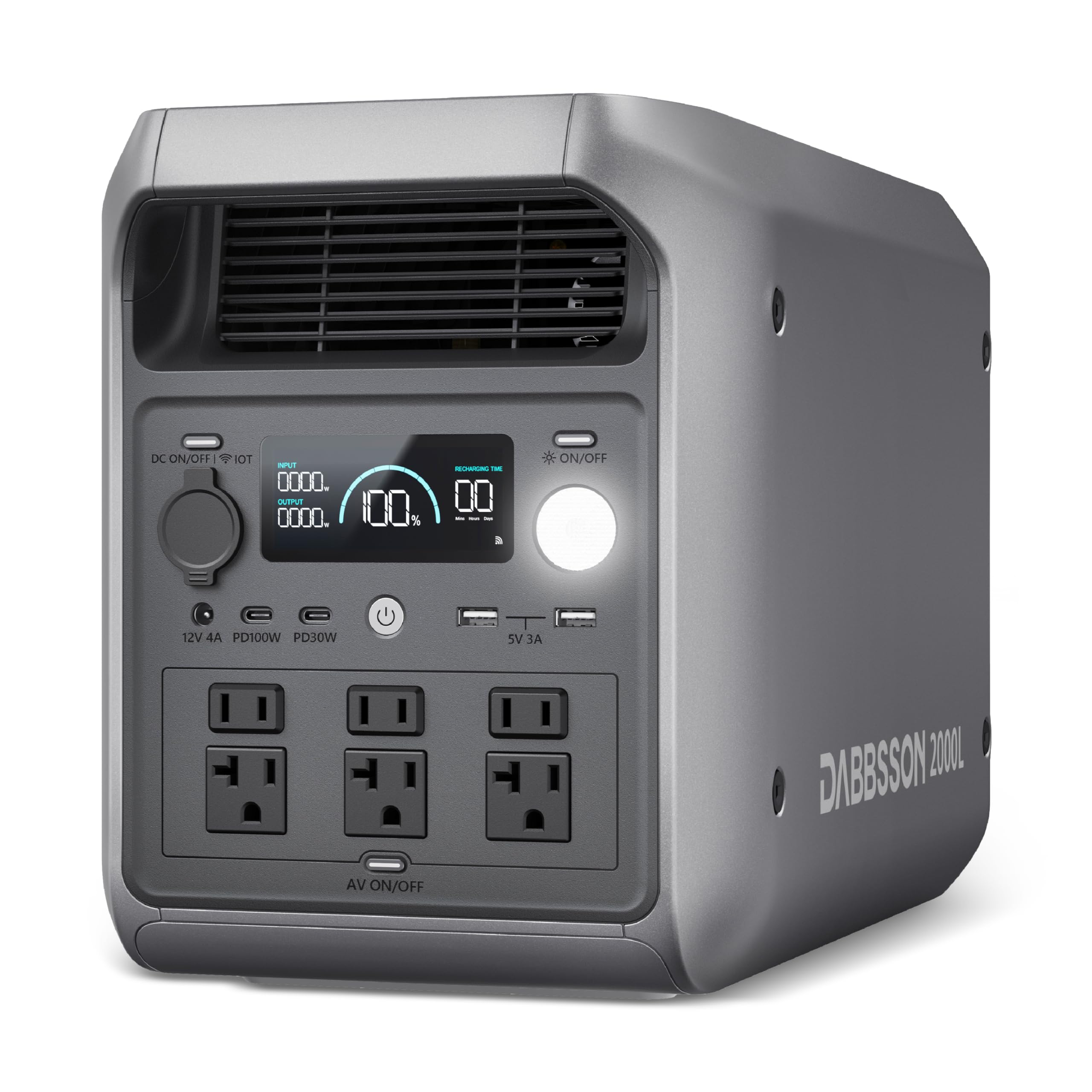
2. DABBSSON Portable Power Station 2000L
The semi-solid pack built for households that stack fridges and freezers.
Its 2200W continuous with a 3300W boost is calibrated for exactly the load that matters here — a fridge or freezer compressor kicking on. Owners mention it running two freezers plus two fridges for 7.5 hours, or a single double-door fridge for 20.7 hours, on one fill. That is the real-world figure that matters more than any spec sheet line, and it’s why this sits at the value spot on the list.
Where it edges the Anker SOLIX C2000 Gen 2 above is on the chemistry story. The semi-solid LiFePO4 cells (a gel-like lithium formulation between a standard liquid LFP and a full solid-state cell) are rated for 4000+ deep cycles to 80%, which the maker frames as over 10 years of daily use. The boost number is the one head-to-head where Anker leads — 4000W peak versus 3300W here — so if you plan to run a window air conditioner and a fridge together under load, the C2000 Gen 2 keeps more headroom. For fridge-and-freezer duty alone, this unit is the better match for its footprint (11.2″L × 18.3″W × 8.9″H) and price.
Charging is genuinely fast: 1-hour AC full charge, plus solar up to 800W MPPT (maximum power point tracking, a charge controller that squeezes the most watts from your panels as light changes) and 12V car charging. The UPS switch lands at under 15ms, so the router and NAS on the same circuit never see a blip. A few gripes show up in the review pages: the fan cycles on every few minutes even with nothing plugged in, and the firmware can be stubborn about that “charge to 90, discharge to 10” energy-management setting.
The compromise to weigh: that 3300W boost is where the cheaper station separates from the strongest peak competitor — fine for a fridge and freezer, but window A/C plus a fridge at once is asking a lot.
For the money: 2200W / 3300W / 2048Wh / 41 lb with 4000+ cycle chemistry is a strong balance for anyone whose primary job is keeping food cold.
Pick this one when: your outage pattern is food safety first, and you want a 1-hour recharge plus 4000+ cycle longevity from semi-solid cells.
skip it if: a microwave-plus-A/C combo is your typical load — the 3300W boost, not 4000W, is the ceiling here.
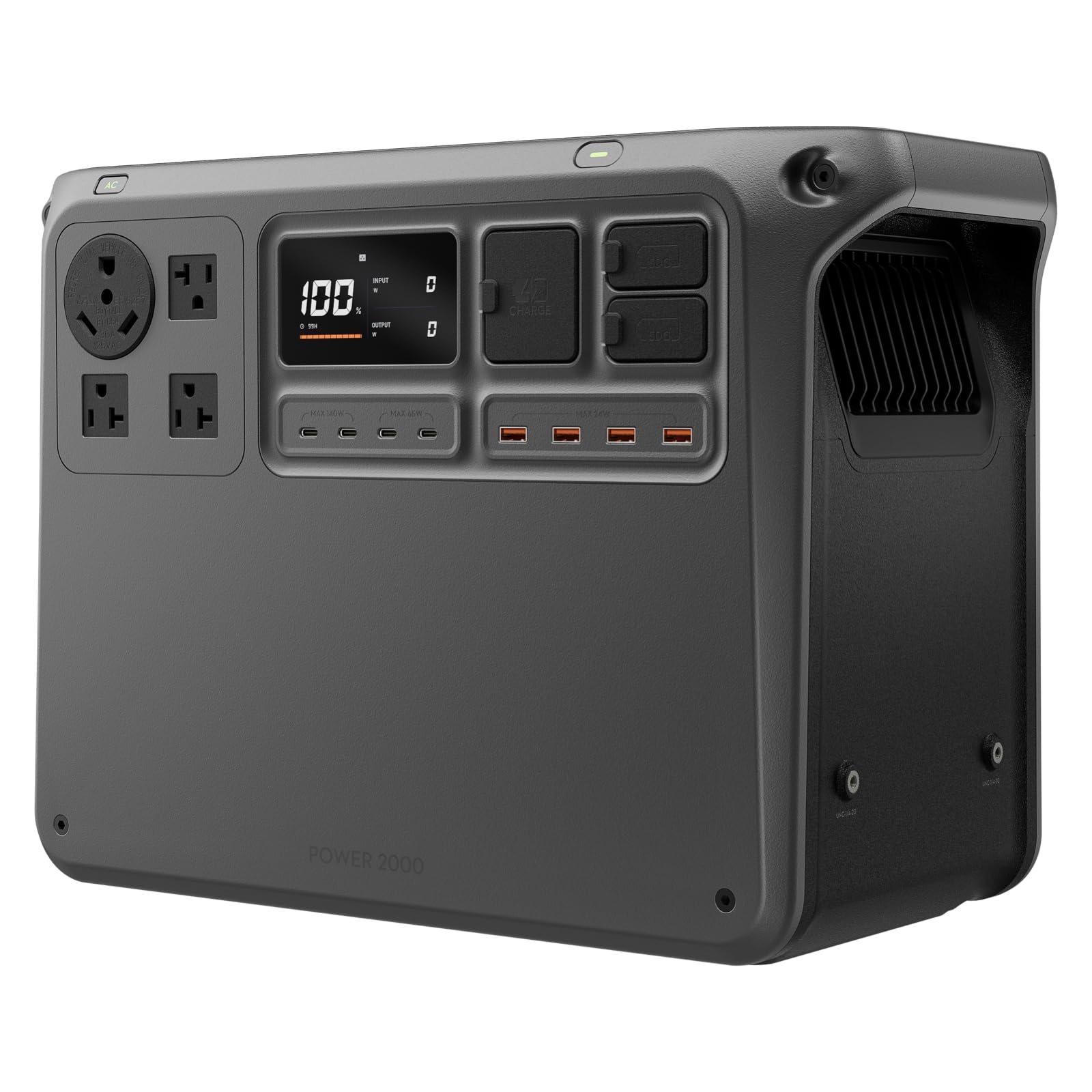
3. DJI Power 2000 Portable Power Station
Full 3000W behind a fan you can sleep next to.
This pick goes to the kitchen that shares a wall with the bedroom. DJI rates the unit as low as 30 dB during nighttime use — roughly a whisper for a station this powerful — and owners running it in campers report replacing a noisy gas generator with something they describe as absolutely quiet. Its 3000W continuous output is the highest of the three 2kWh-class stations at the top of this list, ahead of the Anker C2000 Gen 2’s 2,400W and the DABBSSON’s 2200W.
Where DJI plays a different game is system reach. Capacity expands to 22.5kWh with expansion batteries (sold separately), which is enough in theory to run essential home devices for 4–6 days during a blackout. Port count is unusually high at 15, including dual full SDC ports — an SDC port is DJI’s high-current DC output, useful for daisy-chaining. UPS switch time is 10 ms, half the EcoFlow DELTA 3 Max’s is faster still at under 10ms — either way, fast enough that a router or workstation won’t blip.
The honest catch lives on the expansion side. DJI’s own peripheral modules — solar and car charging adapters — have been notoriously slow to restock, and owners who bought the station intending to add the 1.8kW solar/car charger have waited months. Standalone use works cleanly; expansion beyond the box is the part to plan around. Charging is otherwise brisk at 80% in 55 minutes, and the 2048Wh LFP battery carries smart BMS and a flame-retardant housing rated for wet or rugged outdoor use.
The 15-port advantage: a family of four to five charging phones, lights, fans, and laptops at once — from one station — is a real camping and RV differentiator that the smaller two-port stations can’t touch.
The peripheral caveat: if solar expansion is central to your plan, confirm adapter availability before you commit — a few owners have been stuck waiting.
Best for: RVers, campers, and night-side kitchens where quiet beats every other spec.
Not the one if: you need out-of-the-box solar or car charging — adapters are sold separately and restock has been slow.
4. BLUETTI Elite 200 V2 Portable Power Station

A fridge-backup battery you can hand down to your kids.
Under the hood is a 2073.6Wh battery rated for over 6000 cycles and a 17-year lifespan at everyday use — the longest cycle rating in this lineup by a wide margin. For a refrigerator backup, that is the whole ballgame: the unit you buy now should be the unit still running your freezer a decade from now, and the CNAS-certified true automotive-grade LiFePO4 cells here are the reason it earns the top lifespan label. The performance is no slouch either — 2600W continuous and 3900W power lifting, which is the temporary surge to fire up a compressor or high-demand appliance like a coffee maker or hair dryer.
Standby draw is only 10W, three times lower than comparable stations according to the manufacturer, which translates directly into less waste and longer runtime on the same charge. Customers note it quietly powering a fridge for a full day, holding charge for extended stretches, and working cleanly even in cold temperatures. One owner put it through real camp use — a router plus Starlink, security cameras, a well pump, and a trickle-charge for a depleted battery bank at roughly 140W baseline — and it held up through snow and falls. Against the similarly rated Anker C2000 Gen 2, this one gives up 400W of peak (3900W vs 4000W) but gains ~85% more rated cycles (6000+ vs 4000+).
The trade-offs are honestly listed: it weighs 53.4 pounds, it does not accept expansion batteries, and the solar input voltage is capped at 60V, so a 1000W array has to be sized around that ceiling rather than pushed. If your priority is future battery stacking, the Anker or DABBSSON above handles that; if your priority is a fridge backup that outlives the appliance, this one is the safe long-term choice.
Why it wins on longevity
- 6000+ cycles with a stated 17-year lifespan — best in this lineup
- 2600W continuous / 3900W lifting — handles compressors and high-demand loads
- 10W standby draw, 3× lower than comparable stations per the maker
- 0–80% in 50 minutes via dual AC + DC; full charge in 2 hours
Honest limits
- No expansion battery support, unlike larger rivals on this list
- 60V solar input ceiling constrains panel sizing above 1000W
- 53.4 pounds — a two-person or wheeled move for most kitchens
Choose this if: you want the longest-lasting fridge backup on the list, full stop, and don’t need expansion batteries.
Think twice if: you plan to grow the bank past 2073.6Wh — the Elite 200 V2 is a closed system.
5. Jackery Explorer 2000 v2 Portable Power Station

The one you’ll actually carry — fridge backup that fits a car trunk.
At 39.5 pounds, this is the lightest 2kWh-class station here, and the framing is direct: 41% lighter and 34% smaller than typical 2kWh LiFePO4 stations, using the same CTB (Cell-to-Body, a structural design that makes the battery casing part of the chassis) approach used in EVs. Capacity is 2042Wh with 2200W AC output across three AC ports, plus a USB-C PD 100W port that fast-charges a laptop without an adapter brick. For a fridge plus phone plus router scenario, this packs enough for a night and moves without needing two people.
Runtime is where owners have tested it hardest: one owner ran their fridge for 21.3 hours on a single fill, and reported pass-through charging held roughly 1500W while the fridge stayed powered. Charge side is fast — 0 to 80% in 66 minutes via AC Fast Charging, or a full charge in 102 minutes via the Emergency Super Charging mode routed through the app. Silent Charging mode lands a full charge in 5 hours at under 30dB. LiFePO4 chemistry is rated up to 10 years, backed by 4,000-cycle capacity retention to 70%.
The honest caveat is real-world power accounting. One electrical-engineer reviewer measured a ~70% apparent loss on a first test with a 17W load (17W only ran about 34 hours instead of a calculated 100+), though a second test measured closer to expected — worth knowing if you intend to run low-draw devices like routers and phone chargers for very long stretches. The UPS switch lands at 20ms, and the UL1778 certification is stated for uninterruptible power systems. For most users cooking with a fridge and charging phones and laptops, this is the most manageable unit on the list to live with.
Carry-ability verdict: 39.5 pounds with the CTB chassis means one person can move it from kitchen to garage to campsite without hassle — the everyday pain point for 2kWh stations.
Honest note on idle draw: if your plan is trickle-charging a router or a phone overnight, plan the runtime around real-world reported efficiency rather than the rated watt-hours alone.
Best match for: apartment dwellers, campers, and anyone who needs to move their fridge backup from room to room.
Not for you if: your main use is running dozens of small low-wattage devices around the clock — the report of higher-than-expected idle loss is worth weighing first.
6. PECRON Portable Power Station 3072Wh E3600LFP

Three thousand watt-hours with a five-year warranty and a growth path.
The 3072Wh starting point is the draw here — enough for a fridge and freezer together for extended periods, or to carry a van conversion’s 12V system through days of off-grid use. Continuous AC is 3600W, so a heavy-duty kitchen appliance, an air conditioner, or a compressor fridge can start without stressing the unit. Expand to 18.43kWh using four additional EP3800-48V batteries (sold separately), which is the largest battery-stack ceiling in this lineup.
Charging is where this pick earns back its cost quickly. Full AC charge in 1.3 hours with the 3200W input, or 2 hours on a 1800W circuit; solar support runs to 8 × 300W panels with a 1.5-hour full-charge from that array. Sixteen output ports cover AC (four outlets plus a TT30-R), four USB-A, two 100W USB-C, XT60-F, cigar, and DC5525. Owners running van conversions report the 12V 30A output comfortably carrying two fridges, a fan, lights, and an air conditioner, and the phone support gets repeat praise. The 3072Wh starting point is nearly 50% more capacity than the 2048Wh stations above it in this list.
The honest trade-offs are weight and idle behavior. At 79 pounds, this is not a portable picnic battery — the handle and wheels matter. Energy management is reported as inconsistent, with a handful of owners flagging slow drain in standby rather than a clean battery-holding pattern, and the fan noise gets mixed notes. For anyone treating this as a stationary, growth-oriented home backup rather than a grab-and-go station, those quirks fade next to the capacity math.
Where the value shows up
- 3072Wh with an 18.43kWh expansion ceiling — the most room to grow in this lineup
- 3600W continuous AC — heavy-duty appliance startup without overloading
- 1.3-hour full AC charge from the 3200W input
- 16 output ports including TT30-R and 2 × 100W USB-C
Room for caution
- 79 pounds — treat it as stationary, not portable
- Standby drain inconsistency is reported by a handful of owners
- Fan noise gets mixed notes in reviewer summaries
Get this one when: you want a fridge backup that can grow into near-whole-home territory over time.
Pass if: portability is the priority — 79 pounds locks this to one spot.
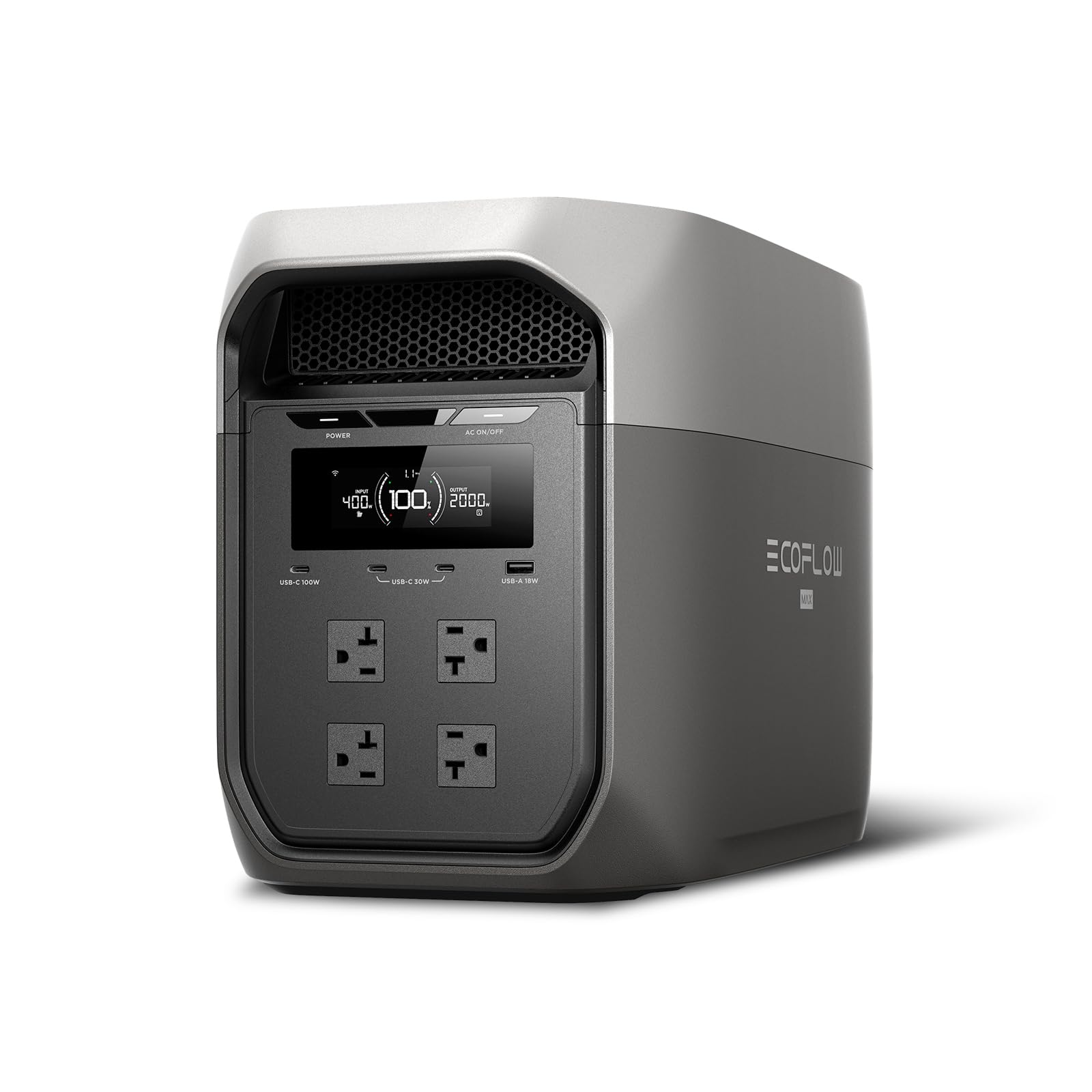
7. EF ECOFLOW DELTA 3 Max Portable Power Station
Refills faster than your fridge can warm up.
The headline number is 0–80% in 1.13 hours via EcoFlow’s X-Stream charging — under an hour and a quarter to be ready for the next outage, which matters when storms roll through in waves. Capacity is 2048Wh with an LFP battery rated for a decade of daily use, and the output runs to 3400W X-Boost, which EcoFlow states is enough to power 99% of appliances including fridges, microwaves, and power tools. UPS switch time is under 10 ms, the fastest on this list alongside the DJI Power 2000, making it the safest bet for keeping sensitive electronics alive on the same circuit as the fridge.
Where it pulls away from other 2kWh stations is peak output. It runs 3400W against the Jackery Explorer 2000 v2’s 2200W and the DABBSSON 2000L’s 3300W boost, and it is 1000W above the Anker C2000 Gen 2’s rated 2400W. That headroom is why reviewers point out it driving multiple appliances on the same circuit — fridges, and in one case a mobile DJ rig that consumed only 25% of the battery over a 6-hour session. The manufacturer lists a 5-year extended service, which is a relevant selling point for a home backup purchase.
The recurring gripe is weight and app polish. It is a genuinely heavy unit to move around, and a handful of owners on the app side report disconnect requirements and confusing operating-mode descriptions. The hardware itself gets consistent praise — one long-term user reports 1700W wall charging with the fan running quietly and battery temp sitting around 100°F indoors, dropping fast. If you want plug-and-forget reliability with the fastest single-charge refill in the class, this is the pick.
The standout spec: 1.13-hour 0–80% refill is the fastest AC recharge in this lineup — meaningful when the next storm rolls in before the last one clears.
The compromise: portability — the aluminum-and-plastic chassis earns weight complaints, and the app has a steeper learning curve than the hardware deserves.
Right for you if: you deal with back-to-back outages and want the fridge back online in under ninety minutes.
Look at the smaller Anker instead if: lugging a heavy unit around the house is your main pain point.
8. BLUETTI Elite 300 Portable Power Station
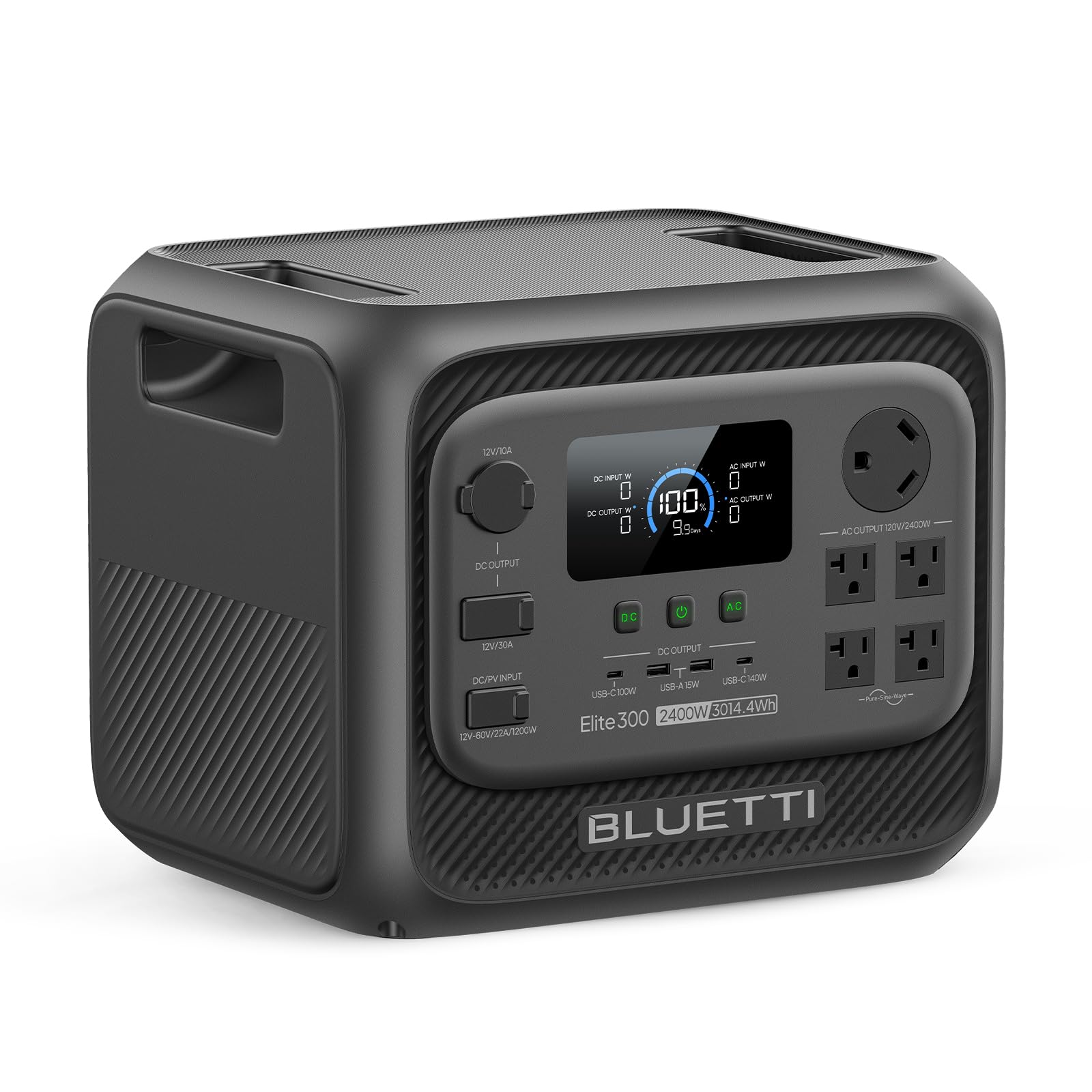
Three thousand watt-hours in a body the size of a small cooler.
The 3014Wh pack fits in a case that is nearly 59% smaller than traditional large power stations per BLUETTI’s claim, and it ships with a TT-30 RV outlet plus a 12V/30A DC output built specifically for RV loads like 12V fridges, water pumps, and diesel heaters. Output is 2400W continuous with a 4800W surge, which is the highest surge in this lineup and specifically useful for resistive loads like kettles that pull hard at startup. The UPS switch is 10 ms, and the LiFePO4 cells are rated for 6000+ cycles. 0–80% recharge takes as fast as 78 minutes.
Owners consistently single out the compactness for the capacity. One ran a 12,000 BTU air conditioner all night on the Elite 300; another kept a fridge, fans, and a phone running for a full day and framed the size as roughly two ammo cans with truck-battery weight. The company’s own app handles monitoring and output control. Solar works but with a caveat — reviewers flag the 60V/20A solar ceiling as lower than the marketing “1200W” phrasing implies, and an over-voltage from an over-sized array can void the warranty. Also worth noting: expansion batteries are not supported, so 3014Wh is the ceiling for this unit.
For RVers running a fridge and a DC appliance on top of AC loads, this is one of the best-matched units on the list. The trade-off versus the DJI Power 2000 above is that DJI expands to 22.5kWh and BLUETTI Elite 300 does not — but DJI gives up 1014Wh of starting capacity and the TT-30 outlet.
Why it belongs here: a true 3kWh-class station that fits in the same nook as a 2kWh unit and hands you a TT-30 outlet plus 12V/30A DC for RV fridge and pump duty.
Know before you commit: solar input is capped at 60V, so match panel voltage carefully — and treat the 3014Wh capacity as fixed.
Ideal for: RV owners and off-grid campers who want the smallest 3kWh-class station with a dedicated RV outlet.
pass on it if: you need solar arrays above 60V or expansion batteries down the road — this unit is a closed system.
9. PECRON Portable Power Station E3800 LFP
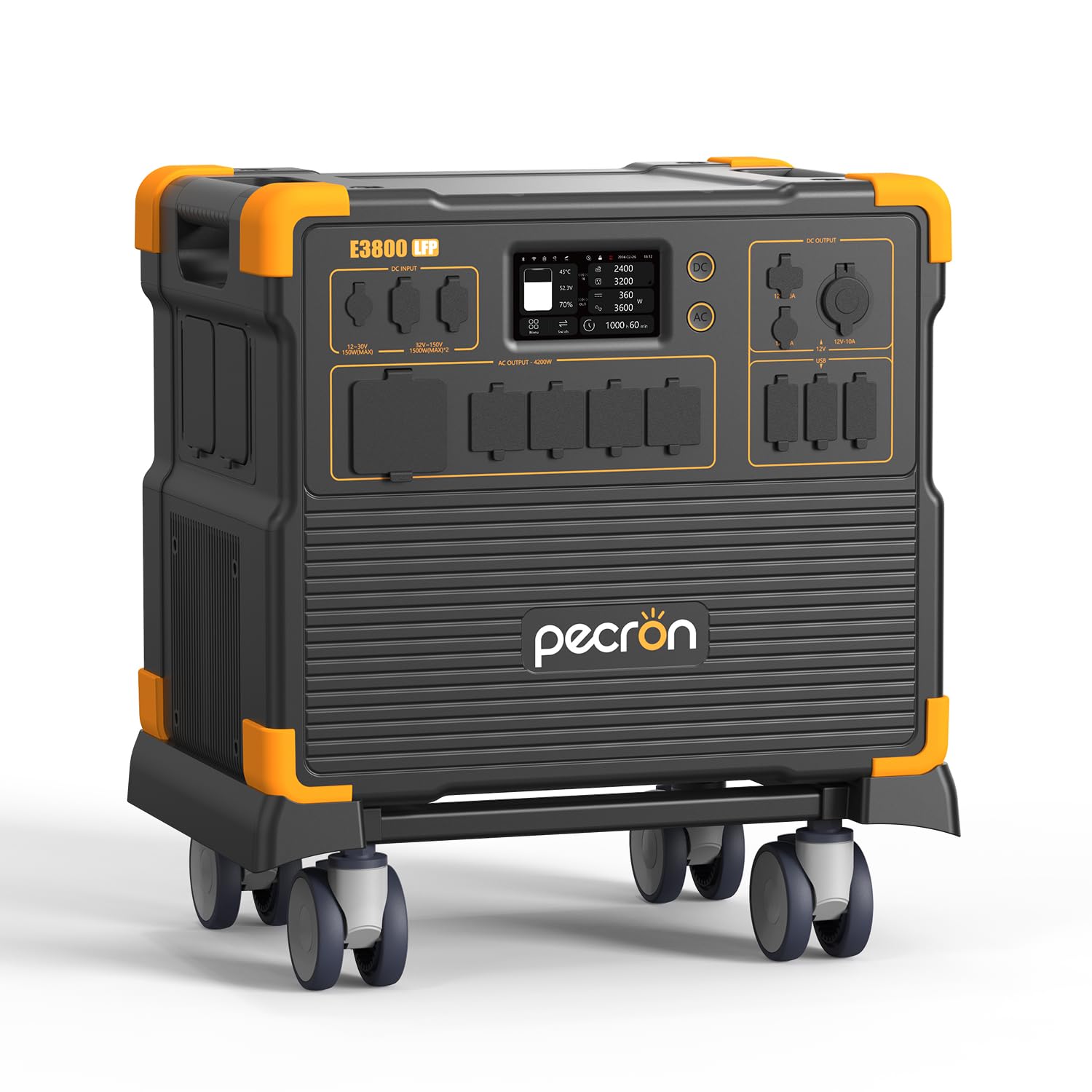
The heavy hitter that can grow into a whole-home bank.
3840Wh and 4200W rated AC output make this the biggest single-unit capacity on the list, and it will absorb just about anything you plug into it — refrigerators, microwaves, power tools, and RV appliances all run comfortably within the ceiling. Four AC outlets plus one TT30-R RV outlet deliver 100V–120V pure sine wave, and the total output count is 14 ports including 2 × USB-C at 100W. Expansion goes to 53.76kWh with additional batteries (sold separately), which is the deepest capacity stack in this whole comparison.
Charging keeps pace with the size: 0–100% in 1.4 hours on 3200W AC input, or 2.5 hours on 1800W, or 3000W of solar (VOC under 150V). That is a faster fill on a bigger battery than several of the smaller units here, and the UPS function lands at 8–20 ms with support up to 3600W via the 30A cable. Owners running off-grid report it ran 1500W of space heater for 2+ hours, soaked a 1/2hp sump pump startup without trouble, and kept fans and lights alive all night at 101 degrees on 60% battery. One powered a 450 sq ft shop with a mini-split 24/7 for months using the E3800 plus three extra batteries — heavy real-world use where the BMS held up.
The catch is weight. At 87.3 pounds this unit needs the trolley or a second person for any move, and simultaneous heavy loads (an air conditioner plus a fridge plus a microwave at once) can trip it — restarting via the app solves it, but the lesson is that you stack loads carefully. A niche report of batteries draining unevenly across expansions shows up once; the vendor response was prompt. If capacity is the primary constraint in your kitchen, this unit solves it in one piece.
Why capacity-seekers pick it
- 3840Wh base capacity with expansion up to 53.76kWh
- 4200W continuous AC output — highest rated on the list
- 1.4-hour full AC charge via 3200W input
- 14 ports including TT30-R and 2 × 100W USB-C
Real-world trade-offs
- 87.3 pounds — essentially stationary for most buyers
- Stacking A/C + fridge + microwave simultaneously can trip the output
- A rare report of uneven drain across expansion batteries
Made for: off-grid homes, extended outages, and anyone who needs the biggest single-unit capacity and the deepest expansion ceiling.
Not the right pick if: you ever plan to move it without wheels — 87.3 pounds rules out casual repositioning.
10. Jackery HomePower 3000 Portable Power Station
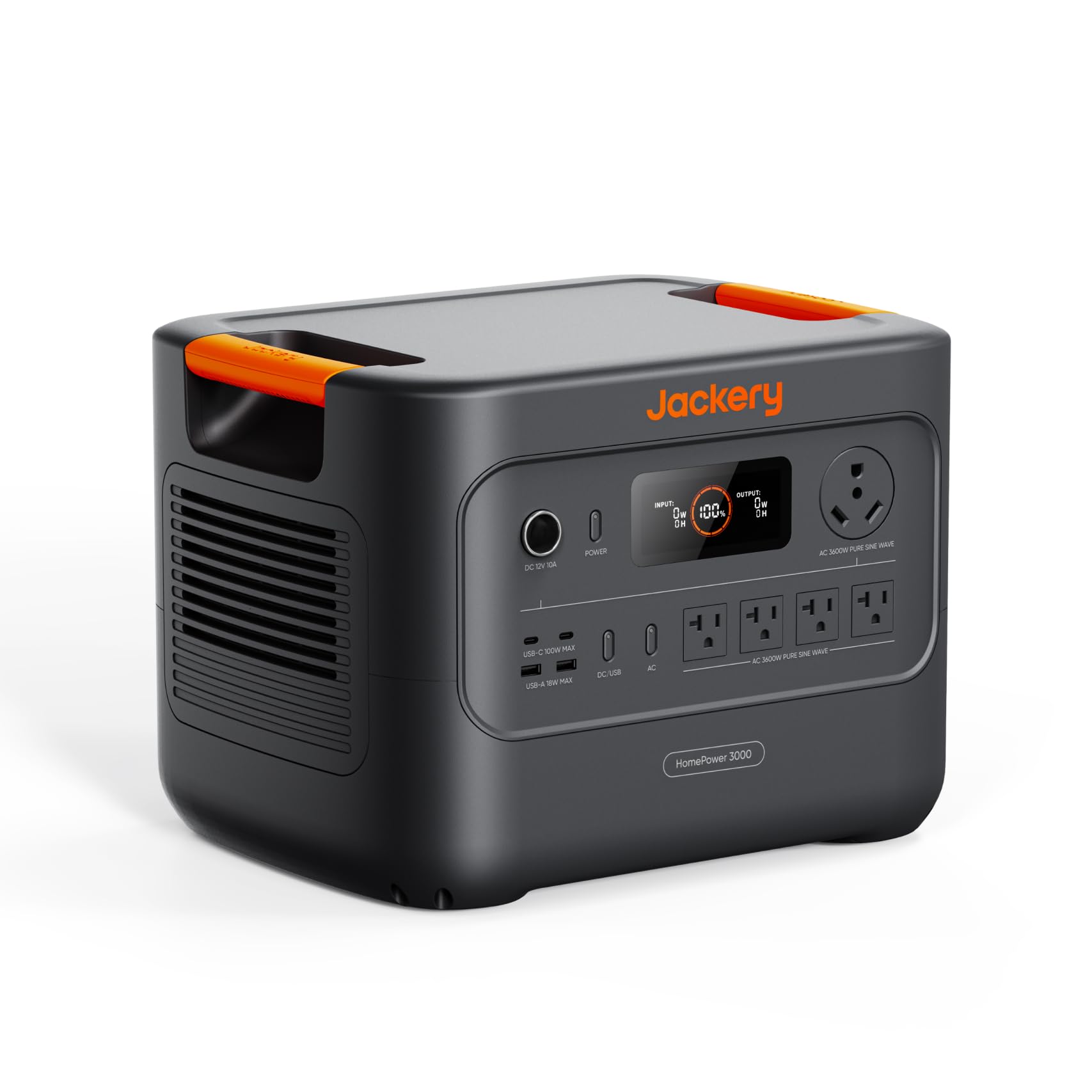
Enough to run the fridge, the freezer, and the WiFi while the block is dark.
With 3072Wh feeding 3600W continuous and 7200W surge, this pick is built to cover a household’s essentials, not just one fridge. Jackery states it powers a household for up to 15 hours and keeps a refrigerator running for 1 to 2 days on a single charge. The ≤20 ms UPS is UL-certified for uninterruptible power systems, so security cameras, routers, and pet feeders keep running uninterrupted. The unit is the lightest and smallest of the 3kWh class per Jackery’s own claim — 47% smaller and 43% lighter than comparable-capacity models — thanks to CTB construction.
Owners confirm the everyday value: plugged into a 30A RV outlet, it runs a 30-foot trailer for 3+ days without air conditioning, and one householder reported it ran the office gear and freezer during outages with fast recharge between cycles. The LiFePO4 battery is rated for 4,000 cycles retaining 70% capacity, and recharges fully in 1.7 hours via hybrid AC and DC or 2.2 hours AC-only. A TT-30 RV port and dual 100W USB-C PD ports round out the plugin options.
Two honest notes. First, weight sits at roughly 59.5 pounds and the fan can reach around 60dB under any load — a minority of reviewers find that a dealbreaker for always-on UPS duty. Second, if your plan is running a diesel block heater in freezing conditions, one owner reported it shut off at low temperatures even inside the rated window; that application is not where this unit’s balance sits. For fridge, freezer, WiFi, and phone charging during a blackout, it is squarely in the balance.
The whole-home angle: 3600W continuous with a 7200W surge is enough to chain a fridge, a chest freezer, and a household’s lighter loads on one unit.
The details to weigh: 59.5 pounds and fan noise around 60dB under load are the recurring owner notes — fine for emergency running, less so as always-on UPS duty.
Built for: households that want one station to carry the kitchen, the router, and a few rooms of lights through a multi-hour blackout.
Reconsider if: you want the unit permanently wired in as an always-on UPS — the fan noise under load is louder than a dedicated UPS, and weight makes relocation a two-hand job.
11. EF ECOFLOW DELTA Pro Portable Power Station
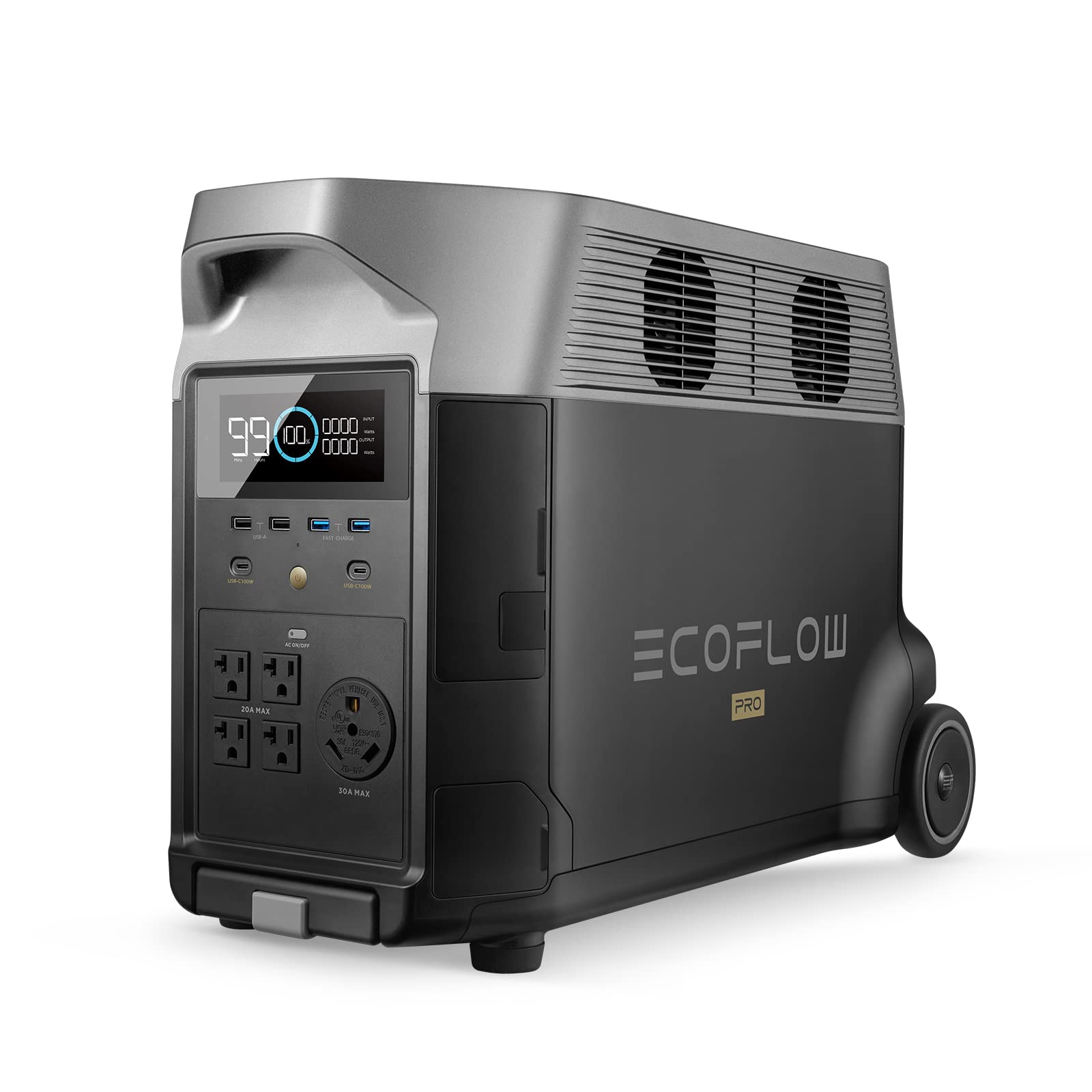
The one that keeps the whole house warm and lit — and stays quiet doing it.
At 3600Wh and 3600W AC output — expandable to 4500W with X-Boost, or 7200W when you pair two units — this is the most powerful fridge-and-home battery on the list. The 3600Wh LFP battery can expand from 3.6kWh to 25kWh with additional batteries (sold separately), and the 15 output methods — including 5 AC outlets, 2 × USB-C at 100W, an Anderson port, and a car power output — mean the unit can feed a fridge, the router, the lights, and a workstation all at once. It fully recharges in 1.8 hours via 240V outlets (3000W) or 2.7 hours on standard wall power, and solar fills it in 2.8 hours with four 400W panels at up to 23% solar conversion efficiency.
Owners have leaned on it hard. In a rural setting with frequent multi-day outages, one household ran a refrigerator, propane furnace blowers, lights, the internet, and computers for around 15 hours, then recharged it in about two hours off a gas generator and shut the generator back off — saving roughly half the fuel cost per the owner’s own estimate. Another runs it as the power source for a mobile vending operation, driving a heat press at markets with no voltage drops. The review pages consistently point to performance and reliability as the two things owners trust most, and the 5-way charging (wall, solar, car, EV station, smart generator) makes the recharge logistics flexible.
The honest catch is bulk and portability: at 99 pounds, this is a wheeled or two-person move, and the unit ships with a handle specifically because it needs one. A handful of reviewers also flag that solar input is capped at 15A, so oversized solar arrays won’t deliver the way newcomers might expect. For a kitchen where the primary job is a fridge, freezer, and household essentials over multi-day outages — and budget allows for a true premium pick — this unit is the biggest single-box answer here.
Where the power shows
- 3600Wh expandable to 25kWh, 3600W base / 4500W X-Boost per unit
- 1.8-hour recharge via 240V / 3000W; fast 2.7-hour wall charge
- 15 output methods including 5 AC outlets and 2 × 100W USB-C
- Smart app control via Wi-Fi or Bluetooth for monitoring and scheduling
What to know first
- 99 pounds — needs the extendable handle or a second person for any move
- Solar input is capped at 15A, so oversized arrays under-deliver versus expectation
- Heavy footprint makes it more of a stationary home unit than a camping grab-and-go
The one to get if: your priority is whole-home resilience with room to grow to 25kWh over time.
it’s not for you if: you want something that moves easily — at 99 pounds the DELTA Pro is built to sit, not to travel.
Understanding the Specs
Continuous AC Output Versus Peak Output
The number that keeps your fridge alive through the night is continuous AC output — the steady wattage the unit can supply for as long as the appliance is running. Peak output (sometimes called surge, boost, or power lifting) is a short burst the battery can supply for only a few seconds, which is what handles the compressor startup when your fridge first kicks on. If you plan to run a fridge alongside a microwave, air conditioner, or power tool, add those continuous draws together and make sure you stay under the continuous rating — not the peak rating.
Capacity in Watt-Hours and Battery Chemistry
Capacity is measured in watt-hours (Wh) and tells you how long the battery can supply a load before it runs out. A refrigerator cycling between 100W and 400W uses different amounts of power per hour, so the same 2,000Wh unit can run a fridge for over a day in one house and closer to half a day in another. Battery chemistry matters long term: LiFePO4 (lithium iron phosphate, chosen for its heat tolerance and slow capacity fade) typically rates thousands of cycles before dropping to 80% capacity, which is why most picks here advertise multi-year lifespans. UPS transfer time — measured in milliseconds — is how quickly the unit switches to battery during an outage, and anything at or under 20ms keeps a router or desktop computer from rebooting.
FAQ
How many watt-hours do I need to run a refrigerator overnight?
Will these backup batteries run a French door fridge that has a freezer drawer?
How long can a 2,000Wh backup battery keep my freezer cold?
What is the difference between a power station and a gas generator for fridge backup?
Do I need LiFePO4 chemistry or does a standard lithium battery work?
Can I recharge these batteries from solar panels during an extended outage?
How long does a power station actually hold its charge when sitting unused?
What is UPS mode and why does it matter for my fridge circuit?
Do I need an electrician or special wiring to use a fridge backup battery?
Is the surge or “boost” wattage rating safe to run my fridge on continuously?
Final Thoughts: The Verdict
For most kitchens, the Anker SOLIX C2000 Gen 2 is the strongest all-around fridge backup — 2,048Wh held behind only 9W of standby draw means the charge goes to the fridge instead of leaking out while the unit does nothing. It runs a dual-door fridge for up to 32 hours, refills in 58 minutes, and stays under 42 pounds. If you want the deepest capacity in one piece, the PECRON E3800LFP brings 3840Wh and 4200W. For a compact, mobile setup that travels between kitchen and RV, the BLUETTI Elite 300 trades the lightest footprint for a full 3014Wh. And if you want whole-home power with a 25kWh growth path, the EF ECOFLOW DELTA Pro is the biggest single-box answer here. Nearly 700 owner ratings support the C2000 Gen 2 — pick the capacity that matches your longest outage, and the fridge will hold.
How We Picked
We do not accept paid placement. Every pick is matched to a real buyer and a real use-case; we do not hands-on test units.
Sources & Methodology
Specifications: manufacturer listings and product documentation. Review insights: verified customer reviews, as of September 2026. Pricing: not shown on this page (it changes often); check the current price via the retailer link.
As an Amazon Associate, KitchPrep earns from qualifying purchases. This does not affect which products we feature.
Related Guides
