
Specs are compiled from manufacturer listings and verified buyer reviews and can change over time — please confirm the key details on the product page before buying.
Passing inspection on the first try depends on two things: the copper has to be genuinely bare, and the gauge has to match the job. Get those right and the install is boring, which is exactly what you want. Get them wrong and you are re-pulling wire through a wall. This shortlist sorts the eight most sensible bare copper buys by what each one is actually built for, from a 15-foot residential grounding length to a 100-foot pool bonding run.
I’m Mohammad Maruf — the founder and writer behind KitchPrep. This guide is built by comparing the manufacturers’ published specifications and the patterns across verified customer reviews, so you get each pick’s real strengths and trade-offs instead of marketing spin.
Everything below is uninsulated copper, meaning there is no plastic jacket or coating over the metal, so it can clamp straight to a rod, a lug, or a grounding bar. If you are weighing which metal actually belongs in your setup, the short answer is that a proper bare copper ground wire carries fault current away from people and equipment far more reliably than a coated or aluminum substitute.
Our Picks at a Glance
How To Choose The Best Bare Copper Ground Wire
Grounding wire is the least glamorous purchase in any electrical project and the one most likely to get skimped on. The good news is you only have to get four things right, and each one is printed right on the listing.
Start with the gauge, not the length
Gauge (the wire’s thickness, written as a number) is the decision that matters most, and it runs opposite to instinct — 6 gauge is noticeably fatter than 18 gauge. A lower gauge number means a thicker conductor that can carry more fault current. Southwire’s 15-foot roll arrives at 8.2 gauge, while uxcell’s spool ships at 18 gauge, and those two are playing completely different games. Match your gauge to the circuit or the bonding requirement you are satisfying rather than to whatever looks substantial in the photo.
Decide between solid strand and braided strap
Solid single-strand copper, like the Southwire roll and the Wirenco 100-foot cut, holds its shape and pushes neatly through a hole or down a rod. Braided copper, like the KWOKWEI flat strap, is woven from many thin strands into a ribbon so it bends around corners a solid wire would fight you on. If your run has tight turns, vibration, or a moving joint such as an engine block, the flexible braid is the friendlier choice.
Check whether the listing is licensed electrical wire or craft copper
Some of the best-value bare copper on the shelf is sold as jewelry and weaving wire, and it is still greater than 99 percent pure copper with no coating. Small Parts’ 18 AWG spool is one of these — marketed for crafts, built to QQ-W-343 and ASTM B3 standards, and perfectly usable as a grounding length. The trade-off is that craft spools often come in thinner gauges, so read the diameter before you commit.
Quick Comparison
| Model | Best For | Gauge | Length | Form | Amazon |
|---|---|---|---|---|---|
| Southwire 8-Gauge Bare Copper Wire★ Best Overall | Residential grounding and DIY rewire | 8.2 | 15 ft | Solid, single strand | Amazon |
| Wirenco 8 AWG Solid Bare CopperTop Performer | Long runs, solar and electroculture | 8 | 100 ft | Solid, single strand | Amazon |
| KWOKWEI Flat Copper Braid CableMost Flexible | CB and HAM antenna grounds, tight bends | 5/8 in braid | 10 ft | Braided, flat | Amazon |
| JumpingLight Bonding Pool Ground Wire | Pool bonding and heavy bonds | 6 | 100 ft | Solid, single strand | Amazon |
| Small Parts Bare Copper Wire, 18 AWG | Jewelry, craft and light grounding | 18 | 195 ft | Solid, single strand | Amazon |
| Small Parts Bare Copper Wire, 22 AWG | Fine wire wrapping and light duty | 22 | 500 ft | Solid, single strand | Amazon |
| uxcell Bare Copper Ground Wire, 18 Gauge | Light fixtures, fans and equipment grounding | 18 | 100 ft | Braided | Amazon |
| ELECTRAPICK 99.9% Soft Pure Bare Copper Wire | Electroculture, craft and hand-bending | 16 | 127 ft | Solid, single strand coil | Amazon |
In‑Depth Reviews
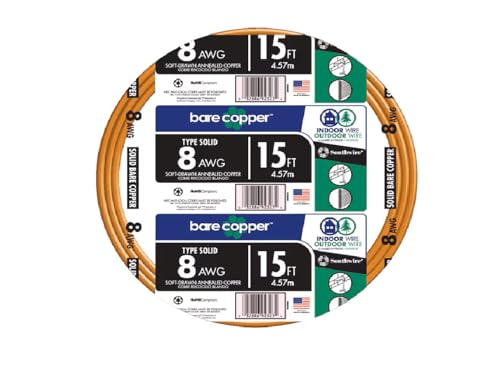
1. Southwire 8-Gauge Bare Copper Wire – Solid Soft‑Drawn Uninsulated Copper Conductor for Grounding & Electrical Applications, 15ft
Our pick — over 4.5★ from 650+ verified ratings; the strongest balance of quality and price.
The heavy, single-strand copper that turns a grounding job into an inspection formality.
If you are bonding a pool or running a ground to a rod before the service enters the house, this is the spool that does the job without argument. The conductor is 8.2 gauge solid copper in a soft-drawn temper, which is a metalworker’s way of saying the wire was heated and cooled so it bends without cracking. It carries a 600-volt rating and ships as a single uninsulated strand, so it clamps straight to a lug or grounding bar with no stripping.
What wins people over here is the material itself — the copper reads as thick and solid in hand, which is exactly what you want when the whole point is a durable electrical connection. The value story holds up too, with several buyers finding it cost-competitive against local supply houses while still meeting what they needed. It is the crowd favorite here at 4.8 stars across 670+ ratings, and owners consistently report the copper is genuine rather than an alloy lookalike.
Compare it to the longer spools below and the trade-off is simply length: 15 feet goes fast if you are wiring more than one ground point, and at 8.2 gauge it is noticeably stiffer to route around tight corners than a braided strap. It is also a heavier gauge than the 18-gauge uxcell roll, so it is built for current-carrying bonds rather than light fixture pigtails. One buyer rewiring a 1940s house reported no failures or hazards and rated it above other brands they had used.
Where it earns its keep
- 8.2-gauge solid copper with a 600-volt rating — substantial enough for real grounding and bonding duty
- Soft-drawn temper means it bends and shapes without snapping, unlike harder unannealed wire
- Uninsulated single strand needs no jacket stripping, so installs stay quick
- Consistently described as genuine, thick copper rather than an alloy stand-in
What to plan around
- 15 feet runs out fast on multi-point jobs — measure your route before ordering
- At 8.2 gauge it is stiff, so tight bends and cramped boxes take more effort than a braided strap
- Delivery scheduling, not the wire, is the recurring frustration in the feedback — order when you can be there to receive it
Buy it for: residential grounding, pool bonding, and rewire jobs where you want thick genuine copper and a voltage rating to match.
Think twice if: your run is longer than 15 feet or your route is full of tight corners — a 100-foot spool or a flexible braid will serve you better.
2. Wirenco 8 AWG Solid Bare Copper Building Wire (100 FT Cut)
One hundred feet of 8-gauge solid copper for people who would rather not buy twice.
The gauge here is the thing: 8 AWG solid copper, uninsulated and unjacketed, with an outside diameter of 0.129 inches. That is the same gauge class as the Southwire roll above, but you get 100 feet instead of 15 — which makes it the pick when your run crosses a yard to a ground rod or spans several frames. Buyers have run it from aluminum solar panel frames down to a copper ground rod, and report it fit the clamp brackets and worked cleanly.
The flexibility surprised people who expected 8-gauge copper to fight back. It is described as thick but easy to bend around poles and t-posts, and strong enough to stand straight on its own in a garden electroculture setup. That combination — stiff enough to hold a line, soft enough to shape by hand — is what separates a good spool from a frustrating one. Quality is the trait that comes up most in the feedback, and the recurring note is that it matches the description rather than overpromising.
It is also the honest caution case in this lineup: the spool does not unroll like a coiled wire, and the most common friction point is that it resists feeding off the reel. If you are used to a flexible craft spool, budget a few extra minutes and a helper to keep the cut straight. Price-wise it lands in premium territory, but you are buying a hundred feet, so the per-foot value is where it earns its place on a bonding or distribution job.
The gauge argument: identical 8-gauge class and thicker than the 18-gauge uxcell roll, but with roughly six times the length of the Southwire cut — a different tool for a longer run.
Set realistic expectations: the wire itself earns praise for quality and function; the hassle is in the unrolling, not the copper. Bring a second pair of hands and the job is straightforward.
Reach for this if: your grounding or bonding run is long enough that a 15-foot cut will not finish it.
Look elsewhere if: you want a spool that feeds smoothly one-handed — a coiled craft spool will unroll far more easily.
3. 10FT Flat Copper Braid Cable, KWOKWEI 5/8″ Braided Copper Ground Strap
A flat copper ribbon that folds into the tight corners a solid wire simply refuses.
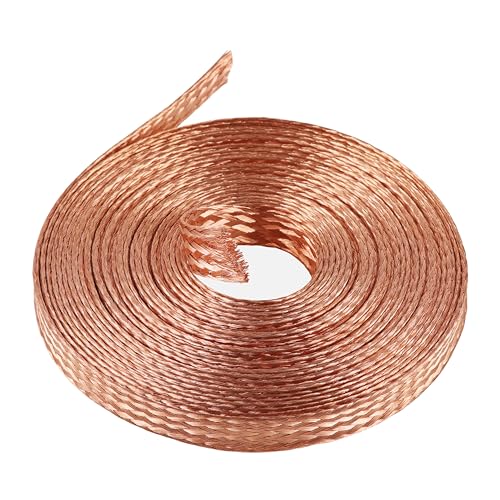
Antenna work is where this strap lives. It is a 10-foot flat braid at 5/8 inch, woven from many thin copper strands into a ribbon shape instead of a single rigid rod. That braided structure increases the surface area of the conductor, which is the listing’s own explanation for the efficient current flow. Buyers have used it as the ground cable for a CB antenna with no complaints, and ham operators running it in stacked lugs found it handles far more current than their setup demanded.
Flexibility is the whole pitch, and it holds up. Where solid 8-gauge copper is thick and stubborn, this braid bends and conforms to irregular shapes and confined spaces, which simplifies installs inside equipment cabinets and along engine blocks. Owners describe it as high-quality copper that feels heavy in hand, which is a fair proxy for actual copper content rather than a plated substitute.
Two honest notes. At 10 feet it is the shortest run on this list, and the flat ribbon is unfinished copper, so it will patina over time if exposed. It is also worth knowing that it is a bonding and shielding strap rather than a building wire — it belongs on equipment grounds, antenna systems, and short jumpers, not as a long main grounding conductor. Keep it to that role and it is a genuinely versatile little spool.
The right buy when: you need a flexible ground path for an antenna, radio equipment, or a short bond on a vibrating or moving joint.
Pass if: you need a long residential grounding run — the 10-foot length and unfinished ribbon suit short, tight, equipment-side bonds instead.
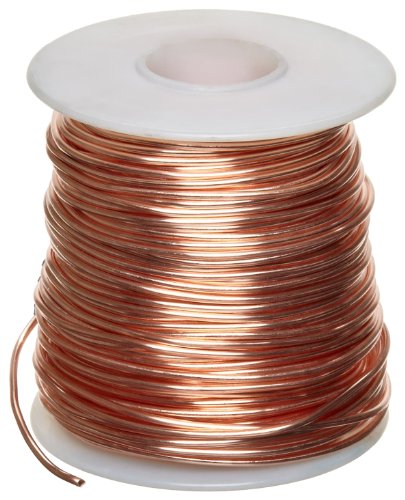
4. Small Parts Bare Copper Wire, Bright, 18 AWG, 0.04″ Diameter, 195′ Length
Craft copper that quietly meets real electrical standards, which is rarer than it sounds.
Most jewelry wire is exactly that — jewelry wire — but this spool is a legitimate two-for-one. It is 18 AWG uninsulated single-strand copper at a 0.04-inch diameter, sold for crafts yet built to QQ-W-343 standards for uninsulated copper wire and ASTM B3 standards for annealed copper wire, with RoHS compliance on top. That means the same 195-foot spool you wrap pendants with can also serve as a light grounding lead in a fixture or a small equipment bond.
The value story is what buyers keep returning to: this is repeatedly called the most economical bare copper spool for wire wrapping compared to craft store brands, and several owners say it has become the only wire they buy for jewelry. It is greater than 99 percent pure copper, which is why it takes a patina so well — the antique, darkened finish people want for oxidized designs comes from the copper itself, not a coating that fades. It winds cleanly and evenly with no stretching and consistent sizing spool after spool.
Where 18-gauge works against you is on heavier grounding duty. It is thinner than the 8-gauge Southwire and the 8 AWG Wirenco, so it is fine for light fixture pigtails and small equipment grounds but not for a main service bond. The other honest note is the occasional spool with a bit of excess shrink wrap or a single overlapped winding — a packaging nit, not a wire defect, and it has not stopped anyone from buying again.
What people rave about
- Meets QQ-W-343 and ASTM B3 standards for uninsulated annealed copper — genuine electrical-grade metal, not craft filler
- 195 feet at 18 AWG gives you the longest run on this list at the thinnest, most bendable gauge
- Greater than 99 percent pure copper oxidizes and polishes beautifully for patina work
- Wound cleanly and evenly, with no stretching and consistent sizing across spools
Know before you order
- 18 gauge is too thin for main grounding conductors — use it for light fixtures and small bonds only
- An occasional spool shows stray shrink wrap or one overlapped winding — packaging, not conductor quality
- 0.04 inches is a fine diameter to handle, so it kinks if you are rough with it
Pick this if: you flip between jewelry work and light grounding, and want one standards-compliant spool that covers both.
Choose heavier copper if: the job involves a main ground or high-current bonding — 18 gauge is the wrong tool there.
5. Small Parts Bare Copper Wire, Bright, 22 AWG, 0.025″ Diameter, 500′ Length
Half a thousand feet of fine-gauge copper for people who wrap, weave, and twist by the yard.
Five hundred feet at 22 AWG — a 0.03-inch diameter — is a serious amount of fine copper, and it is aimed squarely at projects that eat wire. Wire-wrap jewelry, bead trees, and intensive weaving are the natural homes here, because at this gauge the metal manipulates easily and holds the twist you put in it. It is uninsulated single-strand copper greater than 99 percent pure, and like its 18-gauge sibling it carries the QQ-W-343 and ASTM B3 standards plus RoHS compliance.
Buyers describe the spool itself as great and the wire as beautiful, with no kinks, bends, or breakage out of the pack — the mark of wire that was wound properly at the plant. It oxidizes and patinas well in liver of sulfur for an antique finish, and one owner notes the color is slightly shiny at first but looks great once twisted with beads. The whole spool is the cost-effective way to buy when you are working through a lot of wire on a single project.
The nuance worth flagging is gauge confusion. There is at least one report of a spool arriving with the wrong gauge inside, so it is worth checking the label against the wire the moment it lands. That is a packing slip problem rather than a copper problem, and it does not change the fact that at 22 AWG this is a detail wire — ideal for wrapping, too fine for anything carrying meaningful current. If you want a grounding lead instead, the heavier spools above are your answer.
Versus the 18-gauge spool: this one is thinner at 0.03 inches versus 0.04 inches, but you get 500 feet instead of 195 — so it is the choice when yardage and fine detail matter more than thickness.
Real-world caveat: the one gripe that surfaces is a mixed-up gauge on arrival, so verify the spool before you start cutting. Otherwise the copper does exactly what a wrapper needs.
Suits you if: your project is wire wrapping, weaving, or fine craft work where 22 gauge bends and holds exactly where you put it.
Not your spool if: you need a conductor for anything electrical beyond the lightest duty — go heavier.
6. uxcell Bare Copper Ground Wire, 18 Gauge 100 ft Solid Braided Copper Cables
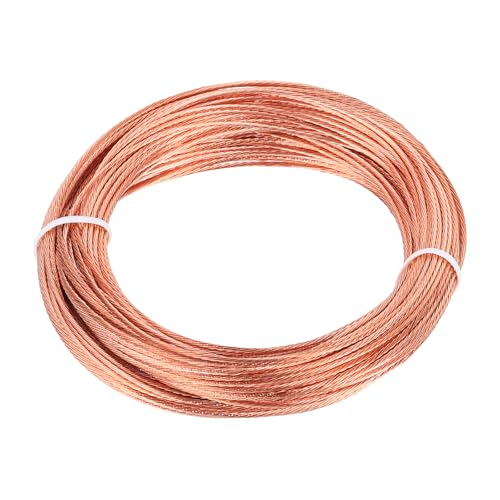
Braid that bends into a light fixture canopy where a solid 8-gauge simply would not.
This is a 100-foot braided copper ground wire at 18 gauge, and the interesting part is the build: 1.2 millimeters in diameter, made from multiple strands of bare copper braided together rather than one thick rod. Braiding matters because multiple strands bend and take twists and turns that a solid conductor of the same thickness resists, which is why this one is listed for ceiling fans, lighting fixtures, and overhead power distribution where the wire has to thread through a canopy and around a box.
The quoted uses extend well past lights — photovoltaic panels, cable trays, junction boxes, and general equipment wiring all show up in the description, and it holds up in practice. A ham radio operator used a length of it to build a Moxon antenna for the 6 meter band, proof the braid handles real RF grounding work as well as fixtures. Pure copper is the material throughout, chosen for tensile strength and low resistivity, meaning it fights stretch and resistance at the same time.
The honest limitation is gauge, not quality. At 18 gauge and 1.2 millimeters, this is a lighter conductor than the 8-gauge rolls above, so it is a fixture and equipment ground rather than a heavy main bond. It is also braided rather than single-strand, which makes it slightly fussier to terminate into a tight lug than a clean solid tip — but that same flexibility is what you came for if your run has bends.
Choose it if: you are grounding lighting fixtures, fans, panels, or equipment and need a flexible 18-gauge braid to reach into tight hardware.
Go heavier if: your job needs a thick solid conductor for a main ground — this braid is meant for lighter, bendier runs.
7. ELECTRAPICK Copper Wire, 99.9% Soft Pure Bare Copper Wire, 16 Gauge, 127 Feet
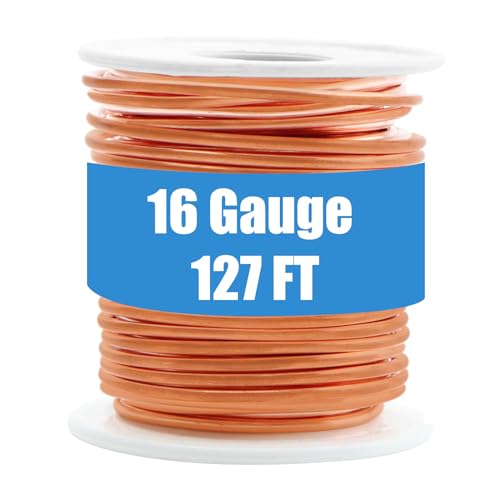
Garden-scale copper that you shape by hand and it stays exactly where you bent it.
Electroculture gardening and hands-on craft work are the twin targets of this spool, and the dimensions suit both. It is 16 gauge copper at 1.3 millimeters in diameter, coming as a 1-pound coil with 127 feet on it — the longest reach on this list after the 500-foot 22-gauge spool. The listing rates it at 99.9 percent pure C11000 copper, and unlike the bare wire higher up, it arrives as a coil in round rod form, which makes it easy to pull a length and cut what you need.
The hand-bending behavior is what buyers really rate. It is thick enough to stay visible and hold its shape with no sagging, yet it can be bent by hand and coiled evenly around a pen — which is exactly the trick for a school science demo or a garden antenna spiral. In the review pages, buyers put it plainly: “Can be bet by hand but still holds its shape.” That mix of firm and workable is why it is hard to find fault with for electroculture and craft purposes.
The trade-off is temper. One owner ordered it expecting the listing’s dead-soft description and found the copper clearly stiff, comparing it to hard-drawn wire instead — so if you need a very pliant metal for delicate weaving, go thinner at 22 gauge rather than 16. For gardening and stand-up shapes, though, that stiffness is precisely what keeps your spirals standing.
On length and thickness: 127 feet at 16 gauge beats the 18-gauge spools on reach and the 22 AWG spool on thickness — a middle path for people who want both visible copper and a lot of it.
Made for you if: you are building electroculture spirals, garden shapes, or craft pieces that need copper stiff enough to stand up on its own.
Look thinner if: you need dead-soft metal for fine, delicate wrapping — a 22-gauge spool is the more workable choice.
8. JumpingLight Bonding Pool Ground Wire Solid Bare Copper 6 AWG 100 FEET
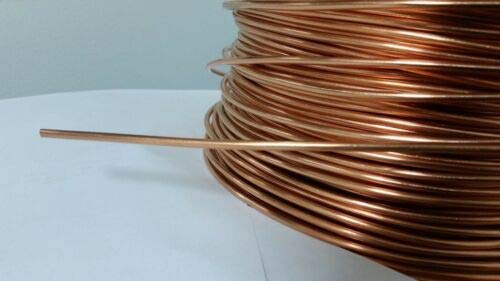
The fattest conductor on the list, built for the one job where thickness is the whole point.
Pool bonding is the mission here, and the numbers back it. This is 6 AWG solid bare copper — the heaviest gauge in this lineup, thicker than the two 8-gauge rolls and far beyond the 18 and 16 gauge spools — shipped as a 100-foot length for the ground loop around a pool. Single-strand solid copper is the right call for that application because the bond needs to be a durable, unbroken path rather than a flexible jumper, and a solid conductor holds up to burial and weather without strands fraying apart.
For the specific buyer it serves, it does the job cleanly. One owner bonding a 27-inch round pool found it the perfect length and passed inspection, and another confirmed it matched the description with no issues. Those are the two things a pool bond has to deliver: enough copper to complete the loop, and a result that satisfies the inspector. At the low gauge the copper is substantial in hand, which is what you expect from a conductor meant to carry bonding current around a wet environment.
The fair caveat is that 6 AWG solid copper is heavy and stiff, so it is not the wire to fight into tight corners or chasing a curve — that is what the braided strap is for. It is also the premium spool here, reflecting the extra copper in every foot. If your job is a pool, a spa, or a heavy structural bond, that weight is a feature; if you just need a short fixture ground, it is far more metal than you need.
Gauge in perspective: at 6 AWG, this is the thickest conductor on the list — noticeably heavier than the 8-gauge Southwire and Wirenco, and the right choice when the bonding requirement calls for the most copper.
The clean answer if: you are bonding a pool, spa, or heavy structural ground and need a full 100 feet of solid 6-gauge copper.
Overkill for: light fixture grounds and small equipment bonds — thinner 18-gauge spools will do that work for far less.
Understanding the Specs
Gauge and Diameter — Why Lower Numbers Mean Thicker Wire
Gauge is the measurement most likely to trip up a first-time buyer, because it runs backwards: 6 gauge is thicker than 18 gauge. Think of the gauge number as the count of times the wire was drawn through a smaller die — more passes, thinner metal — so a low number like 8 AWG or the Southwire roll’s 8.2 gauge is a fat conductor, while 22 AWG is fine detail wire. The diameter printed on the listing usually restates this in plain inches or millimeters: the two 18-gauge spools land around 0.04 inches and 1.2 millimeters, the 16-gauge coil sits at 1.3 millimeters, and the Wirenco 8 AWG measures 0.129 inches across. The practical rule is simple — heavier gauge for grounding and bonding that carries real current, lighter gauge for fixtures, craft, and fine work.
Solid Strand vs Braided Strap
Solid single-strand wire, the form used by the Southwire, Wirenco, JumpingLight, and both Small Parts spools, is one continuous piece of copper. It holds its shape, stands up straight, and resists fraying, which suits fixed grounding runs and pool bonds where durability matters. Braided wire, like the KWOKWEI flat strap and the uxcell 18-gauge, weaves many thin strands into a ribbon or cable, giving it the flexibility to bend around tight corners and absorb vibration that a stiff solid conductor cannot. Braiding also increases the surface area of the conductor, which the listings credit for efficient current flow. Match the form to the route: solid for straight, permanent bonds, braided for tight spaces, moving joints, and equipment-side connections.
FAQ
What gauge bare copper ground wire should I use for a residential ground?
Can I use jewelry wire spools as grounding wire?
Is solid copper better than braided copper for a ground wire?
How long does bare copper ground wire last outdoors?
Does bare copper ground wire need to be insulated?
Can I bond a swimming pool with 8-gauge copper instead of 6-gauge?
What does 99.9 percent pure copper actually mean for a ground wire?
How much bare copper wire do I need for a grounding run?
Can braided copper ground strap be used for a HAM or CB radio antenna?
Why does my bare copper wire look darker after a while?
Final Thoughts: The Verdict
For most home and shop grounding jobs, the bare copper ground wire to reach for is the Southwire 8-Gauge Bare Copper Wire, because its 8.2-gauge solid copper, 600-volt rating, and genuine-copper reputation make it the safest single spool to start with. If your run is long, take the Wirenco 8 AWG 100 FT Cut and stop worrying about running short. And when the job is pool bonding specifically, the JumpingLight 6 AWG gives you the heaviest conductor here for the loop around the water. Measure your route, confirm the gauge your setup needs, and the rest is simple.
How We Picked
We do not accept paid placement. Every pick is matched to a real buyer and a real use-case; we do not hands-on test units.
Sources & Methodology
Specifications: manufacturer listings and product documentation. Review insights: verified customer reviews, as of September 2026. Pricing: not shown on this page (it changes often); check the current price via the retailer link.
As an Amazon Associate, KitchPrep earns from qualifying purchases. This does not affect which products we feature.
Related Guides
