
Specs are compiled from manufacturer listings and verified buyer reviews and can change over time — please confirm the key details on the product page before buying.
If you are running a new outlet or a light switch in a bedroom, garage, or basement, the wire you want is 14-gauge, two-conductor cable with a ground — sold as 14/2. It is the standard wire for 15-amp household circuits, and every roll on this list is the real thing. The differences that actually matter are how easily the jacket strips, whether the copper is solid bare copper, and how much length you get for the money.
I’m Mohammad Maruf — the founder and writer behind KitchPrep. This guide is built by comparing the manufacturers’ published specifications and the patterns across verified customer reviews, so you get each pick’s real strengths and trade-offs instead of marketing spin.
Copper prices move, packaging varies, and one roll can look identical to another on the shelf, so the deciding factors are stripping ease, copper quality, and length. This breakdown of the market’s 14/2 electrical wire covers both indoor NM-B cable and outdoor landscape wire so you match the roll to the job.
Our Picks at a Glance
How To Choose The Best 14/2 Electrical Wire
You already know you need 14-gauge wire. What you may not know is why one 50-foot roll strips cleanly and another fights you at every junction box. The difference depends on the jacket compound and the copper inside. Understanding that helps you pick the right roll before you add it to your cart.
Match the wire type to where it runs
Indoor NM-B cable is the white-sheathed wire for branch circuits that feed outlets and switches inside dry walls. It is not rated for wet or damp spots. If your project is outdoors — say, a line running to a landscape light along the garden path — you want low-voltage landscape wire instead, which is built to sit in sunlight or buried in soil. These are different products, and mixing them up is the most common mistake on the shelf.
Check the copper, not just the price
The best rolls use solid bare copper conductors. Copper-clad aluminum looks the same at a glance but carries current less efficiently over long distances, which can mean dimmer lights at the far end of a run. The term you will see is “no CCA” — copper-clad aluminum — and it appears on the better NM-B products. Beyond that, look for solid construction, which holds a shape when you push it through a wall cavity.
Jacket feel matters more than you think
A stiff, hard jacket resists pulling around corners and is tougher to strip back at the box. A flexible jacket slides through studs and bends around obstacles. This is the single biggest difference between a quick job and one that makes you want to set down your strippers.
Quick Comparison
| Model | Best For | Length | Voltage Rating | Copper Type | Amazon |
|---|---|---|---|---|---|
| Southwire Romex Simpull 14/2 NM-B 50ft★ Best Overall | Everyday residential wiring | 50 Feet | 600 volts | Copper (SIMpull jacket) | Amazon |
| Energeaster 14/2 NM-B 25ftCompact Pick | Small jobs and quick runs | 25 Feet | 600 volts | Copper | Amazon |
| CIRENKO 14/2 NM-B 50 FT | Code-conscious dry-location installs | 50 FT | 600V Rated | Solid Bare Copper, No CCA | Amazon |
| Arizona Electrical Solutions 14/2 NM-B 50 FT | Middle-size remodel runs | 1 Count (50 FT roll) | — | Copper | Amazon |
| SUNVIE 14/2 Low Voltage Landscape Wire 100FT | Outdoor landscape lighting | 100FT | 300V | 100% Pure Copper | Amazon |
| Arizona Electrical Solutions 14/2 NM-B 100 FT | Whole-house wiring projects | 100 Feet | 600 volts | Copper | Amazon |
| Stock Wire 14/2 NM-B 250 FT | New construction and major remodels | 250 FT | 600-Volt | Copper | Amazon |
In‑Depth Reviews
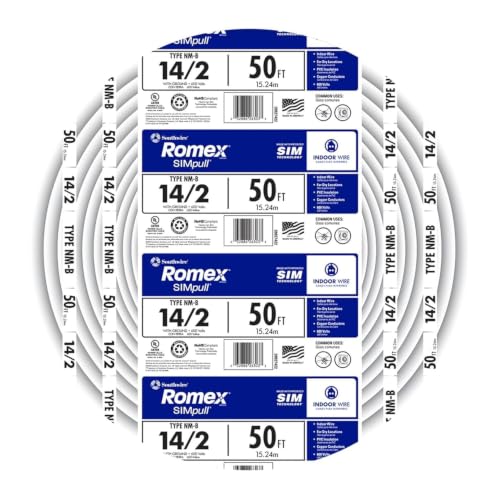
1. Southwire Romex Brand Simpull™ Solid Indoor 14/2 W/G NMB Cable 50ft coil – SW# 28827422
Our pick — over 4.5★ from 16,500+ verified ratings; the strongest balance of quality and price.
The 50-foot coil electricians grab first for residential branch circuits, thanks to its SIMpull jacket.
This is the household name. The 50-foot coil sells on one specific promise: the patented SIMpull Cable Jacket coating, which is a slick outer layer engineered so the wire slides through studs and around corners with much less resistance than a bare sheath. That single design choice is why so many people who wire houses for a living tie this to their belt before they start a run.
At 600 volts with a 14-gauge solid construction, this coil is built for standard branch circuits feeding switches and outlets in dry locations. The 3-pound roll carries 3 wires — the two insulated conductors plus the ground — and it is rated for indoor use above ground only. One thing to know up front: this is not for wet spots, and it is not meant to be buried outside walls.
The value read is simple — this beats a big box store run on price for most buyers, and it holds the go-to status that a decade of residential wiring jobs has earned it. The one consistent theme in the review history is reliability and price. As owners put it: “Wire was great it’s Romex… significantly cheaper than the big box store.” The catch is that a 50-foot coil runs out on whole-room projects, and anyone rewiring a floor will want the 100-foot roll instead.
What wins buyers over
- The SIMpull jacket genuinely reduces pulling effort compared to uncoated NM-B
- 50 feet at 3 pounds is easy to carry and coil, hard to tangle
- Romex branding carries weight with inspectors and experienced hands
- Consistently undercuts local big box pricing
The catch worth knowing
- Indoor, dry-location use only — never for buried or damp runs
- 50 feet runs short on multi-room projects; the 100-foot roll exists for a reason
- The ROMEX stamp on the jacket is the trust anchor, but it also means standard pricing rarely bends
Best for: The homeowner or DIYer running one or two circuits who wants the same wire a licensed electrician would pick up at the supply counter.
Think twice if: Your project is bigger than 50 feet, or if any part of it involves outdoor or underground routing.
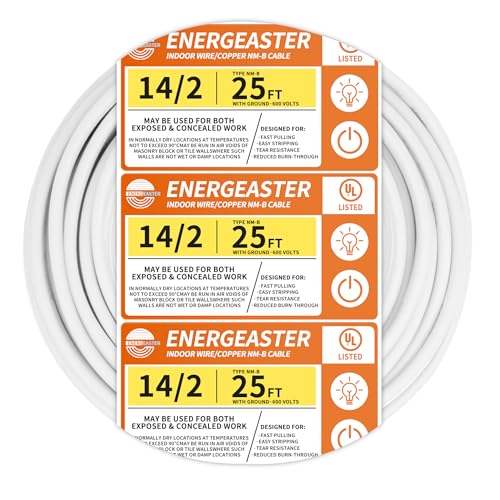
2. Energeaster Solid Indoor 14/2 W/G NMB Cable 25ft, Electrical Wire, White
A 25-foot coil for one outlet or one switch, with no leftover wire to store.
This is the roll for one outlet or one switch, not a whole wall. At 25 feet with a 600-volt rating and 14-gauge solid copper conductors, it covers the kind of quick fix where buying a longer roll means shelving the rest for years. The construction is textbook NM-B: two insulated conductors, black and white, running parallel, with the bare ground wire wrapped in fire-retardant paper and laid between them. Same gauge as the ground. Same 14-gauge solid build too.
There is one honest catch that shows up repeatedly in the feedback: the sheathing is stiff to strip. That is not a defect, but it is a real working condition — you want a sharp utility knife and a fresh pair of strippers before you start. Buyers who expect the sheath to peel back easily report fighting it. The trade-off is on the other side of the ledger: several commenters describe the jacket as rigid, which they credit for making vertical wall runs easier to control.
What actually prices this pick into the shortlist is straightforward. Compare its 25 feet against the 50 feet of the Southwire pick above — the smaller roll wins when you genuinely only need one run. This pick has more reviews than the CIRENKO 50 FT pick — 600+ ratings to that pick’s smaller pool — though it holds a slightly lower score, which tracks with the stripping complaint.
Where it stands out: A 25-foot coil at a genuinely lower price than the big-box equivalent is exactly what a small job calls for, and the rigid jacket makes vertical drops easier to steer.
Where it needs patience: Budget real time for stripping the jacket. Feed the ground wire carefully through each box because the wrapped paper wants to hold on.
Reach for this if: You are wiring one outlet, one switch, or one device and want to buy exactly the length you need.
Look elsewhere if: You are chasing the fastest strip rate — the stiffer jacket will slow you down.
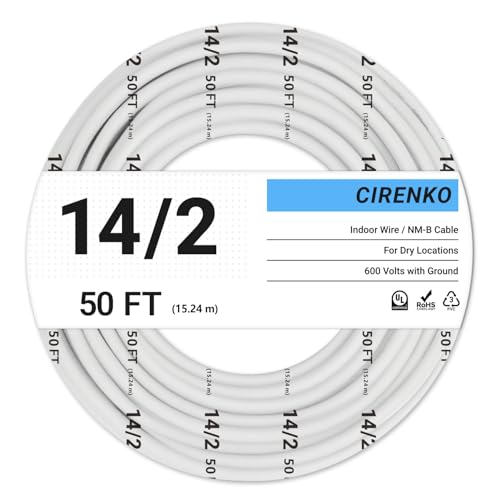
3. 14/2 NM-B Cable 50 FT, UL Listed 14 Gauge Indoor Wire with Ground
A verifiable UL E-file number on the label and solid bare copper conductors with no CCA.
If you need a piece of paper that traces this exact roll to a code listing, this is the one. The 14/2 NM-B 50-foot cable is UL Listed and built to meet UL83 and UL719 standards, with a verifiable UL E-file number on the label. Two insulated 14 AWG solid bare copper conductors sit alongside a bare copper ground, and the listing states plainly: no CCA. That is the check that separates a wire you can trust on a long run from one you cannot.
The other selling point is the sheath itself. It is the standard white thermoplastic NM-B jacket with clear printed markings running the length so an inspector can read the specs without cutting into the box. The product listing calls out a smooth jacket and easy-to-strip insulation, both aimed at trimming minutes off every termination. The maximum current is 15 amps, which is standard for 14-gauge wire on a residential branch circuit.
This pick earns its spot as the code-first choice. Choose it when the UL listing (a safety certification from Underwriters Laboratories) matters to your lender, your inspector, or your own confidence. That same documentation is why its 50 feet cost a touch more than some CCA-free rolls here. If you are wiring a finished basement with exposed work, this is the roll to grab.
What earns its grade
- Verifiable UL E-file number on the label, not just a printed claim
- Solid bare copper, explicitly no CCA
- Clear printed markings run the full length of the sheath
- Manufacturer lists smooth jacket and easy-strip insulation as design goals
Where it falls behind
- 50-foot length caps you out before mid-size jobs are done
- No ampacity advantage over other 14-gauge rolls here — all top out at 15 amps
Ideal for: Anyone whose project has to pass an inspection and who wants the UL listing verifiable, not just promised.
Not the one for: Buyers who are perfectly happy with big-brand 14/2 and do not care whether the copper is bare or clad.
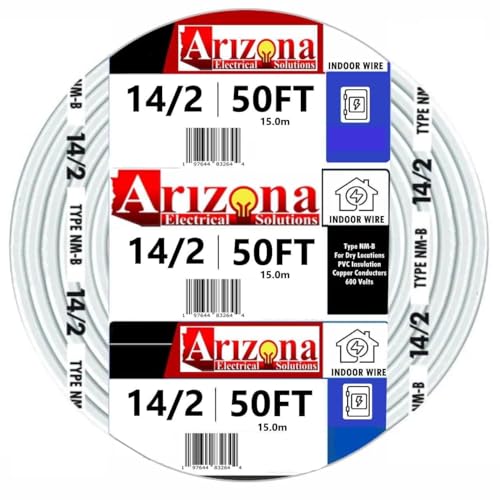
4. 50 Feet 14/2 Type NM-B Copper. #14 AWG, 2 Conductors with Ground. Insulated Jacket White
A 50-foot roll for medium remodel circuits, with a jacket that holds up on long spans.
What makes this 14/2 NM-B stand apart is how much ground it covers without breaking a sweat on long spans. The white PVC jacket has a bit of heft to it, and the copper inside pulls perfectly whether you are running a straight 20-foot span or threading through a tight corner. That combination is why a buyer using it to rewire an unfinished basement reported the whole run finished in about two hours of active work. Footage is half the draw here, but the working feel is the other half.
The engineering paperwork matches the performance. It meets UL Standard 719 and UL 83 for conductor construction, comes within ASTM B-3 and B-8, and is built to Federal Specification A-A-59544 alongside the National Electrical Code, NFPA 70. It is also REACH and RoHS Compliant. That is a longer compliance sheet than most rolls at this length carry, and it tells you the manufacturer is gunning for inspectors as much as buyers. The unit is one 50-foot roll with a solid copper gauge of 14 and a single strand count.
This pick sits in the balance for someone who wants brand-quality wire without the name-brand markup. Buyers report it is the same quality as a name brand — often better priced. The one honest gripe: a few owners mention the outside covering is heavy enough that peeling it back takes real work. Plan on cutting the sheath to length at each box rather than expecting it to strip cleanly in one pull.
Where it delivers: The combination of solid copper, a compliance sheet that satisfies UL 719 and NFPA 70, and a jacket that holds up to long spans makes this a natural fit for remodel grade work.
The honest trade-off: The heavy jacket protects well but strips slowly, so you will want a sharp blade and a steady hand at each termination.
Right for you if: You are running a medium-length remodel circuit and want rubber-meets-road compliance documentation with name-brand working feel.
skip it if: You want the fast-strip smoothness of a coated jacket — this one is a little more stubborn.
5. SUNVIE 100FT 14/2 Low Voltage Landscape Wire ETL Listed Copper Wire 14AWG
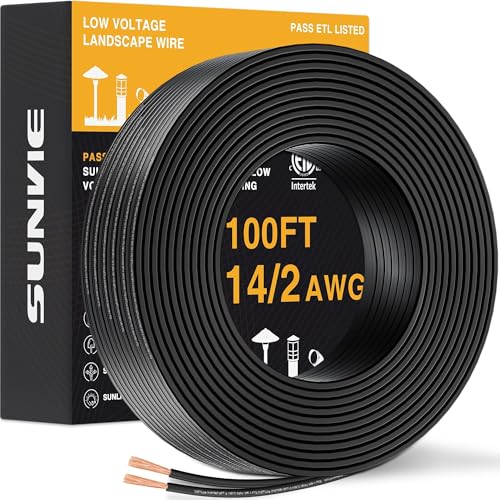
This is 14/2 low-voltage landscape wire, not household NM-B — built for outdoor lighting runs.
Read the type carefully: this is 14/2 low-voltage landscape wire, not household NM-B. The construction is 100 feet of two conductors in SPT-2 black PVC insulation, rated to a maximum working volt of 300V — well matched to a landscape lighting transformer, not a branch circuit feeding outlets. The 41-strand build is pure copper, which the manufacturer says gives maximum conductivity and minimal voltage drop.
The design brief here is outdoor life. The PVC insulation is formulated to stay flexible in both heat and cold, so the wire pulls and bends at the same feel in July as it does in January. The jacket is rated VW-1 fire resistant and made to handle direct sunlight, abrasion, and moisture, and the roll is rated for direct burial, which means you can sink it along a garden path without running conduit first. It is ETL Listed, and the 4.2-pound coil handles 100 feet without becoming a wrestling match to reel out.
The straightforward trade-off: this is the most expensive roll on the list at 100 feet, and it is useless if your project is indoor 120V work. Pair it with a transformer for path lights, spotlights, and in-ground fixtures, not for the outlet behind your couch. What the reviews keep praising is the sheer functionality of the thing — it works, it holds up to the elements, and it does exactly what low-voltage landscape wire is supposed to do. One owner even rebuilt an entire yard lighting run after a lightning strike, replacing wire and all.
Why it earns the outdoor slot
- 100% pure copper with 41 strands — smooth current flow, minimal voltage drop
- Direct burial rated: no conduit required along a garden path
- Flexible PVC insulation is formulated for staying pliable in heat and cold
- ETL Listed and VW-1 fire resistant
What to understand first
- 300V maximum — this is low-voltage landscape wire, not household NM-B
- The largest price tag on this list, and the length only pays off if your yard layout needs it
- Won’t help at all for indoor outlet or switch runs
Made for this job: Landscape lighting systems fed by a low-voltage transformer — path lights, wall lights, spot lights, in-ground fixtures.
Wrong pick if: Your project is standard indoor wiring — this roll has almost nothing in common with the NM-B cables above it.
6. Arizona Electrical Solutions 100 Feet 14/2 NM-B Copper Building Wire
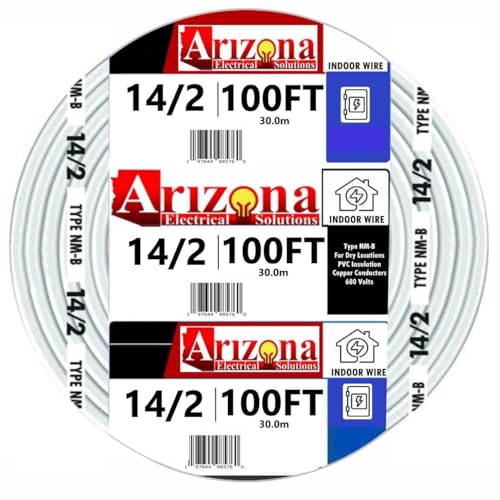
A 100-foot roll with the same UL 719, ASTM B-3/B-8, and NFPA 70 compliance as the 50-foot version.
One hundred feet is the number that earns this pick its slot. The roll carries 14-gauge solid copper conductors with two insulated conductors plus a bare copper ground, all wrapped in a white PVC jacket rated for 600 volts.
Compliance-wise, this one is thorough. It meets ASTM B-3 and B-8 and Federal Specification A-A-59544, and it is REACH and RoHS Compliant. Temperature rating is suitable where temperatures do not exceed 90C, with ampacity held to 60C conductor ratings per the National Electrical Code, NFPA 70 — the standard setup for a residential dry-location branch circuit. The white jacket carries markings for easy identification during rough-in and inspection.
The value here is length per roll — plain and simple. This 100-foot spool beats buying two 50-foot spools of the same gauge for the same job, and it beats a big-box run on price for builders and serious DIYers. Customers note it pulls easily through two stories and fishes cleanly to outlets, which is the one thing you do not want going badly on a long run. The honest caveat: 100 feet is a lot of wire to coil, and if your whole job is one outlet, you will be storing the rest.
Where the length pays off: Two full stories of fish runs, basement panel feeds, and multi-circuit additions are exactly where 100 feet stops feeling like too much.
What it is not: A short-run solution. For a single outlet or switch, the 25- or 50-foot rolls above are the more sensible purchase.
Built for: Remodelers, builders, and serious DIYers wiring a whole room or floor who would rather buy one roll than three.
Skip if: You are wiring a single device — the length will outlast the job.
7. 14/2 NM-B, Non-Metallic, Sheathed Cable, Residential Indoor Wire (250 FT)
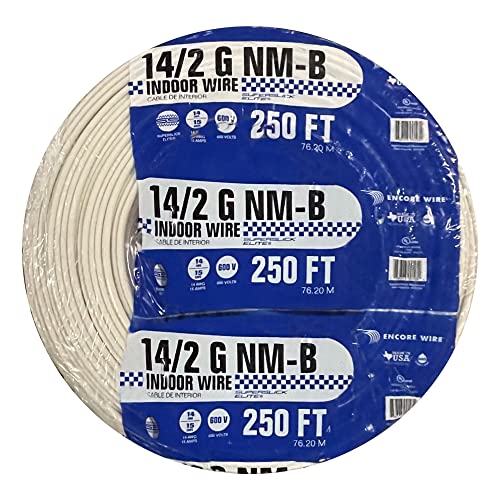
A 250-foot spool of 14/2 NM-B for new builds and whole-house rewires that would otherwise need multiple rolls.
The number on this one is the whole story. A 250-foot spool of 14-gauge, two-conductor NM-B with a copper ground is the length that makes a new build or a full-home rewire possible without stopping midway. The rating is 600-volt maximum with an allowable ampacity of 15 amps, which matches the standard 14-gauge residential branch circuit spec, and it is intended for dry installations in residential applications only — outlets, switches, and other loads.
The copper is standard solid conductor, and the sheathing is your typical NM-B build. This is a straightforward product without much pretense: same basic construction as the big box brands at less money, which is what turns remodelers toward it. One owner in the middle of a whole-house remodel described it as the wire that carries the electrical work off the ground. That is the read — a stock-length roll for stock-length jobs. Note the caveat directly from the product: the color of the wire may not be the same as shown in the picture, since white and black sheath runs come off the same production line.
Compared with the 100-foot roll from Arizona Electrical Solutions above, this one doubles the footage. It also carries a lower score and fewer total ratings, and the price-per-project advantage only materializes if you actually run two hundred and fifty feet. For anyone building or rebuilding from the studs out, this is the length that ends the “I need one more roll” trip.
What it nails
- 250 feet of 14/2 NM-B at 600-volt maximum with a 15-amp ampacity rating
- Copper conductors with ground wire, standard residential construction
- Length that fits new-build scale work without a mid-job restock
What to plan around
- The sheath color on delivery may differ from the listing photo — the company says so directly
- 250 feet only saves money if your project really uses most of it
- Dry locations only, same as every NM-B roll here
The right call for: New builds, whole-house rewires, and large remodels where dry-location residential wire is the day-to-day standard.
Not for you if: Your job is smaller than 100 feet — this roll will not earn its keep.
Understanding the Specs
Gauge and Conductor Count (14/2)
The “14” in 14/2 means 14 AWG — American Wire Gauge — the measurement of the copper’s thickness. The “2” is the number of insulated conductors inside the jacket, not counting the bare ground wire that runs alongside. Together, a 14/2 cable with ground gives you three separate wires inside one sheath, which is what a standard 15-amp residential branch circuit expects. If you see “14/3” on a roll, that has an extra conductor for a different wiring setup and is not interchangeable with the 14/2 rolls here.
Voltage Rating and Ampacity
Every NM-B roll in this guide carries a 600-volt rating — the insulation’s safe ceiling, well above the 120 or 240 volts a residential circuit actually runs at. Ampacity (the current a wire can carry continuously without overheating) for 14-gauge copper is 15 amps in this application. Landscape wire sold under the same 14/2 label has a different ceiling: 300V maximum for the SUNVIE roll here, because it feeds a low-voltage transformer rather than a branch circuit. Getting this distinction wrong is the most common mistake buyers make.
FAQ
Can I use 14/2 NM-B cable for an outdoor outlet on my porch?
How many amps does 14/2 wire carry safely?
What does “no CCA” mean and why does it matter?
Can I run 14/2 wire underground or bury it?
Is 14/2 NM-B cable the same as Romex?
Do I need a special stripper for 14/2 NM-B cable?
What is the difference between 50-foot and 100-foot rolls for a typical job?
Can I use this low-voltage landscape wire for house wiring instead?
Why does the sheath color on some 14/2 wire arrive different from the listing photo?
Is 14/2 wire safe to use for a refrigerator or a heavy appliance?
Final Thoughts: The Verdict
For most buyers wiring a residential branch circuit, the 14/2 electrical wire that carries the go-to status is the Southwire Romex Simpull 14/2 NM-B 50ft — its SIMpull jacket reduces pulling effort, it comes from the brand that set the standard for this cable, and it consistently undercuts local big-box pricing.
If you need the paper trail for an inspection, the CIRENKO 14/2 NM-B 50 FT with the verifiable UL E-file number is the one to grab. If your project is bigger than 50 feet, the Arizona Electrical Solutions 100 FT or the Stock Wire 250 FT roll will keep you from buying twice. And for anything outdoors along a path or garden bed, the SUNVIE 100FT landscape wire is the only correct answer on this list — low-voltage transformer job, not a household circuit.
How We Picked
We do not accept paid placement. Every pick is matched to a real buyer and a real use-case; we do not hands-on test units.
Sources & Methodology
Specifications: manufacturer listings and product documentation. Review insights: verified customer reviews, as of September 2026. Pricing: not shown on this page (it changes often); check the current price via the retailer link.
As an Amazon Associate, KitchPrep earns from qualifying purchases. This does not affect which products we feature.
Related Guides
