
Specs are compiled from manufacturer listings and verified buyer reviews and can change over time — please confirm the key details on the product page before buying.
Cooling one room, one garage, or one attic without ductwork is exactly what a 1 ton split AC does. Here is the honest answer up front: the Senville LETO is the one most people should buy. It pairs a 19 SEER2 rating and 700 sq. ft. coverage with the most consistent owner reviews in this lineup. Below, you will see why, and which of the other nine fits better if your room, wiring, or climate differs from the average buyer’s.
I’m Mohammad Maruf — the founder and writer behind KitchPrep. This guide is built by comparing the manufacturers’ published specifications and the patterns across verified customer reviews, so you get each pick’s real strengths and trade-offs instead of marketing spin.
Every unit here is a genuine 1-ton (12,000 BTU) ductless mini-split — an indoor wall head plus a separate outdoor condenser. That size is usually right for a single room, a finished basement, an attic studio, or a garage. The differences that actually matter are the SEER2 efficiency number, the voltage the unit runs on, how low the operating noise drops, and how the install plays out in real life. These are the 1 ton split ac picks worth your money.
Our Picks at a Glance


How To Choose The Best 1 Ton Split AC
A 1 ton split AC moves 12,000 BTU of heat out of your room every hour. That number is fixed across every unit on this list. What changes is how efficiently it does the job, how much noise it makes while doing it, and whether your house can feed it the right power.
Match the BTU to the room, not to the house
12,000 BTU suits a single zone — a bedroom, a garage, an attic, a small office, a rental unit. If you are trying to cool a whole floor with one head, none of these will do it well. Measured coverage runs from 400 square feet up to 750 square feet depending on the model and how well sealed your space is. High ceilings, poor insulation, and big west-facing glass all shrink that number fast.
Read the SEER2 number before anything else
SEER2 is the efficiency score — the higher it is, the less electricity the unit uses to hit the same temperature. In this lineup you will see ratings from 18 SEER2 up to 24.5 SEER2. The old rule of thumb was 16 SEER2; anything at or above 20 is doing real work on your monthly bill, and the highest numbers here qualify for tax credits.
Check your voltage before you buy
Some of these run on 115V — standard household power. Others need 230V. If you do not have a dedicated 230V circuit where the outdoor unit will sit, you are looking at an electrician’s visit on top of the install. This is the single most common surprise for first-time mini-split buyers.
Understand that “professional installation” is not a suggestion
Every unit here ships pre-charged with refrigerant and includes a line set. That does not mean you can bolt it on and go. The lines have to be pulled to a vacuum before the refrigerant is released, or moisture stays inside and poisons the system. Some buyers do everything except the vacuum and line connections, then bring in a licensed tech for that final step.
Quick Comparison
| Model | Best For | SEER2 | Coverage | Voltage | Amazon |
|---|---|---|---|---|---|
| Senville LETO 12,000 BTU★ Best Overall | Most buyers | 19 | 700 sq. ft | — | Amazon |
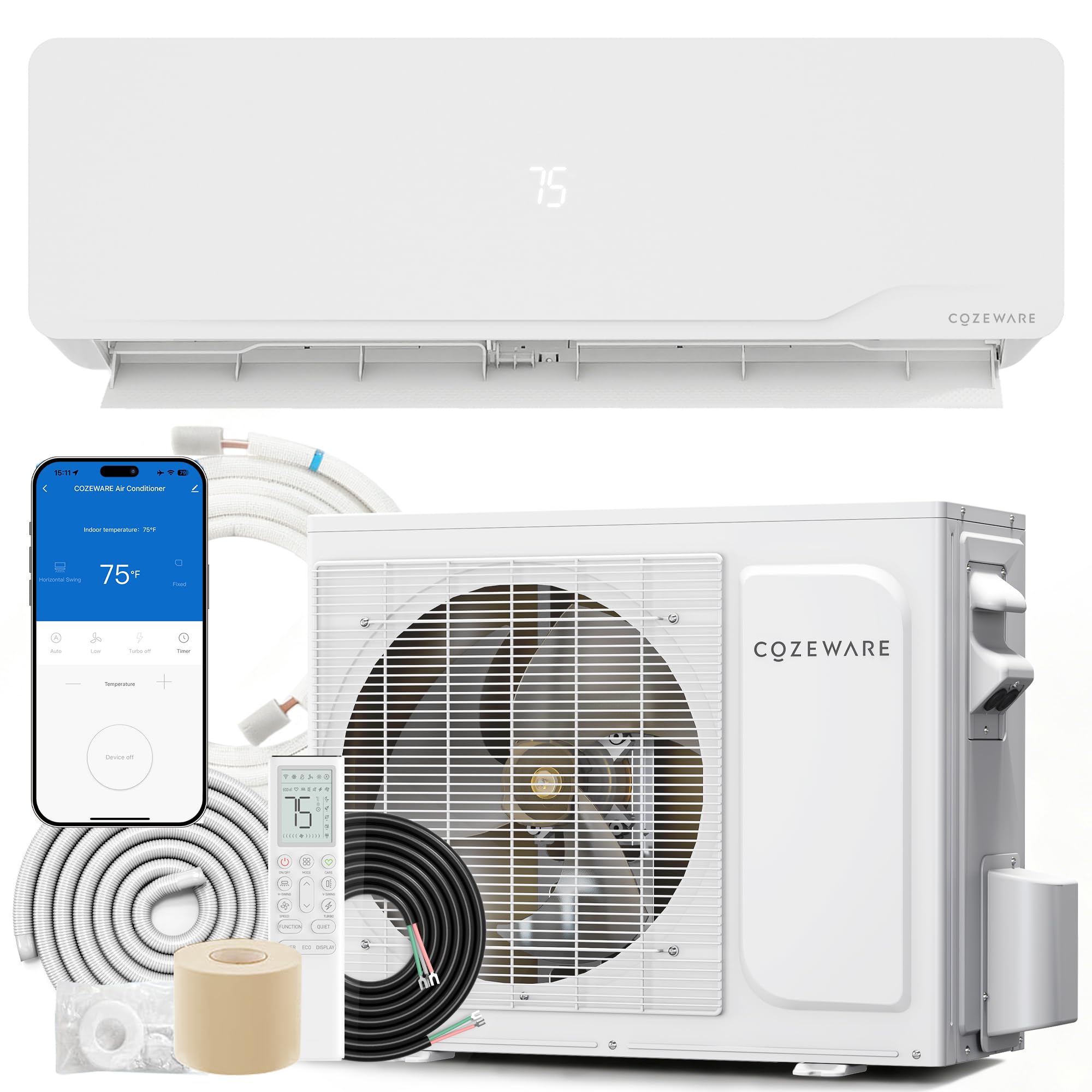
| Cozeware 12,000 BTU 230VBest Value | Garage and hot climates | 20 | 750 sq. ft | 230V | Amazon |
| COSTWAY 12,000 BTUBest for DIY Install | DIY installers | 21 | 750 sq. ft | 208-230V | Amazon |
| TOSOT Cosmo 12,000 BTU | Bedrooms and offices | up to 22 | 1500 sq. ft | 115V | Amazon |
| DELLA Serena 12,000 BTU | Small rooms on 115V | 22 | 550 sq. ft | 115V | Amazon |
| DELLA Motto 12,000 BTU | Deep-cold climates | 19 | 550 sq. ft | 230V | Amazon |
| ACiQ Essentials 12,000 BTU | Small outbuildings | 20 | 400-600 sq. ft | 115V | Amazon |
| TOSOT Aoraki 12,000 BTU | Extreme cold and efficiency | 24.5 | 750 sq. ft | 110-120V | Amazon |
| Cooper & Hunter MIA 12,000 BTU | Quiet whole-home add-on | 21.2 | 550 sq. ft | 115V | Amazon |
| Daikin Entra 12,000 BTU | Brand-name reliability | 18 | 550 sq. ft | — | Amazon |
In‑Depth Reviews
1. Senville LETO Mini Split Air Conditioner, Heat Pump, White, 12000 BTU
Our pick — over 4★ from 500+ verified ratings; the strongest balance of quality and price.
A 19 SEER2, 700 sq. ft. unit that cools fast and runs near-inaudible on turbo.
For the average buyer — a bedroom, a converted basement, a home office — the Senville LETO is the safest 12,000 BTU purchase on this list. It runs on a 19 SEER2 rating, which is a solid step above the old baseline, and it covers 700 square feet. That is real measured coverage, not a marketing guess, and it lands right where most single rooms sit. It also comes in a complete install package: the indoor air handler, the outdoor condenser, a remote, and a 16-foot line set with communication wire, pre-loaded with refrigerant for runs up to 25 feet.
The performance story is where this unit separates itself. Across the review pages, what owners talk about most is the quiet — as owners put it, “cools great 550 sq ft area.” The indoor and outdoor units both run at near-inaudible levels, even on turbo. A second theme shows up just as often: it handles winter. The heat pump keeps working down to 5°F (-15°C), and one owner with a Pennsylvania basement reported consistent heating and cooling through cold winters with no drama. The Wi-Fi kit failed on that owner’s first unit, and Senville shipped a free replacement.
Here is the honest catch. The included 16-foot line set runs short in some installs — tall rooms and long runs will need a longer set, and that means a refrigerant top-up. The unit also requires professional installation; it is not a plug-and-play DIY job. And the Senville uses a 19 SEER2 rating, which trails the higher-efficiency models further down this list. If your power bill is the priority, those higher numbers do save more. If you want the safest all-around pick, this is it.
The case for the LETO
- Covers 700 sq. ft on 12,000 BTU cooling
- Heat pump keeps working down to 5°F
- 16-ft line set and communication wire included
- 5-year parts and 5-year compressor warranty
Where it asks more of you
- Professional install required — no DIY shortcut
- 19 SEER2 trails the higher-efficiency picks
- Long or high-ceiling runs may need a longer line set
Buy it if: you want a bedroom, basement, or living-area unit that installs once, runs quietly, and handles both summer and winter.
Look elsewhere if: you are chasing the absolute lowest power bill or trying to self-install.
2. 12000 BTU Mini Split AC/Heating System 230V 20 SEER2 Ductless
A 230V, 20 SEER2 unit rated for 750 sq. ft. and triple-digit summer heat.
The Cozeware 12,000 BTU unit is the highest-coverage 12,000 BTU system here at 750 square feet — and it makes the most of it. That is a 7% gap versus the Senville LETO above, and for an open-plan room, garage, or studio apartment, that extra floor coverage matters. It runs on a 20 SEER2 rating, uses an inverter compressor, and pulls a rated 600 kWh per year. It also drops to 31dB in sleep mode, which is roughly the sound of a quiet library. Eight operating modes (Cool, Heat, Dry, Fan, Sleep, Auto, ECO, and Care) plus seven fan speeds cover every season.
What buyers report most consistently is performance and build quality. That is the pattern across the review pages: the unit cools in real heat — one owner reported running it in triple-digit southern California weather with a professional install and having it hold. Another reported cooling a garage from 85°F to 74°F in 20-25 minutes on the 18,000 BTU version of the same platform. The heat mode works too — owners mention it heating right away after install. The included install kit and app both draw praise, and the 5-year parts / 7-year compressor coverage is one of the longest on this list.
The catch is real and worth stating plainly. This is a 230V system, so if you do not have a 230V circuit near the outdoor unit, budget for an electrician. It also needs a vacuum pump and a 5/16 gauge adapter to install — standard manifold gauges will not fit the port. And smart-home buyers should know there is no native Home Assistant integration; the Cozeware app is the practical route. Reversed line wiring causes an F6 error, so follow the diagram carefully or hand the job to a pro.
Best for hard climates: this is the 12,000 BTU unit to buy if your summer routinely hits triple digits or your install location gets direct sun. The 20 SEER2 rating and 750 sq. ft coverage are built for that.
Reach for this if: you have a 230V circuit ready and a room that runs hot.
Think twice if: you want a plug-and-play 115V install or need Home Assistant control.
3. COSTWAY 12,000 BTU Mini Split Air Conditioner, with Heat Pump
A 21 SEER2, 10 HSPF2 machine that covers 750 sq. ft. and ships with a 13-ft copper line set.
Efficiency is the headline here: a 21 SEER2 rating and a 10 HSPF2 heating rating sits a clear step above both the Senville LETO’s 19 SEER2 and the Cozeware’s 20 SEER2. That score translates directly to a lower power bill — and the reviews back it up, with owners reporting meaningful drops in their monthly electric costs after switching from window or portable units. Cooling capacity is 12,000 BTU, heating is 12,300 BTU, and it covers 750 square feet.
The install package is what wins over most buyers. It ships with both indoor and outdoor units plus a 13-foot copper piping set and communication wire. Owners with no prior mini-split experience report finishing the job themselves and being surprised at how manageable it was. What buyers love most about the whole experience is performance, and there is a pattern in the reviews: fast cooling, even in tough spaces. One owner reported cooling a 20’x40′ room with 12-foot ceilings and holding the set temperature. Another put a 12,000 BTU unit in a 460 sq. ft garage apartment and has been running it since January with no trouble. A third swapped out a much pricier brand for this one specifically and noted no regrets.
The honest trade-off: upkeep is not optional. The filters want weekly washing during cooling season, and the outdoor unit benefits from periodic cleaning. Some owners also ran into the indoor vanes losing alignment from repeated use of a plastic arm inside. Support for a minor part failure has been slow in a few cases. If you are handy and want the best efficiency-per-dollar 12,000 BTU unit here, the COSTWAY is the pick.
Where the efficiency shines: the 21 SEER2 and 10 HSPF2 ratings beat both 12,000 BTU units above, and the self-cleaning cycle runs at 135°F so you are not pulling the coil apart by hand.
Maintenance reality: this is not a set-and-forget box. Plan on weekly filter rinses and a clean outdoor unit, or the efficiency rating will not show up on your bill.
Pick this if: you are reasonably handy, want the best efficiency-per-dollar 12,000 BTU unit here, and will actually keep up with filter cleaning.
skip it if: you want zero maintenance or a fully hands-off install.
4. TOSOT 12,000 BTU Mini-Split Air Conditioner, Wifi Enabled Ductless Inverter Split System AC Unit Heating System, Compatible with Alexa – 20 SEER2 115V

A 115V unit with a 22dB indoor floor and up to 22 SEER2, built for bedrooms and offices.
If you are installing this where you sleep or work, noise is the spec that decides it. The TOSOT Cosmo runs as low as 22dB indoors, on up to 36dB at the top of its range. That low end is closer to a whisper than a room appliance — you will hear it, but you will not be annoyed by it. Cooling and heating rating sits “up to 22 SEER2,” and TOSOT claims that translates to up to 27% in energy cost savings versus baseline. Coverage is rated up to 1,500 square feet, the largest stated range on this list.
Install runs smoother than expected for a unit this quiet. Across the review pages, customers note moderate DIY difficulty — instructions are thin in places, but the answer is a YouTube tutorial before you start. Condenser and indoor head both run very quiet, temperature stays consistent, and the heat mode does its job. TOSOT is the same Gree-built platform as several other names on this list, so the Gree+ app works and the LED display can be turned off for a dark room. The unit cools in temperatures up to 122°F and heats as low as -13°F, and reviewers point out it uses only 1348 watts at cooling load.
The two things to know. First, small parts are metric — you may need a torque wrench with crow’s feet, and the manual lists the wrong nut sizes in places. Second, shipments sometimes split and arrive in separate boxes. One buyer in an RV reported the outdoor unit arrived alone, and TOSOT’s customer service shipped the missing indoor unit quickly. Both situations are annoying, not deal-breaking.
What TOSOT gets right
- 22dB indoor noise floor — quietest low end on the list
- Adjustable 122°F cooling limit and -13°F heating floor
- Works with Gree+ app, Alexa, and Google Assistant
What to plan around
- Manual has wrong nut sizes — verify before you tighten
- Shipments sometimes split across multiple boxes
Buy it for the quiet: bedrooms, nurseries, home offices, or any room where the noise floor matters more than the last point of efficiency.
Look past it if: you need precise published install torque specs in the manual or you want all parts in one box.
5. DELLA Serena 12000 BTU Mini Split AC & Heat Pump, Energy Star 22 SEER2 1 Ton Inverter 115V Ductless AC System for Rooms up to 550 Sq.Ft, WiFi & Voice Control, Pre-Charged, 16.4ft Install Kit

A 22 SEER2 115V unit that claims up to 57% in power savings and runs at 23dBa in mute mode.
Here is the efficient small-room pick. The DELLA Serena rates 22 SEER2 and runs on 115V — meaning it can plug into standard household power without an electrician running a new circuit. That combination is rarer than you would expect at this efficiency level on this list. It is rated for rooms up to 550 square feet, ships pre-charged with R32 refrigerant for runs up to 25 feet, and includes a 16.4-foot install kit with 1/4″ and 3/8″ copper pipes plus a 78.7″ drain pipe. At 23dBa in mute mode, it is nearly as quiet as the TOSOT Cosmo above, and its WwiFi includes a geo-location feature that adjusts temperature based on where you are.
What owners talk about most is the quiet — the recurring theme is that these run very quiet indoors and out. Renters have put multiple units into properties and reported clean installs with everything in the box. One owner reported cooling and heating a 1,100 sq. ft. room with two Serena units and needing only an HVAC pro to run the lines while self-installing the heads. Another had a damaged line set of their own doing and DELLA shipped a replacement head unit free. Seven months of year-round use with no issues is the pattern.
The honest caveat: temperature control gets mixed feedback. Some owners say it keeps their building at a perfect temperature, and a few report it not heating as strongly as described in cold weather. The manufacturer mandates professional installation — this is not sold as a DIY unit, and line-set vacuuming is required. Maximum fuse size is 25A. If your space is small and you are on 115V, this is the efficiency-per-dollar leader.
Where it wins: a 115V system on 22 SEER2 with a 23dBa mute mode is a rare combination — most high-efficiency 1-ton units force you onto 230V.
Reach for this if: your room is under 550 square feet and you want the efficiency of a 22 SEER2 system without paying for a 230V circuit.
Look elsewhere if: your climate drops well below freezing — the heating reports are mixed when it gets truly cold.
6. DELLA Motto Series 12000 BTU Mini Split AC, Cools up to 550 Sq.Ft, 19 SEER2 230V, Energy Efficient, Ductless Inverter System, 1 Ton Pre-Charged Heat Pump, Works with Alexa and WiFi, 16.4ft Kits
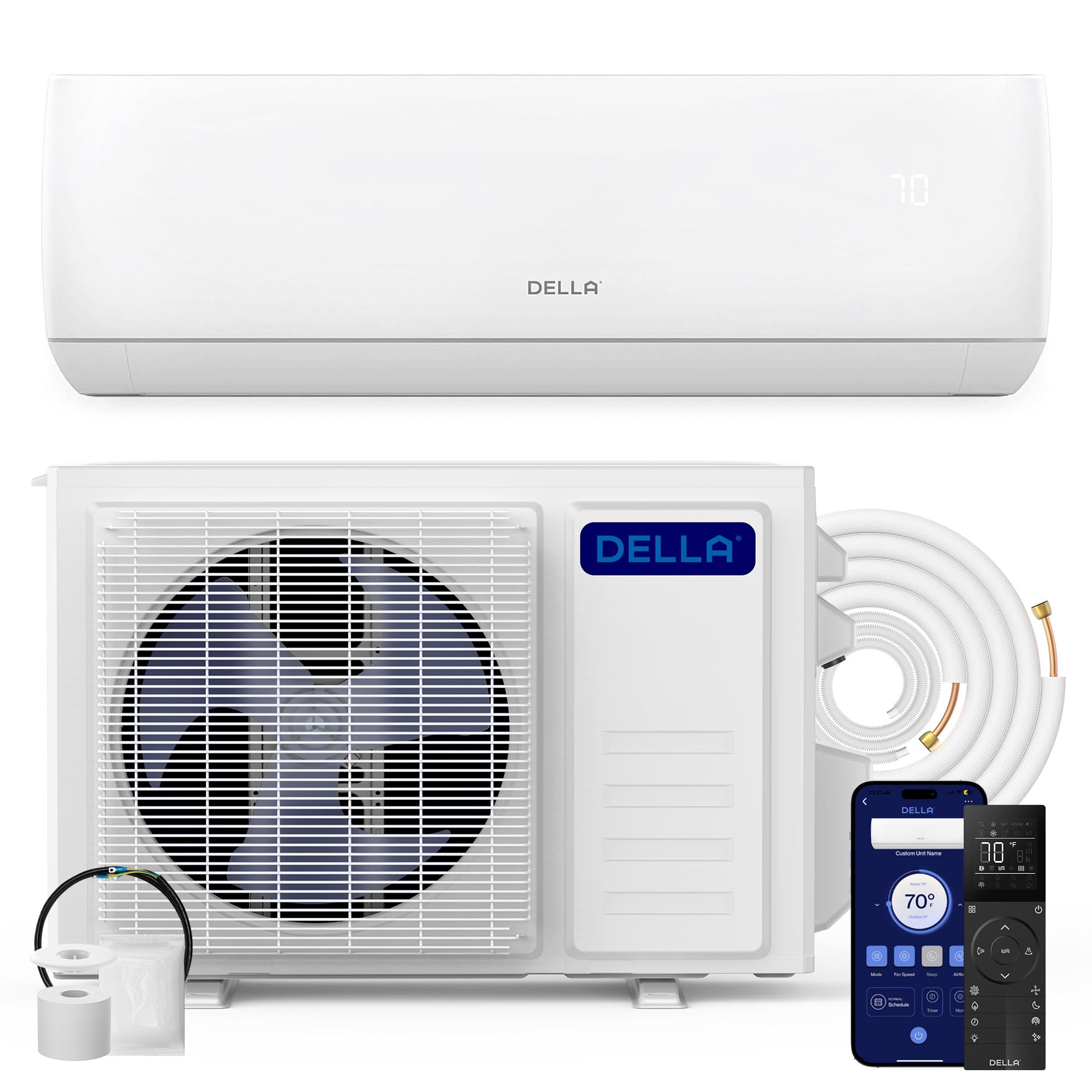
A 230V, 19 SEER2 heat pump that owners run in garages at -13°F and below.
The DELLA Motto Series runs on 230V, rates 19 SEER2, and cools or heats up to 550 square feet. On paper that looks modest. In practice, owners put it in garages, workshops, and outbuildings across cold-weather states and report the heat pump keeps producing. One owner with a Minnesota two-car garage install reported the unit producing heat at -20°F despite a stated 15°F minimum, with roughly 90°F output. Another reported heating an office to 70°F even at -13°F ambient. That is the reason to pick this over the higher-rated units above if you live somewhere with a real winter.
You get real, measurable efficiency here. Della rates the DC inverter (a variable-speed compressor that adjusts power instead of switching on and off) at up to 30% power savings versus baseline. Shoppers say the unit drawing around 800 watts total in cooling — one owner reported cutting their electric bill in half after replacing a portable AC with this system. Indoors and outdoors it is rated to run at 27dBa (a quiet hum, about as loud as a whisper), so it will not drown out conversation. The “smart sensor” feature actually reads temperature at the remote, not at the wall head — so it adjusts airflow based on where you are sitting, not where the machine is mounted. It also ships with a full 16.4 ft copper line set (the pipe that carries refrigerant between indoor and outdoor units), I feel mode, 4D airflow, and a 24-hour timer.
The honest trade-off here is durability risk on the compressor. Most buyers report reliable service, but a small number have had a unit fail within the first year or two. DELLA’s warranty response in those cases has been inconsistent — one owner was offered a full-price replacement instead of a covered swap. The system also needs a proper vacuum and line-set torque; the manual’s torque specs are not always reliable, so a pro install is worth it. Maximum fuse size is 10A on this unit, which is unusually low and means your existing 230V circuit needs to match.
Why cold-climate buyers pick it
- Owners mention heat output holding at -13°F and lower
- Customers note ~800W cooling draw and roughly halved power bills
- Remote-located temperature sensor adjusts to where you actually sit
What to keep an eye on
- A small number of compressor failures reported in the first year
- Warranty response inconsistent when a unit does fail
Pick this if: you need a 12,000 BTU unit that keeps heating when the temperature outside drops well below freezing.
Steer clear if: you want a wider warranty safety net or a unit that only needs a standard 15A circuit.
7. ACiQ Essentials 12000 BTU 115V 20 SEER2 Mini Split AC/Heating System, White
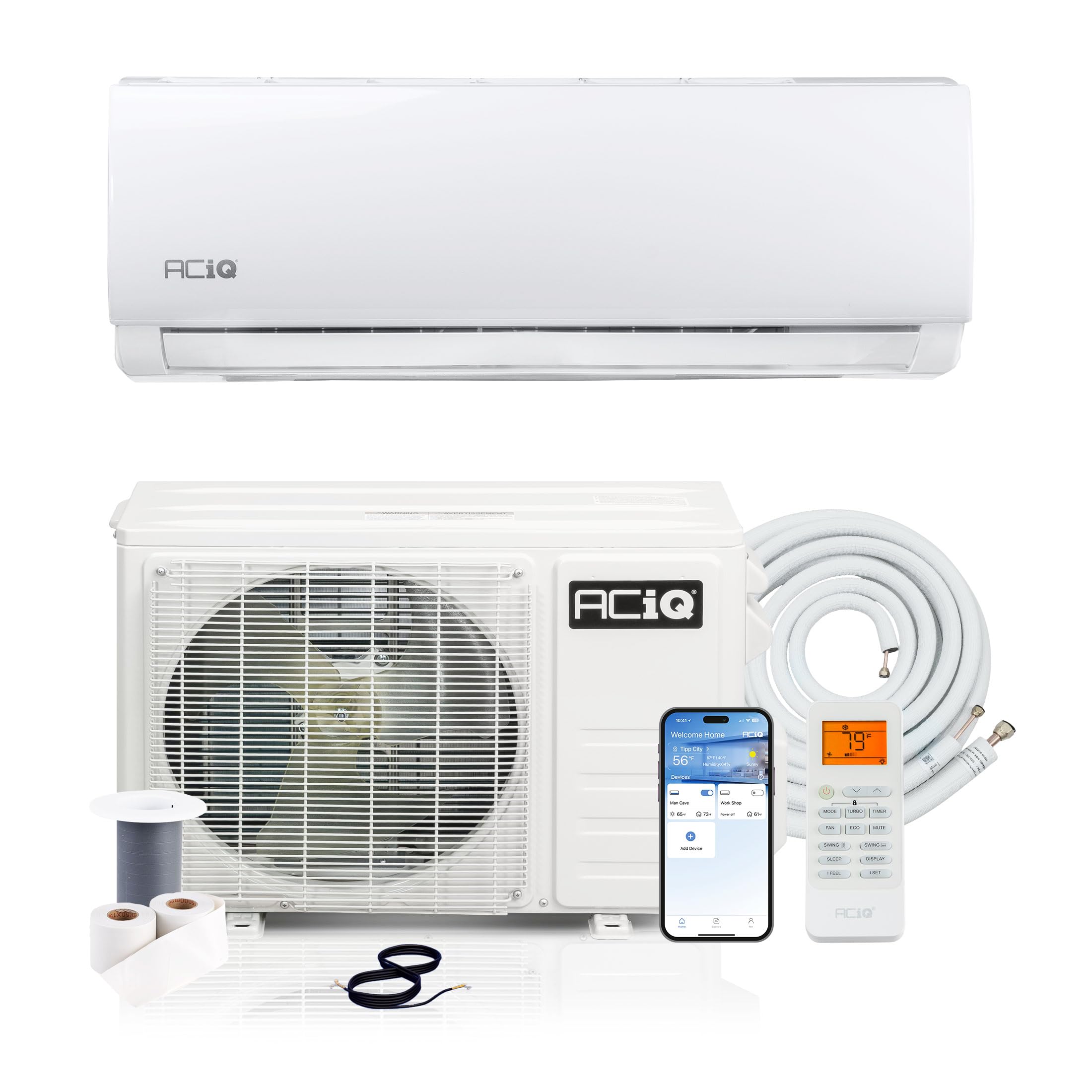
A 115V, 20 SEER2 unit sized for 400-600 sq. ft. outbuildings, attics, and sheds.
Where the DELLA Serena is built for rooms up to 550 square feet, the ACiQ Essentials is honest about its real range: rooms around 400 to 600 square feet. That makes it the right pick for an attic conversion, a shed, a small garage, or an RV — not a large open-plan space. It runs on 115V, rates 20 SEER2 and 10 HSPF2, and cools from 5°F to 127°F outdoor ambient while heating within -4°F to 75°F. It ships pre-charged with R32 — enough to fill the included 16-foot line set without extra refrigerant. Only a vacuum is required on install.
The install experience is what most owners highlight. The kit arrives with a 16-foot line set, remote and mount, power cable, indoor mounting plate, rubber feet, wall cap, drain elbow, plasticene, and screws with anchors. Reviewers point out the install was not too difficult once a pro handles the line vacuuming. The performance gets described as quiet and cold — one reviewer noted cooling a garage studio very nicely. A second update came after installation declaring it “quiet, blows air to floor, looks nice.” The unit also carries an impressive 4-year parts and 6-year compressor warranty when registered online, which is above average in this class.
Two things to know going in. The minimum set temperature is 60°F, not 50°F, so it is not the pick if you want to run the room unusually cold. And the physical air handler is not the sturdiest — one buyer described it as flimsy, and another received a unit with a cracked valve cover in shipping. It is manufactured as pro-install equipment with a firm warranty process, so verify the panel arrives intact before the crew starts.
Why efficiency buyers like it: getting 20 SEER2 and 10 HSPF2 on standard 115V household power is the standout — most other efficiency leaders here need 230V.
Reach for this if: you have a small building, RV, or converted space and want high efficiency without a new circuit.
Look past it if: you want the room to get below 60°F or you need a sturdier-feeling wall head.
8. TOSOT 12,000 BTU 24.5 SEER2 Mini Split, Aoraki Series, 110-120V, White
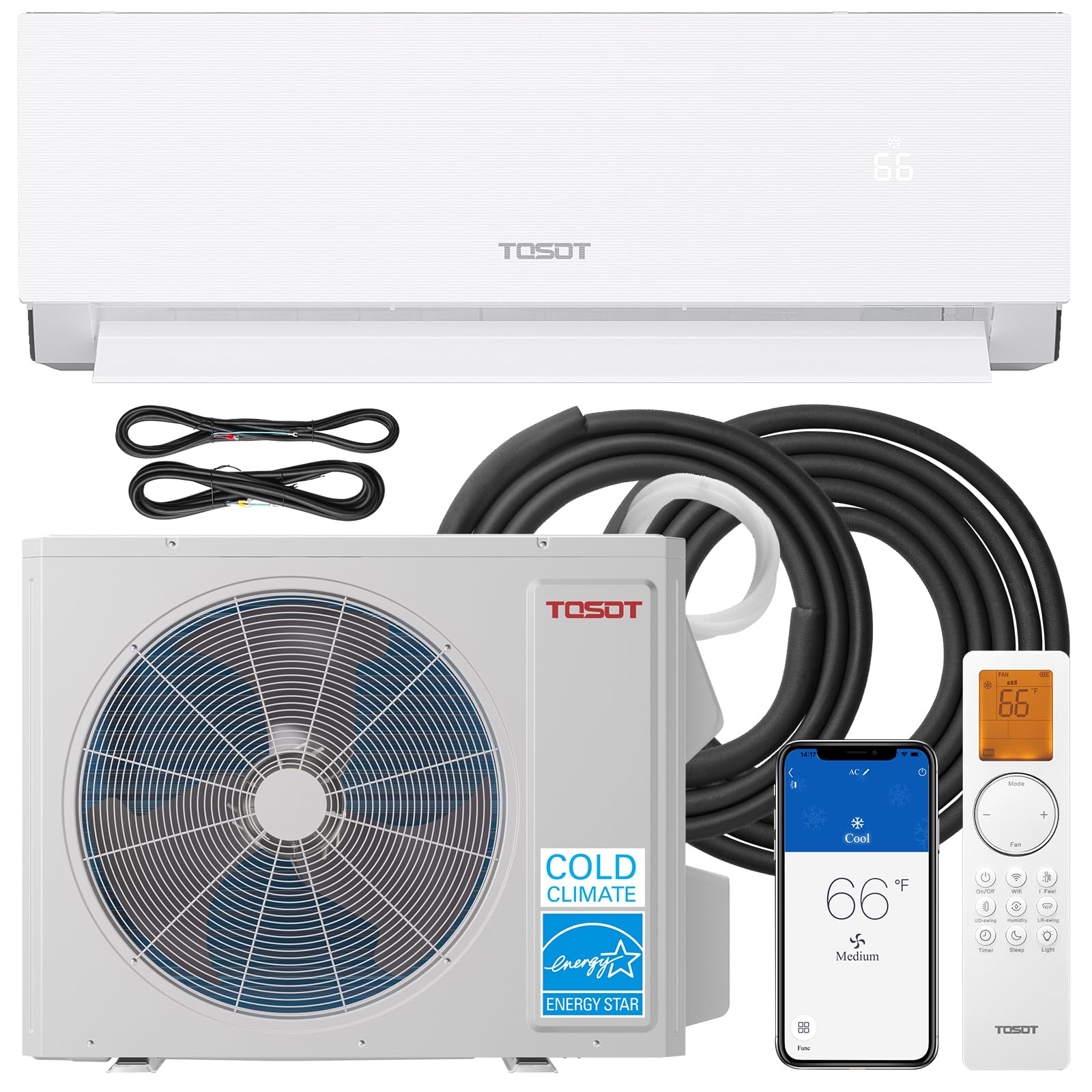
A 110-120V unit at 24.5 SEER2 that covers 750 sq. ft. and heats down to -22°F.
24.5 SEER2 is the highest efficiency rating on this list — a clear step above the 22 SEER2 of the DELLA Serena and the 21 SEER2 of the COSTWAY. According to TOSOT, that number translates into savings of up to 35% on energy bills compared to a 16 SEER2 unit. It holds ENERGY STAR, COLD CLIMATE, ETL, and AHRI certifications and qualifies for tax credits. It runs on 110-120V, covers up to 750 square feet, and features a dual electric heating belt that keeps the outdoor unit functional down to -22°F. It is the most cold-hardy 1-ton unit in this whole lineup.
Owners love it on the efficiency angle. Shoppers say extremely low power consumption and note that the unit cools or heats a 1,200 sq. ft. space evenly with minimal fan noise. The Aoraki reaches 70°F in about two hours from 94°F on the 12,000 BTU version per one owner — that is roughly an hour of work for a small space at real temperature lift. It also can be paired with a separately purchased ERV (energy recovery ventilation) accessory, something TOSOT says is a first in the US mini-split market. The quiet operation is one of the things buyers praise most: indoor sound drops as low as 20dB, which makes the DELLA Motto’s 27dBa sound loud in comparison.
The honest note: the Wi-Fi module has been reported as glitchy. Owners also flag inconsistent packaging — the outdoor unit is heavy (about 90 lbs) and has arrived with crushed fins for multiple buyers. TOSOT’s seller side has handled those situations with refunds or concessions, but the shipping process itself is the weak link. If you order, unbox and inspect on the delivery day.
Why efficiency-first buyers choose it: 24.5 SEER2 with ENERGY STAR and Cold Climate certifications on 110-120V wiring is a combination nothing else on this list matches. Tax credits apply, and the -22°F heating floor means it will work in a Minnesota winter, not just a mild one.
Buy it for the efficiency: this is the pick if your goal is the lowest long-run power bill and cold-climate heating without moving to 230V.
Look elsewhere if: the glitchy Wi-Fi reports bother you or you want guaranteed pristine packaging on arrival.
9. Cooper & Hunter MIA 12,000 BTU 115V Wall Mount Mini Split AC, 21.2 SEER2

The widely-chosen MIA that cools a woodshop to 34°F supply air on an 80° day.
Cooper & Hunter MIA rates 21.2 SEER2, runs on 115V, and covers 550 square feet. It ships with a smart kit for app-based control and includes a 16-foot pre-flared, insulated copper line set, 16-foot communication wires, and a 16-foot drainage extension. It also claims heating capability in ambient temperatures up to 5°F. Longtime reviewers describe the AC blowing 34°F supply air on an 80°F day and heat output of 115°F when the outdoor temp is 48°F. That is genuinely cold air.
What buyers praise most is the silence. The unit runs quiet inside and out — one buyer mentioned the indoor noise floor being low enough for a recording studio in silent mode. Install is doable for a serious DIYer who is comfortable running a line set and calling in an electrician for the disconnect. It also qualifies for energy rebates when properly registered, and the warranty registration requires a licensed HVAC tech’s license number within 60 days of install — read that requirement before you start, because it is a hard gate.
The honest trade-off is a small but real pattern of unit failures. Most buyers report reliable service over a year and beyond, but a handful encountered early failures — one case had the outdoor fan work loose within a day of install, and the support response was slow and split on who paid for the replacement fan. Another case involved preinstalled hose clamps on the indoor drain pipe arriving loose and leaking water indoors. Neither is the norm, but the pattern is worth knowing about if you are installing in a place where water damage would be expensive.
Where MIA lands a good one
- 21.2 SEER2 on a 115V circuit — no electrician running new power
- Reported 34°F supply air at the vent on an 80°F day
- Full 16-ft line set, wires, and drain extension included
Read before you buy
- Warranty registration requires an HVAC tech’s license number within 60 days
- Drain-pipe hose clamps can arrive loose — check on install day
Pick this if: you want a 21.2 SEER2 115V unit with a long owner track record and you are comfortable calling a licensed pro for the install.
Steer clear if: you cannot register the warranty within the 60-day window or you want to control the unit without the app.
10. Daikin 12,000 BTU 18 SEER2 Entra R32 Series Heat Pump Mini Split A/C

The brand-name pick with the highest build reputation and the most granular published specs.
Daikin is the marquee name here. The Entra series rates 18 SEER2, 9 HSPF2, 8.5 EER2, and 3.30 COP, runs on a DC inverter, and covers up to 550 square feet. Cooling capacity is 12,000 BTU with a range of 4,400 to 13,300 BTU, and heating is 11,300 BTU with a range of 4,400 to 16,400 BTU. It cools between 50°F and 115°F outdoor ambient and heats between 5°F and 65°F. It ships with an indoor wall-mount fan coil, a smart inverter condenser pre-charged with R32, a remote, a 15-foot 1/4 x 3/8 Maxwell refrigerant line with cables, and a wall-mounting bracket.
What this pick buys you is the most predictable ownership experience. Professional HVAC contractors who review the unit call it easy to install and quiet and efficient once running. The unit itself is described as very quiet with easy controls, a simple on/off timer, and easy filter cleaning. It blends well on the wall. The titanium apatite photocatalytic air filter and Blue Fin coil protection are the details brand-loyalists are paying for — treatment against coil corrosion that most budget units skip entirely. Coverage at 550 sq. ft. is honest.
Where to be careful: the 18 SEER2 rating is the lowest on this list. If your main goal is a small power bill, a higher SEER2 unit above will save you more, and this unit costs more than several of them. Support reports are mixed on the vendor side — one case had an initial unit not work and the vendor replace it quickly, while another had repeated failures and a tech who gave up. Handle the warranty registration and vendor contact carefully, and this becomes the most durable pick on the list.
What you are paying for: brand history, the R32 pre-charged condenser, Blue Fin coil protection, and the titanium apatite purifying filter — the extra engineering that budget units skip.
Buy it for reliability: this is the pick if you want brand-name support and stainless-steel-tier coil protection, and efficiency is a secondary concern.
Skip if: your priority is the lowest possible SEER2 power draw — several higher-efficiency units above beat it here.
Understanding the Specs
SEER2 Efficiency Rating
SEER2 measures how much cooling you get per unit of electricity used — it is the grade on the unit’s fuel economy. In this lineup, the ratings run from 18 SEER2 up to 24.5 SEER2. A higher number means the compressor does more cooling with less power draw. TOSOT claims its 24.5 SEER2 Aoraki saves up to 35% on energy bills versus a 16 SEER2 unit, and DELLA claims its 22 SEER2 Serena can save up to 57% on power versus a baseline. Both are maker claims, but they are pointing at the same math: the higher the SEER2, the less you pay each month. If your power bill is a priority, pick the highest rating your voltage allows.
115V Versus 230V
This is the split that trips up first-time buyers. A 115V unit plugs into standard household power. A 230V unit needs a heftier circuit — usually one an electrician has to install. Many of the efficiency leaders here, including the DELLA Serena, TOSOT Cosmo, ACiQ Essentials, TOSOT Aoraki, and Cooper & Hunter MIA, run on 115V. The COSTWAY and the Cozeware run on 230V. Rough check before buying: open your panel and confirm what circuits you already have near where the outdoor unit will sit. If you do not have the right circuit on hand, add an electrician’s visit to your total cost before you commit.
Coverage in Square Feet
Square footage here is measured under ideal conditions — typical ceiling heights, average insulation, no direct sun baking the wall. The Senville LETO covers 700 sq. ft.; the Cozeware and TOSOT Aoraki stretch to 750 sq. ft.; the TOSOT Cosmo goesup to 1,500 sq. ft. in its rated spec; the DELLA Serena, DELLA Motto, Cooper & Hunter, and Daikin each rate 550 sq. ft.; the ACiQ Essentials rates 400 to 600 sq. ft. Real-world coverage is smaller if your ceilings are high, your insulation is thin, or you have big west-facing glass. The safe move for anything above 550 sq. ft. is to size up or plan for a second unit.
dB Noise Rating
Decibels measure how loud the indoor head runs. Normal conversation is about 60dB; a library is around 30dB. The TOSOT Aoraki drops to 20dB indoors — the lowest figure here — while the TOSOT Cosmo goes to 22dB and the DELLA Serena hits 23dB in mute mode. The DELLA Motto runs at 27dBa. Those differences matter in a bedroom or office: at the low end, the unit is quieter than the room’s ambient noise floor. Every unit listed here ships with a sleep or mute mode, and the sound ratings are the numbers that decide whether that mode is actually useful.
Inverter Technology
An inverter compressor can ramp its speed up and down. A non-inverter unit runs at full blast or off — think of a light switch instead of a dimmer. Every unit on this list uses inverter technology, which is why they hold a steady temperature instead of swinging hot and cold. It is also why the numbers above look calmer than a window AC: the compressor parks at exactly the speed needed to match your setpoint, drawing less power in the process. COSTWAY rates its inverter at 21 SEER2 with a 10 HSPF2. DELLA rates the Motto’s DC inverter at up to 30% power savings. The Senville LETO and Cooper & Hunter MIA both use inverter compressors as well.
Minimum Operating Temperature
This is the outdoor temperature below which the heat pump can no longer pull heat from outside air. The higher the number, the more mild your winters need to be. On the low end of capability, the Senville LETO, Cooper & Hunter MIA, DELLA Serena, and DELLA Motto all heat down to 5°F. The ACiQ Essentials goes slightly lower at -4°F. The TOSOT Cosmo holds to -13°F, and the TOSOT Aoraki goes down to -22°F — the deepest cold handling here. Real-world owners do push these limits: Minnesota and RV owners of the DELLA Motto report heat output holding at -13°F and even -20°F. If you have actual winters, buy the lowest operating temperature you can get.
Refrigerant Type
Refrigerant is the fluid that carries heat from your room to the outdoor unit. The two grades you will see are R32 and R-410A. R32 is the newer, lower-impact formulation with a lower global warming potential, and it is the standard on the newer units here. The DELLA Serena, DELLA Motto, TOSOT Aoraki, and Daikin Entra all ship pre-charged with R32. COSTWAY uses R32 and calls out its GWP of 675. The Senville LETO is pre-loaded for up to 25 feet of line, the DELLA Serena for the same distance. Practically: R32 is the forward-looking choice, but either grade works — the important variable is that your installer handles the line set properly and does not need to top up the charge after a long run.
Warranty Terms
Coverage here splits into parts and compressor, and the compressor is the expensive piece. The Senville LETO covers 5 years on parts and 5 years on the compressor. The Cooper & Hunter MIA covers 21.2 SEER2 hardware but registration requires a licensed tech’s number within 60 days. The ACiQ Essentials offers 4 years on parts and 6 years on the compressor when registered. The DELLA Serena includes a lifetime warranty on the unit. The COSTWAY offers 5 years on parts and 8 years on the compressor — among the longest here. The TOSOT models handle warranty through the seller with mixed reports. Always register within the required window; the compressor is the part that costs real money to replace.
FAQ
Will a 1 ton split AC cool my whole house?
Do I need a 115V or 230V circuit for a 12,000 BTU mini split?
Is a 1 ton mini split big enough for a garage?
Can I install a 1 ton split AC myself?
How long does a mini split last?
What is the difference between SEER and SEER2?
Does a 1 ton mini split work in winter?
How often should I clean the mini split filter?
Does a 12,000 BTU mini split come pre-charged with refrigerant?
Can I use a mini split AC with Google Home or Alexa?
Final Thoughts: The Verdict
For most buyers, the best 1 ton split AC is the Senville LETO — 12,000 BTU, 19 SEER2, 700 square feet of coverage, heat pump down to 5°F, and pre-loaded for a 25-foot line set. It is not the highest efficiency unit on the page, but it is the safest combination of proven reliability, quiet operation, and complete install package. If you want the best efficiency on standard household power, the TOSOT Aoraki at 24.5 SEER2 and -22°F heating capability is the machine to beat. And if you have a 230V circuit and cold winters, the DELLA Motto is the unit owners actually run at -13°F. Pick the one whose voltage, coverage, and climate rating matches your install, and the 1 Ton Split AC decision becomes simple.
How We Picked
We do not accept paid placement. Every pick is matched to a real buyer and a real use-case; we do not hands-on test units.
Sources & Methodology
Specifications: manufacturer listings and product documentation. Review insights: verified customer reviews, as of September 2026. Pricing: not shown on this page (it changes often); check the current price via the retailer link.
As an Amazon Associate, KitchPrep earns from qualifying purchases. This does not affect which products we feature.
Related Guides
