
Specs are compiled from manufacturer listings and verified buyer reviews and can change over time — please confirm the key details on the product page before buying.
If your hands ache after a single lemon, an automatic citrus press solves that in one push — you cut the fruit, drop it on the cone, and the motor does the rest. The trick is knowing which motor size, which cone setup, and which build actually survives daily lemonade duty. Some of these machines run at 75 watts, some at 150, and one at 300, and that number tells you more about real-world speed than any glossy photo.
I’m Mohammad Maruf — the founder and writer behind KitchPrep. This guide is built by comparing the manufacturers’ published specifications and the patterns across verified customer reviews, so you get each pick’s real strengths and trade-offs instead of marketing spin.
You will see cone sizes, wattage, dishwasher-safe parts, and the honest gripes that show up again and again. From counter-hogging presses to compact ones that tuck under a cabinet, this breakdown covers the best automatic lemon squeezer options for every kind of kitchen.
Our Picks at a Glance


How To Choose The Best Automatic Lemon Squeezer
The fastest way to pick wrong here is to shop by looks. A shiny stainless shell says nothing about whether the motor stalls halfway through a bag of lemons, or whether the cone grips a lime without it spinning off into the pulp tray. Here is what actually separates a press you keep on the counter from one that ends up in a cupboard.
Motor Wattage Sets Your Real Speed
Wattage is the power rating of the motor, and it decides how much fruit you can push through before the unit needs a break. A 75-watt press handles a couple of glasses at a leisurely pace. An 85-watt unit is the common middle ground in this category. A 150-watt or 300-watt press powers through a full bag without you standing there waiting. Higher wattage does not automatically mean louder, either — some of the quietest machines in this list carry the biggest motors.
Cones Decide What Fruit Fits
Most presses ship with two interchangeable cones (the spinning caps the fruit presses against). The small cone is sized for limes and lemons, the large one for oranges and grapefruits. Skip a model with only one cone size and you limit yourself to one fruit family. The better designs nest the small cone inside the large one so you do not lose a part in a drawer.
Cleanup Decides How Often You Use It
A press that takes ten minutes to scrub is a press you stop using by week three. Look for removable parts and, ideally, dishwasher-safe ones. A drip spout that flips up to pause the flow saves you wiping the counter every time, and a cord wrap on the base keeps the machine tidy between uses. The easier it is to rinse, the more often you will actually reach for it.
Quick Comparison
| Model | Best For | Power | Cones | Weight | Amazon |
|---|---|---|---|---|---|
| FOHERE Orange Juicer Squeezer★ Best Overall | Everyday lemonade and lime shots | 85W | 2 interchangeable | 3.8 lb | Amazon |
| QCen Electric Citrus JuicerCompact Pick | Tight counters and small kitchens | 85W | 2 interchangeable | — | Amazon |
| Reemix Electric Citrus JuicerTop Performer | Fast all-fruit batch juicing | 85W | 2 interchangeable | — | Amazon |
| Oster Electric Citrus Juicer | Juicing straight into a glass | 75W | Single cone | — | Amazon |
| Healnitor 150W Electric Citrus Juicer | Quiet early-morning juicing | 150W | 2 cones | — | Amazon |
| Eurolux Hands-Free One-Touch Juicer | High-volume lemon batches | 300W | Single cone | — | Amazon |
| Eurolux Premium Electric Orange Juicer | Large households juicing daily | 120W | All-in-one cone | — | Amazon |
In‑Depth Reviews
1. FOHERE Orange Juicer Squeezer Electric Citrus Juicer with Two Interchangeable Cones
Our pick — over 4.5★ from 350+ verified ratings; the strongest balance of quality and price.
An 85-watt press with two cones and a flip-up anti-drip spout for daily lemonade and lime shots.
This is the machine for anyone who gave up on hand-squeezing because their wrists could not take it. An 85-watt motor spins the cone while you press down lightly, and a sensitive switch means you barely touch it to start — no wrestling, no force. What wins people over is the performance: it tears through a job that used to take ten minutes and turns it into two. Buyers report it “juiced 5 lbs of oranges in no time,” which is exactly the point of owning one of these at all.
The two-cone setup covers you from small limes right up to grapefruits, and the small cone nests inside the large one so you are not hunting for a lost cap. A flip-up anti-drip spout lets you pause mid-glass without juice hitting the counter. It runs quiet enough to use at 6 a.m. without waking the house, and the brushed stainless body actually looks like something you would leave out on purpose.
Here is the honest catch: one recurring gripe is the white rubber part, which can break off over time, so treat the moving bits gently. At 3.8 pounds it is light enough to slide back into a cabinet without a grunt. Cleanup is hand-wash only, which is a small trade-off for the build quality — but everything comes apart easily, so it is a two-minute job rather than a twenty-minute one.
What you get
- 85-watt motor with a sensitive press-to-start switch that responds to light pressure
- Two interchangeable cones covering limes through grapefruits
- Flip-up anti-drip spout for pausing mid-pour
- Quiet operation and a brushed stainless body that suits any kitchen
What to know
- Hand-wash only — no dishwasher cycles for this one
- The white rubber component has been reported to break off over time
- Stalls briefly under too much pressure, then resumes when you ease off
Reach for this if: you want one quiet, well-built press for daily lemonade, lime shots, and the occasional grapefruit.
Look elsewhere if: you refuse to hand-wash parts and need everything to go straight into the dishwasher.
2. Electric Citrus Juicer Brushed Stainless Steel Orange Juicer
A 12-inch-tall stainless press with an 85-watt motor that fits a 5.9-inch-deep counter gap.
If your counter space is a battleground, this one wins on footprint alone. Where the FOHERE measures 6.69″D x 6.29″W x 9.84″H, this QCen stands taller and narrower at 5.9″D x 8.6″W x 12″H — a real difference when you are squeezing it next to a coffee maker. An 85-watt motor does the work, and the dual-size cones handle oranges and grapefruits on the large cone, lemons and limes on the small one.
The build is brushed stainless steel throughout, and the handle press means you start juicing with a light push rather than a hard squeeze. Suction feet keep it planted. As owners mention, the machine “yields ~4 oz from 2 lemons” with a clean, no-mess pour, and the rubber handle makes the pressing part genuinely low-effort. It disassembles in seconds for rinsing under the tap.
The honest trade-off: durability is a coin toss in some reports, with a few units breaking early and some owners finding the cone sizing does not suit every fruit perfectly. If you are juicing daily for years, that is a risk to weigh. For everyday lemon-aid duty at a reasonable pace, it holds up fine and looks the part doing it.
Space-saver verdict: a genuinely compact stainless press that earns its spot purely on footprint and ease of use.
The catch: durability varies unit to unit, and the cones will not suit every fruit size you throw at them.
Best for: tight kitchens where every inch of counter counts and you want stainless looks.
Think twice if: you need a machine you can hand down to the next generation — this is a workhorse, not an heirloom.
3. Reemix Electric Citrus Juicer with Two Interchangeable Cones
A 7.2-inch-tall press with an 85-watt motor and a pressure-sensor handle that slides under a low cabinet.
What makes this Reemix stand out is its proportions. It sits 12.87″D x 7.28″W x 7.2″H — noticeably lower and longer than the tall QCen above at 5.9″D x 8.6″W x 12″H — which means it slides under a low cabinet lip without a fight. The 85-watt motor squeezes quietly, and the pressure sensor system means a single push of the handle starts and stops the whole thing.
Two interchangeable cones cover big fruit like oranges and grapefruit on the large side, and limes and lemons on the small side. Non-slip feet keep it steady so it does not walk across the counter when you press down. Buyers have run serious volume through it, with one reporting five gallons juiced in a single session, and the small cone getting a surprising amount of juice out of limes.
Two things to know before you buy. First, this is a motor that wants a breather — run it long and it can get hot and stop on its own, then resume once it cools. Second, effectiveness is debated: some owners find it excels only with limes and lemons, while larger fruit is less consistent. If citrus is your daily ritual, the rest-time habit becomes second nature.
Where it shines
- Low profile fits neatly under most upper cabinets
- Pressure sensor starts and stops on a single handle push
- Two cones cover small limes up to large grapefruits
- Non-slip feet keep it stable while juicing
Where it asks patience
- Needs rest breaks between long juicing sessions
- Some owners find it works best on limes and lemons rather than large fruit
- Value is debated — some love it, some feel the price tag is steep for the output
Pick this one if: you want a compact, quiet press that tucks away under a cabinet and handles lemons and limes with ease.
skip it if: you plan to run it hard for an hour straight — the motor wants to cool down between batches.
4. Oster Electric Citrus Juicer High-Performance Silver 75 Watt Motor

A 75-watt press with a 450ml pitcher and a direct-pour attachment for glass or batch juicing.
Oster gives you two ways to pour, which is genuinely useful if you switch between a single glass and a full pitcher of lemonade. Use the 450ml easy-pour pitcher (which holds up to 16oz) for a batch, or swap on the direct-pour attachment and juice right into your glass. The 75-watt motor is the lowest wattage in this list, but it still handles a serious load — customers note it can take on a 10 lb. bag of oranges without complaint.
A built-in filter captures seeds and pulp, so you get clean juice without straining. The one-touch auto start-and-stop means you push down to begin and release to stop, and the whole thing powers down when you let go. Cord storage in the base plus a dust cover make it easy to tuck away, and every part that touches juice is dishwasher safe — the easiest cleanup on this list.
The trade-off is durability. A few units have died early, with one owner reporting a failure after two months, and the housing is mostly plastic. But the majority report it being sturdy and powerful for its size, and two oranges yield enough for a 6 oz glass. It is a value pick, not a longevity champion — treat it accordingly and it will serve you well.
The value play: a dual-pour press with the easiest cleanup in this lineup, thanks to fully dishwasher-safe parts.
What to accept: the build is plastic-forward and the lowest-wattage motor here, so it favors light daily use over heavy all-day juicing.
Made for: anyone who wants pitcher-to-glass flexibility and zero scrubbing, on a small-kitchen-gadget budget.
Not for: buyers hunting a heavy-duty press for years of daily marathon juicing.
5. Healnitor 150W Electric Citrus Juicer Squeezer with 2 Cones

A 150-watt motor — double the 75-watt Oster — that runs at a reported 60 decibels or less.
Healnitor jumps to a 150-watt motor — roughly double the power of the 75-watt Oster and the 85-watt FOHERE — while keeping the noise down to a reported level no higher than 60 decibels. That is about the volume of a normal conversation, so early-morning juicing stays a solo activity. Four non-slip rubber feet keep the stainless body planted, and the aluminum die-casting handle takes minimal pressure to activate.
Two different cone sizes and a new pressing technology claim to improve juice yield across all citrus types, and the anti-drip spout plus stainless slag tray keep the pour clean and the counter dry. Everything removable is dishwasher safe, which puts it ahead of the hand-wash-only FOHERE on cleanup convenience.
Two real considerations. First, some heavy users find 150 watts is not quite enough for a nonstop session — one owner juiced four lemons and the machine needed a few minutes to rest. Second, durability has drawn concern, with a few units reportedly failing on the first day. For typical household batches of lemonade and juice, most reviewers point out it works well and cleans easily.
Why it earns its spot
- 150-watt motor at roughly double the power of the budget presses
- Operates at no higher than 60 decibels — quiet enough for early mornings
- Dishwasher-safe removable parts for quick cleanup
- Anti-drip spout and stainless slag tray keep the pour tidy
Before you commit
- Heavy users report it needs a rest break after a few lemons
- A few units have been reported to fail early
- The larger cone has to sit on top of the smaller one, which some find fiddly
Ideal when: you juice in the morning and do not want to wake anyone, and you want a more powerful motor than the entry picks.
Pass if: you plan to process large volumes back-to-back — this one wants a cooldown between batches.
6. Eurolux Electric Citrus Juicer Stainless Steel Hands-Free One-Touch
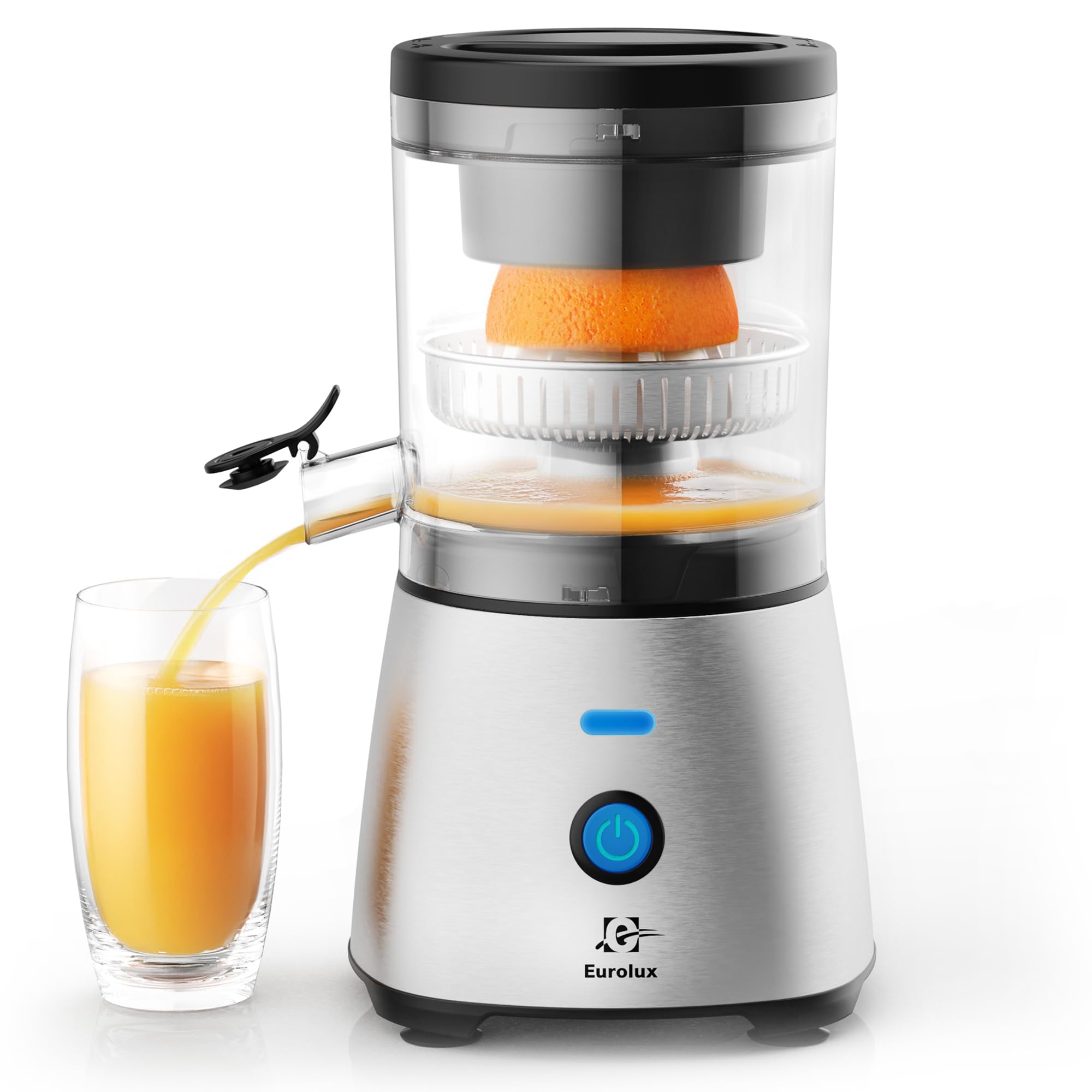
A 300-watt motor spinning at 110 RPM that works through a 5-pound bag of lemons in about 10 minutes.
The headline number here is 300 watts — four times the Oster’s 75 watts and double the Healnitor’s 150 — spinning the cone at 110 RPM. That is the muscle behind the batch performance, and it shows: this press works through a 5-pound bag of lemons in about 10 minutes. If lemonade is a weekly ritual in your house rather than a holiday treat, this is the power tier that keeps up.
Operation could not be simpler — cut the fruit, set it on the cone, close the lid, press the single button, and the motor does the rest. Removable parts that touch food are top-rack dishwasher safe, and a secure part-locking system plus rest-interval protection keep the machine from being pushed past its limits. BPA-free components and a stable non-slip base round out a build that feels genuinely safe for regular household use.
Two honest notes for careful buyers. Some owners describe the noise level as mixed — not egregious, but not the whisper a “quiet” label suggests. And durability has drawn concern, with a few units reported to break after about four months. Pulp can also clog the strainer after roughly a cup of juicing, so you clear it as you go. For most owners, though, the speed and thorough extraction more than make up for it.
Power-house verdict: the 300-watt motor delivers the fastest batch performance on this list, backed by rest-interval protection that protects the machine.
What to know: pulp clogs the strainer after about a cup, and a few shoppers say failures around the four-month mark — treat the cooldown cycle as non-negotiable.
Great for: big-batch lemonade makers who need a 300-watt motor to power through pounds of fruit fast.
Skip if: you only juice an occasional lemon and would rather pay less for a compact, quiet press.
7. Eurolux Premium Electric Orange Juicer with Auto Shutoff

A 120-watt motor that yields two cups of lime juice in under five minutes, quietly.
The Eurolux ELCJ-1600SN uses a re-engineered motor gear that delivers the same extraction power as a 160-watt juicer at just 120 watts — the maker’s claim is better energy efficiency and longer motor life. Whether or not you buy the efficiency math, the real-world outcome is what counts: this press can produce two cups of lime juice in less than five minutes, and it runs quietly while it does it.
Operation is automatic one-touch — a soft grip rubber handle needs only a light push to start, and an auto-on/off function stops the motor the moment you release pressure. The integrated filter traps pits and unwanted residue so the juice pours clean, and the one-size-fits-all cone secures fruit in place without you swapping parts for each type of citrus. Stainless steel throughout, it looks the premium price it carries.
The trade-offs are honest ones. Large grapefruits are reported to be less consistent than limes and lemons, and the machine is bulky enough to want dedicated storage space. Some owners also find the top of the press trickier to clean than the rest, needing a wipe or a lean under the faucet rather than a full dishwasher cycle. None of these are dealbreakers — they are simply the shape of a premium press built for repeat performance.
Why it costs more
- Engineered to match the power of a 160-watt juicer at only 120 watts
- Auto-on/off function stops the motor the instant you release the handle
- Integrated filter traps pits and residue for clean, seedless pours
- One-size-fits-all cone means no swapping parts between fruits
Honest limits
- Less consistent on large grapefruits than on limes and lemons
- Bulkier build that wants dedicated cabinet or counter space
- The top section is trickier to clean than the rest of the machine
Built for: households that juice frequently and want premium build, high output, and automatic convenience.
Think twice if: you are short on storage space or only ever juice the occasional grapefruit.
Understanding the Specs
Motor Wattage and What It Means in Practice
Wattage (the electrical power the motor draws) tells you how much fruit you can juice before the machine needs a cooldown. Every press here uses a corded electric motor, from the 75-watt Oster up to the 300-watt Eurolux. More watts does not always mean more noise — the 150-watt Healnitor runs at a reported level no higher than 60 decibels (about the sound of a normal conversation), quieter than some lower-watt models. Match wattage to your juicing habit: a light weekly press suits the 75 to 85-watt tier, while daily batch juicing rewards a 150-watt machine or higher.
Cones, Dishwasher Safety, and Drip Control
Interchangeable cones are the swappable caps the fruit presses against, and most presses here ship with two — a small one for limes and lemons, a large one for oranges and grapefruits. The Oster and the Eurolux One-Touch each use a single all-in-one cone instead, which means no parts to lose but less flexibility in fruit size. On cleanup, dishwasher-safe parts erase the biggest excuse for not juicing — the Eurolux presses and the Oster go straight into the machine, while the FOHERE is hand-wash only. Anti-drip spouts and flip-up spouts determine how tidy your counter stays between fruit halves.
FAQ
Can an automatic lemon squeezer juice grapefruits as well as lemons?
How many watts do I need for juicing a whole bag of lemons?
Are the parts dishwasher safe on these electric citrus juicers?
Do these machines get hot and stop on their own?
Which automatic squeezer is quietest for early morning use?
Will a lemon squeezer leave pulp in the juice?
How much juice will I get from two lemons or two oranges?
Can my kids safely use an automatic citrus juicer?
How often do these juicers need replacing and what breaks first?
Final Thoughts: The Verdict
For most kitchens, the automatic lemon squeezer winner is the FOHERE Orange Juicer Squeezer because it balances a quiet 85-watt motor with two-cone versatility and a build that draws the least resistance from owners — 4.6 stars across 300+ ratings, with the FOHERE’s performance singled out as its strongest quality. If you juice in serious volume and want the most power, the Eurolux One-Touch brings a 300-watt motor to the party. And for a family press the whole household can share, the Reemix die-cast model is the smooth, friendly pick.
How We Picked
We do not accept paid placement. Every pick is matched to a real buyer and a real use-case; we do not hands-on test units.
Sources & Methodology
Specifications: manufacturer listings and product documentation. Review insights: verified customer reviews, as of September 2026. Pricing: not shown on this page (it changes often); check the current price via the retailer link.
As an Amazon Associate, KitchPrep earns from qualifying purchases. This does not affect which products we feature.
Related Guides
