
Specs are compiled from manufacturer listings and verified buyer reviews and can change over time — please confirm the key details on the product page before buying.
A deck is the hardest thing most homeowners ever sand down. You are standing on the surface you are working, the boards are weathered and grey, and every board has a seam, a screw head, and a rail that gets in your way. The wrong sander means a belt that walks off the platen, a motor that bogs in the heat, and an afternoon spent fighting the tool instead of finishing the job. The right one cuts fast, holds its tracking, and lets you get flush against the house without gouging the board next to it.
I’m Mohammad Maruf — the founder and writer behind KitchPrep. This guide is built by comparing the manufacturers’ published specifications and the patterns across verified customer reviews, so you get each pick’s real strengths and trade-offs instead of marketing spin.
Deck work rewards motor amperage, belt tracking, and dust control far more than any spec-sheet buzzword, and the picks below are ranked with that in mind. If you want the short answer, the picks that separate cleanly for a weathered deck are the ones built to run flat and hard for hours without wandering.
Our Picks at a Glance


How To Choose The Best Belt Sander for a Deck
Deck sanding is a stock-removal job first and a finishing job second. You are taking decades of sun-bleached fibre, raised grain, and flaking stain down to clean wood so a new coat will actually bond. That means the tool has to remove material fast, run for hours at a stretch, and let you work around rails, posts, and the house wall without wrecking the surface you just finished.
Match the belt width to the size of the job
A 3″ x 21″ belt is the classic size and it fits into corners and between rails on a railing-heavy deck. A 4″ x 24″ belt covers more board with each pass, which is why it suits big open deck fields. If your deck is mostly wide, uninterrupted boards, the wider belt is the one that saves you passes and time.
Look at amperage and how it holds speed under load
Amperage is the measure of how much electrical current the motor can draw, and on a sander it is the clearest sign of how well it resists bogging down. When a belt loads up with old stain and you press into a weathered board, a weak motor slows and stalls. All the picks here run corded power, so there is no battery runtime to worry about — only how the motor behaves under sustained pressure.
Belt tracking is not a detail, it is the whole job
A belt that walks off the rollers mid-pass tears itself apart and scratches the wood. Auto-tracking systems keep the belt centred on their own, while manual systems need a knob adjustment. Either way, a sander that holds its tracking while hot is worth far more on a long deck session than one that needs constant fiddling.
Decide how you will handle the dust
Dust collection means the sander traps the sawdust it makes instead of throwing it into your face and onto the fresh surface. Growing numbers of these sanders ship with a dust bag, a port to connect a shop vacuum, or both. A vac connection controls dust far better than a bag, but you have to check the port size and shape before you buy, because adapters are the most common complaint in this category.
Quick Comparison
| Model | Best For | Belt Size | Amperage | Variable Speed | Amazon |
|---|---|---|---|---|---|
| Makita 9903 3″ x 21″ Belt Sander★ Best Overall | All-round deck work and fine control | 3″ x 21″ | 8.8 A | 690 – 1,440 ft./min. | Amazon |
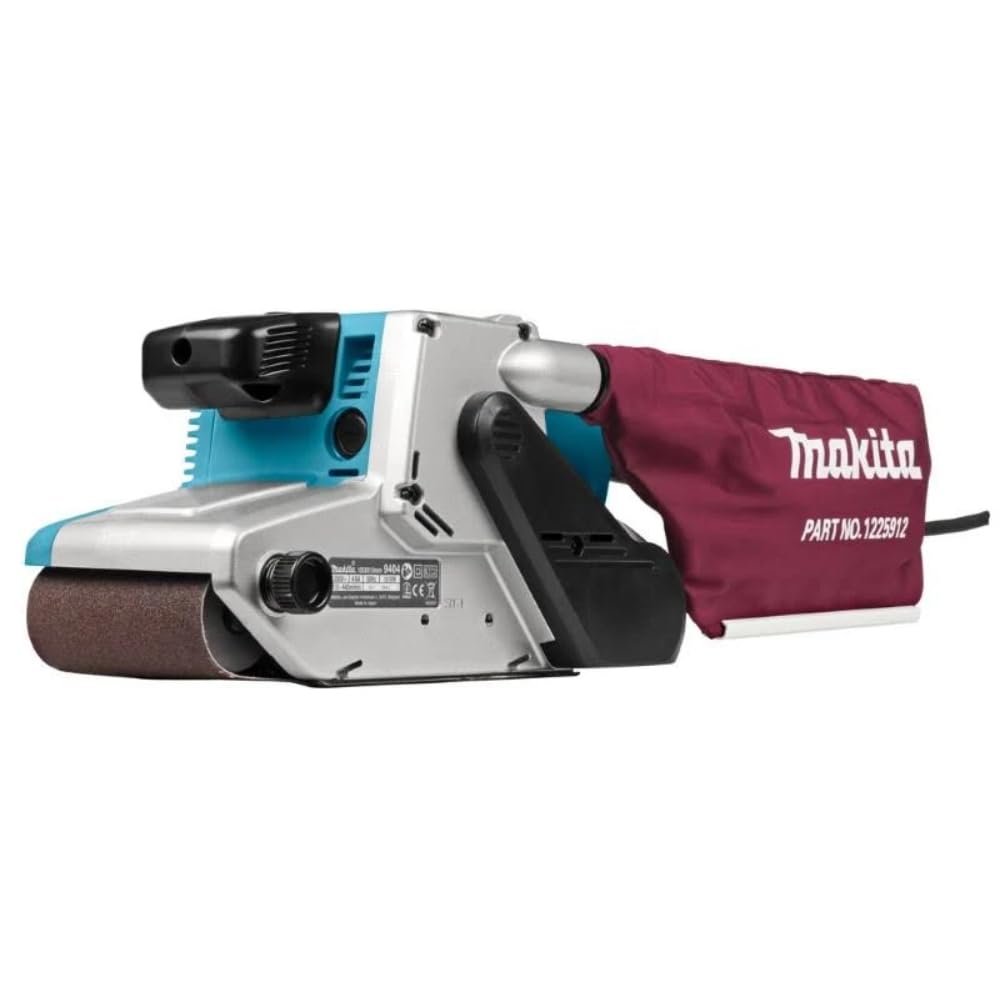
| Makita 9404 4″ x 24″ Belt SanderTop Performer | Big open deck fields | 4″ x 24″ | 8.8 A | Yes | Amazon |
| STANLEY FATMAX FMEW204K-QSBest Display | Fast coverage with a carry case | 533 x 76 mm | 1010 W | 6 speeds | Amazon |
| Einhell TE-BS 850 E | Bench-mounted material removal | 533 x 75 mm | 850 W | Up to 400 m/min belt speed | Amazon |
| Metabo HPT SB8V2 | Long warranty and rugged build | 3″ x 21″ | 9 A | Yes | Amazon |
| Triton T41200BS | Bench-invertible stock removal | 4″ x 24″ | 10 A | Yes | Amazon |
| Triton TA1200BS | Sanding flush to a wall or house | 3″ x 21″ | 10 A | Yes | Amazon |
| WEN HB424V | Converting to a benchtop sander | 4″ x 24″ | 10 A | 660 to 1310 ft./min. | Amazon |
| Genesis GBS321A | Light-duty decks and tight budgets | 3″ x 21″ | 8 A | Yes | Amazon |
In-Depth Reviews
1. Makita 9903 3″ x 21″ Belt Sander
Our pick — over 4.5★ from 900+ verified ratings; the strongest balance of quality and price.
Silky tracking and an auto-centring belt make this the deck sander that fights you least.
What wins people over is how it behaves under load. An 8.8 A motor spins the belt from 690 up to 1,440 ft./min. (feet per minute — how fast the abrasive travels), so you can slow it right down for a finish pass or open it up to rip through grey, raised grain. If you are picking one number that decides whether this tool earns its slot, it is the 8.8 A at the top end: that is only slightly behind the 10 A Triton T41200BS under the hood, and the Makita carries it in a chassis that weighs 9.5 pounds and still turns in a quiet 85 dB (decibels — a rough measure of how loud the motor runs). At 85 dB, it is quiet enough to run without shouting over it.
Owners run this thing hard, and it answers. As owners put it, one deck-build owner “Used 1 month on redwood/doug fir deck lumber (20 4x6x16ft boards, 10 4x4x8ft posts).” — with perfect tracking regardless of heat, pressure, or use, working 50-80 grit then 120. That is a whole deck worth of lumber. The auto-tracking belt system does the centring for you: the belt rides on the platen without you stopping to adjust it, which matters on a deck where every seam and screw head tugs at the belt. It also sands flush to a wall with the nose and side, so you get the last board tight to the house without a gouge. A 40-year furniture restorer sums it up as “light, quiet, smooth, removes lots of material with little effort,” and racked up two weeks of daily use before calling it a keeper.
The planer-flat top opens a second job: flip it over and clamp it down and it becomes a stationary sander for shaping, which several owners lean on for precision work. A woman who ran it for hours at a stretch called it well-balanced with the weight barely noticeable, and trimmed a belt bevel beautifully while removing 1/32 uniformly — that is the tracking doing its job. As owners put it: “Rugged and effective.” It replaced an unreliable DeWalt DW433 for one buyer, and another found near-complete dust pickup running it to a vacuum.
The case for the Makita 9903
- Auto-tracking belt system centres itself so you are not dialling tracking mid-deck.
- Variable speed from 690 to 1,440 ft./min. covers heavy stripping and fine finishing in one tool.
- Quiet 85 dB motor and a flat top that lets it double as a clamped benchtop unit.
- Sands flush to a wall with the nose and side — crucial at the house line.
Where it gives ground
- Weight sits in the heavier class for a 3″ x 21″, which tells on a long overhead rail pass.
- Connecting a shop vac to the dust port can need an adapter that is hard to find.
- An occasional unit arrives with a damaged sole plate in shipping — inspect on arrival.
The pick if you want one sander: a full-deck run where you strip grey boards, sand flush to the house, and value quiet, self-tracking control in a single tool.
Look elsewhere if: you only need to hit a small railing and would rather not carry weight — a lighter 3″ x 21″ makes more sense there.
2. Makita 9404 4″ x 24″ Belt Sander
A wider belt for wide decks, so you take fewer passes across every board.
If your deck is open field — long, wide boards with few rails breaking them up — the 4″ x 24″ belt on this Makita is what shortens the job, because it covers more board with every sweep than the 3″ x 21″ 9903 above. It carries the same 8.8 A motor as its narrower sibling, and a 16.4-ft. power cord so you can walk a deck without dragging an extension around the whole perimeter. It runs at 84 dB, a touch quieter than the 9903’s 85 dB, and it weighs 10.3 pounds.
The calling card outdoors is its stability off the deck. Superb ergonomics and a flat base let it sit steady on its back or side at 90°, so you can tip it up and feather an edge without it skating. It tracks dead straight across 36-120 grit, which one woodworker proved by flattening a 90″ x 34″ white oak top with clean, even results. The variable speed does what it should — though it is worth knowing that dropping to a low speed with aggressive paper can bog the motor, so match speed to grit rather than crawling on 36 grit.
This is a serious-removal tool, and owners treat it that way. A 50-year woodworking veteran rates it quiet and easy to control with ample power for general woodworking, removing planer marks on alder at 180 grit on a lower speed with no need for a random orbit pass afterwards. One owner kept it in service for a year stripping 1930s floor and cabinets — gumming up belts on lacquer and paint until the surface was scraped first, then running clean. It takes a shop vac, changes belts easily, and one buyer had it run almost two hours continuously.
The honest catch: the internal dust ducting can pack up before dust ever reaches the fan or exhaust, even with a shop vac attached — you end up emptying it more often than you would like on a big job.
Who it fits: an experienced owner with a lot of open decking who wants aggressive removal and does not mind a heavier machine and routine dust maintenance.
Reach for this if your deck is the wide-open kind: the 4″ x 24″ belt and 16.4 ft. cord turn a large surface into fewer, steadier passes.
skip it if: your deck is crowded with rails, spindles, and narrow gaps — a 3″ x 21″ gets into those spots more easily than a 4-inch belt.
3. STANLEY FATMAX FMEW204K-QS Belt Sander
Six speeds, parallel metal rollers, and a carry case that keeps your belts organised.
This one is about coverage and control in one package. A 1010 W motor (watts — the motor’s raw power rating) turns a 533 x 76 mm belt at up to 390 m/min., and the six-speed dial lets you step the abrasive down as you move from stripping to finishing. Parallel metal rollers keep the belt running true across the platen, which is exactly the trait a deck demands when you are sweeping board after board. Soft-grip coating soaks up the vibration that would otherwise numb your hands over a long session. It comes with a belt and a hard plastic carry case.
Sustained, punishing use is where owners say it shines. One owner sanded 120 hardwood fence and gate boards carrying several layers of old stain and got a perfect result — running 5-6 hours a day for a week without the machine tiring. Another worked 8 hours a day for two days straight and reported no trouble, calling it very reliable. A third describes it as near-professional: powerful, sturdy, with sandpaper that changes easy via a lever, a lockable start button, and a dust bag filter. That lockable start button matters on a deck, because it lets the sander run without your trigger finger cramping over hundreds of passes.
The profile is compact for a 4-inch-class machine, and it is slanted for the big flat surfaces a deck is made of. The six-speed dial suits different materials, the belt tracks by hand adjustment, and the integrated suction port clears chips as you go. It can be connected to a vacuum system through that port if a bag is not enough.
Where it asks for care: there is no front protection, so the leading edge is exposed — the rubber front roller wore quickly under one owner’s intense use, though it was replaced promptly. The dust bag zipper also fills up fast and needs emptying often.
What it delivers: a high-output motor in a compact, vibration-damped housing built to run all day on a big surface.
Best for: a large deck, fence line, or any big flat run where six speeds and a high-wattage motor keep you moving steadily.
Think twice if: you want built-in protection at the front edge — this one expects you to work carefully around the exposed roller.
4. Einhell TE-BS 850 E Belt Sander
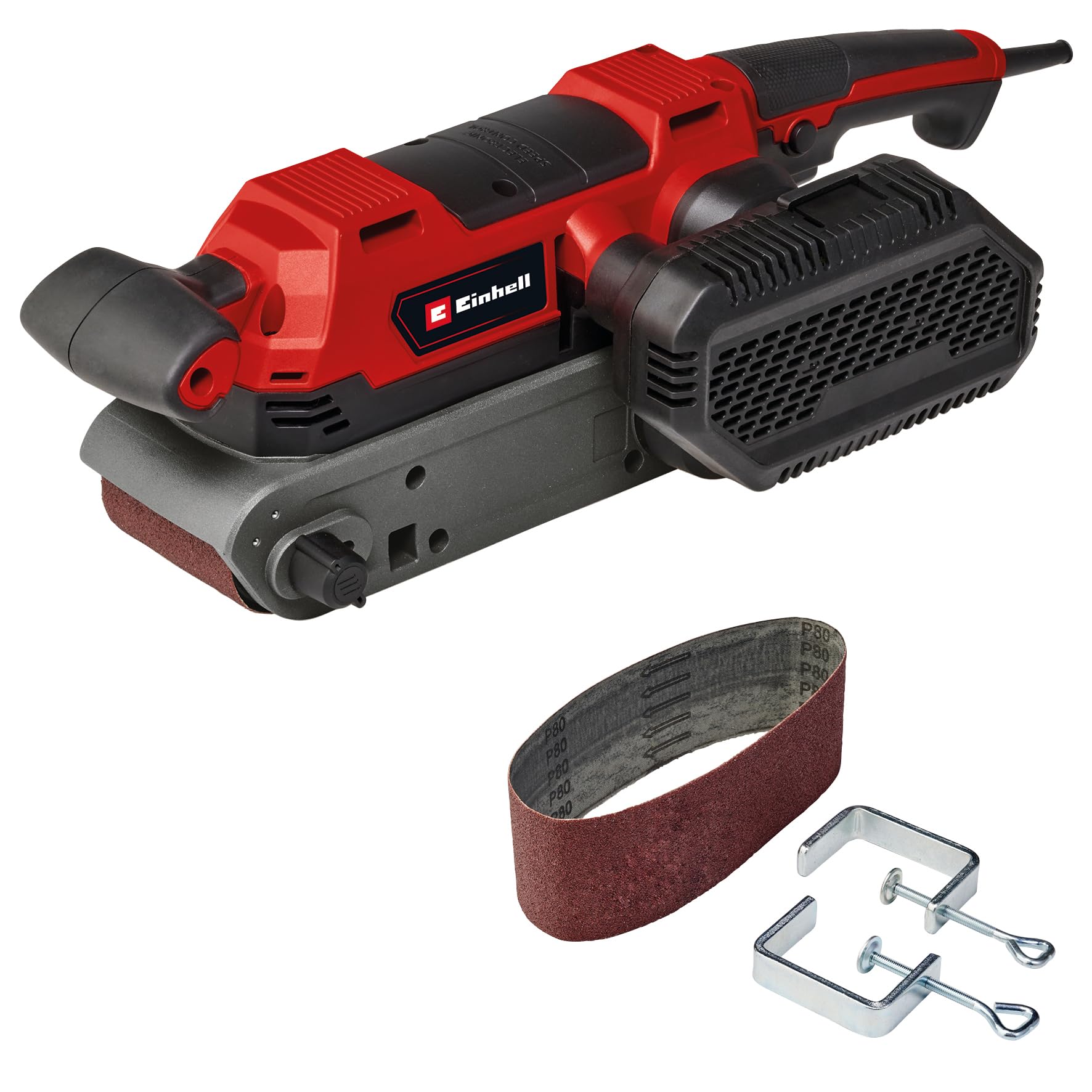
Flip it, clamp it, and it becomes a bench sander — rare flexibility for one tool.
The standout here is dual personality. An 850 W motor drives the belt up to 400 m/min., and the variator lets you dial the sanding performance to the task, but the real trick is the integrated support surface. With the continuous running function and the two included screw clamps, you can lock this sander to a bench and use it as a stationary machine — useful for cleaning up the ends of railings and posts that a handheld pass cannot reach cleanly. It ships with three P80 belts (80 grit — a middle-grade abrasive) measuring 533 mm long by 75 mm wide, and the belts change without tools and adjust precisely via the adjustment device.
The build quality is the point several owners keep returning to. One notes the main structure and the area beside the abrasive belt are metal, which matters because a sideways belt shift will not damage the housing the way it would if the frame were plastic. Another describes it as very sturdily built, with a belt that changes fast and tracks well. A third calls it a single-of-its-kind machine that clamps to the bench with the clamps included, and finds it light and not too noisy. The suction system with its dust collection cassette and vacuum connection keeps a clean work area, and the soft-grip surfaces and auxiliary handle let you steer it with both hands.
Sanding large areas of wood is the stated purpose, and posts, railings, and the flat run of deck boards all qualify. Used as a bench unit it earns its keep on the fiddly pieces; used handheld it handles the broad strokes. Either way, the metal-track design gives it durability that a plastic-framed tool simply does not offer.
Pick this if you want one tool that works handheld and clamped: the screw-clamp bench setup and 400 m/min belt speed cover deck boards and the post ends a handheld pass misses.
Consider carefully if you want maximum motor punch: at 850 W it is the lighter-powered option against the 1010 W STANLEY FATMAX above.
5. Metabo HPT SB8V2 3″ x 21″ Belt Sander

A 5-year warranty on a 9 A deck sander is the kind of cover that changes the maths.
Behind the headline warranty is a 9 A, 1,020-watt motor on a 3″ x 21″ belt — a step up in amperage on the Triton TA1200BS’s equal-10 A class rival and clearly ahead of the 8 A Genesis GBS321A. Variable speed sits on a dial at the base of the handle for one-handed manageability, and a clear front cover raises visibility when you are sanding up against the house. The flush surface design lets you run it tight to a wall, and the dust bag mounts on the left side — a placement that helps corner sanding because the bag stays out of the way of the belt.
The build earns its keep. Owners describe it as rugged and well-made with plenty of power, excellent variable speed control, easy belt changes, and accurate belt tracking adjustment. A retired professional woodworker bought it to replace an old Porter Cable machine and called it perfect in every way — sturdy, not too heavy, good handling ergonomics. Another rates it deeply and easier to run than most on this list.
That left-mounted dust bag is the one wrinkle that surfaces most. The weight distribution leans left, so the sander can pull to one side and cut heavier on the left edge — a real handling note, not a defect, and one owners work around by letting the sander’s own weight do the cutting. A separate flock reported the drive belt tearing after about an hour of use, while others have run it without trouble, so it reads as a mixed point rather than a pattern.
The 5-year warranty play: this is the longest cover of any corded sander on the list by a wide margin, and it is backed by US-based support through Koki Holdings.
The balance note: the left-biased layout means you steer against a sideways pull, so lighter pressure against the grain helps keep an even cut.
Reach for this if warranty length leads your decision: a 5-year limited warranty on a 9 A, 1,020-watt deck sander is hard to match at this tier.
Look at the Makita 9903 instead if: you want the tracking and flush-sanding reputation that tool built over decades, and can price out the warranty difference yourself.
6. Triton T41200BS 4″ x 24″ Belt Sander

A 10 A, 4″ x 24″ deck eater with the flat-top bench trick built in.
For sheer material removal on a big deck, a 10 A motor turning a 4″ x 24″ belt is the top of this list’s power curve. That is a bigger belt than the 3″ x 21″ 9903 and more amperage than the 4″ Genesis GBS321A’s 8 A. Variable speed control keeps the tool useful when you move to finer grit, a rear-facing dust port can run to either the supplied bag or a full extraction system, and belt tracking adjustment keeps the wide abrasive aligned. Rubber over-moulding on the grip adds support and control, and the lock-on button saves your trigger finger during extended passes.
The inversion clamps are the detail deck owners notice. Flip the sander onto its back, clamp it down, and it becomes a benchtop machine for precision stock removal — exactly the setup you want cleaning up the ends of posts and short railing pieces. Owners call the flat-top-and-clamps combo a real bargain, and the same reviewer reports plenty of torque driving the belt. One owner left the tool confident enough to buy it as a value alternative to higher-priced Makita 4″ x 24″ machines.
The cord is long enough to walk a deck perimeter, belt changes are quick, and the 3-year warranty beats the 1-year cover on the Makita 9404 above. It runs a little heavier and larger than a 3″ x 21″ but the weight goes unnoticed once you are moving.
The dust reality: the supplied dust bag catches only a fraction of what the belt produces — under hard use you get far more on the ground than in the bag, so a vacuum connection through the rear port is the better path on a big job.
The case for the T41200BS: 10 A of torque, a 4″ x 24″ belt, and a flat top that doubles as a bench sander, all in one machine with a 3-year warranty.
Built for the heavy open-field deck: the widest belt on the list paired with the highest amperage here turns a big flat run into a short afternoon.
Not the pick if dust control leads: budget for a shop vac and a rear-port adapter or you will be sweeping more than sanding.
7. Triton TA1200BS 3″ x 21″ Belt Sander
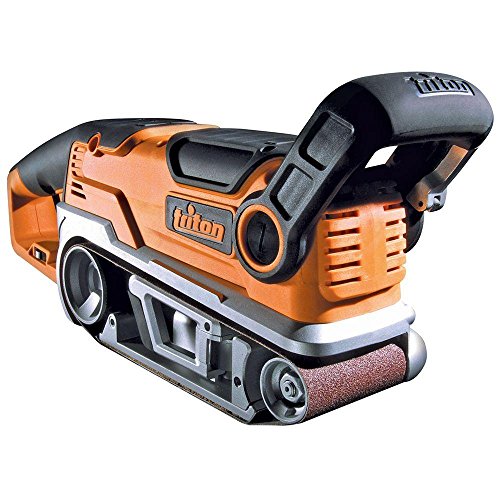
One of the few 3″ x 21″ sanders that runs flush to the wall of your house.
A 10 A motor in a 3″ x 21″ body is the combination this Triton nails — equal amperage to the 4″ x 24″ Triton T41200BS above, packed into a narrower, curve-friendly deck tool. Variable speed control, an adjustable auxiliary handle, a lock-on button, and belt tracking adjustment round out the controls, and the package includes inversion clamps, a dust bag, and one 3″ x 21″ belt. The side dust port lets you route the bag or connect a vacuum system instead.
The flush design is the stand-out. It is a rare 3″ sander that reaches up against a wall — meaning the last board against the house gets cut clean without a corner you cannot reach. That is the job a deck sander either gets right or leaves as a monthly headache. Owners who bought it for log-work report it removes deep chain saw marks fairly easy and quickly, and that it installs new belts fast with easy tracking adjustment. The adjustable handle and hold-down clamps come up again and again — this is a sander built for extended stationary and handheld work.
On a deck it is the tool for curves and rails, where the 3-inch width earns its keep against the 4-inch machines. It runs heavier and the auxiliary handle needs a custom frame if you want to mount it as a bench unit rather than just clamp it down. Low speed works best with grits of 80 or finer, and belt tracking adjustment stays reliable as long as that area is kept clean.
The weight trade: this is not a featherweight, and the weight actually helps it cut without you pressing, but it will tell on overhead rail work — a fair trade for the flush-edge reach.
The volume note: at around 100 dB this is one of the louder sanders on the list, so pack ear protection for a long deck session.
Made for the deck edge and rail: a 10 A motor in a 3″ x 21″ body that reaches flush to the house and holds its tracking.
Choose otherwise if quiet operation is a priority: the around-100 dB output is loud enough to make earplugs non-optional.
8. WEN HB424V 4″ x 24″ Combination Belt Sander

A 4″ x 24″ combo that flips from deck board to fixed benchtop in seconds.
The point of the HB424V is that it does two jobs in one. A 10 A variable-speed motor turns the belt from 660 to 1310 ft./min., which beats the 8.8 A Makita 9903 at the top end of the power range on paper and matches the top amperage of the 4″ Triton T41200BS. Quick-release belt tension lets you swap grits in seconds, and the lock-on switch lets it run without your finger on the trigger. The included rubber mounting pad, two mounting clamps, and detachable dust bag with a 1.2-inch port round out the package, backed by a two-year warranty.
Belt tracking is called out honestly in the reviews — the tracking knob works perfectly, and buyers report the belt stays stable under load without wandering across the platen. A larger front wheel, compared to a 3″ x 21″ machine, dramatically extends belt life, and the wide 4″ belt covers more board per pass on a deck. The included L-clamps and flat body let it double as a stationary sander for shaping, and the trigger latch holds useful during long runs. One owner switched over from a 3″ x 21″ specifically for the larger front wheel and larger working area, and was not disappointed.
Owners call it a beast — heavy-duty, metal-bodied, and easy on belts once tracking is dialled in. Weight draws a mix of feedback: it is heavy enough to help the belt bite the wood without you leaning in, but heavy enough to tire you on overhead rail work.
Best as a dual-mode tool: the clamps and flat top turn this into a benchtop sander whenever you need more control than a handheld pass allows.
The honest gap: for clamping the wide belt down, a purpose-built bench sander with a larger platen still beats it — the WEN is a strong handheld that turns into a decent bench unit, not the reverse.
Great for a hobbyist with a deck and a bench: the 4″ x 24″ belt, 10 A motor, and included clamps cover stripping and shaping without a second tool.
Think twice if longevity is your only concern: this is a newer design with a shorter track record than the decades-old Makita-lineage pick above.
9. Genesis GBS321A 3″ x 21″ Variable Speed Belt Sander

An 8 A, single-lever sander that lets a light-duty deck job get done without spending up.
This one is aimed at the homeowner with a moderate deck and a tighter budget. An 8 A motor drives a 3″ x 21″ belt — lighter on power than the 10 A Triton TA1200BS above, but well matched to a smaller surface of boards you are refreshing, not a whole commercial deck. A single-lever quick-change gets the belt off and on with no tools, which keeps a re-sand session moving. The low-profile body slips into tight spots, and the adjustable front handle plus a flat side help you sand flush next to doors, jambs, and hand rails. The kit includes a dust bag and one sanding belt.
Owners do not baby it. As a buyer reports, one owner “Sanded 200+ board feet of redwood over a weekend; never bogged or overheated, excellent results.” That is a real deck-scale session on an 8 A machine, and it came through with the belt changing easily and good dust-bag pickup. Others run it on stair treads and tabletops, call the power double that of a cheap competitor sander, and find the second-handle quick-release and rubber grip comfortable for two-handed use. Variable speed dials the sanding down as you move to a finer grit.
Where it asks for care is the plastic side parts — a small plastic belt-adjust knob and plastic side pieces draw honest notes. A heavier-duty replacement is the safer bet if you are running hundreds of boards yearly; treat this as a light-to-medium-duty tool and it will likely serve a weekend warrior fine.
The value case: an 8 A motor, variable speed, and single-lever belt change for a budget outlay that leaves money for belts and finishes.
The plastic caveat: side parts and the belt-adjust knob are plastic, so lean on gentler pressure and clean the tracking area often to keep them serviceable.
Good fit for a weekend deck refresh: a patio, a small deck, or a few doors and hand rails where occasional use makes a heavier machine hard to justify.
Skip if you plan year-round heavy runs: the plastic componentry and lighter motor make the premium picks a better match for sustained commercial-styled use.
Understanding the Specs
Belt size and why it matters on a deck
A 3″ x 21″ belt is narrower, so it reaches between rails, around posts, and into corners better than a wider belt does. A 4″ x 24″ belt covers more surface with every pass, which is a big win on open, uninterrupted boards. The trade is that wider belts feel heavier and less nimble, so the size you pick should match how much of your deck is open field versus how much is broken up by railings.
Variable speed in belt feet per minute
Belt speed is how fast the abrasive travels, and it decides how aggressively the tool cuts. High speed strips weathered wood fast; low speed lets you finish without burning or gouging. Running a low speed with coarse grit can bog the motor on some units, so match the speed to the grit — hog at high speed on coarse paper, then drop the speed only as you move toward finer grits.
Motor amperage under sustained load
Amperage tells you how much current the motor can draw, and more of it means the sander resists slowing down when the belt loads up with old finish. On a deck, where each board fights the abrasive for hours, amperage is the difference between a sander that keeps cutting at full speed and one that stalls partway through a pass.
Dust collection: bag versus vacuum
A dust bag catches the sawdust the belt throws so it does not cloud your face or settle on fresh surface. A vacuum connection through the dust port captures far more, but the port size and shape must match your vac — the wrong adapter is the single most-mentioned frustration with these tools. If clean work matters on your deck, plan the connection before you buy belts.
FAQ
What belt width should I use for a deck?
Can I sand a deck with a handheld belt sander instead of a floor sander?
What grit do I start with when sanding a weathered deck?
Do I need a dust bag or a shop vac when sanding a deck?
How loud are these belt sanders?
Is a 10 amp belt sander better than an 8 amp one?
Can a belt sander be used as a stationary bench sander?
Will a belt sander tear up the edge of my deck boards?
Do I need variable speed to sand a deck?
How long does a belt normally last on a deck job?
Final Thoughts: The Verdict
For most decks, the winner is the Makita 9903 3″ x 21″ Belt Sander — the auto-tracking belt system, the 690-1,440 ft./min. speed range, and the flush-to-wall design together do the exact job a deck demands. If your deck is open and wide, reach for the Makita 9404 4″ x 24″ Belt Sander for the widerbelt coverage and its 16.4-ft. cord. And if you want the widest belt with the most torque for the heaviest open-field stripping, the Triton T41200BS brings a 10 A motor and a 4″ x 24″ belt at a mid-range outlay. For a light-duty deck refresh on a tight budget, the Genesis GBS321A still handles a weekend’s worth of redwood without complaint. Whichever way you go, choose the belt width that fits your deck, plan your dust routing before the first pass, and let the tool’s own weight do the cutting — you will finish faster and with fewer gouges.
How We Picked
We do not accept paid placement. Every pick is matched to a real buyer and a real use-case; we do not hands-on test units.
Sources & Methodology
Specifications: manufacturer listings and product documentation. Review insights: verified customer reviews, as of September 2026. Pricing: not shown on this page (it changes often); check the current price via the retailer link.
As an Amazon Associate, KitchPrep earns from qualifying purchases. This does not affect which products we feature.
Related Guides
