
Specs are compiled from manufacturer listings and verified buyer reviews and can change over time — please confirm the key details on the product page before buying.
Two quarter-inch cable spools can look identical on the shelf and still hold very different weights. That gap is the whole story: one of these ropes carries a 1,400 lbs working load (the weight you can trust day after day), one is rated for a 7,000 lbs breaking strength (the point where it snaps), and one arrives with clamps and thimbles in the box so you skip a second trip. This guide sorts the seven spools worth your time. It tells you which ones survive a saltwater dock and which belong on a backyard zip line. It also flags the one snag that will bite you — a coil that shows up twisted or frayed and eats an afternoon of untangling.
I’m Mohammad Maruf — the founder and writer behind KitchPrep. This guide is built by comparing the manufacturers’ published specifications and the patterns across verified customer reviews, so you get each pick’s real strengths and trade-offs instead of marketing spin.
You will see which construction keeps a rope flexible under load, and which length leaves you spare footage for the next job. That gets you from spool to finished project without a return.
Our Picks at a Glance
How To Choose The Best 1/4 Steel Cable
A quarter-inch cable is measured by its diameter. But the number that decides whether your project holds is the working load limit — the weight the rope is rated to carry safely day after day. The breaking strength is the point where it snaps, and a smart buyer always stays well under the working load figure. The second thing to lock down is the environment. A galvanized coating (a zinc layer bonded to the steel) shrugs off rain and backyard weather. Near a dock or on a boat, you want 304 or 316 stainless instead.
Match the strand count to how you will handle it
The strand count tells you how the wire is built. A 7×19 construction means seven outer bundles, each made of nineteen fine wires. Those thin wires are what let the rope bend around a small pulley or thimble without kinking. Thicker wires make a stiffer rope that resists abrasion better but rides rough over moving parts. Running the cable through a winch drum or a zip line trolley? The flexible 7×19 lay is the smoother choice. Pulling logs or dragging a gate? The coarser construction wins on wear.
Buy the termination hardware in the same order
Cable is only as strong as the ends you put on it. Thimbles protect the loop from rubbing, and swages or crimps (metal sleeves squeezed onto the strands) bite down hard for a clean, permanent hold. U-bolt clamps work, but you must torque them properly, and they are the weaker option for a safety-critical pull. Some spools here ship with clamps and thimbles included. That saves you a trip and keeps the parts matched.
Do the length math before you click
Overestimate. A 250 ft coil covers a long span, leaves spare footage for a second line, and costs less than buying two shorter coils. Building a boat lift, a deck railing, or patio light strings? A shorter coil keeps the leftovers manageable. Going back for a second spool mid-project is the mistake that stalls every build.
Quick Comparison
| Model | Best For | Length | Material | Load Rating | Amazon |
|---|---|---|---|---|---|
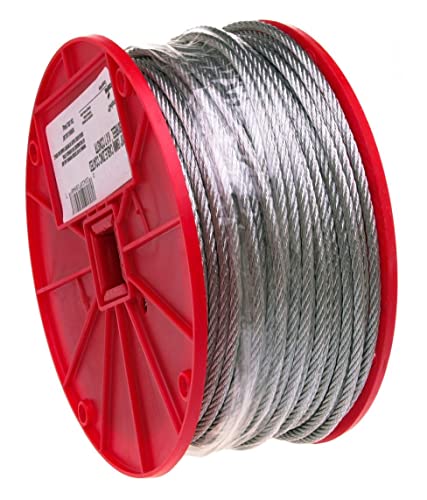
| Campbell 1/4″ x 250′ Galvanized Cable 7000827★ Best Overall | Long backyard zip lines and spans | 250 feet | Galvanized steel | — | Amazon |
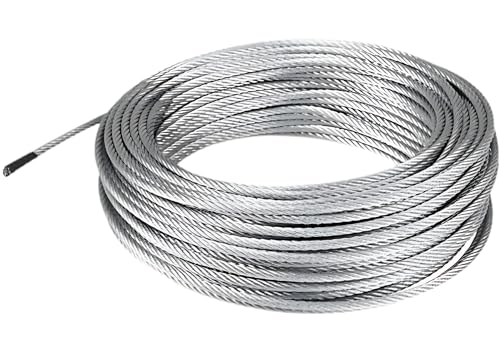
| HYW Galvanized Aircraft Cable 1/4″ 7×19 50 ftBest For Rigging | DIY decking, rigging, and lifts | 50 feet | Galvanized steel | 1400 lbs working / 7000 lbs breaking | Amazon |
| Mariocsa 25FT 1/4IN 304 Stainless Steel Cable with M8 Clips & Thimbles | Winches and boat lifts | 25 feet | 304 stainless steel | 6400 lbs tensile | Amazon |
| lifstar Heavy Duty Wire Rope 1/4″ x 100′ | Garage doors, winches, and tie-downs | 100 feet | Carbon steel, galvanized | 1400 lbs working | Amazon |
| VEVOR 1/4″ 250 ft Zinc Galvanized Carbon Steel Cable | Deck railing and handrail projects | 250 feet | Carbon steel, galvanized | 7000 lbs breaking | Amazon |
| US Stainless 316 Wire Rope Cable, 1/4″ 7×19 50′ | Boat rigging and coastal railings | 50 feet | 316 stainless steel | — | Amazon |
In‑Depth Reviews
1. Campbell 1/4″ x 250′ Galvanized Cable 7000827 Aircraft Cable
Our pick — over 4.5★ from 400+ verified ratings; the strongest balance of quality and price.
One 250-foot coil that finishes the whole zip line with footage left over
This one tops the list because a single order stretches 250 feet — ten times the footage of the 25 ft stainless spool below. So a 70-foot span between two trees costs you one purchase instead of a stack of short coils. That length is the reason to buy it; everything else just supports it. The galvanized finish (a zinc coating over the steel) handles backyard weather, and the 7×19 construction (seven bundles of nineteen thin wires each) bends around a thimble without fighting back.
The builds made from this rope carry real weight. Buyers report a two-cable bridge moving a 600 lb suspended cart over an 80-foot span, with the tension holding firm when the turnbuckles were cranked down. Outdoors users report two full summers of heavy kid traffic with no wear and no corrosion, through sun, rain, snow, and ice. Reviewers also note the value, which is why it holds 4.7 stars across 425 ratings.
Watch the tensioning on long runs. Anything past a hundred feet sags and fights a standard turnbuckle — a 50 lb rider drooped a 175-foot line hard enough that a turnbuckle bent out at the ends. The fix is a permanent 2-ton come-along rated for pulling, which holds steadier than a turnbuckle on a long span. The spool is the other soft spot: the wire arrives wrapped, and the reel can show up cracked and leave the coil loose. It still works, and a quick re-wrap or a homemade spool keeps the extra footage tidy.
What earns the top spot
- A full 250 feet on one coil — enough for a long span plus a spare line
- 7×19 lay stays flexible for thimbles and pulleys
- Galvanized surface held up outdoors across multiple seasons without rust
- Holds heavy loads — a 600 lbs cart moved over an 80-foot span
Where it needs a hand
- Long runs need a come-along to tension; a turnbuckle alone can bend
- The reel can arrive cracked, letting the coil unspool
- No clamps or thimbles in the box — order the hardware too
Build the big line: ideal for anyone running a backyard zip line, a long span, or a moveable cart where a single 250-foot coil beats piecing together short sections.
Bring a come-along: if your span passes a hundred feet, a turnbuckle alone will not pull it tight — plan for a puller.
2. HYW Galvanized Aircraft Cable Wire Rope 1/4″ 7×19 50 ft Coil
A short coil with both load numbers printed on the label
The printed rating is what puts this coil on the list: a 7000 lbs breaking strength and a 1400 lbs working load limit. Read those two numbers together and the logic is simple. The breaking figure is where the wire finally gives. The working load is the weight you can trust day after day. The 50-foot length suits a boat lift, a stair rail, or a short hoist job. The galvanized coating keeps rust off through wet conditions, and the 7×19 lay bends around thimbles and pulleys without kinking. Against the thicker 316 stainless pick below, this one gives you far more length for the money — 50 feet versus the same 50 feet at a marine-grade premium.
Riggers and tinkerers who buy this coil mention the strength-to-cost ratio first. Reviewers report it outclassing non-aircraft cable at the same money. One buyer bought the 50-foot coil for a 25-foot boat lift and kept the extra footage as spare. It also hangs light fixtures and privacy screens without complaint, and repeated owners mention they would reorder. For a DIY build, 50 feet is often the exact amount that leaves no wasted scrap.
Two honest notes. The coarse 7×19 wires make it grippy under a trolley, so a zip line ride over this rope feels rougher and sounds noisier than a finer strand cable — a real trade-off for smooth gliding. And like most bare cable, it stretches slightly on first tension, so snug it up and re-check after a day. Covering exposed sections with a split garden hose protects the surface where it rubs.
The value read: 50 feet of galvanized quarter-inch at a 1400 lbs working load is a smart starting coil for decking, rails, and light hoisting, and the strength keeps more margin than a cheap lighter rope.
Terminate it right: use swages or crimps rather than u-bolt clamps for any load-bearing end — clamps slip under serious tension.
Reach for this if you are rigging a boat lift, a deck rail, or a short tension line and want a proven load rating in hand.
Skip the smooth ride if you are building a kid’s zip line — the coarse wires make for a bumpier, louder glide than a fine-strand cable.
3. Mariocsa 25FT 1/4IN 304 Stainless Steel Cable with M8 Clips & Thimbles

Everything you need to finish the job, down to the thimbles and clamps
Most cable listings leave you hunting for the ends separately. This one ships as a full kit: 25 feet of quarter-inch 304 stainless steel, plus 8 wire rope clamps and 8 thimbles in the box. 304 stainless (a rust-resistant steel grade) is the grade to want when a rinse with a hose is your only maintenance. The rope is rated to a 6400 lbs tensile strength and uses the same flexible 7×19 lay, so it threads a winch drum or a garage-door track cleanly.
Winch owners get the most out of this kit. A buyer replacing a DLB800 auto-winch line called it quality stainless cable expected to outlast the winch. The arrived-in-perfect-condition note shows up again and again. Matched hardware means you are not guessing at sizes or making a second order. Weigh it against the 250-foot Campbell coil: you give up 225 feet of length, but you gain every fitting you need in one box. For a compact lift, a winch, or a set of deck railing fittings, that convenience is the draw.
Know what you are buying on the surface: this is bare, uncoated cable. Buyers hunting for a nylon-coated rope sometimes land here because the listing shows up in that search, and the rope arrives shiny stainless with no plastic sleeve. Want a coated cable for a slide or a boat rail? That is a different product. Want raw strength with exposed strands? This is exactly it.
Kit convenience: the hardware in the box saves a step and a shipping wait, so the job finishes the day it arrives.
Mind the surface: it is uncoated stainless — strong and corrosion-resistant, but not sleeved in nylon, so it will not glide like a coated cable.
Best for: winch replacements, small lifts, and railing jobs where you want the rope and the termination hardware in a single order.
Look elsewhere if: you specifically need a nylon-coated cable — this is bare stainless from end to end.
4. lifstar Heavy Duty Wire Rope, 1/4″ x 100′, 1400 lbs Working Load Limit

The middle-length spool that covers a garage door or a gate without waste
Not every project needs 250 feet, and this coil fills the gap between the short 50 ft spools and the long 250 ft reels. Its 100-foot length suits a garage door, a winch line, a set of tie-downs, or a gate that lifts and winds on a spool. It carries a 1400 lbs working load limit and the same flexible 7×19 lay that lets the rope wrap tight around a small drum. The galvanized finish keeps rust away through outdoor use.
What buyers keep coming back to on this coil is how it holds up outside. Customers note lengths used for months at a time without a spot of rust. One buyer looped an end and wound it onto a six-inch spool as a gate cable, and it stayed flexible. Others lean on it for the dirty jobs — pulling trees down, dragging logs — and describe it as stronger than any rope for the same task. For a job that gets done a few times a year and then sits in the weather, that tells you the galvanizing is doing its work.
Where it plays second fiddle is scope. A 100-foot coil runs out fast on any span past about eighty feet, so measure twice before ordering — the 250-foot coils above will save you a second order mid-build. The sturdy clamshell it ships in does make storage neat, which matters when the leftover footage sits in the shop for months between jobs.
Choose this for: garage doors, winches, tie-downs, and gate cables that live outdoors and need to hold their strength season after season.
Think bigger if your project runs past eighty feet — a 250-foot coil will save you a second order mid-build.
5. VEVOR Wire Rope, 1/4″ 250 ft Zinc Galvanized Carbon Steel Cable with Gloves
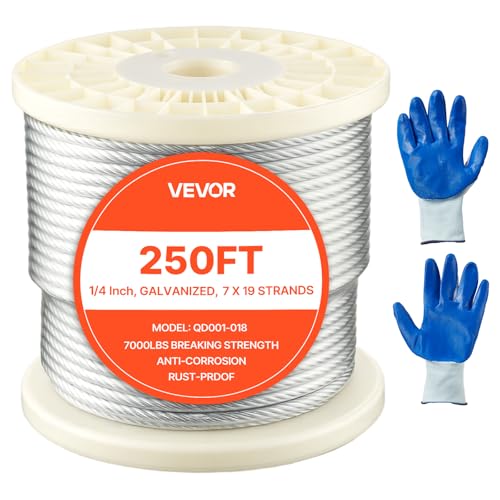
A long coil for handrail and decking runs, with gloves thrown in for the handling
Deck railing projects eat footage fast, so this VEVOR coil answers with a full 250 feet of quarter-inch galvanized carbon steel and a 7000 lbs breaking strength. That breaking figure matches the HYW coil above, but this one gives you 250 feet against its 50 — the difference between a full railing system and a single short run. The wires run 7×19 for flexibility, and the polished surface is meant to feel smooth through bare hands and hardware. The galvanized coating is the corrosion defense for anything set outdoors.
The smooth finish is what owners bring up most — the rope reads uniform and clean across its length. It also hangs sun shades and adds extra zip lines to a kit you already own, and the pair of gloves in the box is a thoughtful touch for handling the bitter ends. Reviewers point out using the full 250 feet with a come-along winch for directional tree felling, working easily with proper termination hardware.
The one caveat is built into how any steel cable behaves. This rope stretches under heavy tension, more than some first-timers expect, and the thimbles on a cheap hardware kit can deform before the cable gives. Pull the slack out in stages, then re-tension. The included gloves run snug, so if you have larger hands, keep a pair you already own nearby. Neither point changes the decking verdict — the footage and the breaking strength are hard to argue with.
Decking strength: 250 feet at a 7000 lbs breaking strength covers a full railing system with a smooth, uniform surface that threads hardware without snagging.
Plan the tension: expect some stretch as it loads up, and pick quality thimbles — a cheap set can bend under the load before the cable ever does.
Ideal for: handrail, stair, and decking cable runs where you need a long coil with a name-brand breaking strength behind it.
Skip if your hands are large and you are counting on the bundled gloves — bring your own pair for the handling.
6. M&R INDUSTRY Wire Rope 1/4″ x 250′, 7×19 Galvanized Cable Reel

Plenty of footage for the price, if you are willing to check the wire as it feeds
This M&R reel is the budget route to serious length. You get 250 feet of quarter-inch galvanized cable on a single reel, rated to a 1400 lbs working load limit, with the flexible 7×19 construction that makes it easy to handle and install. Compared with the Campbell coil at the top, you trade some long-term corrosion resistance for the lower outlay. For garage doors, winches, and tie-down work, it is a lot of rope for the money.
The buyers who score this reel well are making their own lengths with it. Shoppers say cutting 50-foot sections with thimbles and clevis hooks to pull logs. One buyer ran patio light strings on it and reported they held up over time. The value is the recurring theme — a large spool you can meter out into whatever lengths your jobs need, then store the rest. Buyers report it does what a value reel should.
Two things to weigh honestly. The galvanizing does its job in normal weather, but this is a value rope, and long-term corrosion resistance is not its strongest card — a couple of owners mention stray frayed leads in the coil, so unspool it and inspect as you go rather than assuming every foot is clean. And on the fit question, at least one buyer found the working diameter off enough that standard clamps slipped at a fraction of the rated load — check the fit of your clamps before you commit to a load-bearing pull. Buy this for the footage and the price, and treat the wire as something to inspect, not something to trust blind.
Where the value lands
- 250 feet on one reel for a low outlay
- 1400 lbs working load limit for garage and tie-down duty
- 7×19 lay bends around small drums with ease
What to watch for
- Long-term corrosion resistance is the weaker point — expect less life near salt water
- Some coils show stray frayed leads, so inspect as you unspool
- A minority report sizing that lets standard clamps slip, so test your clamps
Buy it for: garage doors, winches, and tie-downs where a big coil at a low outlay fits your budget and you want the flexibility to cut your own lengths.
Not for: coastal or saltwater rigging — for salt air, reach for a 316 stainless coil instead.

